Meet the new boss, not the same as the old Boss

Steve Cohen

Steve Cohen, outside Citi Field. The fan-friendly Mets owner preaches patience. Attention-deficit Met fans say, “and we want it right now!”

Listen up, frustrated (and spoiled) Yankee fans who think any early season series lost demands an accounting of “what would George do.” Look across town to the owner of the Mets, whose frustrated fan base seems to wish he was prepared to go full-on Boss because the 2023 Mets, thus far, are (shall we say) underwhelming.

Enough Yankee fans think a season is illegitimate unless the Yankees reach, never mind win the World Series. Enough Met fans think, “this year is next year,” upon one terrible inning—in April. The Yankee fan wishes their owner had even an eighth of his father’s notorious impatience. The Met fan wishes their owner might consider selling to The Boss’s ghost.

Not so fast, urges that owner, Steve Cohen, who is disinclined to push the proverbial plunger simply because the team he thought was well constructed has shown cracks aplenty.

Met fans can’t question Cohen’s own passion. Like me, he is a Met fan since the day they were born. Like me, he knows that frustration comes with the territory at least as much as surreal miracles or surreal self-resurrections. He, like me, knows that blowing a faltering team up at the first drop of a bad inning leaves little enough beyond difficult to contain rubble and fallout.

“When things get really bad,” Cohen told the New York Post‘s Joel Sherman over the weekend, “I’m not going to blow up. I don’t think that’s the proper response. I don’t think it solves anything, other than it gives people a one-day story. But it doesn’t really solve anything.” Where was he when George Steinbrenner turned the 1980s Yankees into Jacobin France as it might have been administered by the Rufus T. Firefly Administration?

“There’s plenty of blame to go around from a performance point of view,” Cohen continued. “So blowing up, I’m not sure it solves anything. It would demonstrate, ‘Oh, he really cares. He’s one of us.’ But the reality is it’s not going to solve our problems. And I think in some ways it can be demotivating.”

Hark back to how many times a Steinbrenner tantrum demotivated and demoralised Yankee teams from their top of the line stars to their glittering turned jittery prospects. (Roger Erickson, 1983 pitcher: “They told me I’m their future. I told them, ‘I don’t want to be in your future. It’s frustrating enough being in your present’.”)

“I’ve got enough experience, whether in my business or even in baseball now,” Cohen said, “to know that when things are going great, you are never as great as you think you are, and when things are going really bad, you are not as bad as you think you are. Things can turn around fairly quickly.”

They can. Until they can’t. Sometimes, they do. Sometimes, they don’t. Sometimes, things turn around quickly from tragedy to triumph. (Think of the 2019 Nationals and, what do you know, the 1973 Mets.) Sometimes, they turn around quickly from triumph to tragedy. (Think of the 1964 Phillies, the 1969 Cubs, enough Red Sox teams for the final 82 years of the 20th Century, and the 2007 Mets, to name a few.)

Cohen has the patience of Job. Enough of his fan base seems to wish Job had hit the ceiling running. But neither he nor they expected Max Scherzer and Justin Verlander, a pair of future Hall of Famers in the sunsets of splendid careers, to show their ages quite this drastically. Neither Cohen nor Met fans expected rotation inconsistency from that pair down to turn into bullpen exhaustion. Neither Cohen nor Met fans expected Pete Alonso to hit the injured list with a wrist injury off being hit by a pitch. Neither Cohen nor Met fans expected inconsistent hitting with men in scoring position.

Certainly manager Buck Showalter and general manager Billy Eppler have made an error or three. The Met fans who lack Cohen’s lifelong immersion in the team think the solutions range from throwing out the first manager to throwing out the first general manager—and then getting really mad. But Yankee fans with memories long enough and hubris short enough can tell you how well that worked for The Boss in the 1980s.

It’s not as though the National League is composed entirely of threshing machines. The league is somewhere between modest and mediocre overall this season. The Mets may not look quite as terrible as their surface record and their daily over-under-sideways-downs. And things could have been much worse.

Remember the gnashing when Steven Matz was thought to have gone back on his word and then signed with the Cardinals? How did that work out for the Cardinal Wayward? Matz had an injury-addled 2022 with a 5.25 ERA, and his non injury-addled 2023 has him at 5.72 and demoted to the bullpen.

Remember the prayers that some way, some how, Jacob deGrom might be made a Met for life? The injury-compromised great now requires his second Tommy John surgery. Of all the might-have-beens in baseball history, deGrom is liable to go down as the saddest of them all, a Hall of Fame talent who owned the mound when he was healthy but whose body told him, almost continuously, “Don’t even think about it, Buster.”

Remember how close the Mets got to making Carlos Correa one of their own? Until Correa flunked a physical exam for the Mets, just as he had for the Giants, then re-upped with the Twins. This season, thus far, Correa has a 97 OPS+, a .304 on-base percentage, a pace to hit far enough less than his career-long 162-game average 28 home runs, and he’s one defensive run below the American League average for shortstops. That should be a sigh of relief that he didn’t become a Met and become the planned third base experiment.

Cohen is not going to erect a guillotine in Citi Field or anywhere else just yet. The Boss kept his Yankee guillotine on red alert every month, so it seemed, at the worst of his depths. Meet the new boss, not the same as the old Boss.

“[T]he only other thing I see that, frankly, I’m a little bit troubled by is I’m seeing mental errors that we didn’t see last year and that we can fix,” Cohen continued. “That’s fixable.”

And I just don’t know why that’s happening. We all see it on the field on a daily basis. And that’s, that’s on the players, you know, and they’re working hard. I guess teams get into a funk, that happens. And then come out of it. These are veterans that have performed before, and they’re working hard. They care. They’re good guys. I believe in them.

And they’re smart enough, they care enough, that they’ll fix it on their own. They’ll fix, at least the mental side. We’re going through a bad period, but they know it, and they are willing to own it. Those are what I would call unforced errors that we can fix and we will because these are good guys who are working hard. As much as the fans care, as much as I care, they care even more.

It could be worse. Much worse. To which one fears today’s attention-deficit Met fan would reply, “Off with your head!” Even Cohen knows the present state can’t continue. That he refuses to just blow up the joint is more than admirable. But he may also know that a move or two may have to be made, soon enough.

The former Dark Knight, retiring with grace

Matt Harvey

Matt Harvey, young, a Met, and a Dark Knight.

Few baseball surges of the 2010s were as electrifying as Matt Harvey’s. Few baseball shrinkages were almost that electrifying. And, after a few years of trying and getting not even close to back to where he once belonged, Harvey elected to call it a career Friday.

The former Dark Knight, who’d provoked Mets fans to declare “Happy Harvey Day!” on the days he started, announced his retirement on Instagram. “With all the amazing memories came a lot of injuries and tough times,” the 34-year-old righthander wrote.

The realization that those amazingly powerful moments that make me thrive as a pitcher and help my teammates and city win are no longer possible. Believe me I wish I could have done more and brought more of those amazing moments back to life. I have to say this is my time to say thank you, and goodbye.

Asking Harvey to retire with no regrets would be asking him to be superhuman. That’s an ask he can’t possibly satisfy. He’d tried that earlier and too often in his career, on the mound and off it, and he nearly fried himself alive trying.

In the Show, Harvey was last seen trying a comeback with the Orioles two years ago. He started with three shutout innings followed by a dicey fourth in his first Oriole start. He went on to post for the season a modest 4.60 fielding-independent pitching (FIP) rate, a ghastly 6.27 earned run average, a 2.57 strikeout-to-walk rate, a 1.54 walks/hits-per-inning pitched rate (WHIP), and was hittable for 11.3 hits per nine innings.

That was double the transcontinental distance from his staggering second Mets season, 2013, when he led the Show with a 2.01 FIP, posting an 0.97 WHIP and a 6.16 K/BB rate, good enough to finish fourth in the National League’s Cy Young Award voting.

Those were the days when Harvey embraced New York and its white-hot heat as ardently as the city embraced him. “To the fans, most importantly the NY Mets fans: you made a dream come true for me,” he wrote in his retirement post. “A dream I never could have thought to be true. Who would have thought a kid from Mystic, [Connecticut] would be able to play in the greatest city in the world, his hometown. You are forever embedded in my heart.”

He’s had worse than that embedded in his heart. Harvey’s early ability to pitch like an executioner on the mound was equaled only by his ability to find and dwell among the demimonde as though it had his name on it.

He electrified the country when he started the 2013 All-Star Game and—having to shake off a leadoff double from future Hall of Famer Mike Trout followed by hitting Robinson Canó with a pitch—struck three out in two innings’ work and surrendering not a single run. (The American League went on to win, 3-0.)

He missed 2014 recovering from Tommy John surgery, but he electrified the country further when he all but ordered his manager Terry Collins to leave him in to pitch the ninth in Game Five of the 2015 World Series.

Uh-oh. Collins went with Harvey’s heart while misreading his fuel tank. He walked Kansas City’s Lorenzo Cain to open, then surrendered Eric Hosmer’s RBI double. Then Collins lifted him for Jeurys Familia. Two ground outs, one of which provoked Hosmer’s daring dash home while Mets first baseman Lucas Duda threw what should have been an easy double play ball offline to the plate (Hosmer would have been dead on arrival if the throw was accurate), tied a game the Royals won with a five-run twelfth as the rest of the Mets bullpen lost its wheels.

The Royals had bypassed Harvey in the 2010 draft. The guy they took instead, infielder Christian Colón, sent what proved the Series-winning run home. “I still have nightmares over that,” Harvey would tell the New York Post about the game. “One thing I’m most angry about is not getting it done.”

He’d have better reason to be angry the following season: he was hit with thoracic outlet syndrome in July 2016 and gone for the season. And, never again the same pitcher. TOS occurs when blood vessels and/or nerves between your collarbone and your first rib compress. That causes shoulder and neck pain and finger numbness.

“I had TOS,” Harvey’s former fellow Mets pitcher Dillon Gee once said. “I know how much that sucks. It definitely changes you. You start trying to tinker with things. It’s not natural anymore. You start being robot-ish. You start not trying to hurt one area and totally hurt another area. Your whole body is out of whack.”

Harvey’s body wasn’t the only thing going out of whack. Between TOS and a 2017 season interrupted nastily by another shoulder injury, Harvey melted down almost completely. The mound no longer elevated him; the city’s bright lights and demimonde no longer seemed to comfort him entirely.

Very publicly, he found himself dropped by a Brazilian supermodel with whom he thought a real romance was seeded—until she elected to return to her former beau, an NFL wide receiver, leaving a glittering party with the man. That was the night before he showed up late for a game against the Marlins claiming a migraine that was translated to mean a hangover.

Harvry had had such a big-timing attitude prior that now, when he needed empathy, aid, and comfort most, he had none. A year later, after refusing to try it out of the bullpen, perhaps out of stubborn lingering pride, Harvey’s days as a Met ended in a trade to the Reds. “Besides life on his fastball and bite on his slider, you know what was missing with Matt Harvey?” asked Joel Sherman of the New York Post after the deal. The answer:

Compassion. There was no empathy from a teammate or member of management for Harvey’s plight. They wanted him to rebound and do well, but that was about the team and their own selfish desire for success.

Matt Harvey

Humbled, Harvey pitched respectably for the Reds following his trade from the Mets. But he couldn’t reimagine his form successfully in stops at Anaheim, the Oakland system, Kansas City and Baltimore (above). 

Tom Verducci, the Sports Illustrated writer who first handed Harvey the Dark Knight nickname (picking up on Harvey’s boyhood love of Batman), advised one and all that Harvey’s taste for New York’s night life wasn’t the reason he’d collapsed on the mound. “The truth is, for all the times he wound up in the tabloids other than the sports section, Harvey failed because his arm failed him,” Verducci began.

. . . His arm likely failed him because of how he threw a baseball. And when his arm failed him, he knew no other way. He couldn’t pitch without an A-plus fastball, he couldn’t embrace using a bullpen role as a way back, and he couldn’t believe in himself again.

. . . The Mets cut Harvey because his once-fearsome fastball became the almost exact definition of a mediocre fastball (MLB averages: 92.7 mph, 2,261 rpm). Because he couldn’t find another way to get hitters out, because he could not change his mechanics and because he could not buy into the bullpen, the Mets could not keep sending [him] out to the mound as a starter.

The decline in his stuff was obvious. And there was no way his fastball was coming back with the way he throws.

As a Red, Harvey finished his walk year into free agency with a respectable if unspectacular enough performance that the Angels were willing to take an $11 million flyer on him for 2019. He lasted long enough to be designated for assignment that July. The Athletics signed him but he never saw Show action. The Royals took a chance on him for pan-damn-ically shortened 2020.

A free agent again, the Orioles took a chance on Harvey for 2021. He re-signed with the organisation for 2022 but he spent the season at three minor league levels around a sixty-day suspension after testifying in the Eric Kay trial that he’d used painkillers provided by Kay while with the Angels.

Kay was tried, convicted, and sentenced to 22 years in federal prison, having been the man who provided the drugs that killed popular Angels pitcher Tyler Skaggs. On the stand, Harvey admitted he’d given Skaggs (who was likely addicted to painkillers following early-career Tommy John surgery and subsequent other injuries), a few Percocets, perhaps unaware of the depth of Skaggs’s addiction. He didn’t shrink from it, he didn’t try to excuse it.

Harvey pitched in this year’s World Baseball Classic—for Italy, posting a 1.29 ERA in two starts before Team Italy lost to Japan and eventual WBC most valuable player Shohei Ohtani in the quarterfinals. It tempted him to try one more major league comeback. But it was just a temptation. Maybe the most important temptation Harvey resisted. He got to leave the mound permanently on a very high plane, at any level.

(For the record, his Team Italy manager, Hall of Fame catcher Mike Piazza, saluted Harvey upon his retirement announcement: “Look forward to teeing it up with you man..I want to Thank You for your awesome effort in the @WBCBaseball, You’re a warrior on the bump.”)

Back in 2020, he offered the Post something few who knew him as a Met might have accused him of having: introspection. “There are a lot of things I’d do differently,” he began, “but I don’t like to live with regret.”

There were just things I didn’t know at the time. Now, obviously, I’ve struggled the last few years. And what I know now is how much time and effort it takes to stay at the top of your game. I wouldn’t say my work ethic was bad whatsoever, but when you’re young, it’s not like you feel invincible, but when everything is going so well, you don’t know what it takes to stay on the field. It’s definitely more time consuming and takes more concentration.

Too many sports party boys don’t learn until their sports say goodbye to them first. Harvey learned soon enough, if sadly enough, that the party doesn’t always end on your terms. The Dark Knight who crashed and burned off the mound while his body betrayed him on it became something far more important before he retired: a man.

Hobie Landrith, RIP: Of Polo Grounds and oranges

Hobie Landrith

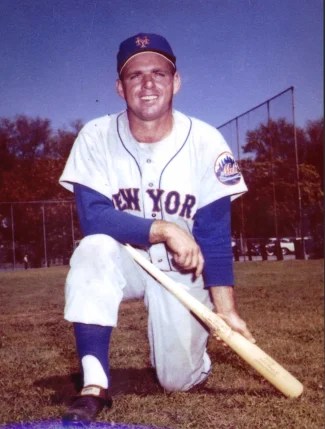
Landrith, the very first Met.

The plot was simple enough. Visiting my favourite aunt and uncle in their still somewhat new Poughkeepsie (NY) digs, a splendid colonial home that was actually the model for the development, my three cousins would awaken me promptly at seven the next morning. They wanted to see me and my twelve-year-old baseball brain win a local radio station’s “Sports Call” contest and whatever prize would come.

So there was Tommy drumming out the fabled climax of the William Tell Overture (or, the theme from The Lone Ranger, if you prefer) against the nightstand next to my bed. (And, specifically, my ear.) There was Bobby, ready to dial the “Sports Call” number with the phone to my ear. Not to mention Linda, the eldest of the trio, standing by with a grin I’d swear was caught between amusement and amazement.

And there I was, maybe a quarter awake, Bobby starting to dial the split second the host began asking the question: Who was the first player chosen in the National League’s expansion draft? (The draft creating the Montreal Expos and the San Diego Padres was yet to arrive.)

Great hitters can hit rice pudding thrown right into their wheelhouses for distance, even if they happen to be hung over. At age twelve I wasn’t exactly hung over, but I wouldn’t have said no to about two more hours sleep except for the “Sports Call” idea. (A 7 A.M. awakening when it wasn’t a school day was not my idea of paradise.) Sure enough, the other end of the line answered, the host’s voice asking the question again to me directly. Right into my wheelhouse.

I managed to croak, “Hobie Landrith, catcher, by the New York Mets.” Pay dirt. Minutes later, the station’s music finished and the host came aboard to say he’d just received the fastest correct “Sports Call” answer since he’d begun doing the feature on his morning show. A few hours later, there were Bobby, Tommy, Aunt Marge, and yours truly, in the station wagon, pulling up to . . . a pleasant stand-alone produce market, where my knowledge of Landrith’s expansion draft status landed me two large crates of freshly imported Florida oranges.

I left one of the two crates with Aunt Marge and Uncle Herb, now of blessed memory. (Their long, happy marriage ended only with their departures to the Elysian Fields a year apart in 2015-16.) Somehow, I managed to haul the other aboard the train to Marble Hill in the Bronx, where my mother met me for a night at my maternal grandparents before returning home to Long Beach. She almost collapsed when she saw me hauling the oranges with my small suitcase atop the crate.

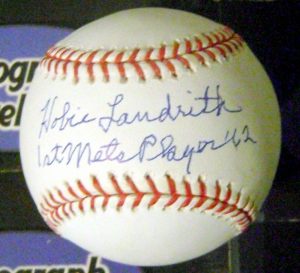
In later years, Landrith loved to sign autographs adding that he was indeed the first Met ever. 

“The first thing you have to have is a catcher,” said Original Mets manager Casey Stengel, explaining why the new team handed the first expansion draft pick chose the non-renowned veteran catcher from the Giants. “Because if you don’t have a catcher, you’re going to have a lot of passed balls and you’re going to be chasing the ball back to the screen all day.”

Stengel was probably too occupied managing and winning pennants with the 1949-60 Yankees to notice that, as a 1956 Cub, Landrith was charged with ten passed balls. But in the same season, he threw 23 would-be base larcenists out for a respectable 38 percent caught-stealing percentage. In three seasons as a Giant part-timer, before the Mets picked him, Landrith’s caught-stealing percentage was 41 percent.

“Thirty-one year old catcher who looked twenty-eight and played like forty,” wrote Leonard Shecter, in Once Upon the Polo Grounds, of Landrith, who died at 93 in California last Thursday. “Hobie always said he was 5’8″. He probably was 5’6″. It wasn’t his fault he wasn’t big enough to play this game.” (Baseball Reference actually lists Landrith as 5’10”, if you’re scoring at home.)

The Decatur, Illinois native was a perfect Original Met, until he wasn’t. On Opening Day 1962, he threw past second trying to arrest a base thief. He was charged with three passed balls in 21 games. But he spoiled the fun when the Mets swept a doubleheader from the Braves that May. He won the first game by pinch hitting a two-run homer off Hall of Famer Warren Spahn. Into the upper deck of the ancient Polo Grounds, the Original Mets’ home while awaiting Shea Stadium’s completion.

Remember: The Original Mets had Abbott pitching to Costello, with Who the Hell’s on frst, What the Hell’s on second, You Don’t Want to Know’s on third, and You Don’t Even Want to Think About It’s at shortstop. Clearly enough, Landrith didn’t really have what it took to animate the Original Met faithful. So the Mets made him do the only thing, really, that he could have done to help the anti-cause.

The next month, they sent him to the Orioles to complete a deal they made in May, a deal in which they sent cash plus a player to be named later for first baseman Marv Throneberry. Marvelous Marv himself. It may have been Landrith’s greatest contribution to the Original Mets’s unlikely grip upon New York’s heart. “The Mets were different, they were counterculture, they were fun,” Stengel biographer Robert W. Creamer would remember. “The worse they were, the more fun they were.”

The Orioles didn’t yet resemble contenders when Landrith was sent there. The Washington Senators, to whom the Orioles sold him later in 1963, weren’t exactly American League ogres, either. At least Landrith got to have a sort-of reunion before the Second Nats cut him loose after that season. His former Met teammate, Hall of Famer Gil Hodges, became their manager, after Mickey Vernon’s 14-26 ’63 start led to his execution and Eddie (The Walking Man) Yost’s running the team for one loss before Hodges came aboard.

“I was in the major leagues more because I was a good defensive catcher, and the fact that I was good at handling pitchers,” said Landrith, once upon a time, to This Great Game. The pitchers who threw to him lifetime had a respectable 3.92 ERA. His not-so-formidable bat was probably the thing that kept him from becoming a regular catcher over his early seasons with the Reds, the Cubs, and the Cardinals—even if he walked 253 times while striking out 188. (His lifetime Real Batting Average—total bases + walks + intentional walks + sacrifice flies + hit by pitches, divided by total plate appearances: .424.)

“I always thought I was a fairly decent hitter, but I realized that I wasn’t in the big leagues for my bat,” he continued in the same interview.  “I had what they called ‘warning track power.’ You know, I’d hit the ball pretty good, the fans would get up on their feet, and then they’d groan, because the ball would die at the warning track.”

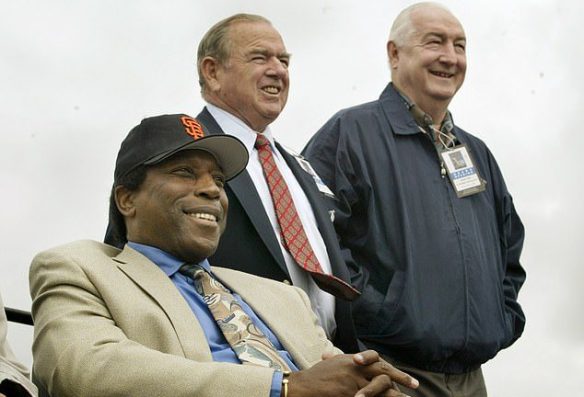
Willie McCovey, Hobie Landrith, Tom Haller

The San Francisco Chronicle captured Landrith (center), flanked by former Giants teammates Willie McCovey (left) and Tom Haller, watching a game in 2003.

As a Giant, Hall of Famer Willie Mays called Landrith “Honest John.” Landrith had no idea why. “He gave some of us strange nicknames. Folks would criticize Willie for being hard to talk to, but it wasn’t always that way. Willie got burned by the [San Francisco] press one time too many, and he got a little harder every time it happened. He was never that way with his teammates, though. I loved Willie and I had a great relationship with the man. I still do.”

Likewise Hall of Famer Willie McCovey: “People ask me all the time, what kind of a guy is Willie McCovey? And I tell them, if Willie walks into a room and smiles, everyone in that room smiles too. I was in the lineup for his first major league game when he went 4-for-4 against [Hall of Famer] Robin Roberts. I just feel fortunate that I was able to play with the man during my career. He’s just a wonderful person.”

That game, on 30 July 1959, featured three Original Mets to be (Landrith, Hall of Fame center fielder Richie Ashburn, and Phillies first baseman Ed Bouchee), plus two more eventual Mets: Mays, and Giants shortstop Ed Bressoud—who ended up becoming an Original Colt .45 (Astro) first, in the same expansion draft in which the Mets selected Landrith to kick things off.

After working as a Senators’ coach for 1964, Landrith left baseball and became a longtime public relations executive for Volkswagen. He and his wife, Peggy, had six children (three sons, three daughters), eleven grandchildren, and eleven great-grandchildren. If he just wasn’t made to be a true Original Met, he certainly was made for family and business success.

His roost in the Elysian Fields should only be that kind of serene. And I still can’t drink a glass of orange juice without remembering a certain phone call that landed me two crates of its source. Or, without remembering the catcher who helped make those crates plus Marvelous Marv possible.

Freak vs. foolish injuries

Edwin Diáz

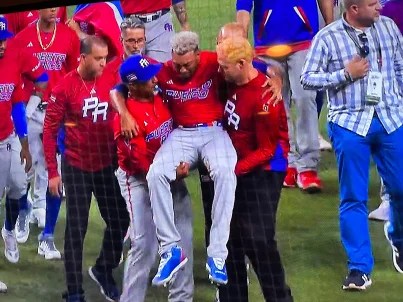
Edwin Diáz helped off the field after a freak season-ending knee injury while celebrating Puerto Rico’s quarterfinal advance in the WBC.

No, it’s not happy news that Mets relief ace Edwin Diáz is going to miss the 2023 season after tearing his patellar tendon celebrating Puerto Rico’s World Baseball Classic win. (Diáz and teammates whooped it up after beating the Dominican Republic to advance to the WBC quarterfinals.) But no, this does not exactly fall under the heading of Incredibly Stupid Injuries By Guys Who Ought to Know Better.

Further: I’d be all-in on shifting the WBC to a time of year when baseball players are in better shape to compete. Mets pitcher Max Scherzer thinks it might supplant the All-Star Game entirely and enable a full week’s worth of a mid-year break. That might be worth a look, if you can get past teams having similar concerns about their stars adding wear and maybe injuries as the stretch drive approaches. Might.

Meanwhile, the WBC means something to every player who signed up for it, whether representing MLB’s home country or representing their own home countries. They’re putting it on the line for the sort of honour that escapes the like of Keith Olbermann with his insouciantly sexist conclusionThe WBC is a meaningless exhibition series designed to: get YOU to buy another uniform, to hell with the real season, and split up teammates based on where their grandmothers got laid.

Diáz is also not the only one who went in, either, on a fresh or potential delicious multi-year, nine-figure deal. That’s how many millions Shohei Ohtani figures to make when he hits the market this fall, assuming the Angels decide to let him walk all the way into someone else’s arms?

You think Diáz tearing his patellar celebrating a key win is dumb at all, never mind the worst of the dumb? You sure don’t know the real history of incredibly foolish injuries. Diáz’s was a freak injury. It could have happened at a family wedding during some particularly exuberant whooping-it-up. It could have happened walking out to his car from the mall. He wasn’t even a hundredth as foolish as the following roll of baseball players and their incredibly weird injuries:

Bite Me Dept.—1923: Nondescript pitcher Clarence Bethen put his false teeth into his hip pocket, thinking he looked meaner on the mound when they were out. His lifetime 7.32 ERA thinks otherwise. But in one game he actually hit a double, slide hard into second—and took a bite in the butt from the pocketed choppers.

CONCLUSION: That wasn’t what they meant by putting your teeth into your work. (What was Bethen expecting when he pulled up at second—an immediate corned beef on rye with mustard?)

Jim and Jill Went Down the Hill Dept.—1967: Cy Young Award-winning Red Sox pitcher Jim Lonborg went skiing after the season. That’s where he suffered the torn left knee ligaments that cost him half the 1968 season and left him far less than the pitcher he was in 1967. It’s said Lonborg’s companion on that trip was actress Jill St. John, of whom he may or may not have been in hot pursuit down the slope.

CONCLUSION: Well, nobody could blame anyone for giving a Jill St. John hot pursuit. Except maybe Lonborg’s manager, Dick Williams, who probably took it as a) a devastating loss going into 1968; and, b) a personal affront to himself. Not necessarily in that order.

(Lonborg’s happy ending: he became a respected New England dentist after his pitching career ended, retiring from practise in 2017.)

Chumpionship Ring Dept.—1970: Braves closer Cecil Upshaw thought demonstrating his slam dunk technique by way of an awning on the street was a clever idea . . . until it cost him the entire season, after his ring got caught in it and he damaged ligaments in his hand.

CONCLUSION: Leave the slamming dunks to the ones who get paid to do them. The ones who wear NBA or WNBA underwear.

Take Him Out of the Ball Game Dept.—1983: On an off day for the Royals, Hall of Famer George Brett broke his toe running from . . . his kitchen to his living room, to continue watching a Cubs game, specifically to see his buddy Bill Buckner hit.

CONCLUSION: That was a foolish idea no matter whom Brett couldn’t bear not to see at the plate.

Rolling Blunder Dept.—1985: Vince Coleman, the Cardinals’ road running base thief, got his foot caught in a tarp-rolling machine at Busch Stadium before Game Four of the National League Championship Series. Incurring a bone chip in his knee and a foot bruise, Coleman—who set a rookie record for stolen bases that year—was stopped for the rest of that postseason.

CONCLUSION: It’s a lot safer to put your foot in your mouth. (Coleman did, a few times during his major league career.) But, seriously, this, too, was more of a freak accident than Vincent Van Go deciding to challenge a tarp roller to a footrace.

Cowboy Down Dept.—1986: Hall of Famer Wade Boggs once missed a week with a back strain suffered when . . . pulling on a pair of cowboy boots. This gave pulling yourself up by your own bootstraps a bad name.

CONCLUSION: Easy does it.

Oh, What a Mangled Web Dept.—1990: Then-Blue Jays outfielder Glenallen Hill fell out of bed and right into a glass table—suffering bruises and cuts on elbows, knees, and legs—as he . . . awoke violently from a nightmare about spiders.

CONCLUSION: Calling your friendly neighbourhood Spider-Man . . .

Ice, Ice, Baby Dept.—1993: Hall of Famer Rickey Henderson fell asleep with an ice bag on his foot . . . and the Man of Steal suffered a nasty case of frostbite, which froze him out of three August games.

CONCLUSION: There’s more than one reason not to doze off during a game.

Sorry, Wrong Number Dept.—1994: Relief pitcher Steve Sparks once thought that just because a motivational speaker he’d seen could rip a thick phone book in half he could do it—until his dislocated shoulder told him, “No, you can’t.”

CONCLUSION: Don’t believe everything you see.

Bed Sore Dept.—2002: Outfielder Marty Cordova once suffered a bad sunburn across his face . . . on a tanning bed.

CONCLUSION: Tan, don’t burn, get a Coppertone tan.

Oh, Deer! Dept.—2005: Promising Rockies rook Clint Barmes was given some choice deer meat by elder teammate Todd Helton. The venison won the battle when its weight caused Barmes to fall and break his collarbone. He went from leading National League rookies in most offensive categories to journeyman after recovering.

CONCLUSION: Presume that Bambi isn’t exactly one of Barmes’s favourite films.

Pie in the Sky Dept.—2010: Marlins utility man Chris Coghlan tore the meniscus in his left knee when . . . he fell while trying to smoosh a pie in the face of Wes Helms, who’d just won a game for the Fish with a bases-loaded single.

CONCLUSION: It might have been a good thing Helms didn’t win it with a grand slam—Coghlan might have been tempted to try hitting him with a whole bakery truck.

Honey, I Forgot to Look Dept.—2012: Jonathan Lucroy reached under his bed for a sock and didn’t see his wife fiddling with suitcases on the bed. One of the suitcases fell over the bed and onto Lucroy’s hand. He hit the disabled list after trying but failing to hide that he couldn’t grip his bat properly.

CONCLUSION: Look out above.

Baggage Claim Dept.—Royals catcher Salvador Perez punished his knees enough in thousands of squats behind the plate without blowing the opening of the 2018 season when he suffered a torn medial collateral ligament in his knee . . . while carrying a heavy suitcase up some steps.

CONCLUSION: There are reasons Mr. Otis invented the (ahem) safety elevator.

Now you tell me what’s worse or what’s less responsible—a freak accident while celebrating a tournament win? Or, blowing a season showing on the street that you could have busted a backboard any old time you chose?

Tim McCarver, RIP: On first guess . . .

Tim McCarver

Tim McCarver, gracing a Sports Illustrated cover in 1967, as his Cardinals struck for a pennant and a World Series championship.

It should have surprised no one that the most frequent phrase uttered in the notices was “first guess.” Most baseball broadcast analysts have in common with fans a trigger, if not a mastery, of the second guess. Tim McCarver, who died at 81 of heart failure Thursday, was the longtime master of the first guess.

Two decades as a major league catcher who saw the whole game in front of him and didn’t restrict himself to handling the pitchers who threw to him did that for him. That McCarver leavened it with disarming wit was merely what Duke Ellington would call a cherries-and-cream topping to your sundae afternoon.

And just as “first guess” was the most often deployed phrase in the obituaries, the most frequently deployed evidence for the defense was Game Seven of the 2001 World Series.

That’s when Yankee manager Joe Torre, with his Hall of Fame closer Mariano Rivera on the mound, and the bases loaded for the Diamondbacks with one out in the bottom of the ninth, ordered his infield in with Luis Gonzalez coming to the plate. At long last—Snakes manager Bob Brenly tended to leave him with nobody aboard to advance or drive home that Series—Gonzo had men on base to work with.

Watching the game on Fox Sports, I heard McCarver remind viewers that Rivera’s money pitch, his fabled cut fastball, ran in on lefthanded hitters and, if they made contact at all, it was broken-bat hits shallow in the outfield. “That’s why you don’t bring the infield in with a guy like Rivera on the mound,” he said.

Bing! After Gonzalez fouled the first pitch away, Rivera threw him a cutter running inside. Gonzo broke his bat sending the ball floating above Hall of Fame shortstop Derek Jeter, into shallow center, for game, set, and Series.

The man who sent grand salami into baseball’s lexicon for the grand slam (he’d done it in one of his earliest broadcast jobs, on the Mets’ team of himself, Steve Zabriskie, and Hall of Fame slugger/from-birth booth mainstay Ralph Kiner) was a catcher who never feared learning, whether it was how to handle mercurial pitchers or how to overcome his upbringing as the son of a Memphis police officer in a time of racial growing pains for the Cardinals and the country.

In October 1964, his account of the pennant races that culminated in the World Series conquest of the last old-guard Yankee team by a new breed of Cardinals, David Halberstam recorded Hall of Fame pitcher Bob Gibson giving McCarver a quick lesson in race relations. Quick, and profound, and perhaps a little shocking even to a white kid whose baseball heroes had actually been Hall of Famers Henry Aaron and Monte Irvin.

Gibson hailed McCarver and asked, “Hey, Timmy, do you know how a white boy shakes hands with a Negro?” When McCarver said no, Gibson enlisted center fielder Curt Flood as his co-star, Gibson playing the white guy. He shook hands with Flood—and, after looking at his hand a moment, promptly wiped his hand on his pants. “You’ve done it before, haven’t you, Tim?” Gibson asked. The shocked McCarver thought a moment and realised Gibson was right.

They became close friends (Any relationship you enter into with Bob is going to be intense, McCarver once said of Gibson), and McCarver had demonstrated his willingness to listen and learn. And, take a gag. His habit of yelling “Gigub” like a frog after losing a ball popping out of his mitt inspired Gibson to mimick it exactly. Those Cardinals used humour next to sobriety to teach their lessons to each other and the league.

But after leading the 1966 National League with thirteen triples, McCarver whacked one in an exhibition game the following, prompting Gibson to buttonhole him after the game, saying, “Hey, you like to hit triples!” According to Halberstam, McCarver took it to mean Gibson telling him he was a good ballplayer and just might be a good man, too. (When he was inducted into Cooperstown as a Frick Award winner in 2012, McCarver lamented and called for arresting the decline in African-American participation in the game.)

The Cardinals out-bid the Yankees and the Giants to sign McCarver with a $75,000 bonus in June 1959. The first things he did, according to Peter Golenbock’s The Spirit of St. Louis, were to buy his parents a new car and to pay off their mortgage, before buying himself some stock in AT&T. By 1963, he’d become the Cardinals’ regular catcher.

He bought into the Cardinals’ ways of teaching the game while flinching at the ways they over-did selling their traditions to incoming young players. “One of the bad things about the Cardinal tradition,” he’d remember in due course,

was the provincialism there in St. Louis that as far as the press was concerned was a lot more unfair than the Eastern press. Everyone says the Eastern press is a lot tougher. I disagree with that. Because provincialism is a lot more difficult to deal with than a press that may be tougher but is more objective, and I’m talking about New York, Philadelphia, Boston. St. Louis is more provincial than any of them. And that provincialism, like the obligations of the family, is much more difficult for the athlete to deal with. Whenever there’s an obligation, there is less desire to do it, because you feel you have to do it.

Nelson Briles, a fine pitcher and a character in his own right, once called McCarver the team’s de facto captain behind the plate.

I have never pitched to a catcher who could call a better game, strategise behind the plate, know what was going on. He was a fiery competitor as well. He was really into the game. He paid attention to game situations, paid attention to the way the hitters were hitting, paid attention to their stance, and if they had changed. And watched what was going on.

And if you shook him off, he was in your face, wanting to know why. “What’s your reason for doing that? I’ll tell you why I called for my sign: Two pitches from now, I want you to do this.” Maybe he was not the best defensive catcher, but he battled for you. He was in the game and would constantly be there to kick you in the pants or to lift your spirits.

Tim McCarver

McCarver accepting his Frick Award to the Hall of Fame, 2012: “I saw Frank Robinson at breakfast and I said, ‘I’ll try to be brief.’ He said, ‘You?‘”

That about the kid who once had the nerve to think about going out to the mound to talk to Gibson, before their relationship solidified, only to get an earful from Gibson before he reached the mound: Get back there behind the plate where you belong! The only thing you know about pitching is that you can’t hit it. Rarely at a loss, McCarver eventually zinged Gibson back: “Bob is the luckiest pitcher in baseball. He is always pitching when the other team doesn’t score any runs.”

(Let the record show that the pitchers who threw to McCarver behind the plate lifetime posted a 3.23 ERA, 43 points below the league average for the span.)

He caught two World Series winners (and stole home during the 1964 Series) and in due course provided analysis on television for 29 straight Series. He was part of the trade to the Phillies that provoked Flood to his reserve clause challenge and thus began the dismantling of the reserve era finished when Andy Messersmith pitched 1975 without a contract and won in arbitration.

He became the personal catcher for notoriously insular Hall of Fame pitcher Steve Carlton, who loved that McCarver would call for as many sliders as Carlton wanted to throw. (“When Steve and I die,” he once said, “we are going to be buried in the same cemetery—sixty feet, six inches apart.”)

He became a broadcaster who learned quickly enough that the game looked far different from above than it did from behind the plate, and he adapted almost as swiftly as a Gibson heater or a Carlton slider hit his mitt. He refused to surrender his objectivity, even when it cost him, as it finally did with the Mets in 1999. Not even when the target of one McCarver barb dumped ice water over him, as Deion Sanders did when he high-tailed it from the postseason-playing Braves to play an NFL game.

McCarver ended his national broadcasting career fortuitously enough; the Cardinals went to the 2013 World Series during his final year in the Fox booth. (They lost to the Red Sox.) A year earlier, he stood at the Hall of Fame podium accepting his Frick Award. “I saw [Hall of Famer] Frank Robinson at breakfast,” he began his acceptance speech, “and I said, ‘I’ll try to be brief.’ He said, ‘You?‘”

It’s to regret only that McCarver—who analysed World Series games for ABC and CBS before joining Fox—was never paired with the late Vin Scully on a World Series broadcast even once.

He returned to St. Louis to become part of a rotating analytical team on local Cardinals broadcasts, until a St. Louis-only broadcast setup for 2021 collided with his doctor’s orders not to travel while he still lived in Florida.

“When do moments in life become memories?” McCarver asked in his Fox farewell, then answered. “I’m not sure, but maybe it starts with a flutter in your heart or a gasp in your throat and ends with just the hint of a tear in your mind’s eye. Maybe it’s the magic of October, because when it comes to baseball, I have never felt more moments to remember than in the World Series.”

That from a man whose professional baseball life began as Hall of Famer Stan Musial’s teammate and whose national baseball life ended with Xander Bogaerts playing in his first World Series, with the Red Sox. A man who caught World Series games in which Hall of Famers Gibson, Carlton, Mickey Mantle, Whitey Ford, Lou Brock, Orlando Cepeda, Carl Yastrzemski, and Al Kaline played.

McCarver had only one part of life with more moments to remember, his 58-year marriage to his high school sweeheart, Anne, their two daughters (one a broadcast news producer, the other an accomplished triathlete), and their grandchildren.

Their sorrow now can be mitigated only by knowing he’s serene in the Elysian Fields with his longtime batterymate Gibson, teammates such as Musial, Briles, and Brock, opponents such as Kaline, Ford, Mantle, and Robinson, maybe even getting to call a game with Scully at last. But only partially.