The Mets, under new ownership?

2019-12-05 JacobDeGrom

The Mets may soon be owned by a man who paid more for one sculpture than they’re paying Jacob deGrom for the next five years.

Lose a pitcher, gain an owner? As it looked as though the Phillies would sign Zack Wheeler for five years and $118 million, less than he was offered by the White Sox, his now-former Mets looked as though they were about to sell an 80 percent stake in the team to a Long Island boy who, like me, has been a Met fan since the day they were born.

Steve Cohen has in common with me having seen our first Mets games courtesy of the original troupe who played in the ancient Polo Grounds while awaiting Shea Stadium’s completion. That’s almost the full extent of our common ground. For openers, at present he owns a four percent stake in the team, while I own nothing of the team but an alternate game hat and several books.

Cohen played baseball as a boy until a shoulder injury put paid, apparently, to any thoughts he had of growing up to pitch professionally, presumably in a Met uniform. His career ended with slightly more honour than mine did: I discovered 1) I couldn’t hit a fair ball unless the foul lines were moved to a single line crossing the rear point of home plate; and, 2) I couldn’t throw a strike unless the strike zone sat on the batter’s derriere.

So each of us ended our baseball careers and settled for pursuits less likely to provide even that one in a billion shot at immortality.

Mine was becoming an Air Force intelligence analyst and, following, a professional journalist at the regional level with a career described as fitful at best. Cohen’s was going to Wall Street and building a fortune that would, if he intends to buy that 80 percent stake in the Mets, make him baseball’s wealthiest owner almost overnight.

I say “almost” because the reporting holds that the incumbent Wilpons will stay in command for five more years. But the transition of power could happen sooner, as often it does. “According to my sources, Cohen, who is currently a minority owner of the Mets, would immediately own at least a tad over 50% should the deal be approved,” writes Mike Ozanian in Forbes. “Why would anybody buying a majority stake in a dysfunctional business allow the folks who ran it dysfunctionally for years keep running it? Time is of the essence.”

To see the reaction of Met fans who’ve despaired over what The Athletic calls the Wilpons’ “tight fisted and ham handed stewardship of the Mets” is to think the Messiah has come at long enough last. Met fans salivate over the prospect of the tight fists turning into open hands.

Cohen is known for a previous bid to buy the Dodgers (he lost out) and as an art lover and collector who once paid for one sculpture (Pointing Man, by Alberto Giocametti) $3.8 million more than the Mets agreed to pay their back-to-back Cy Young Award-winning pitcher Jacob deGrom for five years beginning in 2020.

The Wilpons’ fists tightened when they turned up among the wounded (victims and partial culprits alike) in the Bernie Madoff Ponzi scheme. Cohen’s SAC Capital Investors, which he built, copped to five counts of insider trading in 2013 and ponied up a $1.2 billion fine. Though Cohen himself wasn’t accused of wrongdoing, SAC Capital was barred from outside investments from there forward.

Cohen merely picked himself up, dusted off, and created Point72 Ventures three years ago and Cohen Private Ventures, which he says will manage his majority Mets stake if the deal is done. The Wilpons are still trying to get out from under the Madoff mess, which only began for them when they thought investing with Madoff would help them with things like the botched Bobby Bonilla deal. (Which the Mets must pay through 2035 at $1 million a year, for a player who’s been retired almost two decades.)

“Madoff ‘made’ them boatloads of money that never existed and they invested it in places they’re still trying to pay back (like their team *cough Bonilla* and television station),” writes Sarah Valenzuela of the New York Daily News. “By 2015, they were paying off about $100M/year to get to the principal amount of their debts, plus the cost of the recently built Citi Field.”

Fred and son Jeff Wilpon have been known as Steinbrennerian meddlers (George, not Hal) without much of anything resembling Steinbrennerian results after they wrested the team’s full ownership from co-owner Nelson Doubleday in 2002. And as often as not the meddlings were destructive enough to be considered human neglect.

The elder Wilpon once forced Hall of Fame pitcher Pedro Martinez to pitch a meaningless game for the box office in 2006 despite a toe injury; it may have aggravated shoulder issues, invited 2007 season-losing surgery, and limited Martinez in 2008, to the point where he returned to the Red Sox after his deal expired to retire as a Red Sox.

When Doubleday wanted in the worst way possible to bring Hall of Famer Mike Piazza to the Mets in 1998, Wilpon actually tried to thwart the deal. Today Piazza’s Hall of Fame plaque shows his head under a Mets cap. Way to call ’em, Fred. Meanwhile, for every Carlos Delgado, Carlos Beltran, and Johan Santana acquisition there were Bonilla’s second Mets deal and acquisitions of aging, past-prime, or completely lost players almost too numerous to mention.

Wilpon pere and Wilpon fils have also been renowned for blocking signings and deals their baseball brain trusts have recommended strongly enough to them while signing off on signings and deals described as dubious most charitably.

And no managerial firing in the Steinbrenner Yankees’ history was half as despicable as the manner in which Wilpon ordered the executions of Willie Randolph, his pitching coach Rick Peterson, and his first base coach Tom Nieto in 2008—after the team traveled to Anaheim and won the first game of the road trip. And after midnight while they were at it.

But before my fellow Met fans drink too deep in celebrating the advent of the Cohen era, they may do wise to ponder the Wednesday evening caution from MLB Trade Rumours‘s Steve Adams:

Any ownership-level shakeup, of course, can have payroll implications for a team, but there’s no immediate indication that the Mets will increase spending in the near future. To the contrary, multiple reports this week have indicated that the Mets may need to move some undesirable contracts before spending further this winter — a reality that has long since been apparent to any who’ve closely examined the team’s payroll outlook. As for what would happen with regard to team payroll down the line, that can’t be known at this time, but it’s worth highlighting that the Bloomberg Billionaire Index lists Cohen’s net worth at a staggering $9.2 billion.

Today’s announcement seemingly puts a finite window on the Wilpons’ rein atop the organization and, as ESPN’s Buster Olney points out (Twitter link), perhaps explains why the club has been so focused on winning as soon as possible and making splashy moves toward that end.

That’s a somewhat extensive way of reminding Met fans—since the day they were born and otherwise—how wise it is to cut the cards no matter how deep you trust Mom.

Cohen grew up on Long Island in Great Neck, a well-to-do place in Nassau County familiar to me mostly as the home of a classic opulent wedding-and-bar-mitzvah semi-factory. Leonard’s of Great Neck, now Leonard’s Palazzo, is known to television fans as the joint where Johnny Sack asked Tony Soprano to perform a hit before Sack was hauled from his daughter’s wedding back to prison, in season six, episode five.

Take that, Mr. Cohen: After my parents moved us from the north Bronx, I finished growing up (har, har) in Long Beach, an island strip across a channel in southern Nassau which had a little bit of every economic strata, a lot of beach and boardwalk, and a home for Don Vito Corleone in The Godfather, from which son and heir Michael plotted and delivered the execution of the heads of the Five Families.

My mob’s better than your mob. #LFGM.

From Piazza to Mets pitching coach?

2019-11-18 SteveKarsay

As a Brave, Steve Karsay served a home run pitch New York and the country will never forget. Now he may become the Mets’ pitching coach.

Steve Karsay has a unique place in Mets history thanks to a 21 September 2001 game in New York. Now he may become their next pitching coach, depending on whether 2019 interim Phil (The Vulture) Regan really doesn’t factor into the plan going forward.

Native to New York, growing up a Yankee fan in the College Point section of Queens, Karsay took over for Mike Remlinger to work the bottom of the eighth in the late Shea Stadium, right after the Braves broke a one-all tie in the top of the inning on an RBI double. It was only the second time Karsay saw action in Shea in his career at that point.

Future World Series-winning Nationals manager Dave Martinez, a pinch hitter in that inning, stayed in the game to play first base for the Braves. He didn’t know then that it would be the final month of his major league playing life: he’d miss all 2002 with a knee injury and retire after that season.

Karsay surrendered a one-out walk to Mets third baseman Edgardo Alfonzo and Mets manager Bobby Valentine sent Desi Relaford out to pinch run. Checking in at the plate: Hall of Famer Mike Piazza, who couldn’t keep the tears back when bagpipers walked across the pre-game field intoning “Amazing Grace,” among other small ceremonies for New York’s first sports event after the 9/11 atrocity.

“I think the baseball part was secondary until we started getting deeper into the game,” remembered then-Mets general manager Steve Phillips. And when Piazza stepped up to the plate the Shea Stadium audience rose to their feet waving small American flags and cheering as much for the will to endure after such an atrocity as for the Mets.

Karsay started Piazza with a fastball down and away hitting the corner for a strike. “I get back into strike mode as a pitcher,” the righthander would remember to The Atlantic a decade later. “I wanted to throw another fastball down and away, which I did.”

This time Piazza didn’t miss. He electrified the ballpark, the city, and maybe the country that needed all the electricity it could find when he hit it so far over the left center field fence it banged off the second level of a television camera scaffold posted behind that fence. The fact that Piazza’s bomb gave the Mets a 3-2 lead that held up for a win was almost secondary.

Karsay remembered the ball almost hitting the camera operator aboard that scaffold. Other than that, he didn’t give a full glance on the mound to the ball in flight. The crowd noise told him everything he needed to know. “It’s one of those shots that doesn’t leave my mind,” he said a decade after the game. “Not that it bothers me, because I feel like I threw a good pitch and he hit a good pitch.”

None of the Braves begrudged Piazza’s moment. “If there was any game in my career that I had to lose or take the loss, that’s the one I would have wanted it to happen,” Karsay said. “I don’t think you could portray it any better than how that situation occurred.”

“It wasn’t a competition against our most hated rivals,” remembered Valentine in due course. “It was so much bigger than anything I had ever been part of before. It was just inevitable that something really special was happening.”

“I think we all, as Braves, knew that night we were in trouble,” Hall of Famer Chipper Jones (who went 2-for-4 with a run scored that night) remembered. “Because we’re not only playing a very good baseball team, but you just had the feeling that God and every other baseball god was on New York’s side that night. The matinee idol Mike Piazza ends up hitting the storybook homer that sent everybody home feeling great, feeling wonderful. We’d done our jobs as baseball players to entertain people, but we’d gone I feel above and beyond just the normal day’s work.”

“When Piazza hit the home run, it was kind of like, ‘OK, that was supposed to be. These people needed this a whole lot more than we needed to win a game’, ” Hall of Famer Tom Glavine—who’d pitch for the Mets late in his career—remembered three months ago, on 9/11’s anniversary. “It was the only game that we played at that level where I felt that way.”

“[F]or the fans, it was an unbelievable breath of fresh air,” said Martinez on the 9/11 anniversary this year, too. “This country’s been through a lot, and we stuck together. So to be a part of that, and to be a part of this country, I’m just really happy to be an American.

“And those people that lost lives, my heart goes out to them, always . . . ,” he continued. “I just kind of stood back and just watched [Piazza] jog by me like, ‘Wow’. I just listened. And I could hear the fans. Look in the stands, and there were people crying. There were so many people from the fire department, the police department there, at the game. It was something.”

The one part Karsay might want to walk back was after he got the inning’s third out. He fumed at plate umpire Wally Bell over a borderline pitch he thought was a strike to Alfonzo that helped lead to the walk, and Bell ejected him from the game on the spot.

He was having his best major league season to date in an injury riddled career. He’d been an Athletic (after being traded out of the Blue Jays organisation so they could get  Hall of Famer Rickey Henderson) and an Indian (a trade for fellow relief pitcher Mike Fetters), before becoming a Brave three months before 9/11—in the trade that rid the Braves of misanthropic reliever John Rocker.

After the 2001 season Karsay signed as a free agent for four years and $22.5 million with the Yankees he grew up rooting for. The injuries continued (he missed all of 2003 following shoulder surgery) and, after a year in the Rangers’ system (where he combined on a perfect game in the minors), an aborted reunion with the Indians, and the A’s buying him back from there to no avail, Karsay retired in 2005.

He spent several years as a pitching coach in the Indians’s system before becoming the Brewers’ bullpen coach and, among other things, helping Drew Pomeranz finally find his groove as a reliever—Pomeranz posted a 2.39 ERA and 2.68 fielding-independent pitching rate as a Brewer following his deadline trade from the Giants this year.

That could be a key reason why Karsay’s now in the Mets’ sights if they’re uncertain about Regan continuing at 82. God only knew the 2019 Mets bullpen was described in charitable terms as a mess. Their solid rotation—two-time Cy Young Award-winning Jacob deGrom, Noah Syndergaard, Zack Wheeler (who may yet depart as a free agent), Marcus Stroman, and Steven Matz—was compromised too often by the arson squad.

Between the collapse of prize acquisition Edwin Diaz and the inconsistencies elsewhere, until Seth Lugo and Justin Wilson proved the steadiest bulls down the stretch, the most feared words in the English language around Met fans were “pitching change.”

But if Regan moves elsewhere within the Mets structure and Karsay becomes the new pitching coach, he might yet turn an arsonist or two into an executioner or two. The rotation and enduring Piazza’s post-9/11 surrealism are nothing compared to that.

A principled Peter

2019-11-12 PeteAlonso

Pete Alonso hit one for the record book on 28 September, but the NL Rookie of the Year struck a bigger blow for respect on the 9/11 anniversary.

It’s not that Pete Alonso didn’t have the kind of season that deserved the honour. But sometimes baseball award voters are human enough to pick a winner based on something equal to and maybe a little better than his performance—even performance that would blast in neon, as Alonso’s did this year.

Voting Alonso the National League’s Rookie of the Year, they may have thought both.

Alonso’s season performance by itself would have been enough to nail him the award, even if you can make the case that Braves pitcher Mike Soroka—who got the one first place vote Alonso didn’t get—had at least an equivalent season on the mound.

Breaking the rookie season home run record (with a major league-leading 53), creating 126 runs and using only three outs a run to do it, and producing 220 (100 scored, 120 driven in) runs on the season, gets you attention in a big enough hurry. So do three out of a possible six National League Rookie of the Month awards, which Alonso won in April, June, and September.

So does helping put the game back into the game with your enthusiasm, on a team that needed it in the worst way possible this side of the world champion Nationals. The Mets lacked for sharks, baby and otherwise, but thanks to Alonso they became abundant in jersey stripping on game-ending, game-winning hits during their surprising post-All Star break run.

So does a shameless and welcome display of emotion such as Alonso—who’d made the Mets out of spring training on a non-roster invitation—showed when he nailed Soroka’s rotation mate Mike Foltynewicz on the next to last regular season night in New York for the record, then couldn’t hide the tears when he returned to first base.

But so does finding the way to elude baseball government’s edict against special haberdashery commemorating the 9/11 atrocity, as Alonso did for that very anniversary. The Mets and a few other teams wanted to wear such hats; baseball government said no, stick with the official commemorative patches on the sides of the uniform hats.

Alonso said not so fast.

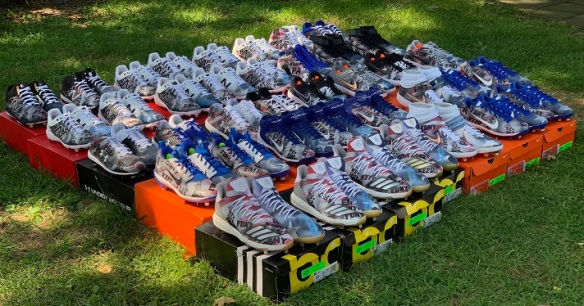
Telling no one but his fellow Mets what he was up to, Alonso gathered up the shoe sizes of his teammates, manager, and coaches, then arranged for special commemorative cleats to be made for the game by Adidas, New Balance, and other top athletic shoemakers. It isn’t every major league rookie who delivers the kind of audacity that ennobles his team and his game.

2019-09-13 Mets911Shoes

The shoes that put the Mets’ best feet forward on 9/11.

The cleats featured American flag striping, the initials of first responder agencies, a small image of New York firefighters raising an American flag at Ground Zero, and a silhouette of the Twin Towers. Making the major league rookie salary of $550,000 for the season, not to mention winning $1 million as this year’s Home Run Derby champion at the All Star break, Alonso paid for every pair of the special cleats himself.

“For me, this season has been an absolute fantasy. I just want to give back. I want to help,” said Alonso, a Florida first grader when the atrocity happened. “I don’t just want to be known as a good baseball player, I want to be known as a good person, too. And I just want to really recognize what this day is about. I don’t want it to be a holiday. I want it to be a day of remembrance of everything that happened. It was an awful day.”

He hatched his podiatric plot well in advance of the 9/11 anniversary, and it’s not exactly impossible that the Mets being so unified as a team on the matter might have kept baseball’s customarily capricious official leadership from sanctioning the team.

It probably didn’t hurt, either, that a little favour fell upon the Mets from the Elysian Field gods that night. Their surprising bolt out of the post All-Star gate could only get them to within three games of the National League’s second wild card, proving that even the subordinate gods work must work within a budget, but they could at least spend a little extra on the 9/11 anniversary itself.

Thus did the Mets, wearing Alonso’s subversive commemorative cleats, shut the Diamondbacks out on . . . nine runs and eleven hits, including six home runs, two (Todd Frazier, Brandon Nimmo) back-to-back in the Mets’ five-run first, and with Frazier and Jeff McNeil each hitting a pair of them before the carnage was finished.

The following night, the Mets again nailed eleven hits off the momentarily hapless Diamondbacks, but this time they were good for eleven runs, the big blow the first of Juan Lagares’s pair of blasts, in the bottom of the third. The center fielder checked in with the bases loaded, nobody out, and the Mets up 1-0 on an unearned run, then hit a full count service from Alex Young into the left field seats.

And any threats of fines or disciplinary measures against Alonso or the Mets over the commemorative shoes went unfulfilled.

Yordan Alvarez, the Astros’ phenom bombardier, was named the American League’s Rookie of the Year unanimously, beating out Orioles pitcher John Means, Rays second baseman Brandon Lowe, White Sox outfielder Eloy Jimenez, and Blue Jays second baseman Cavan Biggio—the son of Astros Hall of Famer Craig Biggio.

By arriving in a June callup after decimating the two highest minor league levels, Alvarez has the second-shortest Rookie of the Year season behind Hall of Famer Willie McCovey. And, as Alonso did in the National League, Alvarez won a trio of American League Rookie of the Month prizes. (June, July, August.)

He premiered by teeing off against another Oriole pitcher, Dylan Bundy. He went on to tie the rookie record for the most home runs in 100 games or fewer, hit righthanders and lefthanders with equal deadly force, and followed an almost invisible American League Championship Series by hitting .412 with one bomb in the Astros’ seven-game World Series loss.

The third Rookie of the Year in Astro history—Hall of Famer Jeff Bagwell won the award in 1991; Carlos Correa (2015) became the first Astro to win it after they were moved into the American League—Alvarez is Alonso’s near-opposite, the strong, silent type. He shares Alonso’s essential humility, but you’re not likely to see him shred the jersey away of any Astro nailing a game-ending hit. Yet.

“He’s a quiet man by nature,” says his manager A.J. Hinch, “and his demeanor is very low key. But he’s always in tune with other players and other people and the information.”

Alonso is the Mets’ sixth Rookie of the Year, following Hall of Famer Tom Seaver (1967), Jon Matlack (1972), Darryl Strawberry (1983), Dwight Gooden (1984), and Jacob deGrom (2014), and only the second Mets position player (after Strawberry) to win the prize. His race for the prize might have been a lot closer, maybe even lost by a hair, if the Padres’ phenom Fernando Tatis, Jr. hadn’t been held to 84 games thanks to the injured list.

Interesting synergy. This year’s Rookies of the Year belong to a pair of teams born from the same expansion draft, for 1962. Neither of whom could possibly have imagined the day to come when one would be the team to be named later when a third expansion team, the Brewers, would be traded to the National League.

But Alonso played all but one game in 2019. And it took the Mets’ often-criticised general manager Brodie Van Wagenen, a former players’ agent, to convince the club to take Alonso north with them when spring training ended, rather than do as too many other clubs have done with promising youth and bury him one more year in the minors for the sake of extended team control.

Unlike in days of Mets future past, there’s a realistic chance that they might be able to lock Alonso down on a longer-term commitment when his first free agency comes within not-so-distant sight. They’ll be freed of major commitments to too-oft-injured Yoenis Cespedes (in danger of missing all of 2020 as well off multiple-ankle and knee surgery) and aging Robinson Cano well enough when that day arrives.

Assuming Van Vagenen makes no more trades that involve importing still-onerous contracts, such as the deal that landed Cano in the first place, the Mets would be able to keep Alonso in the blue and orange for a long enough time to come. Assuming Alonso continues the kind of performance he showed exponentially in 2019, it would be manna for a franchise that often forces its fans to dine on quail.

And in this case we’re not talking strictly about Alonso’s performances at the plate or at first base, where he shook away the periodic hiccup to establish himself as more than capable afield. Whether Alonso proves the equal of Mets legend Keith Hernandez, who revolutionised the position by making it one of infield leadership as well as fielding virtuosity, remains to be seen, but he showed the potential for either or both.

He showed more than the right stuff in uniform. First, he sent a tenth of his Home Run Derby prize money to a pair of 9/11-inspired charities, the Wounded Warriors project (which aids post-9/11 military wounded) and the Stephen Siller Tunnel to Towers Foundation, named for the firefighter who lost his life on 9/11 trying to save lives in the World Trade Center.

Then, he plotted and executed his end-run around official baseball’s official strictures against any 9/11 commemorative gear above and beyond the hat patches. The gesture couldn’t possibly restore the lives lost in the atrocity but they could and did at least indicate to the city battered by it almost two decades earlier that someone playing baseball in a New York uniform understood that baseball’s transcendence sometimes has to wait its turn behind spiritual transcendence.

It wasn’t given to Alonso to electrify the Citi Field audience this 9/11 the way Hall of Famer Mike Piazza did in the Mets’ first game back in the late Shea Stadium after the original atrocity. When Piazza swung on 0-1 against Braves pitcher Steve Karsay with pinch runner Desi Relaford aboard in the bottom of the eighth and hit it far enough over the center field fence to ricochet off a television camera posted on a scaffold. And, prove the game winner for the Mets.

With his family and his fiancee in the house, Alonso had to settle for sending Foltynewicz’s 2-1 service over the center field fence in the bottom of the third on 28 September, pushing him past Aaron Judge as the single-season rookie home run champion and bringing the Citi Field crowd to its feet not just because of the blast itself but because he couldn’t keep his emotions from overflowing in its immediate wake.

With the memory of his 9/11 commemorative subterfuge likely still fresh, the crowd refused to turn off the love as Cano flied out to deep center for the side and the Mets re-took the field. And Alonso stationed at first base finally couldn’t contain himself, lowering his head and crying shamelessly, the magnitude of his accomplishment overwhelming him in disbelief.

It was the perfect night for nice guys to defy Leo Durocher. While Alonso swung his way into the record book, on the opposite coast the Astros’ Hall of Famer-to-be Justin Verlander threw his way into it.

Verlander struck out the Angels’ right fielder Kole Calhoun in the bottom of the fourth for career strikeout number 3,000, and struck Calhoun out again in the bottom of the sixth for season strikeout number 300. Lifting a page from the late Ernie Broglio, Calhoun can say at least that he played with a couple of Hall of Famers and helped put at least one pitcher there.

Unlike Alonso, alas, Verlander’s entry into history came with a p.s. The fourth-inning strikeout went for a wild pitch, enabling Calhoun to first base, where Calhoun stayed only long enough for the next Angel batter, shortstop Andrelton Simmons, to hit one into the left field bullpens. It didn’t stop the Astros from winning the game, but sometimes you just can’t slip further into the books without one misstep.

Verlander’s a very well seasoned veteran and Alonso is a freshly-initiated kid with, hopefully, a long enough career ahead of him. Maybe, if the Mets don’t relapse and see the core of Alonso, deGrom (still young at 31), McNeil, Nimmo, Michael Conforto, J.D. Davis, Seth Lugo, and Amed Rosario as a young enough core to build around and not fool around with, including a postseason or three.

Maybe even a postseason taking the Mets to face the Astros in a World Series. Maybe. If astronauts first walked the moon when the Mets won their first Series at the tender age of eight, and the Nationals could win this year’s World Series entirely on the road, it reminds you of one of baseball’s truly unimpeachable laws: Anything can happen—and usually does. So who’s to say?

Alonso’s uniform number—20—is deemed by Bible scholars to indicate the perfect waiting period, and by numerologists to indicate infinite potential in relationships and diplomacy. Of course. He fell into the perfect waiting period to make his Show debut this season—no waiting, right out of spring training—and, proving that good things indeed come to those who wait, to break Judge’s rookie home run record on the next-to-last day.

His potential on and off the field appears infinite enough. For now you get the parallel pleasure of seeing that not only does the right player swing for the record book, and play to earn a major award, but every so often he proves to be the right man for both.

The Mets take a hearty Beltran

2019-11-02 CarlosBeltran

From crossing home as a Mets player to coming home as their new manager.

Leave it to a few too many Met fans. The organisation hires one of the best respected former players in the game to manage the team, and all they can remember is that he was frozen solid to end the 2006 National League Championship Series.

So let’s get it out of the way once and for all. No, I wasn’t any more thrilled than you when the Cardinals’ Adam Wainwright nailed Carlos Beltran with strike three to end that NLCS. Especially after Beltran to that point had thirty at-bats in that NCLS before that one, with three bombs, four steaks, and a .307 batting average.

But Wainwright had baseball’s nastiest curve ball that season. It would have frozen Willie Mays himself. The heartbreak when your team gets beaten isn’t always mitigated when your arguable best gets beaten by their arguable best. But unless you’d rather Beltran frozen by Braden Looper it’s long past time to forgive what needs no forgiveness.

Certainly it didn’t freeze Beltran for the rest of his baseball life. He didn’t look for the nearest mouse hole into which to spend it. He merely played 548 more games as a Met with ninety home runs, three All-Star teams, two Gold Gloves, and a few MVP votes, before he was traded to the Giants for a kid named Zack Wheeler.

And he even put up with the indignity when he defied the Mets’ powers that were at the time to undergo surgery on a bothersome knee, thanks to the past sane thought that just maybe his chosen doctors knew a little bit better than the Mets’ designated quacks what his knee needed. (Indeed, the day would come when the Mets would finally overhaul their medical brain trust.)

He knew enough to play seven more useful seasons including a farewell with the Astros’ 2017 World Series winner. It’s not that he put on a show in that Series (he batted three times, struck out once, and had nothing else to show for it), but there wasn’t an Astro to be found who didn’t benefit from his counsel, either.

As a Met Beltran was invaluable not just because he was a Hall of Fame-level player but because, in the middle of any maelstrom buffeting the team in the city that rarely forgives and rarely forgets, he was a stand-up man no matter the scandal or the struggle amidst the team.

He mentored and shepherded players, he faced the press no matter how hard the loss or how ridiculous the externals, he answered any and every question without evasion, and he was maybe the only baseball man in New York this side of Joe Girardi who couldn’t be T-boned by an unsuspected disaster running the figurative red light.

Now the Met who couldn’t be caught off guard even in testy New York gets to manage them. And they’re in slightly better shape than people think. Their rather stupefying second-half run in 2019 wasn’t enough to save the head of the hapless, often clueless Mickey Callaway, but it might be enough for Beltran to lead them to next year’s postseason after all. Might.

They have the National League’s likely Rookie of the Year. They have arguably the league’s best pitcher still, with arguably several more seasons of comparable performance yet to come. They have a youthful core who showed mettle, flair, and adaptability in 2019. If the Mets give Beltran the thing he needs most—a bullpen overhaul that leaves him more than just bull—he’ll have an advantage even before spring training begins.

Beltran also has a unique ability to connect with even the most disparate players and coaches, something he was known for as a player and a skill he refined even further in two years working in the Yankee front office. Show Beltran two players about whom fire and gasoline would be understatements, and Beltran will show you two players he kept from further combustion.

SNY’s Andy Martino has a classic example. Carlos Gomez and Brian McCann once clashed on the field after Gomez, the punk, had fun hitting one out against the Braves and McCann blocked him up the third base line from scoring to finish the homer over, you know, the Sacred Unwritten Rules. It was hard to know who looked more foolish, Gomez for having his fun or McCann for deciding he had no right to touch the plate.

Mirabile dictu, Gomez and McCann ended up teammates on the same 2017 Astros World Series winner. While they were there, both the Fun Boy and the Fun Fuzz accepted Beltran as a mentor. Beltran could and did counsel Gomez how to have fun without bruising egos; he could and did counsel McCann, we presume, that nobody likes a self-appointed gendarme putting on the cuffs before the not-so-bad guy finishes his job.

Beltran’s reputation, Martino observes, includes that he was the de facto hitting coach for every team who employed him as a player, and that he has a genius for picking up on the tiniest missteps by the other guys and exploiting them, from off-kilter field positioning to pitch tipping. It’s not impossible that Beltran was one of the Astros who caught Yu Darvish tipping pitches early in 2017 World Series Game Seven, enabling the Astros to run him off the mound while securing the Promised Land lease before his departure.

A baseball mind married to a people person gives a brand new manager a leg up already. Right away Beltran isn’t a candidate to blow up his clubhouse before he has a chance to secure it. He also has the advantage of distance on his side. He’s not being handed the Mets’ bridge immediately after his days of playing for them ended.

That was the mistake the Yankees made with Yogi Berra when handing him their bridge for 1964. Berra was too freshly removed as a player to establish a clubhouse rhythm or to avoid a few too many of his veterans from using manager-turned-general manager Ralph Houk as a behind-Yogi’s-back sounding board. Especially when it took Berra awhile to stop lifting his starters too soon and stop looking for bullpen saviours he didn’t yet have.

The ’64 Yankees had other problems, of course, most notably the subterfuges involved in the team’s sale to CBS and the lack of a viable bullpen between April and September. They rehorsed in time to win the pennant and lose a thriller of a seven-game World Series.

Yogi never saw it coming when he was beheaded the following day in favour of the man who’d just beaten him in the Series, Johnny Keane. And Keane himself dodged more than a few similar backstairs betrayals on the season and was actually offered the Yankee job-to-come behind the channels, well before both teams came back to win their pennants after all.

The Mets these days aren’t exactly a model baseball administration, either. Beltran could find himself only too soon wondering what on earth he got himself into when he finds his front office hands him or can’t diffuse a logjam or a bomb.

But it isn’t as though first-timers on the bridge can only fail—-see Alex Cora (a World Series ring his first time out), Aaron Boone (only the second Yankee manager ever to pilot back-to-back 100+ win seasons his first time out), and Rocco Baldelli. (He managed the thumping Twins to this year’s American League Central title.)

And, so far as we can predict, Beltran won’t be managing (yet) the way Boone had to manage the Yankees in 2019—unable to determine whether he was trying to win a division and a pennant or the Nobel Prize for Medicine.

Beltran also becomes the ninth Mets manager who ever played for the team in an earlier life. The roll includes, in ascending order, Gil Hodges (an Original Met before his knees betrayed him for keeps), Yogi Berra (a few pinch-hit appearances for the 1965 Mets before returning to the coaching line for keeps), Joe Torre, Bud Harrelson, Dallas Green (briefly a pitcher on the 1966 Mets), Willie Randolph (he ended his distinguished playing career on the sorry 1992 Mets), and Bobby Valentine (he split 1977 between the Mets and the Padres).

You may care to note that three of those men—Hodges, Berra, and Valentine—won pennants managing the Mets; Hodges, of course, won a World Series managing the 1969 Miracle Mets, and Berra got to within a game of winning the 1973 World Series. Hodges apprenticed as a manager with the second Washington Senators; Yogi spent seven years on the Mets’ first base coaching line; and, Valentine spent eight prior seasons commanding the Rangers before he took the Mets’ bridge.

Beltran’s going to have to show he can develop in-game tactical and strategic smarts fast enough to match his skills at picking up field nuances and missteps and at fostering relationships. But you won’t expect him to be caught flatfoot if questioned over as questionable a move as the now-deposed Callaway was in Chicago in June.

When Callaway left a gassed Seth Lugo in for a second inning only to get him and the Mets clobbered despite a fresh option or two for whom to reach. And, when Callaway accepted the inevitable post-game questions by demanding his questioner be removed from the room and doing nothing when one of his other pitchers threatened to knock the questioner the [fornicate] out.

But when you decide Beltran is the man you want over such candidates as Nationals first base coach Tim Bogar (whose playing career began as a Met), Brewers bench coach Pat Murphy, or Eduardo Perez (former Astros and Marlins coach whose tenures were short lived but who ended up a finalist with Beltran for the Mets job), you’d better know something we don’t know yet.

Which is what Mets observers said when Callaway was handed the Mets’ bridge for 2018, after several years as the respected Indians pitching coach. Callaway proved to be in so far over his head managing the Mets that he needed a periscope just to see a mile below the surface. He’s since moved on to the Angels in the gig for which he’s suited best, pitching coach for their new manager Joe Maddon.

If Beltran proves a capable manager, never mind the kind who can lead the Mets to consistent excellence, he could also accomplish something only Yogi Berra has ever done as a Met—stand at the 2023 podium in Cooperstown, as Yogi did in 1972, accepting his Hall of Fame plaque for his playing achievements while he’s managing the Mets. Never underrate the power of that kind of symbolism.

Beltran goes in with one very key endorsement, from a man with whom he grew up friends in their native Puerto Rico and to whom he reached out after his playing days, as a Yankee advisor, and as he went through the Mets’ hiring process. A man who thinks there’s more than just a marquee name involved in Beltran’s hiring.

“This is something he earned. He has made adjustments throughout from a guy who was quiet to all of a sudden is eager to share information and to talk to players, coaches and front office people,” said Alex Cora, the Astros’ bench coach during the 2017 World Series run he shared with Beltran and who went from there to nail a World Series managing the Red Sox in 2018.

Cora told the New York Post that Beltran did his homework and prepared himself fully after showing he could stay on top of the game by evolving.

“I had him as a player in 2017 and we had long conversations,” Cora continued. “We had some radical ideas of how to do things to kind of prepare myself for what was coming. He would tell me things and I would share stuff with him on how to run a big league team. He helped me out a lot.”

Never underrate the power of a World Series-winning manager’s endorsement, either.

Mickey’s monkey is off the Mets backs

2019-10-04 MickeyCallaway

Now the former Mets manager . . .

The least unpredictable fact when the regular season ended was Mickey Callaway’s job status. Never mind the Mets’ little comedy of an organizational meeting without him; the question was when, not whether Callaway had a date with the executioner.

Thursday proved the when. Mickey’s monkey is off the Mets’ backs.

At least Mets chief Jeff Wilpon and general manager Brodie Van Wagenen had the decency to fly to Callaway’s Florida home and tell him to his face. They didn’t send a flunky to do the firing for them, the way George Steinbrenner once did with Clyde King when he decided he wouldn’t fire Yogi Berra because the players did.

Even the Mets’ deceptive second-half self-resurrection, pulling them as close as two games from at least a wild card game entry but not quite close enough, wasn’t enough to save Callaway’s job. Or, for that matter, bench coach Jim Riggleman’s.

They brought Riggleman in to help shepherd Callaway through game situations. Riggleman doesn’t exactly have a sterling managerial record himself. And based on a lot of the Mets’ results this season, whether in the first half nightmare or the deceptive second half revival, it didn’t seem as though Riggleman was the best bridge lieutenant.

It’s a shame after a year during which the Mets yielded up the likely no-questions-asked National League Rookie of the Year (Pete Alonso) and possible second-straight National League Cy Young Award winner. (Jacob deGrom.) It’s no surprise, though, after the Mets played thrilling baseball one minute and looked like crisis junkies the next.

But time and again in the diciest moments Callaway’s moves blew up in his face, sometimes because that’s the way of the game and oftentimes because he wasn’t exactly the most in-tune observer of the moment.

One of them almost cost him his job in June. Against the Cubs in Wrigley Field, Callaway let Seth Lugo go out for a second inning’s relief work on a day Lugo didn’t exactly have his A game in his first inning’s work but Callaway had a fresh (and as yet uninjured) Robert Gsellman and his closer Edwin Diaz ready in the pen.

So Lugo went out for the eighth, fed Kyle Schwarber a hanger he was lucky didn’t disappear across the street but went up the middle for a shallow hit, walked Anthony Rizzo a fly out later, and served Javier Baez a meaty slider to serve into the right field bleachers, turning the game into a 5-3 Cub lead that held up through the ninth.

There wasn’t a reporter in the room who wouldn’t ask why Callaway stayed with a faltering Lugo who’d struggled to survive the seventh, or why he didn’t think to bring in Diaz to try for a five-out save after Schwarber’s single. Callaway snapped at Newsday writer Timothy Healey in particular, and so did then-Mets pitcher Jason Vargas, who threatened to “knock you the [fornicate] out.”

Right then and there another team’s general manager would have dumped Callaway and shuttled Vargas right the hell out of town. Right then and there nothing of the sort happened. It wasn’t Callaway’s first head-scratcher from the bridge and it sure as hell wouldn’t be the last:

* He often pulled his starting pitchers when they were more or less cruising and at extreme minimal pitch counts only to be caught by not having allowed his relievers enough warmup time. And this was from a manager who probably knew in his heart of guts that he could trust most of his bullpen the way a cobra would trust a mongoose on a dinner date.

* He never quite clued in to the idea that a lot of his pitchers were more comfortable throwing to Tomas Nido behind the plate—with the numbers to back them up—than Wilson Ramos. This is probably on general manager Brodie Van Wagenen as well, but it merely amplified a key Mets dilemna: choosing between a catcher who could hit but didn’t always get the best out of his pitchers, or a catcher who usually got his pitchers’ best but couldn’t hit with the Washington Monument.

* Granted he had a bullpen of 98 percent arsonists, but he sometimes over-used his better bulls and never really defined who’d be doing what, particularly with his high-priced closer Edwin Diaz, who turned into a season-long mess wondering who’d burglarised him and made off with his once-deadly slider.

* In early September, with the Mets down 9-6 in the seventh, Callaway ordered an intentional walk to the Phillies’ number eight hitter to load the bases, even knowing Bryce Harper, who hadn’t started that day, loomed as a pinch hitter for Phillies reliever Mike Morin, merely because Callaway wanted Morin out of the game—which Morin was liable to be, anyway, after the inning ended.

Then Mets reliever Taylor Bashlor walked Harper unintentionally to bring home the tenth Phillies run. Be careful what you wish for.

Well respected as a pitching coach with the Indians, from whence the Mets hired him, Callaway—according to several published reports since his execution—rarely if ever drew on his pitching knowledge to give his pitchers more than cursory counsel. About the only thing he may have done, the reports say, was fume when pitching coach Dave Eiland was canned in favour of octogenarian Phil (The Vulture) Regan, who actually proved a lot more effective with Mets pitchers.

Callaway may also have helped cook himself by contravening earlier promises to open wider communication lines with his players. He’s said instead to have isolated himself in his office far more often and delegated far too many more responsibilities to his coaches.

And Mets players weren’t the only ones tempted to believe Callaway was really a front office plant who didn’t always call the shots. Nobody seemed to know whether his marching orders and in-game maneuvers came from Callaway himself, or from Van Wagenen, or even from chief operating officer Jeff Wilpon.

The only thing anyone knew was that, whether the Mets looked falling apart or looked like they’d really sneak into even the wild card picture, Callaway resembled a ship’s captain who couldn’t really believe torpedoes were striking for the hull and wouldn’t give the appropriate orders to cut them off.

So the question becomes whom the Mets will bring aboard to succeed Callaway. The answer may not be simple. And some of the options a lot of fans seem to favour may end up being worse.

One rumour has it that the Mets have eyes on former Cardinal manager Mike Matheny. Because he has postseason experience. Never mind that Matheny blew a couple of postseasons with his own head scratchers and refusal to contravene The Book, and blew up his own clubhouse in early 2018 (hence the advent of Mike Schildt) when he turned out to have a taste for engaging veteran snitches to play fun police with his young team.

Another suggests former Yankee manager Joe Girardi. Postseason experience. World Series ring. Itching to get back on the bridge. Except that Girardi is better suited, really, to a mostly veteran club, not a largely youthful club such as the Mets are now, something he may have proven when he had the vaunted Yankee youth in their first true season together but may have lacked for real communication with them.

A third suggests former Yankee, Diamondback, and Oriole manager Buck Showalter. Nice idea until he gets you to the postseason, refuses just like Matheny to throw The Book to one side despite the game situation demanding it, leaves his best relief pitcher in the bullpen because it’s just not a proper “save” situation, and watches a three-run homer fly into the left field seats with the other guys’ division series ticket attached.

A fourth suggests freshly deposed Cub manager Joe Maddon. Wonderful with youth and vets alike. Actual or alleged cursebuster. World Series winner. Postseason entrant. And probably more likely to have his eyes on southern California, where the Angels for whom he worked eons need to replace freshly executed Brad Ausmus and the Padres need to replace last-minute in-season execution Andy Green.

But a fifth pair presents a little intrigue. One involves Edgardo Alfonso, once a fine third baseman for the Mets and lately a winning manager for their Brooklyn Cyclones farm. The other involves Luis Rojas, currently the Mets’ quality control coach, who also managed a lot of the younger Mets in the minors and who’s said to have enormous respect from most Mets players.

Rojas comes by his baseball knowledge more than honestly: he’s also the son of longtime player and respected former manager Felipe Alou. (No, there was no extramarital hanky panky: The family name is Rojas, actually, and reads properly as Rojas-Alou, in the Spanish custom of the paternal family name coming first. The Giants scout who first signed Felipe Alou mistook the matronymous “Alou” for the proper family surname.)

Other candidates? Depending on where you look, they include current Astros bench coach Joe Espada (whose boss A.J. Hinch is a Van Wagenen friend), current Nationals first base coach Tim Bogar (once a Met player), former Mets bench coach Bob Geren (now Dave Roberts’s consigliere with the Dodgers), current Pirates third base coach Joey Cora (brother of Red Sox manager Alex and former Mets minor league manager), and former Mets infielder Joe McEwing. (Now White Sox manager Rick Renteria’s consigliere, but was a finalist for the job Callaway got with the Mets.)

But if Callaway really was just an errand boy for Van Wagenen as often as not, maybe the Mets need to re-think Van Wagenen, too. It seems strange to say about a team that finished third in the National League East and ten games over .500, but the Mets are probably due for the overhaul few seem to think they’re ready to deliver. Third and .531 look a lot better on paper than the Mets really looked this year.