That’s the way the cookies crumble

2020-07-26 McNeil'sDog

I’ve heard of Bark in the Park but this was ridiculous, sort of: Cardboard cutouts of (left to right) Griffey (belonging to Michael Conforto), Kali (also Conforto’s), and Willow (belonging to Jeff McNeil), watching from the right field seats in Citi Field Saturday . . . moments before Adam Duvall’s home run caught Willow right in the snoot.

So you’re still not thrilled about those new rules this year about the free runner on second to open the extra inning or the three-batter minimum for relief pitchers? You’re not alone. Cleveland Indians righthander Mike Clevinger is on your side. (And mine.)

You could say Clevinger has solid reason. In the Indians’ second game of the new truncated season, after his rotation mate Shane Beiber came up one short of the Opening Day strikeout record, Clevinger saw his seven-inning Saturday start (ruined only by a pair of Kansas City Royals homers back to back in the first) laid waste by the cookie on second.

He also got to see the Royals’ new manager Mike Matheny roll serious dice and come up boxcars. The Royals got what proved the game-winning run without a single official at-bat on the ledger. We tried to warn you this kind of mischief was possible.

It went like this: Since the free cookie on second is the guy who batted last for the team, Kansas City veteran Alex Gordon opened the top of the tenth on second. Until he didn’t; Matheny sent reserve outfielder Brett Phillips to run for him to open. He ordered Erick Mejia to bunt Phillips to third, before Matt Franco sent Phillips home with a sacrifice fly to break the two-all tie.

After Royals second baseman Nicky Lopez walked, he got thrown out stealing with center fielder Bubba Starling at the plate. Then Greg Holland—the prodigal Royals reliever, far enough removed from the days he anchored their once-feared H-D-H bullpen (Holland, Wade Davis, Kelvim Herrera)—shook off plunking Indians center fielder Bradley Zimmer leading off and struck out the side in the bottom of the tenth.

Clevinger thought it was all about as amusing as a boom box aboard a hearse.

“This isn’t travel ball,” he told reporters after the game. “You know how hard it is to get a runner on second base off the back end of any bullpen, how incredibly hard that is? I’m not happy about it. I’m sure when other teams face the situation and this happens to them, you’re going to get similar reactions.”

Calling the New York Mets. They got burned but good Saturday afternoon. It was bad enough that closer Edwin Diaz followed an excellent save on Opening Day with having the Atlanta Braves down to their final strike—after he fell behind 3-0 on Marcell Ozuna—only to have Ozuna send one over the right field fence to send the game to the tenth tied likewise at two.

Then Mets manager Luis Rojas, knowing the three-batter minimum, sent Hunter Strickland (erstwhile Giant and National) out to pitch the tenth. This was something like naming Mrs. O’Leary’s cow the official mascot of the Chicago Fire Department.

The good news was that, unlike on outings past, Strickland didn’t have long balls to serve, a la carte or otherwise. The bad news was that, since the Braves didn’t exactly have bunts on their minds, Rojas didn’t think to order Strickland to put the inning’s leadoff hitter, Dansby Swanson, aboard—with Adam Duvall, the last Brave to bat in the ninth, as the free cookie on second—to set up a prompt double play.

Instead, Rojas let Strickland pitch to Swanson and the Braves’ shorstop lined a Strickland slider just above the middle floor of the strike zone into center field, sending Duvall home promptly with the tiebreaking run. Johan Comargo, the Braves’ lesser-hitting third baseman, bounced one up the middle that Mets late-insertion second baseman Andres Gimenez couldn’t spear to send Swanson to third.

If Rojas ordered Swanson a free pass to open the inning, Gimenez might instead have speared that bouncer for either a step-and-throw double play or a quick flip to shortstop Amed Rosario to dial Area Code 4-6-3. Leaving the Braves no recourse but a base hit to get Duvall home.

And the inning would have gone 3-2 to the bottom of the tenth, and the Mets’ run would have tied the game. Sending it to the eleventh and . . . oops. Free cookies on second and three-batter relief minimums to open each half inning there, too, if each skipper reached for a fresh bullpen bull.

Stuck now with Strickland having to face a third batter at minimum by current law, Rojas could only watch helplessly when Strickland got the Braves’ late-insertion center fielder Endier Inciarte to bounce one right back to the box but bobbled the ball before having to take the sure out at first. Now it was 4-2, Braves, and Rojas had all the legal room on earth to get Strickland out of there before playing with another match.

Oops.

Even with Drew Smith up and ready in the Mets’ bullpen, Rojas stuck with Strickland. And Strickland played with another match. William Contreras, the younger brother of Chicago Cubs catcher Willson Contreras, smashed a first-pitch slider to the back of right center for an RBI double.

Then Rojas brought in Smith. And Smith promptly got Ronald Acuna, Jr. to look at strike three before Ozzie Albies grounded out to first base for the side but a 5-3 deficit the Mets couldn’t overthrow in the bottom of the tenth. Not even with free cookie Jeff McNeil on second to open and Jake Marisnick (erstwhile Houston Astro) and Pete Alonso singling up the pipe to load the pads for pinch hitter Dominic Smith.

That was last year: Smith returning from the injured list for the Mets’ final regular season game, pinch-hitting with two on in the bottom of the eleventh, and hitting a game-winning three-run homer. This was Saturday afternoon: The best Smith could get this time was a measly sacrifice fly. Not enough. Mets catcher Wilson Ramos grounded to short to force Alonso at second for the game.

It only takes one game to make a manager go from resembling a genius, which Rojas resembled when the Mets beat the Braves on Opening Day, to a nut, which Rojas resembled trusting the top of the tenth—after his closer blew the ninth in the first place—to a once-decent relief pitcher whom the eventual world champion Washington Nationals practically ordered held hostage out of sight after he surrendered three homers in last year’s division series.

But if Braves manager Brian Snitker thinks he’s liking the extra-inning free runner and the three-batter relief minimum now, wait until his Braves get burned likewise by it in a game. He may have something different to say about it then.

I have something to say about it now: if commissioner Rob Manfred is still foolish enough to insist on using the free cookies on second to start the extra innings this season, then he should declare the three-batter-minimum for relief pitchers void for those innings. No questions asked.

At least there was one amusement for both sides before the game ended. Duvall smacked a home run off Mets starter Steven Matz in the top of the second. With Citi Field empty beyond a smattering of cardboard cutouts in the seats, Duvall’s blast sailed into the right field seats . . . where it smacked the cardboard cutout of one of McNeil’s dogs, an Alaskan Malamute puppy named Willow, sitting next to cutouts of outfielder Michael Conforto’s dogs, Griffey and Kali.

Right in the snoot.

If you’ll pardon the expression, the wags said it was the easiest game of fetch Willow played all year so far. The game result, however, had some thinking the poochie took such postgame requests as “Willow Weep for Me.”

It’s deja vu all over again for the Mets

2020-07-24 YoenisCespedes

Cespedes went into the seats in his return but deGrom added just more evidence for a non-support case Friday.

Pandemic delay or no pandemic delay, the 2020 season finds the New York Mets picking up just about where they left off last year. Not that beating the Atlanta Braves 1-0 on Friday was a terrible thing for them, of course. And not that Yoenis Cespedes, too long among the Mets’ living dead on the injured list, going long his first day back was terrible, either.

But their neglect of theirs and the National League’s best pitcher two seasons running, pending Jack Flaherty’s continuing maturation, continues yet. He’s too much a team player to say it, but surely Jacob deGrom thinks of games like Friday’s and thinks to himself, “It’s been lovely, but I have to scream now.”

Defending back-to-back Cy Young Awards, pitching like a future Hall of Famer, eight strikeouts in five innings, one walk, and one measly hit. (The innings limit was the Mets taking no chances after deGrom’s back tightness last week.) And nothing to show for it other than an ERA opening at zero.

Last year, deGrom had twelve such quality starts, averaging seven innings per, and came out with nothing to show for those. If his team played the way he pitched, he’d have been a 23-game winner and the Mets might have ended up in the postseason. Him definitely; them, might. As a former Mets manager once said, it was deja vu all over again Friday afternoon in Citi Field.

The Braves’ starting pitcher, Mike Soroka, got a grand taste himself of how deGrom must feel at times. He pitched six innings and, while he wasn’t deGrom’s kind of strikeout pitcher Friday afternoon, he did punch out three, scatter four hits, and come away with nothing to show for it but handshakes from the boss and whatever equals a pat on the back in the social-distancing season.

His relief, Chris Martin, wasn’t so fortunate. After ridding himself of Michael Conforto to open the bottom of the seventh on a fly out to deep enough center field, Martin got Cespedes to look at a first-strike slider just above the middle of the plate. Then he threw Cespedes a fastball just off it, and Cespedes drove it parabolically into the empty left field seats.

The piped-in crowd noise at Citi Field drowned out the thunk! when the ball landed in no man, woman, or child’s land. It was the game’s only scoring, but the Mets’ bullpen had a surprise of their own in store once deGrom’s afternoon was done.

They left the matches, blow torches, gasoline cans, and incendiary devices behind. They performed no known impression of an arson squad. They cleaned up any mess they might have made swiftly enough.

Seth Lugo, maybe the Mets’ least incendiary reliever last year, shook off a double to left by newly minted Brave Marcell Ozuna, and his advance to third on a passed ball, to get Matt Adams—signed but let loose by the Mets and scooped up by the Braves—to ground out to third and Austin Riley to look at strike three. Crowning two innings relief in which Lugo also made strikeout work of Alex Jackson and Ronald Acuna, Jr.

Justin Wilson, taking over for the eighth and looking like he was finding the right slots last year, shook off Dansby Swanson’s leadoff single to strike Adam Duvall out looking, before luring pinch hitter Johan Comargo into grounding out to second and striking Acuna out for the side.

Then Edwin Diaz, the high-priced closer who vaporised last year, opened by getting Ozzie Albies to ground out, shook off a walk to Freddie Freeman, and struck Ozuna out looking and Adams out swinging for the game.

Already freshly minted Mets manager Luis Rojas looks like a genius, or at least unlike a lost explorer. And Cespedes—about whom it was reasonable to wonder if he’d ever play major league baseball again—made sure any complaints about this season’s universal DH were silenced for this game at least.

“The funny thing is I joked with him before the game,” deGrom told reporters postgame. “I said ‘why are you hitting for me?’ He went out and hit a home run for us which was big. I was inside doing some shoulder stuff, my normal after pitching routine and yeah I was really happy for him.”

It didn’t work out quite that well for the Braves, with Adams going 0-for-4 with two strikeouts on the afternoon. Neither side mustered an especially pestiferous or throw-weight offense other than Cespedes’s blast.

But you half expected a low-score, low-hit game out of both deGrom and Soroka considering the disrupted spring training, the oddity of “summer camp,” and perhaps just a little lingering unease over just how to keep playing baseball like living, breathing humans while keeping a solid eye and ear on social distancings and safety protocols.

In a sixty-game season it all counts even more acutely than it would have on a normal Opening Day. The Mets and the Braves were each expected to contend this season before the coronavirus world tour yanked MLB’s plans over-under-sideways-down. They’re not taking their eyes off that just yet.

Before the game began, the Mets and the Braves—like the New York Yankees and Washington Nationals in D.C., like the Los Angeles Dodgers and San Francisco Giants by the Bay Thursday night—lined up on the baselines and held a long, long, long black ribbon. This time, with nobody kneeling before “The Star Spangled Banner” was played.

Maybe athletes can remind people that it’s dead wrong for rogue police to do murder against black and all people without running into the buzz saws of explicit national anthem protests and fury over the protests, after all.

The Braves have other alarms, though. Freeman, of course, is recently recovered from COVID-19 but two of their three catchers—Tyler Flowers and former Met Travis d’Arnaud—showed COVID-19 symptoms and went to the injured list. The good news: both catchers tested negative for the virus.

But lefthanded pitcher Cole Hamels hit the IL with triceps tendinitis. Not good. Every live arm counts in a short season, especially for legitimate contenders. Just ask the Mets, who’ll be missing Marcus Stroman with a calf muscle tear, even if Stroman historically heals quickly.

You hope both teams recover swiftly enough. You also hope the Mets find a way to make deGrom’s won-lost record look as good as he pitches and fast. Those non-support filing papers don’t take that long to draw up.


Alex Rodriguez, prodigal owner?

2020-07-17 JenniferLopezAlexRodriguez

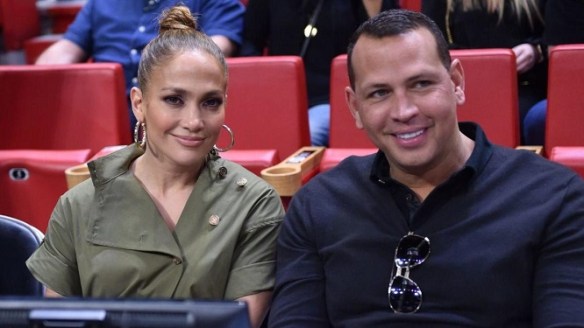
Alex Rodriguez with Jennifer Lopez, watching a game. J-Rod, as a few tabloid papers refer to the couple, are in play to buy the New York Mets.

It’s one thing for Alex Rodriguez to have rehabilitated his public image somewhat, during his final major league playing season and in his life since then as a broadcaster who’s owned up to his baseball sins. Including those that made him persona non grata for 2015 and finished the reputation wreckage from which a comeback then seemed only slightly less likely than Richard Nixon’s was once upon a time.

But it’s something else entirely that A-Rod and his paramour Jennifer Lopez now seek to become baseball owners. They can well afford to be, of course, but red flags hoist. The couple is in play to buy the New York Mets. Wherein lies a tale I’ve told before, elsewhere. It’s worth revisiting, because had he gotten what was once believed his career wish he might (underline that) have resisted the temptations to which he became prone in due course.

When Alex Rodriguez the player arrived at his first major league free agency, in 2000, he let it be known that the team he wanted to play for more than any on the planet—if his now-former Seattle Mariners were disinclined to re-sign him for the dollars he was sure to command as baseball’s greatest all-around shortstop—was the Mets. He grew up a Met fan (his idol was said to be first baseman Keith Hernandez) and, as I wrote once upon a time, there wouldn’t have been a structure big enough to contain his happiness if he could suit up for them beginning in 2001.

The dollars in play weren’t disclosed, but know this: the Mets then could have had A-Rod for a decade, and for two-thirds or a little less of the money for which he’d sign in due course. Coming off a 2000 World Series loss to the Yankees that was closer than the five-game Series looked on the surface, the Mets would have loved nothing more than to dress baseball’s best shortstop cross town from the Yankees’ Derek Jeter—who just so happened to be A-Rod’s best friend in the game at the time.

The Mets’ then-general manager Steve Phillips went to the December 2000 winter meetings to meet Rodriguez’s then-agent, Scott Boras, believing he was going in with A-Rod on the hook over very succulent bait. Phillips came out of that meeting without his stomach. It went AWOL. A decade later, ESPN’s Ian O’Connor ran it down:

A-Rod’s agent was telling the team’s general manager his client needed perks that would have made the world’s greatest divas blush . . . The list included a Shea Stadium office, a marketing staff, a merchandise tent at spring training, a luxury box, use of a private jet, and more billboards than Jeter could count.

The agent said some of the perks, not all, were absolutely required in any deal worth A-Rod’s signature. Boras never mentioned a dollar figure in the meeting, and he didn’t need to. The Mets wouldn’t even be offering Rodriguez cab fare home.

Nobody knew for dead last certain whether Boras’s laundry list was composed in any part by Rodriguez himself, and Rodriguez wasn’t known to have spoken of it publicly. “I remember Steve coming back to our suite and telling everyone, ‘You’re not going to believe it, but this is what Boras wants for Alex Rodriguez’,” another former Met executive, Jim Duquette, told O’Connor. “All of our jaws just dropped. We kept hearing how this was the place Alex wanted to play, but we knew then it wasn’t going to happen.”

Phillips then made a grave mistake. He spoke publicly about the Mets wanting to avoid a 24-man-plus-one roster, even though he never knew how much of the perk list was far more Boras than A-Rod talking. He lived to regret his remark.

That label stuck to Alex, and I didn’t mean for that to happen. But I just thought the rules had to be the same for everybody. Mike Piazza was the most low-maintenance superstar there was, with no entourage, only his brother and dad coming around once in a while. Mike always had the prettiest girl waiting for him after the game, and that was it. It was just Mike.

Not only was Rodriguez not going to become a Met, he inadvertently tore it with his BFF Jeter, who was going through his own contract haggle with the Yankees at the time. When A-Rod finally signed his precedent-busting deal with the Texas Ranger ($250 million), he also commented on the Jeter haggle. Oops.

“Jeter’s been blessed with great talent around him; he’s never had to lead,” Rodriguez said. “He can just go and play and have fun. He hits second—that’s totally different than third or fourth in a lineup. You go into New York, you wanna stop Bernie [Williams] and [Paul] O’Neill. You never say, ‘Don’t let Derek beat you.’ He’s never your concern.”

He didn’t mean for it to sound as though he’d just reduced The Captain to a mere ship’s mate. But there was a right and wrong way to say aloud that you thought Jeter was only one of a pack of leadership-quality Yankees who didn’t have to take the whole thing upon himself. Which is probably what A-Rod tried to say. Seeing it in cold print, he knew it meant trouble.

Assorted stories then and since have said Rodriguez hustled it to Jeter’s Tampa spread post haste to straighten it out and got a closed door to greet his arrival. The worse news for Rodriguez was that Jeter did have one thing in common with the Yankees’ Hall of Fame legend Joe DiMaggio, or so it was said: if he thought you did him dirty, even once, you might as well remove him from your address book. Permanently, perhaps. (Since 2010, their first spring training together after a Yankee World Series win, A-Rod and Jeter have patched up their once-fractured friendship.)

The Rangers didn’t exactly blow up the league with A-Rod. It wasn’t exactly A-Rod’s fault that the pitching-challenged Rangers of the time thought the solution to their most glaring problem was to spend the equivalent of a solid pitching staff on . . . one shortstop. The worse news was A-Rod’s insecurities kicking his insides out. “You wonder now about the real impact all that had on A-Rod,” I wrote upon his finalized suspension.

You wonder how his own agent botching a deal with the team of his dreams ate away at him. You wonder how deeply costing himself his best friend in baseball haunted him. You wonder what that cost him in a time when Jeter could have given Rodriguez critical moral support and steerage, when—slapped hard across the face with the reality of his off-the-chart deal, and the expectations attached to it, actual or suggestive — Rodriguez instead drove himself toward the netherworld of actual or alleged performance-enhancing substances, out of a quiet desperation to live up to his deal that equaled not trusting the talent that put him in position for the deal in the first place . . . Even if you acknowledge the Rangers bid against themselves to give one shortstop the money that would have built a long-term competitive pitching staff, you can’t lay that kind of responsibility upon his head.

Which brings us now to Rodriguez’s public suggestion that major league baseball players need—wait for it!—a salary cap. Especially after the owners tried to strong-arm them into a virtual one during the haggling over when and whether to open a 2020 season during the coronavirus world tour. A-Rod sounds only slightly less hypocritical than the Congresspeople standing foursquare for the balanced budget on the campaign trail but standing for glandular deficit spending in office.

As happened with his ancient observation of Derek Jeter, Rodriguez probably stumbled over his own tongue. He wasn’t wrong to suggest as he did concurrently that baseball would be wise to “get to the table and say the No. 1 goal, let’s get from $10 to $15 billion [total value of baseball] and then we’ll split the economics evenly.” But sports circles tent to interpret that as code for salary capping. A man who earned almost half a billion dollars playing the game and now implies it’s time for a salary cap looks too deeply to be saying, “I got mine, the hell with yours.”

Which is exactly how a number of players and other officials representing them see it. A-Rod’s one-time Yankee teammate, now-retired pitcher Brandon McCarthy, practically called for a little cancel culture sent his way. “I hope to god he’s shouted out of every clubhouse he attempts to enter in this and future seasons,” former 13-year pitcher Brandon McCarthy said in a Thursday tweet. “Call him a self-serving liar and make him explain himself to a room full of his former peers if he wants broadcast content.”

Tony Clark, the executive director of the Major League Baseball Players Association, wasn’t quite inclined to go there. “Alex benefited as much as anybody from the battles this union fought against owners’ repeated attempts to get a salary cap,” said Clark a little more reasonably. “Now that he is attempting to become an owner himself his perspective appears to be different. And that perspective does not reflect the best interest of the players.”

Before you decide that A-Rod is unique in threatening to graduate from a player to a potentially odious owner (assuming J-Rod become the winning bidders for the Mets), hark back to some baseball history. It’s strewn with players who became snakes in the front office. Eddie Lopat (pitcher), Paul Richards (catcher), Ralph Houk (catcher), and Al Campanis (second baseman and, incidentally, eventual provocateur of Andy Messersmith’s successful reserve clause challenge) were just four such reptiles known to screw players on contracts and other things.

It also features Al Rosen. The power-hitting Cleveland Indians third baseman of the 1950s became a very generous general manager in the 1980s, having learned from the ever-spending Yankee owner George Steinbrenner. Rosen injected a steroid shot (no pun intended) into salary escalation when, running the San Francisco Giants in 1990-91, he signed decent but no great shakes pitcher Bud Black to the kind of deal you’d have expected the Orel Hershisers and Dwight Goodens of the time to sign first.

The same Al Rosen who lamented runaway salaries to reporters at the December 1990 winter meetings, saying, “For a hundred years we couldn’t find a way to destroy this game, but now I think we’ve found the key.” John Helyar (in The Lords of The Realm) wasn’t the only observer wondering whether Rosen’s listeners should laugh, cry, or drop a hood over him and a final cigarette between his lips before a firing squad.

Now, along come J-Rod. Seeking to own the team for whom A-Rod once wanted in the worst way possible to play, until he did or didn’t freeze himself out of the chance. Bear in mind, too, that power couples owning sports teams doesn’t always mean joy to the world, or at least their teams and fan bases. Just ask former Los Angeles Dodgers owners Frank and Jamie McCourt.

With Rodriguez speaking of salary caps after earning about half a billion uncapped balloons during his own playing career, Mets fans and observers may not be the only ones pondering whether they’ll have to laugh, cry, or bring in the firing squad. If not pondering whether A-Rod has some sort of peculiar revenge in mind.

Rodriguez the boyhood Mets rooter might care to know that there is a one-time Mets pitcher named Bill Denehy living in southern Florida. He’s the man the Mets traded to the second Washington Senators to obtain manager Gil Hodges. Injuries (and a grave misdiagnosis or two) shortened Denehy’s career to portions of three major league seasons with the Mets, the Senators, and the Detroit Tigers. Excessive cortisone injections likely contributed to Denehy’s near-total blindness today.

The affable Denehy (fair disclosure: we have become friends over the past year plus) is one of 600+ short-career former major league players who were left out of the 1980 player pension realignment that vested players for pensions after 43 days’ major league service time and for health benefits after one day’s time.

Since 2011, when then-Players Association leader Michael Weiner and then-commissioner Bud Selig hammered out one small adjustment, those players get $625 per quarter for every 43 days’ major league time, up to four years. It was a start Weiner didn’t live long enough to pursue further.

Denehy, former Rangers pitching phenom David Clyde, former Atlanta Braves pitcher Gary Niebauer, and former Chicago Cubs third baseman Carmen Fanzone, are just four of those players. They and dozens more such as them, all whose careers proved short for assorted reasons, also hit the hustings for the Players Association to get among other things the free agency that brought Rodriguez his un-capped millions.

J-Rod (and Clark, for that matter) might want to lend them even a small eye and ear about that.

Darkness gone for the former Dark Knight?

2020-06-07 MattHarveySI

Little did Tom Verducci know that when he pegged Matt Harvey as the Dark Knight that another kind of darkness would compromise Harvey’s once-promising career.

Ten 7 Junes ago, the Kansas City Royals with the number four pick elected to draft a Cal State-Fullerton shortstop named Christian Colon instead of a University of North Carolina pitcher named Matt Harvey—because they thought they had enough pitching.* The New York Mets in the same draft picked two pitchers: Harvey, with the number eight pick overall, and a Stetson University kid named Jacob deGrom.

Five years after that draft, Harvey bulldozed his manager Terry Collins into letting him try to finish a World Series Game Five shutout that would have sent the set to a sixth game back in Kansas City.

“Would I take back getting to the World Series with those guys and the city of New York?” Harvey asks now, before answering.   “There’s not a chance. I believe things happen the way they are supposed to. I got hurt and maybe I would have anyway. Getting to the World Series was worth it.”

Then Collins had to lift his gassed Dark Knight after a leadoff walk and an RBI double and bring in his closer Jeurys Familia, who already had a sick-looking Series resume thanks to those Mets’ porous infield gloves. Unfortunately, you can’t give the blown save to the defense under the save rule.

Two groundouts, then a terrible throw home to complete what should have been a simple game-ending double play, and Game Five went to extra innings. Where Colon, pinch hitting for Royals reliever Luke Hochebar, broke the two-all tie in the top of the twelfth, opening a five-run inning that won the Series for the Royals after the Mets couldn’t get a single baserunner past second in the bottom of the frame.

Today, deGrom—who waited until the ninth round before the Mets took him, too, ten years ago—is the National League’s back-to-back defending Cy Young Award winner. Arguably, he’s also the best pitcher in the game right this moment, among those not named Max Scherzer or Gerrit Cole.

Harvey, whom the Mets traded to the Cincinnati Reds in 2018, who signed as a free agent with the Los Angeles Angels for 2019, who was released after that experiment tanked, and who gave it another try in the Oakland Athletics system the rest of the season, now looks for a job. In the Korean Baseball Organisation.

MLB’s tug-of-war between the owners and the players over the financials in getting a coronavirus-delayed 2020 season in at all probably meant it was a very long shot for Harvey to catch on with another major league organisation for now. He doesn’t mind taking his chances otherwise.

“It’s been an interesting ride, a roller coaster,” Harvey tells the New York Post. “With where I am now, physically and how I’m feeling, I hope I get another shot.” Calling it “an interesting ride” may be an understatement. Which is saying something about a pitcher you could call many things other than understated.

“As soon as he signed, he came to New York. I saw this big, good-looking kid standing in our bullpen with a black suit, white shirt, very thin tie — very GQ-ish, as he always was,” the Mets’ then-pitching coach Dan Warthen tells the Post. “His hair was always perfect. Then you see the ball coming out of his hand and you say, ‘Oh, it won’t be long until he’s playing baseball up here.’ And he was cocky, oh Lord. He said, ‘Hey, I’ll be ready to pitch for you next year’.”

Harvey premiered for the Mets in late July 2012, against the Arizona Diamondbacks.  He struck out ten in five and two-thirds innings while walking three and scattering three hits. “All of the reports I read,” says then-Mets manager Terry Collins, “didn’t talk about a 98 mph fastball. It was ’94-95, pretty good slider, working on changeup.’ All of a sudden, this guy is throwing 97-99 with a 92-mph slider. I said, ‘Holy cow!’ We were shocked by what we saw.”

“When he burst on the scene with a fury, it was fun, man,” then-Mets pitcher Dillon Gee—whose own career was sapped by injuries until he retired last year—tells the Post. “You had heard about him coming up. When he got here, he was like on a different level. You could tell he was a special talent.”

By the following season, Harvey was practically the talk of the town in New York baseball. When he ended June 2013 with a 2.00 ERA, Met fans has already begun greeting his starts with “Happy Harvey Day!” Harvey started that year’s All-Star Game—which was played in Citi Field, his home ballpark. The American League went on to win, 3-0, but Harvey’s three strikeouts in two innings electrified the joint.

Then Sports Illustrated put Harvey on the cover with the headline, “The Dark Knight of Gotham.” But the writer who delivered that cover story, Tom Verducci, would write five years later, after Harvey pitched (and, many said, partied) his way out of New York, “The truth is, for all the times he wound up in the tabloids other than the sports section, Harvey failed because his arm failed him.”

. . . His arm likely failed him because of how he threw a baseball. And when his arm failed him, he knew no other way. He couldn’t pitch without an A-plus fastball, he couldn’t embrace using a bullpen role as a way back, and he couldn’t believe in himself again.

. . . The Mets cut Harvey because his once-fearsome fastball became the almost exact definition of a mediocre fastball (MLB averages: 92.7 mph, 2,261 rpm). Because he couldn’t find another way to get hitters out, because he could not change his mechanics and because he could not buy into the bullpen, the Mets could not keep sending [him] out to the mound as a starter.

The decline in his stuff was obvious. And there was no way his fastball was coming back with the way he throws.

Especially not after blowing his elbow ligament into Tommy John surgery late in 2013 (which didn’t keep him from leading the Show with his 2.01 fielding-independent pitching rate or third in the National League with his 2.27 ERA), or incurring thoracic outlet syndrome, the surgery for which cuts somewhat invasively into the shoulder and the back, or trying too hard to come back too soon from both.

Be very afraid, Pittsburgh Pirates fans. Your struggling pitcher Chris Archer (though he did pitch decently after last year’s All-Star break) just underwent thoracic outlet syndrome surgery himself, who probably won’t return if and when major league baseball returns, and who may even find himself receiving a contract buyout before he can pitch 2021 and hit free agency after that season.

Like Harvey, alas, Archer’s post-surgery career prospects don’t look as promising as he himself formerly looked.

“I had TOS,” Gee says. “I know how much that sucks. It definitely changes you. You start trying to tinker with things. It’s not natural anymore. You start being robot-ish. You start not trying to hurt one area and totally hurt another area. Your whole body is out of whack.”

The limelight and the taste for night life among New York’s demimonde certainly didn’t help Harvey in the long run. “You could see the media and limelight kind of became part of what he wanted to do,” says Gee. “I’m sure that is super, super hard not to let that creep in, as popular as he got. I couldn’t imagine being bombarded as he was. He was the guy.”

Who’s to say, too, that Harvey didn’t sink into the demimonde because the slow realisation that his body began betraying the talent that got him there in the first place was too painful to bear? Dark Knights are supposed to be invincible, right?

Verducci believes Harvey’s mechanics both took him to the Show and eroded him soon enough. “Harvey pulls the ball far behind him—crossing the airspace over the rubber,” he wrote, “a strenuous maneuver that rarely leads to long careers.”

Harvey’s psyche also may have fallen out of whack in 2017, when that May Brazilian supermodel Adriana Lima, with whom he thought he had an enduring romance in the making, parted with him to leave a tony Manhattan afterparty with her former boyfriend, a New England Patriots football player.

Up to that point Harvey’s taste for the charms of supermodels was rivaled only by his taste for a ride whose value sometimes equaled that of a modest suburban home. But a few days later, Harvey missed a game claiming a migraine but possibly suffering a ferocious hangover, as the Post‘s Page Six had it. It got him a three-day suspension from the Mets.

Then Harvey suffered yet another injury, a stress fracture in his shoulder area, ending his 2017 and draining more off his fastball. The following season, in which he approached his first free agency, his continuing decline prompted then-Mets manager Mickey Callaway to think about moving him to the bullpen to rehorse, a move that tasted to Harvey rather the way Brussels sprouts taste to small children.

“We were trying to get him to use his curveball and changeup more, which he did in spring training — and he had a nice, four-pitch mix,” says then-Mets pitching coach Dave Eiland. “And then once the regular season started, he went back to his old habits, fastball and slider primarily. The command of it wasn’t quite there. If he missed a little bit, the outcome was going to be a little different than when he missed 97-99 with a 92-93 slider.”

When Harvey rejected the bullpen option, sometimes nastily, the Mets designated him for assignment, then dealt him to the Reds.

“I gave him the Dark Knight nickname, because I saw in Harvey someone who not only had the stuff to save the Mets in Gotham—they were in the middle of six straight losing seasons when Harvey arrived—but also the desire to play the role,” Verducci wrote. “He embraced not just being a staff ace but also a dominating personality.”

Learning to be just a young man may be almost as tough as re-learning how to pitch. Once upon a time Harvey was the most identifiable Met to the public but a somewhat alienating one inside his own team. Maybe riding the high life too hard distanced Harvey from people who might otherwise have felt for him, empathised, wanting to feel for him.

In Cincinnati and in Anaheim he was described as a changed young man, not exactly the type to just jump when the siren call of a tony party beckoned. If Gee and former Mets general manager Sandy Alderson are any examples, there’s empathy now, even if through hindsight’s eye.

“I liked Matt. I continue to like Matt,” Alderson tells the Post. “Sure, he had his reputation, but ultimately I thought as an individual, he was sort of a vulnerable person. Someone whose confidence was a little brittle. I remember in his postgame interviews, he came across as a real solid, humble, genuine guy. The things that we went through with him were not novel for me. It was part of the job. I didn’t resent it at all. I didn’t take it personally.”

Alderson isn’t the only one with a hindsight’s eye view of the Harvey dilemna. The former Dark Knight has one of his own. “There are a lot of things I’d do differently,” the 31-year-old Harvey now says, “but I don’t like to live with regret.”

There were just things I didn’t know at the time. Now, obviously, I’ve struggled the last few years. And what I know now is how much time and effort it takes to stay at the top of your game. I wouldn’t say my work ethic was bad whatsoever, but when you’re young, it’s not like you feel invincible, but when everything is going so well, you don’t know what it takes to stay on the field. It’s definitely more time consuming and takes more concentration.

Pitching respectably in Cincinnati got Harvey that shot in Anaheim that collapsed last year. The word now is that the video he’s produced of a pitching workout may impress someone in the KBO to give him a try. Eiland says he’s seen the video and it shows Harvey’s arm “looked like it was working well.” Warthen agrees: “This is the cleanest and easiest that I’ve seen him throw the baseball in a long time.”

Harvey also looks healthy. Shorn of his once-familiar beard, he looks as young as he was when the Royals bypassed him and the Mets snapped him up ten years ago. Almost as though he’d erased all those nights on the town and the flash he once embraced, except from inside his mind and soul where he can review them and remind himself how not to do it.

If Harvey can suggest that he knows better now what it takes to stay on the field or the mound, it’s an even more encouraging sign. It could also mean him trying to fend off the possibly inevitable one last time. It could also mean Harvey having to come to terms at last with the possibility that whatever else fell out of whack in his life before, his body’s betrayal was just too profound in the long run.

——

* Colon, the shortstop the Royals preferred to more pitching in the 2010 draft, remains the reserve-level player he’s been all his major league life. Before he was waived out of Kansas City, the Miami Marlins claimed and shortly farmed him out. 

The Braves signed him but released him the following May, the Mets (of all people) signed him on a minor league deal but let him walk as a free agent, then the Cincinnati Reds signed him to a minor league deal, gave him a cup of coffee last September, and re-signed him on a minor league deal.

But he’ll always have Game Five of the 2015 World Series. With one swing in the top of the twelfth he drilled his way into permanent baseball lore. It’s more than a lot of journeymen get.

In the same 2010 draft, the Royals passed over another pair of stars-to-be: outfielder Bryce Harper and pitcher Chris Sale. Harper is now in the second year of a $330 million/thirteen-year contract. Sale was the last man standing—striking out the side in the Game Five ninth—when the Boston Red Sox won a 2018 World Series that may or may not be tainted by their replay-room sign-stealing cheating that season.

Does Tim Tebow face a final curtain?

2020-01-10 TimTebowSyracuseMets

Tim Tebow at the plate for Syracuse in 2019; the parent Mets have invited him to 2020 spring training as a non-roster invitee.

If he earns nothing else when his athletic career ends at last, Tim Tebow will earn eternal respect for his stubborn determination to play on until the last sports uniform is torn from his back. Whether that uniform will come off this year remains open, but Tebow can look forward to a spring reprieve at minimum.

The Mets have handed him a non-roster invitation, which probably indicates he’ll start a second season with the Syracuse Mets (AAA). But it isn’t likely to indicate that his chances of playing major league baseball, slim enough as they are already, will improve. At 32 years old, and with a total performance resume described as dubious at best, Tebow’s professional athletic career may head for the final curtain.

Tebow has played in the Mets’ system since 2016, almost a year after his last chance at quarterbacking in the National Football League ended with the Philadelphia Eagles. His previous baseball experience was as a high school junior, when the Angels thought of drafting him had he played the game as a senior first. When not playing baseball the former Heisman Trophy winner works as an ESPN college football analyst and motivational author.

He hasn’t exactly flown like an eagle in the Mets’ system, but he remains popular with fans and even with fellow Mets minor leaguers, who cite him as a good teammate regardless of what he does at the plate or in the field. That jibes with his NFL reputation, in which few put off by Tebow’s sometimes overbearing popularity faulted Tebow himself for it.

Nor was it Tebow’s fault that he wasn’t able to cling as an NFL quarterback or that his actual skills didn’t equal even a modest NFL backup. (What he really had were the skills of a solid running back.) I’ve seen no better assessment of his core dilemna—the one momentarily obscured by his fluke late-season Denver success—than that of How They Play‘s Tony Daniels:

His throwing style was awkward, and his passing was inaccurate as a result. He adopted a run-oriented mindset early in his career that caused him to take off running when his primary receiver wasn’t open or when he felt pressure. The most glaring reason why he failed as a quarterback in the NFL was because of the coaching he received in high school and at Florida.

Tebow was never forced to develop into a conventional quarterback. Because he was big, strong, and could run, his coaches at the lower levels simply went with the flow and allowed him to run without helping him to develop other skills. As a result, he simply improved on what he naturally did well and got weaker at what he didn’t do well; passing the football . . . Why else would NFL quarterback coaches have to work so hard with him on his mechanics? What were his high school and college coaches doing when he was in their practices? Was no one working with him on his footwork, stance, throwing motion, delivery, and following through then?

You stay mindful of the good teammate’s spiritual clubhouse value (“He’s the kind of guy who’s good for the team even when he’s not playing well,” said a Seattle Pilots teammate of pitcher Gary Bell after a Bell trade), you remain mindful at once that baseball teams require ability and results. Whatever the Angels saw in him as a high school junior was atrophied long enough.

By the time the Mets decided Tebow was worth having, maybe more to goose their minor league gates, he wasn’t a bona-fide baseball prospect. His personality and agreeability made you wish in your heart of hearts for some previously-unimaginable emergence of baseball talent. (They still do.) His shameless religious faith, which seemed jarring at first to the jaded, should never have been jarring and remains something to behold and admire in a time when spiritual faith sees more knockdown pitches than any hitter does.

Tebow launched his baseball career with a bang in his first professional plate appearance. But after four minor league seasons, one or two interrupted by injuries, Tebow’s  batting statistics—along traditional and what I call real batting average lines—would be impressive here and there . . . for a decent National League-bound pitcher:

Traditional Stat Line AB H BB SO AVG OBP SLG OPS
Tim Tebow, 2016-2019 940 210 85 327 .223 .299 .255 .495
Real Batting Avg. Line PA TB BB IBB SAC HBP RBA
Tim Tebow, 2016-2019 1048 318 85 0 5 18 .406

Looking in absolute fairness, Tebow’s lifetime RBA is higher than only two 2019 Silver Slugger Award qualifiers with 500+ plate appearances last year, but those two qualifiers have other abilities that make them at minimum just able to play major league baseball.

Tebow’s best minor league season was 2018—at AA level Binghamton—and this was with a traditional slash line of .273/.336/.399 and an RBA showing a deceptive .453. He played in 87 games that season with his more or less standard results: little power with inconsistent bat speed, an apparent allergy to walks, five strikeouts for every walk, little running speed, and not a lot of outfield range.

Somehow, he became a AA All-Star; that may have tied to an unexpected showing for hitting safely with two out and runners on second or better. (He had 53 such plate appearances and hit .346, with thirteen runs driven in but only two of eighteen hits going for extra bases.) Then he lost almost half of July and all the rest of the season with a broken hand, which stopped once-unlikely momentum for him in June and in July’s first half: he hit a combined .317 for June and July, even if it wasn’t exactly that productive a .317. The Mets then moved Tebow up the ladder to AAA Syracuse last year. His slash line: .163/.240/.255. (OPS: .495.) His RBA: .326.

And yet, as Syracuse.com’s Lindsay Kramer wrote toward the end of the Syracuse Mets’s season, “While it could be argued that other players might have been a lot more deserving of the at-bats that appeared wasted on Tebow, at least his roster spot didn’t deny a quality young prospect playing time.”

That was on 13 August, after Tebow’s season ended with a cut to his left pinkie. In what could be called a summation of his baseball career to date, Kramer wrote, “[G]etting a chance is one thing, taking advantage of it another. Tebow . . . showed perseverance in his bid to transition from NFL quarterback to pro baseball player but that dedication is still a long way from producing numbers anywhere near someone deserving of a big-league look.”

Or, at last, generating the positive attendance numbers that once made the Mets’ Tebow experiment an unlikely success at the gate. “Poor play plus poor attendance numbers is a brutal combination,” wrote Sportsnaut‘s Jesse Reed. “Tebow is beloved by many, yet he isn’t compelling his fans to come watch any more.”

Said Tony DeFrancesco, last year Syracuse’s manager and for 2020 the Mets’ first base coach, “It might take a little more time than people expected, third year professional ball, first year Triple-A. Unfortunately, injuries got to him. Those are at-bats that I think Tim really needs to develop, to really understand his swing, his decision-making, seeing pitches. So I think that still has to improve.”

Said Rene Rivera, a catcher at Syracuse last year but with eleven seasons of major league experience, “He tried. He didn’t seem to be so comfortable with the league. This is a tough league. This is a lot of veteran players, a lot of upcoming big-leaguers. We know that he didn’t do well by the numbers. But I think the good thing that he takes with him is the experience that he can come next year and be more comfortable and know what he has to do to be successful.”

The S-Mets’s hitting coach, Joel Chimelis, observed that consistency (“You don’t have room to have a swing one day and not the next day”) is “very difficult” to show in the Show if you can’t show it in the high minors. Tebow can drive balls when he connects properly, but connecting properly is the question for which the answers fade further in the rear view mirror for a now 32-year-old who wasn’t exactly a prime prospect in the first place.

“Not everybody’s body works the same,” Chimelis continued. “Guys are a little bit more flexible than others around the hips, a little bit more bat speed. Me, personally, I’d rather have quickness, bat speed, than power because bat speed is power. If you have bat speed, you’re going to drive the ball. And it’s not necessarily the biggest guy that’s driving the ball and hitting the ball the hardest. He’s kind of big, so he has to be more efficient with his mechanics in order for that to happen.”

Such assessments earned by other minor leaguers at or close enough to Tebow’s age, and often younger, usually send them the message that it might be time to exercise whatever exit strategy they have toward taking up another line of work, if they don’t have one off-season already.

Sports history is overcrowded with athletes who proved better human beings than performers in their chosen sports. Getting the athletes whose talents were as good as their selves was rare enough. Getting the athletes whose selves were as admirable as their talents were trans-dimensional made the former seem routine.

2020-01-10 TimTebowDemiLeighNelPeters

Tebow with his fiancee, Demi-Leigh Nel-Peters, after they became engaged during a visit to his Jacksonville home.

That’s why we revere the like of Lou Gehrig, Stan Musial, Jackie Robinson, Yogi Berra, Henry Aaron, Ernie Banks, Roberto Clemente, Sandy Koufax, Bob Gibson, Cal Ripken, Albert Pujols (even in his heartbreaking, protracted, injury-seeded decline), and Mike Trout. Talent above and beyond, people better than their sports legends. It’s also why you root for someone like Tim Tebow, who personifies exponentially the guy who’s a better man than he’ll ever be a ballplayer.

If you consider such things to be rewards for such decency, be advised that, a day before I wrote here, Tebow celebrated his year-old engagement to a South African beauty queen, Demi-Leigh Nel-Peters, 2017’s Miss Universe, who met him during her reign, enjoyed her first American Thanksgiving at his home, and thanked him publicly for his support when her reign ended.

When Tebow and Nel-Peters announced the engagement on Instagram, they charmingly asked followers for help with wedding hashtags. The followers weren’t exactly shy about providing such help. One, referring to Tebow’s oft-remarked habit of kneeling in prayer on NFL sidelines (it became famous as “Tebowing”), suggested “#TookAKneeForDemiLeigh,” perhaps after seeing a shot of Tebow popping the question—on his knee—during one of her visits to his Jacksonville home. Others stretched it a mite: “#TyingTheTebow,” “#ToHaveAndTebow,” that sort of thing.

Mrs. Tebow-to-be isn’t just another ethereal pageant queen, either: a month after she was crowned Miss Universe, carjackers in Johannesburg forced her to hand them her car keys and get into their car, whereupon she administered a prompt, solid punch in the throat to one of the thieves and escaped for help. She also conducts worldwide self defense workshops.

Her husband-to-be doesn’t have to worry about F. Scott Fitzgerald’s not-always-true observation that there are no second acts in American life. Tebow fashioned one even before his first in football ended. Baseball’s been close enough to a third act for him. His athletic career may approach the final curtain sooner than he’d prefer, but his numerous virtues include that he has his second act with a long, pleasant epilogue yet to go, and impeccable taste in woman.