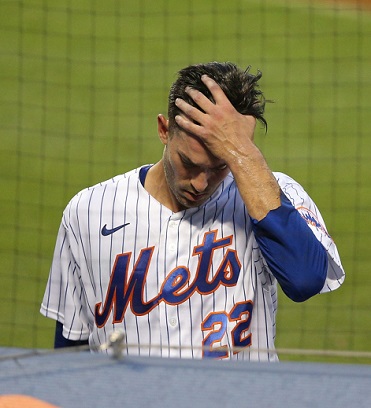
Tempered joy in Metsville

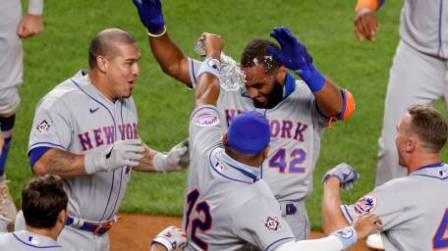
Amed Rosario (arms up) gets a hero’s welcome after his walkoff bomb finishes a doubleheader sweep of the Yankees Friday night. Crowning a pair of surreal days for these surreal Mets.

When hedge fund titan Steve Cohen first emerged as a potential buyer of the New York Mets, I had a little mad fun with that news because we have a couple of things in common. Not financially, of course; Cohen can hand out in tips about a million times what I’ll ever be required to pay in taxes. But we have our mutual grounds regardless.

We’re both Long Island boys who’ve been Met fans since the day they were born. We both made our baseball bones on the original troupe about which it’s fair to say they were baseball’s anticipation of Monty Python’s Flying Circus. We both grew up or (in my case) finished growing up (har har) in Long Island towns with pronounced Mob connections.

Cohen grew up in Great Neck, where there lives the opulent wedding/bar-mitzvah factory emporium (Leonard’s) at which Johnny Sack asked Tony Soprano to perform a hit, a request made just before Sack was carted back to prison from his daughter’s wedding. Bronx native though I am, I finished growing up (snort) in Long Beach, also the home of Don Vito Corleone in The Godfather.

Sorry, Mr. Cohen. My mob family’s Oscars can blow up your mob family’s Emmys.

But it looks at last as though Cohen will graduate from an eight percent stake to controlling ownership of the Mets, more or less as the last man standing. So that gives him more than one up, since the only piece of the Mets I own and can afford is a game hat.

Celebrity would-be buyers Alex Rodriguez, a former Yankee who actually grew up loving and hoping to play for the Mets one day (he actually had his chance, which either he or his then-agent blew like a ninth-inning Met lead), and his paramour Jennifer Lopez, pulled out of the bidding Friday. That may have been the first heavy sigh of relief from Met fans on the day.

Apparently, not even J-Rod could come up with quite the money needed to buy the Mets, whose incumbent Wilpon ownership has long enough been a two-man implosion machine. The J-Rod group would also have included one NFL owner (the Florida Panthers’ Vincent Viola), a BodyArmour founder (Michael Repole), and a WalMart e-Commerce U.S. wheel. (Chief executive officer Marc Lore.)

J-Rod said farwell to the bidding by observing they “submitted a fully funded offer at a record price for the team which was supported by binding debt commitments from JP Morgan and equity commitment letters from creditworthy partners.” The Athletic‘s Daniel Kaplan observes red flags:

[N]otable in the statement is a reference to debt and equity commitment letters from creditworthy partners. On the latter, equity commitment letters are different from money in the bank, and adding a lot of debt to a team that loses around $50 million per year, pre-COVID-19, is not a recipe upon which MLB may have looked fondly.

MLB isn’t “too keen on another [Derek] Jeter/Marlins where they had to scrape their last nickel to pay the purchase price,” a source close to MLB told The Athletic earlier this month, referring to the debt-heavy Marlins. “Especially for a major-market club that already has such large operating losses. Cohen’s checkbook is even more valuable in a COVID and post-COVID environment.”

Not that Kaplan missed red flags flying around Cohen himself, of course. Cohen’s former SAC Capital outfit copped to insider-trading charges and coughed up a record fine of $1.8 billion. Cohen himself wasn’t accused of wrongdoing, but in 2016 he had to agree to the Securities and Exchange Commission’s demand that he not manage the monies of outside investors for 24 months.

Just as problematic may be sex discrimination claims filed in Connecticut against Cohen’s Point72 Asset Management, which I noted myself during the week. Those don’t charge Cohen personally, but one filed in 2018 does, Kaplan writes, though he adds that later in 2018 “the parties voluntarily agreed to terminate the case and submit the case to arbitration, according to court filings.”

Buying an eight percent take in a major league franchise won’t place you under the proverbial microscope, but looking to become the controlling partner will. Baseball’s 23 other major league ownerships have to be edgy about welcoming to their often-dubious ranks a man whose history includes battles over financial crime and sex discrimination charges.

Fred Wilpon and his son, Jeff, haven’t been anywhere near such suspicions so far as anyone knows. They’ve been seen mostly as having been more dumb than dishonest regarding the Bernie Madoff scandal, in which they invested and took an extremely expensive bath. The same could be said for most of Madoff’s investors. But the fallout eventually amplified the Wilpons’ wounding flaws.

Their naivete about Madoff helped them leverage to make the notorious Bobby Bonilla deferred-compensation contract, compel them to pay a reported $29 million into the fund marked for compensating other Madoff victims, and force them “to borrow hundreds of millions more to cover debts they had made against their Madoff assets, [having] almost a major-league payroll’s worth of money due every year just in interest on those debts.”

In baseball terms, the Wilpons weren’t exactly geniuses, either. Before they bought out their original co-owner Nelson Doubleday, they tried to thwart a deal Doubleday wanted to make in the worst way possible. Lucky for them that wiser minds prevailed. That’s two wild cards, one pennant, and one World Series appearance—not to mention the post-9/11 shot heard ’round the world and a Mets hat atop his head—underwriting Mike Piazza’s Cooperstown plaque.

For every Piazza, Carlos Beltran, Carlos Delgado, Johan Santana, and Billy Wagner deal, the Wilpons blocked exponential other solid signings and tradings their baseball brain trusts recommended or signed off on deals and trades about which “dubious” could be considered a compliment.

When Cohen first stepped into the Mets’ controlling partnership picture last winter, I remembered the Wilpons also doing once what some thought could never be done. They made George Steinbrenner himself, the man who threw out the first manager of the year during the 1980s, resemble the epitome of benevolence, with their despicable 2008 execution of manager Willie Randolph, his pitching coach Rick Peterson, and his first base coach Tom Nieto.

The guillotines dropped on the trio after the struggling Mets traveled all the way west from New York to play the Los Angeles Angels in an interleague set and won the first of the set. At three in the morning. It must have been enough to make Randolph, a longtime Yankee fixture at second base, nostalgic for The Boss’s Malice in Wonderland fun house.

Red flags or no red flags, the news that J-Rod dropped out of the Mets’ bidding does indicate the Mets dodging at least one bullet, if what I noted during the week is true and Rodriguez was taking informal counsel from disgraced former Houston Astros general manager Jeff Luhnow. Taking baseball administration counsel from Luhnow is like seeking family counseling from Ma Barker.

The news may also have had an effect on the Mets otherwise.

On Thursday, the night before J-Rod pulled out of the Mets’ running, the Mets’ front office botched almost completely a stirring protest gesture against rogue police and racism, when the Mets and the Marlins observed a moment of silence on field before walking off the field postponing their game.

But come Friday, as MLB commemorated its pandemic-delayed Jackie Robinson Day, and—tragically—the actor (Chadwick Boseman) who played Robinson so powerfully in 42 lost his battle against colon cancer the same day, the Mets swept a doubleheader from the Yankees in the Bronx.

The sweep finished when Amed Rosario, pinch hitting for starting Mets shortstop Luis Guillorme, caught hold of a hanging slider from Yankee closer Aroldis Chapman with pinch-runner Billy Hamilton aboard and sent it into the left field seats. A Mets team who entered the twin bill as the Show’s worst for hitting with men in scoring position (.199) went 5-for-12 in that situation Friday.

Come Monday is the reported deadline for new Mets ownership bids. Joy in Metsville about the end of the Wilpon era is probably tempered by their wish that a saviour with cleaner hands might enter at the eleventh hour. Such a saviour will need five king’s ransoms to out-bid the Long Island boy who once paid for a single painting what the Mets will have paid stud pitcher Jacob deGrom for the entire length of his current contract.

The Mets have been many things in their 58-year life. Dull isn’t necessarily one of them.
Be careful what you wish for, Mess fans

Earlier this week, the worst you could say about the New York Mess (er, Mets) was a piece of doggerel I sketched to Prince’s “1999,” after a Miami Marlins baserunner stumbled, bumbled, and fumbled down the third base line—and still stole home:
Two thousand, 2020, party over—oops! Shame on you!
Tonight we’re gonna party like it’s 1962.

A Met fan since the day they were born can tell you that, compared to loving the Mets, it was easier for Mad Men‘s Don Draper (who kept a souvenir Mets pennant in his office) to be loved by his first and second wives, neither of whom found it simple and both of whom, their own flaws to one side, often felt like singing “19th Nervous Breakdown.

Draper was haunted by having been born and raised in abject hell, if “raised” is the proper word to describe a child treated like a home invader and handed an accidental chance to remake/remodel himself in a wartime accident that killed his field commander. The Mets weren’t quite born in hell, but they’ve been haunted by managements that often treated them like home invaders.

The Mets have been built, un-built, re-built, un-built, re-built again, and un-built again, more often than Orpheus rolled the stone up the mountain to be rolled back down. Today the Mets are on the sales floor. And the Wilpons, who have never been quite the same since they walked into Bernie Madoff’s pyramid trap and walked out fortunate that their heads weren’t removed from their shoulders, simply can’t go gently into that good gray night.

Thursday’s Twitterverse exploded with the news from ESPN’s Jeff Passan that Mets general manager Brodie Van Wagenen, a man seen in over his head when speaking politely of him, zapped commissioner Rob Manfred for the thought that the Mets and the Marlins might walk off the field tonight in protest, over the police shooting of African-American Jacob Blake, only to return to play an hour later.

Until he didn’t. Within less time than it once took for Mike (The Human Rain Delay) Hargrove to complete a plate appearance, Van Wagenen hustled a statement forth saying, whoops! The idea was really Jeff Wilpon’s, not Manfred’s, after Wilpon was informed the Mets’ players voted not to play tonight, a decision with which the Marlins apparently concurred. Van Wagenen concurrently apologised for the original Manfred remark.

What the Mets actually did was take the field, led by Dominic Smith and Billy Hamilton, two African-American Mets. The Marlins did likewise. Both teams observed 42 seconds of silence (the 42 refers, of course, to Jackie Robinson’s uniform number), then walked off the field. The idea was that of the Marlins’ Miguel Rojas. The game was postponed, just as three were on the same grounds Wednesday.

This after Los Angeles Dodgers pitcher Clayton Kershaw stood with his teammates standing together when Mookie Betts opted not to play Wednesday. Observing the negative backlash, Kershaw said, “Yes, I have seen those comments and that’s okay because I feel we’re doing the right thing.” Among other things were those backlashers accusing the Dodgers of standing up for a convicted child molester.

The now-paralyzed Blake isn’t a sterling citizen, of course, and he dealt with Kenosha, Wisconsin police last weekend in the first place over an arrest warrant involving a domestic dispute with his estranged girlfriend, with whom he has three children. The child molestation/child sex assault charges have been debunked. (Yes, you can look it up.)

A criminal suspect’s right not to be shot seven times in the back isn’t contingent on the crime he’s accused of committing. Jack Ruby wasn’t a cop but prying through a small crowd to shoot presidential assassin Lee Harvey Oswald to death didn’t make him any less a murderer.

And those police officers who succeed in performing their jobs without becoming the criminals they’re consecrated to apprehend must be grotesquely appalled whenever one of their breed commits if not succeeds at such attempted murder, knowing as they’re trained to know that absent a bona fide life-and-death moment they’re not sworn in to exercise absolute power of life and death.

Today’s clumsiness is just the latest in a bill of particulars a Met fan and others can lodge against the Wilpon ownership and its administrative subordinates while agreeing the sooner their ownership ends, the better. However, Met fans may well be advised to be very careful what they wish for.

Steve Cohen, who now has a small ownership stake in the Mets but would like to buy the team outright, seemed at first like the ideal choice having grown up a Met fan himself. But reports earlier this month imply that sexual discrimination charges filed recently against his Point72 Asset Management hedge fund firm would compromise him as the next Mets owner.

A team in the middle of a surrealistic enough truncated season in which the game’s players now speak and act on behalf of battling racism, discrimination, and the criminal element within law enforcement can’t afford to become the property of a man whose own company may have issues with discrimination.

But Alex Rodriguez (former Mariners/Rangers/Yankees star (however tainted) turned broadcaster) also aspires to own as big a stake in the Mets as he and his paramour Jennifer Lopez can buy. And Rodriguez is said “in touch” with suspended former Houston Astros general manager Jeff Luhnow, whose results uber alles mentality did too much to reduce the Astros from champions to pariahs.

Luhnow’s administration was exposed plausibly as lacking human decency to match its cold analytical inclinations, while fostering concurrently conditions that made possible the Astrogate illegal electronic sign-stealing scandal that stained the kings of the American League West (and 2017 world champions) until, possibly, the entire roster and organisation are turned over in due course.

The good news is that Rodriguez isn’t said to be thinking of Luhnow as his GM should he win his stake in the Mets, and Luhnow can’t be employed in baseball again until 2021, assuming anyone in baseball wants him. The bad news is that, if that’s who A-Rod leans upon for even informal counsel, be afraid, Mess fans. Be very afraid.

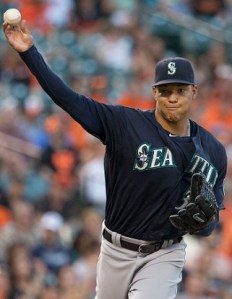
So why did the Mariners trade Walker?

If the Mariners traded Walker over his speaking out pro-protest postponement, they got some splainin’ to do.

Me and my big mouth. Well, keyboard.

Earlier today, writing about baseball game postponements in protest over the Jacob Blake police shooting, I referenced a 1968 trade involving pitcher Milt Pappas, who supported no games played during Robert F. Kennedy’s funeral. Pappas fumed when his Cincinnati Reds management may have strong-armed players into playing. In sort of a blink, he was then an Atlanta Brave.

That’ll teach me.

On Wednesday, when the Seattle Mariners and the San Diego Padres elected not to play, Mariners pitcher Taijuan Walker tweeted, “Glad to be apart of this organization and group of people!” Thank you for standing with us always!!” Come today, Thursday, Walker became a Buffalonto Blue Jay, traded for the proverbial player to be named later. He inprocesses with his new team Friday, when baseball is supposed to commemorate Jackie Robinson.

Pappas would never really know whether the Reds’ then general manager Bob Howsam told the truth when he insisted that 1968 trade was in the works before the Kennedy funeral issue. Walker at this writing may or may not really know soon, or even ever, if Marines general manager Jerry Dipoto had a deal in the works before the protest postponements, either.

In 1968, then-commissioner William D. (Spike) Eckert ordered no baseball to be played during Kennedy’s funeral. Washington’s notorious traffic issues delayed the procession, bumping the funeral to coincide with the start of the Reds’ scheduled game against the St. Louis Cardinals. Pappas supported not playing; the team voted 13-12 to play, possibly after pressure from Howsam and manager Dave Bristol. Three days later—Pappas was gone.

Major League Baseball’s official statement on the protest postponements said, “Given the pain in the communities of Wisconsin and beyond following the shooting of Jacob Blake, we respect the decisions of a number of players not to play tonight. Major League Baseball remains united for change in our society and we will be allies in the fight to end racism and injustice.” Walker tweeted his approval of his team’s protest postponement decision the same night they made it. One day later—gone.

If timing is everything, this timing looks more than a little out of time. It may not even pass the proverbial smell test.

Pappas, who died in 2016, was a white man born in Detroit of Greek parents. (His name at birth: Miltiades Stergios Papastergios.) Walker is a black man born in Shreveport, Louisiana; his father was black, his mother a Mexican-American woman who raised him alone. One dead pitcher and one living one can now hold hands as they say, plausibly enough, that baseball still has growing pains over intolerance not solely regarding a racial issue.

The game has never been entirely comfortable with players known to be outspoken on all sorts of matters. Once upon a time, the Chicago White Sox tried to compel the late pitcher/author Jim Brosnan to sign a contract enjoining him from writing for publication without prior team approval. The author of from-the-inside baseball classics The Long Season and Pennant Race elected to retire rather than allow the White Sox to decide what he could or couldn’t write.

When the then-Florida Marlins traded first baseman Carlos Delgado to the New York Mets after the 2005 season, Delgado—who’d sat in the dugout as a Blue Jay and a Marlin during seventh-inning-stretch playings of “God Bless America,” in protest the Iraq War and using his native Puerto Rico’s island of Vieques as a bombing practise spot—changed his protest tune, possibly under compulsion from the Mets’ front office.

“The Mets have a policy that everybody should stand for ‘God Bless America’,” Delgado said at the time, “and I will be there. I will not cause any distractions to the ballclub . . . Just call me Employee Number 21.” Said Mets chief operating officer Jeff Wilpon at the same time, “He’s going to have his own personal views, which he’s going to keep to himself.”

Delgado didn’t act during playings of “The Star Spangled Banner,” but on Wednesday Mets outfielder/first baseman/designated hitter Dominic Smith did. A young black man who’s a product of south central Los Angeles, Smith took a knee during the song’s pre-game playing to protest the Blake shooting.That contravened his stance in the George Floyd aftermath, when he said a knee wasn’t enough compared to teaching and learning.

There went that idea. Though his teammates had his back, too, refusing to criticise and some supporting him publicly (outfielder Michael Conforto in particular), Smith spoke for himself at a press conference. In tears. Asked by a reporter to describe the most difficult part of the past two months, Smith paused, then sighed, then said through a few sobs, “I think the most difficult part is to see people still don’t care . . . it just shows the hate in people’s hearts and, I mean, that just sucks.”

The Mets’ administration hasn’t said or done anything regarding Smith as I write. That can be considered good if we’re talking about dealing him out of town, post haste or otherwise, as the Mariners may or may not have dealt Walker over his comments. But that can be bad if we’re talking about whether Smith’s team above and beyond his clubhouse teammates will stand for his elementary right to speak his mind and heart.

I’ve said it before in these pages, but I’ll say it again: I have skin in the game of police lawlessness. I’m the paternal grandson of a New York police officer whom you could call both a true man’s man and yet one of the gentlest and most playful of men you’d ever meet in your life, especially with any and all of his eight grandchildren.

Grandpa Walter would have been as appalled at police officers behaving like the thugs they’re charged with apprehending as he would have been about people using police criminality as an excuse to break entire cities. If he’d been presented with the case for doing away with the “qualified immunity” that shields police officers from consequences for their crimes, I believe Grandpa would support its end, as I do.

But I think baseball fans and those who play and administer the game should want to know, for dead last certain, whether the Mariners traded Taijuan Walker—a serviceable, about-average major league pitcher—because it was an already-in-the-works trade on baseball grounds alone.

If they really did, they’re guilty perhaps of bad timing alone. If they didn’t, well, Lucy, they got some splainin’ to do. Did they deal Walker out of Dodge because the very thought that he spoke out proudly and unapologetically on behalf of his teammates postponing a game in protest of racism and police lawlessness offended them?

They stink the body electric

AlfredHitchcockMets

Some say this season came out of Stephen King. Others might think the Mets are Alfred Hitchcock Presents The Outer Limits of The Twilight Zone.

Dysfunctional organisations are about as alien to baseball as a pack of cigarettes rolled into a T-shirt sleeve once was to a 1950s greaser. But then there are the New York Mess—er, Mets—whose 58-year history has had several administrations that could give lessons in chaos to any given White House.

On Sunday, the Mets’ game against the Atlanta Braves had just gotten underway, seemingly, when a statement from the Mets hit the ground running like the Flash: Yoenis Cespedes, who’d homered for their only run in an Opening Day win against the same Braves, was AWOL.

As of game time, Yoenis Céspedes has not reported to the ballpark today. He did not reach out to management with any explanation for his absence. Our attempts to contact him have been unsuccessful.

In due course Sunday it transpired that Cespedes opted out of the rest of 2020. For COVID-19 reasons? For dwindling plate appearance opportunities as the Mets’ number one designated hitter this year? For both? Inquiring minds wanted to know and, seemingly, almost didn’t want to know, at the same time.

The only thing everyone in Mets Land and elsewhere seemed to agree with for long enough on Sunday was that Cespedes’s absence scared the Mets and their observers alike.

When Yoenis Cespedes didn’t show up today, the Mets sent security to his room,” tweeted ESPN writer Jeff Passan later Sunday afternoon. “They found it empty. He had taken his belongings, just up and left, and through his agent informed the team mid-game that he was opting out, according to Mets GM Brodie Van Wagenen.”

UPDATE: Yoenis Céspedes has decided not to play the remainder of the season for COVID-19 related reasons,” tweeted MLB.com writer Anthony DiComo around the same time as Passan’s tweet.

The Mets-inclined Twittersphere wavered between wondering whether Cespedes’s none-too-glittering stats since that opening day home run were one factor, whether Cespedes possibly losing interest was another factor, and whether the Mets not exactly burning up the league was a third. One or two even contemplated aloud whether the injuries that originally took Cespedes down and cost him all 2019 were legitimate after all.

Already rehabbing on his Florida ranch after surgery to remove calcification on both his heels, Cespedes suffered multiple ankle fractures last May when he hit a hole on his grounds—revealed in due course to have happened while tangling with a wild boar he tried releasing from a trap.

Sure it sounded absurd on the surface. Haven’t enough baseball players and other professional athletes gotten themselves injured in some of the craziest, most hare-brained ways? Yes, they have. They’re funny to everyone except the injured.

A Hall of Famer, George Brett, once suffered a toe fracture . . . because, on a day off, he was just that anxious to get back to the television set to watch his buddy Bill Buckner take a turn at bat and smashed the toe against a door jamb. Another Hall of Famer, Rickey (The Man of Steal) Henderson, fell asleep with an ice bag on his ankle and woke up with a nasty case of frostbite. In August.

Once upon a time, last year’s World Series MVP Stephen Strasburg might have had murder in his heart if you’d known he struggled through a rough outing after getting a little Icy Hot balm on his family jewels accidentally. His method of your execution would have depended on whether you serenaded him with a certain Jerry Lee Lewis oldie.

Cespedes fracturing both ankles in multiple places after a tangle with a wild boar is nothing in the absurdity department compared to those. And that’s without remembering that freshly-crowned Cy Young Award winner Jim Lonborg, of the 1967 “Cinderella Red Sox,” tore up the knee on his landing leg when he was or wasn’t chasing movie star Jill St. John down the ski slopes that winter.

Lonborg’s mishap compromised his pitching career; when he returned, he inadvertently altered his motion to go easy on the landing knee and caused himself shoulder issues for the rest of his pitching days. It also inspired adding the “Jim Lonborg Clause” to the universal players contract enabling teams to bar players from “dangerous” off-field activities.

Whether the Mets looked askance out of the public eye about Cespedes’ battle of the boar is anybody’s guess. But the New York Post‘s Mike Puma and Joel Sherman say that, twice during this truncated regular season’s first nine games, Cespedes complained that he may have been kept out of the lineup a few times the better to block him from reaching certain incentive bonuses.

One of those came Saturday, when Cespedes first talked to [manager] Luis Rojas and then [general manager] Brodie Van Wagenen about his playing status and bonuses. Then Cespedes knew before the buses left for Truist Park on Sunday he was not in the starting lineup and he never showed for the game against the Braves, triggering a bizarre day even for the Mets.

Cespedes might have been struggling since his Opening Day launch, but this wouldn’t exactly be the first time a team has tried playing cute with a player over performance bonuses. It probably won’t be the last, either. But it doesn’t often happen when the team’s general manager just so happens to be the player’s former agent, either.

That same Saturday just so happened to be the fifth anniversary of the day Cespedes first arrived in New York and flipped the switch all the way up on the Mets’ season turnaround, the turnaround that took them all the way to the World Series they lost—thanks mostly to the porous defense they finally couldn’t out-hit—to the Kansas City Royals.

Cespedes may be rolling glandular dice with his opt-out. He becomes an unrestricted free agent at season’s end. It’s difficult if not impossible to fathom him getting even the kind of money he agreed to take for this year, after he and the Mets negotiated it from $20 million down to six. Even the Mets’ apparent dysfunction doesn’t leave him with a great look now.

“There is no way to defend Cespedes on this, at all, if we are to believe multiple sources,” writes another Post columnist, Mike Vaccaro, “and on two levels: Not just using the COVID opt-out as cover—think about that one for a minute—but also, given how much of a fiasco his four-year contract . . . has been, that he would make this kind of stand over money.”

Fair play: Cespedes’s mother is ill and at-risk. He does have legitimate health concerns. He also did say goodbye to several Mets teammates Saturday night, but he told his agency, Roc Nation, about his decision, and either Cespedes or the Roc Nation group didn’t tell the Mets’ brass right away. Is that so Mets, or what?

This coronavirus-truncated and mishap of a season has already been described by yet another writer as something straight out of a particularly literary Red Sox fan named Stephen King. I’m more convinced it’s Alfred Hitchcock Presents . . . The Outer Limits of The Twilight Zone. With the Mets’ latest mess (or is that the Mess’s latest mets?) as the episode called “I Stink the Body Electric.”

Sunday, bloody Sunday

2020-07-27 RickPorcello

Rick Porcell wasn’t the only person in Citi Field smacking his head over Sunday’s carnage.

If the coronavirus doesn’t get the New York Mets, their pitching staff might based on Sunday’s lack of results. With apologies to Clark Griffith, Mets fans like home runs as much as the next fans, and—Jacob deGrom excepted—they seem to have assembled a pitching staff that is certain to please them.

Especially in the middle of the 14-1 massacre.

When Hunter Strickland, a relief pitcher who has surrendered a few significant launches in his past, is the first and only Mets pitcher to work an inning without surrendering anything more than a base hit that wasn’t cashed in one way or another by the Atlanta Braves, something is amiss.

Reviewing the Mets’ maiden season of 1962, Jimmy Breslin (in Can’t Anybody Here Play This Game?) ruefully observed, “For a Mets pitcher in 1962 only two things were certain. Either he was going to be hit for some of the longest home runs in baseball history, or he was going to have to stand helpless and watch his teammates make those amazing plays.”

Reviewing Sunday afternoon, any writer old enough to have seen the Original Mets is liable to write likewise. Except that Sunday’s Mets committed only one error through eight innings. They’re definitely not going to cut the mustard in Marvelous Marv Throneberry’s rumpus room at his Elysian Fields residence.

Four Braves hit for distance against the Mess Sunday, and they started that bombardment after the Mets already helped the Braves to a 7-1 score. The Braves started building that score on a pair of first-inning RBI singles and three RBI doubles in the third. The lone rude interruption was Brandon Nimmo doubling home Tomas Nido in the second. Why, the nerve of him.

The cardboard cutout of Jeff McNeil’s Alaskan malamute pup, Willow, was joined by cutouts of five more Mets doggie friends. Maybe manager Luis Rojas should have sent Willow and her friends out there to pitch.

Instead, he started Rick Porcello, the erstwhile Boston Red Sox pitcher and very erstwhile Cy Young Award winner. The good news: Porcello didn’t give up a single home run. The bad news: His afternoon only began with those back-to-back RBI singles, with two out in the first, escaping only when former now-you-see-him/now-you-don’t Met Matt Adams—who hit one of those RBI singles through that delicious open meadow created by an infield overshift—was thrown out trying to take third on the second of those.

Porcello shook off back-to-back one-out singles in the second by tricking Ronald Acuna, Jr. into dialing Area Code 5-4-3. Nimmo returned the favour in the bottom of the inning when he drove Atlanta starter Sean Newcomb’s 1-2 meatball to the back of left field to send home Nido, who’d walked with two outs.

Then, after McNeil mishandled a throw from short on Ozzie Albies’s inning-opening grounder, the third inning is where the fun really began. For the Braves. With one RBI double to left center by Marcell Ozuna and, a walk to Adams later, a two-run double to the same neighbourhood by Dansby Swanson on a meatier meatball.

Rojas finally decided Porcello was punished enough for punishing the Mets and brought in Corey Oswalt to relieve him. Remember, the three-batter minimum for all relief pitchers this season, which can prove dangerous if the reliever in question hasn’t got much to deliver. Oswalt didn’t. Except as far as the Braves were concerned.

Did the Mets have to find a young pitcher who was especially certain to please the home run lovers among their fans? Oswalt was making his twentieth major league appearance. When it ended at last, he could claim to have given fans eighteen major league home runs worth of pleasure.

Met fans would prefer that he’d hit them instead of served them.

He fought Austin Riley to a full count before walking him. He threw Endier Inciarte a canteloupe down the middle and Inciarte ripped it to the rear end of right field, sending Adams and Swanson home on poor Porcello’s dollar. That’s how Porcello’s box score ledger shows seven earned runs allowed and only six outs obtained. Oswalt isn’t likely to appear on Porcello’s Christmas list this coming winter.

Then Oswalt got three straight outs to escape further use, misuse, and abuse. But the poor young man was sent out to pitch the fourth. Just when it looked as though he’d escape Freddie Freeman’s leadoff double, with two outs and a full count on Swanson, he threw Swanson a sinker that rose instead of sinking. And Swanson sunk it over the right field fence. Unlike his teammate Adam Duvall on Saturday, Swanson’s bomb didn’t hit a single doggie cutout in the seats. Oh, well.

Same old song and dance in the Atlanta fifth. Almost. Again Oswalt had two outs and a man on second. Only this time it was two outs to open the inning and Acuna doubling to left. This time, Oswalt threw the canteloupe to Albies for the RBI double to the back end of right.

The worse news was that Oswalt seemed too anxious to get the worst of it over with in the top of the sixth. Ozuna must have sensed it, too, because he drove a 2-1 service over the left field fence to open the inning. Oswalt then got two swift outs that looked soon enough as though he were just dying to serve up the next cantaloupe, this time to Riley, who sent it likewise over the left field fence.

Rojas finally decided Oswalt had suffered enough for his sins and sent Paul Sewald out to pitch the top of the seventh. We may be using “pitch” facetiously here.

Sewald had William Contreras 1-2 when he served something just enough for Contreras to whack into right for a leadoff hit. He tricked Acuna into forcing Contreras out at second on a grounder to third. To which Albies said, “It’s not nice to trick Junior Nature,” driving a 3-1 fastball over the center field fence.

Sewald escaped with a ground out, a walk, and a swinging strikeout. The scoring ended on the day. The final two and a half innings must have seemed like simply trying to put the Mets out of their misery once and for all. You didn’t even have the heart to tell them they’d faced four Atlanta pitchers, gone 1-for-8 with runners in scoring position, and left ten men on base.

Nor did you have the heart to remind them that Newcomb was taken out of the game after three and a third innings, despite an eight-run lead, because he was actually erratic enough to start seven of his first nine batters faced with balls instead of strikes, threw only slightly more than half his 82 pitches for strikes, plunked two, and threw a wild pitch. Because it would have reminded the Mets that they had but one run to show for such generosity.

The Mets didn’t waste any time after the game sending Oswalt to their alternate training site in Brooklyn after he worked those four horrific innings to be saddled with the official loss. Far as Oswalt’s concerned, it just might be the sweetest relief he experienced all Sunday long. Might.

The word emerged when the game was just about over that, presumably for safety’s sake, the Mets planned to travel to Boston for an engagement with the Red Sox aboard six chartered buses. Outfielder Michael Conforto said lots of Mets planned to bring their XBoxes and/or PlayStations for lots of Call of Duty play.

They may miss things like team dinners or dinners among groups of teammates on the road, but better to be safe than sorry and, anyway, they’ll have lots of Call of Duty players to help ease the burden. Except that what they need most in Boston is lots of baseball players. On Sunday afternoon, they didn’t seem to have many.