NLCS Game Four: Shoh there!

Shohei Ohtani

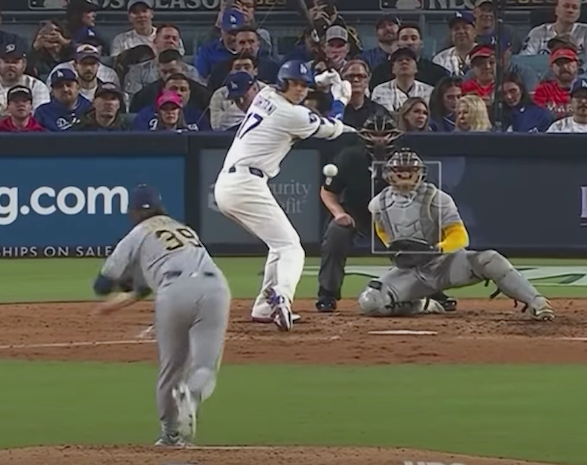
Shohei Ohtani is about to send his second of three NLCS Game Four bombs to somewhere approaching the Delta Quadrant . . .

Was this destiny, or the mere re-awakening of a sleeping giant? Had he gone 2-for-the-National League Championship Series entering Game Four only to set Dodger Stadium and the world up for a display any world’s fair including last century’s gaudy boondoggles in New York would have been proud to hoist?

Don’t ask. You’ll drive yourself mad trying to answer, becasuse any answer might be right and any might be wrong. Just remember that Shohei Ohtani did what he did to win Game Four on both sides of the ball.

On side one he was Bob Gibson without the glare and stare, throwing six innings of two-hit, ten-punchout, shutout ball, before he ran into a spot opening the seventh ticklish enough for Dodgers manager Dave Roberts to lift him with two on, nobody out, and Alex Vesia warm and good in the bullpen.

On side two, Ohtani was . . . oh, David Ortiz, Reggie Jackson, and Babe Ruth, all at once. If there’s such a thing as a postseason series sweep you could call dramatic, Ohtani made sure this one was it.

The vanquished Brewers who’d only managed to muster up a single run in each of the four games could do little enough other than watch and appreciate what was being made on their dollar. Even as they could only mourn that, whatever they were doing to keep Ohtani on his best behaviour prior to Game Four, it failed them miserably enough.

“We’re watching something we’ve never seen before,” said Dodgers manager Dave Roberts, who probably still couldn’t believe the manner in which his team’s ticket to the World Series was stamped Friday night. The scoreboard said 5-1, Dodgers. The margin was four runs; the Dodgers out-hit the Brewers by four. But . . .

There have been ouitlier pitchers who’ve hit home runs in postseason play. As Jayson Stark exhumes, only two starting pitchers have ever hit two postseason bombs in their whole careers: Hall of Famer Gibson (1964, 1968) and one-time Orioles co-ace Dave McNally (1966, 1974). And, “[s]eeing as how all pitchers not named Ohtani aren’t even allowed near a bat rack anymore, that’s a record that will never be broken,” Stark adds. “Unless Ohtani breaks it!”

Babe Ruth, you say? Well, now. Ruth pitched 166 games lifetime, including the postseason, and never hit two homers in any but one of those games, on 13 June 1921. He also recorded one measly strikeout that day. The Bambino hit three homers in a single postseason game twice, Game Four in the 1926 Wortld Series, and Game Four in the 1928 Series. Guess how many innings he didn’t pitch in either of those games.

It gets even more insane from there. How would you like to name all the pitchers who’ve hit more home runs at the plate in a game than what they allowed from the mound in the same game? Stark has named the two, Philadelphia’s Rick Wise (23 June 1971) throwing a no-hitter and Detroit’s Jesse Doyle (28 September 1925) in relief but hung with the loss despite getting eleven outs during his turn.

Yes, it’s very fair to say that Ohtani blasted those two right out of the running. What the hell, he began the blasting in the first inning. Top—he shook off a leadoff walk to Brewers second baseman Brice Turang to strike out the side. Then he led off at the plate in the bottom half, worked the count full against Brewers starter Jose Quintana, and hit one into the right field bleachers.

Two base hits and a strikeout later, Tommy Edman singled Mookie Betts home and Teoscar Hernández pushed a ground out to first that enabled Will Smith to score. As things turned out, that was really the only scoring the Dodgers needed on the night. These Brewers may have had the regular season’s best record and outlasted the wild-card Cubs in the division series, but they found themselves playing the futility flutes against the Dodgers’ big brass.

Bottom of the fourth, the count 3-1: Ohtani launched Brewers reliever Chad Patrick’s 3-1 offering to and past the rear end of the right center field bleachers. Speculation that the ball ended up making its way to the Hollywood Freeway wasn’t unreasonable.

“My reaction,” said Dodger president of baseball operations Andrew Friedman, “was just mouth agape. Trying to track it. Not seeing it come down. And saying: Did that one just leave the stadium?” All I could see was the ball flying over a Starlux Airlines sign and its roof section. Maybe it ended up somewhere in nearby Glendale, maybe in the back yard that once belonged to Hall of Fame manager/character Casey Stengel.

The sad part was that blast being the only real blemish against Patrick on the evening. He pitched four relief innings and kept all but one of the Dodgers from getting any cute ideas against him. If the Brewers now ponder the what-ifs if Patrick could have started, you can’t exactly say they’re wrong.

Bottom of the seventh, Trevor Megill relieving Patrick and striking Andy Pages out to open. Megill, who’d posted a 2.49 regular-season ERA and a .209 opponents’ batting average against him. Pitched respectably in the earlier rounds this postseason, too. Now he had Ohtani in the hole 1-2. The next launch had to settle for landing a few rows up the left field bleachers.

Well, what did you expect? You thought Ohtani would hit a third bomb into satellite orbit? The man’s only human, after all.

Here are the guys I feel sorry for other than the Brewers, who ran entirely out of fuel at the worst possible time after such a magnificent season: the Mariners. They finally fought back hard against the Blue Jays who’d threatened to sweep them away in their own Seattle playpen, en route an American League Championship Series fall.

Then, they had an eighth inning to remember Friday: Cal Raleigh leading off with a Game Five-tying home run; then, after back-to-back walks and a hit batsman, prodigal Eugenio Suaárez hitting an opposite-field grand slam four rows up the right field seats. Guaranteeing a Game Six back in Toronto, where they’d swept the Jays out of Games One and Two.

Cal who? Eugenio what? Not even their late-hour of power could erase the magnitude and the impact of the Shoh in Los Angeles.

Go ahead. Review every great single-game postseason performance. Then tell me if they were better than Friday night in Chavez Ravine. Tell me Reggie Jackson seeing only three pitches and hitting every one of them onto or near the el train behind Yankee Stadium in Game Six of the 1977 World Series was a better performance. Now, tell me how many innings he pitched at all in that game.

Tell me Don Larsen’s perfecto in the 1956 World Series and Roy Halladay’s no-no in the 2010 National League division series were better performances. Now, tell me how many home runs they also hit in those games.

I don’t remember Bill Mazeroski, Kirk Gibson, Joe Carter, David Ortiz, and David Freese pitching even in the bullpen in their Big Postseason Games. Nor do I remember Howard Ehmke, Carl Erskine, Sandy Koufax, or Moe Drabowsky dialing the Delta Quadrant at the plate during their postseason pitching virtuosities.

Bob Gibson punched out ten and hit one out in the decisive Game Seven of the 1967 World Series. He did the same thing in Game Four of the 1968 Series. In between was his seventeen-punchout jewel in Game One of the ’68 Series without hitting one into the seats. None of them equal 10+K/3 HR in the same game, either.

(Who the eff is Moe Drabowsky, you say? He the eff is the guy who relieved Dave McNally in Game One, 1966 World Series, and pitched 6.2 innings of spotless, eleven-strikeout, one-hit, shutout relief the rest of the way, launching the Orioles on their surprising sweep of the last-standing Koufax-Drysdale Dodgers. At the plate, alas, Drabowsky went 0-for-2 with a walk and a strikeout.)

I don’t want to leave either the Mariners or the Blue Jays hexed or vexed as they get ready to resume ALCS hostilities. But remember that the Dodgers won the first three NLCS games without Ohtani doing much at the plate. They’re dangerous enough without him. Friday night was a staggering reminder of how dangerous they are when he is on. Whomever wins the American League pennant has a lot of studying to do.
NLCS Game Five: A Mets blowout and a Dodgers gambit

Jack Flaherty

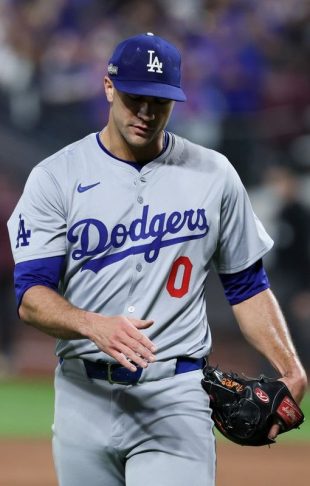
On a day he didn’t have it, Dodgers righthander Jack Flaherty had to take eight (runs in three innings) for the team while the Mets blew them out in NLCS Game Five, so as not to compromise manager Dave Roberts’ Game Six bullpen game plan.

If the Mets deliver what some still think is near impossible, and snatch the National League pennant right out from under the Dodgers, don’t be terribly shocked if the number one question on the lips of Dodger fans and others will be, “Why did Dave Roberts leave Jack Flaherty in to take a three-inning, eight-run beating in Game Five?”

The most likely answer—considering the Mets would go on to finish what they started and blow the Dodgers out 12-6, thus sparing their elimination for another day—is Game Six.

In a National League Championship Series during which each team has won its games by blowout, Game Five may yet secure a place among the least conscionably allowed pitcher abuse by any manager. Ever. Abuse nobody could have seen coming. Could they?

Hadn’t Flaherty, a comeback kid of sorts starting with the Tigers before his trade to the Dodgers at this year’s deadline, pinned the Mets with seven shutout innings in Game One en route the Dodgers finishing with a 9-0 opening thrashing?

Yes, he had. But in Game Five he didn’t have it. His fastball wasn’t terribly fast, his breaking balls could have been court-martialed for insubordination, and the Mets were only too willing to wait him out, wait for the balls coming into the meat of the strike zone or close enough, and pounce.

Now the 29-year-old righthander went from virtuoso extension of Dodger pitching’s consecutive scoreless inning streak this postseason to a piñata in five days. But Roberts didn’t want to reach into his bullpen unless he absolutely had to with a likely bullpen game looming for the Dodgers in Game Six.

Their starting pitching has been so compromised that bullpen games became necessary survival for them. Roberts is counting on his Game Six bullpen game to win the pennant for him. He knows these Mets aren’t quite pushovers, but he has to take the chance that, somehow, his bullpen bulls can help him win a pennant and save Walker Buehler to open a World Series.

The manager had better be right, because what the Mets did to Flaherty Friday could have been called human rights violations. They only began with surrendering a one-out, three-run homer to Pete Alonso in the bottom of the first.

Flaherty shook a leadoff double by Starling Marte off to get three straight second inning outs. But then came the third. Then came back-to-back walks (Alonso, Jesse Winker) to open. Then came Marte doubling into left field to send them both home. Two outs later, Marte came home on Francsco Alvarez’s single, Francisco Lindor tripled Alvarez home, and Brandon Nimmo singled Lindor home.

Leaving things 8-1 Mets—Kiké Hernandez scoring on David Peterson’s wild pitch in the top of the inning seemed almost an excuse-us run for a good while—and leaving Flaherty the fourth pitcher in postseason history to get himself torn for eight or more runs in a game  that would have meant a series clinch for his team. (The others: Hall of Famers Walter Johnson [Game Seven, 1925 World Series] and Tom Glavine [Game Six, 1992 NLCS], and Charles Nagy [Game Five, 1999 American League division series].)

On a day Dodgers center fielder Andy Pages homered twice (solo in the fourth, three-run bomb in the fifth), you could remove Flaherty’s eight-run bequest and the Dodgers would have won the game and clinched the pennant with a 6-4 tally. Flaherty didn’t look like his best self early enough, but this was as unconscionable as it could get.

Roberts even hinted postgame that Flaherty was dealing with a health issue. He didn’t specify what, and Flaherty hadn’t discussed it at this writing. He’s dealt with injuries enough in his career—repeated shoulder injuries, an oblique injury—which helped reduce him from a Cardinals super pitcher to a kind of journeyman who shows flashes of his old mound brio and pitches as much on heart as stuff.

That the Dodgers don’t need. Not after everything else bedeviling their starting pitchers this year.

The Mets, of course, are showing how easy it isn’t to kill them this time around. Even if their bullpen isn’t as strong or consistent as the Dodgers. Blow them out one day, get blown out by them the next. With the set returning to Los Angeles, the Mets face yet another arduous test, even if they do find ways to pick, peck, pounce, and pound the Dodgers’ Game Six bullpen parade.

That test, if they make it, is called Game Seven, in hostile territory.

But wouldn’t it be nice to see one or two NLCS games that won’t become blowouts? They’re fun when the team for whom you root does the blowing out, but a good hair raiser has its place as well. Just so long as the hair isn’t raised because of sloppy or shaky play.

NLCS Game Two: Knuke the Knack

Landon Knack, Mark Vientos

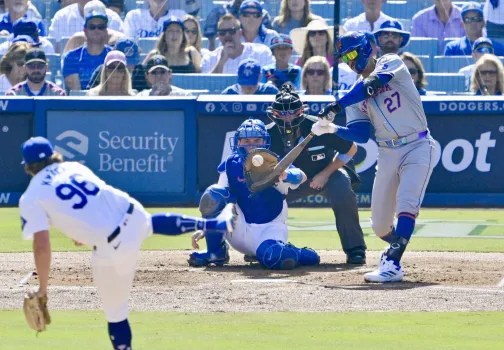
The wrestle between a Dodger reliever and a Met batter insulted by a bases-loading intentional walk ahead of him ends with Mark Vientos knuking the (Landon) Knack . . .

Let’s see. The Mets built a postseason rep for deploying serious weaponry when the games got late. But after a 9-0 blowout loss to the Dodgers in Game One of their National League Championship Series, the Mets struck early enough in Game Two. And, as things turned out, often enough, for a 7-3 series-evening Game Two win.

They struck first with one of their usual late-game demolition experts. This time, Mets shortstop Francisco Lindor wrestled Dodgers opener Ryan Brasier to an eighth pitch on a 2-2 count before sending that pitch into the right field bleachers to open the game. One inning later, with second and third, two outs, a second Met run home (RBI double), and rookie Landon Knack working the second for the Dodgers, they elected to put Lindor on to try their luck with Mark Vientos.

Said a broadcast announcer of Vientos: “As good as he’s been this year, nobody’s Lindor.” Said Vientos to himself, probably, knowing that he’s done damage enough for the Mets cause—he had a measly 1.674 with two home runs against the Phillies in the NLDS—Sure, he’s Francisco Freaking Lindor, but you’re gonna put him on thinking I’m a pushover for a third out? Boy, have I got a surprise for you, gentlemen.

It took Vientos a ninth pitch on a full count, but just like that he knuked the Knack.

Just like that, too, his blast over the center field fence had the Mets up 6-0, and they’d never really look back despite a Dodger run in the fifth and two in the sixth. Not on a night Mets starter Sean Manaea had the Dodgers stone frozen until Max Muncy punctured him for a fifth-inning solo bomb before he ran out of fuel in the sixth.

Two walks to open, a bases-loading fielding error at second base, and Manaea’s night was over. Mets manager Carlos Mendoza brought Phil Maton in to pitch. He got an almost immediate pop out from Will Smith. But he surrendered a two-run single to Tommy Edman, before getting Kiké Hernandez to dial Area Code 5-4-3 for the side and before any further Dodger damage.

The Mets tacked another insurance run on in the ninth with Starling Marte’s RBI single. But their bullpen held the Dodgers off admirably from the seventh forward. Even if Edwin Díaz had to channel his inner Craig Kimbrel in the Dodger ninth with a leadoff single (Andy Pages) and a walk (Shohei Ohtani) before striking the side out swinging to secure it.

All most of the Mets seemed to want to talk up, other than sending the NLCS to New York even-up, was Vientos leaving Dodger manager Dave Roberts with an omelette on his face.

“There’s one thing that Mark doesn’t lack,” chuckled Lindor himself, “and that’s confidence. That’s who he is. I’m glad he took it personal.”

“I didn’t think he was going to give me a fastball,” Vientos said of Knack, who’d fed him a diet of sliders four straight, two of which he let go and two of which he fouled off. “My approach was to see a heater up, but I wasn’t expecting heater. I thought I was going to get a slider and I was just going to poke it in the hole.” But he got the fastball at last. “Yeah, I wasn’t going to miss it,” he said.

The Dodgers did win a bullpen game in their division series conquest of the Padres. But that was before one of their key high leverage men, Alex Vesia, was lost for the rest of the postseason thanks to a side injury. And, before one of their others, veteran Daniel Hudson, let Roberts know he was still sore from a twenty-pitch eighth inning in Game One, available only if a dire emergency presented itself.

Roberts got three innings’ shutout relief from Brent Honeywell, Jr. and two innings’ one-run relief from Edgardo Henríquez Monday night. Second guessers might wonder why he didn’t turn to either of those instead of toward Knack, a 27-year-old rookie with a 3.83 strikeout-to-walk ratio on the regular season but a tendency toward surrendering the long ball, as in fourteen bombs in 69 innings.

Still, Roberts did manage to spare some of his other medium-to-high leverage for the New York leg, where the Mets and the Dodgers pick up after a day’s travel and rest. And, with three of those higher-leverage men, Blake Trienen, Michael Kopech, and Evan Phillips, all on four days rest. Considering the Dodgers’ starting rotation took such big hits this year they that have to think of bullpen games now, they may face another one in a Game Six if the game’s needed.

And, by then, the Mets may have figured enough out about working, hitting, pitching, and sneaking their ways around these Dodgers to make it irrelevant. May. They know the series isn’t won just yet. But they also have the home-field advantage now.

Maybe the Mets won’t get a shot at knuking the Knack again too soon, but don’t dismiss their home audience from their chances, either. Citi Field can make Dodger Stadium resemble a crypt when need be.

NLCS Game Seven: Don’t worry. Be happy.

Arizona Diamondbacks

The Snakes start the pennant party after Phillies pinch-hitter Jake Cave flied out to end NLCS Game Seven.

So this is what the World Series will hoist. One team who got there with a bang—or several. One team who got there with whispers, almost, belying the pre-strike warning of the reptile that gives them their name.

It’s not that the Diamondbacks really intended to get to the World Series on the quiet side. But if the Rangers bludgeoned their way to the Series with back-to-back demolitions of the Astros in Houston, the Diamondbacks pried their way to the Series with four wins that could be called cool, calm, collected by comparison.

“We were silent, and we made damage,” said their shortstop Geraldo Perdomo, after the Snakes more or less nudged the Phillies home for the winter with a 4-2 National League Championship Series Game Seven win. “Be happy and enjoy what you do. That’s all. That was the message.”

Go ahead. Cue that ancient Bobby McFerrin hit. Don’t worry. Be happy. It wouldn’t be the worst theme song you could attach to a pennant winner.

The biggest lead by which the Diamondbacks beat the Phillies this set was a four-game margin in Game Six in Philadelphia. They won the National League pennant Tuesday night with a win in which it was harder to determine which was more profound, a small pack of squandered Phillies chances or a thick enough pack of quiet Diamondbacks opportunity seizings.

It was almost as though the smiling Snakes snuck their way to the World Series in the end. From their first Game Seven run scoring on a soft grounder the Phillies couldn’t turn into an inning-ending double play in the first to three of the least noisy fly outs finisher Paul Sewald got the Phillies to hit to end it.

Come to think of it, it was as though the underestimated Arizona gang wasn’t even fazed when Phillies third baseman Alec Bohm hit Diamondbacks starter Brandon Pfaadt’s first pitch of the second inning into the left center field seats. Pfaadt certainly wasn’t. He got second baseman Bryson Stott to fly out to the center field track, then struck catcher J.T. Realmuto and right fielder Nick Castellanos out swinging to prove it.

Pfaadt only looked shaky two innings later, when Bohm wrung him for a one-out walk, and Stott doubled him home to give the Phillies what proved a very short-lived 2-1 lead. Realmuto followed with a line single to left sending Stott to third which brought Castellanos to the plate.

The guy who began looking like Mr. October during the Phillies’s division series dispatch of the Braves and continued when he homered during his first plate appearance of this NLCS had gone 0-for-21 entering this plate appearance. Pfaadt struck him out swinging. Then the righthander shook off a four-pitch walk to left fielder Brandon Marsh to strike spaghetti-bat center field sweeper Johan Rojas out on three pitches.

And again the Diamondbacks didn’t resemble a team of no-names whose postseason days were going to be numbered by Philadelphia’s comparative star power.

Third baseman Emmanuel Rivera started unfurling that evidence with a leadoff line single up the pipe in the top of the fifth. Shortstop Geraldo Perdomo bunted him to second, perhaps ill-advised considering the wasted out and second baseman Ketel Marte’s swinging strikeout to follow.

Enter Corbin Carroll, the rookie about whom it’s very fair to say the Diamondbacks world revolves these days. After scoring that first run in the first, and in the middle of a 3-for-4 night, Carroll shot a base hit into center to send Rivera home to re-tie the game and push Phillies starter Ranger Suárez out of it.

Then catcher Gabriel Moreno greeted reliever Jeff Hoffman with a base hit after Carroll stole second, enabling the rook to be run number three before Moreno was caught trying to stretch to second. Meanwhile, Carroll also spent his evening tying a postseason rookie record for hits in a winner-take-all contest.

Most teams run out of an inning when they could do more damage might go into mourning at that point. Not these Diamondbacks. Their reliever Joe (Be Fruitful and) Mantiply shook off Kyle Schwarber’s bottom of the fifth-opening double to get Phillies shortstop Trea Turner to ground out to third and Bryce Harper, the dangerous convert to first base, to fly out to the track in left.

That was enough to prompt Snakes manager Torey Lovullo to get Mantiply the hell out of there and bring Ryan Thompson in to lure Bohm into a pop out Marte caught at the back of the infield for the side.

You could almost hear the still-underestimated Diamondbacks—who swept their way to this set in the first place by pushing the Brewers out of the wild card series and the oh-so-superior Dodgers out of a division series—thinking, if not whispering, “We do this kind of stuff to them all through the pictures.”

Don’t worry. Be happy.

Two innings later, the Snakes delivered what proved to have been one of the least dramatic knockout punches of the entire postseason. After José Alvarado relieved Hoffman for the Phillies with one out, Perdomo singled to left and Marte doubled him to third—making Marte owner of the longest postseason-career-opening hitting streak at sixteen.

Up stepped Carroll. Proving he could do things the quiet way as well as any other way, he lofted a sacrifice fly to left for the fourth Diamondbacks run and the final run of the game. Don’t worry. Be happy.

Then came Zack Wheeler, the Phillies’s Game Five starter who pitched like an ace when they needed it most to take a 3-2 NLCS lead, to pitch an inning and a third’s spotless relief. During which Harper lost the grandest opportunity to overthrow the Diamondbacks for good when he batted in the bottom of the seventh.

Cristian Pache pinch hit for Rojas with one out and walked off Diamondbacks reliever Andrew Saalfrank. Schwarber worked out a full count walk. Exit Saalfrank, enter Kevin Ginkel for the Snakes, and Turner flied out to bring Harper to the plate. The guy who sent the Phillies to the World Series last year with that eighth-inning homer in the mud hit one out to center field this time, but with not enough to avoid landing in center fielder Alek Thomas’s glove for the side.

“Just missed it,” Harper lamented postgame. “Not being able to come through in that moment, just devastation for me. I feel like I let my team down and let the city of Philadelphia down, as well. That’s a moment I feel like I need to come through.”

He was hardly alone. These Phillies who’d bombed the Diamondbacks in a 10-0 Game Two blowout scored a grand total of four runs in three of their NLCS losses and went 1-for-7 with men in scoring position in Game Seven alone.

“I would say frustrated is the correct word,” said Castellanos, maybe slightly less for himself than for his team. “Just because the potential of this team is so much greater than going home before the World Series. Last year, when we lost Game Six, there was a lot of, ‘All right, we got here. Now we can build off that.’ Knowing how we feel about this team and coming up short from the year previous, it’s a disgusting feeling, honestly.”

When pinch hitter Jake Cave flied out to right against Sewald to end Game Seven, the Phillies may have been more voluminous in their self-criticisms than the Diamondbacks were celebrating their first pennant since 2001. And the clubhouse celebration has been described politely as mayhem, from drenching general manager Mike Hazen to first baseman Christian Walker passing out the cigars.

Don’t worry. Be happy.

It doesn’t mean you have to stay silent in the end. It also doesn’t mean the Snakes will count themselves out no matter how monstrous the Rangers might look. Maybe they figure that, if they could finally dismantle the big bad Phillie phloggers there’s no reason to fear the Texas wrecking crew. Yet.

“We were coming here to play our best baseball,” Lovullo said postgame about his and his team’s pre-game thinking, “and that’s been the messaging, and it’s been very consistent throughout the course of the year. Today is going to be our finest hour, and I just wanted to make sure that they knew that’s how I felt.”

“The Brewers were supposed to beat us,” Thompson said. “The Dodgers were supposed to beat us. The Phillies were supposed to beat us. They’re gonna say that the Rangers are supposed to beat us, too. We’ll see how it goes.” He could afford to be sanguine, since the Rays released him earlier this season but the Diamondbacks took a flyer and he rewarded them by becoming one of their key bullpen bulls.

And Lovullo could afford to be just a little self-congratulatory. Knowing that famed sports talking head Chris (Mad Dog) Russo swore to retire from radio if the Diamondbacks got to the World Series, Lovullo couldn’t resist. “I would love to see him quit if we won today,” the manager said before Game Seven began. “There’s nothing better than a wise guy New Yorker saying something and then having to chomp on those words.”

Except maybe a manager who shepherds the guys the world doubted to baseball’s biggest dance. Or, a team that finally doesn’t let the insane asylum known as a Citizen’s Bank Park crowd intimidate them out. Just don’t ask the Snakes to explain how they pulled it off. “I don’t even know if there is an explanation,” Carroll said. “It’s just magic.”

But you might ask Harper. “Watching them prior to this series, I don’t think anything scared that team,” he said graciously. “I don’t think they had any doubts in their minds of coming back here and playing in Philadelphia. I don’t think that team is scared of any situation or any spot.”

Don’t worry. Be happy.

If that’s what got the Diamondbacks to the forthcoming World Series, don’t knock it. Baseball has enough too-serious-for-their-own-good teams as it is. Just try to picture most of this postseason’s vanquished (the Phillies aren’t exactly a gang of mopes, after all) approaching things that Diamondbacks way. Not to mention a lot of the teams who couldn’t make the postseason in the first place.

They’d sooner toast each other with castor oil martinis than be caught thinking, Don’t worry. Be happy. And where are those guys now?

NLCS Game Five: All things small and big

Zack Wheeler

Zack Wheeler pitching almost spotlessly in NLCS Game Five did as much to save the Phillies season as their early running and mid-game bombing did.

Ask, and you shall receive. The Phillies asked Zack Wheeler to pitch like an ace in National League Championship Series Game Five—and he did. They asked their hitters to step up and swing when it mattered—and they did. They asked their bullpen to hold fort—and they did.

Their reward for doing those things was a handy 6-1 win in Chase Field and a trip back to Philadelphia with not one but two chances to punch their World Series tickets. The Phillies, of course, not to mention the throng liable to greet them in Citizens Bank Park come Monday, would prefer it not take that long.

All it took otherwise was for the Phillies to put Games Three and Four behind them, the ones in which their overtaxed bullpen let the Diamondbacks waste a grand start by Ranger Suárez in the former and their overtaxed bull Craig Kimbrel implode them toward a come-from-ahead loss in the latter.

Not to mention Kyle Schwarber starting the Game Five ball rolling in a way you don’t expect of the bombardier who showed up nuclear in the sixth inning, beating one into the ground to take a slow enough roll toward third, a region left open with the Diamondbacks in a slight shift toward second, that he beat out for a leadoff hit.

Not to mention Bryce Harper sending him to third with a one-out single shot right back up the pipe, Bryson Stott lining him home with a single. And, Harper coming home on a double steal while inadvertently colliding with a momentarily-stunned Diamondbacks catcher Gabriel Moreno as the throw from Snakes second baseman Ketel Marte to the plate went off it. It was the first time any Phillie stole home in any postseason.

Not to mention Wheeler and his Diamondbacks counterpart Zac Gallen engaging a pitcher’s duel that was noiseless, generally, until Schwarber opened the top of the sixth by turning Gallen’s 2-0 hanging breaking ball into a satellite flying over the Chase Field pool and several rows into the seats behind it. Giving Schwarber the all-time National League Championship Series home run lead with eleven.

Not to mention Harper, one out later, wrestling back from 1-2 into a full count before driving a fastball slightly over the middle of the zone and a little further into the same general real estate where Schwarber’s leadoff bomb landed.

Not to mention J.T. Realmuto abusing the Diamondbacks’ third reliever of the evening, Luis Frias, for a two-out two-run homer in the top of the eighth, which could have been considered repayment for Diamondbacks center fielder Alek Thomas—the hero of the Snakes’ Game Four win with his unlikely eighth-inning, game-tying two-run homer—hitting Wheeler’s first pitch of the seventh over the right center field fence for the only score of the evening for his team.

Not to mention the Phillies bullpen keeping the Diamondbacks off the board the final two innings despite a couple of dicey moments in the ninth, when Evan Longoria drew a two-out walk off Seranthony Domínguez and took second on defensive indifference before Perdomo landed on first after his bouncer hit Domínguez’s leg and deflected to shortstop.

Manager Rob Thomson reached for Matt Strahm. Strahm landed a swinging strikeout on Diamondbacks rookie Corbin Carroll to finish off. The Phillies reached for ways to express how it felt to shake off such a heartbreaker as the Game Four loss.

“I just want to win. That’s it,” said Harper, whose evening included a grand first inning play when he speared Diamondbacks DH Pavin Smith’s hard grounder lunging right and onto a knee before taking it to the pad himself. “Whatever that takes, whatever that’s going to be, whatever that’s going to look like. That was a big game for us. Coming in here and getting one is huge. That’s a good team over there. We took advantage of everything we could.”

Harper also tended Moreno at once after the double-steal collision, perhaps mindful that Perdomo has been under concussion watch before in his career and was caught in the head on a backswing during the D-Backs’s wild card set. “The way he went down,” Harper said postgame, “I was making sure he was good and stable.”

(Memo to: Social media idiots. It wasn’t a dirty play. Harper came straight down the base line without trying to collide with Moreno. Moreno moving from in front of the plate to reach for the throw crossed into Harper’s path, unintentionally but technically blocking the plate without the ball in his mitt, illegally, leaving Harper nowhere to go at that moment.)

The collision to one side, Realmuto seemed less impressed by his own home run than by the double steal that made Harper the second-oldest (at 31) ever to steal home in a postseason game. (Hall of Famer Jackie Robinson at 37 remains the oldest; he did it in the 1955 World Series.) “After what [the Snakes] did to us the last two games, they had all the momentum in the world,” the Phillies catcher said postgame. “So we had to try to do something early in the game to get it back. That was a great call by [Thomson] putting that on.”

The plot was simple. Stott would take off for second and draw Moreno’s throw while stopping just short of the pad. It looked like Stott getting himself caught in a rundown, but Marte winged his throw home almost immediately after Stott stopped with Harper, instructed to “be aggressive” by Phillies third base coach Dusty Wathan, gunning it home.

“It just shows you,” said Phillies shortstop Trea Turner, “how being aggressive and putting pressure on those guys — not just them but everybody in general, to put pressure on the other side is good and it makes things happen.” Make things happen? The Phillies opened by taking a page out of the Diamondbacks’ grinding book and shoving right back before even thinking about the long ball side of their own game.

For all the Phillies’s basepath daring and bomb launching, though, Wheeler had to have been the player of the game for them when all was said and done. “He gave us exactly what we needed with where our pen was at,” said Thomson. “It’s incredible what he does,” said Harper of Wheeler, who threw 21 first-pitch strikes facing 28 batters. “It’s so much fun to watch. I love playing behind him, and it’s incredible. He’s legit, man.”

Now it’ll be up to Aaron Nola to pick up in Game Six where Wheeler left off in Game Five. As for the rest of the Phillies? Who knows what surprises they might bring? Another double steal including a theft of the plate? Another evening of acrobat defense? Another bomb or three?

You almost hope the set goes the full distance, if only to give the Diamondbacks more chances to show the talent might overcome this edition’s general lack of postseason experience. They’re a young team with a lot of upside and a lot of dynamism in their own right. They showed they, too, can exploit mistakes or misfirings in pushing this NLCS to a two-all tie in the first place.

But if they want to hang around a little longer, they’ll have to find a way to beat the Phillies in the Phillies’ own playpen, where the audience never sleeps and the noise rarely lets up before the final out. The Phillies just won their first NLCS road game. Going home, however, means a lot more to them than just scoring a run.