Underhanded Counselling?

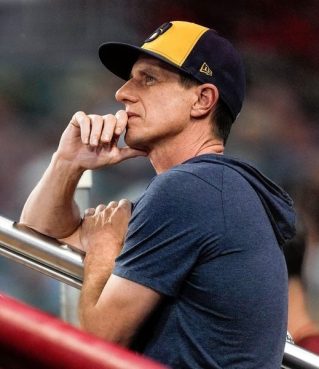
Craig Counsell

No, the Cubs did not poach Counsell from the Brewers. What they did to David Ross, however . . .

Would you blame David Ross if you discover he feels like the husband who was thrown over with little to no warning because the wife decided something better was available? OK, that’s not really a fair analogy. Grandpa Rossy is seven years younger than Craig Counsell. But considering the Cubs’ treatment, he might as well be seven years older.

But something isn’t passing the proverbial smell test about Counsell’s hiring and Ross’s firing.

First, let’s clear this one at once. The Cubs didn’t poach Counsell. Not from the Brewers or from anyone else. Counsell’s contract expired first. He didn’t exactly lack for interest once it became known he intended to test his own managerial market. But test it he did, as a proper free agent.

Now, that said, the manner in which the Ross firing and Counsell hiring were done was a weak look. Team president Jed Hoyer had a deal done with Counsell before flying to Ross’s Florida home to meet and execute Ross, the guy from whom Hoyer said he wasn’t really looking to move on. The headline on The Athletic‘s Patrick Mooney’s take said it with jarring simplicity: “David Ross’s downfall as Cubs manager? He isn’t Craig Counsell.”

Just like Rick Renteria wasn’t Joe Maddon. Just like, as things turned out, Maddon—on whom the Cubs “soured” almost too swiftly when they faded from World Series drought busters to also rans—wasn’t Ross, who’d been one of his more valuable role players for that almost surrealistic 2016 World Series run but received a front-office grooming for the bridge to follow after his retirement.

Maddon also proved not to be Counsell. It was Counsell’s Brewers who chased Maddon’s Cubs down in 2018, possibly putting Maddon onto a very warm seat the heat from which swelled a year later—when the Cubs fell from contention, had a chance to knock the Cardinals out of the races, but got swept by the Cardinals in Wrigley Field in their final home set of the year.

Hopefully, someone in the Cubs’ orbit has tipped Counsell to watch his back in case the Cubs’ administration decides, somewhere along the road, no matter what success that administration allows him to have, that he’s not whomever they’d like to romance and marry in due course.

Especially if, as they did with Ross, the Cubs announce he’s their guy in public only to romance a purported upgrade behind closed doors. Especially if they announce Counsell’s their guy despite a season being ended at the hands of Counsell’s now-former team. With the way the Cubs are administered, nothing’s impossible, including infamy.

This isn’t the single most suspicious fire-and-hire I’ve seen in a lifetime of baseball watching. Nothing compares to the shameful Yankee double switch of 1964. They canned an undermined Yogi Berra the day after the Cardinals beat his Yankees in the World Series. Then, they hired Johnny Keane, the skipper who’d just beaten him in that Series.

We learned only later that then-Yankee GM Ralph Houk had every intention of dumping Yogi after the season, no matter what, even backchanneling during the season to gauge Keane’s interest in the Yankee job, if the Cardinals were ready to let him go before their own pennant race comeback and triumph.

At least Ross didn’t get it the way the Mets once dumped an embattled Willie Randolph, either. Feeling fire under his hindquarters over the Mets’ blowing a seven-game National League East lead in September 2007, Randolph and his Mets opened 2008 34-35 and he was fired—after managing a doubleheader split in New York, then flying coast-to-coast to Anaheim to manage a win over the Angels, and getting fired . . . at 3:11 a.m.

As a manager, Ross was better than some, perhaps not as good as others. He earned his players’ trust even as the Cubs administration allowed a championship team to dissipate and a seeming team of also-rans to replace it. Yet he steered them deftly through the 2020 pan-damn-ic and into that surrealistic postseason. And his Cubs played hard in 2022, especially after the All-Star break, and despite the front office fire-selling at that year’s trade deadline.

In 2023, a Cubs team not supposed to compete competed. They pulled themselves to .500 by 27 July, then to 78-67 on 11 September. But from there they collapsed to going 5-12 to finish the season. They’d ended August taking two of three from Counsell’s Brewers but ended the season losing two of three to them.

Counsell’s NL Central-winning Brewers returned to first in the NL Central to stay on 3 August and probably secured it with a nine-game winning streak during that month’s second half, though going 8-4 to finish the regular season didn’t hurt. Then they got swept right out of the wild card series by the eventual NL pennant-winning Diamondbacks.

Except for pan-damn-ically short 2020, Counsell had only one losing season on the Brewers’ bridge. They reached nine postseasons and one National League Championship Series under his command. And Counsell earned respect for managing those runs despite the Brewers not exactly being or behaving like more than a small-market team.

When his contract with the Brewers expired, many were the speculative stories sending Counsell to a very different Mets organisation, under still-new ownership and now administered by the man who hired him in Milwaukee in the first place, David Stearns. Counsell built a reputation as a communicative players’ manager in tune with the game’s analytic side and in synch with the human side.
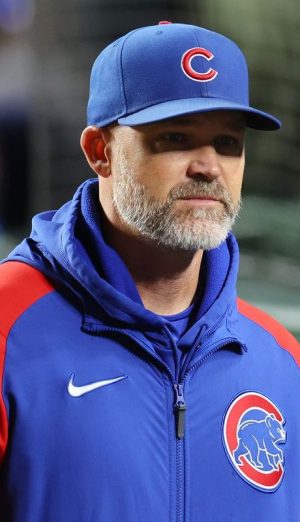
David Ross

So much for being “their guy” . . .

I saw some speculation that Counsell leveraged the apparent Mets interest in him to carve a large contract out of whomever might win his favour at all. But I also saw smarter observations that the Wisconsin-reared and rooted Counsell—the winningest manager in Brewers history—didn’t want to stray far from home in any job change.

He got what he wanted and more, the Cubs signing him for five years and $40 million to steer their Ricketty ship. That alone may do wonders on future markets for steadily successful managers who are usually expected to work for comparative peanuts and be bosses to players who could buy and sell them for the equivalent of a year’s worth of sales taxes.

The Cubs may not fall into big bidding wars for this winter’s free agency class, but they’re expected to be active enough to fortify a team that looked like a rising team often enough in 2023. Cub fans know only too well how swiftly expectations can turn, of course, but let’s leave it be for now.

I would repeat my earlier counsel to Counsell: watch your back—and not just from Brewers crowds ready to hammer you the first time you lead the Cubs to Milwaukee for a series. The next rising managerial star might turn Cub eyes toward him at the first sign of availability, too. And it may not matter whether or not you continue building a resume that might include managing the Cubs to another World Series title, either.

It took Ross—a World Series hero as a role player on the 2016 Cubs, who hit his final major league home run during that staggering Game Seven—several days to speak out about his execution. Telling Talahassee Democrat writer Jim Henry that anger is poison to him, Ross preferred gratitude:

There was a lot of people who worked really hard alongside me. … I am really thankful for the four years I got, coming from zero coaching experience to getting the chance to manage such a great organization that has impacted my life in a great way. There’s great people there. I really don’t have a whole lot negative to say, to be honest.

I get mad from time to time but I have a lot to be thankful for.

Few men and women pick up and dust off from their unexpected purgings with that kind of grace. The Cubs should consider themselves fortunate that Grandpa Rossy didn’t elect to stay away from future team commemorations as long as the incumbent ownership and administration is in place. As with the case of a certain Yankee legend, nobody might blame him if he did.
How to avenge an unwarranted plunk

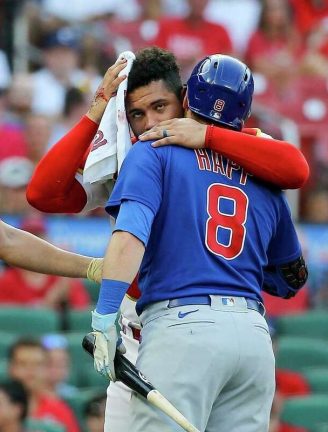
Willson Contreras, Ian Happ

Contreras and Happ embracing, after Happ’s backswing caught Contreras on the coconut, quite accidentally—which didn’t stop Cardinals starter Mike Mikolas from buzzing, then drilling Happ in wrongful retaliation Thursday.

Memo to: St. Louis Cardinals. Subject: The Backswing Bop.

Dear Cardinals: We don’t care how long, how deep, and how bristling is your ages-old rivalry with the Cubs. Nobody checks in at the plate looking to conk a catcher on the coconut with a backswing, no matter what kind of swing he has, long, short, whatever. And, no matter that the catcher is set up so far inside for an inside pitch that he might have been lucky if his head didn’t meet the batter’s lumber.

P.S. When your conked catcher and the batter in question—who happen to be former Cub teammates— hug on the catcher’s way off the field, right then and there you should take it to mean peace, and let’s play ball.

You do not want your starting pitcher taking the perverted law into his own hands going back to work by buzzing that batter upstairs before planting one squarely on his backside. Not if you want to keep your pitcher in there instead of seeing him thrown out of the game, turning things over to an unprepared bullpen that’s liable to get pried, pricked, pounded, and poked for ten runs over the eight and a third innings to come.

Unfortunately, that’s exactly what happened after Cardinals starter Miles Mikolas threw one up and in to Cubs left fielder Ian Happ, in the top of the first, making the count 3-1, before drilling Happ squarely in the top of his right rump roast on the next pitch. There were actually two things wrong with that drill.

Thing one: Mikoas was dead wrong to even think about sending “messages” to Happ and the Cubs at all. Happ wasn’t even close to trying with malice aforethought to catch Willson Contreras on the cranium with his backswing. Their hug as a cut and bleeding Contreras left the game told each other, I didn’t mean to hit you, dude. I know, dude. We’re good.

Thing two: Doing it with two out and resurgent Cody Bellinger on deck was an invitation to potential trouble of the kind having nothing to with machismo retaliation and everything to do with the scoreboard kind. The only kind the Cubs were willing to pursue.

It was also liable to produce exactly what it did produce immediately, Mikolas getting tossed from the game. To the none-too-subtle outrage of the Cardinals’ broadcast team who seem to believe accidents deserve assassination attempts in reply. Come on! You gotta be kidding me! You have got to be kidding me! Have a little feel for baseball. Have a little feel for the game. That’s awful.

What’s awful is a pitcher not seeing his catcher’s injury was unintentional and throwing twice straight at the batter, the second one hitting him. No “feel for the game” justifies throwing at a batter over a pure accident. What did Mikolas expect for playing that kind of enforcer? The Medal of Honour?

“[The umpires] had a meeting and decided to toss me,” a seemingly unrepentant Mikolas said postgame. “The umpires can believe what they want to believe. That was their choice. They believed there was intent there and that’s all umpires need.”

One pitch a little too far up and in, followed by the next pitch bounding off Happ’s posterior, was rather convincing evidence. So, exit Mikolas (and Cardinals manager Oliver Marmol); enter Dakota Hudson, who wasn’t going to get a lot of time to heat up because Mikolas didn’t leave the game on account of being injured.

Hudson promptly surrendered a base hit to Bellinger and walked Cubs right fielder Seiya Suzuki on five pitches before walking shortstop Dansby Swanson with the bases loaded and surrendering a ground-rule, two-run double to designated hitter Christopher Morel, before Cubs catcher Yan Gomes grounded out for the side.

The Cubs extorted three more runs out of Hudson before his day’s work was done, on a pair of third-inning RBI singles and a run-scoring fourth-inning forceout. Hudson’s relief, Andrew Suarez, was greeted rudely when Cubs center fielder Mike Tauchman planted a 2-2 fastball over the center field fence opening the top of the sixth, before a pair of one-out walks in the top of the seventh paved the way for Gomes to slash a two-run double.

During all that, the Cardinals had nothing much to say other than Contreras’s successor, Andrew Knizner, hitting Cubs starter Justin Steele’s first offering of the bottom of the fourth into the left field seats. Not until Knizner batted in the eighth with one out and Cardinals first base insertion Alec Burleson on second (leadoff double) and hit another one into those seats.

It made Knizner the first catcher to enter a game off the bench instead of in the starting lineup and hit a pair over the fences since . . . Cubs manager David Ross, as a Brave on 14 June 2009. “You don’t have much time get ready,” Knizner said postgame. “You just trust your instincts.”

The Cubs said, well, we’ll just see about that in the top of the ninth. Especially after late catching insertion Miguel Amayo was hit by a pitch before being forced at second to set up first and third, from which point Tauchman beat an infield hit out enabling Morel to score the tenth Cub run.

The 10-3 score held up, bringing the Cubs back to .500. They’d sent their own message back to the Cardinals. You want to drill one of ours because of an accidental shot in the head, we’re going to drill you the right way—with hits and runs.

Not even Mikolas (and, apparently, possibly-departing Cardinals pitcher Jack Flaherty) appearing to invite them to come out of their dugout for, ahem, a little chat, could sway them into anything but answering on the field, at the plate, on the mound.

Contreras’s wound was closed with special glue. “I feel good and I want to make sure I’m ready to go tomorrow,” he told reporters. “I wanted to stay in. It was bleeding really bad. It was bad for me because I wanted to stay in there.” Officially, he’s listed day-to-day at this writing.

Having now won eight of their last nine games, the suddenly-hot Cubs have not been without their problems thus far this season. Going back to nursery school with a willfully juvenile opposing pitcher wasn’t one of them.

The unforgiving wall

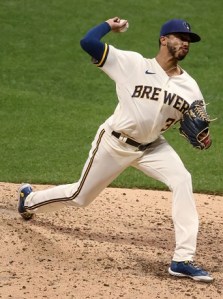
Devin Williams

Devin Williams—to err is human; to forgive is not the policy of a wall attacked by a flying fist.

Baseball is the thinking person’s sport. It requires acute intelligence and mental acuity as much as it requires certain physical skills to play well. For some of the thinking people who play the game, the problem becomes that their brains go to bed when the game is over.

Submitted for your consideration—Devin Williams. Righthanded relief pitcher for the Brewers. Celebrating with his teammates in a champagne soaked, happy noise in the clubhouse after clinching the National League Central title Sunday.

Somewhere after the team revelry, young Mr. Williams left the clubhouse, had a few drinks, and got mad at “something,” nobody seems yet to know just what, on his way home from the party. And he discovered the hard way what too many players of sensitive temperament, elevated frustration, and perhaps a sip of champagne too far must learn, and re-learn.

To err is human, to forgive is not the policy of a solid, inanimate wall.

Young Mr. Williams has been one of the better lights in the Brewers bullpen, for a team that relies on its pitching most of all for this season’s success. In one of the National League’s better bullpens, on one of the National League’s better pitching staffs, he’s arguably the second best relief pitcher in a Brewers uniform, the set-up ace behind designated closer Josh Hader.

He sports a 2.50 ERA, a 2.81 fielding-independent pitching rate, and a 14.5 strikeouts-per-nine-innings rate. His value becomes even more acute when you note that opposing hitters are hitting for a measly .186 average against him in 58 relief assignments this season to date.

But losing his temper for even a single moment leaves Mr. Williams with a broken pitching hand and the Brewers without his deeply needed setup relief services through the end of the National League Championship Series at minimum. Even healing in time for the World Series, should the Brewers get that far, isn’t guaranteed.

Whether or not at the urging or the pressure of team superiors, Mr. Williams met and addressed his Brewers teammates on Tuesday. He’s quoted as saying among other things, perhaps, ““I’m pretty upset with myself. There’s no one to blame but me. I feel like I’ve let my team down, our coaching staff, our fans, everyone. I know how important of a role I play on this team and a lot of people count on me.”

Whatever it was that upset him on the way home, you hope it was grave enough to understand in that moment why thoughts about his team, his role, and those who count upon him performing it might have escaped him while throwing a right cross at a wall that requires no effort to defend itself.

We try not to conceive that professional baseball teams must include lectures on the futility of punching non-living objects as a means to express frustration, rage, or sorrow. Of all the game’s storied, romantic, and multi-coloured history, baseball’s history of injuries upon such futile acts is involved enough, and embarrassing enough.

We present for your further consideration one John Tudor. Frustrated understandably at being slapped silly by the Royals in Game Seven, 1985 World Series, Mr. Tudor left the mound in the third inning. Wrought up in raging disappointment, he punched a moving electric fan.

His fortune in the season being almost over with time to heal was spoiled only by the press box figure who observed, knowing Mr. Tudor’s sometimes testy relations with the press, “Ahhh, the shit hit the fan!”

We present, too, even a Hall of Fame pitcher caught on the wrong side of frustration. It was one thing for Mr. Randy Johnson as a rookie to be sore after trying to stop a line drive back to the box with his bare pitching hand. It was something else to come out of the game at once, then punch the bat rack.

But the future Cooperstown immortal at least showed a degree of sense. If you must take swings at non-living objects, it’s best to do it with the hand that doesn’t earn your keep.

We know how often mortal people are angered by what’s on television. Meet Mr. Jason Isringhausen, relief pitcher. Once a star for the Athletics and the Cardinals, Mr. Isringhausen approaching the end of his fine career fumed after being hit for a three-run homer. Without knowing what on television might provoke him further, Mr. Isringhausen punched a TV set out. Knocking him out for a fifteen-day disabled list visit.

The foregoing three puglists at least took their swings out of specific baseball-related  frustration, rage, sorrow. For young Mr. Williams, however, the swing that ended his season and thwarted his postseason may yet prove to be the swing that helped swing his Brewers’ postseason potential foul.

Better to climb the wall than to punch your way through it. Lesson learned the hard way, reminding Mr. Williams . . .

Maddon era ends with a Cubs whimper

2019-09-29 JoeMaddon

Joe Maddon watches from the Busch Stadium visitors’ dugout on his final day as the Cubs’ skipper.

What was long enough presumed was made official Sunday. The Joe Maddon era in Chicago ended with the Cubs’ regular season finale, and a 9-0 loss to the National League Central-clinching Cardinals while they were at it.

The final decision came Friday, apparently, despite the Cubs taking one from the Cardinals to start the weekend, when Maddon and president Theo Epstein met over a bottle of wine, and Epstein affirmed there’d be no contract renewal.

And it may not be quite as simple as saying that, if only the Cubs could have played just  last weekend the way they handled the Cardinals the first two games this weekend, Maddon might have survived.

Getting swept by the Cardinals in the Cubs’ final season set at Wrigley Field last weekend merely finished breaking their backs for the year. They still had another week and weekend to play and, until they hit St. Louis Friday night, the Cubs still looked and played broken—and against the Pirates, yet.

But the plain truth is that the Cubs were broken long before last weekend. And the breakage wasn’t Maddon’s fault entirely or exclusively. Maybe ESPN’s Jesse Rogers said it best after Sunday’s news broke: “Maddon’s dismissal from the Cubs boils down to one sentence: He wasn’t able to outmanage the mistakes the front office saddled him with.”

That happens only too often and not exclusively with the Cubs. But it feels magnified anyway because the Cubs delivered in 2016 what was long presumed impossible. And enough people in Cub Country and elsewhere really thought it was the opening salvo for a dynasty-to-be.

The dynasty that isn’t hit their wall in their own venerable playpen at the end last year. They slip-slid into a National League Central tiebreaker with the Brewers and lost that game. Then settled for the NL wild card game against the Rockies and lost that one, too. Scoring a grand total of two runs in both games, 22 innings worth of baseball.

The Maddon era qualifies cumulatively as a raging success, but its finish qualifies as a raging flop. For two straight seasons Maddon presided over a team that didn’t achieve what their talent demanded. He wasn’t necessarily in a great position to continue the earlier success, but he wasn’t necessarily able any longer to call his team to account before trouble spots became chronic.

Enemy teams came to salivate, not shiver, at the prospect of Cubs on the bases—they led the National League in baserunning outs this year. The other guys had only to put the bat on the ball and often as not save their prayers—this year’s Cubs were the league’s most error-prone defense.

“When you make a lot of errors in the field, when you make a lot of errors in the baserunning, that’s momentum,” pitcher Cole Hamels told Rogers. “That’s an area that could get corrected. There’s still a lot of players in here that are still learning.”

Hamels could have been talking about accountability, too. This year’s Cubs seemed to lose that. Maddon’s isn’t an in-your-face style of leadership, but as Rogers notes it’s believed that even when he did call players in to account for their mishaps, mistakes, and misses, “he didn’t address matters strongly enough . . . or the message didn’t get through.”

It’s not easy being as well respected as Maddon is for keeping his sanity when everything and everyone else around you has search parties out trolling to retrieve theirs. Neither is it easy to discover your remarkably sane and becalmed manner in keeping your clubhouse on message and on task no longer keeps it either.

“[P]eople — players, coaches, general managers, fans, even writers — came to see it is possible to work your butt off and still be a reasonable human being,” wrote Yahoo! Sports‘s Tim Brown. “You can be the boss without being condescending. You can lose and find hope. You can win and recognize that’s about an inch from losing.”

You can even manage the Cubs out of the wilderness, back to the Promised Land for the first time since the Roosevelt Administration (Theodore’s), and keep them in contention for the two seasons to follow, and still keep your marble (singular) when everything around you dissipates.

Which is probably the best reason while Maddon may not remain unemployed for very long. The rumour radar seems to be trained on the Mets, the Phillies, and the Padres as prospective new employers. The Padres job is open since Andy Green was pinked last week; the Mets and Phillies jobs may be opening very shortly.

A rumoured-enough possible Maddon successor is David Ross, whose clubhouse leadership and work as Miguel Montero’s co-backup behind the plate was invaluable to that 2016 World Series conquest. Ross retired after that Series. Don’t think for a moment that the Cubs didn’t miss him in the clubhouse from that point forward.

That was another problem after the ’16 triumph. The Cubs’ most tangible clubhouse leadership came by way of imports from other teams: Ross, Miguel Montero, John Lackey, Jon Lester, Jason Heyward. Their homegrown core led by example enough mostly but didn’t develop, or didn’t feel comfortable developing, more direct and over influence.

Ross retired after the World Series conquest. And Montero blew his leadership cred when he a) complained publicly about losing ’16 postseason playing time to Willson Contreras and Ross behind the plate; and, b) blamed Jake Arrieta publicly for the June 2017 day the Nationals ran wild on the bases (seven attempts, seven thefts) against Montero’s arm.

The latter got Montero run out of town post haste. Lackey retired after the 2017 season. Lester really started showing his age this season. Heyward is still a plus defender but a minus hitter.

But nobody expected Albert Almora, Jr. to stop hitting, or David Bote to become a defensive liability, or Hamels to be injured, or Contreras and Kyle Schwarber running the bases like trucks with flat tires, or Kyle Hendricks developing a seeming allergy to winning on the road. (At home in ’19: 2.05 ERA; .206 batting average against; 0.87 walks/hits per inning pitched. On the road in ’19: 5.02 ERA; .290 BAA; .141 WHIP.)

Hendricks himself reflected a major Cub dilemna this year. At Wrigley Field, if you don’t count that final weekend’s implosion, the Cubs played like a world champion in the making. On the road, they played like the 1962 Mets without the laughs. They dealt with key injuries, of course, and in abundance enough—but so did the Yankees and the Astros, and those two were deep enough to keep on winning.

Which is why Epstein himself may have some splainin’ to do. He didn’t exactly retool the retooling-needy bullpen with solid bulls. He depleted the farm to win the ’16 Series and beyond. The Cubs haven’t drafted a single major league-quality pitcher under the Ricketts/Epstein regime; the scouts haven’t mined deeper for jewels. Their 2018 round one pick, Nico Hoerner, proved a pleasant surprise. His September callup turned into a presence in the Cubs’ 2020 scheme, almost unexpectedly.

More than just the manager may be different next year. Hamels is about to test the free agency market. So does trade deadline acquisition Nicholas Castellanos, whose torrid play after joining the Cubs was too far from enough to help. So does relief pitcher Steve Cishek.

Aging utility man Ben Zobrist—whose season was disrupted by a harsh divorce, harsh enough to prompt his leaving the team to tend his children through it—may or may not retire. And there may (underline that, gang) be trade winds blowing around Almora, Kris Bryant, Jose Quintana, and the should-have-been-purged Addison Russell, whose too-much-proven domestic violence embarrassed everyone around the Cubs.

Maybe, too, Epstein overshot when he said last winter he wouldn’t even think about extending Maddon (if at all) until after this season was done. If it made Maddon too lame a duck maybe that extended to the players. Nobody likes that coming unemployment is a given for the boss you happen to love.

So why not send that boss out with a bang instead of a whimper? If the Cubs couldn’t stay the course to the postseason, the least they could have done was finish what they started and try forcing the Cardinals into an NL Central tiebreaker.

No such luck. Cardinals pitcher Jack Flaherty could have thrown from a sitting position, maybe even in a deep leather sofa Sunday afternoon. The Cardinals buried the Cubs, 9-0. It seemed almost like a mercy killing. And even a Cub win wouldn’t have forced the tiebreaker, after all: the Rockies beat the Brewers in thirteen in Coors Field. On a walkoff wild pitch.

But it might have shown a little pride.

Things in Busch Stadium began quietly enough and within reason with an RBI single by Paul Goldschmidt and a run-scoring Area Code 6-4-3 dialed by Marcel Ozuna in the first. The quiet lasted just long enough for Dexter Fowler—another element in the Cubs’ 2016 triumph allowed to leave—to hit one into the left field seats with Flaherty himself aboard on a base hit in the second.

And the Cardinals didn’t wait for the Cubs to regroup in the third, either. Ozuna singled home Goldschmidt and, after Yadier Molina walked, Matt Carpenter sent one over the right center field fence. Then Goldschmidt continued the party with a one-out bomb in the fourth.

It got so bad that Maddon sent Zobrist out to pitch the eighth. But Maddon wasn’t trying to be cute, even if there’ll be those sourpusses who decide he’d just surrendered completely without even a whiff of a fight back. He really did want to give a little gift to his 2016 World Series MVP, a personal favourite from their days together in Tampa Bay.

Zobrist walked Fowler to lead off but got a prompt line out to right center from Tommy Edman before walking Goldschmidt. He got a pop out to second baseman (and former Cardinal) Daniel Descalso. Then, he struck Molina out on 2-2 for the side. Molina couldn’t resist a sly grin as he lingered a moment in the batter’s box. Zobrist enjoyed the moment thoroughly. (He can also brag, wink wink, about a 0.00 lifetime ERA if he wants.)

It was a pleasant gesture and a pleasant way to accept the gift. God and His servant Jolly Cholly Grimm only knew how often the Cubs’ regular relievers got torched with men on and two outs during the season. Maybe Zobrist’s unlikely ability to wiggle into and out of trouble gives the front office a hint about fixing that bullpen. Among other things.

What’s brewing out of Milwaukee?

2019-09-26 RyanBraun

Ryan Braun slammed the Brewers toward a postseason berth clinch Wednesday night.

This season’s been strange enough without picking out the unlikeliest feel-good stories of the year. You thought a season-long battle with the injured list making the Yankees actually seem lovable was strange enough? You thought slugging their way to the American League Central title makes the almost-unexpected Twins’ case?

Well, then, what do you think about the real feel-good story of the year? It’s out of Milwaukee, you know. It’s called Lose MVP, Make Postseason Anyway. And as of this morning it could start changing to Lose MVP, Take Division.

The Brewers are doing what lots of fans only wish their teams might have done. Everyone wants to see their teams rise from the dead. The Brewers are bloody well doing it. Just like they did last September. Except that this time around they looked a little worse for wear before the month began. And they won’t have Christian Yelich in service again until spring training.

Be real. A runaway success is well and good. For all intent and purpose, that was this year’s Astros, Braves, Dodgers, and even the Yankees. Jaw dropping as the Yankees’ endurance was despite their season being St. Elsewhere, Yankee Stadium, their organisational depth helped make sure the farthest behind the Yankees ever fell was five and a half games—on 18 April.

The Astros were probably baseball’s second-most injury-challenged team, maybe with the now also-ran Phillies right up there with them. But the Astros are made of a lot stronger stuff and are at least as deep as the Yankees. They’re liable to end up with baseball’s best regular season record, if the Yankees don’t. They were last seen near five games behind even earlier than the Yankees—on 3 April.

And with Mike Trout out of the picture since going down for the season over nerve surgery in his right foot, Alex Bregman—who’s been Trout’s only anywhere-near-viable competition for the prize this year—is liable to end up as the American League’s Most Valuable Player, with Justin Verlander the likely AL Cy Young Award winner. These Astros aren’t exactly sad sacks. They could even win this year’s World Series. Could.

So turn to the Brewers. Whose best player and team carrier got knocked out of the box literally on 10 September when he smashed his kneecap on his own foul off the plate. A knockout that had an awful lot of people, yours truly included, thinking the Brewers might have been knocked out right then and there. Even as they hung in anyway that day to beat the Marlins by a run.

They finished that day five games out in the NL Central and a game behind the Cubs for the same. They finished the same day a game behind the Cubs in the wild card standing. And with Yelich out of  the picture, for all manager Craig Counsell’s absence of fear for what’s outside or nowhere within reach of the box, it was too easy to wonder how soon, not whether the Brewers’ tickets home for the year would be punched.

Lots of teams take a refuse-to-lose posture when disaster strikes. But you can count on a single hand how many act like their posture then. The Brewers are 19-4 in September overall—but 12-2 since Yelich was lost.

And after jumping the Reds for six in the first en route a 9-2 win Wednesday night—Ryan Braun’s grand salami on the game’s 20th pitch was merely the opening blow—they had the pleasure of delivering knockout punches to two teams for the price of one: the Cubs, who’ve spent September imploding; and, the Mets, whose post-All Star pluck and jive turned out to be less pluck than jive, after all.

The Brewers are not going to get cocky and kid either you or themselves that this makes Yelich expendable. They may be insane, but they’re not that crazy. But they weren’t exactly a threshing machine before September, either: they entered the month three games over .500 after an August that proved their season’s worst month.

They opened September 2-2, winning once and losing once each to the Cubs and the Astros. And then . . . and then . . .

* They took three straight from the Cubs.

* They beat the Marlins two straight before and including the night Yelich kneecapped himself, then beat them two straight more.

* They took two out of three from the Cardinals and three out of four from the Padres.

* They swept the Pirates, whose internal dysfunction this season was the year’s saddest feel-bad story, and now sit on the threshold of sweeping Cincinnati.

Go ahead and say it. The Brewers fattened themselves this month the way the Mets did out of the All-Star break, on preponderantly weaker pickings. But just as the Mets had to figure ways to elude both a bullpen made of 95 percent arsonists and a moment-challenged manager, the Brewers had to overcome:

* An entire roster whose individual wins above replacement-level player this year didn’t even show a single other All-Star level player, never mind anyone within a hundred nautical miles of Yelich’s level. And that’s despite five Brewers hitting 20 home runs or more this season (including Yelich’s 44), two (Yelich and Mike Moustakas) hitting 35 or more as of this morning, and the team’s on-base percentage sitting fifth in the league (.329) as of this morning, too.

* A starting rotation with only one member (Brandon Woodruff) showing a fielding-independent pitching rate under 4.00. (Woodruff missed all of August and most of September on the injured list.)

* A bullpen showing only one member (closer Josh Hader) with an FIP and an ERA below 3.00, with the average FIP (among its regular bulls) otherwise being 4.46. (They might have had a second bull close enough to Hader if Corey Knebel didn’t miss the season following Tommy John surgery.)

Now the Brewers are fighting on two fronts. They have a clean shot at sneaking the NL Central title right out from under the Cardinals’ noses. Or, they might have, if the Cardinals got to finish the regular season against anyone other than the Cubs. The Cubs have imploded so severely that winning even one of the final three this weekend might require a clergyman to verify the miracle.

More realistically, the Brewers have home field in the wild card game at stake. If the season ended this instant, the game would be played in Washington. But if the Brewers could end up tying the Nats’ season record, the game would be played in Miller Park, since the Brewers beat the Nats in their season series 4-2.

And the Nats—who had to find ways to survive their own manager’s periodic tactical lapses and their own self-immolating bullpen—won’t have it easy. After they finish with the Phillies today, they get to end the season interleague and against the Indians, still in the postseason hunt despite waking up this morning a game and a half behind the Rays for the second AL wild card.

The Indians won’t make things easy for the Nats. If they could survive a sweep at the Mets’ hands in New York, which proved maybe the true last grand stand of the Mets’ season, and stay in the hunt since, they won’t go down without a battle to the Nats.

But stranger things have been known to happen, including the Brewers being this far in the first place. Maybe the Cubs find enough self pride to give the Cardinals a run for it this weekend. Maybe enough, assuming the Brewers spend the weekend in Coors Field reminding the Rockies (whom they haven’t seen since may) who they’re dealing with, to set up a possible NL Central tiebreaker game.

They’re not strangers to that circumstance. Just last year they forced a division tiebreaker with the Cubs and beat them to force the Cubs to the wild card game they lost to the Rockies. These Brewers don’t seem to fear anything yet. Which gives this year’s almost-as-feel-good Cardinals a little more incentive than just rivalry pride to keep the Cubs in their apparent place on the final weekend.

But don’t bet too heavily against the Brewers, anyway. A team that loses its MVP and carrier and continues the September binge they started with him is not a team who’s going to dry up and blow away upon command.