Bob Uecker, RIP: Always join them laughing

Bob Uecker

‘We’d like to inject you with hepatitis. We need to bring an infielder up.”—The words Bob Uecker put into 1964 Cardinals general manager Bing Devine’s mouth, during Uecker’s Hall of Fame speech.

The man who went from making people laugh with the way he played baseball to making them laugh with the ways he talked about the game and himself has gone home to the Elysian Fields. Their gains in laughter and inverted wisdom are our losses on this island earth.

“I’d set records that will never be equaled,” Bob Uecker told the Cooperstown gathering, as he was inducted into the Hall of Fame’s broadcasters’ wing, “ninety percent I hope are never printed: .200 lifetime batting average in the major leagues which tied me with another sports great averaging 200 or better for a ten-year period—Don Carter, one of our top bowlers.”

There was far, far more to the jovial former catcher than the “jussssssssssst a bit outside” call in Major League. Most of it came forth over decades of broadcasting the Milwaukee Brewers and more than a few evenings in the guest chair with Johnny Carson. A lot of it came forth when he spoke in Cooperstown that day.

Those who think just anyone can be funny could never say they’d left half a stage of Hall of Famers in tears from laughter, led by Willie Mays himself. For now I’m going to borrow some immortal words from Vin Scully: You really ought to hear and/or read it for yourself, so I’m just going to keep my pen to myself . . .

I signed a very modest $3,000 bonus with the Braves in Milwaukee, which I’m sure a lot of you know. And my old man didn’t have that kind of money to put out. But the Braves took it. I remember sitting around our kitchen table counting all this money, coins out of jars, and I’m telling my dad, ‘Forget this, I don’t want to play.’ He said, ‘No, you are going to play baseball. We are going to have you make some money, and we’re going to live real good.’ My dad had an accent, I want to be real authentic when I’m doing this thing.

So I signed. The signing took place at a very popular restaurant in Milwaukee. And I remember driving, and my dad’s all fired up and nervous, and I said, ‘Look, it will be over in a couple of minutes. Don’t be uptight.’ We pull in the parking lot, pull next to the Braves automobile, and my dad screwed up right away. He doesn’t have the window rolled up far enough and our tray falls off and all the food is on the floor. And from there on it was baseball.

Starting with the Braves in Milwaukee, St. Louis, where I won the World’s Championship for them in 1964, to the Philadelphia Phillies and back to the Braves in Atlanta, where I became Phil Niekro’s personal chaser. But during every player’s career there comes a time when you know that your services are no longer required, that you might be moving on. Traded, sold, released, whatever it may be. And having been with four clubs, I picked up a few of these tips.

I remember Gene Mauch doing things to me at Philadelphia. I’d be sitting there and he’d say, ‘Grab a bat and stop this rally.’ Send me up there without a bat and tell me to try for a walk. Look down at the first base coach for a sign and have him turn his back on you. But you know what? Things like that never bothered me. I’d set records that will never be equaled, ninety percent I hope are never printed: .200 lifetime batting average in the major leagues which tied me with another sports great averaging 200 or better for a ten-year period, Don Carter, one of our top bowlers.

In 1967 I set a major league record for passed balls, and I did that without playing every game. There was a game, as a matter of fact, during that year when [knuckleball specialist/Hall of Famer] Phil Niekro’s brother Joe and he were pitching against each other in Atlanta. Their parents were sitting right behind home plate. I saw their folks that day more than they did the whole weekend. But with people like Niekro, and this was another thing, I found the easy way out to catch a knuckleball. It was to wait until it stopped rolling and then pick it up.

There were a lot of things that aggravated me, too. My family is here today. My boys, my girls. My kids used to do things that aggravate me, too. I’d take them to the game and they’d want to come home with a different player. I remember one of my friends came to Atlanta to see me once. He came to the door, he says, ‘Does Bob Uecker live here?’ He says, ‘Yeah, bring him in.’ But my two boys are just like me. In their championship little league game, one of them struck out three times and the other one had an error that allowed the winning run to score. They lost the championship, and I couldn’t have been more proud. I remember the people as we walked through the parking lot throwing eggs and rotten stuff at our car. What a beautiful day.

You know, everybody remembers their first game in the major leagues. For me it was in Milwaukee. My hometown, born and raised there, and I can remember walking out on the field and Birdie Tebbetts was our manager at that time. And my family was there: my mother and dad, and all my relatives. And as I’m standing on the field, everybody’s pointing at me and waving and laughing, and I’m pointing back. And Birdie Tebbetts came up and asked me if I was nervous or uptight about the game. And I said, ‘I’m not. I’ve been waiting five years to get here. I’m ready to go.’

He said, ‘Well, we’re gonna start you today. I didn’t want to tell you earlier. I didn’t want you to get too fired up.’

I said, ‘Look, I’m ready to go.’

He said, ‘Well, great, you’re in there. And oh, by the by, the rest of us up here wear that supporter on the inside.’ That was the first game my folks walked out on, too.

But you know, of all of the things that I’ve done, this has always been number one, baseball. The commercials, the films, the television series, I could never wait for everything to get over to get back to baseball. I still, and this is not sour grapes by any means, still think I should have gone [into the Hall of Fame] as a player. Thank you very much. The proof is in the pudding.

No, this conglomeration of greats that are here today, a lot of them were teammates, but they won’t admit it. But they were. And a lot of them were players that worked in games that I called. They are wonderful friends, and always will be.

And, the 1964 World’s Championship team. The great Lou Brock. And I remember as we got down near World Series time, Bing Devine, who was the Cardinals’ general manager at that time, asked me if I would do him and the Cardinals, in general, a favor. And I said I would. And he said, ‘We’d like to inject you with hepatitis. We need to bring an infielder up.’ I said, ‘Would I be able to sit on the bench.’ He said, ‘Yes, we’ll build a plastic cubicle for you because it is an infectious disease.’ And I’ve got to tell you this. I have a photo at home, I turned a beautiful color yellow and with that Cardinal white uniform. I was knocked out. It was beautiful, wasn’t it, Lou? It was great.

Of course, any championship involves a World Series. The ring, the ceremony, the following season in St. Louis at old Busch Stadium. We were standing along the sideline. I was in the bullpen warming up the pitcher. And when they called my name for the ring, it’s something that you never ever forget. And when they threw it out into left field. I found it in the fifth inning, I think it was, Lou, wasn’t it? And once I spotted it in the grass man, I was on it. It was unbelievable.

But as these players have bats, gloves . . . I had a great shoe contract and glove contract with a company who paid me a lot of money never to be seen using their stuff. Bat orders . . . I would order a dozen bats and there were times they’d come back with handles at each end. You know, people have asked me a lot of times, because I didn’t hit a lot, we all know that, how long a dozen bats would last me? Depending on the weight and the model that I was using at that particular time I would say eight to ten cookouts.

I once ordered a dozen flame-treated bats, and they sent me a box of ashes, so I knew at that time things were moving on. But there are tips that you pick up when the Braves were going to release me. It is a tough time for a manager, for your family, for the player to be told that you’re never going to play the game again. And I can remember walking in the clubhouse that day, and Luman Harris, who was the Braves’ manager, came up to me and said there were no visitors allowed. So again, I knew I might be moving on.

Paul Richards was the general manager and told me the Braves wanted to make me a coach for the following season. And that I would be coaching second base. So again, gone. But that’s when the baseball career started as a broadcaster. I remember working first with Milo Hamilton and Ernie Johnson. And I was all fired up about that, too, until I found out that my portion of the broadcast was being used to jam Radio Free Europe . . .

Keep them laughing in the Elysian Fields, Mr. Ueck.

Who dares call it cheating?

When Gaylord Perry passed away as December began, there were almost inevitably those who snarked about his actual or reputed virtuosity with the illegal-since-1920 spitball—or, in his case, the grease, wax, petroleum jelly, or even oil ball. (Maybe even a lard ball, since Bobby Murcer once sent Perry a gallon of the stuff as a gift.) Who knew for dead last certain?
Show me someone outraged that such a cheater got to pitch 22 major league seasons, never mind go to the Hall of Fame, and I’ll show you one who still ROFL over this or that story of Perry’s subterfuge. Maybe he used one, some, or all those substances on his pitches. Maybe he merely planted enough suggestions to live rent-free in over half of baseball’s heads, at the plate and elsewhere.

But when further evidence is adduced that baseball’s government not only can’t but seemingly won’t settle on a consistently-manufactured ball, and doesn’t think anything’s untoward about sending certain livelier balls to be used for certain games—or even on behalf of certain milestones—the response is about the size and volume of a wounded amoeba.

Oh, they howled over pitchers trying to get a grip on inconsistently-covered balls with that good new-fashioned medicated goo. Will anyone howl likewise over the balls themselves having more than inconsistent covers . . . like inconsistent insides that impact the likely play of the game even more?

It’s almost a full week since Insider‘s Bradford William Davis, by way of astrophysicist and Society for American Baseball Research member Meredith Wills, Ph.D.’s research, revealed that MLB enabled baseballs of three differing weights for official game usage, even before commissioner Rob Manfred swore to God and His servants in the Elysian Fields that this, folks, is a one-ball season.

Players who noticed and were unamused by the differences were either waved away (Cy Young Award winner Justin Verlander, to name one) or all but ordered to sit down, shut the hell up, and be done with such nonsense. At minimum. When Giants outfielder Austin Slater wanted to collect balls for Wills to analyse, Slater was answered with a memo from the Major League Baseball Players association saying baseball’s government threatened to fire anyone sending aiding and abetting him. 

A year earlier, Davis disclosed Wills’s research revealing the 2021 season featured two balls of differing weights, not to mention the possibilities that a set between two tankers might get a lead ball while a set between two contenders or longtime rivals might get a Super Ball. This year, with the third ball apparently in play, a ball somewhere between 2021’s deader and livelier balls, MLB still can’t play ignorant and get away with it, though not for lack of trying.

“[W]e do know that the league keeps track of information that would permit it—if it wanted—to know which balls get used in each game,” Davis wrote last week. “According to two sources familiar with MLB’s ball shipment process, the league not only directs where its balls are sent, it also knows which boxes its game compliance monitors–league employees tasked with ensuring each team adheres to league rules–approve and use before each game starts.”

There’s a word for that kind of subterfuge. You know it. I know it. Few if any dare say it in this context, though they love to deploy it in others.

Assorted batsmen have been caught with or confessed to using doctored bats, usually but not exclusively corked. Albert Belle, Norm Cash (who copped to using a loaded bat winning the 1961 American League batting title), Wil Guerrero, Billy Hatcher, Amos Otis (another confessed scofflaw), Graig Nettles (master of the Super Mini-Ball stick), Chris Sabo, and Sammy Sosa were a few denounced with that word.

Assorted pitchers not named Gaylord Perry have been suspected powerfully or caught outright putting more on their pitches than their fingers. Some got laughs first: Lew Burdette (tobacco juice swamp next to the rubber, applicable when he bent over to adjust his shoelaces), Whitey Ford (late-career mud balls and ring balls, the latter balls cut on the rasp in his wedding ring), Mudcat Grant (soap balls, until he rubbed too much soap inside his gray road jersey and the sun finked on him), Joe Niekro (emery board balls), Don Sutton (sandpaper and other things, plus notes he left in his glove fingers for umpires frisking him: “You’re getting warmer, but it’s not in here”). Some avoided the laughs: Ross (Skuzz) Grimsley (greasy hair), Kevin Gross (sandpapered glove pocket), Michael Pineda (pine tar balls), Phil (The Vulture) Regan (sweat balls), Mike Scott (sandpaper). They all got denounced with the same word, too.

Assorted actual or alleged users of actual or alleged performance-enhancing substances, on both sides of the ball, didn’t get half the laughs drawn by the second-story men at the plate or the embezzlers of the mound. But such actual or alleged users—Sosa, Barry Bonds, Roger Clemens, Mark McGwire, Rafael Palmeiro, Manny Ramírez, Álex Rodríguez, others—did (and still do) get hammered with that word, too.

When teams set up off field-based sign-stealing operations—from buzzers underground (the 1899 Phillies) to telescopes behind the outfield (the 1951 Giants most notoriously), inside the scoreboards (the 1948 Indians, the 1961 Reds), and high behind the ballpark (the 1910s Philadelphia Athletics); from rifle scopes in the seats (the 1940 Tigers) to illegal real-time cameras feeding an extra clubhouse monitor next to which the pilfered intelligence is signaled to batters (the 2017-18 Astros)—they got denounced for that word. Even if only one got disciplined by baseball’s government while the predecessors got disciplined merely by history.

If those ex-cons real or alleged can be judged accordingly, why the hell can’t baseball’s government be judged likewise over the Three Ball Blues? Hitters altering bats and pitchers scuffing balls earn the verdict. Teams engaging off field-based electronic intelligence gathering earn it. Why can’t baseball’s own government and the official ball manufacturer it co-owns earn it for inconsistent manufacturing and seemingly willful, selective deployment?

Some dare call it what then-Commissioner A. Bartlett Giamatti denounced when he ruled that Gross’s appeal of his ten-game suspension wasn’t all that appealing:

Unlike acts of impulse or violence, intended at the moment to vent frustration or abuse another, acts of cheating are intended to alter the very conditions of play to favour one person. They are secretive, covert acts that strike at and seek to undermine the basic foundation of any contest declaring the winner—that all participants play under identical rules and conditions. Acts of cheating destroy that necessary foundation and thus strike at the essence of a contest. They destroy faith in the games’ integrity and fairness; if participants and spectators alike cannot assume integrity and fairness and proceed from there, the contest cannot in its essence exist . . . Cheating is contrary to the whole purpose of playing to determine a winner fairly and cannot be simply contained; if the game is to flourish and engage public confidence, cheating must be clearly condemned with an eye to expunging it.

Aaron Judge went to the plate last season unaware he’d be swinging at three different-consistency balls, unaware that he might have been given a little surreptitious assistance, en route breaking the American League’s single-season home run record. Now-retired Hall of Famer in waiting Albert Pujols went to the plate last season unaware he, too, might be swinging at differing balls, en route finishing his career with over 700 lifetime home runs.

They and everyone else at the plate last season deserved to know they were being pitched consistently made baseballs, not balls of differing makeup depending upon whom was at the plate reaching for which potential milestones. The pitchers who faced them deserved likewise to know going in that the games’ integrity was unimpeded, and to know that they or the other guys were just better, not that they were unknowingly throwing lead balls or Super Balls at any given time.

If you’re looking for denunciations of cheating toward the Manfred administration for its Three Ball Blues, from the same fans, observers, and chroniclers who would have and did scream bloody murder when confronted with actual or alleged cheating players and teams, save your energy for the time being. At this writing, their overall silence is louder than a heavy metal concert.

Three-ball blues

The Ball

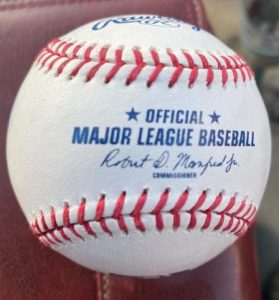
This is the baseball I landed during batting practise before Opening Day at Angel Stadium this year. (I gave it to my son who attended with me.) Who knew if it was juiced or drained?

Signing with the Mets for two years and $86 million was good with and for Justin Verlander. But it may not be the most important thing he did outside pitching the decisive World Series Game Six. The most important thing the future Hall of Famer did this year was buttonhole a baseball official before a game against the Yankees in June and demand, “When are you going to fix the [fornicatin’] baseballs?”

It’s not the first time he complained. In 2017, Verlander was just one of several who noticed and complained that balls used that postseason were a little too smooth for comfort. And it got worse instead of better. By 2021, Major League Baseball had two kinds of baseballs, one slightly heavier than the other, and thus containing a little more life than the other.

With a lot of help from Meredith Wills, an astrophysicist and baseball fan whose passion is examining the makeup of baseballs and who’s discovered the Show can’t get it straight or consistent, Insider exposed 2021’s two-ball tango. The Insider reporter who delivered Dr. Wills’s discoveries and alarms, Bradford William Davis, has now seen and raised: in 2022, baseball played its own version of “Three Ball Blues.”

That vintage blues song discussed pawn shops, the traditional sign for which is three golden balls. The lyrics include the old joke inside the pawn business: “It’s two to one, buddy, you don’t get your things out at all.” Baseball’s three-ball blues may mean it’s two to one on getting its integrity back after engaging its own kind of cheating—still inconsistent and often juiced balls.

Not necessarily in the final game scores. Davis and Wills suggest powerfully that baseball’s government wanted a little more oomph on behalf of a lot more hype, with certain events such as the Home Run Derby, the postseason, and maybe even Aaron Judge’s chasing and passing Roger Maris as the American League’s new single-season home run king.

Verlander was far from the only player to complain. Davis says Giants outfielder Austin Slater fell upon that 2021 Insider story, sought to collect balls to send Wills for analysis, and was ordered by “a top executive in the commissioner’s office” to back off.

“The warning,” Davis says, “sent in the form of text messages that Insider reviewed, came via a [Major League Baseball Players Association] official who was relaying the league executive’s displeasure.” Displeasure over what? Being caught red-handed delivering inconsistently-made baseballs about which the game’s own commissioner seems distinctly under-alarmed?

Rob Manfred told reporters before the All-Star Game that, yup, we had two balls in 2021, but it was the fault of a pandemic-times issue in Rawlings’s Costa Rica manufacturing plant: closues and supply chain issues, as Davis translates, meant MLB’s plan to stay with a new, lighter, deader ball was compromised when it had to “dip into a reserve stock of the older, heavier, livelier balls for some 2021 games.”

MLB claimed random distribution between the two 2021 balls. Davis’s 2021 reporting via Dr. Wills brought forth suspicions that MLB wasn’t just doing it randomly, that at times they were sending balls to certain places for certain series depending on what they thought might be the gate: say, a game between a pair of also-rans might get the deader ball but a game between a pair of big rivals or contenders might get the livelier ball.

Now Manfred told that July conference think nothing of it, we’ve got it knocked, we’re sticking to the deader ball, and every ball made for 2022 will be consistent. Not so fast, Dr. Wills discovered, according to Davis: “Major League Baseball did not settle into using a single, more consistent ball last season, Wills’ research suggests: the league used three.”

By the time Manfred made that statement in July, Wills had already found evidence that at least a handful of those older, livelier, “juiced” balls — the ones that the “new manufacturing process” purportedly replaced — were still in circulation. Though these juiced balls are from 2021 or earlier, according to manufacturing markings, they were in use in 2022; Insider obtained two of them from a June 5 Yankees match against the Tigers.

Over the next few months, Wills and Insider—with whom Wills exclusively shared her research—worked together to collect game balls for her to painstakingly deconstruct, weigh, and analyze. What she found was striking: In addition to that small number of older juiced balls and the newer dead balls, Wills found evidence that a third ball was being used at stadiums across the majors.

Davis says Wills’s data indicates production on the third ball began six months before Manfred promised 2022 as a single-ball season. “This new third ball’s weight,” Davis writes,

centers somewhere between the juiced ball the league phased out last season and the newly announced dead ball: It is, on average, about one-and-a-half grams lighter than the juiced ball and one gram heavier than the dead ball. According to the league’s own research, a heavier ball tends to have more pop off the bat, meaning the third ball would likely travel farther than a dead ball hit with equal force.

Aaron Judge

Aaron Judge had no clue whether he’d be pitched a dead, lead, or Super Ball while chasing Roger Maris this year.

Wills calls it “the Goldilocks ball: not too heavy, not too light—but just right.” But this isn’t the Three Bears we’re talking about here. This is about the possibility that hitters didn’t know going in when one hefty swing would send a ball over the fence but another such hefty swing with the same square, powerful contact might result in a sinking line drive, a dying quail, or a long out.

In other words, Judge—who’s just signed a nine-year/$360 million deal to remain a Yankee, after betting big on himself during his contract walk year—had no clue just what he was going to hit, and I don’t mean fastball, curve ball, slider, cutter, or sinker. Nobody knows for certain whether or how many such Goldilocks balls Judge sent into the Delta Quadrant. And that’s allowing for him being strong enough to hit a clump of seaweed into the second deck.

“But we do know,” Davis writes, “that the league keeps track of information that would permit it—if it wanted—to know which balls get used in each game. According to two sources familiar with MLB’s ball shipment process, the league not only directs where its balls are sent, it also knows which boxes its game compliance monitors–league employees tasked with ensuring each team adheres to league rules–approve and use before each game starts.”

Baseball government people were handed the net results of Dr. Wills’s reseach and all but waved it away with an all but run-along-girlie-you-bother-me statement:

The 2022 MLB season exclusively used a single ball utilizing the manufacturing process change announced prior to the 2021 season, and all baseballs were well within MLB’s specifications. Multiple independent scientific experts have found no evidence of different ball designs. To the contrary, the data show the expected normal manufacturing variation of a handmade natural product.

Rawlings itself, co-owned by MLB since 2018, issued a similar statement:

This research has no basis in fact. There was no ‘3rd ball’ manufactured and the ball manufactured prior to the 2021 process change was fully phased out following the 2021 season. All balls produced for the 2022 season utilized the previously announced process change.

While storage conditions during research can easily impact ball weight measurements, a one-gram difference in ball weight would be within normal process variation. We continue to produce the most consistent baseball in the world despite the variables associated with a handmade product of natural materials.

Davis demurs. “While lighter and less bouncy than the balls used before Rawlings switched up its manufacturing in 2021,” he writes, “the Goldilocks balls have a weight profile that makes them livelier and more batter-friendly than the dead balls that the league says it now uses exclusively.”

To which Manfred says, essentially, Integrity of the game? Shut up and get back to shortening the times of games without even thinking about cutting down the broadcast commercials. Any time Manfred comes up with something reasonable—the universal designated hitter, slightly larger bases, the advent of Robby the Umpbot—he comes up with or allows about five or more unreasonable things to counteract.

Differing baseballs aren’t just “unreasonable.” They strike at the very core (pun intended) of competition at least as profoundly as something like Astrogate did, on both sides of the ball. Pitchers who don’t know whether they’ll be given a grippable ball to pitch have just as much skin in this game as hitters who don’t know whether they’ll square up a dead, lead, or Super Ball.

The men who play the game, the fans who pay to see them play, the team builders  tasked with putting the teams on the field, and the managers who have to run the games and make the moves that mean distinction or disaster, deserve as level a field as possible.

The era of actual/alleged performance-enhancing substances was considered criminal for undermining the level playing field. Tanking teams are considered criminally negligent for providing something less than truly competitive product. Likewise, when it comes to honest competition, inconsistently-made baseballs should be considered weapons of mash  destruction.

The sounds of silence, ushered in by a lie

MLB lockout

Today was supposed to see pitchers and catchers reporting to start spring training. There went that idea, thanks to the owners and their Pinocchio. (CBS Sports photo.)

Say what you will about the Major League Baseball Players Association, but they haven’t pleaded poverty yet at all, never mind with the thought that they could say it without their noses growing. On the day pitchers and catchers would have reported to spring training but for the owners’ lockout, a five-day old lie by commissioner Rob Manfred still rattles through baseball’s sounds of silence.

George Burns once said of his logically illogical wife Gracie Allen, “All I had to do was ask, ‘Gracie, how’s your brother,’ and she talked for 38 years.” All you have to do is ask a question, and Manfred will talk out of so many corners of his mouth you’ll suspect it resembles a martial arts throwing star, while his nose grows long enough to cross the Verrazano Narrows Bridge.

Last Thursday, as an owners meeting concluded, somebody asked Manfred whether owning a baseball team was a sound investment. All Commissioner Pinocchio had to do was speak what’s not exactly a badly kept secret. He chose to play the poverty card, as the owners often enough have done during baseball labour disputes. This time, however, the joker in the deck isn’t very funny

“If you look at the purchase price of franchises,” Manfred began, citing what he’d been told by investment bankers without identifying just whom, “the cash that’s put in during the period of ownership and then what they’ve sold for, historically, the return on those investments is below what you’d get in the stock market, what you’d expect to get in the stock market, with a lot more risk.”

Hello, darkness, my old friend.

Commissioner Pinocchio knows very well that baseball franchises, even those mired out of the races and even those accused plausibly of tanking, increase in value as investments up to ten percent annually. Yahoo! Sports writer Hannah Keyser wasn’t going to let him get away with that kind of lie.

“Let’s get something out of the way: The owners cried poor during the negotiations to start the pandemic-suspended season in 2020 to justify demands that the players take a pay cut,” Keyser began.

And although the owners have been quieter about it during the current collective bargaining negotiations, the implicit entrenched position is the same — on the broadest scale, they don’t want to make all the economic concessions that the union is asking for and one of the reasons they’re citing is that they can scarcely afford it.

That’s why Manfred said what he did. It’s not that he’s stupid (he’s just hoping you are) or confused. It’s strategic. To concede on the record that the current economic system is working fabulously for owners—and increasingly so in recent years—would be chum to a union that’s angry, energized and determined to push the pendulum in the other direction.

Baseball and other sports teams’ owners, according to ProPublica, whom Keyser cited, and who managed to get IRS records to probe, “frequently report incomes for their teams that are millions below their real-world earnings, according to the tax records, previously leaked team financial records, and interviews with experts.” Tax code provisions and creative amortization use, Keyser noted, “allows owners to negate gains or claim losses, substantially reducing their tax obligations and saving them millions of dollars.”

If you still believe baseball’s owners are really going broke, that Antarctican beach club for sale is now a couple of hundred thousand less expensive. They want to continue playing the poverty card despite it being about as legitimate as Astrogate? Here’s what the players should say in return: nothing. Not one proposal, not one further concession, not even a syllable, until the owners open their books completely, honestly, and without further smoke blowing, sand throwing, or shuck jiving.

It wasn’t the players who elected to strike over the owners’ three-card monte games this time. There wasn’t any legitimate reason for the owners to lock the players out after the CBA expired instead of letting the game carry forth while they sat down to honest negotiations.

Fair play: the players aren’t exactly without dubious issues. Their proposal for a mere twelve-team postseason instead of the owners’ reputed push for a fourteen-team postseason is still an idea whose time should be put out of its misery. The already-expanded postseason has diluted championship meaning and created saturation to the point where the World Series becomes a burden to watch for too many fans, not the penultimate baseball pleasure.

The seeming sounds of silence thus far on Manfred’s shameful insistence that minor league spring campers remain unpaid because the “life skills” they gain is more important than earning their keep is deafening.

So are the continuing sounds of silence on redressing what their late union leader Michael Weiner only began to redress, the now-525 pre-1980, short-career major leaguers denied pensions in the 1980 re-alignment. Weiner plus then-commissioner Bud Selig gained those players $625 per 43 games’ major league roster time, up to $10,000 a year, in 2011.

The bad news further is that they can’t pass those monies on to their families should they pass away before collecting their final such dollars. Nor did they receive any cost-of-living adjustment in the last CBA. No less than Marvin Miller himself subsequently said the 1980 pension freeze-out for them was his biggest regret. Weiner at least began a proper redress.

But when Commissioner Pinocchio and his employers the owners look you in the eye and claim owning a baseball team isn’t profitable, you should be very tempted to demand polygraphs, if not sobriety tests.

“Do you know how else I know Manfred isn’t telling the truth?” Keyser asks, before answering. “Because if he were, he wouldn’t be a very good commissioner. If it was true, he would be failing in his de facto fiduciary duty to the owners. Say what you will about Bud Selig, but under his commissionership, team valuations skyrocketed. He made being a baseball owner into a very lucrative proposition. So Manfred is saying that during his reign, that has ceased to be the case. Or he’s lying.”

Once upon a time, a Brooklyn Dodgers pitcher caught by his wife en flagrante with a woman other than said wife ran down the stairs, pointed upward to where he’d been caught, and said, “It wasn’t me!” It’s not exactly unrealistic to suggest the owners and their wooden puppet are that kind of honest.

Death threats be not proud, continued

Don Denkinger

MLB umpire Don Denkinger needed FBI protection after threats on his life over his 1985 World Series mishap. In the social media era, it wouldn’t take just radio people blasting his address and phone number around the world for further such threats.

What does it tell you, when almost the first thing on the mind of a professional athlete who loses a contest isn’t what a tough loss it was but how many death wishes or death threats are liable to show up in his or her direction on social media? It ought to tell you how brain damaged too many sports fans are.

Shelby Rogers got waxed in straight sets by Britain’s Emma Raducanu in round four of tennis’s U.S. Open Monday afternoon. The 28-year-old told a press conference after the match she expected “nine million” social media death threats afterward. That’d teach her to draw the spotlight after she flattened number one-ranked Ashleigh Barry in the third round.

“Obviously we appreciate the spotlight in those moments,” Rogers told the conference, “but then you have [losing to Raducanu] today and I’m going to have nine million death threats and whatnot. It’s very much polarizing, one extreme to the other very quickly.”

She wasn’t alone. Former Open winner Sloane Stephens lost this time, Angelique Kerber beating her in three sets after she took the first set. Stephens says her Instagram account was flooded with a few thousand abusive messages some of which went from mere swearing and racial insults (she is black) to downright threats of death and sexual abuse.

“This isn’t talked about enough,” Stephens posted, “but it really freaking sucks.”

It really freaking should be talked about more than enough. I’ve done it. I don’t want to minimise what Rogers and Stephens now deal with, but baseball and other sports people have put up with that kind of vile nonsense for decades. Just not so instantly as today.

Long before there was such a thing as social media, hapless umpire Don Denkinger found himself on the wrong end of a harassment campaign after his blown call in the ninth inning of 1985 World Series Game Six helped cost the Cardinals a win they should have been two, not three outs from consummating.

Back then, about the worst that could happen beyond snarky newspaper columns was a radio disc jockey obtaining and airing your home address and telephone number. Two St. Louis disc jockeys did just that to Denkinger. He received death threats by mail for a couple of years to follow and, at one point, needed MLB to ask the FBI for help.

The fact that the Cardinals still had three defensive outs to play to nail that Series, or still had a seventh game to play if they lost Game Six, escaped the slime contingent. Denkinger being rotated to calling balls and strikes for Game Seven didn’t mean the Cardinals should implode in that game escaped them, too.

At least Denkinger waited until after that Series for the full brunt of his mishap to happen. Phillies reliever Mitch Williams had no such fortune in the 1993 Series. Thanks to a few death threats from enough indignant Phillies fans, the hyperactive lefthander spent a sleepless night or two with a shotgun in his lap after blowing a Series save . . . in Game Four.

Williams went on to throw the pitch Joe Carter belted to win that Series in the bottom of the ninth in Game Six, of course. His stand-up post-game performance may have saved his life otherwise. But he shouldn’t have had to spend a night cradling his weapon instead of his wife.

I’ve said it until I’m blue in the keyboard. Don’t ask what would have happened if Denkinger, Williams, and members of the long, sad roll of sports “goats”—the Bill Buckners, Ralph Brancas, Gary Andersons, Roberto Baggios, Wrong-Way Marshalls, Fred Merkles, and Andres Escobars—had had their moments of horror in the social media era.

Horror, or death: Colombia’s goalkeeper Escobars inadvertently put the ball into his own net in soccer’s 1994 World Cup tournament. That night, he was out with friends when a car pulled up, an argument broke out, and he was shot to death.

Denkinger at least had FBI help until the idiocy passed. What defense or protection do you have against social media, even if you leave it? Rogers says she doesn’t like social media but she’s forced to make a presence there because of her sport’s marketing. Maybe her sport and all sports need to re-think that a little.

Mets relief pitcher Edwin Diaz walked himself into trouble and a Mets loss in Washington Monday. All that did was throttle the Mets’ pennant race recovery a little. It didn’t blow up the subway during rush hour.

Diaz is known as much for his mound struggles as his mound triumphs. Maybe that protects him from death threats. Or maybe we don’t know that he’s received them, or how many he’s received. The Mets’ administration seems to care more about their players replying to the boo birds than whether the boo birds might graduate to threatening their players’ lives.

Remember Indians reliever Nick Wittgren—battered for five runs in the ninth, his wife and family subject to social media death threats. Wittgren said it was said that such is now the pro sports norm—and that 90 percent of players he knows personally have received them. If you need me to tell you what’s wrong with that picture, you have problems I’m not qualified to solve.

Social media contends with the shouting-“fire”-in-the-movie-house dilemna. It thrives on free speech, but it also has to draw certain lines that, often as not, refuse to be drawn organically. The sports goat business stopped being funny a long time ago. The sports death threat business needs to be put out of business even faster, if possible.

The law says you can’t threaten the lives of the president of the United States or any public official. The law also says you can’t send threatening snail or e-mail to someone. A professional gambler faces five years in federal prison for Instagram threats he sent the lives of players in a 2019 game the Rays lost to the White Sox in extra innings.

It shouldn’t stop there. Twitter, Instagram, and other social media platforms should think seriously about not just banning such scum contingent from their platforms but arranging such charges against as many of them as possible regardless of whether or not they have money on the table.

Games are not life and death. The fate of what’s left of the free world doesn’t hang in their balance. Mortal men and women in an entertainment try their best and fail. It doesn’t make them cowards, chokers, or moral degenerates when someone on the other side is just that hair’s breadth better in the biggest of the big moments.

Yet people are prepared to perform massacres upon the defeated in sports while letting far more grave misbehaviour die on the proverbial vine. This is above and beyond mere fan passions. It shouldn’t be enabled.

You wish for openers that people were at least as outraged over New York’s mishandlings of the pan-damn-ic (it took a sexual harassment scandal to do what that malfeasance didn’t and rid the statehouse of Andrew Cuomo) as they might be over Shelby Rogers losing a shot at winning the U.S. Open, or the Mets losing a shot at the postseason.