It wasn’t over until it was over

Chris Taylor

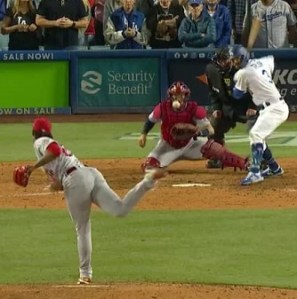
Chris Taylor, about to demolish Alex Reyes’s hanging slider and the Cardinals’ season in the bottom of the ninth . . .

If the postseason means anything, it means the biggest men on the field can come up as short as the least among them can come up Bunyanesque. You can watch the big men go hammer and tongs at it only to find the last or next-to-last man swung the wrecking ball that counted.

But if you thought a utility man who’d gone seven-for-September (well, seven hits in 71 plate appearances) would send the Dodgers to a National League division series after spending most of the NL wild card game riding the proverbial pine, you should be buying stocks, futures, and lottery tickets.

Infielder-outfielder Chris Taylor was sent into the game to open the seventh in left field, in a managerial double switch, and bat ninth in the order. And in the bottom of the ninth Wednesday night, with two outs, Cody Bellinger on second, and Alex Reyes on the mound for the Cardinals, Taylor with one swing reinforced two inviolable laws.

One was the Biblical admonition about the last being first. The other was Berra’s Law. The truest valedictory for this National League wild card game is that it most assuredly wasn’t over until it was over. It took a man who’d gone from All-Star in the season’s first half to also-ran in the second half, when a neck nerve issue contributed to making him almost literally half the player he’d been from April through July.

The number nine batter sent the Dodgers toward a division series showdown with their lifelong blood rivals, the Giants, with one swing, one two-run homer, and one moment in which the Elysian Fields angels decided the Red Sox deflating the Yankees in the American League wild card game just wasn’t quite enough.

Taylor turned on Reyes’s slider hanging a sliver under the belt and sent the ball about ten rows into the left field bleachers. He also sent Dodger Stadium into a racket that could have been heard practically across the state line separating California from Nevada.

Remember Hall of Fame broadcaster Jack Buck’s ancient holler after broken-bodied Kirk Gibson ended Game One of the 1988 World Series with a home run? Even home plate umpire Joe West—on the threshold of retirement at last—looked as though he wanted for once to come out from behind his cloak of professionalism, and beyond his reputation for inserting himself too much into games, to holler it.

I don’t believe—what I just saw!

Dodgers starting pitcher Max Scherzer believed it. Those who were there swear Scherzer turned to Dodger reliever Joe Kelly in the dugout as Bellinger checked in at the plate, telling Kelly, “I think Belli is going to get on here, and CT is gonna hit a homer.” If that’s true, maybe Scherzer should be buying stocks, futures, and lottery tickets himself.

Bellinger—whose regular season was laid waste by incomplete recovery from shoulder surgery last off-season and more than a few injuries nagging and otherwise including a broken bone or two—wrung himself into a full-count walk. Then, he stole second when Yadier Molina, the Cardinals’ grand old man behind the plate, couldn’t find a handle to throw against Bellinger’s big jump off first.

With the next pitch, Taylor made Scherzer into a prophet. Ending a game in which neither side could pry more than a single run out of either Scherzer or the Cardinals’ co-grand old man Adam Wainwright despite neither righthander having anything much resembling their truly vintage repertoires, other than a few tastes of Scherzer’s better sliders and Wainwright’s better curve balls.

“We’re going to need him,” Dodger manager Dave Roberts said about Taylor before the game. “I can’t predict what spot, whether it’s to get a bunt down, take an at-bat, play defense, start a game. I can’t predict that. I do know that he’s one of my favorite players. I trust him as a ballplayer, as a person. We’re going to need him this postseason.”

Need, meet net result. And, the newest member of a distinguished fraternity of modest men who step up immodestly in the postseason when it matters the most.

With the Dodgers’ season on the line—and TBS broadcasters Brian Anderson and Ron Darling having predicted two innings earlier that the game was liable to be won in the final at-bat—Taylor joined the like of Travis Ishikawa, Chris Burke, Aaron Boone, Todd Pratt, and Bucky Dent on the roll of the unlikeliest postseason bombers making the difference in win-or-be-gone games.

“[I]t’s been a grind for me,” Taylor said postgame. “I haven’t been playing my best. So to come through in the ninth, it felt really really good.”

Somehow, some way, Wainwright ground through five and a third innings with only Justin Turner’s leadoff launch to the rear of the Dodger bullpen in the fourth against him. Scherzer didn’t quite last that long. Despite his game-long wrestling matches with the Cardinal lineup, he was none too thrilled to get the hook in the fifth. He wouldn’t even give Roberts the ball as he left the mound.

Post-game, of course, Max the Knife was in his glory, interviewing shirtless and slightly inebriated from the party champagne. And, celebrating with his erstwhile Nationals teammate Juan Soto, who’d been in the field boxes—wearing Dodger shortstop Trea Turner’s Nats jersey, sitting next to Nats hitting coach Kevin Long in Scherzer’s Nats jersey.

“You gotta get rid of this echo,” Scherzer said on camera. “Can’t talk. I’m drunk, whatever.”

For all that the Cardinals made Scherzer wiggle into and out of jams as if it were par for the course, the only run they pried out of him was his own doing, when he wild-pitched Tommy Edman home on 0-2 to Nolen Arenado in the top of the first.

This was a game dominated by full counts, batters unable to cash gloriously positioned baserunners in, even with Scherzer and Wainwright looking like the elders they are on the mound. The Cardinals had the worst of that, going 0-for-11 with men in scoring position against Scherzer and four Dodger relievers—particularly resurgent closer Kenley Jansen, striking out the side in the ninth around Edman’s one-out single and theft of second.

Taylor also ended a too-brief battle between two men who’d gone from first-half boom to second-half bust. Like Taylor, Reyes was an All-Star for his first half. But he’d pitched his way out of the Cardinals’ closing job in the second. Just as Dodger manager Dave Roberts never once lost faith in his veteran Taylor, Cardinals manager Mike Schildt never really lost true faith in his still-young reliever.

Schildt isn’t the only one having Reyes’ back after Taylor broke his and the Cardinals’ backs Wednesday night.

“I just gave him gave him a huge hug,” said Adam Wainwright, the Cardinals’ other grand old man and wild card game starter. “Told him we love him, told him I loved him and gave him another big hug and just told him how special he was as a player and as a teammate, as a person.

“You know, it’s all you can say in a moment like that,” Wainwright continued. “He doesn’t probably want to hear any of it, but it’s all true. He’s a great teammate, is a great player. He’s a great pitcher. He’s a great friend, and I hate seeing anyone go through that, but he’s got an incredible future ahead of him.”

He’ll only have to shake off having thrown the pitch that ended a season in which the Cardinals lost a little too much—including their pitching ace-in-the-continuing-making Jack Flaherty—to the injured list and to deflated expectations for much of the season.

A season in which the Cardinals ironed up when it mattered most and rode a staggering seventeen-game winning streak, not to mention a fine young outfield, a mostly stingy defense overall, mostly solid hitting, and their elder anchorage of Wainwright and Molina,  toward the second National League wild card.

The Dodgers might have been humiliated more if they came up short. A 106 game-winning defending World Series winner, settling for the first National League wild card, after they couldn’t quite get that one game past the NL West-winning Giants? There wouldn’t be enough available space to hold all the variations on the implosion theme.

There may not be enough space to hold all the variations of Taylor-made sure to come forth now.
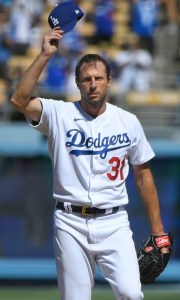
Could that someone be Max the Knife?

Max Scherzer

Scherzer’s stellar pitching has made possible the Dodgers leaving the Bauer embarrassment behind.

On Saturday, Los Angeles Times columnist Bill Plaschke called Trevor Bauer the biggest embarrassment in Dodgers history. Two days later, Plaschke’s fellow Times columnist Bill Shaikin called Max Scherzer cover for the Dodgers’ Bauer disaster.

Bauer’s 2021 season is over. With his legal status remaining in limbo, baseball’s government and the Major League Baseball Players Association decided it was the better part of valor that Bauer should remain on paid administrative leave through the end of the season.

“He will surely never pitch for the Dodgers again,” Plaschke wrote Saturday. “He may never pitch for anybody again. But the damage his brief presence wrought upon an organization built on strong community and smart baseball has been indelible.”

“[H]istory,” Shaikin wrote Monday, “seldom offers a silver lining more glistening than this: If Bauer is on the Dodgers’ roster, Max Scherzer is not.”

Signing Bauer last winter indicated only that the Dodgers were willing to gamble on a misogynist alone. Even vetting Bauer completely, the team couldn’t have foreseen his exposure as having crossed lines separating mere kink from downright abuse, making mere misogyny resemble virtuousness.

Dealing for Scherzer and shortstop Trea Turner from the Nationals at the trade deadline may yet make the Dodgers’ Bauer embarrassment the footnote to a footnote in their long and storied-enough history. Especially if the deal turns out to have made the postseason and the pennant possible.

It’s not that Turner has been useless, far from it. He’s had more than a few moments since he swapped Nationals for Dodgers fatigues. (For one thing, he’s now the only baseball player known to have almost moonwalked his way back up and out of a safe slide across the plate.) But he can’t begin to measure up to Scherzer’s impact.

Nobody can.

Nobody else could conceivably start eight straight games for a team and post a 0.88 ERA, a 1.26 fielding-independent pitching rate, five measly walks, and 72 strikeouts over those eight starts. Except maybe an uninjured Jacob deGrom, who actually did spend starts from 25 May through 1 July posting a 1.20 ERA, a 0.92 FIP, four measly walks, and 71 strikeouts.

But deGrom is more than a fair few seasons younger than Scherzer. DeGrom has slightly more than half of Scherzer’s lifetime 3,003 strikeouts. It would be foolhardy at best to predict that a day lurks in the future when deGrom will nail his 3,000th strikeout on the same day he pitches an immaculate inning and takes a perfect game into the eighth inning.

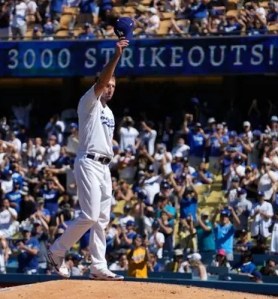
That’s what Max the Knife did Sunday. The Dodger Stadium crowd didn’t exactly pack the house, but it made noise enough that only a corpse on the Klingon home world couldn’t have heard it when Scherzer threw down and in on a full count and eluded Padres first baseman Eric Hosmer’s bat for the milestone swishout.

He pitches for a team that has an easier time keeping greatness on the mound from going unrewarded. Unlike deGrom, who pitches like a Hall of Famer for a team that knows how to snatch the proverbial defeat from the jaws of victory as often as not, the Dodgers have won every one of Scherzer’s eight starts since his arrival.

“None of Bauer’s teams,” Shaikin notes, “have won eight consecutive games in which he started.” That’s any eight consecutive starts, never mind the first eight he’s made with any of the four teams for whom he’s pitched.

(For those curious, this year the Mets did manage to win eight straight deGrom starts—but deGrom got win credit in only five of those games. On the other hand, one of his injury issues put a big time space between the first two of those starts. DeGrom’s ERA over those starts was four points lower than Scherzer’s over his first eight Dodger starts, and deGrom’s FIP was eleven points lower.)

Plaschke feared free agent-to-be Scherzer would be a rental only. But when Shaikin noted another future Hall of Famer, Clayton Kershaw, sitting a mere 347 strikeouts away from the Magic 3,000, he quoted Max the Knife about that: “Hopefully, I’m here, and able to watch his 3,000th as well.”

Could that have been a not-so-subtle hint that Scherzer would like nothing more than to stay in Dodger silks for the rest of his career? Could that have been a not-so-subtle suggestion that the Dodgers are thinking about the same thing as they begin to imagine a post-Bauer world for which Bauer bears the brunt of the blame?

Don’t even think about it: Merely because a judge denied a restraining order against Bauer regarding one of his victims, Bauer isn’t off the hook. Restraining order petitions address  feared future acts. They don’t deny or acquit known previous acts.

“[T]he central truth of this entire affair — the stuff that Major League Baseball will look to regarding Bauer’s behavior, irrespective of whether [criminal] charges are brought — points pretty clearly to Bauer doing exactly what his accuser said he did,” wrote former NBC Sports baseball analyst Craig Calcaterra last month.

Everything else is secondary.

After 12 hours of testimony, his accuser said, under oath, “I did not consent to bruises all over my body that sent me to the hospital and having that done to me while I was unconscious.” There was zero evidence presented which explained how those bruises appeared in a way that was benign or refuted the idea that the woman was unconscious when Bauer inflicted them. That, in my mind, is all that matters.

Six days before the Dodgers pulled the trigger on the Scherzer trade, it became known widely enough that there wasn’t a Dodger to be found in the clubhouse who really wanted Bauer back among them.

Between that day and the day they landed Scherzer, the Dodgers fell from two to three games out of first in the National League West. They’re back to two and a half out of first with a few hiccups here and there, none of which involved Scherzer. But his one-for-the-books outing Sunday further exposed the upstart Padres (18.5 games out of first) as not ready for National League West prime time just yet.

Both Scherzer and Kershaw face free agency this winter unless the resources-rich Dodgers elect to stay their course with both pitchers. For Kershaw it would be keeping him in the only baseball family he’s known his entire career. For Scherzer it would be making sure he finishes his career with his fourth and final baseball family. Maybe with another World Series ring or two on his finger.

Remember: Enough of the world thought the Nationals made a huge mistake signing Scherzer to a long-term deal. Then Scherzer finished his Nats tenure with a) the most wins above replacement-level pitcher of any marksman during the life of the deal; b) struck more batters out than anyone else in the Show over the life of the deal; and, c) helped the Nats win an unforgettable World Series title.

Somewhere in there, Max the Knife also managed to win two of his three Cy Young Awards. Back-to-back while he was at it. He’s even in this year’s conversation as regards winning his fourth Cy Young Award.

After net results such as those, nobody would necessarily bet on the Dodgers just burning money if they elect to make Kershaw and Scherzer offers they can’t refuse to stay. Even four-year deals keeping them Dodgers for the rest of their baseball lives.

“Wasn’t it true,” Mario Puzo had Don Vito Corleone musing in The Godfather (the novel, not the film), “that sometimes the greatest misfortune brought unforeseen rewards?”

The Dodgers’ rewards are bound to be a lot happier with Scherzer aboard for his final acts than they’d be with even one more episode of the Bauer dope opera.

Max the Knife vs. the Lindor Rock

Max Scherzer

Max the Knife went from immaculate to 3,000 in the same Sunday afternoon game . . .

Who says baseball isn’t good for a little hair raising anymore? If you weren’t paying attention Sunday, you missed some real hair raising in Los Angeles and New York. As a matter of fact, you could feel sorry for Dodger Stadium’s  being upstaged by Citi Field’s.

Even if both hit the history books running.

Max Scherzer took a perfect game into the eighth inning. Along the way he pitched an immaculate inning—the third man ever to do it three times, joining Chris Sale and Hall of Famer Sandy Koufax—and bagged his 3,000th career strikeout. Right there it should have been the biggest story in the game.

Immaculate inning? Three thousand strikeouts? Could that someone be Max the Knife?

Those Big Apple pains in the ass had to horn in on Scherzer’s glory. They had to go from a brothers-in-arms 9/11 twentieth-anniversary hair-raiser to a Sunday night soiree full of chirping, whistling, snarking, bombing, and oh, yes, Francisco Lindor doing what nobody else in the 139-year history of the Subway Series had done before.

It wasn’t enough that Scherzer should have struck San Diego’s Eric Hosmer out swinging on down and in and a full count in the fifth to record the milestone strikeout. It wasn’t enough that Hosmer was sandwiched by Fernando Tatis, Jr. and Tommy Pham in the middle of that immaculate second.

It wasn’t even enough that Hosmer should have been the one to bust Scherzer’s perfect bid with a double deep to right field, a little quiet revenge for having been on the wrong side of Max the Knife’s further burrowing into the history books.

No. Those spoilsport Mets and Yankees had to go out and enable Lindor—the off-season signing splash whose first year as a Met has been a battle at the plate while remaining a study at shortstop (where he’s worth five defensive runs saved about the National League average)—to do the damage that mattered in a 7-6 Met win.

Never in the entire history of New York’s major league teams tangling against each other—we’re talking serious World Series tonnage, plus all those decades when the Dodgers and the Giants turned baseball into total warfare against each other, not to mention the Yankees and the Mets in regular-season interleague play—had any single player hit three home runs in a single contest between them until Sunday night.

In other words, Lindor accomplished what not even a small truckload of Hall of Famers ever did in Big Apple uniforms against each other. Not Home Run Baker or Babe Ruth. Not Lou Gehrig or Mel Ott. Not Joe DiMaggio or Jackie Robinson. Not Yogi Berra or Johnny Mize. Not Mike Piazza or Derek Jeter. Not even Willie, Mickey, and the Duke.

All around the Lindor clock, hey, let’s do the Lindor Rock!

Bottom of the second. Lindor batting lefthanded, squaring off on 1-1 against Clark Schmidt, a Yankee excavated from the farm system to make the start in the first place, and hitting a hanging breaking ball for a three-run homer into the bullpens behind right center field, pulling the Mets from a 2-1 deficit into a 4-2 lead.

“If Francisco Lindor’s first year as a Met could include a signature moment,” called ESPN broadcaster Matt Vasgersian as Lindor came down the third base line and crossed the plate, “we just watched it.” If only his crystal ball had undergone a tuneup.

Bottom of the sixth. One out, Yankee reliever Wandy Peralta throwing his first pitch to Lindor batting righthanded. The changeup arriving down and on the lower outside corner got driven high and into the left center field seats. Fattening a 5-4 Met lead by a run.

Francisco Lindor

“I am the Whistler, and I know many things, for I bomb by night . . .”

On the way home down the third base line, Lindor made a gesture simulating a kid sticking two fingers into his mouth to whistle a huge blast—a zap back at the Yankees over suspicions that Saturday night’s Mets starting pitcher, Taijuan Walker, was caught tipping his pitches with the Yankees whistling the tips to their batters during their five-run second.

Maybe the Yankees did it, maybe they didn’t. It’s not as though the Yankees have been immune to suspicions of on-field chicanery in the recent past, even if they’re not yet suspected or affirmed to have been quite as deep-cover as the 2017-18 Astros were shown to be for espionage aforethought.

But Lindor tripped a Yankee trigger when Giancarlo Stanton smashed a game-tying two-out, two-run homer in the top of the seventh. Stanton and Lindor jawed back and forth while Stanton was still running the homer out, though the Yankees and the Mets were both kind enough to let Stanton cross the plate before the benches and bullpens emptied completely for a little, shall we say, conversation over the matter.

“The last couple nights, we’ve just been loud over there,” said Yankee manager Aaron Boone. “Not doing anything.”

“I’m not accusing them,” Lindor said post-game Sunday night. “I’m not saying they’re doing it 100 percent because I don’t know 100 percent, but it definitely felt that way. And I took that personal. I took that personal and I wanted to put runs on the board to help my team win.”

For his part, Stanton postgame thought Lindor was actually ticked off at Peralta for whistling—not to steal signs but to try putting a little more life into what Stanton suggested had been a sluggish Yankee bench during a sluggish Yankee spell. That, Stanton said, is what he was trying to convey to the Mets’ shortstop en route the plate.

“If you’ve got a problem to Wandy, give it to Wandy,” the left fielder said. “Don’t be talking to multiple people, bringing everybody into it. Running around the bases, that was my thought process. Obviously, I didn’t get all that out running around.”

If anyone had a real complaint about Peralta’s whistling, it was probably Yankee right fielder Joey Gallo. “It’s definitely not for pitch-tipping or anything like that,” Gallo insisted, before complaining  good naturedly. “It’s been hurting my ear, honestly. It’s unbelievable how loud he can whistle.”

Bottom of the eighth, one out, Lindor back batting lefthanded against another Yankee reliever, Chad Green. This time, he hit a 2-0 meatball practically down the chute even higher over the right field fence than his first flog of the night traveled.

It wasn’t as spiritually delicious as Hall of Famer Piazza’s eighth-inning blast in old Shea Stadium, during the Mets’ first home game after the original 9/11 atrocities’ baseball hiatus, but the Citi Field racket as it traveled out of reach was equal in volume to that twenty-year-old cathartic hysteria.

There’s nothing like a three-thump night to make a high-priced shortstop—who’s spent most of his first such high-priced season struggling at the plate if not with the leather—suddenly feel lovable. “It probably helped them believe in me a little bit more,” Lindor said post-game.

Poor Scherzer. The tenacious righthander hit the history books with a flying fist. So he had to be one-upped by those New York yo-yos. Not even Mookie Betts speaking postgame could neutralise things. “He was destined for it,” the Mookie Monster told reporters. “All the work he puts in, everything he does. It kind of sounds weird, but I expect nothing less from him.”

Echoes of Hall of Famer Don Drysdale once saying of his rotation mate and buddy Koufax, “I expect Sandy to pitch a no-hitter every time he takes the mound.”

The bad news in New York was that Met fans have come to expect a discomfiting balance between virtuosity and disaster from reliever Edwin Diaz. And Diaz delivered just what they expected in the ninth Sunday night.

He wasn’t the only bullpen culprit in the hair raising, not after Jeurys Familia threw Gleyber Torres a two-run homer in the sixth, and not after Brad Hand handed Stanton that jaw-inspiring two-run shot in the seventh. But Diaz was the bull most over the edge, almost.

A leadoff strikeout followed by a base hit. A followup walk followed by a swinging strikeout. Then, he had a little help from catcher James McCann, letting a 1-1 pitch to Stanton escape, enabling pinch-runner Tyler Wade and Yankee first baseman Anthony Rizzo to third and second.

Lucky for Diaz and the Mets that Stanton got under the 2-2 fastball and popped it up. To the left side. Where, of all people, Lindor awaited to haul down the game’s final out. Some dared call that one poetic justice.

Bases full of Mets? You’re off the hook.

J.D. Davis

J.D. Davis would love to have back that Max Scherzer meatball with the bases loaded in the fifth.

You hate to add to whatever inner misery comes into play for him. But J.D. Davis has spent this weekend making himself a prayer for the opposition. Bases full of Mets? Pray that Davis is the next man up. You can breathe again.

Missing about two months from May through past the All-Star break with a wrist injury has hurt like hell. It’s done Davis no favours, and it’s hurting the Mets in places where they need help, not hurt.

Friday night: Dodgers ace Walker Buehler left first and third for his relief Alex Vesia, after Pete Alonso caught a huge break when a ball he hit off his foot was ruled no foul and enabled him to beat out a run-scoring grounder. Vesia promptly walked Michael Conforto to load the pillows.

Up came Davis with the Mets down now by a single run. Ahead in the count, 2-1. Fastball rising—swing a shade too soon, swish. Fastball falling—Davis kept the bat on his shoulder and the ball barely hit the strike zone floor. Side retired, 3-2 Dodger win held up.

Saturday afternoon: The Mets down 3-0 to open the top of the fifth against Max Scherzer. Make that 3-1, after Brandon Nimmo hit one out. Jeff McNeil doubles to right. Alonso himself gets hit on the arm by a pitch. Conforto goes from 1-2 to three straight balls.

Pads padded. The Mets have Max the Knife going rope-a-dope. Up steps Davis. Another 2-1 count. Looks at a pitch just off the middle—called strike. Gets an unlikely meatball down the pipe—fouls it off. Gets damn near the same pitch next—swings right through it for strikeout, side, and the Dodgers clinging with their lives to that 3-1 lead.

That lead became 4-1 after Mets reliever Miguel Castro, relieving starter Rich Hill to open the Los Angeles sixth, surrendered a leadoff base hit to Dodger pinch hitter Matt Beaty, then walked the bases loaded and a run home. Leaving Jeurys Familia to enter the burning building and get the Mets out alive with a pop out behind second base, a fly out to somewhat deep right, and a force out at second.

Leaving Nimmo himself wondering perhaps what he might have to do, short of bribery, to arrange men on base when he’s at the plate later in the game. He ended his day a triple short of the cycle, the Dodgers unable to get rid of him until reliever Blake Treinen caught him looking at a third strike barely on the floor of the zone in the seventh. His first-inning double opened the game; his third inning single came with one out and nobody on in the third.

And, of course, no Met managed to reach base in the fifth until after Nimmo fouled off a fastball to open with two out in the first before pulling an inside Scherzer service into the right field bleachers.

There’s no point in singling one long-haul culprit out. These Mets overall have been a mess since Jacob deGrom went down for the count yet again, and maybe for good this season, in early July.

One big reason is their inability to hit with the bases loaded: holding a .208 average in that situation, the fifth lowest in the Show, isn’t the way to win games. Especially when the other guys are hitting .292 against them with the bases loaded.

Castro walking the bases loaded and then walking Beaty home ended up being the difference Saturday—Alonso’s two-out, seventh-inning blast into the left field bleachers with McNeil aboard gave them their second and third runs. The Mets put a man aboard in each of the eighth and the ninth and stranded both.

Things weren’t exactly helped when Hill opened by surrendering a leadoff bomb off the top of the left field fence to Trea Turner opening the bottom of the first and, one fly out to deep center later, a first-pitch yank over the center field fence to ancient Albert Pujols, to put the Mets into an almost-immediate 2-0 hole.

At 41 years old each, Hill vs. Pujols weren’t quite the oldest pitcher-batter matchup to end in a home run in Show history. That belongs to Julio Franco and Hall of Famer Randy Johnson. Thanks to my sabermetric friend Jessica Brand, I learned The Big Unit was a young turk at 43 when Franco, then a measly 49 and a Met, no less, turned on an 0-2 service in the top of the second and drove it over the left field fence. It was the 173rd and final home run of Franco’s career.

With 92 years of age between that pair, there’s something to be said for respecting your elders.

Davis himself is 0-for-6 with six strikeouts when he hits with the bases loaded this season. If you take Mets manager Luis Rojas at his word, Davis is pressing it too hard when he checks in at the plate with chances to do major damage. “Sometimes, guys tend to get anxious,” the skipper told MLB.com’s Anthony DiComo after Saturday’s loss.

I use J.D. as an example with the bases loaded in that situation; he was trying to do too much. He was trying to gather a little bit too much. It caused him to be late on a fastball. That’s probably from a mental standpoint what happens, you just get a little anxious because you have the bases loaded. It’s a key situation. There’s an adrenaline rush, and sometimes you drift away from your approach of being aggressive in the zone, which is what we preach here.

Davis wasn’t even trying to murder the ball. As peculiar as this might sound to those dismissing this year’s game as just a bomb-or-bust offensive game, neither the Mets nor the Dodgers tried hitting six-run homers in every plate appearance. Even with six of the game’s seven runs scoring on home runs, there was about as much hard ground contact as air lifting between the sides Saturday afternoon.

It’s not that the National League East is a division full of invincibles. But the Mets held the division’s ownership papers despite their glandular injury issues until very recently. They’ve now lost seventeen of twenty-three; they’ve fallen two games below .500; they’re seven back of the now division-leading Braves almost a month after they led the division by four.

It got bad enough for the Mets at the plate that new owner Steve Cohen—who’d shown the patience of Job up to that point—zapped them for their inconsistent hitting aboard Twitter during the week just finished. In cold print, it looked like a mini-tirade. In actuality, we’re not exactly talking about a certain late Yankee owner.

Cohen didn’t throw out the first manager of the year. He didn’t even really single any particular Met out for embarrassment. He didn’t demand an apology to the city of New York or build a guillotine outside Citi Field. He didn’t compare any pitcher to a horse who spit the bit; he didn’t dismiss his best power hitter as Mr. May.

He didn’t do anything, really, except get Rojas and injured shortstop Francisco Lindor—the off-season splash signing whose bat’s been inconsistent but whose defense has been off the chart (he was worth thirteen defensive runs before his injury)—to say he was right about the bats.

The fact that the Mets didn’t exactly hog the headlines at the trade deadline lingered in the back of some minds, too.

The Mets’ immediate response to Cohen’s comparatively benign bop was to beat the Giants in twelve with a three-run homer (Kevin Pillar) and an RBI double (freshly called-up Chance Sisco, pinch hitting). From there, it’s three straight lost to the Dodgers with one more to play Sunday before a cross country trip home to host the Giants.

It may also be one of the only periods in which you might hear Met fans saying to themselves, “We have the bases loaded? We’re doomed.”

Max the Knife comes up aces

Max Scherzer

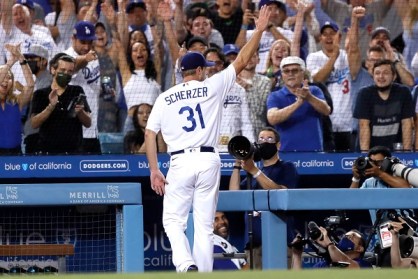
Dodger fans asked Max the Knife for something he’d never had in his career before Wednesday night—a curtain call.

Nothing could spoil Max Scherzer’s mound premiere in a Dodger uniform Wednesday night. And it wasn’t for lack of trying by the Astros. Not even for lack of trying by one particularly brain dead Dodger fan down the right field line.

The Astros made a grand enough effort after Scherzer left the game following seven stellar innings and ten strikeouts marred only by a solo home run and an RBI single. They had to settle for losing by two runs instead of five.

The Dodger bullpen made a grand enough effort, too, letting the Astros pry three runs out of them including a two-run homer in the top of the ninth off Kenley Jansen before he finally struck out the side to end the 7-5 Dodger win without any further self-immolation.

The aforesaid meathead in the stands did his best to contribute to a potential overthrow, too. With two out in the top of the eighth, struggling Cody Bellinger playing right field, and Carlos Correa at the plate against his old buddy Joe Kelly, Correa on 1-0 lifted a long foul down the line. Bellinger had a running bead on the ball and a certain side-retiring catch ready and waiting.

Until he didn’t.

Bellinger jumped just enough to make the catch. Except that the idiot in a Mookie Betts jersey with a glove on his left meathook reached up to snatch the ball right before it would have landed in Bellinger’s glove. Some of the fans surrounding the jerk congratulated him. Others surrounding him looked as though they wanted to brain him.

Technically, the jerk didn’t quite cross the line into obvious fan interference. But you’d think even the most profit-hungering souvenir hunter would be smart enough to back down when the right fielder has a chance to end an inning with a catch just above the edge of the fence padding.

Instead of side retired, Correa got extra life against Kelly. He swung and missed for strike two immediately after the stolen foul out, fouled another off, then turned on a hanging slider and sent it almost halfway up the left field bleachers for the third Astro run of the night.

Dodger Stadium security removed the miscreant after Correa finished his trip around the bases. A few of the fans in the same region let the security people know just how happy they weren’t over that removal. They’d better be grateful that this wasn’t another World Series game.

They’d also better be grateful that not even jerks being jerks could spoil Scherzer’s first outing as a Dodger.

The packed, roaring house just gave Scherzer even more incentive to go forth and do what he tends to do best, refusing to let even Michael Brantley’s one-out bomb in the top of the first, or Kyle Tucker singling Yordan Alvarez home with two outs in the fourth keep him from his appointed ten punchouts thanks to an effective curve ball setting up the fastest fastballs he’s thrown all season.

“You live for this,” Max the Knife said after the game. “You live to pitch in front of 50,000 people going nuts.”

They went nuts enough that still-ailing Clayton Kershaw, his fellow three-time Cy Young Award winner, nudged Scherzer back out of the dugout after his outing ended to take what he’d never taken in his entire career to that point—a curtain call.

“With everything on the line, the way the crowd was, that was a high-adrenaline start, coming here,” the righthander continued. “Try not to do too much. Just pitch my game, go out there and do what I can do, and just try to navigate the lineup. The offense tonight went off.”

“Went off” was a polite way to put it. The Astros barely had time to let their opening 1-0 advantage sink in when Betts turned on Jake Odorizzi’s slider and sent it over the center field fence to lead the bottom of the first off. A walk, a swinging strikeout, and a Jose Altuve throwing error later, Will Smith turned on Odorizzi’s fastball and drove it into the right field bleachers.

One inning and one out after that, Betts struck again, hitting a 3-1 heater into the left field bleachers. An inning, two outs, and a walk after that, A.J. Pollock hit one over the left field fence and Odorizzi must have thought by then that he could have pulled an automatic pistol out of his pocket, fired toward the plate, and still watched the bullet travel out of the yard off the end of a Dodger bat.

The Astro righthander blamed poor mechanics since the All-Star break, but with a 4.95 ERA and a 5.06 fielding-independent pitching rate on the season you could almost wonder whether the Astros threw him up as a sacrificial lamb Wednesday night.

“My fastball has been flat,” Odorizzi said after the game. He could have said “flat-tened” and it wouldn’t have made a difference. “There are a lot of things I am working on between outings, but then I am reverting back to bad form.”

The bad news for the Dodgers was that such reversion threatened to ruin Jansen and them in the top of the ninth. He surrendered a leadoff single to Aledmys Diaz before Tucker sent a hanging cutter into the right field bullpen. Then Jansen re-horsed to strike Robel Garcia, Jason Castro, and pinch-hitter Meyers out swinging.

Nothing, though, could diminish Scherzer’s impact. Especially with the Dodgers in straits desperate enough in the starting pitching department. Walker Buehler and Julio Arias have had to hold fort while Kershaw’s forarm inflammation hasn’t subsided yet, and it’s already kept the lefthander out since early July.

Tony Gonsolin’s shoulder is inflamed likewise. Still-ailing Kansas City import Danny Duffy isn’t likely to be ready before September. And the execrable Trevor Bauer remains on administrative leave while MLB and the Pasadena police continue investigating sexual assault accusations against him.

The Dodgers hogged the headlines on trade deadline day when they swept in and snatched Scherzer (plus star infielder Trea Turner) from the Nationals and right out from under their downstate rival Padres’s noses. Now Scherzer had to live up to the headlines—just the way he forced himself to live up to the biggest noise of 2019 and pitch on nothing but fumes and will to keep the World Series-winning Nats in Game Seven just long enough to give them a chance to win it in the first place.

Manager Dave Roberts almost wasn’t worried. Almost. Buehler and Urias must have felt as though thousand-pound iron blocks were removed from both their shoulders after Scherzer’s evening’s work finished.

“From the moment I got to the ballpark, we got to the ballpark, you could just see that elevation, anticipation from our guys,” Roberts said post-game. “The buzz in the crowd from the first pitch, him taking the mound, donning the [Dodgers’ home uniform] for the first time—he delivered. He delivered. Just the intensity. It was so much fun. And it was just really cool to see the crowd smell it and want him to finish that seventh inning.”

“I mean, it’s Max Scherzer,” the Mookie Monster said post-game. “I think that kind of speaks for itself.” (In case you were curious, Betts had one hit—a double—in six lifetime plate appearances against Scherzer before they became teammates.)

For Scherzer, coming off the only mid-season trade of his distinguished career, and to the team he’d helped beat in the 2019 National League Division Series, the hardest part’s over. For now. “I’m a Dodger,” Max the Knife said. “It feels a lot more normal when you just go out there and pitch and win. Winning kind of cures everything.”

It might even get him the final home address of his career. Might.

If he keeps pitching the way he did Wednesday night, even at age 37, and nobody including Scherzer shouldn’t be shocked if the Dodgers decide to make it worth his while and his bank account to keep him in the family. At least until his arm finally decides to resign its commission a couple of years from now. Maybe with a couple of more World Series triumphs to its credit before he’s done.