A season without the Trout hitting?

2020-07-03 MikeTrout

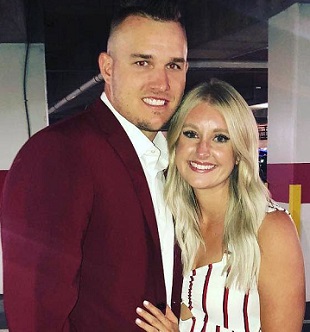
Mike Trout and his wife, Jessica, in a photo they posted to Instagram. If push comes to shove, Trout would rather sit this season than risk infecting her and their child-to-be.

Mike Trout’s virtues include that he’s as close to a hopeless romantic as a baseball player gets. This is the Angel who proposed to his wife by hiring a skywriting team to pop the question. He is also the Angels’ franchise face who’s pondering seriously whether to opt out of playing whatever the 2020 season happens to be.

Jessica Trout expects their first child next month. And her husband the romantic would like to be as certain as a young man can be that he doesn’t bring home such unwanted gifts for mother and child as the coronarivus.

As a matter of fact, the very thought of it makes Trout quake more than any pitcher has ever made the three-(should-be-four-)time American League Most Valuable Player quake. “Honestly,” Trout has told Los Angeles Times baseball writer Mike DiGiovanna, “I still don’t feel that comfortable. It’s gonna be tough. I’ve got to be really cautious these next couple weeks. I don’t want to test positive. I don’t want to bring it back to my wife. It’s a tough situation we’re in.”

Yes, it’s a difference from when Trout was among the players pleading, “When and where,” before the impasse between the owners and the players over starting a season finished. And, yes, there are millions of other people who’ve gone to work at far less lucrative jobs than Trout performs for money some small national economies rarely if ever see.

Let’s just put that into perspective, if we dare. The Wal-Mart or 7-Eleven clerk, the gas station attendant, the Starbucks barista, the cashier or floor walker at Macy*s, the servers at the Olive Garden, the local bartender, the dealers and floor walkers at the casino, are seen doing their jobs and judged on the spot by several thousand people every day.

But not at the same time. Not concurrently on national and even international television aboard which they’re watched by several million as well as the 55,000 who would be in the ballpark in normal, non-viral times. Unless they make a mistake too egregious to ignore, and it happens within range of the nearest smartphone camera trained upon them, their errors are unlikely to go past their boss and their complaining customers.

They don’t get hammered en masse aboard social media for having the occasional 0-for-4 day or night. They don’t get massively insulted for the heinous offense of not coming with 25 clones able to lift a team its best player can’t always be proud of from the ranks of the also-rans.

Whether or not you think it’s a crime, or at least a miscarriage of justice, the clerks, attendants, baristas, cashiers, floor walkers, servers, bartenders, and dealers don’t exactly bring uncounted millions into their companies through sales of their hats, uniforms, and aprons, or other bric-a-brac of their jobs. Nobody’s in half the hurry to hit the nearest Lids, Inc. or call Amazon up on their computers to buy their favourite barista’s Starbucks shirt.

Nobody loves the idea that those folks plus particular farmers, factory or warehouse labourers, repair people, waterfront workers, or airport workers can be replaced simply enough. Replacing a Mike Trout is something else entirely. It’s not his fault the Angels have been a nowhere team for his entire career to date. Good luck asking them (as some social media meatheads have) to just pay the ingrate off and find another player with even a passing resemblance.

Baseball’s paradoxes include one enunciated best by Hall of Famer Sandy Koufax, when he returned to the Los Angeles Dodgers as a pitching instructor in the late 1970s/early 1980s. “You are part of an entertainment, but you are not an entertainer,” he told Thomas Boswell, reflecting on his pitching career. (The article was re-published in Boswell’s anthology, How Life Imitates the World Series.) “But I enjoyed it, probably more than the fans enjoyed watching. I thank them for enjoying it with me.”

To this day people rub their eyes in amazement that Koufax walked away from baseball at the absolute height of his pitching career, at age thirty, because the thought of living without full use of his left arm—which is exactly what doctors told him he risked if he tried to pitch even one more season—troubled him that deeply. Koufax earned $125,000 in his final season, 1966. That salary in today’s dollars would be about $2 million short of what Trout stands to earn just pro-rated for the 2020 season.

Today there are probably people enough rubbing their eyes in amazement that Trout would even think of walking away from just that salary because the idea of becoming infected with a grave disease he might transmit to his wife and his child-to-be offends him as deeply as the idea of crippling himself for life on behalf of just one more season offended Koufax.

After almost three months worth of the owners trying to game the players out of their previously-agreed pro-rated season salaries for whenever a season might be played, the coronavirus world tour shows few if any signs of winding down. The least sensible among us accuse them of malingering while injured; the completely witless have been known to accuse them of inviting the injuries.

When Hall of Famer Ken Griffey, Jr. incurred a few too many injuries during his Cincinnati years, I had a few too many arguments with a few too many Reds fans accusing him of failing to stay in proper shape and thus leaving himself injury prone. As if the most perfectly conditioned athlete could yet avoid three season-ending injuries in four years and their impact on his swing, bat speed, and outfield range.

We see ballplayers as wealthy sport savants and forget more often than we should that they’re human men. (How often do you hear the least sensible fans accuse them of malingering while injured, simply because proper recovery time is longer than fans like?) We barely accept when they’re injured on the field; we wrestle with them now wrestling between their itch to play, our itch to watch them play, and their too real need to safeguard themselves reasonably and their families profoundly.

The most fearless player on the planet finds no reason to quake facing a 100-mph fastball, or running to haul down a fly ball only a foot between himself and disaster against a particularly unforgiving outfield wall. A virus with a particular penchant for death makes him fearful for his family and for himself. Trout knows it.

“I got to be really cautious these next few weeks,” he told an online news conference Friday morning. “I think the biggest thing is obviously I don’t want to test positive and I don’t want to bring it back to my wife. We thought hard about all this, still thinking about all this. It’s a tough time, tough situation we’re in, everyone’s in, and everybody’s got a responsibility in this clubhouse to social distance, stay inside, wear a mask, and keep everybody safe.”

ESPN’s Alden Gonzalez cites an unidentified major league infielder’s concern “how the quick ramp-up to what MLB is calling ‘Summer Camp’ might prevent teams from having the logistics in place to ensure proper social distancing at their respective facilities. He also expressed doubt that all those people making up Tiers 1 and 2 — up to 125 per team, consisting of players, coaches, trainers, front-office executives, public-relations employees and clubhouse personnel, among others — will care enough to consistently adhere to all the health-and-safety protocols.”

Later Friday, MLB and the Major League Baseball Players Association announced 38 of the first 31,185 people going through its screening process tested positive for the coronavirus, and 31 were players. Thirty-eight overall out of 31,185 is .001 percent. Thirty-one out of 38 is eight points higher than Hall of Famer Rickey (The Man of Steal) Henderson’s lifetime stolen base percentage. (.808, if you’re scoring at home.)

Previously, it became known that Colorado Rockies outfielder Charlie Blackmon and twelve members of the Philadelphia Phillies were infected. Today, the Atlanta Braves revealed first baseman Freddie Freeman tested COVID-19 positive.

The game’s government and players have developed protocols for testing and social distancing. But Gonzalez warns, “It will come down to discipline, accountability and self-policing. Positive cases are inevitable; the hope is to avoid the type of outbreaks that might postpone or even cancel the season. If one person wavers, the entire system might collapse. And even if players adhere to monklike sensibilities over the next three to four months, the realities of a pandemic that forges on might render their efforts meaningless. It’s why so many players are hesitant.”

Arizona Diamondbacks pitcher Mike Leake was the first player to exercise the opt-out option on playing this year. Following suit were two World Series-champion Washington Nationals (first baseman Ryan Zimmerman, pitcher Joe Ross), another Rockies outfielder (Ian Desmond), and free-agent pitcher Tyson Ross. There could be more to follow, with or without Trout joining their number.

A third National, relief pitcher Sean Doolittle, who’s become something of a social media star with his wife, Eireann Dolan, through their articulate tweets, has said aloud that he fears baseball won’t work this year no matter the protocols. Eireann suffers chronic lung issues leaving her prone to respiratory infections and with several hospital stays on her resume.

Doolittle would love to play this year but hates to make things worse for her. He’s popular above and beyond his team’s fan base, but he’s not exactly the final face of the Nats. Neither is Leake for the Diamondbacks; they’d take a bigger blow if they lose freshly-minted Madison Bumgarner or breakout star Ketel Marte. Blackmon’s arguably the Rockies’ face (when you can see it under his hat and behind his Bunyanesque beard), but not yet baseball’s. Freeman’s one of the Braves’s two faces. (Ronald Acuna, Jr. joins him.)

Even a truncated season without Trout would shatter not just the Angels but the game itself. Even if commissioner Rob Manfred once decided the reason Trout isn’t the face of the game above and beyond just the sport itself was . . . Trout himself, considering Trout is possibly baseball’s least self-promoting young man.

It’s almost to worry, should more players such as himself finally opt out of playing this year, that Manfred might see any coming opt-outs and decide it’s all . . . Trout’s fault, for opening his big yap, and admitting that push coming to shove would mean he’d rather take the season off than infect his wife and child-to-be.

The owners, running out of feet

2020-06-14 CamdenYards

Oriole Park at Camden Yards. Other than frustrated Oriole fans who’d like to throw things at Peter Angelos, baseball fans don’t spend money to see their teams’ owners. The owners still don’t get the message.

But . . . but . . . not. profitable. That’s what enough of Major League Baseball’s owners kept trying to tell us while they tried to strong-arm their product (the players, in case you keep forgetting) into playing a short 2020 season and accepting less than their agreed-in-March pro-rated 2020 salaries. Right?

But . . . but . . . not. profitable. Never mind that the redoubtable Thomas Boswell once actually figured out that, over the past century’s time, baseball owners have hauled down a twelve percent compound annual rate of return: “That kind of tax-free compounding . . . is like striking an oil well that never runs dry.”

But . . . but . . . not. profitable. Baseball’s such a money loser that MLB just nailed a billion-dollar deal with Turner Sports—you may recall that its founding father once owned the Atlanta Braves—to “keep a playoff package that includes one of the league championship series on the network,” according to the New York Post. Earning MLB at least $150 million a year more than under the current deal set to expire after next season.

Philadelphia Phillies outfielder Andrew McCutchen couldn’t resist. “But baseball is dying!” he snarked. And who could blame him?

When you’re a group that pulls down the aforesaid compound annual rate of return, Boswell said three days ago, and you happen to be baseball’s stewards, “holding the sport in multicentury trust for fans who love it and support it,” you “have a duty to take the brunt of the financial hit from the coronavirus. In the long run, the owners, as a group, are always the huge winners. The players just pass through and get what they can grab — some of them a fortune but most far less.”

. . . The owners’ position appears to be: We don’t want to lose money. The whole world is. But us, no. We want players to accept additional pay cuts below a prorated level (but we won’t show you our books). In contrast, we will take a $0.00 year but not a share-the-pain loss . . .

. . . The owners are so self-protective, so oblivious to the good of the game, they even want to maximize their defenses against a second wave of the virus. Oh, we will play until the normal Oct. 31. But don’t talk to us about playing games in November because that would increase the chance of an erased World Series, lost TV money and losses for us.

That was three days before the Turner Sports deal. Now, remember, as Boswell does: The owners want the absolute maximum safety margin if the Show comes back, but if you assume the coronavirus isn’t quite finished with its grand tour guess who takes the maximum safety risk?

Hint: They’re the ones you pay your hard-earned money to see in uniform on the field, at the plate, on the mound. Accuse me as you must of flogging a dead horse, but nobody hands over anywhere from $15 to $150 or more per ticket to take themselves and their families or friends out to the ballpark to see Peter Angelos (not counting frustrated Oriole fans wanting to throw things at him), Mark Attanasio, Jim Crane, Bill deWitt, John Henry, Mark Lerner, Arte Moreno, Tom Ricketts, Hal Steinbrenner, and company.

Again assuming the coronavirus tour isn’t finished, the maximum risk takers are also the ones who guide you to your parking spot; sell you the food, drinks, souvenir hats and jerseys and other chatzkahs of rooting; post around the parks to keep the lunatics from spoiling your fun; and, run the park facilities from the gates to the scoreboards to the concession stands and back.

Show me a baseball owner and I’ll show you someone who shoots himself in the foot so often it’s a wonder he has a foot left to shoot. Of all the cliches you can attach to the so-called Lords of Baseball, and it’s been true for just about the entire life of professional baseball, the truest may be that they never miss the opportunity to miss an opportunity. (Except, perhaps, for the tax write-offs.)

Here’s the sport that could and should have dropped the big one on its competitors and gotten major league baseball back onto the field on the Fourth of July. “You get 15-games-a-day visibility before the NBA and the NHL return,” Boswell wrote, “as well as a two-month jump on the NFL.” So much for that idea.

That kind of image enhancing would have been worth more than the entire difference ($4.6 billion, roughly, if you’re scoring at home) between what Hal Steinbrenner’s late father paid to buy the New York Yankees from CBS in 1973 and what the Yankees are worth today.

The only shock, then, in the players all but walking away from the negotiating table on starting a delayed 2020 season—as The Athletic‘s Ken Rosenthal and Evan Drellich put it Saturday, “The March agreement between the parties empowers commissioner Rob Manfred to set the number of games as long as the league awards the players their full prorated salaries, with the caveat that the league make its best effort to make the schedule as long as possible”—is that anyone should be shocked.

Except, perhaps, by the owners looking for every possible way to renege on the March agreement, and the players—not always eloquently, not always with their best (unshot) feet forward—looking for every possible way to thwart them.

Remember the wisdom of the late Hall of Fame manager Sparky Anderson, again: We try every way we can think of to kill this game, but for some reason nothing nobody does never hurts it. Come Monday, when the players asked the commissioner to finalise seasonal plans, we may begin learning whether Anderson is still right.

MLB’s own Saturday statement said they were “disappointed” that the players chose not to negotiate “in good faith.” Set aside for the moment how similar that is to the classic Communist tack of claiming the invaded were the invaders. Remind yourself that, from time immemorial, the owners demanding “good faith” is like hearing Attila the Hun sing “All You Need is Love.”

The financial not-so-merry-go-round goes round

2020-06-04 ManfredBaseballsMaybe Hall of Fame pitcher Tom Glavine was wrong when he said last month that, if major league baseball doesn’t return, the players are going to look bad no matter how right they might be. The deeper goes the impasse between the owners and the players, the more the owners resemble the people to whom the good of the game equals nothing but the bottom line.

The owners and the players agreed in March to play any shortened season with the players paid their signed-for 2020 salaries on a pro-rated basis—until the owners said not so fast. The owners tried for a 50-50 revenue split knowing it would cost a lot of players a lot more money than just playing under their pro-rated 2020 salaries—and the players said not so fast.

Now the players, as if they needed further evidence for the defense that yes, they’d rather be playing baseball, proposed a 114-game season. The owners, who first thought of an 82-game season, said, essentially . . . not so fast. They rejected that proposal almost out of hand, then decided that negotiating further meant nothing when they could find a way to impose a 50-game season and, by the way, the players were perfectly free to negotiate against themselves.

That’s the way Yahoo! Sports columnist Hannah Keyser phrased it, more or less. MLB “believes that language in that agreement around ‘economic feasibility’ of restarting a season allows them to negotiate a further pay cut for the players now it’s become clear that games will be played without fans, at least at first,” she writes. “The union disagrees with that interpretation, as well as the league’s assertion that owners will lose money on every regular season game.”

By comparison it’s been simpler for the owners and the players to agree on such details as playing this season with a universal designated hitter (and it should be kept when things become normal again in 2021), a one-time-only postseason expansion, and wringing out the fine details of proper health protocols.

Where they demur mostly is about money. The owners, who’ve rarely passed on a chance to try suppressing player pay in the past, are using the coronavirus-triggered season delay to try it now. The players, who know they have a March deal to play pro-rated, have the unmitigated gall to insist the owners live up to the deal to which they themselves agreed.

Oh, sure, the owners harrumph that they’ll still pay pro-rated 2020 salaries under a 50-game season. Don’t fool yourselves: it means the players earning less thanks to drastically slashed time on the job. Talk about a de facto salary cap.

It means, as Keyser writes, that commissioner Rob Manfred and the owners “would declare the negotiations a failure and effectively cut the hours of their employees who refused to agree to lower wages. All of which they seemingly can do, and it would be a success . . . ”

That is an almost embarrassingly trite and self-evident thing to say based on the behavior of Major League Baseball owners over the past few years. Of course they’re more concerned with minimizing costs than retaining top talent or paying minor league players a living wage. But it’s worth emphasizing that they just announced they’re also more concerned with savings than even hosting baseball games. They’re betraying more than the spirit of competitive balance with their cheapness now, they’re also depriving fans of the very product they’re trying to sell.

Speaking of paying minor league players living wages, it’s worth noting that major league players have embarrassed a few teams out of trying to cut their minor leaguers off. Without even throwing a single regular season pitch in the uniform, Los Angeles Dodgers pitcher David Price elected to hand each minor leaguer in the Dodger system $1,000 out of his own pocket.

When the world champion Washington Nationals thought about cutting their minor league players off at the pass, their players—as announced by relief pitcher Sean Doolittle last weekend—said not so fast, and prepared to pool their own monies to take care of those minor leaguers, prompting the organisation to keep their farm players on the payroll after all. Doolittle subsequently announced the Nats’ major leaguers would continue offering the team’s farm players financial help.

Remember: The major league players may not be impoverished, exactly, but the owners are impoverished far, far, less. When Chicago Cubs owner Tom Ricketts says it’s not like they can just move money around at will—given that the virus shutdown has wreaked losses at a “biblical” scale and MLB doesn’t exactly “make a lot of cash”— even his fellow owners know he’s talking through his chapeau.

For the seventeenth year in a row, 2019 saw MLB set a new revenue record. Forbes recorded it as $10.7 billion. “In accounting, revenues are calculated before factoring in expenses,” writes NBC Sports’s Bill Baer, “but unless the league has $10 billion in expenses, I cannot think of a way in which Ricketts’ statement can be true.”

Something else to ponder as well, if the owners aren’t going to the poorhouse and are trying to game the players yet again, and if the players are willing to extend financial helping hands to their teams’ minor leaguers: What about going the extra few miles and extending helping hands to 600+ short-career pre-1980 major leaguers who were frozen out when baseball’s pension plan was realigned that year to shorten up the time in MLB service required for a full MLB pension to vest?

Remember: The late players union director Marvin Miller said in due course that not revisiting and remodeling that realignment to include those pre-1980 short-career players was his biggest mistake and regret. The players in question do receive some monies from a deal worked out between former commissioner Bud Selig and the late players union director Michael Weiner—but they can’t pass that $625-per-quarter-of-MLB-service to their families when they pass on.

Today’s players union director Tony Clark has been (phrased politely) cool about the matter. The Major League Baseball Players Alumni Association has been likewise, unfortunately. Amplified especially since three of the players who’d been involved actively in the pension redress cause—former pitchers David Clyde and Gary Niebauer, and former first baseman/longtime coach Eddie Robinson—were squeezed off the association’s pension services committee.

Maybe today’s players, if they can be made further aware, might think of pitching in likewise for those short-career men who also supported their union in actions that helped pry open the door to free agency and tackle other pertinent issues involving major league players, and sacrificed considerable income despite earning less than princely salaries for assorted reasons.

Maybe. First, let’s find the right way to get a 2020 season played at all, about which the owners seem less concerned than about preserving whatever they think remains of their bottom lines. You don’t want to know what might emanate if the owners get away with imposing a too-short season for no better reason than to cut the players off at the financial pass.

The mattresses on the floor

2019-12-23 MiLBThings were quite interesting in 1935. Porky Pig (on screen) and Fibber McGee & Molly (on radio) premiered. Amelia Earhart became history’s first human to fly solo from Hawaii to New York. Bill Wilson founded Alcoholics Anonymous. Babe Ruth played his last major league game. The Phillies and the Reds played the Show’s first night game. The Tigers won the World Series.

And a bellettrist of the time—a former semi-professional baseball player, turned Episcopalian priest, turned journalist and eloquent sociopolitical critic, the work for which he’s remembered best, if at all, outside a small but devoted transgenerational following—delivered his signature critique against eroding the distinction between proper, unobtrusive government and the improper, to a fare-thee-well intrusiveness of the State.

Early in chapter one of Our Enemy, the State, Albert Jay Nock isolated rather lyrically his interpretation of the State’s approach to its subjects (we can hardly call it regarding them as citizens):

The State has said to society, You are either not exercising enough power to meet the emergency, or are exercising it in what I think is an incompetent way, so I shall confiscate your power, and exercise it to suit myself . . . The accumulation of State power in various countries has been so accelerated and diversified within the last twenty years that we now see the State functioning as telegraphist, telephonist, match-peddler, radio operator, cannon founder, railway builder and owner, railway operator, wholesale and retail tobacconist, shipbuilder and owner, chief chemist, harbour maker and dockbuilder, housebuilder, chief educator, newspaper proprietor, food purveyor, dealer in insurance, and so on through a long list . . . [T]he competition of social power with State power is always disadvantaged, since the State can arrange the terms of competition to suit itself, even to the point of outlawing any exercise of social power whatever in the premises; in other words, giving itself a monopoly.

Leave it to a one-time baseball player to point over the fence, hit one right to the spot, and have it unheeded, largely, for eighty-four years hence, to the point where the State of Nock’s suspicions stands potentially to become baseball’s commissionership, at least, if not its operator. And leave it to another former player, who spent shy of a decade in the majors, to pick up the warning and heed it, even if he doesn’t know and probably hasn’t read the Nockian critique.

“The courts are reviewing a case that brought to light the below-poverty-level wages that many minor league players earn,” writes former outfielder Doug Glanville, whose career included time with the Cubs, the Phillies, and the Rangers, in The Athletic. “The salary to qualify for poverty is just over $12,000, and the players bringing the lawsuit are citing the fact that a significant number of players make $7,500 a year or less for a full minor league season.”

Forty-five former minor leaguers signed onto the lawsuit, which seemed thwarted when Congress approved the Save America’s Pastime Act in 2018. Among other things, as phrased by the University of Colorado Law Review, the Act

(I)nsulate(s) its minor-league pay practices from legal challenge after they had become the subject of a federal class-action lawsuit alleging that the league’s teams failed to pay minor-league players in accordance with the Fair Labor Standards Act’s (FLSA) minimum-wage and overtime provisions. The SAPA helps shield MLB from these claims by creating a new statutory exemption largely excluding most professional baseball players from the protections of the FLSA.

Glanville says the lawsuit action didn’t “register” with him in the beginning, him having been a bonus signing and believing as he did that the minors were “just a pit stop” en route his complete lack of doubt that he would get to the Show:

It’s not meant to sustain you while you take care of a family, or pay real rent . . . right? It was the money you collect when you crack open that Monopoly box, play money. Go see a movie, go to the club, it’s just a glorified stipend until the real money comes in, which of course is inevitable. Do people actually live on this? Don’t we all just go home to Mom’s house when the season is over?

But Glanville knows he was one of the absolute minority who make it to the majors for however long their careers prove to be. “Former teammates who didn’t make it through are on the other side of the tracks,” he writes. “And if you never switch off the minor-league track, you just glide along the rainbow and right off a cliff. The vast majority of these players never get out of this theme park of poverty. Some may get on a big-league roster, make a decent Triple-A salary, but that is still an elite group. Most end up as filler — and many decision-makers already knew that about certain players well in advance.”

The Show seems now to be in several places regarding the minors. One place is pondering whether to eliminate 42 teams for assorted reasons, economic and otherwise. Another place is pondering how to remedy the Monopoly money otherwise, particularly after the Blue Jays last May raised the salaries of their minor league players by half. Indeed, baseball’s government said this about that when that happened:

While each Club makes its own decisions regarding minor league salaries, the Office of the Commissioner is presently in negotiations with the National Association of Professional Baseball on the terms of a new agreement between the Major Leagues and the Minor Leagues to replace the agreement that expires in September 2020. The working conditions of minor league players, including their compensation, facilities and benefits, is an important area of discussion in those negotiations.

But Glanville delivers a subtle warning shot to those such as him who made it to the Show and stay for longer terms and bigger dollars:

It appears these court cases, and perhaps some political figures, could be about to change that. MLB players may not notice any significant changes in their pocket books, but minor league players may be able to afford more than a mattress on the floor.

Maybe, one day soon, big leaguers will push for the answer to the question they did not think was worth asking. Only then will minor league players be compensated as true professionals who have a future, regardless of whether they make it to the major leagues.

We’ve romanced the minor league experience often enough, thanks to such films as Long Gone and Bull Durham. We’ve cracked up over their hijinks and not always stopped to ponder the mattresses on the floor. Often as not the current grapple between major league commissioner Rob Manfred and minor league baseball seems like a bid to tell the minors hey, we’ll solve your problem for you—we’ll kill part of you.

Glanville isn’t wrong to suggest today’s major leaguers should consider what was once their own existence as they aimed toward the Show themselves. Theirs could be gilt-edged pressure. They weren’t all big bonus children and they aren’t all nine-figure earners, but they might think about twenty percent of a single year’s minimum major league salary equaling above-poverty-line salaries for ten to twenty sub-AAA minor leaguers apiece.

That’s something for the Major League Baseball Players Association to ponder for themselves: if the Show won’t redress the mattresses on the floor of its own volition, the union certainly could. It would be one of the greatest good-will gestures any labour union ever delivered, but particularly a union representing workers whose products just so happen to be themselves. (Quick: When was the last time you paid your way into the ballpark to see the team’s owners?)

While they are at it, if they choose to be at it, they might also re-consider what no less than the late Marvin Miller himself eventually called one of his biggest mistakes: the Players Association allowing a 1980 pension re-alignment that froze (at the time) over eight hundred players with extremely short Show careers between 1947-1979 out of pensions while shortening the qualifying time for Show players incumbent and to come.

Now, refer back to Glanville writing, “these court cases, and perhaps some political figures” opening the eyes of Show players and administrators. Refer to your own experiences following baseball teams that aren’t always operated with smarts to match their vault contents. Then, remind yourself what Mr. Nock knew when the State’s camel pokes its nose into the tent. You have only so long before the nose is in too far to drive back out without a battle leaving things worse, and further beyond the game’s control, than they might have been.

We almost don’t have to ask what the State’s operation if not ownership of assorted enterprises doesn’t deliver. Describing it as ten-thumbed is polite. The last thing anyone in or who loves baseball should desire, in terms of operatorship if not ownership, is the State making literal the National Pastime. “Some political figures” poking their noses into the tents threaten just that.

Smile! You’re on Candid Camera

PoloGroundsClubhouse

The Polo Grounds clubhouse behind center field. Leo Durocher’s coach Herman Franks sat in one of the windows with a spy glass buzzing stolen signs to the Giants bullpen down the 1951 stretch and possibly in the fabled pennant playoff.

Once upon a time there was a major league catcher whose eventual biography was called The Catcher Was a Spy. But Moe Berg took up his life with the old Office of Strategic Services after his baseball career expired.

Other than possible on-field gamesmanship, Berg wasn’t exactly known for applying advanced surveillance techniques to baseball when he played. The well-educated catcher about whom it was said he mastered a dozen languages but couldn’t hit in any of them waited until World War II to practise intelligence.

After that life ended for him, Berg lived as best he could as a nomadic shadow man who preferred the company of those who’d ask him anything except about himself. And his is the only known baseball card on display at the headquarters of the CIA.

There may be some now who think a few more ought to join Berg’s card there. A few Astros, a couple of Red Sox and Yankees, a Phillie or three, a couple of Braves and Tigers, a Giant or three yonder, and maybe a few more elsewhere.

That, of course, would depend on whether baseball’s government is serious about investigating espionage in the ranks, now that former Astros/current Athletics pitcher Mike Fiers has, shall we say, pulled some of the deep cover away from an apparent high-tech sign-stealing operation by the Astros Intelligence Agency.

An ESPN writer, Buster Olney, advises one and all not to hold their breaths. Partially because the Astros say they’re investigating their own cheating, which some might compare to a police department investigating its own corruption:

It probably took longer for the Astros to generate the statement about the forthcoming investigation than the actual investigation should require — that is to say, two phone calls, to ask two questions.

Astros owner Jim Crane can call Jeff Luhnow, Houston’s general manager and head of baseball operations, and ask: What happened?

And if Luhnow doesn’t know, he can call his video operator and ask: What happened? That’s all it should take.

As Groucho Marx once said, it’s so simple that a child of five could do it—now, somebody send for a child of five. All things considered, that might not be a half bad idea. But this isn’t five-year-old children playing Tinker, Tailor, Soldier, Spy. These are (it is alleged) grown men playing all’s fair in baseball and war.

Fiers told The Athletic‘s Ken Rosenthal and Evan Dillich that the 2017 Astros had a camera in center field tied to a large television set stationed adjacent to the steps from the clubhouse to the dugout. Assorted Astros (Fiers didn’t name names) would see the catcher’s signs on the set, decipher them, and relay them to Astro hitters in two shakes of a tail feather.

Runners on base or coaches on the lines catching, deciphering, and relaying stolen signs merely with their eyes and hands are guilty only of gamesmanship. Aided by technology off the field, it’s grand theft. And before anyone gets the brilliant idea that the Astros invented it, let it be said that they’ve taken it to its technologically logical 2010s extreme but they weren’t exactly the first to even think about it.

“Every team with a scoreboard in center field has a spy inside at one time or another,” wrote Hall of Famer Rogers Hornsby in his memoir—called My War with Baseball. Longtime catcher/coach/manager Birdie Tebbetts once told a Boston newspaper the 1940 Tigers didn’t have a spy in center field but a pitcher in the seats with binoculars—helping those Tigers lead the league in runs and win the pennant by a game.*

Two decades later, the Braves were caught playing The Riddle of the Stands, when two presumed fans in the Wrigley Field bleachers turned out to be pitchers Bob Buhl and Joey Jay, posing as bleacher creatures but relaying signs stolen by binoculars to the Braves dugout.

But the 1951 Giants had a spy in the center field clubhouse of the Polo Grounds. When Leo Durocher discovered a former Cub now a Giant (Hank Schenz) owned a Wollensak spy glass—which he used to steal signs from Wrigley Field’s center field scoreboard—Durocher couldn’t resist, deploying coach Herman Franks to the clubhouse, spyglass in hand.

From there, Franks would catch the opposition catcher’s signs through the spyglass darkly and relay them to the Giants bullpen, from whence quick flashes of tiny but visible light would tell Giant hitters who wanted the purloined signals what was coming up to the plate. Yes, children, the Giants stole the pennant! The Giants stole the pennant!

The 1951 Dodgers suspected Durocher was up to something down that stretch—the Giants came back from thirteen games out to force the pennant playoff—but when they thought about catching his surveillance cold with their own pair of binoculars an umpire confiscated the field glasses post haste. Can’t have the cheated playing tit-for-tat against the cheaters, you know.

In due course, and after the Giants moved to San Francisco, an infielder on the 1951 pennant cheaters (er, winners), Bill Rigney, now managing the team, fashioned a simpler system in 1959 to keep the Braves at bay while two games ahead with ten left in the season: the spy would simply close and open certain scoreboard slats to relay pilfered signs.

Rigney also found a player objecting to that bright idea, relief pitcher Al Worthington. A man of deep Christian beliefs, Worthington persuaded Rigney to knock it off unless he wanted Worthington to walk off the team. Rigney knocked it off. The Braves ended up in a pennant playoff with the eventual winning Dodgers.

“I told Bill that I had been talking to church groups, telling people you don’t have to lie or cheat in this world if you trust Jesus Christ,” Worthington told a magazine writer. “How could I go on saying those things if I was winning games because my team was cheating?”

But when Worthington was traded to the White Sox, after their 1959 American League pennant, he was slightly surprised to discover general manager Hank Greenberg’s crew had a binocular sign-stealing system in full swing. And that he couldn’t discourage Greenberg quite the way he discouraged Rigney.

“Baseball is a game where you try to get away with everything you can,” Greenberg told the stolid relief pitcher. “You cut corners when you run the bases. If you trap a ball in the outfield, you swear you caught it. Everybody tries to cheat a little.” Worthington took a hike. Trying to trade him, the White Sox discovered Worthington now had a reputation as a nutbag.

Let’s see. Greenberg couldn’t quite enunciate the distinction between corner cutting on the bases, ball trapping in the outfield, and spying, buzzing, and binocularity. And Worthington needed psychiatric attention? (In due course, Worthington returned to the Show, first with the Reds, and then with the pennant-winning 1965 Twins.)

Sometimes teams have been caught red Octobered. In 2010 a Phillies bullpen coach, Mick Billmeyer, was caught on camera sitting on the bullpen bench with binoculars up to his eyes. Billmeyer claimed he was only monitoring Phillies catcher Carlos Ruiz’s positioning, but the Rockies television broadcast caught Billmeyer training his binoculars on Rockies catcher Miguel Olivo.

Charlie Manuel, then the Phillies’ manager, gave a beauty of an explanation afterward. “We were not trying to steal signs,” he told a reporter. “Would we try to steal somebody’s signs? Yeah, if we can. But we don’t do that. We’re not going to let a guy stand up there in the bullpen with binoculars looking in. We’re smarter than that.” Don’t ask.

Billmeyer may only have acted upon the impulse of franchise history. The 1899 Phillies got caught red handed with high tech for the time sign stealing, in which a buzzer under the third base coaching line would give a tiny shock to third base coach Pearce Chiles standing atop it—while it was hidden under wet grass.

Reds catcher Tommy Corcoran suspected the coach’s leg twitches and dug his spikes until he hit the board under which the shocker was tucked. Thus was spiked the Phillies’ prehistoric electrotheft, which began with third-string catcher Morgan Murphy hiding behind a center field ad using binoculars to get the opposing signs and relay them by buzzer to Chiles. As if that was liable to be the end of it.

The same year Billmeyer got bagged, Cardinals catcher Yadier Molina caught on to someone in Petco Park’s center field camera well, in a Padres’ sport shirt, brandishing binoculars and clutching a walkie talkie while he was at it. If you think he was chatting between innings with his kids in the grandstands, I have a cane .45 to sell you cheap.

In this decade, maybe the second most suspected of baseball intelligence operations was the Blue Jays, mostly around their once-infamous Man in White—believed to be sitting behind center field in Rogers Centre relaying signs. There were those who believed he was in business up to and including the 2015 American League Championship Series.

And while last year the Indians (eliminated in the division series) warned the Red Sox (who won the pennant and the World Series) to beware Astro infiltration, the previous year a Red Sox trainer was caught deploying an Apple Watch to steal Yankee signs. Which may have been the pot dressing the kettle black: the Red Sox complained the Empire Emeritus used cameras of their YES broadcast network to spy on the Olde Towne Team in-game.

That provided the only known instance in which current commissioner Rob Manfred has punished anyone for espionage, fining the Red Sox and harrumphing that “all thirty clubs have been notified that future violations of this type will be subject to more serious sanctions, including the possible loss of draft picks.”

Lest you think baseball’s high-tech black bag jobbers get away with murder entirely, be advised. The 1899 Phillies finished third behind the National League pennant-winning Brooklyn Superbas (the Dodgers to be). The 1940 Tigers lost the World Series in seven to the Reds. The 1951 Giants were flattened by the Yankees in five in that Series. The 1960 Braves finished second and seven back of the pennant and World Series winning Pirates; the 1960 White Sox finished ten back of the pennant-winning Yankees.

The 2010 Phillies won the National League East but lost the National League Championship Series to the Giants; the 2010 Padres finished second to the Giants in the NL West. The Blue Jays still haven’t been seen anywhere near the World Series since the Clinton Administration. The 2017 Red Sox got pushed to one side by the Astros in the division series.

And, if you assume the Astros didn’t quite put the AIA out of business this year, it did them no favours in this year’s World Series. They had the postseason home field advantage, but the Nats won the Series on the road entirely. If the Astros were stealing signs electronically this time around, it qualifies as maybe the single most inept case of spy-ops since the Watergate burglary.

Reds pitcher Trevor Bauer is known as a drone builder and lover. Before the 2019 All-Star Game in Cleveland—and before the Indians traded him to the Reds—Bauer deployed one of his mechanical flying pets to tour the empty park taking footage, demonstrating potential television broadcast advancement. On another occasion, a Bauer drone followed Indians outfielder Tyler Naquin running out a game-winning inside-the-park home run.

How large a jump would it prove to be from Bauer’s hobbying to a team developing enough drone expertise to hover them over the park on behalf of a new kind of in-game intelligence operation? Would baseball’s next great technological development then be not robot umpires but teams developing strategic defense initiatives? (Will we spend the seventh-inning stretch singing, “Take me out to the spy games?”)

If Mike Fiers has hit the buzzer properly, and if baseball dicks perform the genuine investigation the Astros may not prefer to do, Manfred isn’t long before having the chance to do something more than harrumph that he’s going to . . . be very, very angry at anyone caught playing “Smile! You’re on Candid Camera!” again.

————————————————-

* CORRECTION—It wasn’t binoculars the 1940 Tigers used—it was the telescopic lens of pitcher Tommy Bridges’s hunting rifle. Hall of Famer Hank Greenberg—playing first for those Tigers, of course—owned up and described the idea in his eventual memoir, Hank Greenberg: The Story of My Life.