A murder-suicide squeeze?

Pedro Pagés, Zach Neto

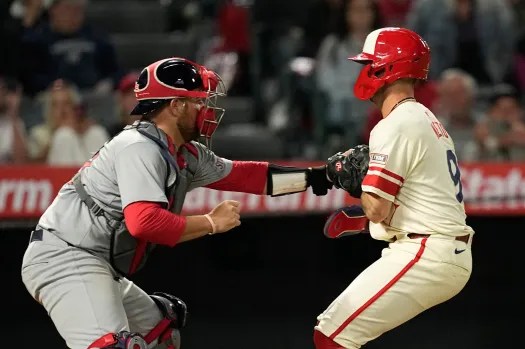
Cardinals catcher Pedro Pagés (left) must have pitied Angels shortstop Zach Neto caught cold on the suicide squeeze that wasn’t on Tuesday . . .

Ron Washington must have returned to managing with the idea that the job credentials now require he be in shape enough to throw players under the proverbial bus. Even if it wasn’t their fault his orders couldn’t be executed without at least one fatality.

The Angels manager who called for a bases-loaded suicide squeeze Tuesday had only one thought after Luis Guillorme tried to obey orders on a pitch you’d have required a door for making contact: It was all Guillorme’s fault.

Cardinals reliever JoJo Romero couldn’t find the strike zone with a search party. It took the lefthander a full count to strike the Angels’ eighth-inning leadoff man Jo Adell out. Zach Neto went to a full count before doubling down the right field line, before Romero walked Kyren Paris and Nolan Schanuel to set up the ducks on the pond.

Lefthanded-hitting Guillorme at the plate and Neto on third were given their suicide squeeze orders on a 1-1 count. Romero went into his delivery and Guillorme squared to bunt with Neto charging down the line for home. Except the pitch was well out of Guillorme’s reach, and Neto was a dead man.

Guillorme hadn’t been an Angel for a full week. Washington’s postgame comments must have made him feel as though the nearest available cave wasn’t deep enough for him to hide. “He didn’t do the job,” the manager said. “It wasn’t anything I did wrong. He didn’t do the job. I would have rather went to the ninth inning with a 6-6 lead than gone to the ninth inning the way we did.”

Aside from the brain fart that let Washington speak of a 6-6 lead, he was even more wrong about the erratic Romero: “Wild? He was throwing the ball in the strike zone,” the manager insisted. “Why are you making excuses? He was throwing the ball in the strike zone. (Guillorme) did not get the bunt down. Period.”

I’ve watched the video several times. Romero’s slider went at least two full feet or better outside the zone. Unless Washington thought Guillorme had heretofore untapped diving talent—or looked in the moment like the late behemoth Frank Howard (all 6’7″ and airplane-like arm span of him)—the only way Guillorme might have reached that pitch would have been to throw his bat toward it.

The ball was outside far enough that, even if Guillorme could have gotten the farthest end of his bat on it the ball might have ticked foul, forcing Neto back to third. In that instance, any element of surprise (perhaps the key element in executing a suicide squeeze) would have dissipated likewise. Of course, with the way Romero was throwing Guillorme might have gone from there to draw the game-tying bases-loaded walk, but we’ll never know now.

It’s only fair to say Washington’s intentions were the best. He had lefthander-vs.-lefthander with the bases loaded. He had his man facing a pitcher whose money pitch, a sinkerball, might have been ideal for dropping a suicide squeeze bunt if the pitch came to the plate in the zone. He was trying to avoid a rally-killing, inning-ending double play.

Now it’s even money who was further out of the zone, Romero and his pitches or Washington and his vision. All that’s left to determine is whether Washington turned the play into baseball’s first known murder-suicide squeeze.

With Neto heading home full speed ahead, any thought of Guillorme laying off the pitch was futile. Cardinals catcher Pedro Pagés had set up for a pitch toward the outside corner and was thus in decent position to snare a ball going as far out of the zone as Romero’s pitch went. He had only to hop up to his left and lay his mitt in front of the ball to take it. It looked almost as though Pagés pitied Neto when he stopped the Angels shortstop cold with the sorry-about-that tag.

Four pitches later—you guessed it, another Romero full count—Guillorme struck out swinging to finish the rally killing. The veteran the Angels picked up in a trade with the Braves earlier this month still took one for his manager after the Cardinals banked the 7-6 win. “He made a good pitch. What else can you say?” Guillorme said of Romero. “I tried to get the bat on it. But he made a good pitch.”

It was made good only because Guillorme tried to reach the unreachable. In further fairness it was only the exclamation point on a day when the Angels were as attractive in the field as ten head of cattle with mad cow disease.

Second inning: Angels starting pitcher Reid Detmers wild-pitched Cardinals right fielder Dylan Carson home, before third baseman Cole Tucker threw home wildly off a ground ball, enabling Cardinals second basman Nolan Gorman to score.

Third inning: Detmers let Cardinals first baseman Paul Goldschmidt and designated hitter Alec Burleson pull off a double steal with Carson at the plate. The pair of them had one stolen base between them all year until then and weren’t exactly road runners to begin with. Detmers ended up walking Carson and striking Gorman out, but then he fed Pagés a meatball good enough for Pagés to bag his first major league hit—a three-run double.

The Angels fought their way back, somehow, especially when their catcher Logan O’Hoppe blasted Cardinals starter Sonny Gray for a three-run homer in the fourth and left fielder Taylor Ward send Schanuel home with a sacrifice fly in the fifth. Burleson wrecked the five-all tie with a two-run homer off Angels reliever Amir Garrett in the top of the seventh, but Kevin Pillar—he whom the Angels picked up at the junkyard after Mike Trout went down with his knee injury—pulled the Angels back to within a run with a two-out RBI single.

That set up the 7-6 score Washington wanted Guillorme to close back up with the suicide squeeze. The one Guillorme couldn’t execute on a pitch impossible to reach. The one that prompted Washington to throw Guillorme so far under the proverbial bus he might actually have passed below another bus behind it before coming to a skidding stop.
The Mets simplify the hard way

2019-08-10 LuisGuillorme

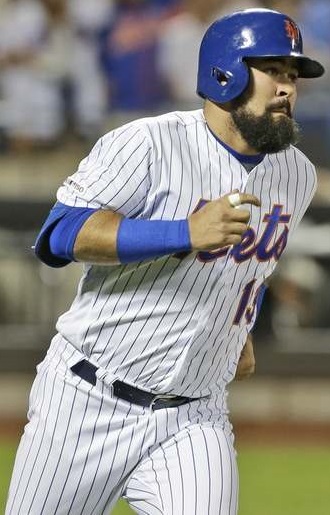
Luis Guillorme defied his unimpressive rookie slash line to help stun the Nats Saturday night . . .

In ancient times Casey Stengel would see ancient Satchel Paige warming up in the enemy bullpen and exhort his Yankees, “Get your runs now—Father Time is coming.” This weekend, the Nationals’ mantra could be, “Get your runs A.S.A.P. Father Time’s predictable compared to these Mets.”

But the Nats don’t really want to know from Father Time, who may be coming sooner than they’d care to know.

Not when they followed a last-minute 7-6 loss Friday night with a 4-3 loss in the next-to-last minute Saturday night. It wasn’t quite the cardiac arrest Friday night was, but it was still enough to tempt them to think of keeping crash carts on call.

Perhaps deploying one out of their bullpen. And another to their manager’s office.

Dave Martinez just didn’t have the heart, or whatever else needed, to send Hunter Strickland—his new bullpen toy, but not even a topic Friday night—out for the eighth inning after Strickland manhandled the Mets in the seventh. But Strickland is two weeks removed from returning from a lat strain that kept him down four months, and Martinez didn’t want to overtax him. Even though he looked smooth enough Saturday night.

This time, his assigned closer Sean Doolittle wasn’t even a topic. Not after the Mets bastinadoed him for four runs in the ninth to win from three runs down Friday night. This Saturday night topic was now Fernando Rodney, the elder, whose previous comparative success against the Mets was two seasons behind and barely visible in the rear view mirror.

But there was Rodney and his trademark, CC Sabathia-like lopsided hat to start the New York eighth. And leading off was a Met rookie, Luis Guillorme, who brought all of a .156/.182/.188 slash line to the plate batting for center fielder Juan Lagares. It should have been meat for Rodney. Instead, he was dead meat.

On a full count, during the making of which Guillorme didn’t even wave his bat, and Rodney didn’t even hint toward throwing the changeup that was once his money pitch and was still reasonably effective, Rodney served Guillorme a meatball. And Guillorme provided the sauce. He sent his first major league home run clean over the right field fence to tie things at three.

Then late-game Mets second base insertion Joe Panik grounded one to short. Sure-handed, sure-footed Nats shortstop Trea Turner had it just as surely. But first baseman Matt Adams mishandled his uncharacteristic low throw, leaving Panik safe to move to second on a followup single lined up the pipe by Jeff McNeil for his first hit of the weekend.

Out came Rodney. In came Daniel Hudson, who’d worked a near-effortless eighth on Friday night. And, after Amed Rosario’s hard grounder pushed the runners to second and third, Pete Alonso checked in at the plate.

The Nats optimist said, we’ll have none of that nonsense this time around. That nonsense, of course, being Alonso drilling Stephen Strasburg for a two-run blast in the fourth Friday night.

The Nats realist said, pick your poison, Davey. Because putting Alonso on to load the pads meant facing J.D. Davis—who’d followed Alonso’s Friday night flog with his own game-tying solo jack in that same fourth. And, who hit one of two consecutive solo bombs in the Saturday night fourth, birthday boy (and former Nat) Wilson Ramos hitting the second of them to tie this game at two.

So Martinez picked Davis. The good news: this time, Davis didn’t reach the seats. The bad news: His fly to right was long and deep enough to send Panik home with what proved the winning run.

And if Martinez couldn’t bear to send Strickland out for a second inning’s work in the bottom of the eighth, Mets manager Mickey Callaway wasn’t as nervous as you might think about sending Seth Lugo out for a second inning’s work in the top of the ninth.

Lugo may have had command issues in the top of the eighth, magnified when Juan Soto hit his second homer of the night, a mammoth drive into the second deck in right, to put the Nats back ahead 3-2. But Callaway gambled that that was just Lugo getting really warmed up. He also wasn’t entirely sure about trusting Edwin Diaz, who’d warmed up during the eighth.

So Lugo, named the National League’s relief pitcher of the month for July, went out for the ninth. Noisy Citi Field and edgy Nats Nation, wherever they were, said their prayers accordingly.

But former Met Asdrubal Cabrera lined out to right.

And Victor Robles looked at strike three on the outer edge, on a night plate umpire Tripp Gibson gave Nats and Mets pitchers alike a very generous outer strike zone.

Then Gerardo Parra—maybe the Nats’ best pinch hitter and bench representative, entering the game with a .319 career batting average against the Mets—batted for Nats catcher Yan Gomes.

And, after Parra fouled off a 3-1 service, Lugo caught him looking at strike three.

All of a sudden, Soto’s two-run homer off Mets starter Noah Syndergaard in the top of the first seemed a small memory to plague Mets fans. Just the way Davis and Ramos’s fourth-inning destruction (setting a new Mets team record for consecutive multiple homer games) seemed to Nats Nation after Soto teed off in the top of the eighth.

Once again, the Mets found a way, any way,  past or around the Nats’ effective starting pitchers, in Saturday night’s case Patrick Corbin. Once again, the Mets got into a bullpen whose 10.10 ERA against them entering Saturday night meant giving them at least one definite victim against who they could fire whatever bullets happened to be handy.

And once again, the Nats couldn’t find a way to make anything stick, even on a night Syndergaard had to shake off an early explosion and some early inconsistency to keep them off the scoreboard further for the rest of his seven innings’ work. Not even on a night when Corbin was mostly his calmly effective self through six.

The Nats compelled the Mets to do things the hard way, late but their bullpen, retooling and all, showed it still had major kinks to un-kink. But the Mets didn’t exactly seem to object to doing things the hard way. It’s coming easier for them that way.

Now, it may not be a question of whether these still-somewhat-flawed Mets can hang with the big boys yet. But it may be a question as to whether these Nats will hang. With the big boys, or at the end of their own noose.