Kerkering Agonistes

Orion Kerkering

Kerkering’s mistake throw home sailing wide left of Phillies catcher J.T. Realmuto as Hyeseong Kim hits the plate with the Dodgers’ NLCS ticket punch. (ESPN broadcast capture.)

In Greek mythology, Orion is the mighty hunter who was felled by either the bow of the goddess of the hunt Artemis or by the sting of a giant scorpion. In National League division series Game Five, Orion was Kerkering, the Phillies relief pitcher stung in the bottom of the eleventh by the gravest mistake of any 21st century Phillie, ever.

If Kerkering wanted immediately to scream for help, you wouldn’t have blamed him. If the next place he really wanted to be was a Himalayan cave at altitude high enough to stop anyone from finding him, you wouldn’t have blamed him for that, either.

Baseball players and other professional athletes are human enough to make grave mistakes on the field. Many of them play for teams whose fans run the gamut from entitled to fatalistic to . . .

Well, put it this way. Again. Those playing in Phillies uniforms represent a city about which it’s said, often enough, that a typical wedding finishes with the clergyman pronouncing the happy couple husband and wife before telling the gathering, “You may now boo the bride.”

So let’s say a prayer, or three, or ten, for Kerkering. Let’s pray that, no matter how the rest of his baseball career goes, he has the heart and soul to stand up, count himself a man, acknowledge that he blew it bigtime enough, and stare the infamous Philadelphia boo birds down without giving in to the temptation to hunt them down for Thanksgiving dinner.

With the bases loaded and two outs Thursday evening, Kerkering served Dodgers center fielder Andy Pages a sinker that didn’t fall from the middle of the strike zone. Pages whacked a two-hop tapper back to the box. Kerkering sprang forward and knocked the ball down, then reached to retrieve it with his bare hand.

Phillies catcher J.T. Realmuto stood fully erect and pointed to first base, with Pages about halfway up the line and Dodgers pinch runner Hyeseong Kim hurtling down the third base line. In a single instant, Kerkering went for what he thought would be the quickest out, as opposed to what every soul in Dodger Stadium expected to be the sure, guaranteed-not-to-tarnish, twelfth-inning-securing out.

He threw home, where he had no shot at bagging Kim, instead of to first baseman Bryce Harper, where he still had a clean shot at bagging Pages. The throw went wide left of Realmuto at the moment Kim hit the plate with the Dodgers’ National League Championship Series ticket punched by his spikes.

Thus ended a game during which neither the Phillies nor the Dodgers flashed anything resembling their usually powerful offenses, while both teams fought a magnificent pitching duel. Whether the 2-1 final was the Phillies losing or the Dodgers winning, take your pick.

Kerkering didn’t duck, either, once he arose from his haunches in front of the mound while the Dodgers celebrated and then let a teammate urge him out of the dugout into the clubhouse for comfort. Then, facing reporters, Kerkering owned up without hesitation.

“I wouldn’t say the pressure got to me. I just thought it was a faster throw to J.T., a little quicker throw than trying to cross-body it to Bryce,” he said. “It was just a horse [manure]  throw . . . This really [fornicating] sucks right now.”

Until Kerkering’s mishap, the Dodgers’ sole score was a bases-loades walk Mookie Betts wrung out of Phillies reliever Jhoan Duran in the bottom of the seventh. And the Phillies’s sole score came in the top of that inning, when Nick Castellanos sent Realmuto home with a double down the left field line.

Other than that, neither side had any real solutions to the other guys’ effective starting pitchers, Tyler Glasnow for the Dodgers and Cristopher Sanchez for the Phillies. These lineups, full of MVPs and big boppers and rippers and slashers, never landed the big bop or rip or slash.

Until Pages swung at Kerkering’s second service of the plate appearance, the story of the game figured far more to be the Dodgers’s Roki Sasaki, the starter who ran into shoulder trouble early in the season, returned to finish the season as a reliever, and now found himself the jewel of a Dodger bullpen about which “suspect” was the most polite adjective deployed.

Sasaki merely spent the set appearing in three games, allowing not one Phillie run, and keeping his defense gainfully employed. The record says he pitched 4.1 innings in the series. He pitched three of them Thursday, the eighth, ninth, and tenth. Whatever he threw at them, not one Phillie reached base. Two struck out; four flied, lined, or popped out; three grounded out. If the Dodgers could have won it in the tenth, Sasaki had a case as a division series MVP candidate.

The Phillies’s usual closer, Jhoan Duran, found himself deployed earlier than usual, relieving Sanchez in the seventh. After Betts’s RBI walk, Duran settled, ended the seventh, and pitched a shutout eighth. Matt Strahm succeeded him for a shutout ninth, and Jesús Luzardo—who was supposed to have been the Phillie starter if the set got to a fifth game—worked a shutout tenth.

Alex Vesia took over for the Dodgers in the top of the eleventh. He walked Harper, then wild-pitched him to second with two outs. Then he fought Harrison Bader—usually the Phillies center fielder but reduced to pinch hitting thanks to a bothersome groin injury—to a full count and a tenth pitch before he pulled Bader into a swinging strikeout.

Luzardo went back out for the eleventh. The tone of the game still suggested it wasn’t going to end too soon. Then Tommy Edman rapped a one-out single down the left field line, with Dodger manager Dave Roberts sending Kim out to run for him. Will Smith lined out deep enough to center field, but Max Muncy grounded a base hit past the left side of second base, pushing Kim to third.

Phillies manager Rob Thomson lifted Luzardo in favour of Kirkering, the 24-year-old righthander who’d become one of their more important bullpen bulls as the postseason arrived. He’d gone from untrusted to unimportant to invaluable in one year.

Now the Phillies needed him to push this game to a twelfth inning in which both teams were all but guaranteed to throw what little they had left at each other until one of them cracked. First, he had to tangle with Enrique Hernández. While Muncy helped himself to second on fielding indifference, Hernández worked out a six-pitch walk.

Up stepped Pages. Into the night went the Phillie season.

J.T. Realmuto, Orion Kerkering

Realmuto was just one Phillies teammate trying to make sure Kerkering could shake it off and not do as Kyle Schwarber advised, let one bad moment define his career and life. (ESPN broadcast capture.)

Kerkering sank in front of the mound as the Dodgers poured out to celebrate around and behind. Nothing mattered to him or to the Phillies now. Not even the unlikely fact that the Phillies had kept Shohei Ohtani, the Dodgers’ best hitter and the best hitter in the game who isn’t named Aaron Judge this year, toothless, fangless, and clawless throughout the set, 1-for-18 with a single RBI hit and nine strikeouts.

The Dodgers weren’t sure what to think, either. “That,” Vesia said postgame, “was a badass baseball game.” Through ten and a half innings, yes. What to call the bottom of the eleventh would probably take time. Even “disaster” seemed like a disguise.

But Thomson and the rest of his players had no intention of throwing Kerkering under the proverbial bus. Realmuto made sure to be the first to embrace and try to comfort him. Castellanos, who’s endured his own share of trials and tribulations, sprinted in to get to Kerkering with brotherly comforts.

“I understand what he’s feeling,” said the Phillies right fielder. “I mean, not the exact emotions. But I can see that. I didn’t even have to think twice about it. That’s where I needed to run to.”

The same mind set overtook Schwarber, who’d done more than enough to push the Phillies toward Game Four after losing the first two in Philadelphia, especially his space launch of a home run in the fourth to tie the game and start the Phillies toward the 8-2 win. (He helped the piling-on with a second bomb, too.) “One play shouldn’t define somebody’s career,” said the Schwarbinator in the clubhouse. “I’ve had tons of failures in my life.”

Just how that team will be defined going forward is up in the air for now. Realmuto, Schwarber, and pitcher Ranger Suárez can become free agents come November. But the Phillies are expected to push to entice Schwarber to re-up, and Realmuto is still too valuable behind the plate for the team to let walk without trying to keep him, too, especially since the organisation is considered very lacking in catching depth.

“I’m thinking about losing a baseball game. That’s what it feels like right now,” said Realmuto after Game Four. “The last thing I’m thinking about is next year.”

Schwarber, too, preferred to stay in most of the moment. “This is a premier organization,” said the designated hitter who sent 56 home runs into orbit during the regular season.  “And a lot of people should feel very lucky that you’re playing for a team that is trying to win every single year, and you have a fan base that cares and ownership that cares and coaches that care. You have everyone in the room that cares. We’re all about winning, and it’s a great thing. That’s why it hurts as much as any other year.”

These Phillies lost the 2022 World Series in six games, the 2023 NLCS in seven, a division series last year in four, and a division series this year in four. What’s up in the air right now just might turn to finding where and making changes enough. Especially since the average age of their regulars this year was 31. (The two youngest regulars, Brandon Marsh and Bryson Stott, are 27.)

Right now, they’re entitled to lie down and bleed. None more so than one young reliever who may not find comfort in knowing that he wasn’t the sole reason the Phillies fell short yet again. He may not find comfort yet in knowing that his teammates outscored the Dodgers by two runs across the entire division series but still couldn’t cash more than one scoring chance in in Game Four to make a difference.

“I feel for him,” Thomson told the postgame press conference about Kerkering, “because he’s putting it all on his shoulders. But we win as a team and we lose as a team.”

His sole comfort for now might be his teammates having his back. “Just keep your head up,” he said was their collective message to him. “It’s an honest mistake. It’s baseball. S— happens. Just keep your head up, you’ll be good for a long time to come. Stuff like it’s not my fault—had opportunities to score. Just keep your head up.”

The question is whether the more notorious side of Philadelphia fandom will try to knock his head off while he tries keeping it up. Maybe—as happened so notoriously to Mitch (Wild Thing) Williams after he surrendered a 1993 World Series-losing home run to Joe Carter—Kerkering’s refusal to hide and willingness to own up should help.

Or not, unfortunately. Even if Kerkering didn’t throw a World Series-losing pitch but committed only a division series-losing error.

If not, it’ll come to whether the worst sides of Philadelphia fandom compel the Phillies  brain trusts to decide, however good his pitching future might be, that it’s not safe for him to see it in a Phillies uniform.

Maybe someone should find ways to ask those sides pre-emptively whether they would have had half the fortitude to own up to a grave on-the-job mistake made in front of 50,000+ fans in a ballpark, and a few million more watching on television, or streaming online, or listening to the radio.

As with too many others who hammered those I call Merkle’s Children—Fred Merkle himself, plus Williams, Ralph Branca, Bill Buckner, John McNamara, Donnie Moore, Don Denkinger, Tom Niedenfeuer, Gene Mauch, Johnny Pesky, Mickey Owen, Ernie Lombardi, Fred Snodgrass, maybe every St. Louis Brown ever—you might be lucky to find a very few who’d answer, “Yes.”
“I’m really at peace with this”

Clayton Kershaw

Kershaw gets to retire as few of the greats truly do—on his own terms.

Often as not, you learn more about those whose careers you admire by the way they face the end than by the ways they did what earned your admiration. In Clayton Kershaw’s case, it might not be learning but re-learning.

When Kershaw froze the Giants’ Rafael Devers like ice cream with a strike-three fastball that could have been accused of clogging up the passing lane to open the top of the fifth Friday night, his mates in the infield surrounded and hugged him, then he handed the ball to Dodgers manager Dave Roberts. Roberts’s final season as a player was Kershaw’s first.

Now, Roberts put an arm around Kershaw and congratulated him on the career that’s written his likely first-ballot Hall of Fame ticket. Kershaw had only one reply: “I’m sorry I pitched so poorly tonight.”

Then, the 37-year-old lefthander looked toward his wife and four and a half children (Mrs. Kershaw is expecting their fifth) in the stands and motioned to the Dodger Stadium crowd before walking down from the mound and toward the dugout. He gave the crowd the curtain call they all but demanded, knowing they’d seen him pitch at home for the final time, then disappeared.

“I’m kind of mentally exhausted today, honestly,” he said after the Dodgers finished the game with a 6-3 win, “but it’s the best feeling in the world now. We got a win, we clinched a playoff berth, I got to stand on that mound one last time. I just can’t be more grateful.” Note the order in which he listed all of it. We first, I second.

That attitude enabled Kershaw not just to rule the earth from the mound in his prime but to pick up, dust off, start all over again after more mound heartbreak than the all-time greats should be allowed. When he triumphed, it was splendor on the mound; when he didn’t, it was down at the end of Lonely Street to Heartbreak Hotel. Never once did Kershaw take the triumphs for granted or the heartbreaks for finalities.

Clayton Kershaw

Kershaw beginning to deliver the strike three freezer to the Giants’ Rafael Devers, his final regular season batter and strikeout in Dodger Stadium.

No worse hour befell him, perhaps, than the night the Nationals yanked the Dodgers out of the 2019 postseason. The division series night Roberts sent Kershaw in relief of Walker Buehler and Kershaw yanked the Dodgers out of a seventh-inning Game Five jam by striking Adam Eaton out on three pitches. The night Roberts should have met Kershaw en route the dugout, given him the proverbial pat on the posterior, then taken the ball and brought Kenta Maeda in for the eighth to do what the manager later admitted thinking should have been done originally: face Anthony Rendon and Juan Soto.

Oops. Kershaw went out for the eighth. He threw Rendon a 1-0 fastball that looked as though it might catch the corner. Looks were so deceiving that Rendon sent it over the left field fence. The next pitch Kershaw threw, to Soto, was a slider that hung just enough for Soto to hang it into the right field bleachers. Then Roberts brought Maeda in. And Maeda struck the next three Nats out in order.

Those blows tied the game at three each, but Kershaw wasn’t anywhere near the mound when Howie Kendrick wrecked Joe Kelly and the Dodgers with the grand slam that punched the Nats’ tickets to the National League Championship Series. (And, to their eventual World Series conquest.) Some small packs of Dodger fans relieved themselves by running their cars over Kershaw jerseys in the postgame parking lot anyway.

Kershaw couldn’t bring himself to say what had to be said, that his manager inexplicably set him up to fail. Instead, he took the responsibility for himself.

“That’s the hardest part every year,” Kershaw said postgame. “When you don’t win the last game of the season and you’re to blame, it’s not fun . . . Everything people say is true right now about the postseason. I understand that. Nothing I can do about it right now. It’s a terrible feeling, it really is.”

He’d go forth to claim two World Series rings, in 2020 and 2024, even though his fractured toe kept him from pitching in last October other than cheerleading. His career 154 ERA+ leads all still-active pitchers. His 2.85 lifetime fielding-independent pitching rate is second among the active only to the often ill-fated Jacob deGrom. His resumé includes three Cy Young Awards, a Most Valuable Player award, and a no-hitter. Baseball-Reference considers Kershaw the number 20 starting pitcher who ever hit the mound; he was the best starting pitcher of his own time before his body finally started telling him, “That’s what you think.”

The fastball isn’t Little Johnny Jet anymore. The curve ball Vin Scully himself labeled Public Enemy Number One might be headed for Leavenworth. The slider that really turned Kershaw from good to great to extraterrestrial has lost just enough of its slide. But he is still Clayton Kershaw, and he will still have a role in the Dodgers postseason. Even if it’s coming out of the bullpen. He’ll be valued, even if he’ll let other arms hog the headlines for better or worse.

He didn’t pitch as poorly as he thought he did Friday night. Sure, he surrended a pair of earned runs and walked four while scattering four hits otherwise, but he struck six out in his 4.1 innings’ work. Even if that freezer to Devers looked borderline enough that you could wonder whether plate umpire Lance Barksdale might have let the moment and the legacy inform his judgment.

Kershaw Family

L to R—Cooper, Charley, Chance, Ellen, and Cali Kershaw contribute to the ovation for their future Hall of Famer as he’s about to begin his final regular-season Dodger Stadium start.

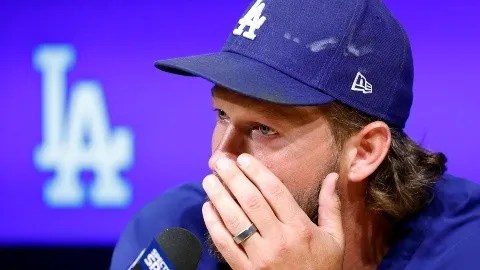
The night before, Kershaw made his pending retirement official, after an annual flirtation with the idea. True to form, he was humble and appreciative, right down to letting his wife share the moment by way of reading a letter she wrote him for the occasion:

From my perch, I have been uncomfortably pregnant, nursed newborns, rocked them to sleep to the roar of the seventh-inning stretch to get their last nap in. Fed them baby food, pouches, teething with crackers, changing blowout diapers, been frazzled with toddlers, tantrums and meltdowns, chased them through the concourses. A Mary Poppins bag filled with tricks and games to keep them occupied, and ironically teaching them the ins and outs of baseball. Explaining all the numbers on the scoreboard and the concession line, the ballpark food.

(I’ve) cried over some really hard losses and some really incredible milestones. (I’ve) watched our kids fall in love with the game, with the players and watching you pitch. Singing “Take Me Out to the Ballgame,” chasing beach balls, ducking from fly balls, spilling food and popcorn all over the fans below them. (I’ve) done it thousands of times, thousands of bathroom runs, all in the stadium. The workers and ushers are (our) best friends now.

A tear crept down Kershaw’s cheek as he read it.

“I’m really not sad. I’m really not,” he said later in the conference. “I’m really at peace with this. It’s just emotional.”

Few of the greats get to choose their own retirement terms. But they show more of what they’re made of when they do so than they ever showed on the field. Kershaw facing the end, whenever it may prove to be, showed more than any triumph and transcended any tribulation. No wonder grown adults wept for and with him.

Davey Johnson, RIP: “Forward thinker with old-school soul”

Davey Johnson

Davey Johnson at a 2016 reunion of his 1986 Mets. L to R: Keith Hernandez (1B), Jesse Orosco (RP), Ray Knight (3B), Lee Mazzilli (OF-PH), Johnson. They made the Deltas of Animal House resemble monks.

In 2012, on the threshold of managing the Nationals to their first National League East title after they moved from Montreal, Davey Johnson had mortality very much on his mind, after his one-time Mets player and lifelong friend Gary Carter lost a battle with brain cancer.

Johnson had seen Carter the previous winter and played golf with him at Carter’s charity event for needy children. When The Kid died, Johnson couldn’t bring himself to attend the funeral. “He would want me to be doing what I loved and not crying over him,” Washington Post writer Adam Kilgore remembers Johnson saying. “I don’t want nobody crying over me, either. It’s that simple. It may be callous, but I don’t look at it that way.”

The man who bookended both Mets World Series championships—he flied out to Cleon Jones to finish the 1969 Miracle Mets triumph, and managed the (shall we say) swashbuckling 1986 Mets to a World Series title—died Friday at 82.

Perhaps former Nats general manager Mike Rizzo described him best, in a Saturday text message to Kilgore: “Davey was a tough guy with a caring heart. One of the great baseball minds of all-time. A forward thinker with an old-school soul.”

During his playing days, Johnson took computer courses as a Johns Hopkins University graduate student and used what he learned to develop best possible baseball lineups. Offering one to his irascible manager Earl Weaver, who spurned it, Johnson said, “I don’t know whether to tell Earl, but the sixth-worst lineup was the one we used most of the time [in 1968].”

When he became a manager in the Mets’ system and then for the Mets themselves, Johnson brought such thinking plus his computer into his clubhouse and dugout. It’s entirely likely that he pushed the door open to sabermetrics as an active game tool and not just a postmortem analysis. He looked for the matchups and took the concurrent measure of his players at once.

But he wouldn’t let you call him one of the smartest of the game’s Smart Guys. “I never thought I was smart,” he said in 2017. “But I love to figure out problems. Through my stubbornness and relentlessness, I get to the end.” Bless him, he had to learn the hard way that the end had more than the meaning he had in mind.

“I treated my players like men,” he once said of his Mets, whom he led out of a dark age through a pair of hard pennant races and second-place finishes before they went the 1986 distance. “As long as they won for me on the field, I didn’t give a flying [fornicate] what they did otherwise.”

Not even when they celebrated a too-hard-won 1986 National League Championship Series by trashing their United Airlines charter DC-10 with partying that made the Gas House Gang and Animal House’s Deltas resemble conclaves of monks.

Maybe Johnson really was a forward thinker with an old-school heart. He treated like men a team with too many players behaving off the field as though their second adolescence came or their first hadn’t ended yet. Such straighter arrows as Hall of Fame catcher Carter plus infielders Howard Johnson, Ray Knight, and Tim Teufel, and outfielder Mookie Wilson, were the exceptions.

“He was just a player’s manager,” said Wilson upon Johnson’s passing. “He made it fun to go to the field. He laid down the law when needed, but other times he just let us play.” Then, and right to the end of his tenure on the Nationals’s bridge, Johnson liked to tell his players, “You win games. I lose them.”

Little by little, general manager Frank Cashen got less enchanted with his team and his laissez-faire manager. No two more opposite minds could ever have come through the Oriole system to bring the Mets to the Promised Land. And almost as swiftly as they got there, Cashen began letting his most characteristic players escape.

“Maybe we’ve made too many trades for guys who are used to getting their asses kicked,” said Dwight Gooden, the pitching star first made human by ill-advised work to fix what wasn’t broken in spring training 1986 and then a long war with substance abuse, to Jeff Pearlman for The Bad Guys Won. The guys who used to snap . . . they’re gone.”

Some also thought Cashen’s gradual dismantling of the team that should have ruled the earth or at least the National League for the rest of the decade took a toll on and the edge off Johnson’s once-formidable in-game cleverness. (He was known to be less than enthusiastic about several trades instigated by either Cashen or his then right-hand man Joe McIlvane.)

Once a second base star with the Orioles who also set a record for home runs in a season by a second baseman as a Brave, Johnson faced the proverbial firing squad in early 1990. It wouldn’t be the last time he brought a team to the Promised Land or its threshold only to be shoved to one side.

He took the Reds to the first-ever National League Central title after the post-1994 strike realignment—despite being told early that season it would be his last on that bridge. Capricious owner Marge Schott apparently didn’t like that he’d lived with his wife before she became his wife.

Then the Orioles made a dream come true and hired Johnson to manage them. Season one: 1996 American League wild card. Season two: The 1997 AL East. Neither brought him a World Series title. The wild card led to an American League Championship Series loss. (The outstanding memory: Jeffrey Maier making sure Derek Jeter’s long drive wouldn’t be caught for a homer-robbing out.) The division title led to another ALCS loss (to the Indians).

Johnson and Orioles owner Peter Angelos weren’t exactly soul mates. Angelos steamed all 1997 when Johnson fined Hall of Fame second baseman Roberto Alomar for missing a team function and ordered the fine to be paid to the charity for which Mrs. Johnson worked as a fundraiser. Johnson admitted soon enough that that was a mistake. (Alomar paid the fine to another charity.) Angelos wanted Johnson to say publicly he’d been “reckless.”

The manager declined, politely but firmly. Then, after the Orioles postseason ended, Johnson waited for Angelos to tell him, ok, you won the division again, that’s enough to let bygones be bygones. “Last week, Johnson called the Oriole owner,” wrote the Washington Post‘s Thomas Boswell, on 6 November 1997.

They talked. And yelled at each other some, too. Aired their differences. Johnson hoped it would help. That’s how it works in the clubhouse. You got a problem with me? Spit it out. Then work it out.

Johnson took a chance on Angelos. When challenged, maybe he’d respond like a big leaguer. Sometimes, after the venting is finished, a friendship develops—even a strong one. Sometimes you just agree to disagree and keep on fussing, like Earl Weaver and Jim Palmer. Either way, you respect each other and pull in the same direction.

Instead, all Johnson heard from Baltimore was silence. So, Johnson had his answer. Angelos wanted Johnson to resign as manager. If the Orioles fired him, they’d have to pay Johnson $750,000 next season . . .

. . . Nobody wants to be where they are not wanted. Especially if they are wanted almost everywhere else. “I’ll make it easy for him,” Johnson said. He wrote to Angelos: “I offer my resignation.”

On the same day Johnson was named American League manager of the year by the baseball writers, his resignation was accepted by Angelos.

Taking the high road helped make sure Angelos wouldn’t try to renege on the $750,000 he still owed Johnson for 1998. You think Angelos appreciated that high road? Not a chance. As with departed Orioles broadcast mainstay Jon Miller, Johnson “asked to be treated with the respect—in contractual terms—that his performance merited.”

In response, Angelos orchestrated the exodus of each. After Miller left, Angelos claimed Miller wanted to leave, contrary to appearances and Miller’s amazed protestations. Yesterday, Angelos said of Johnson, “It seems to me he wanted to move on.” By way of comment, let it be noted that Angelos has one of the rare law firms in which there are no partners. It’s just his name on the door.

Davey Johnson

Once a star second baseman in Baltimore, Johnson presses a point as a successful Orioles manager—who ran afoul of owner Peter Angelos, as Angelos made sure only too many did.

Johnson didn’t remain unemployed for long. (Neither, of course, did Jon Miller.) The Dodgers brought him to the bridge for 1999. He had his first losing season as a manager (though he won his 1,000th game in the job), then turned the Dodgers around in 2000 but fell short of the division title. Back to the firing squad. Again.

He then managed American and (one year) Netherlands teams in international competition before being hired into the Nationals front office. When manager Jim Riggleman decided to quit in June 2011, Johnson was named his eventual successor. He took them to a third-place NL East finish, their best since moving to Washington from Montreal, then led them to the NL East title in 2012 but a division series loss to the defending world champion Cardinals.

That didn’t keep his players from respecting him. Johnson must have come a very long way from the years when a laissez-faire approach to managing men eventually blew up in his face. I could be wrong, but I don’t remember any of his Cincinnati, Baltimore, Los Angeles, or Washington teams accused of trashing jumbo jets, for openers.

“If you come out here and you play hard and really work your tail off,” said his Rookie of the Year winner Bryce Harper during that season, “he’s going to like that. He plays it hard and he plays it right. That’s the type of manager you want.”

“Davey was an unbelievable baseball man but an ever better person,” said longtime Nats mainstay Ryan Zimmerman in a text to Kilgore. “I learned so much from him about how to carry myself on and off the field. No chance my career would have been the same without his guidance. He will be deeply missed by so many.”

On and off the field. Make note.

Johnson did win his second Manager of the Year award guiding the 2012 Nats. He’s one of seven to win it in each league; his distinguished company: Tony La Russa, Lou Piniella,  Buck Showalter, Jim Leyland, Bob Melvin, and Joe Maddon. After a second-place 2013—made slightly worse than it looked when he opened the season saying it looked like a World Series-or-bust year to be—Johnson elected to retire.

“In one respect,” Boswell wrote after his Oriole departure, “he’s different than almost every other manager of his generation. He doesn’t come to ownership with hat in hand. He doesn’t act like he’s lucky to be a big league manager and could never get any other job half so grand. He’s an educated, broadly accomplished man. And he carries himself that way. It has cost him.”

Johnson learned compromise as he aged, both in the game and away from it. So did a few of his former players who once butted heads with him or otherwise made him resemble Emperor Nero fiddling while Flushing flushed. (Darryl Strawberry, with whom Johnson had a relationship often described as “testy,” came to believe Johnson was the greatest manager he ever played for.)

Maybe tragedy had something to do with it, too. Johnson’s daughter, Andrea, once a nationally-ranked surfer but a diagnosed schizophrenic, died of septic shock in 2005; his stepson, Jake, died of pneumonia in 2011. (He also has a stepdaughter, Ellie.) Even the most impregnable man can be wounded. Even men who win two World Series as an Orioles second baseman and one managing the wildest and craziest Mets team of the 1980s.

May the forward-looking old-schooler be escorted to a happy reunion with his daughter, stepson, host of teammates, and Kid Carter in the Elysian Fields.

If they really must visit this White House . . .

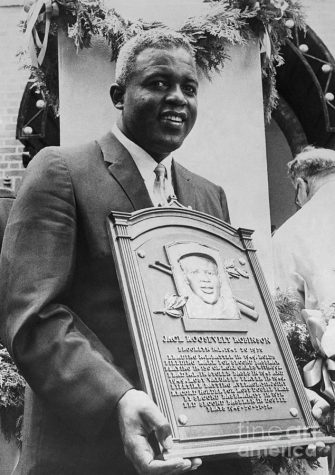
Jackie Robinson

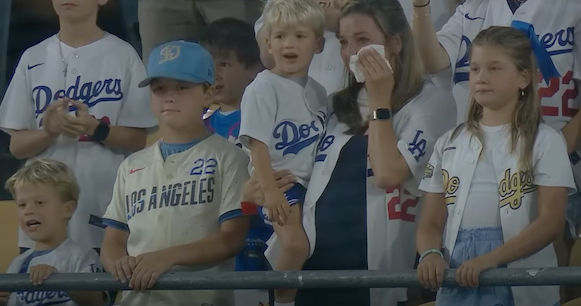
The Dodgers should remind Trump and his minions—quietly, but profoundly—that they don’t hold with Hall of Famer Jackie Robinson’s dismissal as just another DEI hire.

The defending World Series champion Dodgers will go to the White House Monday at the invitation of President Donald Trump. Including Mookie Betts, who once declined the visit when his then-defending World Series champion Red Sox accepted the same invitation from the same president.

Three days before the Dodgers’ scheduled White House visit, Los Angeles Times columnist Gustavo Arellano urged the Dodgers to show up wearing jerseys with Jackie Robinson’s number 42. I hope the Dodgers read that column and heed the advice. Then, after the White House visit, I hope they perform a team march in those jerseys from the White House to the Pentagon, right up to Secretary of Defense Pete Hegseth’s office.

Of course I can dream, can’t I?

Hark back to March. When the Defense Department scrubbed from their Websites the stories of Robinson (an Army lieutenant in World War II, who beat a court martial for refusing to go to the back of a bus), the Navajo Code Talkers, the Tuskegee Airmen, and Ira Hayes, the Native American Marine who was one of the six raising the American flag at Iwo Jima.

When DoD press secretary John Ullyot cited Hegseth saying, “[Diversity, Equality, Inclusion] is dead at the Defense Department.” Until it wasn’t, within just days, following an uproar of the type that’s become second nature to Trump/Trump Administration doings, sayings, undoings, unsayings.

“It’s not a political stance that I’m taking,” the Mookie Monster told The Athletic‘s Fabian Ardaya last Friday. “I know no matter what I say, what I do, people are going to take it as political, but that’s definitely not what it is. This about an accomplishment that the Dodgers were able to accomplish last year.”

Was Betts unaware of Trump’s DoD’s bid to turn Robinson and other wartime African-Americans of the 1940s into non-persons? No one says he or his Dodger teammates should turn the visit into a giant, noisy raspberry. But just wearing the Robinson jerseys would be a more powerful rebuke to Trump than any verbal schpritz.

“Opponents of Trump can’t scream into the void, or among themselves, and think that’s resistance enough,” Arellano wrote.

They shouldn’t cede the traditions of this country, like the flag, the White House and democracy, to a tyrant like Trump just because he has wrapped himself in them.

Going to the White House does not normalize Trump—it’s a reminder that the place is ours, not his . . .

. . . Guys: Y’all pioneered the type of globalism and multiculturalism that Trump loathes, that L.A. now exemplifies and that continues to power the best franchise in baseball. It’s time to stand tall for the Dodger Way at the moment it matters the most.

“We have a lot of different people that are part of this organization,” said Dodger manager Dave Roberts.

Different backgrounds, different cultures, race, gender. So everyone had a different story. Economic situations. So we are all going as an organization. I do know that we’re all aligned, and everyone’s going to have their opinions.

This is not a political thing, and I’m not going to sit up here and make it political. I’m excited to, again, recognize the 2024 World Series champions, the Los Angeles Dodgers.

Roberts should be excited likewise to offer the president a reminder that the Dodgers stand for something above and beyond World Series rings. If they don’t want to wear number 42 Dodger jerseys to the White House, Roberts should think of handing Trump a number 42 Dodger jersey. Hand it to him, and say nothing.

Then—before they lend or spend any further credibility upon a man who rejects that for which the Dodgers have stood, since Jackie Robinson stepped onto a field to begin the Dodger career that launched a powerful rebuke to formal segregation and Robinson himself into Cooperstown and world immortality—Roberts and his players should get the hell out.

Robby the Umpbot wasn’t the end of the world

Robby the Umpbot

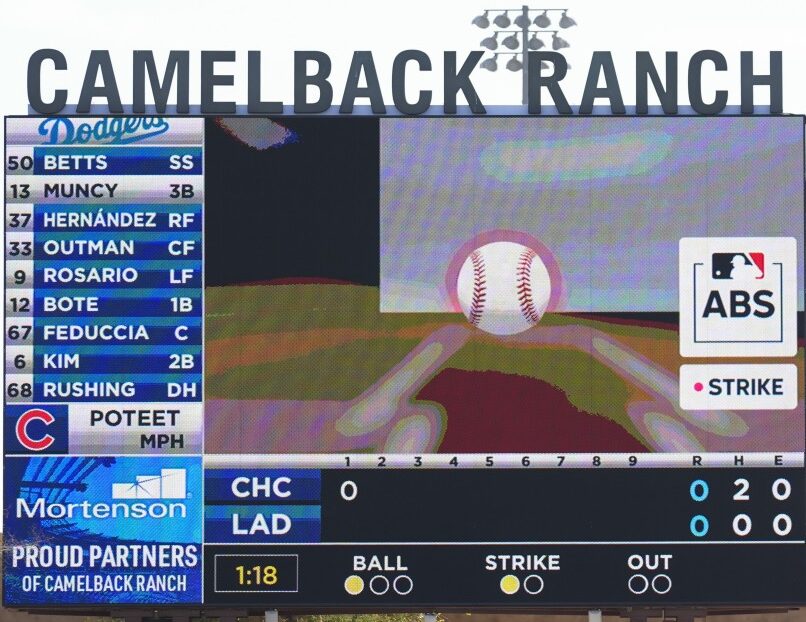
The first MLB deployment of Robby the Umpbot–Cubs pitcher Cody Poteet getting a ball call turned to a strike against the Dodgers’ Max Muncy.

Cody Poteet. Remember the name of this Cubs righthanded pitcher. No, he didn’t surrender three World Series home runs to Babe Ruth in the same game, he didn’t try to start a World Series game the day after pitching four innings in relief, and he didn’t pitch a no-hitter in which he got credit for such a performance despite his defense recording every last out in the game.*

No, Poteet was first on the mound to call for—and win—a ball/strike challenge with aid and comfort from Robby the Umpbot. Even if it was in a spring training exhibition game.

Poteet had Mookie Betts aboard and nobody out in the bottom of the first when he threw Max Muncy a fastball at the knees on 0-1. Home plate umpire Tony Randazzo called it ball one. Poteet said, “Not so fast” . . . and called immediately for Robby the Umpbot’s help. Well, now. The videoboard showed the pitch most certainly did hit the strike zone by the rule book. 0-1 went to 1-1. Muncy ended up looking at strike three not far from the same knee-high location.

Know what happened after that? How about what didn’t happen?

The sky didn’t fall. The earth didn’t move, under their feet or anyone else’s. There were no known tidal waves reported on any world coastline. Donald Trump and his predecessor Joe Biden didn’t suddenly become men of reason and wisdom. The flora and the fauna didn’t make mass entries on the endangered species lists.

About the only unlikely thing to happen from that overturned ball call was the Cubs going forth to batter the world champion Dodgers, 12-4, to open spring exhibition season. They turned a 3-0 Dodger lead after two into a six-run third, added two in the fifth, one in the seventh, and three in the eighth. The only Dodger response was an eighth-inning RBI double.

You might be happy to know that Poteet had an ally on his call for Robby’s review: Muncy himself. “When that ball crossed, I thought it was a strike right away and he balled it,” the Dodger third baseman said postgame. “I look out there and he’s tapping his head and I went, ‘Well, I’m going to be the first one’.”

And, just as with the advent of replay elsewhere, guess what else didn’t happen? The game itself wasn’t delayed unconscionably. Muncy certainly didn’t think so. In fact, he doesn’t mind Robby at all. Neither did Randazzo, seemingly.

“It’s a cool idea,” Muncy said. “It doesn’t slow the game down at all. It moves fast. The longest part was Tony trying to get the microphone to work in the stadium.” Meaning, Randazzo announcing the ruling to the Camelback Ranch crowd.

Come the eighth inning, the Cubs called for another challenge. This time, catcher Pablo Aliendo thought Frankie Scalzo, Jr.’s sweeper nicked the top edge of the zone for strike three with Sean McClain at the plate. Not quite, Robby ruled this time. Ball four.

The rule for deploying the automated ball/strike system (ABS), as it’s called officially, is that only three on the field (pitcher, catcher, or batter) can call for Robby’s opinion and each team gets only two challenges thus far. If the challenging team wins, as the Cubs did, they keep the challenge. When the system was brought online in the minors, the estimates became that the average such challenge was (wait for it!) seventeen seconds.

Neither Poteet nor Muncy were new to Robby, according to The Athletic‘s Fabian Ardaya. Poteet started ten times in the Yankee organisation last year, at Scranton-Wilkes Barre; Muncy saw it while on a rehab assignment off a wrist injury. Muncy’s only issue then was, as he put it to Ardaya, “the technology wasn’t entirely there.”

There’d be certain pitches that you would see and you’d look up on the board and it’d have it in a completely different spot . . . Even the catcher would come back and be like, ‘Yeah, that’s not where that ball was.’ The technology isn’t 100 percent there, but the idea of it’s really cool.

Critics (they were legion) feared Robby the Umpbot would penalise too many solid umpires while punishing not enough errant ones. One conclusion Robby’s early works has stirred is a revelation that might be just as jarring, as The Wall Street Journal‘s Jared Diamond puts it: the players themselves, from the mound to the plate, don’t know the strike zone as well as they think.

“Unlike the replay rules already in place, where managers initiate appeals from the dugout after having time to deliberate,” Diamond writes, “ball-strike challenges have two key differences: They can only come from the pitcher, catcher or batter—and they must happen immediately.

“The result is a format that inserts elements of both strategy and personality into the game even while adding automation. That’s because ultracompetitive, often emotional professional athletes aren’t always particularly good at knowing the right time to ask for a challenge.”

On-field embarrassment comes in infinite forms. Dodgers pitcher Landon Knack, who got knuked by the Mets in last fall’s National League Championship Series, told Diamond of times during his AAA-level days when he challenged pitches from frustration and regretted them at once. “All Knack could do,” Diamond writes, “was stand on the mound and watch the scoreboard animation showing the location of the ball, as everybody in the stadium saw that he was embarrassingly wrong.”

It’s something along the line of the store manager calling la policía after showing up at the bank without the bag full of the day’s cash proceeds, only to double back and realise he or she dropped the bank bag in the parking lot on the way to the car—with the whole thing caught on the store’s security cameras.

Other kinks in the system may well include the choice of players who get to call Robby for help. Diamond says AAA-level managers and players agree on the one who shouldn’t: the pitchers. Knack himself admits, “Pitchers are horrible at it.” Said a Dodgers AAA catcher, Hunter Feduccia, “We probably had a 90 percent miss rate with all the pitchers last year.” Admitted a Royals AAA pitcher, Chandler Champlain, “Being biased as a pitcher, I think anything close is a strike.”

Advises Jayson Stark, The Athletic‘s Hall of Fame writer, “Don’t be That Guy whose heat-of-the-moment challenge decisions leave your teammates shaking their heads and calling you names you won’t want to see displayed above your locker. Be smart. Be cool. Be thoughtful. And control those emotions!”

(Some hitters have been known to have dubious strike zone sense, too. Once upon a time, Hall of Fame catcher Yogi Berra had an impeccable strike zone sense behind the plate . . . and a notorious lack of it at the plate. Maybe the best bad-ball hitter of his time, Berra was questioned postgame about a pitch nowhere near the strike zone or even Yankee Stadium’s postal code that he’d smashed for a home run regardless. Bless his heart, Yogi insisted the pitch was a letter-high strike.)

Relax. Robby’s getting a spring training Show tryout only for now. He’s not expected to spread his wings over the regular season Show until 2026 at minimum.

But if the only kinks in the system other than coordinated calibrations thus far are figuring out who should make the challenges and who shouldn’t, you’d have to say Robby’s going to be in good shape and the umpires are going to be in better shape. (They’ll get immediate reminders of the rule book, as opposed to the “individual” strike zone.) And, the game is going to be in the best shape.

* For the record, the Cub pitchers who delivered those non-feats were, in order, Charlie Root (1932), Hank Borowy (1945), and Ken Holtzman (1969).

This essay was written for and first published by Sports Central.