The Rays off script, the Dodgers on top

Clayton Kershaw opened the 2020 World Series with more than a flourish.

Somehow, no matter what the pandemic threw down in baseball’s way, we managed to arrive at the World Series. Somehow, the game’s 99 Cent Store from Tampa Bay bumped, pole vaulted, and sky dove to a Series against the game’s Amazon from Los Angeles.

In Globe Life Field, the brand-new playpen of the Texas Rangers. Where the turf is artificial, the roof makes it resemble the hangar for a Boeing 747, and you can just can all the hoo-ha about the wonders of a neutral-site World Series.

The Dodgers entered with a sort-of home field advantage.They’ve been playing at Globe Life from their National League division series forward. With the pandemic-inspired divisional geography schedule on the irregular season, the Rays never got to play the Rangers even once.

They’ve been been playing there from their division series forward. With the pandemic-inspired divisional geography schedule this irregular season, the Rays never got to play the Rangers even once. And the Dodgers sure took advantage of that inadvertent home-field advantage of a sort Tuesday night.

They waited out a hard labouring Rays starter Tyler Glasnow, aided and abetted by Rays manager Kevin Cash forgetting his well-tested plot, then flipped their merry-go-round to cruising speed from the fourth through the sixth innings, and beat the Rays in Game One, 8-3.

Clayton Kershaw did more than his share starting for the Dodgers. With the continuing questions about his overall postseason life of bad fortune, Kershaw brought the best of his new self to bear, his sliders out-numbering his fastballs, striking out eight through six and getting nineteen misses on 38 swings against him for the highest single-game whiff rate of his entire major league life.

“Kershaw was dealing,” Cash said postgame. “You see why he’s going to the Hall of Fame one day.”

What nobody could see clearly was why Cash pushed his luck with Glasnow labouring to survive, his eight strikeouts negated by six walks—including the leadoff pass to Max Muncy opening the bottom of the fourth to start the Dodgers’ fun—and with only a 2-1 deficit against him when he came out of it.

Will Smith grounded Muncy to second almost right then and there. But Cody Bellinger—the man who rang the Atlanta Braves bell so resoundingly in the seventh National League Championship Series game—hit the first pitch into the Dodger bullpen in right center field. After walking Chris Taylor to follow and wild-pitching Taylor to second, Glasnow was lucky to escape with his and the Rays’ lives on a pair of back-to-back strikeouts.

That’s where Cash moved against his own successfully established grain. The Rays live and prosper on not letting the other guys get third cracks at their pitchers and thus keeping their pitchers from falling into position to fail or get failed. They play that game better than most and rolled the American League’s best irregular season record for their trouble.

Cash withstood the alarms blasted after he lifted Charlie Morton in American League Championship Series Game Seven after five and two-thirds efficient innings when trouble brewed with the Rays up 3-0. The move aligned perfectly to the Rays’ usual M.O. and it paid off with a pennant.

On Tuesday night, though, he left Glasnow in for the fifth despite 107 pitches to that point. With Ryan Yarbrough throwing in the Rays bullpen, Glasnow walked Mookie Betts on four straight balls following an opening strike. Over the past three seasons including a 34-start span, Glasnow had only thrown 100 pitches or more in a game three times, and Tuesday night wasn’t exactly one of his prime outings.

Cash still didn’t make a move after the walk to Betts. Room enough for the Dodgers to boot the merry-go-round. Glasnow walked Corey Seager after Betts stole second without a throw on a low pitch. He struck Justin Turner out, somehow—except that Betts and Seager delivered a near-textbook double steal.

Then Max Muncy bounced one right to Rays first baseman Yandy Diaz. Diaz threw home. This was supposed to be one of those plays the Rays’ usually larger-than-life defense executes with an arm missing and half asleep. Except that Diaz’s throw arrived up the third base line and Betts slid into the plate while Seager took third and Muncy stood safe at first.

“The at-bat with Muncy right there,” Cash said post-game, “just was hoping it felt like [Glasnow] was the best guy to get a strikeout.” Not on a night when only 58 of Glasnow’s 117 total pitches were strikes. Glasnow himself acknowledged trying to rush things a little too much in the beginning, but once he adjusted that he thought his mechanics were off.

“I have to execute pitches better and hold runners better,” he said, admitting the latter is probably his weakest attribute. “Later in the game, I wasn’t really able to throw anything for a strike except the heater. I think the changeup, I probably should have thrown that a little bit more . . . That curve ball, later on, I really didn’t have much feel for it.”

Smith knocked Seager home and Muncy to third with a jam-shot single to center. Finally Cash brought in Yarbrough, a good relief pitcher but a young man whose career to date includes that he’s vulnerable pitching with one out and rare (for him) inherited runners but better when he starts an inning clean.

The lefthander got rid of the lefthanded Bellinger on a pop up to third, but righthanded Chris Taylor lined Muncy home with a clean single to left and pinch-hitter Enrique Hernandez sent Smith home by shooting a base hit between short and third.

Yarbrough escaped with no further damage. Cash sent Josh Fleming out for the sixth. The Mookie Monster sent his first pitch into the right field seats. An infield pop out later, Turner and Muncy doubled back-to-back. Fleming didn’t surrender another run through his next two innings worth of work but that came under the too-familiar heading of taking one for the team.

Not that the Rays left things uninteresting on their end. They chased Kershaw’s relief Dylan Floro with one out in the seventh. Manuel Margot singled right through the middle infielders and Joey Wendle drove on to left center that Bellinger gave a great chase until the ball hit off the heel of his glove, setting the Rays up with second and third.

Then Cash sent Ji-Man Choi to bat for Willy Adames. Dodger manager Dave Roberts brought in lefthander Victor Gonzalez to face the lefthanded Choi. Cash pulled Choi for division series hero Mike Brosseau. And Brosseau lined Margot home with a single to right with Wendle stopping at third. He didn’t stay long. Kevin Kiermaier—whose fifth-inning solo home run was his first hit since being hit by a pitch in ALCS Game Three—lined a single to right to send Wendle home.

It was the final Rays homecoming of the night, but it almost wasn’t. Rays catcher Mike Zunino lined a missile right through the box that Gonzalez snatched just sticking his glove to his right, the ball’s force spinning him right into position to throw and double up Brosseau scrambling back to second. A hair off line or the glove missing by a hair and that missile might have been an RBI single with the Rays still swinging. Might.

The Rays tried to flip their own merry-go-round switch and the Dodgers succeeded in throwing a stick into the motor belt, with Pedro Baez and Joe Kelly finishing up throwing the spotless final two innings.

It was also a night to make history. Kershaw nailed his 201st lifetime postseason strikeout, moving him into second place behind his fellow likely Hall of Famer-to-be Justin Verlander. Betts became the first player in World Series history to homer, steal, and score twice in the same Series game. Cash became the first Little League World Series player to manage in the World Series when he grew up.

“It’s great to get the Series going with a win,” said Kershaw to reporters after the game. “That’s the biggest thing, for us, is to get going. Get that first game—it’s always important to get that first game of a series. Just for me, personally, it’s awesome, you get to pitch well and get a win in a World Series. Like I said, I’m just thankful for another opportunity.”

Bellinger going deep looked like a man who shook off the shoulder dislocation his NLCS bombing brought when it happened during the dugout celebration. He took no chances this time.”I said it before the game,” he told reporters post-game. “If I hit one today, I’m not touching anyone’s arm. I’m going straight foot.”

Since he hit the first Dodger bomb of the Series, Bellinger got to lead the first such dance. Appropriately. And you thought last year’s World Series champion Dancing Nationals knew how to bust moves and cut rugs.
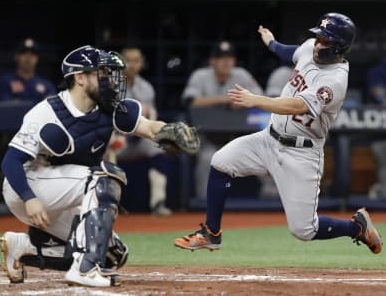
David and Goliath face elimination

2019-10-08 TravisDArnaudJoseAltuve

“They played beautiful defense, especially in that play right there.”—Jose Altuve, about the relay that nailed him at the plate above.

Sometimes you can’t afford to respect your elders. As in, when they’re on the mound on short rest, their less-than-well-rested arms and bodies refuse their lawful orders, and it’s still now or never until your American League division series is over.

There probably isn’t a Rays player or fan alive who doesn’t have a world of respect for Justin Verlander. There isn’t any baseball person alive lacking in such respect. Even at 36, the man has skills, the man has brains to burn, the man has no fear, the man has class, and the man has heart.

And when he says he wants the ball no matter how much rest it wouldn’t be on, nobody says no to Verlander. Not his manager. Not his front office. And sure as hell not Astroworld. Saying no to Justin Verlander with his cred is like it once was telling Evel Knievel the Snake River Canyon wasn’t going to be his new best friend.

But when even a Hall of Famer elects to take the mound in a bid to kick his team into the League Championship Series no matter how fully rested he isn’t, no matter how obedient his slider isn’t, there isn’t a Ray or anyone else alive either who’d spot him with his command gone AWOL and refuse to get the drop on him before he finds a reserve tank.

These Rays seem like nice guys. So do these Astros. But do you think the Astros would stay nice guys if they faced even a Hall of Famer with his tank down to its final fume? If you do, I have a freshly purchased Taj Mahal I’d like to sell you at cost.

Powerful teams are fun to watch when they dominate as these Astros have done all year long, and the Astros are fun to watch even on their very occasional off days. But there’s nothing like a band of upstarts that nobody else wanted pushing them to the equivalent brink of elimination as the Rays did Tuesday night.

Their 4-1 win over the Astros was as good as blowing almost anyone else out by three times that margin. That’s how tough the Astros are. And that’s how stubborn the Rays are proving to be.

Even if Gerrit Cole takes the mound Thursday back in Houston, delivers just half of what he threw at the Rays in Game Two, and sends the Astros to an American League Championship Series with the Yankees—you want to talk about E.R. vs. St. Elsewhere?—there isn’t a soul to be found who’d say the Rays didn’t prove they could hang with the big boys after it looked at first as though they’d get hanged.

So the Rays got cute sending Diego Castillo out to open, and Castillo got cute striking out the side in the first. And impressing the hell out of Astros manager A.J. Hinch. “Castillo, thank God he was an opener and not a regular starter,” he said after the game. “Having him out there for four, five, six innings would be devastating for anybody.”

The Rays got even more cute after Verlander opened the bottom of the first with a three-pitch strikeout of Austin Meadows. Tommy Pham was cute enough to work Verlander to a 2-2 count including one swing at a pitch missing the low and away corner, then send a slightly hanging changeup into the left center field seats.

A walk (to Ji-Hin Choi) and a single (to Avisail Garcia) later Travis d’Arnaud, whom the Mets thought expendable very early in the regular season, expended a base hit into left center field to send Choi home, and Joey Wendle expended a double down the right field line to send Garcia home. Verlander got rid of Kevin Kiermaier with a swinging strikeout to prevent further disaster but the Astros were in a 3-0 hole.

He’d survive first and second in the second and a man on third in the third, but he couldn’t stop Willy Adames (it almost rhymes with “Adonis”) from hitting the third pitch of the fourth over the center field fence. A strikeout, a line out, and a walk later, Hinch had to admit Verlander’d been had on a night when his spirit was willing but his arm and body demanded the rest of the night off.

For a second night running, the Astros got Rayed.

“A good approach for those guys in the first, and then honestly, I need those infield singles to be caught,” said Verlander after the game, referring to balls the Rays hit just past the Astros’ infielders. “When you don’t have it, you need the balls that are put in play to go your way, and they didn’t. Obviously, not the way you would script it. You know, it sucks.”

Thus the Astros joining up to the Rays bullpenning, which began with two out in the second and Rays manager Kevin Cash lifting Castillo for Ryan Yarborough. Whom he’d lift for Nick Anderson with Jose Altuve on second after maybe the single most important play of the game. Maybe even of the Rays’s season.

Yordan Alvarez, the Astros’ uber-rookie, sent a double to the rear of the yard. Kiermaier picked it off the wall hop and fired a perfect strike in to Adames out from short on the grass behind second, and Adames fired just as perfect a strike home to d’Arnaud at the plate spinning to tag the road-running Altuve about a split second before the Astros’ second baseman’s hand touched the plate.

And pop went the Astros’ best rally while the Rays were at it.

“That,” said Kiermaier of Adames’s strike home, “was probably the most incredible relay throw from an infielder I’ve ever seen. That was such a huge moment for us, huge momentum shift, and it just doesn’t get any better than that.”

Not even Choi turning Michael Brantley’s line drive into a single-handed double play in the sixth, bagging George Springer returning to the pillow while he was at it. That was child’s play compared to The Kiermaier-Adames Show.

And Kiermaier gets no argument from Altuve himself. “We’ve been playing aggressive all year long. I don’t see why we shouldn’t do it right now. But sometimes you have to give credit to the other team,” the Astros’ impish second baseman said after the game. “They played beautiful defense, especially in that play right there.”

“You have to tip your cap to those guys,” said Astros catcher Robinson Chirinos, whose just-passing-by solo home run off Chris Poche in the top of the eighth provided the lone Astros scoring. “The relay was perfect. It was textbook. They needed a perfect relay and they did it to throw Jose out at home plate. That was a big difference in the game tonight.”

When Jose Altuve himself gives you a five-star review, you’re being more than—what’s that overcooked word deployed about the Rays?—resilient.

Face it. On one postseason day when the Rays and the Astros had the nation’s baseball stage to themselves, the un-glamorous, un-beautiful, un-sexy, un-bankable Rays stole the show all for themselves. The Beatles themselves couldn’t have upstaged these No-Rays Tuesday night.

They were supposed to be about as deadly as babies in strollers at the plate. They were supposed to be a pitching staff full of anonymous relief pitchers with the occasional token starter and even Cy Young Award winner who couldn’t possibly keep getting away with all that bullpenning jazz.

Never mind that said Cy Young winner, Blake Snell, had Altuve on third and MVP candidate Alex Bregman on first with one out in the ninth when he went in from the pen Tuesday night, then struck Alvarez out swinging before coaxing Yuli Gurriel into the game-ending ground out right up the pipe, where Wendle just happened to be waiting to throw him out.

They have a manager named Cash for a team whose overseers seem allergic to spending any. They play their home games in a toxic waste dump that looks like a warped pressure cooker on the outside and an abandoned landfill on the inside, playing baseball on the last of the sliding-boxed zippered-billiards table surfaces.

And they are resilient, these No-Rays, even if the word “resilient” may turn into something less than a compliment before too long. “We’re good. Everybody uses the word resilient and that’s great but we’re also very good,” Cash told a reporter. “You can use that word resilient over and over and in a way it’s kind of knocking us. The truth is this is a very good team.”

The truth is also that the Astros are finding that out profoundly. The Rays may have finished with the American League’s fifth-best regular season record and the Show’s seventh best, but somehow, some way, the Rays have out-scored the Astros 17-13 in the division series so far. Somehow, some way, they’ve out-homered the Astros six to four. Somehow, some way, they have a better on-base percentage, a better slugging percentage, an OPS slightly over a hundred points higher, and more walks.

The Rays may not survive Game Five, after all, but they won’t leave the Astros thinking it wasn’t a battle royal even if Cole does go second-verse-same-as-the-first. Even if Cole will pitch on regular rest as opposed to Verlander asking to go on three days for the first time in his life and Zack Greinke getting nuked on eleven days’ rest.

“We have a great pitching staff, we play great defence and our bats are starting to come together,” said Pham, with all due modesty.

“People before this series started talking about David and Goliath,” Kiermaier. “I understand they are really good on paper and we might be the team that is not as appealing, but don’t ever count us out. We got guys feeling really good about themselves and we are clicking as a team all year. That is a dangerous recipe for success.”

Sounds a lot like what they once said about the Astros, doesn’t it?

After shoving the similar but slightly less obscure Athletics to one side in the wild card game to get their chance with the Astros—who have all the reputation and intimidation you could ask for in pushing 107 regular season winning chips to the middle of the division series table—the No-Rays and the Astros are equals for standing on the brink of elimination in Game Five.

Even with the Astros holding what they hope is the home field advantage trump. Not that the Astros are worried, necessarily, even if almost to a man they can’t wait to escape the Trop. (The Rays may not necessarily love the joint, either, but their 2019 season record shows ambivalence at best: they were the same on the road as they were at home, 48-33.)

The Astros opened the regular season against the Rays in the Trop and beat them once before losing three straight more. Aside from Games One and Two, they tangled in Minute Maid Park for three in late August. The Astros won the first two of that set; the Rays won the third. It’s not unheard of for the Rays to win in Minute Maid.

“We have done it years ago, when we have the home field. We win at home, then we lost on the road, then we come back home and make it happen,” Altuve said after the game. “So we’ve been here before. There’s no pressure right now.”

Altuve, one of the most intelligent as well as talented players the Astros have ever yielded up, also needs nobody to remind him there was no pressure on the original David, either.

Mortoned and mashed

2019-10-07 KevinKiermaier

Kevin Kiermaier trots home after his three-run homer in the second opened the can against Zack Greinke and the Astros Monday afternoon.

There’s only one problem with having three stud starting pitchers. You might have one of them going for you on too much rest. And just as too little rest is hazardous to a pitcher’s health, too much rest can get him killed to death, too. In Tropicana Field or elsewhere.

Just ask Zack Greinke, stud starter number three for the Astros. Who hadn’t pitched since 25 September. And, who got killed to death in American League division series Game Three Monday by a Rays team looking to keep their season alive in the first place.

After getting Verlandered in Game One and Coled in Game Two, the Rays flipped the script. They didn’t just Morton the Astros in Game Three, they bludgeoned Greinke for five runs before Greinke could get out of the fourth inning alive.

Charlie Morton, who was key enough to the Astros’ World Series triumph two years ago, had just enough to keep the Astros to Jose Altuve’s one-out, first-inning solo launch over the center field wall. And Greinke had little enough to resist early and often firepower, opening the gates to a 10-3 beating.

Remember with apologies to John Lennon: Baseball’s what happens when you’re busy making other plans. Put it in the bank—the Astros didn’t plan for a fourth division series game or anything else that didn’t involve opening an American League Championship Series with Justin Verlander on the mound against whomever. (Likely the Yankees at this writing, unless the Twins awaken somehow in their Game Three.)

Thanks to the Rays abusing Greinke and about half the Astro bullpen, A.J. Hinch had a decision to make, because Game Three exposed the Astros’ one wounding flaw: they, too, have a bullpen described most politely as questionable. And they’re up against baseball’s arguable best bullpen of the year.

It probably took Hinch all of about five seconds to decide. He wants the Rays to get Verlandered again in Game Four. On short rest, which fazes Verlander about as much as the sunrise fazes a rooster. On three days’ rest, which he’s done only once before in his major league life and almost a decade ago at that.

That may or may not prove a break for the Rays whose bats finally arose from the dead in Game Three. And the resurrection only began when a shaky second inning for Greinke climaxed after two hard earned outs sandwiching Avisail Garcia’s single up the pipe, when Greinke plunked Travis d’Arnaud and Kevin Kiermaier almost promptly hit one high over the left field wall

Just when Greinke looked briefly as though he’d find some reserves by bagging Austin Meadows and Tommy Pham on back-to-back swinging strikeouts in the bottom of the third, Ji-Man Choi, the Rays’ hefty and popular first baseman, unloaded on 2-2 and drove one over the right field wall.

And then the Rays really got rude after Morton—who’d been so important to the Astros’ 2017 World Series triumph, especially his Game Seven finish—shook off Altuve’s leadoff double to get an infield ground out and back-to-back strikeouts (Alex Bregman swinging, Yordan Alvarez looking) in the top of the fourth.

Brandon Lowe, the Rays’ second baseman, hit Greinke’s first service of the bottom of the fourth over the left center field wall. A line out, a strikeout, and a walk to Rays shortstop Willy Adames later, Greinke’s afternoon ended almost mercifully and Hector Rondon entered in time for Matt Duffy—who’d taken over at third in the third after Yandy Diaz experienced a sore foot—to single up the middle and send Rondon out in favour of Wade Miley.

Then Meadows sent one over Astros center fielder George Springer’s head and off the wall to send Adames and Duffy home And Pham slashed the next pitch into right for a base hit sending Meadows home. And after Choi walked but Garcia forced him at second for the side, there the Rays stood with an 8-1 lead after four.

The Astros managed two off Rays reliever Chad Roe in the top of the sixth when Bregman singled, Alvarez doubled, and Yuli Gurriel sent them both home with a turf-hop single up the pipe. But Carlos Correa lined out softly to second base and, after Brandon McKay relieved Roe, Aledmys Diaz pinch hitting for Josh Reddick flied out to right.

At the rate things were going by now it seemed almost natural for Adames to drive a 2-2 pitch over the left center field wall to make it 9-3, Rays in the bottom of the sixth. Or, for Choi to reach on an unlikely high throwing error from Bregman at third, Lowe to send Choi to third with a base hit right over Altuve’s reaching leap at second, and—after Joe Smith, the sidearmer, relieved Miley—d’Arnaud to fly deep enough to right to let Choi almost stroll home with the tenth Rays run in the bottom of the seventh.

In the interim, Oliver Drake pitched two strong innings in the seventh and eighth to further save the bigger bulls of the Rays pen for Game Four, namely Nick Anderson, Diego Castillo, and Emilio Pagan, with Colin Poche sandwiching a strikeout between a shallow pop out to center and a fly to normal right field depth to finish it.

These Astros who normally swing with authority went only 1-for-6 with men in scoring position Monday to the Rays going 3-for-7. Altuve’s first-inning launch tied him with Chase Utley for the most postseason home runs (ten) by second basemen in Show history, while Greinke continued his futility in Tampa Bay—he’s never won a game any time he’s ever pitched in the Trop.

Seven of the Rays’ runs scored with two out; seven Rays drove in runs. Not counting Diaz having to leave early with his foot issue, only d’Arnaud failed to hit safely even once otherwise.

And the Astros’ old buddy Morton showed no respect, either, striking out nine in five innings’ work and remaining perfect in postseason elimination games. Doing it Monday tied him at four such postseason elimination wins with Verlander, John Smoltz, Randy Johnson, Curt Schillling, and Clay Carroll.

Tuesday won’t give Verlander a shot at a fifth such win since the Astros still lead the set 2-1, but you can rest comfortably knowing he won’t complain. Unswept as they remain in postseason play, the Rays could still get Verlandered one more time in Game Four. They’ve never needed a running of their bulls as much as they will come Tuesday.