ALCS Game One: Miller time for the Mariners

Bryce Miller, George Springer

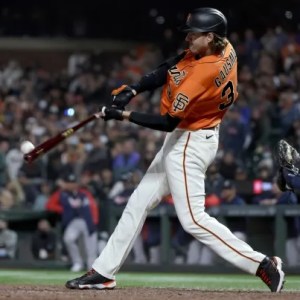
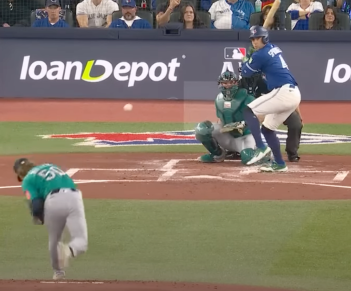
George Springer is about to demolish Bryce Miller’s first pitch of ALCS Game One. It was the only score Miller would allow over six otherwise spotless innings on short enough rest. (Fox Sports television capture.)

At the split second George Springer’s bat connected with Bryce Miller’s first pitch of this year’s American League Championship Series, you could be forgiven if you heard Mariners fans groaning. When the ball banged the Canada Dry sign above the right center field bullpen, you might have heard the groaning turn to moaning.

One pitch, one swing, the 21st postseason bomb of Springer’s career, and only the third leadoff bomb in League Championship Series history since pitch counting began in 1988, according to The Athletic‘s Jayson Stark. Just like that, the Blue Jays took a lead.

And Springer’s opposite-field smash on a fastball away, sending him past Hall of Famer Derek Jeter for fifth place on the all-time postseason bomb list, wasn’t the only reason Mariners fans groaned and moaned.

In the top of that first inning, they groaned, moaned, and fumed when the Mariners didn’t call for a review of that play at the plate on which Cal Raleigh (one-out hit, advancing to third on followup hit) was tagged out when it appeared he’d managed to get his foot on the plate through the legs of Jays catcher Alejandro Kirk. But television replays showed Raleigh’s foot landed a second or two after Kirk tagged his torso.

Were the Mariners unduly alarmed after Springer sprang?

Not after Miller wriggled out of further trouble in the form of a pair of walks courtesy of inducing a pair of line drive outs and a short fly out.

Not after Miller matched Jays starter Kevin Gausman point for point, dollar for dollar, from that point forward, until Raleigh atoned for missing the first inning score by squaring Gausman up, with two out in the top of the sixth, and driving a 2-2 service a little further than Springer’s traveled, about five rows up into the bleachers above that bullpen.

Not after Jays manager John Schneider decided that a followup walk to Julio Rodriguez should be he end of Gausman’s evening before he might incur jn any further damage. That came soon enough when Gausman’s relief Brendon Little wild-pitched Rodriguez to second and surrendered Jorge Polanco’s sharp opposite-field line RBI single to left to crack the one-all tie.

Not after Randy Arozarena wrung a leadoff walk out of Jays reliever Seranthony Dominguez in the top of the eighth, stole second and third while Raleigh suffered a called strikeout, then—after another walk to Rodriguez—came home on another Polanco steak, this time a spanker bouncing three times through the infield and a few more into right.

“I just choked up and wasn’t trying to do too much,” said Raleigh postgame about his bullpen-clearing blast. “I was just trying to get bat on ball and really put something in play, maybe find a hole. I didn’t want to punch out again.” He didn’t seem to mind putting that ball out of reach, out of play, and out of sight, either.

Kevin Gausman, Cal Raleigh

Raleigh is about to smoke Gausman’s splitter for a trip above the right field bullpen . . .

Aside from all that, it was Miller time. For a guy pitching on three days’ rest for the first time in his major league life. For six inning of one-run, two-hit baseball that including getting rid of seventeen of his final nineteen batters. He needed a little comfort from Raleigh at the mound while navigating his way out of that first-inning fire, but that was enough.

Miller went two innings longer than Mariners manager Dan Wilson expected him to go on short rest, only nobody told Miller until he was done for the night.

“They didn’t tell me anything, any plan,” said the lad who threw 27 pitches in the first inning and 49 the rest of his outing. “So I was going out there just letting it rip until they came out and got me.”

“That was incredible from him,” said Mariners reliever Matt Brash (now, there’s a classic name for a relief pitcher), who was one of three Mariners bullpen bulls along with Gabe Speier and Andres Munoz to pitch perfect innings once Miller’s time expired for the evening. Thus the 3-1 Mariners win Sunday night.

“I knew this was the biggest start of my career so far,” said Miller, whom one report revealed stood in Rogers Centre’s center field’s farthest location from the plate staring that direction to help focus, “and I just wanted to get out there and mentally kind of get in a zone and visualize having success on the mound.”

Miller’s season wasn’t always so simple. After a 2.94 ERA in 2004, he ran into elbow inflammation twice and an inflated ERA. He didn’t find himself on his horse fully until some time in August. Then he gave hints of his postseason potential in ALDS Game Four, pitching 4.1 shutout innings against the Tigers.

Remember: These Blue Jays are the ones who demolished the Yankees 34 runs worth in their American League division series and made the Bronx Bombers resemble the Bronx Broken. The Mariners got rid of 23 of the final 24 Jays hitters while they were at it. All of a sudden the Joltin’ Jays didn’t look all that intimidating despite Springer’s first-pitch flog.

Remember, too: These Mariners played fifteen innings Saturday to come out of their ALDS alive and reasonably well and leaving the Tigers for dead. They had to fly cross country and into Canada and endure a four-hour departure delay when mechanical issues forced their airline to get another plane up to Seattle from Los Angeles. They didn’t even have time for a Rogers Centre workout before ALCS Game One.

I’m not sure I’d recommend this as a continuous practise, but it seems as though now and then a team that should have been suffering exhaustion can turn one of the league’s howitzer corps to one side for one night. Now we’ll get to see if the Mariners can manhandle the Jays on a proper night’s sleep and with a proper pre-game workout.

We may even get to see Miller on the mound in a game that would mean the pennant for the Mariners if they win. The lad’s already proving that unthinkable isn’t necessarily impossible.
Starting postseason life with two bangs

Royce Lewis

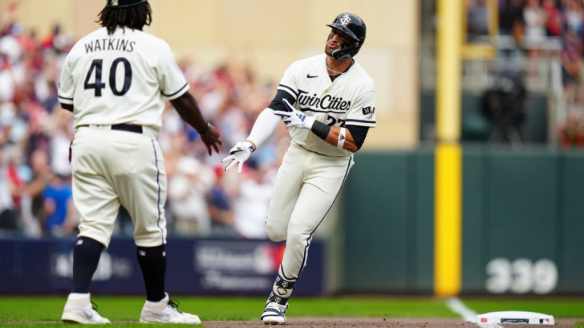
Sometimes things line up too perfectly to pass up on those opportunities.—Royce Lewis, here rounding third off the second of his AL wild card series-opening home runs Tuesday.

Children who grow up with dreams of baseball have numerous supporting fantasies. Rest assured, once they realise they can play the game well, they dream of making the Show. Many of them then dream of going number one in the draft, with or without the glandular signing bonus. Many of those dream of going number one, making the Show, then making the postseason for the first time and making . . .

Waves? Big splashes? Broken precedents? All the above? Ask Royce Lewis, the Twins’ infielder who slotted as the team’s designated hitter for Game One of their wild card set against the Blue Jays Tuesday. The same guy who hit grand slams in back-to-back games against the Guardians in July.

He faced formidable Blue Jays starter Kevin Gausman in the bottom of the first with one out and Edouard Julien aboard (leadoff walk). He worked the count full. Then, he turned on a pitch in the middle of the inside part of the plate, and it sailed on a high line into the left field seats. Game One wasn’t ten minutes old, and Lewis put the Twins up 2-0.

Two somewhat quiet innings later, Lewis checked in against Gausman again. This time, he opened the inning. This time, he didn’t wait for the count to get full. This time, Gausman’s 3-1 service came right down the pipe. This time, the ball took a flight the opposite way, banging off the top of the right field wall, making it 3-0, Twins, turning Target Field temporarily into the world’s largest outdoor nuthouse.

Two plate appearances. Two swings. Two bombs. There have been 58 number-one draft picks since Rick Monday went number one to the then-Kansas City Athletics in 1965. There have been a number of big boppers among them. Only three of those number-ones became Hall of Famers. (Harold Baines, Ken Griffey, Jr., Chipper Jones.) Four, if you count Hall of Famer-in-waiting Joe Mauer.

Not a one of them began any postseason life they had with even one home run, never mind two, never mind hitting the first bomb of any postseason, never mind being responsible for every run scored in their team’s postseason series-opening win, which the Twins won 3-1. The lone Toronto run: Kevin Kiermaier singling Bo Bichette home in the top of the sixth.

“That’s a God thing,” Lewis said postgame. “I’m just blessed to be part of it. It felt like I was blacked out the whole game. My heart was racing.” He keeps blacking out like that and the Twins have an excellent chance of going places other than home prematurely this postseason.

Wherever Lewis’s career goes from here, he’s got bragging rights forever on every fellow member of the Number One Club. He also has the honour of being the man most responsible for ending the Twins’ most peculiar negative achievement, stopping their postseason game losing streak at eighteen. Not to mention only the third player ever, regardless of draft position, to open his postseason life with a first-inning home run, joining Evan Longoria (Rays, 2008) and one-time Twins favourite Gary Gaetti (the eventual 1987 World Series winners).

Eighteen straight postseason games lost over nineteen years, under three different managers and with several franchise icons in the mix, from Mauer to Johan Santana to Torii Hunter to Byron Buxton. It took a guy whose first couple of seasons in the Twins’ fatigues have been disrupted rudely by injuries and who was freshly recovered from a hamstring injury to step up Tuesday and bring his demolition kit to the park with him.

“We just wanted to put an end to something that was very unfortunate to our beloved fans,” said Twins starting pitcher Pablo Lopez, who pitched five and two-thirds strong innings before Kiermaier’s steak single ended his day. “Our fans have been so great to us—they support us, they root for us no matter the situation. It felt right. The way I see it now, we have a new streak going.”

“I thought the place was going to split open and melt,” said Twins manager Rocco Baldelli—who has a pair of postseason home runs on his own resumé, including in the 2008 World Series for the Rays. “Honestly. It was out of this universe out there on the field. The fans took over the game. They helped us win today.”

The Twins’ fielders took over when the fans didn’t. There was center fielder Michael Taylor stealing a prospective game-tying double from Matt Chapman with a flying leap against the fence in the top of the second. There was, especially, Kiermaier’s chopper in the fourth, sneaking away from onrushing Twins third baseman Jorge Polanco.

Bichette on the run from second thought he had a shot at scoring. Plantaar fasciitis-addled shortstop Carlos Correa thought otherwise. He yanked himself running to his right, picked the ball barehand as Bichette headed down the third base line, threw off balance, and managed somehow to get the diving Bichette out by about the full length of a catcher.

“If you like watching the biggest players making the biggest plays in the biggest games,” Baldelli said, “then you should go watch that play. It was fantastic.”

Lewis had the fantastic franchise wrapped up in the first and the third, though.

“Some people believe in fate,” he said. “Some people believe that the things we do today drive what we do tomorrow. But sometimes things line up too perfectly to pass up on those opportunities.”

He had two pitches line up just that perfectly as ironclad evidence.

The Dodgers give the Giants a Game Two Belli-ache

Cody Bellinger

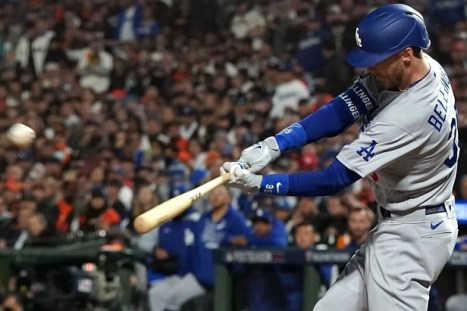
Cody Bellinger, hitting the Game Two-breaking two-run double in the sixth inning Saturday night.

If Cody Bellinger is finally, reasonably healing from everything that turned his regular season to waste, the timing couldn’t be better. For his Dodgers, and for himself.

First, he set up Chris Taylor’s wild card game-winning two run homer with a sharp theft of second base last Tuesday. Now, in division series Game Two, Bellinger started putting the game out of the Giants’ reach Saturday night with a sixth-inning, two-run double off Giants reliever Dominic Leone.

On a night that the Dodgers’ bats re-awakened following their half-asleep Game One loss in San Francisco—even starting pitcher Julio Urias managed to join the fun—Bellinger wasn’t exactly the most prolific Dodger at the plate, just the most important one.

With Trea Turner on second after a leadoff double lined down the third base line, and Will Smith walking his way aboard for first and second, Giants manager Gabe Kapler lifted his starting pitcher Kevin Gausman for Leone. Leone walked Taylor in part because plate umpire Angel Hernandez—what a surprise—called what should have been strike three ball three, on a pitch that hit the upper outside corner squarely enough.

Bellinger checked in at the plate next. With the kind of struggling regular season he had, he wasn’t about to look the proverbial gift horse in the proverbial mouth. He drove Leone’s first service to the back of center field, bounding off the wall, sending Turner and Smith home with Taylor having to stop at third.

Leone barely had time to regroup from that blow when A.J. Pollock lined his next pitch into left to send Taylor and Bellinger home while he bellyflopped his way into second safely for the double. Leone got the final two outs getting Urias’s pinch hitter Gavin Lux to ground out to second and Mookie Betts to fly out to center, but the four-run sixth held up toward the 9-2 Dodger win.

Pollock and Taylor collaborated on the Dodgers’ first run of the game in the top of the second, Taylor lining a one-out double into the gap in left center and Pollock going from 2-0 to a free pass to enable Gausman to get rid of Urias the easy way. Except that Urias refused to cooperate.

Something of an outlier among pitchers at the plate (he actually hit .203 in the regular season, 93 points above pitchers at the plate overall), Urias lined one to right to send Taylor home with the first Dodger run. Betts then lined a base hit to left to send Pollock home for the 2-0 Dodger lead.

Except for Donovan Solano’s one-out sacrifice fly in the bottom of the second, and Brandon Crawford singling home late-game entry Lamonte Wade, Jr. in the bottom of the sixth, the Giants had no answer for the Dodgers’ revival at the plate Saturday night.

The Dodgers weren’t about to provide the Giants answers, either. As if to slam a pair of exclamation points down on the salient point, Smith hit reliever Zack Littell’s first pitch of the top of the eighth into a voluptuous parabola that landed a few rows into the left field seats, and pinch-hitter Matt Beaty (for Dodger reliever Corey Knebel) plus Corey Seager added a pair of RBI singles before the inning expired.

But even though Bellinger struck out three times otherwise, that game-breaking two-run double in the sixth trained most eyes back upon him. He looked at last like the 2019 National League Most Valuable Player again, not like the guy who had everyone not looking deep thinking he spent this season sinking into oblivion with a ten-ton weight strapped to his ankle.

All season long, Bellinger tried to remake his swing to use the entire field while his body refused to cooperate. He’d had shoulder surgery last off-season, after injuring the shoulder first fielding several grounders and then celebrating his home run in Game Seven of last year’s National League Championship Series. Then, he missed the first eight weeks of this season after a leg fracture when he was spiked on a play at first base.

He also suffered a hamstring injury and, in September, a non-displacing rib fracture when he collided with Lux on a play in the outfield.

If you don’t think batterings like that can drain a fellow at the plate, you probably haven’t tried playing professional baseball. Bellinger’s tenacity in trying to play through or around those injuries is as admirable as the reality of his futility at the plate before healing completely from those injuries is deplorable.

Especially when the shoulder continued putting limits on his swing, opposing pitchers saw and exploited the resultant inability to catch up to rising fastballs or reach diver-down breaking balls, and Bellinger’s confidence eroded little by little as the season went forward.

Whether manager Dave Roberts was worse continuing to run him up there than Bellinger was in being so stubborn, despite the shoulder not recovering completely from that off-season surgery, it told you how deep this year’s Dodgers really are that they won 106 regular season games despite Bellinger’s injury-driven deflation.

Now, Bellinger could stand on second base in the sixth with a look akin to the many he had after big hits in his MVP season. Now, Roberts could laugh his fool head off trying to explain it postgame: “Mentally, I don’t see how it could hurt him. There can only be upside. He’s wanted to use the big part of the field, and for him to get rewarded was huge. I think there was a big weight lifted off his shoulders.”

If pun was intended, it wasn’t exactly the smartest or cleverest. It was difficult not to think that Bellinger should have had more extended recovery from that shoulder surgery, taken a somewhat extended spring training, and returned in May at fullest possible strength.

It was between sorrowful and infuriating to see Bellinger playing through the short recovery and subsequent injuries and listening to the witless writing him off as just another slumper who suddenly didn’t know what he was doing.

He’s not quite out of the wilderness yet. But watching him drive that Game Two-breaking double gave you almost as much hope as it seems to have given him. “I feel 100 percent, you know?” he said postgame. “I don’t know how my body is, but I feel really good.”

What he did Saturday night was enough to leave the Giants nursing a serious Belli-ache and the Dodgers feeling even better about moving the series tied at one to Dodger Stadium for Game Three.

Even if they might wonder privately which Max Scherzer will turn up on the mound. Will that someone be Max the Knife? Will he be the tired veteran who surrendered ten runs in his final two regular-season starts, before fighting on fumes to pitch one-run, four-and-a-third innings’ baseball in the wild card game? The answer comes Monday.

It’s a Gaus, Gaus, Gaus—sort of

Kevin Gausman

Kevin Gausman isn’t exactly swinging into McCovey Cove here—and he needed a little help from his friend sliding home head first to win Friday night.

Look, I don’t want to be a spoil sport. OK, maybe I do. A little. But anyone getting any ideas about celebrating Giants pitcher Kevin Gausman’s game-winning pinch loft Friday night as evidence against the universal designated hitter . . .

Seriously?

It’s not as though it meant the National League West for the re-tread Giants. They’d already nailed a postseason berth days before. It’s not as though Gausman was the best pinch-hitting option available to manager Gabe Kapler in the bottom of the eleventh with the bases loaded, one out, and relief pitcher Camilo Doval due up.

And, it’s not as though Braves reliever Jacob Webb threw him something with a nasty enough dance to the plate that the biggest boppers in the National League would have had trouble keeping time and step with it.

So come on. Let’s have a little fun with the home crowd in Oracle Park booing the hapless Gausman—who’s actually in the back of this year’s Cy Young Award conversation, having a splendid season on the mound (he woke up this morning with a 2.78 ERA, a 2.88 fielding-independent pitching rate, a 4.2 strikeout-to-walk ratio, and a 10.7 strikeouts-per-nine rate)—because they had no clue Kapler was clean out of position players to send to the plate.

Let’s have a little more fun than that with Webb and Gausman midget-mud-wrestling the count from 1-2 to a full count, because Webb couldn’t find the zone with a search party and a bloodhound and because the Braves handed Evan Longoria and Donovan Solano free passes to load the pads in the first place.

Let’s have a little more fun than that with the Oracle crowd going from lusty booing to standing-O cheering after Webb pumped and delivered a 3-2 meatball that had so much of the zone a real hitter could have turned it into a walk-off grand slam while looking over his shoulder at Brandon Belt in the Giants’ on-deck circle.

But let’s give ourselves a reality check. Gausman’s loft to Braves right fielder Joc Pederson didn’t exactly push Pederson back to the edge of the warning track. It landed in Pederson’s glove while he took a couple of steps forward in more or less shallow positioning.

Shallow enough that the game missed going to the twelfth by about a foot south, on what might have been an inning-ending double play. Except that Brandon Crawford—who’d opened the inning as the free cookie on second and took third on Webb’s wild pickoff throw—had to beat Pederson’s throw home by sliding head first to the plate.

Crawford would have been dead on arrival if he hadn’t taken the dive and traveled beneath Braves catcher Travis d’Arnaud whirling around for the tag that would have gotten the veteran Giants shortstop squarely even if he’d dropped into a standard slide. Even Gausman knows he had a better chance at breaking the land speed record aboard a Segway than there was of him walking it off.

“More than anything,” he said in the middle of his did-I-do-that postgame, “I was trying to not look ridiculous, just take good swings, swing at strikes. Obviously I never would have thought I would have got in that situation coming to the ballpark today.”

Not with a .184/.216/.184 slash line entering Friday night’s follies. Not with a lifetime .036 hitting average entering this season, despite having a reputation as the Giants pitcher with the best bat control at the plate. Not with tending to go the other way when he does connect on those very rare occasions. “Um, well, that’s the first time I’ve pulled a ball,” he said post-game. “Like, in the big leagues.”

Thanks to the rule that says a sacrifice fly doesn’t count as an official at-bat, Gausman’s loft actually cost him four points on his on-base percentage.

The game got to the extras in the first place because, after d’Arnaud himself hit one into the left field seats with two aboard and one out to overthrow a 4-2 Giants lead in the top of the ninth, another Giants pinch-hitter—Solano, hitting for earlier pinch-hitter/outfield insertion Mike Yastrzemski—hit a two-out, 2-2 service from Braves reliever Will Smith only a few feet away from where d’Arnaud’s blast landed.

After not having swung the bat in a major league plate appearance in three weeks, thanks to a turn on the COVID list, Solano at least entered a record book. His game-tyer meant the Giants have hit a franchise-record sixteen pinch-hit bombs this season, and possibly counting.

Gausman, on the other hand, is only the third pitcher in the Giants’ San Francisco era to win a game with a pinch swing. He joins Don Robinson (bases-loaded pinch single, 1990) and Madison Bumgarner (pinch single, 2018) without a base hit for his effort.

The way the Giants have played this year, cobbled together like six parts Clyde Crashcup and half a dozen parts Rube Goldberg, nobody puts anything past them now.

Gausman is respected as one of the nicer guys in the game. Before Friday night’s contest the Bay Area chapter of the Baseball Writers Association of America handed him their Bill Rigney Award for cooperation with the Bay Area press. “He’s been terrific, including during some trying times with his family,” said the San Francisco Chronicle‘s Susan Slusser announcing the award presentation.

But he didn’t really do any anti-DH people any real favours after all. He hasn’t augmented any legitimate case for keeping any pitchers swinging the bat any further than this year. The best thing you can say for his Friday night flog is that he connected. He ought to buy Crawford steaks for the rest of the season for sliding astutely.

This year’s pitchers at the plate woke up this morning with a whopping collective .110/.150/.142 slash line and an absolutely jaw-dropping .291 OPS. They’re also leading the league in wasted outs (388 sacrifice bunts), with the next-most-prolific such among the position players being the shortstops. (55.)

Now, for the money shot. Belt is one of the National League’s more consistent hitters this season. He took a .942 OPS into Friday night’s game. He whacked a two-run homer to vaporise a Giants deficit in the first inning. With one out, would any sane manager ask a pitcher to do anything more than stand at the plate like a mannequin, with a bat like that waiting on deck to hit with ducks on the pond?

Kapler’s living the proverbial charmed life. As a player, he was a member of the 2004 Red Sox who finally won their first World Series since the Spanish flu pandemic. He wasn’t exactly one of those Red Sox’s big bats, but he was a late-Game Four insertion as a pinch runner, with then-manager Terry Francona letting him hang around in right field as the Red Sox nailed the Series sweep in the ninth.

As the Dodgers’ director of player development in 2015, Kapler got away with a feeble response at best, when a couple of Dodger minor leaguers were accused plausibly of videotaping an assault by two young women against a third, plus sexual misconduct involving a player’s hand down the victim’s panties. The team elected not to report it to the commissioner’s office or to the police—and he didn’t go over their heads to do so, either.

Then, Kapler was run off the Phillies bridge because, in two seasons, he couldn’t marry his analytical bent to the live situations in front of him and the Phillies ended up three games under .500 total with him on their bridge.

Now, he has the bridge of the National League West leaders fighting tooth, fang, claw, and charm against those pesky Dodgers with a two-game division lead and fourteen games left. He’d better not get too comfortable emptying his bench again any time soon. His pitchers are only hitting .081 this season. And they won’t always have Crawford on third to bail them out in a pinch.

These foolish things

MLB: Atlanta Braves at Miami Marlins

Braves catcher Brian McCann with the ball that just zipped behind Jose Urena, squarely in his mitt, squarely behind Urena’s leg . . .

It didn’t take even an eighth as long as it took Hunter Strickland to let Bryce Harper have it over a pair of monstrous postseason home runs. But it took long enough, and was just as stupid. The other difference is that the Braves’ Kevin Gausman threw behind, not into the Marlins’ Jose Urena in the second inning Friday night.

If you need to know what Gausman intended, you don’t remember what happened last 15 August. When Urena threw what ESPN Stats & Info determined was the hardest and fastest pitch he’d thrown all year to that point right into Braves Rookie of the Year in waiting Ronald Acuna, Jr.’s elbow to lead off the first.

Urena simply didn’t like Acuna treating the Marlins like batting practise pitchers. If they couldn’t get him out, Urena was going to try to take him out. And the warnings were handed out immediately after the umpires then tossed Urena on the spot.

Friday night, there were no warnings issued going in, not until Gausman—who’d just surrendered the tying run on an infield ground out after hitting Marlins third baseman Jon Berti with a pitch—sailed one behind Urena’s thighs.

When Urena drilled Acuna last August, he was condemned almost universally but quite rightfully for hitting him after he’d put on a long distance show for two nights running. Gausman himself suggested there might be consequences for that after that game.

“I think he decided he was going to handle it a certain way,” Gausman said after that game, which the Braves went on to win 5-2. “I don’t agree with it, but it’s his career and he’s going to have to deal with the consequences.”

You might have thought the consequences would have come sooner than Friday night. Usually though not exclusively someone else in the Marlins lineup might have faced a message pitch. On the same night. Even despite the warnings.

But none went forth that night last August. Or, in the subsequent set between the Braves and the Marlins in Miami later that month, one of which games Gausman himself started. Urena got a six game suspension for drilling Acuna, which a lot of people thought was impossibly lenient in the circumstance, and didn’t face the Braves in that Miami set.

Having sort of telegraphed it after last August’s postgame remarks, Gausman didn’t exactly deny premeditation after the Braves banked their 7-2 win Friday night, either. “Obviously, the umpire thought that there was a reason behind it and decided to throw me out of the game,” the righthander told reporters. “Obviously, MLB’s going to look at it, investigate it, so I’m not going to really comment anything further than that.”

Obviously, too, Gausman had his chances to send the Marlins a message last August if he wanted to. He could have replied in kind when the Marlins batted in the top of the second after Acuna was drilled, despite the warnings, sending one up and in just enough to drop the hint.

If those warnings were too much for him to think about, he could have sent the message later that month when the Braves went to Miami and he started one of the games.

He didn’t do it either time. Whether it was a mutual agreement among the Braves’ pitchers to wait until they might face Urena himself again isn’t known as I write. Just as Urena looked to one and all as though committing a premeditated act last August, Gausman looked the same Friday night.

At least Urena got the start for the Marlins this time, a mere eight months after drilling Acuna. It’s not as though Gausman had three years to plot revenge.

But the late Don Newcombe had a policy of going after the opposition’s hottest lineup hand whenever he thought they needed an immediate message to be sent, whether it was over their pitcher knocking down or hitting a Dodger batter or—as he did once with the Phillies—silencing a bench coach throwing racial insults at the Dodgers’ early black players by dropping Del Ennis, at the time the Phillies’ hottest hitter.

When Cubs pitcher Bill Hands opened a critical September 1969 showdown with the onrushing Mets by knocking Tommie Agee down leading off, Mets starter Jerry Koosman—following Newcombe’s policy—sent one up and in tight to Hall of Famer Ron Santo in reply the next inning.

“I knew right away I was going to go after their best hitter,” Koosman said years later. (Santo led the National League with 112 runs batted in at the time.) “You mess with my hitters, I’m going after your best one. I’ll go after him twice if I have to.” Santo got hit on the wrist as he fell away from the chin music.

“If it didn’t hit his arm,” Mets outfielder Ron Swoboda said, “it would have hit him onside his head.” Mets bullpen coach Joe Pignatano had another verdict: “Koosman won the pennant for us that night.” (Agee didn’t exactly shrivel, either: when he faced Hands again in the third that night, he sent one over the fence.)

Urena looked cowardly drilling Acuna last August after Acuna’d been a wrecking crew at the Marlins’ expense. But Gausman had his chances to send the Marlins a message last year and he didn’t take a one of them. He doesn’t look all that much better than Urena did. And there’ll be those saying his possible five- or six-game suspension won’t be sufficient, either.

The old school, which is discredited often enough and with cause these days, says there do come times to take one for the team. Especially when the season is still young and you’re less likely to cost your team something critical that you would be down the stretch of a pennant race. The Braves may be lucky it happened the third night of May.

If you doubt Gausman’s or the Braves’ premeditation, be advised they called up pitcher Touki Toussaint before Friday night. Guess who went out to pitch for the Braves after Gausman got the ho-heave, stopped the second inning bleeding, and pitched four total innings of one-run, six-strikeout ball to give the Braves’ bullpen a respite.

“In the end, the biggest failure in this situation has to fall on the umpiring crew,” says Call to the Pen‘s David Hill. “Anyone who saw that the Braves called up Toussaint, and that Urena was the opposing starter, had to know what was going to happen. That both benches were not warned prior to the start of the game, or that Gausman was ejected after throwing that pitch, is entirely their mistake.”

Not theirs entirely.

“From the beginning, they were saying I did it on purpose,” said Urena about the Acuna drill and Friday night’s festivities, “but look at how they did it. That’s the way they claim they are professional?” Unfortunately, when it comes to professionalism, Urena isn’t exactly in any position to talk.