So much for a young man’s game

2019-10-08 ZimmermanScherzer

Ryan Zimmerman (left) and Max Scherzer looked older at a postgame presser than they looked playing Game Five of the Nats’ division series against the Dodgers Monday night.

Once upon a time, a generation insisted you couldn’t trust anyone over thirty. Even that was pushing it; to hear some of them talk (I know, because it was my generation, even if the words never quite came out of my own mouth) you’d have thought trusting anyone over 25 was begging for trouble.

At times in recent years it’s seemed as though baseball’s unspoken but unbreakable mottos include not trusting anyone over thirty. Well, now. If thirty is baseball’s new forty, then baseball’s geriatric generation’s been doing a lot of heavy lifting this postseason and beyond. Without walkers, wheelchairs, canes, or portable respirators, even.

It’s hard to believe because it seems like yesterday, sometimes, that he was a hot draft, but Stephen Strasburg—in the Nationals’ original starters-as-relievers postseason scheme—got credit for the win in the National League wild card game with three spotless relief innings. At the ripe old age of 31.

Strasburg also pitched six with a single earned run against him in division series Game One against the Dodgers and takes a lifetime 0.94 postseason ERA into his Game Five start in Dodger Stadium Wednesday. The Nats aren’t exactly a mostly-young team but they’re putting their fate into thirtysomething hands.

That may be the problem. Even with the professiorial beard he wears now, Strasburg doesn’t look his age yet. He still looks like a lad on the threshold of sitting for his final exams in freshman year. He isn’t even close to being as grizzled as Max Scherzer. Few among even his fellow old Nats do.

If you believe in respecting your elders (never mind how often your elders have betrayed your respect, as often they have), things get better from there. Consider, if you will:

* Two 35-year-old Nats, Max Scherzer and Ryan Zimmerman, delivered the primary goods Monday night to push the Nats-Dodgers division series to a fifth game Wednesday. Max the Knife shook off a first-inning solo homer to go six and two-thirds scoreless including a crazy escape from a seventh-inning, ducks-on-the-pond jam, and Zimmerman jolted Nationals Park with a three-run homer into the crosswinds in the bottom of the fifth.

In those hours both Scherzer and Zimmerman looked as though they’d done it for the first time in their lives. Maybe there is such a thing as baseball’s fountain of youth.

* An ancient Cardinals catcher, Yadier Molina, tied Game Four of their division series with the Braves with an eighth-inning RBI single, then won the game with a sacrifice fly in the bottom of the tenth. And, a followup bat flip the young’uns should envy.

* Another Cardinal ancient, Adam Wainwright, pitched maybe the best exhibition of pressure baseball of his life in Game Three. It went for nothing, unfortunately, since Wainwright left the game with the Cardinals behind 1-0. But Wainwright will tell his eventual grandchildren about the noisy standing O Grandpa got as he tipped his hat to the Busch Stadium faithful.

* On the other hand, if it took a young Braves whippersnapper (Dansby Swanson) to tie the game in the ninth, it took an old fart of 31 (Adam Duvall) to pinch hit immediately after and drive home what proved the winning runs with a single up the pipe. And I didn’t notice Duvall carrying a portable oxygen tank with him.

* “We got Verlandered,” Rays manager Kevin Cash said memorably after Pops Verlander, all 36 years old of him, threw seven shutout innings their way in Game One of their division series. And if you think 29 might as well be 30 and therefore on the threshold of dismissability, be reminded the Rays got Coled the following day. As in, Gerrit Cole’s seven and two-thirds, fifteen-strikeouts shutout innings.

* Abuelo Edwin Encarnacion, like Verlander an ancient 36, tied Game One between the Yankees and the Twins with an RBI double in the bottom of the first. A 30-year-old fart named D.J. LaMahieu put the Yankees up by a pair with a bottom-of-the-sixth home run; a 35-year-old creaker named Brett Gardner hit one out one out later, and the Yankees routed the Twins in Game One and the division series sweep.

Lest you think the postseason’s been the sole triumphant province of the senior citizenry, be reminded sadly that Nelson Cruz—all 39 years old of him, who had the regular season of a player young enough to be his grandson (41 home runs, 290 total bases, 1.031 OPS, 4.3 wins above a replacement-level player), and who hit one out to make a short-lived 2-0 Twins lead in Game One—ended Game Three on the wrong side when he looked at a third strike from all 31 years old worth of Yankee closer Aroldis Chapman.

Just as there’s a rule in sports that somebody has to lose, there’s a parallel rule that says sometimes one old man has to beat another old man to win.

A prehistoric Ray, Charlie Morton, took 35 years to the mound on Monday and threw five innings of one-run, three-hit, nine-strikeout baseball at his former Astros mates to keep the Rays alive, barely. And the Rays abused likewise 35-year-old Zack Greinke—who’d pitched like anything except a nursing home denizen since joining the Astros at the new single-season trade deadline—for six runs including three home runs in three and two-thirds innings’ work.

The Yankees only looked like old men when it seemed you couldn’t visit one New York-area hospital this season without finding a group of Yankees among the emergency room patients. The Astros only looked like old men likewise regarding Houston-area clinics this year. Except to their opponents, it’s funny how they don’t look like old men when they play baseball.

Pops Verlander’s getting another crack at the Rays in Game Four. Strasburg the Elder has to tangle with a whippersnapper named Walker Buehler in Game Five. The eyes of us seniors will be upon them.

Unfortunately, there are those elders who behave occasionally like the ancient Alice Cooper lyric: “I’ve got a baby’s brain/and an old man’s heart.” Molina did after he sent the Cardinals toward Game Five. Hands around his throat in a choke gesture aimed at the Braves. In a series pitting two of baseball’s more notorious Fun Police departments, that puts a new twist on police brutality and underscores why respecting your elders is  easier said than done often enough.
How a Verlander Cy would make history

Houston Astros v Toronto Blue Jays

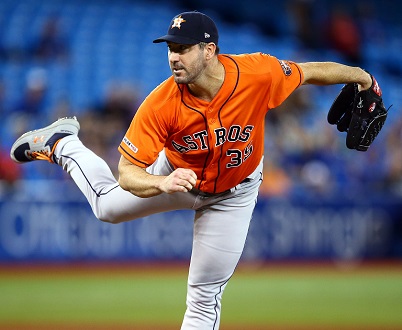
Justin Verlander during his no-hitter against the Blue Jays; if he wins this year’s AL Cy Young Award, he’ll make league history in another way . . .

Even I didn’t catch on and I was watching the game. But Justin Verlander’s no-hitter last Sunday could put him into the history books for reasons other than the no-hitter himself.

That’s because, according to Jayson Stark, five pitchers have thrown no-hitters in the same seasons in which they won Cy Young Awards and Verlander, in theory anyway, could become the sixth. But he’d still make history if he wins this year’s American League Cy—because no American League pitcher has yet won the Cy the same year they went no-no.

The previous five: Jake Arrieta (Cubs), Clayton Kershaw (Dodgers), Hall of Famer Roy Halladay (Phillies), Mike Scott (Astros), and Hall of Famer Sandy Koufax (Dodgers). National Leaguers all. And Koufax did it twice: in 1963, when he pitched the second of his four career no-hitters; and, in 1965, when his fourth proved that practise really makes perfect.

That’s not Verlander’s only shot at the history book this year. (If he does win, it would be his second Cy Young Award.) Suppose he and his rotation mate Gerrit Cole finish one and two in the American League Cy Young Award voting. (It could happen, folks.) According to Stark, it’d be the first time rotation mates ever finished 1-2 in the AL Cy Young vote.

And only one pair of starting rotation mates ever finished 1-2 in a Cy Young Award vote before. No, it wasn’t Koufax and Hall of Famer Don Drysdale. Good guess, though. Koufax won three Cys when it was still a major league award, not one in each league, and he won all three unanimously. Drysdale won it in 1962 even though it’s arguable that Cincinnati’s Bob Purkey probably should have won the award; Dean Chance (Angels) won the 1964 Cy but Koufax was posting a Cy-worth season when it ended after the baserunning injury that exposed his elbow arthritis at last.

It took until 2001 for rotation mates to finish 1-2 in a Cy Young Award vote: Hall of Famer Randy Johnson won the National League award, and should-be Hall of Famer Curt Schilling finished second. The Big Unit, of course, can’t complain since he won five Cy Young Awards including four straight; Schilling’s major Cy Young Award problem is having Cy-worth seasons when someone else was a) just a shade better or b) having a career year.

IF NO KOUFAX—Suppose Sandy Koufax wasn’t in the Show when he copped those three major league-awarded Cy Young Awards? Who would have won them in 1963, 1965, and 1966?

If you go by wins above a replacement-level player, and if Cy Young voters went by it in 1963 (yes, we’re theorising, since nobody thought about WAR back then), the winner would have been . . . Dick Ellsworth, the 23-year-old Cubs lefthander who just so happened to have his career year.

Ellsworth was credited with 22 wins, but he posted career-best full-season 2.11 earned run average (second in the National League to Koufax) and 2.68 fielding-independent pitching. Hall of Famer Juan Marichal won 25 games and had a sub-3.00 ERA for the first time in his career (2.42) and a solid 2.62 FIP.

So how did Ellsworth end up with more WAR than Marichal? Easy: Ellsworth pitched in maybe the National League’s most notorious hitters’ park for a notoriously lousy team still mired in its looney-tooney College of Coaches rotating managers experiment, and he really had to work for those 22 wins. (His ’63 ERA+ was a Show-leading 167.) Marichal’s team was better even though his Giants finished third in the league behind the pennant (and World Series) winning Dodgers and the second-place Cardinals.

Considering that Marichal was credited with 25 wins for a bona-fide pennant contender, it’s entirely possible that if Koufax hadn’t been in the league Marichal would have won the 1963 Cy Young Award. But Koufax was in the league and his ability to miss bats and avoid walks while leading a team to a pennant was just too overwhelming.

Koufax actually didn’t lead major league pitchers in WAR for 1965—Marichal did. So why did Koufax win his second Cy Young Award. Too easy: 26 wins and a fourth no-hitter in as many seasons, which was a perfect game in the bargain. Not to mention pitching the pennant clincher on two days’ rest at the end of a hammer-and-tongs pennant race between the Dodgers and the Giants. And breaking Hall of Famer Bob Feller’s single-season major league strikeout record (with 382) didn’t hurt, either.

But if you went by 1965 WAR Marichal had an MLB-leading 10.3 to Koufax’s fourth-in-Show 8.1. There were two guys in between Marichal and Koufax among the 1965 major league WAR-leading pitchers, both of whom were having their career years: Sam McDowell (Indians) and Jim Maloney (Reds), both of whom finished with 8.2 WAR. And McDowell was arguably better than Maloney that year: McDowell led the American League with a 2.18 ERA and a 2.08 FIP; Maloney’s were a few points higher than Sudden Sam’s.

In 1966, the Dodgers and the Giants went at it for a final time among those 1960s pennant races and this time Koufax led the Show with his 10.3 WAR. He also led with a) his fifth-straight league-leading ERA (1.73, which also led the Show for the third time), his sixth-straight Show-leading FIP (2.07), his fourth Show strikeout title (317), and a Show-leading 27 wins.

Marichal finished right behind Koufax with 9.1 WAR, and Hall of Famer Jim Bunning (Phillies) finished with 9.0. As a matter of fact, only one American League pitcher finished in the top ten Show WAR among the hurlers in ’66: Gary Peters (White Sox), with 5.3.

It’s really to mourn that Juan Marichal, the arguable best righthanded pitcher of the 1960s, never won a Cy Young Award, either the MLB version or the league version, but it wasn’t his fault that a) Sandy Koufax was his contemporary through 1966, and b) someone else not named Koufax had either a career year (Dean Chance, 1964; Mike McCormick, 1967), an extraterrestrial year (Hall of Famer Bob Gibson, 1968), or came into his own completely and to stay (Hall of Famer Tom Seaver, 1969) during several of Marichal’s best seasons.

WHITHER WHITEY?—You may have noticed Hall of Famer Whitey Ford missing from the above discourse. In 1963, the Yankee bellwether got credit for 24 wins while helping lead his Yankees to (what a surprise) the pennant. So why didn’t Ford get much of a Cy Young Award nod that year?

For one thing, Ford wasn’t quite as good as Koufax and Marichal at missing bats; he lived on the ground ball as well as generally avoiding walks. For another thing, Ford got slightly better run support per start than Koufax, Marichal, and Ellsworth did in 1963.

On the other hand, his 24 wins were the second and final time Ford was a 20+ game-winner. And both those seasons came following the Casey Stengel era. The legend about Stengel and Ford is generally true; the Ol’ Perfesser really did tend to save Ford for the Yankees’ best opponents if he could help it.

According to Jay Jaffe’s The Cooperstown Casebook, a researcher named Jason Brannon discovered that Ford made forty percent more starts against the Yankees’ top two rivals than its bottom two in the Stengel era. When Ralph Houk succeeded Stengel starting in 1961, Ford made seven more starts (39) than in the only season Stengel allowed him to make more than thirty. And what do you know: Whitey won the Cy Young Award that year.

Except that he won 25 games but shows only 3.7 WAR. Even if you think Edwin Starr was right (War! What is it good for? Absolutely nothing!), you should know the reason: the 1961 Yankees simply bludgeoned the competition with all those home runs, and they could make any pitcher look like a Hall of Famer, never mind a Whitey Ford who is a bona-fide Hall of Famer.

(The ’61 Yankees are also slightly overrated as a team because of all those home runs and the Mantle-Maris home run chase. If you take the word of Rob Neyer’s Big Book of Baseball Lineups, and it’s a good word to take, five Yankee teams were actually far enough better; from first to fifth—the 1998, 1927, 1939, 1923, and 1937 editions. Me, I’d have thrown in the 1954 edition, if only because there’s something a little sad about a team winning 103 games and not winning the pennant . . . because the Indians chose ’54 to have their career year.)

POOR RICHARD’S ALMANAC—Dick Ellsworth, alas, had a 1966 he’d have just as soon forgotten. At age 26 had a respectable 3.46 FIP but his ERA barely missed reaching 4.00 . . . and he was hung with a major league-leading 22 losses. And the 1966 Cubs finished in tenth place.

The lefthander probably should have suspected it was going to be that kind of year when Topps released his baseball card in the spring. Bad enough: the player shown on the face was righthanded. Worse: The the photograph on the front was actually Ken Hubbs, the Cubs’ second baseman (and 1962 NL Rookie of the Year)—who’d been killed in a February 1964 small plane crash.

The good news is that the 1966 Ellsworth/Hubbs card may not be all that valuable among collectible baseball cards. ComC, the Redmond, Washington-based card and comic trading Website, lists a mint condition Ellsworth/Hubbs at no higher than $55.74. The most valuable Ellsworth card? The 1964 card he shares with Sandy Koufax and Bob Friend (Pirates) showing the National League’s 1963 ERA leaders, at $142.48.

Losing Ken Hubbs was devastating to the Cubs and to baseball, of course, especially given the irony that he took up flying to conquer his fear of it. But Dick Ellsworth didn’t deserve to be embarrassed the way he was on his 1966 baseball card, either.

Previous ejection was Justin time

2019-09-01 JustinVerlander

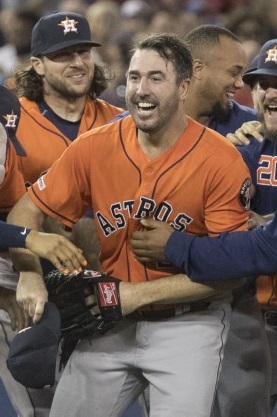
Justin Verlander celebrates after pitching his third career no-hitter Sunday.

If anyone else has thrown a no-hitter in their first outing after one during which he was ejected, I have no record of it. So it’s entirely possible that, in that sense, Justin Verlander’s Sunday afternoon special in Toronto’s Rogers Centre was unprecedented.

Can you just picture some pitcher somewhere arguing with an ump and answering, if and when the ump in question asks why he’s trying to get himself an early trip to the clubhouse, “Nothing personal, but I’d kinda like to throw a no-hitter in my next start, too.”

Or some umpire answering when a pitcher asks why the unexpected or undeserved ho-heave, “Relax, kid, I’m doing you a favour, now you got a good chance of throwing a no-hitter your next time out.”

That assumed those pitchers have anything resembling Verlander’s ability and intelligence. And you can line those who do up on one surfboard. With a little room to spare.

If anyone else’s no-hitter was consummated by an obscure rookie third baseman hitting a two-run homer in the top of the ninth for the game’s only score, then throwing out a far less obscure rookie for the game’s final out, I’m also unaware of it as I write. So Verlander better not have been kidding when he said Abraham Toro was due for a big reward.

Toro ought to get at least a new car (Verlander can afford to buy a dealership, after all, we think) for going above and beyond to make Verlander only the sixth man in Show history to throw at least three no-hitters. Maybe from a Canadian dealership, since Verlander’s the first to throw more than one no-no in the same visitors’ park.

The company he joins? Four Hall of Famers (Bob Feller, Cy Young, Sandy Koufax, Nolan Ryan) and a nineteenth-century deadballer. (Larry Corcoran.)

But I’m pretty sure none of Corcoran’s, Young’s, Feller’s, Koufax’s, or Ryan’s no-hitters featured having to dispatch three sons of former major leaguers (Bo Bichette, Cavan Biggo, and Vladimir Guerrero, Jr.), including two sons of Hall of Famers (Biggio, Guerrero), at the very top of the enemy batting order.

Verlander did. He struck Bichette and Biggio out twice, walked Biggio once, and rid himself of Guerrero on a pair of ground outs to third base and a foul pop to first.

Joining the deadballer may be the most appropriate for Verlander considering he did his Sunday work with a fastball that barely reached 90 mph if at all but a curve ball with more bite than a piranha in danger of missing its three squares on the day. He worked up and down the zone like an elevator operator, back and forth like a vacuum cleaner, and the only thing he had to worry about was whether the American League West-leading Astros would ever get a run on the board for him before his day was finished.

The Blue Jays went to a bullpen game beginning with former Met Wilmer Font, acquired in the Marcus Stroman trade, striking out three with one hit in two innings. Then two more Jays bulls, Sam Gaviglio and Zack Godley, worked three runless innings each, Gaviglio working three perfect with three punchouts and Godley shaking away two Astro hits while punching out two, plunking one, and surviving first and third in the seventh.

Then the Jays turned it over to Ken Giles, the closer and former Astro, having a renaissance season until he hit the injured list for a brief spell around the trade deadline, but who took a staggering 1.67 ERA into Sunday’s contest. And this was a day after he struck out the side to end a 6-4 Blue Jays win.

But Astros third baseman Alex Bregman opened Sunday’s top of the ninth with a double dunked into shallow right field. Giles flicked it off more or less with a three-pitch, swinging strikeout on the Astros’s explosive rookie outfielder/DH Yordan Alvarez, followed by a third-pitch fly out to center by Astros first baseman Aledmys Diaz.

Then came Toro, the switch hitter batting left.. Then came two Giles sliders, the first fouled off and the second ball one down and inside. Then came a four-seam fastball right down the pipe. And there it went the other way into the left field seats. Leaving Verlander to finish what he started, sandwiching a nasty swinging fourteenth strikeout between a pair of ground outs.

And leaving him to history.

“I can’t put it into words,” said the righthander who had four previous shots at a third no-hitter broken up in 2011, 2012, 2015, and last year. “I’ve come so close to the third one so many times.”

Maybe he should have been ejected in the starts immediately preceding those bids, too.