A principled Peter

2019-11-12 PeteAlonso

Pete Alonso hit one for the record book on 28 September, but the NL Rookie of the Year struck a bigger blow for respect on the 9/11 anniversary.

It’s not that Pete Alonso didn’t have the kind of season that deserved the honour. But sometimes baseball award voters are human enough to pick a winner based on something equal to and maybe a little better than his performance—even performance that would blast in neon, as Alonso’s did this year.

Voting Alonso the National League’s Rookie of the Year, they may have thought both.

Alonso’s season performance by itself would have been enough to nail him the award, even if you can make the case that Braves pitcher Mike Soroka—who got the one first place vote Alonso didn’t get—had at least an equivalent season on the mound.

Breaking the rookie season home run record (with a major league-leading 53), creating 126 runs and using only three outs a run to do it, and producing 220 (100 scored, 120 driven in) runs on the season, gets you attention in a big enough hurry. So do three out of a possible six National League Rookie of the Month awards, which Alonso won in April, June, and September.

So does helping put the game back into the game with your enthusiasm, on a team that needed it in the worst way possible this side of the world champion Nationals. The Mets lacked for sharks, baby and otherwise, but thanks to Alonso they became abundant in jersey stripping on game-ending, game-winning hits during their surprising post-All Star break run.

So does a shameless and welcome display of emotion such as Alonso—who’d made the Mets out of spring training on a non-roster invitation—showed when he nailed Soroka’s rotation mate Mike Foltynewicz on the next to last regular season night in New York for the record, then couldn’t hide the tears when he returned to first base.

But so does finding the way to elude baseball government’s edict against special haberdashery commemorating the 9/11 atrocity, as Alonso did for that very anniversary. The Mets and a few other teams wanted to wear such hats; baseball government said no, stick with the official commemorative patches on the sides of the uniform hats.

Alonso said not so fast.

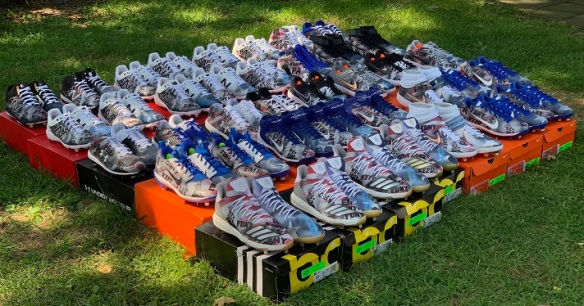
Telling no one but his fellow Mets what he was up to, Alonso gathered up the shoe sizes of his teammates, manager, and coaches, then arranged for special commemorative cleats to be made for the game by Adidas, New Balance, and other top athletic shoemakers. It isn’t every major league rookie who delivers the kind of audacity that ennobles his team and his game.
2019-09-13 Mets911Shoes

The shoes that put the Mets’ best feet forward on 9/11.

The cleats featured American flag striping, the initials of first responder agencies, a small image of New York firefighters raising an American flag at Ground Zero, and a silhouette of the Twin Towers. Making the major league rookie salary of $550,000 for the season, not to mention winning $1 million as this year’s Home Run Derby champion at the All Star break, Alonso paid for every pair of the special cleats himself.

“For me, this season has been an absolute fantasy. I just want to give back. I want to help,” said Alonso, a Florida first grader when the atrocity happened. “I don’t just want to be known as a good baseball player, I want to be known as a good person, too. And I just want to really recognize what this day is about. I don’t want it to be a holiday. I want it to be a day of remembrance of everything that happened. It was an awful day.”

He hatched his podiatric plot well in advance of the 9/11 anniversary, and it’s not exactly impossible that the Mets being so unified as a team on the matter might have kept baseball’s customarily capricious official leadership from sanctioning the team.

It probably didn’t hurt, either, that a little favour fell upon the Mets from the Elysian Field gods that night. Their surprising bolt out of the post All-Star gate could only get them to within three games of the National League’s second wild card, proving that even the subordinate gods work must work within a budget, but they could at least spend a little extra on the 9/11 anniversary itself.

Thus did the Mets, wearing Alonso’s subversive commemorative cleats, shut the Diamondbacks out on . . . nine runs and eleven hits, including six home runs, two (Todd Frazier, Brandon Nimmo) back-to-back in the Mets’ five-run first, and with Frazier and Jeff McNeil each hitting a pair of them before the carnage was finished.

The following night, the Mets again nailed eleven hits off the momentarily hapless Diamondbacks, but this time they were good for eleven runs, the big blow the first of Juan Lagares’s pair of blasts, in the bottom of the third. The center fielder checked in with the bases loaded, nobody out, and the Mets up 1-0 on an unearned run, then hit a full count service from Alex Young into the left field seats.

And any threats of fines or disciplinary measures against Alonso or the Mets over the commemorative shoes went unfulfilled.

Yordan Alvarez, the Astros’ phenom bombardier, was named the American League’s Rookie of the Year unanimously, beating out Orioles pitcher John Means, Rays second baseman Brandon Lowe, White Sox outfielder Eloy Jimenez, and Blue Jays second baseman Cavan Biggio—the son of Astros Hall of Famer Craig Biggio.

By arriving in a June callup after decimating the two highest minor league levels, Alvarez has the second-shortest Rookie of the Year season behind Hall of Famer Willie McCovey. And, as Alonso did in the National League, Alvarez won a trio of American League Rookie of the Month prizes. (June, July, August.)

He premiered by teeing off against another Oriole pitcher, Dylan Bundy. He went on to tie the rookie record for the most home runs in 100 games or fewer, hit righthanders and lefthanders with equal deadly force, and followed an almost invisible American League Championship Series by hitting .412 with one bomb in the Astros’ seven-game World Series loss.

The third Rookie of the Year in Astro history—Hall of Famer Jeff Bagwell won the award in 1991; Carlos Correa (2015) became the first Astro to win it after they were moved into the American League—Alvarez is Alonso’s near-opposite, the strong, silent type. He shares Alonso’s essential humility, but you’re not likely to see him shred the jersey away of any Astro nailing a game-ending hit. Yet.

“He’s a quiet man by nature,” says his manager A.J. Hinch, “and his demeanor is very low key. But he’s always in tune with other players and other people and the information.”

Alonso is the Mets’ sixth Rookie of the Year, following Hall of Famer Tom Seaver (1967), Jon Matlack (1972), Darryl Strawberry (1983), Dwight Gooden (1984), and Jacob deGrom (2014), and only the second Mets position player (after Strawberry) to win the prize. His race for the prize might have been a lot closer, maybe even lost by a hair, if the Padres’ phenom Fernando Tatis, Jr. hadn’t been held to 84 games thanks to the injured list.

Interesting synergy. This year’s Rookies of the Year belong to a pair of teams born from the same expansion draft, for 1962. Neither of whom could possibly have imagined the day to come when one would be the team to be named later when a third expansion team, the Brewers, would be traded to the National League.

But Alonso played all but one game in 2019. And it took the Mets’ often-criticised general manager Brodie Van Wagenen, a former players’ agent, to convince the club to take Alonso north with them when spring training ended, rather than do as too many other clubs have done with promising youth and bury him one more year in the minors for the sake of extended team control.

Unlike in days of Mets future past, there’s a realistic chance that they might be able to lock Alonso down on a longer-term commitment when his first free agency comes within not-so-distant sight. They’ll be freed of major commitments to too-oft-injured Yoenis Cespedes (in danger of missing all of 2020 as well off multiple-ankle and knee surgery) and aging Robinson Cano well enough when that day arrives.

Assuming Van Vagenen makes no more trades that involve importing still-onerous contracts, such as the deal that landed Cano in the first place, the Mets would be able to keep Alonso in the blue and orange for a long enough time to come. Assuming Alonso continues the kind of performance he showed exponentially in 2019, it would be manna for a franchise that often forces its fans to dine on quail.

And in this case we’re not talking strictly about Alonso’s performances at the plate or at first base, where he shook away the periodic hiccup to establish himself as more than capable afield. Whether Alonso proves the equal of Mets legend Keith Hernandez, who revolutionised the position by making it one of infield leadership as well as fielding virtuosity, remains to be seen, but he showed the potential for either or both.

He showed more than the right stuff in uniform. First, he sent a tenth of his Home Run Derby prize money to a pair of 9/11-inspired charities, the Wounded Warriors project (which aids post-9/11 military wounded) and the Stephen Siller Tunnel to Towers Foundation, named for the firefighter who lost his life on 9/11 trying to save lives in the World Trade Center.

Then, he plotted and executed his end-run around official baseball’s official strictures against any 9/11 commemorative gear above and beyond the hat patches. The gesture couldn’t possibly restore the lives lost in the atrocity but they could and did at least indicate to the city battered by it almost two decades earlier that someone playing baseball in a New York uniform understood that baseball’s transcendence sometimes has to wait its turn behind spiritual transcendence.

It wasn’t given to Alonso to electrify the Citi Field audience this 9/11 the way Hall of Famer Mike Piazza did in the Mets’ first game back in the late Shea Stadium after the original atrocity. When Piazza swung on 0-1 against Braves pitcher Steve Karsay with pinch runner Desi Relaford aboard in the bottom of the eighth and hit it far enough over the center field fence to ricochet off a television camera posted on a scaffold. And, prove the game winner for the Mets.

With his family and his fiancee in the house, Alonso had to settle for sending Foltynewicz’s 2-1 service over the center field fence in the bottom of the third on 28 September, pushing him past Aaron Judge as the single-season rookie home run champion and bringing the Citi Field crowd to its feet not just because of the blast itself but because he couldn’t keep his emotions from overflowing in its immediate wake.

With the memory of his 9/11 commemorative subterfuge likely still fresh, the crowd refused to turn off the love as Cano flied out to deep center for the side and the Mets re-took the field. And Alonso stationed at first base finally couldn’t contain himself, lowering his head and crying shamelessly, the magnitude of his accomplishment overwhelming him in disbelief.

It was the perfect night for nice guys to defy Leo Durocher. While Alonso swung his way into the record book, on the opposite coast the Astros’ Hall of Famer-to-be Justin Verlander threw his way into it.

Verlander struck out the Angels’ right fielder Kole Calhoun in the bottom of the fourth for career strikeout number 3,000, and struck Calhoun out again in the bottom of the sixth for season strikeout number 300. Lifting a page from the late Ernie Broglio, Calhoun can say at least that he played with a couple of Hall of Famers and helped put at least one pitcher there.

Unlike Alonso, alas, Verlander’s entry into history came with a p.s. The fourth-inning strikeout went for a wild pitch, enabling Calhoun to first base, where Calhoun stayed only long enough for the next Angel batter, shortstop Andrelton Simmons, to hit one into the left field bullpens. It didn’t stop the Astros from winning the game, but sometimes you just can’t slip further into the books without one misstep.

Verlander’s a very well seasoned veteran and Alonso is a freshly-initiated kid with, hopefully, a long enough career ahead of him. Maybe, if the Mets don’t relapse and see the core of Alonso, deGrom (still young at 31), McNeil, Nimmo, Michael Conforto, J.D. Davis, Seth Lugo, and Amed Rosario as a young enough core to build around and not fool around with, including a postseason or three.

Maybe even a postseason taking the Mets to face the Astros in a World Series. Maybe. If astronauts first walked the moon when the Mets won their first Series at the tender age of eight, and the Nationals could win this year’s World Series entirely on the road, it reminds you of one of baseball’s truly unimpeachable laws: Anything can happen—and usually does. So who’s to say?

Alonso’s uniform number—20—is deemed by Bible scholars to indicate the perfect waiting period, and by numerologists to indicate infinite potential in relationships and diplomacy. Of course. He fell into the perfect waiting period to make his Show debut this season—no waiting, right out of spring training—and, proving that good things indeed come to those who wait, to break Judge’s rookie home run record on the next-to-last day.

His potential on and off the field appears infinite enough. For now you get the parallel pleasure of seeing that not only does the right player swing for the record book, and play to earn a major award, but every so often he proves to be the right man for both.
Hinch didn’t blow it, the Nats won it.

2019-11-01 ZackGreinke

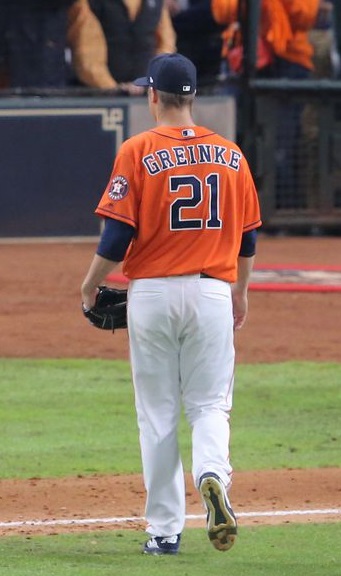
Zack Greinke walks off the field in Game Seven. His manager made the right move to follow. The Nats made the righter one to win.

It’s not going to make the pill any easier to swallow, but it wasn’t A.J. Hinch’s fault. He’s not the reason the Astros lost a World Series they seemed destined to win both going in and while they were just eight outs from the Promised Land.

I know Hinch didn’t even think about bringing Gerrit Cole in if he’d decided Zack Greinke had had enough. I second guessed it myself when first writing about Game Seven. And I was really wrong. Just as you are, Astroworld, to lay the loss on Hinch’s head. The Nats beat the Astros, plain and simple. Through no fault of Hinch’s.

He wasn’t even close to having lost his marble. Singular. He actually managed just right in that moment. It’s no more his fault that Howie Kendrick made him look like a fool right after he made his move than it was his fault the Astros couldn’t bury a Max Scherzer who had nothing but meatballs, snowballs, grapefruits, and cantaloupes to throw, two days after Scherzer’s neck locked up so tight it knocked him out of Game Five before the game even began.

Max the Knife wasn’t even a butter knife starting Game Seven and the best the Astros could do against him was an inning-opening solo home run by Yuli Gurriel and an RBI single by Carlos Correa. Remember, as so many love to bleat, the manager doesn’t play the game. Not since the end of the player-manager era.

And I get the psychological factor that would have been involved if Hinch brought Cole in instead of Will Harris. Likely American League Cy Young Award winner in waiting in to drop the hammer and nail down a win and a trophy. The Nats may have spanked Cole and company in Game One but Cole manhandled them in Game Five.

Even the Nats thought Cole was likely to come in if Greinke was coming out and, as their hitting coach Kevin Long said after Game Seven, they would have welcomed it after the surgery Greinke performed on them until the top of the seventh.

You had to appreciate an anyone-but-Greinke mindset among the Nats. Maybe even think within reason that that kind of thinking—never mind Anthony Rendon homering with one out in the top of the seventh— would leave them even more vulnerable once Cole went to work.

Pay attention, class. Cole pitched magnificently in 2019 and his earned run average was 2.19 with a postseason 1.72. But Harris, believe it or not, was a little bit better: his regular season ERA was 1.50 and his postseason ERA until Game Seven was (read carefully) 0.93.

Cole led the American League with a 2.64 fielding-independent pitching rate and Harris finished the season with a 3.15, but all that means is that Harris depends on the Astros’ stellar defense a little bit more than Cole does. And Harris walks into a few more dicey situations in his line of work. Plus, Cole never pitched even a third of an inning’s relief in his entire professional career, major and minor league alike.

Don’t even think about answering, “Madison Bumgarner.” Yes, Bumgarner closed out the 2014 World Series with shutout relief. And it began by going in clean starting in the bottom of the fifth. Bruce Bochy, who may or may not stay retired as I write, didn’t bring MadBum into a man on first/one-out scenario.

When Hinch said after Game Seven that he planned to use Cole to nail the game down shut if the Astros kept a lead, he was only saying he planned to use Cole where he was suited best, starting a clean inning, his natural habitat. Harris is one of his men whose profession involves walking into fires of all shapes and sizes when need be.

It was need-be time in Game Seven. Even Cole acknowledged as much in the breach, when he said postgame, “We just went over the game plan and he laid out the most advantageous times to use me. And we didn’t get to that position.”

Why lift Greinke after only eighty pitches on the night? Greinke historically is almost as tough on a lineup when he gets a third crack at it, but things really are a little bit different in the World Series. Even if Greinke did surrender a single run in four-and-two-thirds Game Three innings.

He may have performed microsurgery on the Nats through six but he’s not the long distance operator he used to be anymore, either, at 36. And he hadn’t exactly had an unblemished postseason before the Series. He’d been battered by the Rays in the division series; he’d been slapped enough by the Yankees in the ALCS.

As Hinch himself observed after Game Seven ended, “We asked him to do more today than he had done, and pitched deeper into the game more than he had done in the entire month of October. I wanted to take him out a bat or two early rather than a bat or two late.”

And Greinke himself believed the Nats were a lot more tough than their evening full of pre-seventh inning soft contacts at the plate indicated. “They got a good lineup, especially the top of the order,” he told reporters after the game. “It’s tough to get through no matter one time, two times, three times. All of them are tough. Really good hitters up there.”

He got the proof of that when Rendon hammered his 1-0 service halfway up the Crawford Boxes and Juan Soto focused for a walk on 3-1. When it’s winner-take-all you don’t want even a Greinke in a position to fail or for the Nats to be just a little bit better after all.

Hinch wasn’t going to walk his effective but lately erratic closer Roberto Osuna into this moment despite Osuna’s 2.63 ERA, 0.88 walks/hits per inning pitched rate, and league-leading 38 saves on the regular season. Osuna’s postseason ERA was up over 3.50 and his WHIP was reaching 2.00.

So Hinch, one of the most thoughtful and sensitively intelligent managers in the game today, really did reach for his absolute best option in the moment. He was right, I was wrong, and the only thing wrong with Hinch’s move wore a Nationals uniform.

The best teams in baseball get beaten now and then. The best pitchers in the game get beaten. The smartest managers in the game get beaten even when they make the right move. The only more inviolable baseball law than Berra’s Law is the law that says somebody has to lose. And now and then someone’s going to beat the best you have in the moment.

This was not Joe McCarthy starting Denny Galehouse over Mel Parnell with the 1948 pennant on the line.

This was not Casey Stengel failing to align his World Series rotation so Hall of Famer Whitey Ford (whose two shutouts are evidence for the prosecution) could start more than two 1960 World Series games.

This was not Gene Mauch panicking after a rookie stole home on his best pickoff pitcher and thinking he could use Hall of Famer Jim Bunning and Chris Short on two days’ rest in the last days of 1964.

This was not Don Zimmer doghousing Bill Lee, his best lefthander against the Yankees, and choosing Bobby (Ice Water In His Veins) Sprowl over Luis Tiant to stop what became the Boston Massacre in 1978.

This was not John McNamara with a weak bullpen and a heart overruling his head to send ankle-compromised Bill Buckner out to play one more inning at first base in the bottom of the tenth, Game Six, 1986.

This was not Dusty Baker sending an already season long-overworked Mark Prior back out for the top of the eighth with the Cubs six outs from going to the 2003 World Series.

This was not Grady Little measuring Hall of Famer Pedro Martinez’s heart but forgetting to check his petrol tank in Game Seven of the 2003 American League Championship Series.

This was not Mike Matheny refusing to even think about his best reliever, Trevor Rosenthal, simply because it wasn’t yet a “proper” save situation with two on, a rusty Michael Wacha on the mound, and Travis Ishikawa checking in at the plate in the bottom of the ninth in Game Five of the 2014 National League Championship Series.

This was not Buck Showalter getting his Matheny on with the best relief pitcher in baseball (Zach Britton) not even throwing in the pen, never mind ready to go, with two on and Edwin Encarnacion checking in—in a two-all tie in the bottom of the eleventh—against a mere Ubaldo Jimenez at the 2016 American League wild card game plate. Because that, too, just wasn’t, you know, a “proper” save situation.

Hinch did exactly he should have done in the moment if he was going to lift Greinke. He reached for the right tool for the job. So did Mauch, in the 1986 ALCS, with the Angels on the threshold of the 1986 World Series, if he was going to lift Mike Witt but not trust Gary Lucas after the latter plunked Rich Gedman, turning it over to Donnie Moore.

It wasn’t Mauch’s or Moore’s fault that he threw Dave Henderson the perfect nasty knee-high, outer-edge forkball, the exact match to the one Henderson had just foul tipped away, and Henderson had to reach hard and wide again to send it over the left field fence.

It wasn’t Hinch’s fault that Harris threw Kendrick the best he had to throw, too, a cutter off the middle and at the low outside corner, and watched it bonk off the right field foul pole. Just ask Harris himself, as a reporter did after Game Seven: “It’s every reliever’s worst nightmare. [Kendrick] made a championship play for a championship team.”

Better yet, ask Correa, the only Astro somehow to have a base hit with a runner on second or better Wednesday night. “The pitch he made to Howie—I just don’t understand how he hit that out,” he said. “It doesn’t add up. The way he throws his cutter, it’s one of the nastiest cutters in the game. Down and away, on the black, and he hits it off the foul pole.”

Now and then even the best teams in the game get beaten. Now and then even the best pitchers in the game get beaten. Sometimes more than now and then. Nobody was better in their absolute primes this century than Clayton Kershaw and Justin Verlander. Yet Kershaw has a postseason resume described most politely as dubious and Verlander’s lifetime World Series ERA is 5.68.

And even the smartest skippers in the game lose. Hall of Famer John McGraw got outsmarted by a kid player-manager named Bucky Harris in Game Seven of the 1924 World Series, though even Harris needed four shutout relief innings from aging Hall of Famer Walter Johnson and a bad hop over Giants third baseman Freddie Lindstrom to secure what was previously Washington’s only known major league World Series conquest.

McCarthy and Stengel were at or near the end of Hall of Fame managing careers (Stengel was really more of a caretaker as the 1962-65 Mets sent out the clowns while their front office built an organisation) when they made their most fatal mis-judgments.

And yet another Hall of Famer, Tony La Russa, suffered a fatal brain freeze. His failure to even think about his Hall of Fame relief ace Dennis Eckersley earlier than the ninth-inning save situations cost him twice and would have kept the Reds from a 1990 Series sweep, if not from winning the Series itself.

The Astros had seven men bat with men in scoring position in Game Seven and only Correa nailed a base hit. The Nats went 2-for-9 in the same position. And, for a change, left three fewer men on than the Astros did.

The Astros couldn’t hit a gimp with a hangar door. The Nats punctured an Astro who dealt trump for six innings and made two fateful mistakes in the seventh that the Nats took complete advantage of. Then their best relief option in the moment got thumped with his absolute best pitch.

Because baseball isn’t immune to the law of unintended consequences, either. It never was. It never will be. The Astros were the better team until the World Series. The Nats ended up the better team in the World Series. And that isn’t exactly unheard of, either.

Few teams in baseball have been better than the 1906 Cubs, the 1914 Philadelphia Athletics, the 1954 Indians, the 1960 Yankees, the 1969 Orioles, the 1987 Cardinals, the 1988 and 1990 A’s, the 2003 Yankees, and the 2006 Tigers. They all lost World Series in those years. And two of them (’60 Yankees; ’87 Cardinals) went the distance before losing.

Yet the Nats scored the greatest upset in the history of the Series, and not just because they’re the first to reach the Promised Land entirely on the road. The Astros were Series favourites by the largest margin ever going in. And only the 1914 Braves were down lower during their regular season than the Nats were in late May this year.

But that year’s A’s, the first of two Connie Mack dynasties, weren’t favoured as heavily to win as this year’s Astros.

The Dodgers were overwhelming National League favourites to get to this World Series—until Kendrick’s monstrous tenth-inning grand slam. Then the Cardinals were favoured enough to make it—until they ran into a Washington vacuum cleaner that beat, swept, and cleaned them four straight.

The Astros didn’t have it that easy getting to this Series. The ornery upstart Rays made them win a pair of elimination games first. Then it took Yankee skipper Aaron Boone’s dice roll in the bottom of the ALCS Game Six ninth—refusing to walk Jose Altuve with George Springer aboard and comparative spaghetti-bat Jake Marisnick on deck—to enable Altuve’s mammoth two-run homer off a faltering Aroldis Chapman with the pennant attached.

Hinch made the right move in the circumstance and the moment and the Nats made the righter play. The championship play, as Harris put it. The play for the Promised Land. Soto’s eighth-inning RBI single and Eaton’s ninth-inning two-run single were just insurance policies.

When Hinch says that not bringing in Cole was a mistake he’d have to live with, he shouldered a blame that wasn’t his to shoulder. Even if his happen to be the strongest in Astroworld.

One for the road. And, the ages.

2019-10-31 WashingtonNationals

The road was anything but lonesome for the Nationals this World Series.

From early in the season, when the Nationals were left for dead, and their manager left for death row, gallows humour often salved. So has it done though a lot of the now-concluded World Series. Such humour didn’t exactly hurt after their stupefying Game Six win in Houston, either.

Nats catcher Kurt Suzuki, himself hoping for a Game Seven return appearance after an absence due to a hip issue, couldn’t resist, after Max Scherzer showed up alive and throwing Tuesday. “We were all kind of making fun of him,” Suzuki told an interviewer, “saying he was going to rise from the dead.”

You could say that about the Nats themselves. They’ve been rising from the dead since the regular season ended, too. They won the World Series, beating the Astros 6-2 in Game Seven, rising from the dead, too. Inspired in large part by a pitcher who looked for most of his five innings’ work as though his ghost was on the mound clanking in chains.

And, with neither team able to win at home this time around. For the first time in the history of any major team sport whose championship is chosen in a best-of-seven set. The Nats and the Astros burglarised each other’s houses and left nothing behind, not even an old, tarnished butter knife in the silverware drawer. And the Astros’ hard-earned home field advantage proved the Nats’ road to the Promised Land.

Unearth Canned Heat warbling “On the Road Again,” from the opening tamboura drone to the final harmonics and all harmonica-weeping points in between. Crank up the Doors swinging “Roadhouse Blues.” Pay particular attention to the closing couplet: The future’s uncertain/the end is always near.

For five innings Wednesday night the Nats’ future was as uncertain as the Astros’ end was as near and clear as a 2-0 lead could make it. And try to figure out just how Scherzer with less than nothing other than his sheer will kept it 2-0 while getting his . . .

No. Not Houdini, for all his Game Seven escape acts. Scherzer wasn’t even a brief impersonation of Max the Knife, but after Wednesday he ought to think about a stand in Las Vegas. He’d make Penn & Teller resemble a pair of street hustlers. David Copperfield’s a mere practical joker next to this.

“You can’t really call it a miracle,” said Nats right fielder Adam Eaton post-game, “but it will be a reality-TV movie. Come on, how many books are going to be written about this?” Let’s see . . . Bluff, The Magic Dragons? 20,000 Leagues Beneath Belief? Four Innings Before the Mast? The Nats in the Hat Come Back?

Making baseball’s best team on the year take a long walk into winter has all the simplicity of quantum physics. Doing it when you send a pitcher to the Game Seven mound with nothing but his stubborn will is only slightly less complex.

“I don’t think anybody really knew what to expect when he took the ball,” said Nats reliever Sean Doolittle after the game. “After what he went through with his neck, you don’t know how that’s going to hold up with his violent delivery. You don’t know what his stamina is going to be like. But with Max, we’ve come to expect the unexpected. It was gutsy, man . . . He willed us to stay in the game and that was awesome. I know guys fed off it.”

But on a night Astros starter Zack Greinke operated like a disciple of legendary Texas cardiovascular surgeon Michael DeBakey with the Nats practically on life support, that could have been fatal. Until Patrick Corbin, Anthony Rendon, Howie Kendrick, Juan Soto, Daniel Hudson, and—reality check, folks—the lack of Gerrit Cole made sure it wasn’t.

Scherzer pulled rabbits out of his hat and anyplace else he could find them and was almost lucky that only two of the hares treated him like Elmer Fudd. Astros first baseman Yuli Gurriel sent a 2-1 slider with as much slide as a piece of sandpaper into the Crawford Boxes in the bottom of the second, and Carlos Correa whacked an RBI single off Anthony Rendon’s glove at third in the bottom of the fifth.

Nats manager Dave Martinez called for a review on that play, ostensibly to determine whether Yordan Alverez’s foot was actually off the pad after he rounded but was held at third on the play, but realistically to give Corbin a little more warmup time. Then Corbin went to work starting in the bottom of the sixth. And the Nats went to work in earnest in the top of the seventh.

With one out and Greinke still looking somewhat like a smooth operator, Rendon caught hold of a changeup reaching toward the floor of the strike zone and drove it midway up the Crawford Boxes. One walk to Soto later, Greinke was out of the game and Will Harris was in. With Cole—who’d paralysed the Nats in Game Five, and who was seen stirring in the Astro bullpen a little earlier Wednesday night—not even a topic.

For which the Astros’ usually clever, always sensitively intelligent manager A.J. Hinch is liable to be second guessed until the end of time or another Astros lease on the Promised Land, whichever comes first. If he thought Greinke at a measly eighty pitches was done, why not reach for Cole who’d hammerlocked the Nats in Game Five and probably had an inning or three in his tank?

“I wasn’t going to pitch him unless we were going to win the World Series and have a lead,” Hinch said matter-of-factly after the game. “He was going to help us win. He was available, and I felt it was a game that he was going to come in had we tied it or taken the lead. He was going to close the game in the ninth after I brought [Roberto] Osuna in had we kept the lead.”

“They got a good lineup, especially the top of the order,” Greinke himself said. “It’s tough to get through no matter one time, two times, three times. All of them are tough. Really good hitters up there.”

Except that Hinch still had a 2-1 lead when he thanked Greinke for a splendid night’s work.”He was absolutely incredible . . . he did everything we could ask for and more,” said Hinch when it was all over. “He was in complete control, he made very few mistakes, in the end the home run to walk was the only threat to him.”

You can bet that even the Nats thought Hinch would reach for Cole in that moment. It’s the Casey Stengel principle, as his biographer Robert W. Creamer once described: if you have an opening, shove with your shoulder. If you think your man is done but you still need a stopper, you reach for him like five minutes ago.

And in one or two corners of the Nats dugout the thought of Cole coming in was actually welcome. “When we saw Cole warming up,” coach Kevin Long told reporters after the game, “we were almost like, ‘Please bring him in.’ Because that’s how good Zack Greinke was.”

But Harris it was. He was one of the Astros’ most reliable bullpen bulls on the season, and he’d been mostly likewise through this postseason. But after swinging and missing on a curvaceous enough curve ball, Kendrick found the screws on a cutter off the middle and sent it the other way, down the right field line, and ringing off the foul pole with a bonk! that no one sitting in Minute Maid Park is liable to forget for ages yet to come.

“I made a pretty good pitch,” Harris said after the game. “He made a championship play for a championship team.”

“The pitch he made to Howie—I just don’t understand how he hit that out,” said Carlos Correa, the only Astro somehow to have a base hit with a runner on second or better Wednesday night. “It doesn’t add up. The way he throws his cutter, it’s one of the nastiest cutters in the game. Down and away, on the black, and he hits it off the foul pole. It was meant to be, I guess, for them. I thought we played great, but they played better. It was their year.”

Osuna relieved Harris and settled the Nats after surrendering an almost immediate base hit to Nats second baseman Asdrubal Cabrera, but he wouldn’t be that fortunate in the eighth. He walked Eaton with one out, but Eaton stole second with Rendon at the plate and, after Rendon flied out, Soto pulled a line single to right to send Eaton home.

Ryan Pressly ended the inning by getting a line drive out from Cabrera, but another Astro reliever, Joe Smith, wouldn’t be that fortunate in the ninth. Ryan Zimmerman led off with a single up the pipe; Yan Gomes bounced one back to the box enabling Smith to get Zimmerman but not the double play; Victor Robles stroked a soft-punch line single into center; and, Trea Turner fought his way to a walk and ducks on the pond.

Hinch reached for Jose Urquidy, his Game Four opener and five-inning virtuoso back in Washington. But Eaton reached for and lined a hit into shallow enough center with Gomes scoring in a flash and Robles coming in behind him, freed up when Astro center fielder Jake Marisnick, usually one of the surest defensive hands they have, lost the handle on the ball and gave Robles room to move.

And, giving Hudson all the room he needed to pop George Springer out at second and to strike Jose Altuve and Michael Brantley out swinging to pop the corks and blow the lid off 95 years worth of Washington baseball frustration. Which looked impossible in late May, looked improbable just last weekend, but looks just as impossible the morning after.

Believing that Rendon could become only the fifth man to homer in Games Six and Seven of the same Series (behind Hall of Famers Mickey Mantle and Roberto Clemente, plus Allen Craig and—a mere two years ago—Springer himself) was more plausible. Believing Harris could become the first pitcher hung with a blown save in a Game Seven at home since Boston’s Roger Moret in 1975 wasn’t, necessarily.

But believing no World Series combatant would win even a single game at home in a seven game set defies everything. The Nats outscored the Astros 30-11 in Minute Maid Park; the Astros out-scored the Nats 19-3 in Nationals Park. The Astros played their heads, hearts, and tails off all year long to get the postseason’s home field advantage, and the Nats swooped in to rob them blind.

All game long the world seemed to think Martinez had lost his marble—singular—letting Scherzer stay on the mound despite have nothing to challenge the Astros with except meatballs, snowballs, and grapefruits. The skipper who eluded execution after 23 May now looked as though they’d pull the guillotine with his name on it back out of storage. Then the final three innings made him look like Alfred Hitchcock.

That 19-31 start to the Nats’ season? The worst for any team that went on to win that year’s World Series. From twelve under .500 to the Promised Land? You have company, now, 1914 Miracle Braves. An 8-1 postseason road record including eight straight road wins en route the trophy? Good morning, 1996 Yankees.

The first number one draft overall to end his season as the World Series MVP? Welcome to the party, Stephen Strasburg. The sixth man to hit a go-ahead homer in the seventh or later in a World Series? Roger Peckinpaugh, Hal Smith, Bill Mazeroski, Ray Knight, and Alfonso Soriano, meet Howie Kendrick, who’s now the only man in postseason history with more than one go-ahead homer in the seventh or later in elimination games.

The youngest man to hit the most homers in a single postseason and three in a single World Series? Today you are a man, Juan Soto.

All that courtesy of MLB.com and ESPN’s Stats and Info department. They give you the numbers. But they can’t really account for that old Nats magic. Nobody can, try though they might. The Nats just hope this isn’t the end of it. Which might be tricky if the Nats can’t convince Anthony Rendon to stay rather than play the free agency market or Strasburg not to exercise his contract’s opt-out option.

Cole is also a pending free agent. And he plopped a postgame cap on his head bearing the logo of his agent Scott Boras’s operation. When an Astro spokesman asked him to talk to reporters after the game, he was heard saying, “I’m not an employee of the team.” Then, he said he’d talk “as a representative of myself, I guess.”

Liable to be this year’s American League Cy Young Award winner, and facing maybe the fattest payday ever handed to a prime pitcher, Cole wouldn’t say if the Astros losing the World Series prompted him to declare his free agency that swiftly, that emphatically. He wouldn’t say whether he was mad that Hinch didn’t bring him in.

“We just went over the game plan and he laid out the most advantageous times to use me,” Cole told reporters. “And we didn’t get to that position.”

For Altuve, arguably the heart and soul of the Astros on the field and in the clubhouse alike, the heartbreak was impossible to hide. “I don’t think I can handle this,” he said candidly. “It’s really hard to lose Game Seven of the World Series. What I can tell you is we did everything we could . . . We did everything to make it happen. We couldn’t, but that’s baseball.”

Sometimes it’s even harder to win Game Seven. That’s baseball, too. The Nats stand in the Promised Land as living, breathing, “Washington—First in war, first in peace, and first in Show” proof.

Seven up

2019-10-30 MinuteMaidParkWS

Can Game Seven possibly top Game Six for extraterrestriality?

The number seven means lots of things. Days in the week. Colours in the rainbow. Circles in the Seed of Life signifying six days of creation. A former model of open-top two-seat Lotus car. The best-selling model of vintage Sunbeam Mixmaster. And, jackpot with three in a row on old-school slot machines, in Las Vegas and elsewhere.

It’s also going to mean a lease to the Promised Land for either the Astros or the Nationals in Houston Wednesday night.

The Astros would like to join the ranks of the dynastic in winning their second World Series in three years. The Nats would like to finish the precedent they’ve broken already and win the Series with every one of their wins happening on the road. Even if they had to return from the land of the living dead in Game Six to have a shot at it in the first place.

Broken precedent? The Washington Post‘s Scott Allen points out that no best-of-seven series ever, in any major team sport whose championships are decided that way, featured the road team winning the first six games. And that, Allen says, covers 1,420 baseball, basketball, and hockey games. That’s a lot of trophy hunting, ladies and gentlemen.

There’s big enough game at stake Wednesday night. The Astros had their best home record yet in 2019 . . . and lost Games One, Two, and Six by a combined 24-9. The Nats who laid that one on them lost Games Three through Five by a combined 19-3. The 1987 World Series’s theme song could have been Jr. Walker & the All Stars’s soul classic, “Home Cookin’.” This one threatens to make as its theme a Canned Heat blues classic—“On the Road Again.” 

With the Nats’ surrealistic Game Six win, there’s the promise that this Game Seven may well contribute to a long baseball tradition of Game Sevens that prove the truth in the ancient cliche, anything can happen—and usually does. What I’ve pointed out before, that one John Lennon lyric can apply to baseball (Baseball is what happens when you’re busy making other plans), is liable to apply to Minute Maid Park Wednesday night.

Much will be expected of the Nats and the Astros when you review some of the history of seventh World Series games. Including but certainly not limited to:

* Hall of Famer Ty Cobb’s final World Series appearance, in 1909, on the day Babe Adams chose to throw a six-hit shutout for the Pirates on one day’s rest. (Don’t go there: that was the dead ball era, in which pitchers didn’t have to try throwing like howitzers to get their outs and arms and shoulders weren’t half as likely to be destroyed in the doing.)

* Hall of Famer Walter Johnson going out to pitch the ninth in relief, working four shutout innings, and making it possible for the Senators to win the 1924 Series on a run-scoring bad hop over Hall of Famer Freddie Lindstrom’s head at third base—and, with a bullpen game in the first place.

* Hall of Famer Grover Cleveland Alexander in 1926, wheeling in from the pen to strike Yankee Hall of Famer Tony Lazzeri out with the bases loaded to end the seventh and going the rest of the way—right up to the moment Hall of Famer Babe Ruth ended the game in the Cardinals’ favour when he tried and failed (by two country miles) to steal second . . . with Bob Meusel at the plate and a fourth Hall of Famer, Lou Gehrig, on deck.

* Hall of Famer Dizzy Dean defying the laws of orthopedics by throwing a six-hit shutout on one day’s rest in a 1934 Game Seven remembered too much more for the fight between Hall of Fame outfielder Joe Medwick and Tigers third baseman Marv Owen’s brawl over a hard slide at third, prompting fans to shower them with all the love glass bottles and fruit pouring onto the field can show.

* Enos Slaughter’s mad dash home in 1946, abetted by Red Sox center fielder Leon Culberson’s high throw in to cutoff shortstop Johnny Pesky.

* This year was Next Year as Johnny Podres—the number four man in the 1955 Dodgers’ rotation—shut the Yankees out . . . with a lot of help from Sandy Amoros’s running catch off Hall of Famer Yogi Berra and doubling up Gil McDougald at first base by way of Hall of Famer Pee Wee Reese.

* Lew Burdette. Seven-hit shutout. Third 1957 Series win for the former Yankee prospect.

* “I was kneeling in the on-deck circle, thinking I was going to be the hero. And all of a sudden, I was out on the field jumping around.”—Dick (Dr. Strangeglove) Stuart, about Hall of Famer Bill Mazeroski’s Game Seven-winning home run leading off the bottom of the ninth.

* Hall of Famer Sandy Koufax throwing a shutout on two day’s rest following his first shutout of the 1965 Series. The one he began by refusing to pitch Game One because it fell on Yom Kippur.

* Gibby and the Fat Man: A year after pitching and winning a Game Seven, Hall of Famer Bob Gibson picked the wrong Game Seven to suffer a fly lost in the sun turning into a game-changing triple and room for Mickey Lolich to win his third 1968 Series start . . . and the Series.

* Bill (Spaceman) Lee threw Hall of Famer Tony Perez a Game Seven eephus pitch in 1975 . . . and Perez drilled the insult onto Landowne Street behind the Green Monster in the top of the sixth, starting the Big Red Machine’s comeback win.

* The 1985 Cardinals merely blew their stacks over Don Denkinger’s game-changing, errant safe call in the ninth in Game Six. When the ump rotation moved Denkinger behind the plate for Game Seven, the Cardinals imploded completely and the Royals battered them 11-0.

* As if Game Six couldn’t have ended extraterrestrially enough, the 1986 Mets got extra insurance in the Game Seven bottom of the eighth (their first insurance: Darryl Strawberry’s leadoff Mars-shot home run, giving them a two-run lead) thanks to a sneak attack: relief pitcher Jesse Orosco deked the Red Sox infield into the rotation play by showing bunt . . . and swung away for a six-hop RBI single up the abandoned pipe.

* Hall of Famer Jack Morris pitched a ten-inning shutout as the 1991 Series-winning run for the Twins came home on Gene Larkin’s pinch hit RBI single.

* Edgar Renteria. Game and 1997 Series-winning RBI single for the Marlins in the chill of the night and the bottom of the eleventh. Not necessarily in that order.

* Facing Hall of Famer Mariano Rivera in 2001, the Diamondbacks’s Luis Gonzalez dumped an RBI quail and the Yankees in the bottom of the ninth.

* Madison Bumgarner, who’d already started and won a pair of 2014 Series games for the Giants, channeled his inner Joe Page, threw five shutout relief innings, and nailed the longest save in World Series history while he was at it—all protecting a measly one-run lead.

* After losing two 2016 Game Seven leads plus the Indians’ Rajai Davis’s game-tying two run homer in the eighth, then came the rain delay, there came Cub right fielder Jason Heyward’s clubhouse speech, and then came Cub utilityman Ben Zobrist’s tiebreaking double in the top of the tenth. Goodbye actual or alleged billy goat.

The Astros themselves won a charmer of a Game Seven two years ago. They caught then-Dodger starter Yu Darvish tipping his pitches where the Dodgers didn’t (unlike Paul Menhart warning Stephen Strasburg after the bottom of the first Tuesday night), slapped him and them silly, and cranked out a 5-1 win in Dodger Stadium.

Their slogan this year has been, “Take it Back!” The Nats, whose slogan now is “Finish the Fight,” prefer to make it, “Not so fast!”

Based on Game Six, which may or may not prove anti-climactic, there’s nothing stopping either or both teams from a little transdimensional theater, comedy, or both before Game Seven puts the Series into the history books.

It’s in the books before the first pitch, as it is. Game Seven will be the first World Series game to match former Cy Young Award winners (Max Scherzer, Zack Greinke) as starting pitchers. Scherzer will be the second since the Cardinals’ Joe Magrane (in 1987) to start Games One and Seven in a Series in which those were his only gigs.

And, it’ll be the first time since the 1970s that a decade has had five World Series Game Sevens. Not to mention the first World Series Game Seven ever to be played in Houston. Which reminds me that seven of the last eight teams to force a Game Seven on the road lost those games. (The only winner? The 2016 Cubs.)

“If you told me that in the beginning of the year we only had to win one game to be champions,” said Astros shortstop Carlos Correa after Game Six, “I’ll take the chances. Tomorrow we have to go out there and play our best game.”

“It’s going to be fun,” said Nats right fielder Juan Soto, who crunched one into the second deck above right field Tuesday night. “It’s going to be loud. We’re going to be good.”

That’s what happened in the seventh book of the Bible. The book during which Samson brought the temple of the Philistines down upon them and himself. Some think the Nats are this year’s Samsons out to slay the Houston Philistines. Some think it’s the other way around.

But neither side’s fans are coarse or vile about it. As these things go, Nats and Astros fans alike display this year’s greatest example in sports of ear-splitting enthusiasm unsoiled by grotesquery in the ballpark.

This is probably not the best time to mention that number seven also has meaning within the Tower of London: seven people have been beheaded inside the Tower’s walls, privately, on Tower Green. Because one or another World Series team will be beheaded Wednesday night, publicly, across the finely rolled green field of Minute Maid Park.

From chaos to bedlam and Game Seven

2019-10-29 AnthonyRendon

Anthony Rendon knew exactly how to shake off a dubious umpire’s call in Game Six.

The second loveliest word pair in baseball is “Game Seven.” (The first, of course, is “Play ball!”) And oh, brother, are we going to get one in this World Series.

I did say going in that this Series, between these two teams, wasn’t likely to end in either a sweep or an extremely short series. But I sure as hell didn’t expect it to get to Game Seven the way it got there.

Oh, I figured that neither wind nor heat nor gloom of potential elimination would stay a courier named Stephen Strasburg from the reasonably swift completion of his appointed Game Six rounds if he could help it. And, they didn’t.

With one cojones-heavy eight-and-a-third innings performance Strasburg pitched his way into legend and his Nationals to a seventh game that looked anything but likely after the way the Astros battered them in all three Washington games.

But I didn’t expect the next best thing to a 21st Century Don Denkinger moment, either, in the top of the seventh or otherwise. And I sure didn’t expect to see this such moment fire a team up instead of deflate them irrevocably at all, never mind with a near-immediate two-run homer once the hoo-ha stopped hoo-ha-ing.

Plate umpire Sam Holbrook decided, in essence, that a long, bad throw from Astros relief pitcher Brad Peacock fielding Nats shortstop Trea Turner’s little squeaker up from the plate, pulling first baseman Yuli Gurriel off the base, enough to let the throw hit Turner on the back of the knee the split second after his foot hit the base, equaled runner interference.

Turner inadvertently brushed Gurriel’s mitt off his hand. If the throw had reached the inside of the base instead of traveling to its front, Gurriel’s mitt wouldn’t even have been near the onrushing Turner. And Turner’s speed still would have beaten the play at first.

“What else do you do? I don’t know,” said Turner after the game. “The batter’s box is in fair territory. First base is in fair territory. I swung, I ran in a straight line, I got hit with the ball and I’m out. I don’t understand it. I can understand if I veered one way or another. I didn’t.”

It amplified this World Series’s being full of questionable, controversial calls, mostly around the strike zone. And if interference is strictly a judgment call, and umpires really are baseball’s equivalent of judges, as the game’s romantics often analogise, there might be cries for impeachment louder than any cried against particular American presidents past or present.

The Nats fumed long enough over the call—which robbed them of second and third and nobody out—that the umpires donned the headsets and called the New York review nerve center. Not for a review, since runner interference isn’t reviewable, but to send the message that the Nats wanted to play the rest of the game under protest.

And, without manager Dave Martinez, who exploded over the call as the sides changed during the seventh inning stretch and finally got ejected despite two Nats coaches managing to move him back toward his dugout, the better to keep his recently-mended heart and blood pressure from blowing like a presidential tweet storm.

The call in question got thatclose to overshadowing Strasburg’s masterpiece and the otherwise staggering 7-2 Nats win. And, the now very real prospect that this could become the first World Series in which the road team wins every game, including the Game Seven clincher.

This also may prove the most famous instance of a World Series team victimised by an umpire’s controversial call not collapsing, fainting, or imploding afterward. Talking about you, 1985 Cardinals.

That team got a Game Six jobbing in the bottom of the ninth when an inning-opening, obvious-to-the-blind infield out was called safe by first base ump Denkinger, who admitted in due course that he blew the call. Which was nothing compared to the Cardinals blowing their stacks before the Royals went on to win Game Six in that ninth or imploding completely and practically from the beginning—and it didn’t help that the ump rotation planted Denkinger behind the plate—in Game Seven.

But these Nats aren’t those Cardinals. “We’re all human,” said Anthony Rendon after the game in a field interview. “Whether we make mistakes or not, nobody’s going to feel sorry for us, so we’ve got to keep going.” Except that Rendon looked superhuman just minutes after the coolest heads finally prevailed.

Nats catcher Yan Gomes returned to first, his leadoff single having started the seventh-inning shebang in the first place. Adam Eaton popped out to third. Then Rendon himself checked in at the plate. And lodged maybe the single most explosive protest associated with Washington baseball since heartsick fans stormed RFK Stadium’s field at the end of the last Senators home game ever.

That protest caused a forfeit to the Yankees in a game the Senators were an out from winning. Rendon’s idea of a protest was to turn on Peacock’s 1-0 meatball and send it right into the Crawford Boxes above the left field wall. In 1985, Denkinger defanged the bear. On Tuesday night Holbrook poked the bear and he roared back.

That plus Rendon’s subsequent two-run double off the top of the bullpen gate in the top of the ninth sealed the Nats’ return from the land of the living dead. Turns out the interference protest didn’t exactly put Rendon in that bad a mood. “I was out here pretty happy about the delay,” he said in a postgame field interview. “I got to sit down awhile.”

But in another, later interview, Rendon became far more thoughtful.

“You can’t let any outside elements get into the game,” he told ESPN’s Jeff Passan. “No matter if it’s the crowd. You’ve got 40,000 people cheering against you. Or whether it’s the weather or if we’re in D.C. and it’s 40 degrees, whatever it might be. No one is going to feel sorry for you. They’re going to expect you to go out there and just perform as best as you can, and they’re going to expect the best out of you.

“Because I feel like people put professional athletes on a pedestal, where they say, ‘Oh, who cares, they’re making millions of dollars, they’re playing a game for a living so it’s easy. They should go out there and be successful every day’,” he continued. “We try to just keep our head down and keep playing.”

Nobody was going to feel sorry for the Astros, necessarily, after Game Six ended with catcher Robinson Chirinos, proud possessor of two Series home runs, popping out behind second base on a full count with Carlos Correa aboard on a two-out double.

Nobody was going to feel sorry for them, either, just because future Hall of Famer Justin Verlander didn’t have more than three shutout innings in him after Rendon’s first-inning RBI single. And, just because Verlander’s needle finally reached below E in the fifth, when Eaton pulled one down the right field line into the stands and, one out later, Juan Soto saw and raised with a skyrocket into the middle of the second deck past right.

“I didn’t really have great feel for the off-speed stuff,” Verlander, always a stand-up man, told interviewers after the game. “The last inning just a poorly executed slider and then really just kind of a fastball up and in.”

Nobody feels terribly sorry for a 107 regular-season winning team that raided Nationals Park like a S.W.A.T. team gone rogue in Games Three through Five after getting bastinadoed at home, then took an early 2-1 Game Six lead on George Springer’s hefty leadoff double ringing the top of the left field scoreboard, Jose Altuve’s sacrifice fly, and Alex Bregman’s solo bomb halfway up the Crawfords.

Nobody felt particularly sorry for the Nats, either, except perhaps in might-have-been terms, as the game went on and it looked again, too often, as though they’d forgotten how to hit with two strikes or otherwise, and how to see their men on base and in scoring position as wanderers to be invited home, not terminal patients allowed to die in peace.

Surely nobody would feel sorry for Strasburg, on the biggest night of his major league life, opening the game by tipping his pitches, as he subsequently admitted after pitching coach Paul Menhart pointed it out to him after the first inning ended.

He wouldn’t have let them, anyway. He pitched in and out of trouble like a sculptor resolving a particularly knotty chunk of stone midway through the game, then smoothed the knot into oblivion and nailed ten straight outs before he was lifted with one out in the bottom of the ninth.

“I saw an incredible pitcher,” said A.J. Hinch, the Astros’s equally thoughtful manager, after the game. “I mean he was really good, and as I said before the game, he has an uncanny ability to slow the game down when he is under any duress.”

Thus do we get a neck pain-relieved Max Scherzer versus Zack Greinke for Game Seven. With all hands on deck for both sides, very likely, including Gerrit Cole and Patrick Corbin and maybe even Anibal Sanchez. Ready to throw whatever kitchen sinks the Astros and the Nats can throw at each other without pulling their arms right out of their sockets.

Thus did we see Max the Knife throwing on flat ground before Game Six and a little in the bullpen during the game, as if to say the Sunday afternoon shot did what it was supposed to do, though certainly not without risk, and he was going to take the mound come hell, high water, or other pain in the neck.

Remember: this is the guy who pitched when he was black-and-blue in the face a day or so after he got hit by an errant batting practise foul bunt in June. A Sunday cortisone shot, and a little chiropractic, and Scherzer was back in the picture. The Nats thank God and His servant Bucky Harris that the game wasn’t dicey enough to compel Martinez to bring Scherzer in Tuesday night, as the skipper admitted crossed his mind while Scherzer threw just to loosen up at mound height.

As if these Nats are rookies at ducking disaster. Not a team that was 19-31 as of 23 May before doing exactly as the Astros did from that date through the end of Game Six: produce the same won-lost record since. And the Astros’ dominant season belies that they spent too much of it looking like an episode of E.R. If they win the Series you won’t know if they should get rings or medical board certification.

But all of a sudden the worst break of the Series for the Nats—Scherzer’s neck locking him up so severely Sunday morning his wife had to help him just wash and dress and he was a Game Five scratch—turned into maybe the greatest break in their history. Because Greinke has a postseason resume described best as modest. And Scherzer even in questionable health is Max the Knife.

The Nats went back to Houston with their heads squarely in Astro-fashioned nooses. On Tuesday night they threw the nooses off. “It had to be this way, right?” said Nats reliever Sean Doolittle, who shook off Correa’s ninth-inning double to finish what Strasburg and company started. “It’s the most 2019 Nats thing ever for this to go to a Game Seven.”

Some of us think just about the entire world otherwise might be surprised. But maybe Doolittle’s onto something. Why, Soto couldn’t resist getting his Bregman on in the fifth, carrying his bat to his first base coach after hitting his blast a la Bregman doing likewise after hitting his in the first.

Now for the stupid part. Bregman actually apologised after the game for his bat carry. The Sacred Unwritten Rules, you know. “I let my emotions get the best of me,” he told a reporter. “I’m sorry for doing that.”

No few grouses crawled all over him for doing it. Soto wasn’t one of them. “I just thought it was pretty cool,” he said of Bregman’s carry. “I wanted to do it.” Bregman, for his part, said he deserved Soto’s response.

Some Nats might have thought Bregman was being a little bit of an ass; Martinez said after the game, simply, “We didn’t like it.” Doolittle, who’s said in the past that he doesn’t care if those bombing him flip bats or mimick bazooka shootings, wasn’t one of those Nats.

“Knowing Soto, I don’t think there was any malice behind it,” Doolittle told a reporter. “And playing against Bregman for a long time, I don’t think there was any malice behind what he did, either. There’s just a lot of emotion in the game . . . Those are two exciting young players. I thought it was fun.”

Holster your weapons, Fun Police. A little mad fun even in Game Six isn’t a terrible thing. Let Bregman have his when he hits one out; let Soto have his when he hits one out. Especially compared to when it was just plain mad in the seventh inning. Especially when the umpire gives the bear a nastier poke than any big bopper carrying his club to his coach after his big bop.

Especially when we get a Game Seven during which we can expect the Nats and the Astros alike to bop till they drop. The only thing we can’t expect is a Washington or Houston legend like Walter Johnson or J.R. Richard coming in to pitch the ninth, then taking it hammer and tongs through extra innings’ shutout relief, until someone finally bends, breaks, gives, or growls.

Well, nobody said you could have everything. Both the Nats and the Astros will just have to settle for a very prospective kitchen sink Game Seven, and one will just have to settle for hoisting the World Series trophy after it. The lease to the Promised Land. The first such lease for any Washington major league team since the birth of IBM; the second such lease in three years for an Astro team that would secure dynastic status with it.

Game Six proved the viability of an old baseball cliche: Anything can happen—and usually does. Game Seven promises a banquet full of you ain’t seen nothing yet. Let’s hope the promise is kept. For Nats fans, for Astros fans, and for baseball itself.