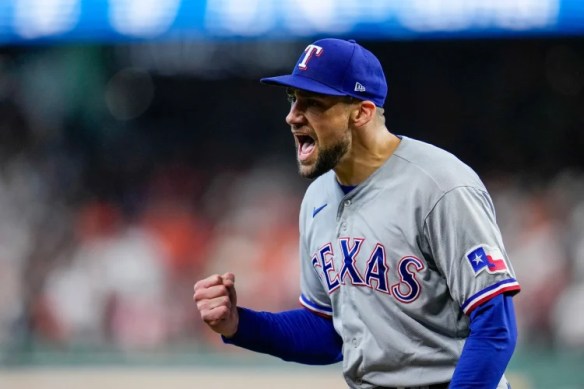
ALCS Game Six: Seriously?

Adolis García

That was Game Five: Adolis García at home, plunked and brawling over it. This was Game Six: García’s grand slam in Houston turning a tight Ranger lead into a blowout win.

Were the Elysian Fields demigods drunk Sunday night? Did Bryan Abreu appealing his two-game suspension, enabling him to pitch if called upon, absolutely have to mean he and Adolis García would square off again, in the top of the eighth, two nights after their confrontation turned into a bench-clearing brawl, three ejections, and the Astros taking a 3-2 American League Championship Series lead?

And did García just have to shake off his fourth swinging strikeout of the Game Six evening at Abreu’s hand only to turn a tight Ranger lead into a 9-2 blowout with a grand slam in the top of the ninth? Seriously?

Of course, to both. Because a) those demigods can rarely resist the opportunity for farce. And, b) because this is baseball, where (said before, saying again) anything can happen—and usually does.

The top of the ninth was absurd enough, with the Rangers loading the pillows on Astro reliever Rafael Montero with a leadoff walk (Josh Jung), a fielding error when José Altuve couldn’t handle Leodys Taveras’s high chopper charging in from second, and Marcus Semien setting García’s moveable feast table with a sharp base hit to left.

This is where you could see those Elysian demigods snickering behind their heavenly brewskis as Astros manager Dusty Baker brought Ryne Stanek in from the bullpen. Stanek got credit for the “win” when the Astros blew the Rangers out in Game Four, and now someone among the demigods had to have had the devil on the horn reminding him to collect his due.

First, Stanek hit Corey Seager with a pitch on 1-0 to send Jung strolling home with the fifth Rangers run. Then, Stanek had García at a 1-1 draw, before throwing him a fastball right atop the bull’s eye of the strike zone. It disappeared midway back into Minute Maid Park’s Crawford Boxes faster than any known American highway speed limit allows.

Thanks, Dev, you could hear the Elysians purring. Eff you, Ol’ Splitfoot, you could hear Astroworld fuming.

Two air outs to follow ended the inning but not García’s glory. On the night Abreu could pitch while appealing his two-game suspension for throwing at García in Game Five, García—who probably should have drawn a similar suspension for starting the brawl to follow when he got into Astro catcher Martín Maldonado’s grille over the driller—made himself the Rangers’ man of the hour.

Maybe even the entire ALCS, too. Even if Rangers starting pitcher Nathan Eovaldi could stake a claim with six and a thirds’ stout two-run, five hit pitching in which he struck out fourr and walked three. But Eovaldi, the solid defenders behind him, and the solid enough bullpen bulls to follow him, made you ponder whether they were merely toying with the Astros allowing a pair of runs on a first-inning RBI single (Yordan Alvarez) and a sixth-inning sacrifice fly (Mauricio Dubón).

Before García unloaded, he’d spent the night striking out swinging twice against Astro starter Framber Valdez, once against Astro reliever Phil Maton, and of course against Abreu. He looked so overmatched in those turns at the plate you could have forgiven him for wondering whether to carry a window, a door, or a great oak tree up to the plate his next time up.

Concurrently, Rangers designated hitter Mitch Garver enhanced one of his finest postseason nights—a game-tying solo bomb in the second; a two-out single telegraphing Josh Heim’s two-run homer in the fourth—by taking out late insurance for his team. After Abreu struck García out, Garver slashed a 3-1 slider on a high line to left that bounced once, ricocheted with a clang off the scoreboard wall, and enabled road-running mid-game Rangers left field insertion Evan Carter (leadoff infield hit; steal of second) to come home in the eighth with the fifth Rangers run.

The Minute Maid audience spent most of the evening booing lustily every time García checked in at the plate and cheering just as lustily every time he struck out. Then he sliced that ninth-inning salami. That was enough to quell the crowd’s appetite and send them starting to strike for the exits before the bottom of the ninth.

And, for Rangers reliever Andrew Heaney to throw four pitches for three ground outs to end the game. If you were an Astro fan still in the ballpark, those four pitches seemed like a mercy killing, no matter that the ALCS was now merely tied at three, but given this year’s Astros’ comparative weakness on the road including a 1-4 postseason record there so far.

Just don’t ask Astros left fielder Michael Brantley. “That doesn’t matter,” he said postgame. “It’s in the past. We need to turn the page and be ready for tomorrow.” They’ll need a lot more than page turning if precedent still matters—including the one saying that no team who lost more at home than on the road in the regular season has yet reached a World Series.

“It’s something you can’t explain,” Dubón said. “We could come tomorrow and win tomorrow and everybody would forget about it. It’s part of baseball. We win on the road. This year, we didn’t win at home and we have one more game to prove it.” Unfortunately, for this year’s Astros, that last remark could be taken two ways.

The Rangers probably couldn’t care less. They were a home powerhouse (.617 percentage) and just under .500 on the road during the season. Three of the four best road teams this year (the Braves, the Orioles, the Dodgers) were punted out of the postseason early.

The Astros, number four on the road overall, might be on the threshold of a postseason exit, but they’re still the Astros, and—in the phrasing of a one-time Astros coach—they’re not out of it until they’re out of it.

And the Rangers know it. Seriously.

Ask them why it’s been the visitors walking into the other guys’ houses and looting and plundering them, and Garver is stuck for an answer. “Seems a little odd nobody is winning at home,” he said postgame. “And I would like for it to stay that way.”

Stuck for an answer, too, is manager Bruce Bochy. “That’s the million dollar question,” said the man who managed the Giants to three World Series-winning games in five years on the road. Including the first of the lot—against a different collection of Rangers, in 2010. This group won’t take the Astros for granted no matter where they’re playing.

“I said it in August, it’s going to be a dogfight all the way to the end,” said Garver. “Really, really good ball club on both sides. They have pitching. They have hitting. But so do we. It’s one game to settle it all, and I think everyone is excited for that.”

Bochy is on record prominently as saying he doesn’t really like a lot of drama. Do you think Game Six changed his mind a little? He’d just been handed the Astros’ heads on a plate courtesy of one of the most dramatic late-game detonations in his team’s history.

“It’s been entertaining with me,” he said postgame. “It’s intense. There’s no getting around it. People ask you, ‘Are you having fun?’ Yeah, it’s fun, you try to enjoy it, but it’s intense out there. That’s what I came back for, to be in this situation. It’s exciting”

Seriously? What happened to the wish for little to no drama? Maybe Bochy knows that wish’s last stand disappeared the moment García’s salami did. Seriously.

ACLS Game Five: Drill, brawl, and another drill

ALCS Game Five

The Rangers and the Astros scrum in the ninth in ALCS Game Five, after Adolis García (bottom-most left) went ballistic when hit by a first pitch from Astros reliever Bryan Abreu.

With one dazzler of an American League Championship Series Game Five play, Rangers second baseman Marcus Semien may have thought he’d saved their season. With one swing an inning later, Adolis García may have thought he’d guaranteed that save.

But that swing provoked a foolhardy act by an Astros reliever costing the team said reliever plus manager Dusty Baker for the rest of the game. And thus provoked, José Altuve sent the Rangers’ season onto life support with one swing in the top of the ninth, leading to a 5-4 Astros win.

The Astros did their level best to continue proving to the Rangers that they were the unmovable force on the road, which they were all season long. The Rangers did their level best to say, “not so fast,” on Friday afternoon. At least, until García inadvertently poked the Houston bear.

There was nothing wrong with García celebrating the moment he unloaded on Astro starter Justin Verlander with Corey Seager (one-out double, then to third on Sean Carter’s single) aboard in the bottom of the sixth, sending a first-pitch fastball over the left center field fence. There was everything wrong with Astro reliever Bryan Abreu drilling García on the first pitch in the eighth.

Abreu was ejected while both benches emptied. Astros manager Dusty Baker argued so vociferously with the umpires that he was ejected post haste. When order was restored, Astros finisher Ryan Pressly had to slither out of the first-and-second jam and did it with a force out and two strikeouts to follow.

Then, Pressly had to slither out of a jam of his own making, surrendering back-to-back singles to Mitch Garver and Josiah Heim, before a line out, a fly out, and a swinging strikeout banked a game the Astros could have lost almost as readily as they won it.

In between those jams, Altuve batted with two on (Yainer Díaz, leadoff single; pinch hitter Jon Singleton, wal), nobody out, and José Leclerc on the mound for the Rangers after relieving Aroldis Chapman to retire the side in the eighth. The delay may or may not have affected Leclerc. Altuve reached down for a down-and-in 0-1 pitch and sent it up and out, over the left field fence.

No one can really prove Abreu’s intent. Watch a replay of the pitch. Astros catcher Martín Maldonado is set for a pitch coming low under the middle of the zone. The pitch shot up and in and off García’s left tricep. García got right into Maldonado’s grille as if thinking Maldonado might have called for a duster but set up to make it look unintentional.

Six umpires called drilling García deliberate. If Abreu really wanted to drill him, he might have disguised it better (say, throwing the duster on the second or third pitch, assuming there would be one) instead of letting him have it on the first pitch. Abreu probably knows well enough to know that you should worry more about getting the man out than sending him messages about previous over-exuberance—especially when you weren’t the one at whose expense he was over-exuberant.

García isn’t exactly a green rookie. It took him long enough to make the Show to stay as it is. Had he just taken his base, he might have kept the Rangers in the game instead of triggering a bench-clearing brawl that ended up possibly harming Leclerc with the extra down-time.

“Everybody on their side is going to say it wasn’t [intentional],” said Rangers second baseman Marcus Semien. “Everybody on this side is going to say it was.”

“I was saying, ‘My bad, it wasn’t on purpose’,” Abreu said postgame. “He was like, ‘bullsh@t’.”

“We know it’s the playoffs,” said umpiring crew chief James Hoye. “We don’t want to make a mistake in a situation like that. So we’re going to make sure that everybody is on the same page, that we all felt the same way. And to a T, all of us felt like that pitch was intentional.”

It’s not impossible, too, that the umpires acted more upon the moment’s emotions when ejecting Abreu for the pitch, García for launching the scrum, and Baker for arguing as wildly as he did over Abreu’s ejection. Abreu did end up hit with a two-game suspension. He could wait until before Game Six to appeal, which would keep him available for Six and Game Seven if it goes that far, though it might keep him out of the World Series’s beginning if the Astros get there.

García probably escaped suspension because he was drilled and furious, but it would not have been out of line for baseball’s government to suspend him, either, for launching the brawl in the first place instead of just taking his base. Especially since his immediate target was Maldonado, not Abreu.

“My plan for [García],” Abreu said postgame, “was just to try to get the ball up and in. That’s my plan with him—up and in, and slider down and away. I just missed the pitch and he just overreacted.”

“I think the optics of the situation are really bad,” said Rangers first baseman Nathaniel Lowe. “It’s the playoffs. You’re allowed to get excited. He got excited. He celebrated because that was a huge swing for us. To have to wear 98 [mph] on the arm after something like that, it’s pretty disappointing.”

Altuve’s ninth-inning nuke made the optics a little bit worse for the Rangers now. The ALCS moves back to Houston. Granted the Astros weren’t a great road team this season, granted the Rangers took it to them in the first two games in Houston this set, but the Astros are not exactly pushovers. Especially not with someone like Mighty Mouse able to hit bombs when the eleventh hour is about to toll.

But it doesn’t keep Baker from a few trepidations over whether the García drill might linger in the minds of both teams if things get testy in Game Six, which is scheduled to pit Framber Valdez starting for the Astros against Nathan Eovaldi for the Rangers.

“I don’t have a crystal ball,” he said Saturday during a workout in Houston. “I mean, it’s going to be what it’s going to be. You have to wait and see, just like me. We don’t script it; it just happens.” That’s just about the last thing either team needs right now.

ALCS Game Three: Max the Knifed

Max Scherzer

Max the Knifed watches José Altuve’s leadoff bomb disappear in the top of the Game Three third Wednesday night.

Which would be more treacherous a thought entering American League Championship Series Game Three? The Astros in the 2-0 hole, needing to win twice for any hope of taking the series home where the Rangers proved impossible to intimidate in the first two? Or Max Scherzer starting for the Rangers at all?

My guess going in was that it was even money. The Astros may have manhandled the Rangers on the regular season, including winning five of six in Globe Life Field. But they got out-wrestled by the Rangers in Houston to open this ALCS, neither team hitting with overwhelming force but the Rangers holding an ALCS ERA one full run lower.

That might or might not change in Game Three, I thought. Scherzer’s age began showing this season well before the Rangers made him their marquee trade deadline catch at July’s end, well before his arm (specifically, it turned out, his armpit) tried to resign on 12 September, knocking him out of the Rangers’ high-wire final stretch.

Scherzer was also once considered a non-factor for this postseason. He, of course, had other ideas. “When this injury happened, we were kind of in that four- to six-week window,” he said before Game Three. “I took one day to feel bad about it and the next day I was back to grinding because I knew we have a team that can compete with anybody . . .

“I’ve pressed all the buttons I can,” he continued. “I’m ready to go . . . I feel normal. That’s all I can say.  All I can do is describe what I feel like and if I have an issue, I have to let them know. But my arm feels fresher.”

On the surface, that sounded better than the 2019 World Series, when Scherzer was a National and had to miss his scheduled Game Six start because of a neck issue that called for a cortisone shot and Stephen Strasburg standing in to deliver heroic pitching. When Scherzer started Game Seven and kept things to a 2-0 Astro lead while he had nothing left in his tank but fumes.

The Nats, of course, went on to win that game and that Series. “We were all kind of making fun of him,” then-Nats catcher Kurt Suzuki said, “saying he was going to rise from the dead.”

Scherzer just might have had to do that again Wednesday night. Whether he’d be Max the Knife or Max the Knifed, he did have a history of sheer survival on the mound going in. But he also had over a month’s rest and rust. And these Astros aren’t quite the same Astros he held off four years ago, but they’re just as formidable—and they flayed him for a 6.55 ERA in two starts on the season.

Plus, Globe Life is a hive where big bops thrive, and Scherzer has averaged 25 home runs surrendered per 162 games lifetime. That won’t paralyse his Hall of Fame case, but there was always the chance that one, two, or even three Astro bombs might murder him and the Rangers in Game Three. And these Astros were a far better road (.630 win percentage) than home team (.481) on the regular season.

Well.

Scherzer and Astros starter Cristian Javier matched shutout innings in the first. But the slider that’s done slightly over half his lifelong lifting began disobeying his orders after that. Fatally. Scherzer said postgame that, while his arm feels good (“That’s the number one thing”), he doesn’t know how he’ll be used the rest of the postseason.

The Rangers may not know just yet, either. Not even if manager Bruce Bochy said he had decent stuff and made “some mistakes.” Scherzer did throw eleven first-pitch strikes and nailed fourteen called strikes. But a little over half his strikes were put into play. The wipeout slider deserted him. The Astros weren’t inclined to show mercy.

Scherzer plunked Yordan Alvarez on the back foot to open the second, then caught José Abreu looking at strike three—before he loaded the bases on a followup walk and a base hit with nobody out.

Then he got Jeremy Peña to pop out to short center, but he wild-pitched Alvarez home with Martín Maldonado at the plate. Seeking his first ALCS hit, Maldonado then nailed it with a two-run single past Rangers third baseman Josh Jung. Maldonado was thrown out at second trying to stretch, but Scherzer left the inning in a 3-0 hole. Which became a 4-0 hole when José Altuve sent a 1-2 service into the left center field seats.

Scherzer went back out for the fourth. Abreu said a rude leadoff hello with a double to the back of center field, and a ground out later Mauricio Dubón singled Abreu home for a 5-0 Astro lead. Getting ahead in the count on most of the Astros he faced did Scherzer no good in the end. The Rangers went to their postseason-surprise bullpen after four full innings.

Max the Knifed.

Javier (.119 batting average against him in his postseason life) kept the Rangers in check with location more than speed, until Nathaniel Lowe rapped a two-out single into left and Jung sent one into the right center field bullpen in the bottom of the fifth. With Cody Bradford on the mound for the Rangers, center fielder Leodys Taveras pulled a likely sixth-inning homer back against Alvarez.

In the bottom of that inning, Rangers rookie Evan Carter sent Javier out of the game and the Rangers’ hair with a two-out double. But Michael Brantley ran down a likely extra-base hit into an out with a running catch on the track off Adolis García’s followup drive and might have saved the game for the Astros.

It must have put a further jolt into the Astro lineup. Alvarez smacked a bases-loaded, two-run single off Rangers reliever Will Harris with two out in the seventh. Then Lowe and Jung delivered a rerun of their fifth-inning flogging—Lowe with a two-out single, this time to right, and Jung with another two-run homer, this time over the straightaway center field fence.

The Astros added an eighth in the eighth off Jon Gray with Peña’s bouncing single through the right side sending Tucker home. It might have been more but for Seager going into the hole at short to stop Altuve’s one-out smash and throw Dubón out at third, before Martin Perez relieved Gray and rid himself of Brantley on the ground for the side. It seemed off script when García singled Marcus Semien home in the bottom of the eighth.

After Alvarez got thrown out at home to end the top of the ninth, here came one final chance for the Rangers in the bottom—the numbers two and three scheduled hitters were Lowe and Jung, following Mitch Garver, even with Astros closer Ryan Pressly coming into the game.

Garver did his part, wringing his way to a full-count leadoff walk, before Lowe struck out swinging and Jung grounded into a game-ending double play. There went the Rangers’ postseason winning streak. The Astros still have an uphill climb ahead of them no matter how good a road team they were this year. Even if they’ve won six out of their last eight games in Arlington.

Scherzer’s competitiveness hasn’t abandoned him. But after the roughest regular season of his major league life, as Yahoo! Sports’s Hannah Keyser observes, “the problem is not rising to the moment but, rather, succumbing to his own physical limitations.” Succumbing to the very real prospect that he really isn’t Max the Knife anymore.

And, to the very real prospect that, however much the Rangers respect him, however much his teammates admire his undiminished need to compete, they may not be able to afford another chance to find out if there’s even one final quality start—never mind one more miracle performance—left in him this year.

“It comes down to execution,” said Max the Knifed postgame. “I know what I need to do.” He almost sounded like a chastened child who made a huge mistake trying to pass a mud pie off as a chocolate cake. That’s not the way a 39-year-old future Hall of Famer or his World Series-aspiring team wants him to sound.

ALCS Game Two: Rangers bent, not broken

Nathan Eovaldi

Nathan Eovaldi, after wresting the Rangers out of a bases-loaded jam in ALCS Game Two. It helped the Rangers go up 2-0 despite Houston bombardier Yordan Álvarez’s two-homer day.

The War for Texas is two games in. The Rangers have won them both, in Houston. Despite being bent a lot more in American League Championship Series Game Two than they were in Game One.

That’s what a four-run first, an arduous wriggle out of a bases-loaded/nobody out fifth-inning jam, and a gutsy four-out save does for you. Even on a day when Yordan Álvarez recovers from an apparent virus and a three-strikeout Game One to hit two bombs.

Álvarez turned out trying to play Game One through an ailment that left him unable to hold food down or avoid headaches, not to mention unable to sleep very much. When it came time for Game Two, Álvarez still knew something his team didn’t until game time: he was going to play Monday no matter what, and nothing short of house arrest would stop him.

And if only the Rangers hadn’t jumped all over Astros starting pitcher Framber Valdez in a four-run first inning, Álvarez’s two-homer Game Two might, maybe, have become something beyond just another tale he can tell his eventual grandchildren.

But it still took a large effort by the Rangers to keep the Astros from overthrowing them and sweeping the first Houston leg of this ALCS. Large enough to prove that you can bend but not quite break these Rangers, who held on tight to win Game Two, 5-4.

It took ten pitches and a throwing error from Valdez to put the Rangers up 4-0 before the game’s first out was recorded. With Nathan Eovaldi starting for the Rangers, Ranger fans could have been forgiven if they thought the rest of the game might, maybe, be something of a leisurely game.

Marcus Semien and Corey Seager opened by hitting the first pitch of each plate appearance for back-to-back singles, Seager’s a shuttlecock that landed before Astros third baseman Alex Bregman running out could reach it. Then it took Valdez pouncing upon Robbie Grossman’s dead-fish tapper back but bobbling it a moment before throwing wild past first, allowing Semien to score and leaving second and third.

Then came Adolis García lining a single the other way to right to score Seager, and Mitch Garver pulling a line single to left to score Grossman. Finally, Valdez nailed an out striking Josh Heim out swinging on three pitches, but Nathaniel Lowe replied almost immediately to follow by sneaking a base hit through the left side of the infield to score García.

That wasn’t exactly in the Astros’ game plan. Valdez finally struck Josh Jung out and got a fly out by Leody Taveras to end the inning. It made Álvarez’s first homer, a yanking drive into the second deck behind right field in the bottom of the second, a crowd pleaser but a mere interruption. Eovaldi went from there to sandwich a strikeout between two ground outs to third, the first of which took a grand throw by Jung from the foul side behind third base to get Chas McCormick by a step.

Nor was it in the Astro plan for Valdez to last only two and a third innings, after Heim led off the top of the third with a blast into the Crawford Boxes for the fifth Rangers run.

“I thought the quality of my pitches were good,” the righthander said through his interpreter postgame. “I think they were good and they maybe got a little bit lucky. There were a couple of balls that they didn’t hit well that fell for base hits a couple times. I tried going as far as I could.”

Valdez has a few more things to learn about luck. These Rangers prefer to make their own luck. They might attack with aplomb at the plate but they’re going to turn your mistakes into disaster, too. You’d better not call them lucky, either, when you’re the poor soul who mishandled and then threw away a potential double play grounder that might have kept the Rangers’ first-inning damage down to a small dent.

Bregman nudged the Astros a little closer back with a leadoff bomb ringing the foul pole in the fourth. Then Eovaldi had to shove his way out of a no-out, bases-loaded jam in the fifth by striking pinch-hitter Yainer Díaz and José Altuve out back-to-back before Bregman beat one into the ground toward third—where Jung, whose over-run of Jeremy Peña’s bouncer loaded the pads in the first place, threw him out at first by three steps.

Michael Brantley pulled the Astros back to within a pair with a sixth-inning RBI double. Josh Sborz relieved Eovaldi for the seventh and got the side in order, including a called third strike on Altuve to end it. Aroldis Chapman went out to pitch the eighth and, after a Bregman fly out to center and a Tucker ground out to second, the first pitch he threw Álvarez would be his last of the day, Álvarez lining it hard and fast into the lower right field seats.

“You can never count us out,” McCormick said of his Astros post-game. “We don’t ever quit.” That was true enough to compel Rangers manager Bruce Bochy to get Chapman out of there after Alvarez’s second launch and ask Jose Leclerc for a four-out save.

Leclerc shook off back-to-back walks to get McCormick to force José Abreu at third for the side, then dispatched the Astros in order in the ninth—the hard way. Peña’s deep fly to right collapsed into an out at the track. Díaz’s grounder toward third was stopped by Jung on the slide before Jung threw him out. Altuve’s fly to center was only deep enough to land in Taveras’s glove for the side and the game.

“We’ve had some chances to win some games,” said McCormick, painfully aware the Astros had several grand Game Two chances laid waste. “Usually we do come through with some big hits. We did earlier in the year and, this time around, we haven’t come up with that big hit.”

Indeed. The Astros have been 1-for-9 with men in scoring position all ALCS so far. And, out of their 24 postseason runs thus far this time around, Álvarez is responsible for eighteen of them, either scoring them or sending them home. But even he can’t thwart the Rangers by himself. Not the way these Rangers do things. Not when they can make a two-homer game by him a sidebar.

“We’re jumping on teams early,” Jung said postgame, “and that helps us settle in. Our pitching has been outstanding. You can’t ask for anything more than what they’ve given us.”

Eovaldi has the knack of transforming from a solid regular-season pitcher to a Hall of Fame-level pitcher in the postseason. Even if he wasn’t quite at his pure best in Game Two, he still had enough to keep the Rangers well ahead of the game by the time his outing ended. He now has a 2.87 ERA and a 2.60 fielding-independent pitching rate in nine career postseason series.

“Something just clicks for him,” his catcher Heim said postgame. “I’m not sure. Same preparation. Same mentality that he has had all year. Just something about big games that he loves.”

It may yet prove to be something Ranger fans will love for eternity and beyond. The Rangers are halfway to the World Series, still unbeaten this postseason, and going home to their own inviting playpen in Arlington. They were far better at home than on the road in the regular season—but now they’ve won seven straight postseason contests with six coming on the road.

“We’ll get ’em in Texas,” Astros manager Dusty Baker vowed after Game Two. Ahem. You weren’t exactly out of Texas in Games One and Two, sir. You’ve been gotten in Texas so far.

ALCS Game One: Bad Astro looks, sharp Ranger pitching

Evan Carter

Evan Carter’s running-and-leaping catch of an Alex Bregman drive that had extra bases stamped on it otherwise ended with doubling up José Altuve in the Game One eighth—on Altuve’s own baserunning mistake.

This was not a good look for the Astros. When Justin Verlander keeps the arguable best remaining postseason offense to the weakest postseason game it’s had this time around but the Astros still don’t win, it’s not a good look.

When Jordan Montgomery scatters five hits in six and a third innings with no Astro scoring against him, before handing off to a bullpen whose regular season was an indictment for arson but has been a challenge to pry runs out of this postseason, it’s not a good Astro look.

When José Altuve, one of baseball’s smartest players, makes an eighth-inning baserunning mistake more to be expected of a raw rookie than a thirteen-year veteran with a Most Valuable Player Award in his trophy case, it’s not a good Astro look.

Astroworld should only be grateful that the Rangers didn’t even think about trolling Altuve the way a certain Brave trolled Bryce Harper on a similar but different play in the National League division series out of which the Phillies shoved the Braves.

Harper didn’t miss second scrambling back to first when Nick Castellanos’s long ninth-inning drive in Game Two was caught on the run and leap by Braves center fielder Michael Harris II, but he was thrown out at first by a hair and a half to end the game and the only Braves win of the set.

Altuve didn’t end American League Championship Series Game One Sunday night, but he did put the kibosh on the Astros’s final scoring opportunity in the 2-0 loss. He’d drawn a leadoff walk against Rangers reliever Josh Sborz, who yielded at once to Aroldis Chapman—a relief pitcher whose best fastball can still out-fly a speeding bullet, but who once surrendered a pennant-losing homer to Altuve himself and is still prone to hanging his sliders.

Then, somehow, Astros third baseman Alex Bregman sent a 2-1 slider off the middle of the zone to the rear end of Minute Maid Park, toward the chain-link fence beneath a Bank of America sign. The Rangers’ rookie left fielder Evan Carter ran it down and still had to take a flying leap to catch it one-handed just before it might have hit the fence and spoiled the Ranger shutout.

“Everybody,” said Astros catcher Martín Maldonado, who probably meant both the Astros themselves and the Minute Maid crowd, “thought that ball was going to hit the wall.”

Carter threw in to shortstop Corey Seager, who tossed right to second baseman Marcus Semien with third baseman Josh Jung pointing to the base emphatically. Semien stepped on the base just as emphatically. It took a replay review to affirm what Seager, Semien, and Jung spotted at once. Second base umpire Doug Eddings rung Altuve up. Altuve never touched second en route back to first.

Ouch!

“I didn’t think he was going to make the play he made—it was a great play,” said Altuve, a man who excels at just about everything you can ask of a veteran except baserunning, what with leading the entire Show with sixteen outs on the bases during the regular season. “You just try to come back to first base (and) that’s what I did.”

“That’s a play,” Semien said, “where I always watch to see what the runner does. Sometimes the umpires are looking at the ball, and that’s exactly what (Eddings) told me. He said he was looking at the ball. He didn’t see it. I tried to remind him. He still called it safe, but luckily that’s a play we can review. I’ve made that mistake before on the bases, so it’s one that we kinda go over in spring training, and all of a sudden in the ALCS, it showed up.”

Carter had also run down and caught leaping a Bregman drive down the left field line in the first. Then he himself accounted for the first Rangers run in the second inning, when he shot a base hit right past diving Astros first baseman José Abreu and gunned his way to second ahead of a throw that was dropped almost inexplicably at the base. Rangers catcher Jonah Heim then singled back up the pipe and Carter, reading the ball almost as a Biblical scholar parses the Beatitudes, scored.

“They always preach to us, especially the ones that can run a little bit, just, ‘Hey, it’s a double until it’s not’,” said Carter, who didn’t play his first major league game until 8 September. “So that’s kind of my mindset. I’m going to get a double until the outfielder tells me that I need to stop. I didn’t feel like I was told I needed to stop, so I just kept going.”

Three innings later, the Rangers’ number nine lineup batter, center fielder Leody Taveras, caught hold of a hanging Verlander sinker and lined it right over the right field fence. That was the second and final blemish against Verlander, the veteran who walked to the Mets as a free agent last winter but returned to the Astros in a trade deadline deal in August.

Altuve’s eighth-inning misstep was only the final among several opportunities the Astros missed all game long. They wasted Abreu’s second inning-opening single almost at once when Michael Tucker forced him at second on a followup ground out, then stranded Tucker on a pair of fly outs.

They wasted first and second with two outs in the third when Yordan Alvarez struck out for the second of three times on the night.

They pushed the bases loaded against Montgomery in the fourth, the only inning in which the Rangers’ 6’6″ tall, free agent-to-be lefthander truly struggled, and Montgomery ironed up and struck Maldonado out swinging on 1-2.

It was only when Astros utility player Mauricio Dubón, playing center field for them Sunday night, slammed a hard line out to center field opening the Houston seventh, that Rangers manager Bruce Bochy decided to reach for the bullpen. Now, the Astros had a clean shot at a bullpen that might resemble the Third Army this postseason but blew 33 out of 63 so-called save situations on the regular season.

Altuve’s baserunning mistake still left the Astros four outs to work with yet and the vulnerable Chapman hardly off the hook with Alvarez checking in at the plate: Chapman’s lifetime postseason ERA in Minute Maid Park was 7.53 entering Sunday night. He fell behind Alvarez 2-1. Then, he threw Alvarez a slider that hung up just enough to be sent into orbit, just as Altuve had done winning that 2019 ALCS.

The only place Alvarez sent this one, though, was on the ground toward first base for an inning-ending out. Then Bochy reached for Jose Leclerc to work the ninth. Leclerc landed a hard-enough earned three up, three down; he went to full counts on Abreu and Chas McCormick before getting Abreu to line out to center for the first out and McCormick to strike out swinging, sandwiching Tucker’s 2-2 ground out to second.

“We just found a way to get a couple of runs across the board,” said Bochy after the game ended. “That was the difference in the game, obviously. But our guy was really good, Monty, terrific job he did. And he got in a couple of jams there and found a way to get out of it.”

Verlander didn’t sound discouraged after Game One despite his solid effort coming up just short enough. “We’ve lost Game One of some playoff series before,” said the future Hall of Fame righthander. “And that’s the great thing about this team. Obviously nobody is sitting in the locker room right now happy. But it’s very matter of fact, okay. We just got punched, how do you answer?”

The Astros have Game Two to start answering, of course. But they might have to find a few more ways to keep Carter from running down and killing their better drives.