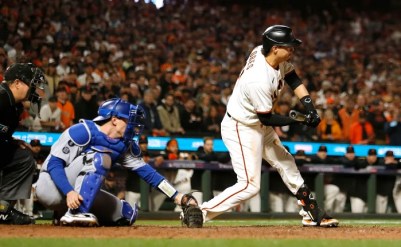
Don Denkinger, you’re off the hook. Flores checking his swing into the arguable worst blown call in postseason history
Giants manage Gabe Kapler wouldn’t say it, even though anyone with eyes to see would say it for him. Even the Dodger fans among them. Maybe it wouldn’t change the outcome with that wired a Max Scherzer on the mound.
But ending this National League division series with that bad an umpire’s call? For the final out of the season for one team, not the first out of the ninth as was Don Denkinger’s infamous blown call at first in Game Six of the 1985 World Series?
There isn’t a jury in the land that would rule Kapler unjustified if he’d blown his proverbial stack or even demanded an investigation. This tight a Game Five between two of baseball’s most bitter of blood rivals plus the two winningest teams in this year’s Show deserved better than that.
These Dodgers and these Giants deserved better than first base umpire Gabe Morales ruling Wilmer Flores’s checked swing a strike to end it, after home plate umpire Doug Eddings—to his eternal credit—called for Morales’s help. That kind of help neither Eddings nor the Giants needed.
Two teams who’d been even-up in their regular season meetings, had the same number of hits against each other (173), and entered Game Five with each having 109 wins for the year including the postseason thus far, deserved better than a 2-1 Dodger win tainted through no fault of either team’s own.
“There are other reasons we didn’t win today’s baseball game,” Kapler said post-game. “That was just the last call of the game.” That was like a Japanese commander saying Hiroshima and Nagasaki were just the last blows of World War II.
Let’s give Morales a temporary benefit of the doubt. “[C]heck-swings are one of the hardest calls we have,” he said post-game. “I don’t have the benefit of multiple camera angles when I’m watching it live. When it happened live I thought he went, so that’s why I called it a swing.”
But Morales was shown a replay of that final pitch. Then, someone asked if he’d still call it failed check swing. Ted Barrett, the crew chief, answered for him. Sort of. As if Morales was incapable of speaking for himself.
“Yeah, no, we, yeah, yeah, he doesn’t want to say,” Barrett said. If there’s a more mealymouthed response upon a blown call’s questioning on record, I’d love to see it. Even Denkinger wasn’t that foolish when confronted with how badly he’d blown it calling Jorge Orta safe at first despite being out by almost a full step.
“Obviously you don’t want a game to end that way,” Kapler also said. “Obviously it’s going to be frustrating to have a game end like that, but pretty high quality hitter at the plate that can climb back into that count. There’s no guarantee of success in that at-bat. It’s just a tough way to end it.”
Flores checked his swing on an 0-2 pitch that came in just under the low outside corner. All things considered, especially the proliferation of dubious pitch calls all series long against both the Dodgers and the Giants, it wouldn’t have been the worst possible outcome for the plate appearance to continue.
But Flores checked his swing. Eddings called to Morales. Morales rang Flores up for game, set, and match. Sending the Dodgers to a National League Championship Series against the Braves, sending Giants fans reaching for the nearest possible liquid salves, and soiling the Game Five this series deserved otherwise.
They’d gone tooth, fang, claw, and just about anything else not just to get to Game Five in the first place but to get to the bottom of the ninth with only a single run separating them.
The Dodgers had gone to a bullpen game, opening with reliever Corey Knebel, continuing with fellow reliever Brusdar Graterol, then sending starting pitcher Julio Urias out of the pen to pitch a solid enough third through sixth. Then back to the pen men Blake Treinen for the seventh and Kenley Jansen for the eighth.
The thinking was that the Giants—a club full of elders and anonymous role players for the most part—were so deadly in situational play that, as The Athletic‘s Andy McCullough observed, the Dodgers’ best shot at neutralising that advantage by throwing two-thirds of their bullpen at the Giants and returning Urias to the postseason role where he’d been so effective in the recent past while they were at it.
It’s not that teams haven’t gone to bullpen games before. The Rays make about a third of their living doing it. Why, almost a full century ago the Washington Senators (Washington—First in war, first in peace, and last in the American League) won the 1924 World Series going to a bullpen game prototype in Game Seven.
All the Dodgers needed was Urias on board with the idea. “He earned the right to pitch in this game,” said Dodgers pitching coach Mark Prior. “If he said, ‘No, I want it,’ he was going to get it.” They surveyed other Dodgers including starters Scherzer, injured Clayton Kershaw, and Walker Buehler, who’d pitched so effectively in the Dodgers’ Game Four win.
“When they were on board,” Prior said, “it made sense. Everyone is in it to win it. Let’s go.”
That’s how they countered the Giants sending their stout young starter Logan Webb out for Game Five. He gave the Dodgers as good as their pen game gave the Giants. He pitched seven solid innings. The only blemishes on Webb were Mookie Betts delivering three of the four Dodger hits against him, and Corey Seager sending the Mookie Monster home with a double down the left field line in the top of the sixth to deliver the game’s first run.
Until Scherzer came into the game, the only real blemish against the Dodgers’ pitching was Giants left fielder Darin Ruf tying the game at one leading off the bottom of the sixth, by hitting Urias’s full-count fastball over the center field fence.
But until the Flores check swing that should have been, the co-story of the game might have ended up being the Dodgers leaving the Giants behind with yet another Belli-ache plus Max the Knife plunged into their backs in the bottom of the ninth. More’s the pity.
Continuing his re-adjusted postseason revival—after an injury-marred regular season reduced him to terms so low people questioned why Dodger manager Dave Roberts kept running his former MVP out there at all—Cody Bellinger broke the one-all tie in the ninth.
He made the Giants pay after their young relief ace in the making Camilo Doval hit Justin Turner up and in on the first pitch after Will Smith grounded out to shortstop to open the top of the ninth. Gavin Lux snuck a base hit through the right side of the infield to set first and second up.
Then, Bellinger took ball one low, swung through a slider around the middle, bounced a foul ball off to the right, then shot one up the middle and into center field sending Turner home with the tiebreaking run. Which probably amped Scherzer up in the pen even more than he’d already sent himself.
When he wasn’t throwing warmup pitches, Scherzer paced and pranced like a maniac. It was a wonder nobody had to shoot a tranquiliser dart into his rump to make sure he could go in and pitch the bottom of the ninth without dismantling himself.
He all but shot in from the pen to the mound as the sides changed. It was so must-see television that the TBS broadcast obeyed the call, too, not cutting to a commercial break as he made his way to the mound. You’d have thought the back of his uniform carried not his surname and number 31 but Danger! High Explosives! Keep Back 500 Feet!
Pinch hitter Matt Beaty ended the top of the ninth by grounding out to Flores playing first for the Giants. “Flores touched first base,” said Betts with a laugh, “and it felt like Scherz was halfway to the mound.”
This was virgin territory: Scherzer had never recorded a relief save in his entire professional pitching career. Yet he flew in from the pen as though fourteen years’ worth of a Hall of Fame pitching career to date was merely the overture to his kind of Unfinished Symphony.
So, with Bellinger shifted from first base to center field and Billy McKinney out playing first, Max the Knife unsheathed. He got Crawford to line out the other way to left. He shook off Turner bobbling Kris Bryant’s grounder up the third base line enabling Bryant safe on the error to strike out Lamonte Wade, Jr., who’d been making a name for himself with assorted ninth-and-later heroics for the Giants.
Then came Flores, the former Met who’d been part of their 2015 run to the World Series. A slider hitting the middle of the zone for a called strike. A foul off. Then, the fateful slider coming down and just off the corner. The checked swing. Eddings’ appeal to Morales at first. Strike three. Game, and Giants’ season, over.
There are eleven categories of reviewable umpire calls that managers are allowed to challenge. In the postseason, a skipper gets two challenges instead of the one allowed during the regular season. Check swings and pitches aren’t among the eleven. Maybe in the postseason they ought to be.
The “human element” be damned. When Whitey Herzog (Cardinals manager in 1985) called outright for replay in his 1998 memoir You’re Missin’ a Great Game, he had it as right as right can be: “This is for the championship—let’s get it right.” This was toward a potential championship and a win-or-wait-till-next-year game in the bargain. It should have been gotten right.
Seventy years ago, the Giants’ Bobby Thomson hit the Shot Heard ‘Round the World to finish a pennant playoff we’ve long since known, with full proof, was tainted by an off-field-based sign-stealing plot that helped those Giants come from thirteen games back to forcing that playoff in the first place.
Maybe it was tempting the fates a little too flagrantly when it turned out someone with the Giants—not a fan or fans, as I thought when seeing the sign in a flickering moment during the Game One telecast—tacked that “Remember ’51!” up on a deck rim in Oracle Park. Very clever, using a tainted triumph for motivation.
But ’51 was then, and this was Thursday night. Tainted not by cheating but by the kind of malfeasance that’s brought demands for further and fuller umpire accountability and for technology to help get the calls right. I don’t have to be as kind as Gabe Kapler.
Don Denkinger, you’re off the hook for the arguable worst blown call in postseason history. Maybe Scherzer would have retired Flores anyway if the proper call was made; maybe Flores would have kept the inning alive with a base hit. Maybe—unlikely as it might have been, considering his 0-for-17 lifetime jacket against Max the Knife—he might have tied or even won the game with one swing.
Maybe. We’ll never know now.
Until or unless baseball’s government effects real, substantial umpire accountability and stops allowing the “human element” to enable them to get away with murder, this NLDS Game Five’s finish should be known forever as The Strike Heard ‘Round the World.


 Throneberry Fields Forever