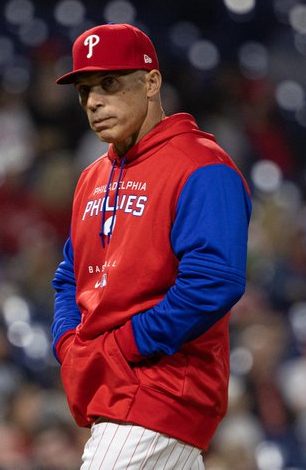
The Phillies throw out the first manager

Joe Girardi

Girardi’s Philadelphia nightmare ends with his execution Friday morning.

Stop me if you’ve heard this one before: A front office builds a team with money no object and no other cohesive object in mind. They front-load the team with sluggers, leaving little room for defensive fortification, overtaxing a fine starting rotation, and discover they can’t out-slug the wasted defensive outs or the bullpen’s arson.

All of which leaves their third-year manager half lost for finding ways to prevent late-inning collapses, early-inning slaughters, and solving the riddle of how he could have been handed what amounts to a desperation roster built with no forward thinking and not even a nod toward replenishing the farm or delivering mid-season fortification.

Then, seeing that uncohesive, porous mess deliver a 22-29 season-opening record, they reach into their heart of hearts, pray hard, and decide it’s time answer all the last fortnight’s speculation and throw out the first manager of the season.

Ladies and gentlemen, your 2022 Phillies. Sitting twelve games behind the division-leading Mets in the National League East. Unlikely to improve even to a shot at one of the NL’s wild cards unless their fielders patch up the holes in their gloves and their defensive routes and their bullpen discovers more than just bull.

For openers. It’s not that Joe Girardi is any sort of managerial genius. He’s been a fairly overrated manager in his entire skippering career. But this one’s on that front office, led by Dave Dombrowski, an executive with a too-well-known tendency to sacrifice a future for a today that doesn’t always strike platinum. Not to mention the classic mealymouthed style of explaining why Girardi should have become the sacrificial lamb.

It has been a frustrating season for us up until this point, as we feel that our club has not played up to its capabilities. While all of us share the responsibility for the shortcomings, I felt that a change was needed and that a new voice in the clubhouse would give us the best chance to turn things around. I believe we have a talented group that can get back on track, and I am confident that [interim manager] Rob [Thomson], with his experience and familiarity with our club, is the right man to lead us going forward.

Translation: We still thought this team could slug more than enough to out-fly fielders who might as well be scrubwomen wearing oven mitts and save the asses of relief pitchers who forget to check the gasoline cans at the gates. And if you think we’re going to execute the people responsible for building that mess in the first place, you don’t know us vewwy well, do you?

Except that four of the Phillies’s sluggers (Nick Castellanos, Rhys Hoskins, J.T. Realmuto, and Kyle Schwarber) haven’t been slugging quite to the extent they were expected to slug, even if three of them dialed long distance during that ten-inning fall to the Giants last Monday.

The slugger who’s been hitting like the defending MVP he is and who just so happens to be their best defender, Bryce Harper, has a torn UCL in his throwing elbow that’s limited him to a DH role for long enough now. He’s been around the league average in right field when he played before the injury; he’s posting a .943 OPS/.166 OPS+ so far that are not too far under the numbers (1.044/181) with which he led the entire Show last year.

The Phillies have achieved the surrealistic feat of outscoring their opposition yet awakening this morning seven games below .500. The big reasons, as ESPN’s Bradford Doolittle reminds us, are a 4-10 record in one-run games and a fourth-highest-in-Show fourteen losses in games during which they held a lead at one or another point.

“Measures such as these are never wholly on the manager,” Doolittle writes, “but they are certainly not data points in his favor. The best embodiment of Girardi’s struggles is probably an early-May loss to the Mets in which Philadelphia blew a 7-1 lead it carried into the ninth inning. It sure seems the heat under his seat kept rising after that game.”

The Phillies also continued leaning upon Corey Knebel to close out games—but why? He spent May picking up four nebulous saves and earning very nebulous credit for one win during which he surrendered the game-tying run in the top of the ninth and was bailed out in the bottom by a two-run infield error.

Meanwhile, Seranthony Domínguez has been an assassin out of the pen through today: he has a 1.83 ERA and a 1.92 fielding-independent pitching rate in 19.2 innings’ work thus far. Knebel: 3.27 ERA/4.01 FIP. You tell me who should be getting the work when the games are squarely on the line—and screw the “save situations,” the real moments when a game needs saving aren’t limited to the ninth inning.

So maybe continuing to assign “roles” to his dubious-enough pen instead of training his eyes upon the best of the group falls on Girardi. He’s hardly the only manager who might still believe in “roles” instead of what the game moment and the records as they are tell him. Maybe his long-time associate Thomson will pay closer attention and move accordingly, even with the continuing dubious straitjacket of the three-batter minimum for relievers.

But everyone with eyes to see looked upon the stockpile of designated hitter-types Dombrowski and company assembled when the lockout ended and that hurry-up spring training began and said, with no sarcasm intended, just what Jayson Stark asked aloud in The Athletic: “Can a team as defensively challenged as the Phillies win anything?”

In one way Dombrowski did work with a hand tied behind his back. Last winter’s free agency market—rudely interrupted by the ridiculous owners’ lockout—offered him little enough chance to fix a dead-last defense (the 2021 Phillies were the Show’s worst for defensive runs saved) at all, never mind in one grand sweep. But there remains the sense that he didn’t have to go all the way the wrong way.

Fair play: There have been teams who could and did hit their way to even the World Series despite having defenses helpless even against a division of babies in carriages. Just ask the 2015 Mets, whose porous defense enabled them to lose a World Series in five games despite taking leads into the ninth inning in three of their four losses.

Maybe these Phillies have done their notoriously negative-think fan base a big favour. (Remember the Philadelphia wedding. Clergyman to the happy couple: I now pronounce you husband and wife. Clergyman to the gathering: You may now boo the bride.) Not by firing Girardi but by collapsing early and often under the weight of their slug-now/defend later construction. They’re not likely to make the postseason even as an outside entrant in the expanded wild card picture. They won’t be able to break the hearts the 2015 Mets broke.

But Girardi isn’t exactly innocent. Another Athletic writer, Britt Ghiroli, isolates the point. Again, stop me if you’ve heard this before, as in when his days managing the Yankees came to a halt, but make note of where Ghiroli places the core responsibility:

Two things seem to have sunk Girardi: recent bullpen-management moves that came under fire and players telling The Philadelphia Inquirer that it didn’t look like they were having any fun on the field. (They aren’t very fun to watch on the couch, either.) Girardi is known as a no-nonsense guy, and although clubhouse culture can be overrated, once players start mentioning it, it almost always spells doom for the manager. This is still a mess Dombrowski created, a defense far worse than anyone envisioned and a bullpen problem that just never seems to go away. Firing Girardi doesn’t make the Phillies a playoff team, or even a competitive unit. But it does quell the masses, at least temporarily.

The only thing missing now is Dombrowski saying, “I didn’t fire Joe. The players did.” The questions now include just how long before the Phillies’s administration gets what previous team regimes finally got and sends Dombrowski on his not-so-merry way, too, in favour of a builder whose materials aren’t limited to collapsible shelves.
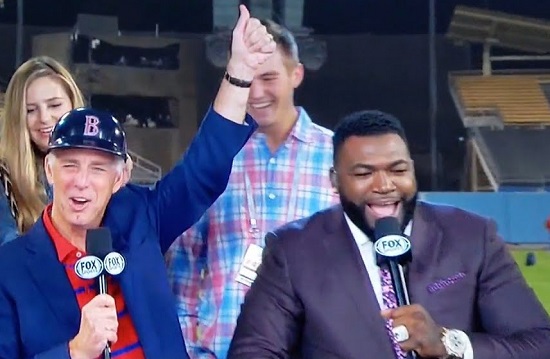
Anatomy of an execution

2019-09-09 DaveDombrowskiDavidOrtiz

Just shy of eleven months ago, Dave Dombrowski wore a Red Sox helmet and let former Red Sox superstar David Ortiz interview him right after the Red Sox nailed a World Series. After midnight last night, Dombrowski went to the Red Sox guillotine.

Watch and ponder a 10-5, home run heavy Red Sox loss to the Yankees on national television Sunday night. Awaken Monday morning to discover the Red Sox threw out the first president of the season just after midnight. Down the stretch. With the Red Sox down to little if any hope of really defending their 2018 World Series championship.

Every once in awhile not even a World Series appearance or conquest is enough to save someone’s baseball job. It wasn’t for Dave Dombrowski. The GM-made-president of baseball operations, who finished what his predecessor Ben Cherington started and steered the Red Sox back to the Promised Land for the fourth time since the 21st Century began, is finished.

And the questions include the price the Olde Towne Team will pay for last year’s conquest. Dombrowski spent big with dollars and with prospects to make last year’s triumph happen. Now the Red Sox farm system is parched, and a lot of the dollars that finished constructing last year’s conquerors could prove a prison as much as a parade.

Forgotten at times during last year’s triumph was that Cherington built the core of the team. Dombrowski took the bows with everyone else after the Red Sox finished stunning the Dodgers last fall but all he did was finish what Cherington started. And everyone who remembered Dombrowski’s years of trying but failing to get the Tigers to the Promised Land and mortgaging the farm several times couldn’t resist asking how long before Dombrowski’s accomplishment with the Red Sox would endure before he’d be nudged out of Boston, too.

It’s unfair to Dombrowski in a few ways, of course. But running a team whose in-house culture is win/win-now/keep-us-winning isn’t simple business. And men who mortgage the farm on its behalf often have lower survival rates than men who know how to remake/remodel without tanking or without letting the farm become a dust bowl.

Cherington got four years. Dombrowski didn’t survive a fourth. Both were hired seemingly out of nowhere. Except that for one of them, “nowhere” was right under the Red Sox’s noses. Cherington was part of the Red Sox baseball operations offices since 1999 and built himself a solid player development background when he was hired to succeed Theo Epstein in 2011.

Cherington’s first order of serious business, alas, was to take it like a manperson when the powers above made him look like a fool after the infamous 2011 Red Sox collapse. He’d promised numerous players that whomever would take the bridge, after Terry Francona quit before he could be fired, it wouldn’t be the rumoured Bobby Valentine. The powers above hired Valentine (specifically, it may have been Larry Lucchino’s call); Cherington’s choice was almost anyone but. (Actually, at the time, it was Dale Sveum.)

Poor Cherington. He found himself having to keep his back door open to help one after another Red Sox player keep his marble (singular) during the Valentine nightmare. Then, he executed the daring August 2012 trade that sent the Dodgers Josh Beckett, Adrian Gonzalez, and Carl Crawford and concurrently blew open a small tonnage of financial headroom while giving himself the space to hatch and execute a post-Valentine plan.

Cherington spent the 2012-13 offseason buying or dealing for a group of more than useful availables and spare parts—Mike Napoli, Jonny Gomes, Shane Victorino, David Ross, Stephen Drew, Brock Holt, and (especially) sleeper reliever Koji Uehara—and bringing home former Sox pitching coach John Farrell to take the bridge and dissipate the Valentine toxins.

That effort, plus the returns to health of such key men as John Lackey, often-injured (and oft-unfairly alienated) Jacoby Ellsbury, and especially future Hall of Famer David Ortiz, got the Red Sox 2013 World Series rings for Cherington’s efforts. It also got Cherington named as the third Red Sox executive ever named by The Sporting News as Executive of the Year.

Concurrently, he devised and executed a longer-range plan that rebuilt the Red Sox farm without even thinking about tanking, which is never an option for a team whose owner John Henry learned what not to do and how not to do it watching the similarly win-now-or-be-gone thinking of the late Yankee owner George Steinbrenner.

Mookie Betts, Xander Bogaerts, Rafael Devers, Andrew Benintendi, Eduardo Rodriguez, and apparently defense-first Jackie Bradley, Jr.—all of whom factored large enough in last year’s conquest—were Cherington’s handiwork, either by in-house development or trade such as the deal that brought Rodriguez to the Red Sox in late 2014.

Where the earnest Cherington mis-stepped was with some of his subsequent free agency signings, including Pablo Sandoval, Hanley Ramirez, A.J. Pierzynski, and Grady Sizemore. When the Red Sox executed him in favour of Dombrowski, Cherington still left them a solid nucleus that didn’t go unnoticed by the incoming Dombrowski.

It didn’t take Dombrowski long to sign such nuggets as David Price and Craig Kimbrel, and watch as the Red Sox went from last to first in the 2016 American League East, though they were shoved out of the postseason by the eventual pennant-winning Indians. Dombrowski traded for Chris Sale, signed Mitch Moreland, and basked in the 2017 AL East title despite another postseason exit short of the Promised Land.

Then he answered Farrell’s apparently losing his clubhouse at last by canning Farrell and hiring Astros bench coach Alex Cora—while the Astros were still advancing toward their 2017 World Series conquest. And Cora let his new players know immediately how they fell short enough: “You guys were easy to game plan against. Too many bad takes [at the plate].”

Dombrowski also landed J.D. Martinez at almost the eleventh hour of last year’s spring training, then watched Benintendi, Bogaerts, Devers, and Betts especially come into their own, Betts almost running away with last year’s American League Most Valuable Player award. Marry that to Price and Sale shaking away whatever problems they might have had otherwise, and the Red Sox turned the 2018 postseason into a thrill that climaxed when Sale struck out the side to end the World Series hoisting the trophy in Dodger Stadium.

Except that there were a few serious cracks in the structure Dombrowski finished atop Cherington’s foundation:

* Almost typical of a Dombrowski administration, the Red Sox didn’t just empty the farm, they took a torch to it. Assorted observers say the farm’s being rebuilt little by little, though.

* Dombrowski ignored the Red Sox bullpen almost entirely both last offseason and approaching this year’s new single mid-season trade deadline. Some say it’s outperformed its expectations this year; others say it became taxed too heavily as one after another Red Sox starter faltered for assorted reasons—especially after they were barely worked in spring training and looked like spring-training pitchers in April.

* Betts has one more season coming under Red Sox control and, unless something happens between now and October 2020 to constitute an offer he can’t refuse, it looks as though he’s going to play the market for the first time then. The Red Sox may have ideas about trading him this winter, but if they go there they won’t get that solid a return for a one-year rental.

* Martinez is posting another magnificent season at the plate, but he has an opt-out clause he can exercise at season’s end and enough observing the Red Sox fear he’s liable to try playing hardball. For more money? For a longer commitment? Nobody knows just yet, but the Red Sox have to brace themselves for either.

* With Nathan Eovaldi, a postseason hero out of the bullpen last fall, missing too much time to injury this year and then having to shake away rust in a return to the rotation, it leaves the Red Sox with him, Sale, and Price as underperformers among the walking wounded and on long-term contracts while they’re at it.

In fact, Sale—who’s now done for the season thanks to pitching elbow inflammation—won’t even see his contract extension begin until 2020, but some argue Dombrowski signing him to that extension might have seeded Dombrowski’s end. Sale swore when signing that his shoulder troubles were behind him. Everyone wanted to believe it. Then his inconsistent 2019—brilliance here, battery there—ended prematurely when his elbow immolated. Uh-oh.

But there’ve been enough bright lights in Red Sox fatigues to make you confident they can win next year. Betts, Bogaerts, and Devers still make for a powerful threesome at the plate, though the Red Sox may want to think hard and start thinking now about keeping Betts in the family. Even if Henry wants to trim payroll up the street, he can’t afford to let his franchise player leave the family.

Benintendi shook away his first half inconsistencies and is having a magnificent second half, and he should be ready for a full season’s high-level production in 2020. Rodriguez is having a breakout season. Matt Barnes and Brandon Workman have become late-inning godsends out of the bullpen.

And rookie reliever Darwinzon Hernandez’s bullpen performance in his first 25 gigs (2.83 ERA; 2.17 fielding-independent pitching [FIP]; 17.0 K/9) in addition to his widely enough reported early maturity may mean the Red Sox’s late-game/ending-game wipeout option of the future is preparing for that future already, even if Cora isn’t anxious to smother the kid with hype.

But Jhoulys Chacin, whom the Red Sox signed after the Brewers parted ways with him late last month, has no such fear. In a perfect position to know, Chacin isn’t afraid to compare Hernandez to Josh Hader, the Brewers’ bullpen assassin. “He reminds me of Hader,” Chacin tells MassLive.com’s Christopher Smith. “He throws that raised fastball that some guys just can’t catch up.

“I’ve talked to him a lot since I’ve been here,” Chacin continued. “I want him to stay healthy and keep doing what he’s been doing. I played with Hader and to see his fastball just raise up, (Hernandez’s) fastball does pretty much the same, too. Like I said, he just needs to stay healthy and take his approach every day to the field and I think he can be a pretty good pitcher.”

It isn’t just Hernandez’s fastball. He’s developed a solid slider and has a curve ball with wipeout potential. Any way you look at him, Hernandez at 22 may hold the Red Sox bullpen’s future in his left hand.

The Red Sox won’t talk publicly about Dombrowski’s execution just yet. Give them credit, sort of, for doing it almost stealthily. The NFL’s New England Patriots hogged the weekend headlines, first signing controversial wide receiver Antoine Brown, after he wriggled his way out of Oakland, then blowing the Pittsburgh Steelers out 33-3 Sunday night to open their season. The Red Sox dropped the guillotine on Dombrowski almost noiselessly.

They left Cora to be the public face of the putsch. It’s not exactly Cora’s most comfortable position, as he made clear after Sunday night’s loss when he was told the blade sliced  through Dombrowski’s neck. “I’m surprised and shocked, obviously,” the manager said. “Right now, I don’t have too much to say. This is the guy that gave me a chance to come here and be a big-league manager. They just told me so I’m not ready to talk about it.”

Martinez and Rick Porcello have said they were all but blindsided over executing Dombrowski, to whom both players were close going back to their Detroit days. Porcello had enough on his plate apologising publicly to Red Sox fans for his, shall we say, modest performance this season, without losing a man he considered a friend.

“At the end of the day” the righthanded former Cy Young Award winner said, “we’re the players who are on the field and we’re the ones who can make or break a lot of things. Ultimately, the onus comes on us. I’m still processing everything. Processing myself, too. It’s really hard to reflect on it, too. I’ll have potentially a better answer for you in a couple days. You never like to see anybody lose their job over what we’re doing on the field.”

As peculiar as it might sound to read in print, the Yankees have had little but front office stability with Brian Cashman as their general manager since 1998—and only one World Series title to show since the turn of the century. The Red Sox have had five full-time general managers since 1998 (Dan Duquette, Mike Port, Epstein, Cherington, and Dombrowski)—and four World Series titles to show since the turn of the century.

A lot of teams would kill for the Red Sox’s 21st Century track record—four World Series rings in fifteen years—even with the extremes of maximum success and (thanks to three dead-last division finishes) maximum recess. And a lot of GMs or baseball ops presidents would kill for Dombrowski’s overall resume: two World Series rings (his other ring: the 1997 Marlins), two American League pennants (the Tigers), in a little over two decades.

But a lot of them wouldn’t turn the farm into the dust bowl to get there, either.

The Red Sox for now will be run by a trio of assistant GMs, Brian O’Halloran, Eddie Romero (the son of 1986 pennant-winning Red Sox spare part Ed Romero), and Zack Scott. Several reports say Romero among the three is most considered to be a full GM/baseball ops president in waiting. Maybe the Red Sox won’t wait too long to make it happen.