Bauer raises a Red flag

2019-08-01 TrevorBauer

Bauer admits pitching hurt. The Reds need to get that out of his system like now.

A tantrum on the field is in the eye of the beholder. Sometimes the beholder seeks the benefit of the doubt, sometimes the beholder couldn’t care less. The former will give you a pass based on your full picture, the latter will run you out of town post haste, most of the time.

Most, but not all.

When Jason Vargas threatened a reporter in Chicago in late June, after an already testy Mets media session in which the big question was why leave Seth Lugo in for a second relief inning when he was barely serviceable in the first, leading to a Mets loss, it should have been grounds to move him onward post haste.

But it wasn’t.

It took the Mets’ rookie general manager Brodie Van Wagenen over a month before getting rid of Vargas. Good thing for him the Mets began playing good baseball after the All-Star break. The bad news is that that hasn’t changed perceptions that Van Wagenen is in over his head.

Last year, when then-Nationals reliever Shawn Kelley pointed to his dugout seeking his manager’s help with a couple of contradictory umpire signals, then surrendered a home run in a ninth-inning outing he didn’t expect during a Nats blowout, he slammed his glove to the ground in frustration. Was it grounds to run him out like five minutes sooner?

It was, alas, as far as Nats GM Mike Rizzo was concerned.

And unlike Van Wagenen, who was too willing to give Vargas the benefit of the doubt, Rizzo couldn’t have cared less about Kelley’s thinking or mood in the moment. You’re either with us or you’re in the way. The Nats got the message the Mets should have gotten almost a year later.

Which brings us to Trevor Bauer.

When last seen in an Indians uniform, Bauer, fuming already over letting the Royals slap him around enough, saw manager Terry Francona come out of the dugout to lift him and winged the ball from the mound clear over the center field fence. It was the only time, as The Athletic‘s Jayson Stark (Hall of Fame baseball writer) observed with a wink, that Bauer ever threw something that sailed over the fence without being hit there.

The next thing you knew, Bauer was fined but not suspended by baseball government, but then he was traded to the Reds in a three-way deal announced the night before the new single trade deadline but not finalised until deadline day itself.

A talented pitcher whose brain oftentimes seems short of a critical resistor or two, Bauer knew at once how childish he’d been when he threw the ball. And Francona didn’t exactly deny that it had a big hand in making Bauer more likely to go than the trade rumours preceding the incident suggested.

“I had concerns what it could do to our team,” the manager told reporters Wednesday, after a loss to the Astros, “and I voiced those concerns. I would never, ever go tell [the front office] something, but they are good enough to always allow me my opinion, and you just try to do the best you can, and I’d be lying if I said I wasn’t a little bit worried.”

The Indians may or may not have known that they had something more to worry about than Bauer’s occasional tantrum or off-field foolishness. And Bauer himself has now suggested the Reds, his new team, who surrendered Yasiel Puig to the Tribe to get him, have a lot more to worry about than whether he has a few screws loose.

Admitting that you’re still trying to pitch through injuries big or small is very hazardous to your health and that of your team, old or new.

“It’s been really frustrating,” said Bauer, who was still with the Indians Wednesday. “One of the things I’m most proud about is I haven’t missed a start this year through two months of probably needing to be on the IL and probably should have missed some starts. I was able to get myself ready and take the ball.”

The injuries include back spasms and torn ankle ligaments, Bauer said. And if the Reds thought his temperament might have been a problem, they should wonder very acutely whether a pitcher risking further injury by trying to work with and despite injuries such as those isn’t risking his career and the team’s performances. And in that order.

The guts-and-glory crowd would probably want to give Bauer a medal for, you know, manning up and toughing it out. Well, now.

Last year Bauer led the American League in fielding-independent pitching rate with a sparkling 2.44, in hand with his 2.21 ERA. This year, Bauer’s FIP is 4.16 and his ERA is 3.79, and if he’s leading the league in innings pitched he also leads with fourteen hit batsmen—five more than all 2018. There was something clearly wrong with him this year. Now he’s copped to it.

The Nationals took no chances and sent Max Scherzer back to the injured list when a rhomboid muscle strain near the spot under his right shoulder that inflamed recently turned up Monday. Manager Dave Martinez said the team was taking no more chances than Scherzer wanted to take in getting back on the mound healthy.

Scherzer knows how foolish it is for even a workhorse like himself to play chicken with his physical condition. “I’ve always [prided] myself in getting out there and making 33, 34 starts,” the righthander said this week. “To not be out there is frustrating, but at the same time I feel fortunate . . . we’re not dealing with anything major here. “[We want] that right program of everything the back needs so that I can be completely durable and go out there and throw 100-plus pitches and recover.”

Of course the Nats aren’t as dismissive of even smaller injuries as have been other teams with other, more questionable cultures.

Bo Belinsky once revealed Gene Mauch took player injuries so personally that, when Belinsky was a brief Phillie, he noticed players downplaying or saying nothing about injuries for fear of the manager’s wrath. Belinsky himself turned up with an injured rib and tried pitching through it; Mauch contemptuously accused the notoriously rakish lefthander of incurring the injury while surfing in Hawaii in the off season.

Leo Durocher made Mauch seem like a kindly country doctor by comparison. One of the reasons his 1969 Cubs collapsed out of the pennant race may have been his nasty penchant for dismissing injured players as quitters. Enough so that assorted Cubs who’d been injured on the field likewise kept their mouths taped shut.

An earlier generation of Astros brain trust ignored J.R. Richard’s complaint of shoulder fatigue before the 1980 All-Star break. Shortly after the break, Richard suffered what proved his career-ending stroke. He also underwent thoracic outlet syndrome surgery—the same surgery that may yet put paid to Matt Harvey’s once-promising pitching career, the same surgery that was the net result of Harvey’s own shoulder fatigue.

Playing or pitching through injuries normally does more harm than good. Baseball’s past is littered with players of glandular promise ground down or out entirely because of injuries. Pete Reiser, Carl Erskine, Karl Spooner, Herb Score, Rocky Colavito, Ernie Broglio, Roger Maris, Tony Conigliaro, Dick Allen, Jim Maloney, Denny McLain, Mark (The Bird) Fidrych, Randy Jones, the Mets’ “Generation K” pitchers of the mid-1990s (Jason Isringhausen, Bill Pulsipher, Paul Wilson) . . . the roll is thicker than the Harvard Classics.

Sandy Koufax—pitching his final two off-the-charts/out-of-this-universe seasons, and securing his peak-value Hall of Fame case, with an arthritic pitching elbow that compelled him to an insane-in-the-brain medication regimen—was a genuine outlier. Allen’s Hall of Fame case might have solidified sooner if injuries hadn’t kept him from a more respectable decline phase.

Hall of Famer Jim Palmer was so haunted by arm trouble after his fine 1966 rookie season (including beating Koufax in a World Series game), and apparent mishandling of it the next two seasons, that when he returned, he became one of the game’s greatest pitchers and most notorious hypochondriacs.

It drove his manager and teammates to drink as often as they respected his competitiveness on the mound. But just maybe Palmer’s hyperactive concern for his health (and he did incur a few more injuries as his career went on) made him a six-time pennant winner, a three-time World Series champion, and a Hall of Fame pitcher, and kept him on the mound until he finally had nothing left by spring 1984.

The Reds are kinda sorta on the fringe of the National League wild card race right now, though they’ve played a game under .500 ball since the All-Star break. Bauer becomes arbitration eligible this winter and can become a free agent after next year. If the Reds want to maximise his talent, they’d better have a sit down with him immediately, if not sooner.

And the message needs to be, “We can put up with your flakiness and your temperament, but if you think you’re going to keep pitching through injuries, buster, you’d better think again. Because we think more highly of you than that. And we need you healthy because we’ll be healthier if you’re healthy. So quit trying to play Ol’ Blood and Guts and start being smart when you get hurt.”

Heard of punching tickets out of town?

2019-07-30 YasielPuig

Yasiel Puig (66) didn’t instigate this Tuesday night brawl between the Reds and the Pirates. Neither did he know just yet that he’d just been traded to the Indians.

Well, now. Baseball government decided a fine but not a short ban was appropriate for Trevor Bauer after his Sunday afternoon tantrum. (“The last baseball Trevor Bauer threw for the Indians landed over the center-field fence,” crowed The Athletic‘s Hall of Fame baseball writer Jayson Stark. “And nobody even hit it!”)

The Indians may have decided otherwise.

They had more say in the three-way Tuesday evening deal that rid them of Bauer and brings them Yasiel Puig from the Reds than they had about Justin Verlander punching out thirteen Tribesmen en route the Astros shutting them out, 2-0.

But did the Indians elect to trade Bauer, in the deal also involving the Padres, because his reaction to surrendering a pile of runs and then manager Terry Francona coming out to lift him en route a loss to the Royals was to throw that ball over the fence?

And was some sort of cosmic mischief at play when Puig, still suited up for the Reds, found himself in the middle of a wild ninth-inning, bench-clearing brawl between the Reds and the Pirates that he had nothing to do with starting?

The three-way deal was announced while the Reds hosted and were being blown out by the Pirates. And, shortly before Reds relief pitcher Amir Garrett received a visit from pitching coach Derek Johnson in the top of the ninth.

Garrett had gotten Pirates shortstop Kevin Newman to ground out after serving pinch hitter Jose Osuna a two-seam fastball too meaty not to hit for a three-run homer that crowned what proved to be an 11-4 burial. But while Garrett was about to hand the ball off to Johnson—who was managing the Reds at the time, the circumstances behind which to come anon—a little chirping rom the Pirates dugout tripped Garrett’s trigger.

Apparently, it was Pirates pitcher Trevor Williams who chirped toward Garrett. Apparently, too, Garrett previously had words for Pirates first baseman Josh Bell, words some tweeters translated to be “[Fornicate] you!” And the next thing anyone saw, Garrett practically flew solo toward the Pirates dugout, fists flying with the intent of nailing anyone in Pirates’ colours, greeted by a swarm of Pirates with the equivalent intent of making sure he couldn’t get any piece of any of them.

The Reds were probably jolted enough at their man’s audacity that it took a couple of moments before they realised they weren’t seeing things and swarmed toward the Pirates swarm.

Puig was actually a late arrival to the dance. Late or no, he plunged into the swarm, apparently intent on getting Garrett the hell out of there by hook, crook, left hook, anything short of an ambulance populated by men and women in white coats armed with straitjackets.

And Puig probably didn’t know he wasn’t really a Red anymore.

The three-way deal sends Puig and minor league pitcher Scott Moss from the Reds to the Indians, Bauer from the Indians to the Reds, outfielder Taylor Trammell from the Reds to the Padres, and three Padres—Franmil Reyes (outfielder), Logan Allen (pitching prospect), and Victor Nova (minor league jack of most infield and outfield trades)—going to the Indians.

Puig and Reyes would make the Indians’ corner outfield that much more productive at the plate, since the pair of them have more home runs between them (49) than the combination of every players seen in the Indians’ outfield corners all season long. If Reyes was on pace to hit 40 bombs with pitcher-embracing Petco Park as his home playpen, Indians fans can only imagine and pray what he’ll hit with Progressive Field to call home.

But Puig was one of eight ejected as a result of the ninth-inning rumble in the Great American Ballpark jungle. It may be an open question as to whether he begins life with the Indians—a rental life at that, since he becomes a free agent for the first time after this season—on the field or on suspension.

All of a sudden, any of Bauer’s past transgressions, including but not limited to some pointed but slightly absurd accusations that Astros pitchers were putting a little too much pine tar on their pitching hands, seem like boys being boys compared to the Cincinnati gang war.

Keep in mind: the Pirates and the Reds aren’t exactly bosom buddies above and beyond common competition. The Pirates were a lot less than thrilled when Reds outfielder Derek Dietrich hit and couldn’t help admiring a pair of homers clean into the Allegheny River on their pitchers’ dollars, one of which triggered a brawl after Dietrich saw a Chris Archer pitch fly behind his head, prompting Puig to take on almost the whole Pirate roster.

The Pirates also make a lot of other people uncomfortable with their penchant for pitching inside as often as possible and even beyond. The Reds aren’t the only team in the game who think that what the Pirates call merely pitching inside is really headhunting.

“Hitters are crowding the plate more than ever to hit pitches on the outer corners,” observed Pittsburgh Post-Gazette writer Nubyjas Wilborn earlier in July. “[Pirates manager Clint] Hurdle and the Pirates want to own the whole plate, and that’s where part of the conflict exists.”

Tuesday night’s shenanigans began when Pirates reliever Keone (Drinkin’ Rum and Coca) Kela threw one up and in enough to Dietrich to trigger a little bristling among assorted Reds in the seventh, including Joey Votto, who had a few sweet nothings to deliver to Kela before home plate ump Larry Vanover urged Votto back to his own lair.

And part of this conflict may also have rooted in Vanover handing both sides warnings after Kela zipped Dietrich, denying the Reds at least a single unmolested opportunity to send a return message. Ignoring the warnings, apparently, Reds reliever Jared Hughes got himself a premature date with the clubhouse shower, when he drilled Starling Marte with the first pitch of the top of the ninth.

Which is how Garrett got into the game in the first place. In between both, Reds manager David Bell got himself the ho-heave when he objected to a strike call with Puig himself at the plate in the eighth. And soon enough came basebrawl.

Hell of a way for Hurdle to celebrate his birthday. Bell got himself into further trouble when, despite having been tossed from the game, he ripped out from the clubhouse to the field on behalf of his players, gave Hurdle a shove, got into and broke his way out of a headlock from Pirates batting coach Rick Eckstein, and barked a little bit at Hurdle.

Bell has his partisans and detractors, too. For every tweeter singing a variation on the theme of Bell “ejected earlier and back on the field being his usual clown self,” there was another singing a variation on the theme of “I would fight a [fornicating] war for David Bell.”

Things looked as though settling down before, for whatever reason, maybe a Pirate hollering what he thought was something out of line, Puig circled back toward the dissipating swarm for a very brief encore before he was finally lured away. He was one of eight Reds and Pirates ejected from the game before the Pirates could finish the 11-4 thrashing they’d begun.

The ejected included Hughes and Reds bench coach Freddie Benavides over the Marte plunk; plus, Garrett and Puig for the Reds; and, Pirates injury-list catcher Francisco Cervelli plus pitchers Williams, Archer, and Kyle (Up the) Crick.

Now the Indians get themselves a Puig-in-the-box who can play baseball brilliantly enough, when he’s firing on the proper cylinders and avoiding the temptations to rumble. The Reds get themselves a million dollar pitching arm attached to a brain that often impresses people appreciative of the pitching talent as being deprived of a few critical resistors.

Almost forgotten in the middle of the trade that didn’t rudely interrupt the Pirates and the Reds replaying The Wild Bunch is that the Padres may have gotten the sleeper of the deal in Trammell, a talented left fielder who’d been the Reds’ top rated prospect and the number 30 prospect in all baseball despite a somewhat slumping season this year at Double-A Chattanooga.

For curiosity’s sake alone, I ran a search for major league baseball players who’ve tangled in bench-clearing brawls while or at least on the same days they were traded. The search result didn’t answer the question directly. But the first result was a headline about Tuesday night’s tarantella. With Puig’s name leading the head.

Some precedents ought not to be wished.

Fiers burns a milestone

2019-05-07 MikeFiers

After spreading his wings to no-hit the Reds, Mike Fiers spread his wings to start the celebration . . .

You’d be hard pressed when asked to think of things baseball people love more than milestones. Except maybe excuses for puns clever and otherwise.

“A’s to Reds: You’re Fiered!” went one such posted on Facebook, after Mike Fiers threw a curve ball that took a swan dive below Eugenio Suarez’s bat to finish a no-hitter Tuesday night.

Imagine if that Facebooker and others in the moment knew it was the 300th no-hitter in major league history. Three hundred has a few magic connotations in baseball and otherwise.

Pitching wins are now overrated in evaluating a pitcher’s actual value, but even those who overrate them with cause like to ponder who’s likely to to be credited for 300 of them next. CC Sabathia’s out of that running since he plans to retire after this season and isn’t likely to earn 52 wins between now and then. Justin Verlander may have an outside shot if his arm obeys his known wishes and lets him pitch another five or six years.

But Fiers didn’t just pitch baseball’s 300th no-hitter but the second one of his otherwise journeyman major league career. With a 4.38 lifetime fielding-independent pitching rate (that’s your ERA when your defenses are removed from the equation, folks) so far in a nine-year career, to go with his 4.11 lifetime ERA, Fiers isn’t exactly a Hall of Famer in the making.

But modestly gifted men have been known to perform immodest deeds now and then. And fans of modest intelligence have been known to say that certain milestones “should” be reached by none but the proven absolute greats.

Such fans several generations ago said it about Roger Maris daring to chase, catch, and pass Babe Ruth’s single-season home run record. You could almost hear the isolated harrumphing now: “Who the hell is this guy to pitch the 300th no-hitter? That’s supposed to be Max Scherzer! Or Justin Verlander! Or Clayton Kershaw! Mike Who?!?”

Unfortunately, baseball doesn’t always work that way, bless the game. If the guy you wouldn’t spot in a Grand Central Station rush hour throng can come up big in the biggest moments like the postseason (Howard Ehmke, Al Gionfriddo, Sandy Amoros, Don Larsen, Moe Drabowsky, Al Weis, Denny Doyle, Mark Lemke, and David Freese, anyone?), why can’t the guy you’d never mistake for Tom Seaver throw a milestone no-hitter?

There are 35 pitchers who’ve thrown more than one no-hitter in their careers and, not counting such still-active men as Justin Verlander and Max Scherzer, 22 of them aren’t Hall of Famers.

Among those like Fiers who’ve thrown two, Cooperstown has seven: Pud Galvin, Christy Mathewson, Addie Joss, Warren Spahn, Jim Bunning, Randy Johnson, and Roy Halladay. Three men have thrown three and only one of those, Larry Corcoran, isn’t a Hall of Famer.

Fiers is also one of only eight men to pitch a no-hitter for more than one team. He’s done it for the Astros (in 2015) and now the A’s. The list includes Cy Young, Bunning, Johnson, and Ryan among the Hall of Famers and Ted Breitenstein, Adonis Terry, and Hideo Nomo otherwise.

Johnny Vander Meer (not a Hall of Famer) is still the only man to pitch no-hitters in back-to-back starts; Sandy Koufax is still the only man to throw no-hitters in four consecutive seasons, with his fourth proving literally that practise makes perfect. Nolan Ryan fell short of that streak by a season (he pitched two in 1973 and one each in 1974 and 1975) while working toward his record seven.

Fiers is in rather charmed company now. Especially since May is the month for milestone no-nos, and the two previous to his were also thrown by Hall of Famers. Carl Hubbell threw number 100 ninety years ago today; and, Dennis Eckersley threw number 200 on 30 May 1977. Anyone care to predict which May to come will feature no-hitter number 400?

And Fiers is another kind of outlier. No pitcher ever took a season’s 6.81 ERA to the mound before throwing a no-hitter.

“I’m just glad they got those lights working,” Fiers deadpanned after the 2-0 win.

He referred to three panels of lights failing above the left field stands in Oakland’s otherwise unloveable Oakland-Alameda County Coliseum. Game time was delayed a little over an hour and a half. Finally, the A’s and the Reds said let’s play ball and Joey Votto checked in at the plate to open.

Votto popped out to the infield to open. Suarez struck out to finish. Except for an error at third in the fourth, Suarez working out a leadoff walk in the seventh, and Yasiel Puig walking later in the inning, no Red reached base in any way, shape or form.

And, yes, Fiers needed a little help from his friends in the sixth inning, such as Jurickson Profar ambling out to shallow right to catch Kyle Farmer’s quail and, especially, Ramon Laureano—making a fresh reputation as an outfield acrobat—taking a home run away from Votto with a leap up the short end of left center field wall.

Not to mention Profar driving home both the runs in the game, first with a two-out double in the second with Stephen Piscotty aboard and then with a two-out launch over the right field fence in the seventh.

Maybe the testiest moment of the game came in the ninth with one out, when Fiers fell behind Votto 3-1 before throwing the Reds first baseman a changeup nasty enough to be worth nothing more than a ground out to first base.

For Laureano that play was an awakening. “That’s the first time I realized he had a no-hitter,” he said of Fiers’ performance. “Really, I didn’t know.”

“I think the stars aligned tonight,” said Farmer of the Profar and Laureano catches. “Once we saw those two plays happening, we said this might be his night.”

It wasn’t exactly a picnic for the last A’s pitcher to throw a no-hitter. “It was way more nerve-wracking then when I was doing it,” said Sean Manea, who threw his last year but who’s still working his way back from September surgery to repair a torn shoulder labrum. “I was shaking on the bench. I don’t know, it was crazy seeing him do it.”

It didn’t stop Manea from being the man to shower Fiers—who wouldn’t have pitched Tuesday at all if the A’s hadn’t shuffled their rotation on their off day, as things turned out—with the Gatorade tank.

“I remember when I was drafted, I wasn’t too high on the charts,” Fiers told reporters after surviving the mobbing he got on the mound when the game ended. “I was a guy throwing 88 to 90, down in South Florida. I’m one in a million down there.” And in more ways than one, his million-to-one shot came home.

A tale of two literary baseball seasons

2019-02-15 BrosnanBouton

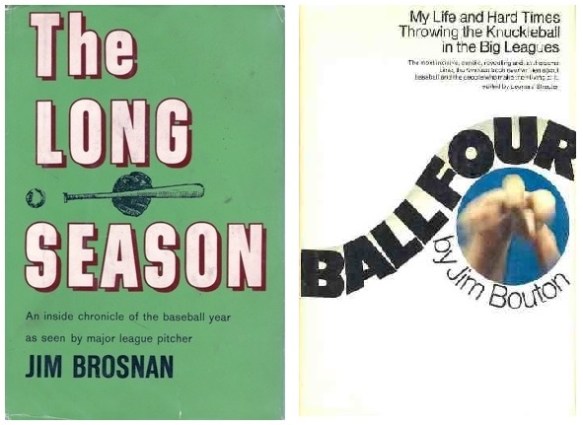
The books they said would subvert baseball. The game goes ever onward and the books never remain out of print. (So far.) Fifty years ago, Jim Bouton pitched his Ball Four season; ten years before that, Jim Brosnan pitched The Long Season.

The New York Public Library’s list of 20th century Books of the Century includes only one book pertaining to sports, Jim Bouton’s Ball Four. Yes, I was surprised, too, considering such volumes as Jim Brosnan’s The Long Season, anything by Roger Angell (one more time: he isn’t baseball’s Homer, Homer was ancient Greece’s Roger Angell), Roger Kahn’s The Boys of Summer, Bernard Malamud’s The Natural, Mark Harris’s Bang the Drum Slowly, and Arnold Hano’s A Day in the Bleachers, among others.

But there Bouton’s volume reposes, in a club to which also belong T.S. Eliot, James Joyce, William Faulkner, Virginia Woolf, Edith Wharton, Ralph Ellison, Jack Kerouac, John Dos Passos, Albert Camus, Agatha Christie, Grace Metalious, and Tom Wolfe. Before you retort that Bouton didn’t exactly write The Waste Land, Light in August, Invisible Man, On the Road, or The Bonfire of the Vanities, it’s only fair to say that Eliot, Faulkner, Ellison, Kerouac, and Wolfe never had to try sneaking a pitch past Carl Yastrzemski, Lou Brock, Harmon Killebrew, or Willie Mays, either.

Bouton was with the Astros when Ball Four was published in April 1970, after excerpts appeared in Look. To say it was received less than approvingly around baseball is to say Baltimore needed breathing treatments after the Mets flattened the Orioles four straight following a Game One loss in the 1969 World Series. “F@ck you, Shakespeare!” was Pete Rose’s review, hollered while Bouton had a rough relief outing against the Reds. All things to come considered, it was a wonder Rose knew Shakespeare wasn’t a brew served on tap at the ballpark.

This year is the fiftieth anniversary season of the one Bouton recorded for Ball Four and the sixtieth anniversary of the one animating Brosnan’s The Long Season. The books have their common ground and their distinctions, chief among the latter being that Bouton didn’t shy from detailing things even Brosnan, whose candor was considered jolting enough in its own time and place, didn’t dare to tread. If Brosnan even hinted at them, it was euphemistically. Bouton didn’t bother with euphemisms.

The two pitchers have something sadder in common, too. Brosnan suffered a stroke from which he was recovering when sepsis came manifest and caused his death in 2014 at 82, a year after his wife of 62 years died. Bouton, on the threshold of 80, suffered a stroke in 2012 that left him with cerebral amyloid angiopathy, a brain disease linked to dementia and compromised his ability to speak and write. Making it worse: the stroke occurred on the fifteenth anniversary of his daughter Laurie’s death in a New Jersey automobile accident.

Bouton’s wife, Paula Kurman, a speech therapist among other things (she has a Columbia University doctorate in interpersonal communications) who has worked with brain damaged children during her career, has worked with him carefully (“Together we make a whole person,” she once told a Society for American Baseball Research panel, to laughter that was sad as much as approving) and he has regained much of his speaking ability.

But he continues to struggle with what Kurman told Tyler Kepner of the New York Times was “a pothole syndrome: Things will seem smooth, his wit and vocabulary intact, and then there will be a sudden, unforeseen gap in his reasoning, or a concept he cannot quite grasp.”

Brosnan’s book was seeded two years before The Long Season‘s focus when he bumped into Sports Illustrated editor Bob Boyle. Having heard the bespectacled reliever had ideas about writing a book about major league baseball, Boyle suggested an article first “if something significant happens.” Brosnan turned in an essay about his trade from the Cubs to the Cardinals for veteran shortstop Alvin Dark, a trade one reporter described as the Cubs committing theft by trading “a mutt for a pedigreed pooch.”

“Loved it,” Boyle told Brosnan. “Why don’t you write a book about a whole season?” Two years later, that’s exactly what Brosnan did. He praised and needled in the same arch but honest tone, even if he did sanitize much of the vocabulary of the locker room or the dugout, as Bouton wouldn’t need to do a decade later. He showed the better and lesser sides of several players, but even his needles seemed not to come from malice aforethought.

Bouton was approached to do what became Ball Four by iconoclastic sports writer/editor Leonard Shecter, who’d previously written an in-depth profile of Bouton for Sport. Shecter proposed an in-season diary somewhat along Brosnan’s lines. “Funny you should mention that,” Bouton replied. “I’ve been taking notes.” During the 1969 season, Bouton would observe of his teammates, “My note-taking is beginning to make the natives restless.”

Brosnan offered no sense of wanting any kind of revenge for any kind of slight, in an era when players were too often slighted under a system that kept them, in essence, indentured servants. (One reviewer for the St. Louis Post-Dispatch wrote that Brosnan’s “pot shots,” such as they were, didn’t enrage fellow players “because ballplayers didn’t read; it was so out of character, or so he said.”) Bouton was often accused of trying to settle scores, particularly about the Yankees, his former team about whom he wrote and spoke extensively enough when the occasion suggested it. All Brosnan and Bouton did was try to show baseball and its players, coaches, managers, and administrators, as a too-human game played and run with too-human foibles, follies, and fantasias alike.

The devil was really in the details and even the language in Ball Four, from neither of which Bouton shied a single step. But both pitchers were accused of a kind of insider trading for fun and profit. “Brosnan has his say about many who may have, in times past, had their say about him,” wrote Bill Veeck of The Long Season, at a time Veeck still owned the White Sox. “This just doesn’t seem to come off so well, and tends to lessen the impact and enjoyment of his undeniably colorful material.” Presumably, Veeck took his own critique to heart when writing his own Veeck—as in Wreck, which did for baseball executives’ memoiring what Brosnan and later Bouton did for players’, and what Veeck did even further with his subsequent The Hustler’s Handbook.

“As an active player on a big-league team I had seemingly taken undue advantage by recording an insider’s viewpoint on what some professional baseball players were really like,” Brosnan wrote, after The Long Season and Pennant Race (his followup, about the 1961 Reds’ unexpected National League pennant winner) were republished on the latter’s season’s fortieth anniversary. “I had, moreover, violated the idolatrous image of big leaguers who had been previously portrayed as models of modesty, loyalty and sobriety — i.e., what they were really not like. Finally, I had actually written the book by myself, thus trampling upon the tradition that a player should hire a sportswriter to do the work. I was, on these accounts, a sneak and a snob and a scab.”

Bouton got the chance to address the hoopla around Ball Four in a followup book, I’m Glad You Didn’t Take it Personally (its jacket featured a baseball with a blackened eye drawn onto the hide) which was just as funny as Ball Four and sometimes a lot more poignant.  “I think it’s possible,” he wrote, “that you can view people as heroes and at the same time understand that they are people, too, imperfect, narrow sometimes, even not very good at what they do. I didn’t smash any heroes or ruin the game for anybody. You want heroes, you can have them. Heroes exist in the mind, anyway.”

Or, out of their minds, if you ponder one reaction to Ball Four. Before the Astros farmed Bouton out in 1970, Bouton discovered a burned copy of the book on the steps of the dugout, courtesy of the Padres. Even Brosnan’s and Veeck’s books avoided that kind of grotesquery.

The worst to happen to Brosnan after The Long Season and Pennant Race, not to mention other essays published in several other magazines, was the White Sox (to whom Brosnan was traded early in the 1963 season, long after Veeck sold the team) inserting a clause in his proposed 1964 contract barring him from writing for publication without prior team approval. Refusing to sign a contract with a clause like that in it, Brosnan retired after no other team took even a flyer on him, despite both Sports Illustrated and The Sporting News taking his side.

Bouton was either reviled as “a social leper” or a cancer on the game for having written and published Ball Four. Commissioner Bowie Kuhn actually tried to suppress the book, hauling Bouton into his office, demanding Bouton sign a statement saying it was all the pernicious work of his editor Shecter. Bouton probably had to restrain himself from telling Kuhn where to shove the statement when he wasn’t trying to restrain himself from laughing.

It was Dick Young of the New York Daily News who described Bouton as a social leper for writing Ball Four. When he ran into Bouton on an Astros visit to Shea Stadium, he said hello and, when Bouton needled him for talking to social lepers, Young replied, “Well, I’m glad you didn’t take it personally.” That reply gave Bouton the title of his followup book, in which he credited such overreactions in the sports press for doing almost the most to ensure Ball Four a best seller.

Both pitchers were witty, literate, and not even close to being thoroughgoing jocks. Brosnan made his way as a competent if mostly unspectacular relief pitcher and spot starter with a strong slider who had his moments. Bouton was a promising, hard throwing Yankee starting star, with a live fastball and a hard curve ball, until two seasons of overwork (1963 and 1964, and a whopping 520.2 innings over the two) left him with arm and shoulder trouble (it began a third of the way through 1964) that reduced him to marginal relief work and prompted him to make the knuckleball, which he’d thrown only as a change of pace previously, his bread and butter pitch.

Brosnan kept so many books in his locker that his 1961 Reds teammate, Hall of Famer Frank Robinson, nicknamed him the Professor. Bouton was no less literate or cerebral, though he may not have had a locker library equal to Brosnan’s, but his early ferocity as a competitor (he was once famous for his cap falling off his head as he delivered) inspired New York Post writer Maury Allen to nickname him Bulldog.

But Bouton may have put baseball into perspective even more than Brosnan did. Both pitchers were very aware of the worlds around them, and both wrote about the periodic spells of boredom, racial tensions, off-field skirt chasings, and self-doubts endemic in their professional baseball lives. Brosnan saved them for his books and articles; Bouton was less reluctant to speak his mind about things like politics, Vietnam, and civil rights when asked or when a conversation left him the opening.

Bouton bought even less into the still-lingering press representations of athletes as heroes. Teammates didn’t always hold with that or other things, like calling them out on it when they made mistakes that cost the Yankees games he pitched.

“After two or three years of playing with guys like [Mickey] Mantle and [Roger] Maris,” he wrote in I’m Glad You Didn’t Take It Personally, “I was no longer awed. I started to look at those guys as people and I didn’t like what I saw. They were fine as baseball heroes. As men they were not quite so successful. At the same time I guess I started to rub a lot of people the wrong way. Instead of being a funny rookie, I was a veteran wise guy. I reached the point where I would argue to support my opinion and that didn’t go down too well either.”

“He stands out,” Shecter wrote of Bouton in Sport, “because he is a decent young man in a game which does not recognize decency as valuable.” Much the same thing was said of Brosnan no matter what particular writers did or didn’t think of his two books.

Brosnan’s post baseball life including writing, advertising work (he’d done it in the offseasons of his pitching career), occasional sportscasting, and raising his family in the same Illinois home he bought with his wife, Anne, in 1956. (When they married, one local story’s headline, referencing his wife’s maiden name, said, “Pitcher Marries Pitcher.”)

Bouton became a sports anchor for New York ABC and then CBS before trying a baseball comeback in the White Sox system and then with the independent (some say notorious) Portland Mavericks, a comeback that ended with getting five starts for the Braves in late 1978. In one of those starts, Bouton squared off against Astros legend J.R. Richard, on the same night Richard broke the National League single-season strikeout record for righthanders, and pitched Richard to a draw. “The young flamethrower against the old junkballer,” Bouton wrote of the game.

A concoction Bouton and Mavericks teammate Rob Nelson invented in the bullpen, shredding gum into strands similar to chewing tobacco, became a hit as Big League Chew when they sold the idea to Wrigley. Bouton also continued writing, became a motivational speaker, and survived the collapse of his first marriage to meet and marry Kurman, blending two families, becoming founders and leaders of a recreational baseball league playing by 19th century rules, and becoming competition ballroom dancers. The Renaissance Bulldog.

The Washington Post‘s distinguished literary critic Jonathan Yardley wrote of The Long Season that it was literature about “[a]n ordinary season — life as it’s really lived — rather than an extraordinary one.” You could say, then, that Pennant Race was literature about an extraordinary season lived and played by ordinary men, if you don’t count Frank Robinson. Ball Four, which ran more temperatures higher up scales than Brosnan could claim, could be called an ordinary season lived and played by ordinary men. Recorded by a man whose extraordinary side was eroded by injuries.

Bouton may have hit the true key as to why all three books also unnerved baseball and its assorted establishments. “If Mickey Mantle had written Ball Four,” he later remembered, “it wouldn’t have been a big deal. A marginal relief pitcher on the Seattle Pilots had no business writing a book.” Likewise, if Robinson or Stan Musial had written The Long Season (Brosnan began 1959 with the Cardinals but was traded to the Reds midway) instead of a middle relief pitcher, it might not have proven a big deal.

Brosnan’s and Bouton’s books became baseball classics (as did Veeck—as in Wreck), and Ball Four also helped further expose the abuses heaped on players by front offices before the end of the reserve clause but probably caused no few of its younger readers to become sports journalists themselves. One suspects even now that Bouton’s revelations about the one-sided contract negotiations to which reserve era players were subject might have infuriated the purists more than his revelations about players’ sex drives, amphetamine indulgences, pranks, and feuds did.

Whenever one of Bouton’s former Ball Four-season teammates goes to his reward, Bouton is genuinely saddened. “I think he came, over the years, to love them,” Kurman told Kepner. “As each one died, he got really teary about it. He realized how deeply they were part of him.” (The Pilots, of course, were sold and moved to Milwaukee for the 1970 season, becoming the Brewers. Writing in Ball Four Plus Ball Five, a tenth-anniversary update, Bouton said, “The old Pilots are a ghost team, doomed forever to circumnavigate the globe in the pages of a book.”)

The Long Season remains “a cocky book, caustic and candid and, in a way, courageous, for Brosnan calls him like he sees them, doesn’t hesitate to name names, and employs ridicule like a stiletto,” as wrote Red Smith, arguably the best baseball writer in New York (then with the Herald-Tribune).

Ball Four‘s true success, wrote Roger Angell himself, “is Mr. Bouton himself, as a day-to-day observer, hard thinker, marvellous listener, comical critic, angry victim, and unabashed lover of a sport. What he has given us is a rare view of a highly complex public profession seen from the innermost side, along with an ironic and courageous mind. And, very likely, the funniest book of the year.”

And in the long, long, long wake of Brosnan’s and Bouton’s books, baseball hasn’t collapsed, the world hasn’t imploded, that Star Spangled Banner yet waves, and men and women of note or fame can be considered in all their human flaws, foibles, and fantasias, without being seen where appropriate as any less than heroes.

The Queen City rides a Wild Horse

2018-12-22 YasielPuig

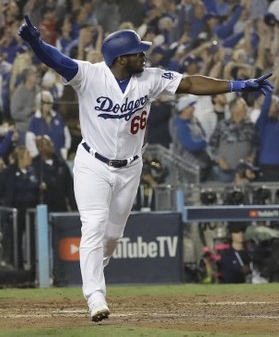
Yasiel Puig, right after hitting the three-run homer that put the Dodgers ahead temporarily in Game Four of the World Series . . .

Vin Scully called him the Wild Horse. Any time Yasiel Puig hit the field or the basepaths in Los Angeles, Dodger Stadium knew the only thing predictable about the talented but maddeningly inconsistent outfielder was how unpredictable he often was. In six seasons as a Dodger, Puig was many things. Boring wasn’t one of them.

It’s not that you can say he didn’t give advance notice. A young man who survived daily death threats from the Castro regime, escaped on what amounted to a milk carton raft, stowed aboard a coyote boat across the Gulf of Mexico, slithered through Mexico with and without the notorious cartels, and walked into Texas to finish his defection, knows a few things about how precious is life is and how exponential is the preciousness of freedom.

Love of life has been snuffed out of lesser creatures in circumstances far less grave. Landing in major league baseball, Puig was like a small boy turned loose in the toy store and told not to even think about coming out unless his wagon was loaded to overflowing. Crash Davis in Bull Durham told a meeting on the mound, “This game’s fun, OK?” Puig has played the game as if Davis’s admonishment was Article VIII of the Constitution.

He had only to learn how to distinguish between incandescent fun and immaturity without wrecking what made him unique in the first place. At one point it took an exile to the minors to deliver the point. Sometimes it really did seem as if nobody loved Puig but the people, at least those in Dodger Stadium or clinging to their televisions and radios around southern California.

But he learned enough in that exile to return as a better teammate with a reasonable harness whose doffing should be saved for particular occasions, such as helping a fun clubhouse atmosphere and dugout enthusiasm. Now the Wild Horse, who can break a game wide open one minute while occasionally letting it escape temporarily the next, has the chance to teach Cincinnati more up close and personal what it means that the game’s supposed to be fun.

On Friday, and with apologies to Whitey Herzog (who once said it of the late Joaquin Andujar, pitcher/human time bomb), the Dodgers traded their Puig-in-the-Box and a concurrent nine surprises a day—along with veteran outfielder Matt Kemp, pitcher Alex Wood, and reserve catcher Kyle Farmer—to the Reds, for struggling pitcher Homer Bailey and a pair of prospects, infielder Jeter Downs and pitcher Josiah Gray.

In one grand move the Dodgers cleared a serious enough outfield logjam and bought themselves some breathing room regarding the luxury tax (oops–competitive balance tax, ho ho ho), which translates even more simply to room for a serious run at free agent rightfielder Bryce Harper, a player who has long enough believed in making baseball fun again and has no reserve about enunciating it.

Things haven’t been all that much fun for the Reds since their last known postseason appearance. And if they weren’t even a topic when it came to the teams with the interest and the finances to hunt down Harper, getting Puig means there’s an excellent chance of things becoming a lot more lively in Great American Ballpark for at least one season.

Puig, Kemp, and Wood can become free agents after the 2019 season. Kemp restored himself as a valuable player in 2018 when he returned to the Dodgers in a deal with the Braves that many thought was supposed to mean a brief stopover before moving on promptly. But he stayed in Los Angeles, made his third All-Star team, and had a first half that looked like a reasonable facsimile of the former self that looked like a superstar in the making but didn’t quite get there.

(Here’s a pretty one for you: the so-called “untradeable contract.” As Bill Shaikin of the Los Angeles Times tweets, “Remember this the next time you hear a player has an “untradeable” contract: Matt Kemp has been traded four times on his ‘untradeable’ contract. The Dodgers alone have traded him twice on that same contract.”)

Wood has been a better than useful pitcher for the Dodgers even if his 2018 wasn’t quite the level of his 2017. In the latter he led the National League in winning percentage while having his best season overall to date. Like Puig, Wood is a six-year veteran; Kemp has thirteen seasons on his jacket and may yet find Great American Ballpark’s hitting friendliness enough to his liking to play himself into one more two- or three-year payday.

But the eyes of Cincinnati will remain on Puig, who could make for the plain most exuberant days of Reds baseball since the incendiary Rob Dibble, Norm Charlton, and Randy Myers forged the Nasty Boys bullpen who factored big in the Reds’ unlikely 1990 World Series sweep and left their own trail of mayhem in their wake before the group was broken up starting a season or two later. Maybe Puig, likewise a free agent after 2019 and looking at age 28, will bring enough fun, mayhem, and destruction of enemy pitching and baserunners (if he doesn’t throw them out, his missile launcher arm at least keeps them still enough) to convince the Reds to extend Puig a few more seasons.

“When Puig entered major league baseball,” writes Sports Illustrated‘s Gabriel Baumgaertner, “bat flips and exuberance were still frowned upon as unnecessary showmanship and disrespectful to opponents. Now, MLB runs marketing campaigns encouraging the type of emotion that was discouraged for so long. Puig is no small reason why the shift in mindset has occurred.”

His first week in major league service sure didn’t hurt. Puig had a week that players would kill to have over a full season: he caught a high drive and doubled up a runner on the same play; he hit four home runs including a grand salami; he threw out Andrelton Simmons at first base from deep right on a throw for which Roberto Clemente would have given a champagne toast.

His final days as a Dodger reversed Don Vito Corleone’s maxim about the relationship between misfortune and reward. On 14-15 September, against the Cardinals in St. Louis, Puig smashed five home runs—two the first day, three the second, overdue vengeance against the fans who’d trolled him a few years earlier, as the Dodgers fell out of the postseason early enough, with “Dodgers win? When Puigs fly!” Games like that helped send the Dodgers to this postseason. And almost helped them win the World Series.

Puig’s three-run homer off Milwaukee closer Jeremy Jeffress in the top of the sixth put Game Seven of the National League Championship Series enough out of reach to send the Dodgers to the Series in the first place. Puig flew, all right—a little bat flip here, a little crotch chop or two there as he ran the bases, having the time of his life, and not even his worst critics this side of Madison Bumgarner could really blame him.

But in Game Four of the World Series, Puig’s great reward led to unforeseen misfortune. A day after the Game Three marathon ended in Max Muncy’s leadoff homer in the bottom of the eighteenth, Puig checked in at the plate—in the bottom of the sixth—after Cody Bellinger’s infield ground out turned into the game’s first run on a throwing error. With one swing Puig made it 4-0, this three-run homer landing even farther up the left center field bleachers than his Milwaukee blast did after bounding off the yellow line.

Who knew that Red Sox pinch hitter Mitch Moreland would answer with a three-run bomb of his own in the top of the seventh? Or, that eventual Series MVP Steve Pearce would hit the game-tying bomb in the following inning, a prelude to his Game Five mayhem? Or, that the Red Sox would run the table for five in the top of the ninth, putting the Dodgers into a Series hole from which they never really saw light again?

In the moment as Puig’s drive flew over the fence Dodger Stadium was noisier than a heavy metal concert. The Wild Horse had almost as much fun running that bomb out as he’d had running out the Milwaukee mash and even the Red Sox weren’t about to think it untoward of him. Maybe they knew in their heart of hearts, “Let the kid have his fun, we have a little fun of our own to have yet.”

In the centenary of their first and worst-stained World Series championship, the Reds hope Puig does with them what he did often enough as a Dodger. The promotional possibilities are limitless, if nothing else. Imagine a Great American Ballpark audience festooned with T-shirts and placards referencing his uniform number and hailing, “Get your kicks with Puig 66!”