They were a little hard on the Bieber last night

Aaron Judge runs out the bomb he detonated off Shane Bieber on the fourth pitch of the game Tuesday night.

New York Yankees manager Aaron Boone is fond of saying his team can turn on a dime. He’d much rather they keep turning on the Cleveland Indians the way they did to open their American League wild card set. As a matter of fact, Boone’s wards were a little hard on the Bieber Tuesday night.

The Yankees and the Indians opened in Cleveland the same night the first debate between Donald Trump and Joe Biden went down. Depending upon where you peeked, the country had a hard time determining which wildfire was worse—the allegedly presidential debate, or the Yankees’ 12-3 demolition. The jury may be out until Election Day.

The Yankees could be seen as having had less time to prepare for Indians starter Shane Bieber than Trump and Biden had to face each other. They hadn’t faced the presumptive American League Cy Young Award winner all irregular season long, anywhere. They also went in having lost six of their last seven irregular season games and compiled an 11-18 road record.

Bieber had twelve season starts and faced four postseason teams—three of whom had winning records—seven times. Nobody took him long in any of his starts. Only once all year did he surrender a single run in the first or fifth innings. Nobody scored on his dollar at home all year.

Then the Yankees caught hold of him Tuesday night.

They needed only four straight fastballs to rip two runs out of him in the top of the first. American League batting champion D.J. LeMahieu saw a third straight fastball and lined a single to right field. Aaron Judge started his first plate appearance to follow seeing a fourth straight Bieber fastball. He finished it with that fastball, too, sending it over the right center field wall.

“We had a big, long hitter’s meeting,” Judge said after the game, “about all sticking to the same plan and just trying to work counts, get pitches to drive and I think, as a whole, we did that. That’s when this team is dangerous, when we go out there and we can just grind out at-bats. Any mistakes that are thrown up there, we hammer them.”

Bieber’s fastball sat so easily up or under in the zone to open that LeMahieu wouldn’t exactly call a three-pitch plate appearance a hard grind when pitch three sat right in the middle. Then the slender righthander who hadn’t surrendered a home run at home all irregular season long made the same mistake to Judge over the middle of the plate.

“The first inning didn’t go as planned,” said Bieber, showing a gift for understatement lacking too vividly in the presidential debate hall. “I wish I would have been with my off-speed stuff in the zone, and challenged those guys a little more. I forced myself into some bad situations and some bad counts on top of not having my best stuff and making mistakes. No excuses. It was not good.”

Neither was the rest of Bieber’s outing on a night Gerrit Cole struck out thirteen Indians in seven innings while walking nobody, had only one truly shaky inning (the third) and escaped with only an RBI double by Indians third baseman Jose Ramirez, then surrendered his only other run an inning after that, when left fielder Josh Naylor hit one over the right center field wall.

Cole otherwise looked even better than the guy who didn’t let five walks stop him from beating the Yankees in Game Four of last year’s American League Championship Series. The guy the Houston Astros let walk into free agency and right into the Yankees’ $324 million arms last winter.

In case you were wondering, only one pitcher before Cole ever struck out thirteen without walking a man in a postseason assignment—the late Hall of Famer Tom Seaver, in Game One of the 1973 National League Championship Series, and that was a game Seaver lost to the Cincinnati Reds, 2-1.

When he blew away the Indians’ middle infield, Francisco Lindor and Cesar Hernandez, on swinging strikeouts, before convincing Ramirez his only recourse was to pop one out to Torres behind shortstop, Cole let the Indians know early enough and often enough that they weren’t going to have a simple evening’s baseball to play.

Only nobody paid as much attention to Cole’s work or his marriage with postseason history as they might have paid if the Yankees hadn’t turned Bieber and a couple of Indians relievers into their personal batting practise pitchers.

They slapped Bieber for a single run in the third, two each in the fourth and the fifth. In order, it was AL home run champion Luke Voit doubling Aaron Hicks home with two out in the third, Brett Gardner doubling home Gleyber Torres and LeMahieu catching the Indian infield asleep with an infield RBI single pushing Gardner home in the fourth, and Torres with Gio Urshela aboard hitting one out in the fifth.

That was the 105th pitch of Bieber’s evening, corroborating Judge’s observation of the Yankee game plan at last. By that point, Bieber was probably itching to tell the Yankees what Biden told Trump during one of the president’s more insistent of his nightlong harangues, “Will you shut up, man?”

Interim manager Sandy Alomar, filling in for ailing Terry Francona, was kind enough to lift Bieber after that 105th pitch of the outing traveled from Torres’s bat to the bleachers. He didn’t tell the Yankees to shut up, man, on a night nobody could. But Alomar—whose guidance of the Indians into the postseason in the first place may actually get him Manager of the Year votes despite his interim status—did speak kindly of his still-young pitcher.

“Seems to be he was too excited,” Alomar said after the demolition ended at last. “He was the best pitcher in the American League this year. He had a bad game tonight.” That was like saying the Japanese navy had a bad set at Midway.

Even injury-hobbled Giancarlo Stanton joined in the fun. After striking out twice in four previous plate appearances on the night, the Yankee designated hitter squared off against reliever Cam Hill with one out in the top of the of the ninth and tore a 1-0 fastball—also arriving in the meatiest part of the zone—over the left center field fence.

The Yankee assault and battery almost wiped Chicago White Sox pitcher Lucas Giolito out of the day’s memory bank, thirty-four days after Giolito pitched a no-hitter the too-easy way against the Pittsburgh Pirates. He went into the top of the seventh threatening to become the only pitcher other than Hall of Famer Roy Halladay to pitch a regular-season no-hitter (that was Halladay’s perfect game) and a postseason no-no the same year.

Former Cardinal/Angel Tommy La Stella said not so fast leading off the bottom of the seventh in the Oakland Athletics’ ramshackle ballpark. With the White Sox up 3-0 already, La Stella took what he could get on a 2-2 service and snuck a base hit right through the middle.

Even playing without their best all-around player, Matt Chapman, the A’s made things a little too easy for Giolito and the White Sox. It only began when they were foolish enough to send lefthander Jesus Luzardo, young, gifted, but inconsistent, against a lineup so full of righthanded bats it’s a wonder the Oakland Coliseum didn’t list when they batted.

“Nothing against him,” said White Sox shortstop Tim Anderson when learning they’d face Luzardo, “but we have been doing good against lefties. I guess they haven’t done their homework so hopefully we can go out and continue to do what we’ve been doing against lefties.”

They did. They got six of their nine Game One hits off Luzardo and chased him in the fourth inning. In the third, they had Anderson on second with two out, Jose Abreu at the plate with a 2-0 count, first base open, and previous called strikeout victim James McCann on deck, and A’s manager Bob Melvin elected to let Luzardo keep pitching to Abreu.

Abreu elected to hit the next pitch, a fastball Luzardo intended to sail toward the outer edge of the plate but disobeyed orders and arrived smack dab in the middle. The ball disappeared smack dab over the left field fence. “Obviously,” Luzardo said post-game, “the guy’s an MVP-caliber type hitter, so you’ve got to be careful. I made a mistake. That’s not where I intended to put it.”

An inning before that, Luzardo intended to throw Adam Engel an 0-2 fastball up and in, and the ball disobeyed orders then, too. That disobedient ball went up, out, and into the bleachers.

It’s been that way for the Billy Beane-era A’s every time they reach the postseason. His A’s have been a second-guesser’s delight. This time, the second-guessers get to guess why Melvin insisted on starting Luzardo instead of rested righthander Mike Fiers against the starboard-hitting White Sox. Saying as the manager did that the White Sox hadn’t seen a lefty with Luzardo’s kind of stuff all year won’t fly half as far as Engel’s and Abreu’s home runs did.

This year’s bizarro-world postseason is barely a game old and the A’s and the Indians face elimination games Wednesday. So do the American League Central-winning Minnesota Twins after the 29-31 Houston Astros beat them 4-1 in Target Field Tuesday. So do the Buffalonto Blue Jays (third) after the AL East-winning Tampa Bay Rays edged them 3-1 in Tropicana Field.

The only solace for the A’s, the Twins, and the Jays is that none of them suffered anything close to the assault with deadly weapons the Indians suffered. Those three aren’t presumed to be half as cursed as the Indians—the last time the Indians won the World Series was during the Berlin Airlift.

With the same pairs playing Wednesday, plus the National League’s wild card sets beginning the same day, it’s to wonder only what further strange brews are liable to boil and which boils get lanced. At least there won’t be a presidential schoolyard argument to detract from the main events.
Put a meal and a stewardess on that flip

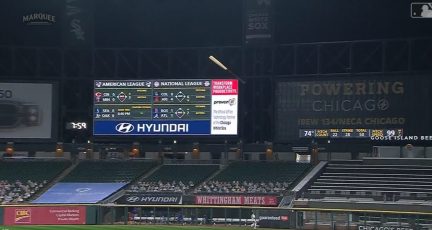
You’re not seeing things. That’s Willson Contreras’s bat in flight after the Cubs’ DH sent a three-run homer about that high en route the right field bleachers Friday night.

If you’re taking tallies to determine the bat flip of the year, Chicago Cubs designated hitter Willson Contreras should be among your top finalists. His Friday night flip in the ballpark formerly known as Comiskey Park, in the top of the third, was an absolute work of art. Enough to make Tim Anderson, Jose Bautista, Bryce Harper, and Tom Lawless resemble nursery school finger painters.

If you’re taking concurrent tallies to determine the most brain-damaged delayed over-reaction to Dali-esque flips, Chicago White Sox pitcher Jimmy Cordero should hold a place among the finalists likewise. He threw a pair of high inside pitches to Contreras and the second caught Contreras flush enough in the back, just off the C that begins the spelling of Contreras’s surname on his uniform back.

Flipped his bat high in the air? Contreras’s flip off the three-run homer he smashed on White Sox starter Dylan Cease (and Desist)’s dollar was the only flip yet where you were tempted to say what you used to holler watching a titanic home run fly out: “Put a meal and a stewardess on that one!”

If you’re going to be Fun Police enough to want retribution for a bat flip that looked as though it took off from O’Hare International and not Contreras’s hands, the time to go for it was Contreras’s next plate appearance in the top of the fifth. Cease walked Contreras on ball one up and a little in, ball two up and away, ball three inside middle, and ball four down and away.

There was no way Cease wanted to feed Contreras anything resembling the fastball that arrived just off the middle of the plate and flew the other way into the right field bleachers two innings earlier.

There was also no way Cease was trying to throw one through Contreras’s assorted anatomy, even if you could make a case that ball one up and in might have been a subtle nastygram reminding Contreras it’s not nice to channel your inner Michelangelo when you’ve already hit a ball through the equivalent of the Sistine Chapel ceiling. Might.

Maybe Cease got it when Contreras defended himself after the game. “I’m not going to change anything,” he told reporters. “I play hard for my team. I always want to do the best for my team. But if they don’t like me, that’s fine. I don’t play for other teams to like me, anyways. And if I have to do it again, I will do it again.”

But there was every way the White Sox—clinchers of a postseason berth at least, hopefuls toward snatching the American League Central title, even in this pandemic-truncated season of surreal—were feeling just a little over-punished on the night.

You tend to feel that way when Yu Darvish and company are shutting you out, Darvish not quite so nail driving as he’s been most of this season—during which he’s redeemed himself to the tenth power and into the Cy Young Award conversation—but effective enough to keep you to three hits and one walk and only two runners getting as far as second base under his command.

You feel even more that way, after Contreras’s bomb flip put the Cubs up 4-0 and Javier Baez’s leadoff launch over the left center field wall made it 5-0 in the top of the fourth, after Victor Caratini wrestled your relief option Gio Gonzalez to a seventh-pitch sinker that didn’t have enough weight to pull it quite to the bottom, and Caratini sunk it into the same bleachers Contreras reached three innings earlier. Not to mention Kyle Schwarber’s second-inning blast, making for the Cubs a four-bomb evening.

“The dog ate his homework,” pleaded White Sox skipper Rick Renteria. “Detention!” replied the umps.

When Contreras got drilled, the Cubs got riled. They hollered mightily from their dugout, enough to get the umpires into a confab that resulted in Cordero, White Sox manager Rick Renteria, and pitching coach Don Cooper the rest of the night off for bad behaviour.

Renteria tried the dog-ate-my-homework excuse after the game. A second-grade child had a better chance of making it stick. “The ball got away from him,” he insisted of Cordero’s cone job. “We couldn’t convince [the umpire] of that . . . There was no warning. They just gathered and ejected him.” As if a second straight up-and-in pitch was inadmissible evidence.

Cordero tried the same excuse. “It was just a bad pitch, a bad pitch to him,” he said after the game. “The ball sunk a lot, and that happened.” Sorry. Attempted sinkers that rise enough to get a man in the back don’t sunk a lot. Detention for you.

Understand that Cubs manager David Ross is just old school enough that it wasn’t programmed into his own playing software to deliver as Contreras did after hitting a hefty home run. But the man whose first major league home run came off an ex-Cubs first baseman named Mark Grace in Arizona late in a blowout, and whose last major league home run put the Cubs up by three in an eventual World Series-winning Game Seven, wouldn’t throw his man under the proverbial bus for his exuberance.

“It wasn’t to disrespect the other group,” Ross told reporters after the Cubs finished what they started, a 10-0 shut-and-blowout. “It was because we’ve been struggling offensively and he brought some swagger. He brought some edge. I loved every second of it. I don’t think he deserved to get hit at all.”

Why, Grandpa Rossy even had the pleasant audacity of comparing Contreras’s orbital flip to the one Anderson delivered a year ago April. When Anderson ripped Kansas City pitcher Brad Keller’s canteloupe over the fence and made of his bat a helicopter rotor while he was at it, got drilled in the rump roast by Keller his next time up, and objected vociferously. Drawing his teammates out of the dugout, getting both Keller and Anderson ejected by Country Joe West—who may or may not have remembered Anderson zapping him over an unwarranted ejection the previous season.

“All the hype is on the guy on the other side when he bat-flipped, right?” said Ross. “I thought Tim Anderson’s bat flip last year where he flipped it and looked in his dugout, that’s what you want. That’s what Willson did.”

Making the White Sox resemble hypocritical flip-floppers is also what Willson did. Their Andersons can flip until the flock flies home, but the opposing flock better not even think about it. The Fun Police are now reduced to the dog eating their homework. The dog looks better than the White Sox.

Was your cutout there? Bully!

Lucas Giolito, the big bully.

When Lucas Giolito’s Tuesday night no-hitter is remembered twenty years from now, and the coronavirus world tour has long been a not-so-pleasant memory, bank on one thing. Ten times the capacity of Guaranteed Rate Field will solemnly swear that their cardboard cutouts were at the game.

Much remarked for coming from a high school baseball team where his pitching teammates included Max Fried and Jack Flaherty, the Chicago White Sox righthander nailed thirteen strikeouts, walked a measly one, and threw 20 first-pitch strikes out of 28 batters faced.

Yes, it was the first no-hitter of the pandemic-truncated season other wise known as The Inner Sanctum of the Outer Limits of The Twilight Zone. And, it still counts as a bona-fide no-hitter now and for all time. But you’ll forgive me, I hope, if I’m not exactly in the mood to blast fireworks over it for ten good reasons.

The ten reasons are the number of Pittsburgh Pirates Giolito faced Tuesday night. They weren’t exactly the Big Red Machine, the Swingin’ A’s, the Pittsburgh Lumber Company, or this year’s Dodgers (who have yet to be nicknamed) Giolito had to face for the nineteenth no-hitter in White Sox pitching history.

They may not have even been the 1962 Mets, and these Pirates wouldn’t exactly go over big at the Hungry I or the Improv. Those Mets had Who the Hell’s on First, What the Hell’s on Second, You Don’t Want to Know at Third, and You Don’t Even Want To Think About It’s at shortstop. These Pirates barely fielded a cast of The Real Househusbands of Allegheny County. (That’s a joke, son. I think.)

These Pirates could accuse Giolito plausibly of bullying them. On Tuesday night, their lineup included nobody with an on-base percentage higher than .295. They have one .406 slugger (shortstop Erik Gonzalez, batting leadoff) and he has a .271 OBP. The collective OBP of Tuesday night’s Pirates was .234—fifty points lower than the 1965 Mets. (In due course you’ll see why I now mention that edition and not the 1962 comic opera—who actually had a team .329 OBP among non-pitchers.)

Come to think of it, said .406 slugger was the night’s only Pirates baserunner, reaching on a four-pitch walk to open the top of the fourth, right after James McCann’s sacrifice fly provided what proved the final 4-0 score. His reward for that walk was a first-pitch pop out behind the infield, a four-pitch strikeout, and an 0-2 line out to third base.

These Pirates strike fear in the hearts of nobody except their own fans watching on television and the cardboard cutouts that bother showing up this year. And maybe their own manager. What should have been shocking would have been if Giolito didn’t no-hit them.

“2020 has been a very strange year,” Giolito told reporters after the game from behind his mark. “Obviously a lot of weird stuff going on with COVID and the state of the world, so may as well throw this in the mix.” It’s baseball’s first-ever no-hit, no-run, no-fans-in-the-stands game.

“After the seventh, six more outs, looking at who I was facing, became very, very, very possible, and then we were able to get it done,” Giolito said. “Just staying with the same, like, mental routine for every single pitch. One pitch at a time. Full focus, full execution, straight through the target.”

It couldn’t have hurt that these Pirate targets were big enough that Dr. Anthony Fauci could have no-hit them if he’d thrown from halfway between the pitching rubber and the front of the plate.

For the longest time I thought the no-hitter Cincinnati Reds pitcher Jim Maloney threw at the Chicago Cubs one fine afternoon in Wrigley Field in 1965 was the single most ridiculous no-no I’d ever see or know. And that was a little more than half a month before Hall of Famer Sandy Koufax made those Cubs prove that practise makes perfect.

Until shoulder issues kicked into overdrive for him, Maloney might have been a genuinely great pitcher—but on 19 August 1965, Maloney did everything in his power to give the Cubs a break (those Cubs’ OBP, non-pitchers: .318)—and his Reds did everything in their power to get Cubs pitcher Larry Jackson on and off the hook.

Maloney’s good news: He struck out twelve in ten innings. His bad news: He walked ten. Jackson scattered nine Reds hits but a) only one of the nine came with a baserunner aboard (Vada Pinson, in the top of the ninth); and, b) the only one that mattered was Leo Cardenas hitting one into the left field bleachers with one out in the top of the tenth.

Then Maloney opened the bottom by walking Doug Clemens before getting rid of two Hall of Famers, Billy Williams and Ernie Banks, on a fly out to left and an Area Code 6-4-3. At least that time Maloney nailed the extra-inning no-no. Two months earlier, he lost one to the Mets when Johnny Lewis opened the top of the eleventh with a shot over the center field wall, and Mets reliever Larry Bernearth held fort in the bottom for the 1-0 Mets win.

Giolito is a pitcher who went from nothing special (5.68 fielding-independent pitching in his first three major league seasons) to a very good pitcher (3.29 FIP since last season opened) with outsize potential if he stays healthy. Unlike Maloney against the ’65 Cubs, Giolito wasn’t his own worst enemy Tuesday night, and he faced an aggregation who made those Cubs and the same season’s Mets resemble Murderer’s Row.

During the second inning, the power in Guaranteed Rate Field went out for a moment, a very brief moment. The power of the Pirates was already out to stay.

Yankowski: Vet, catcher, forgotten man

2019-11-11 GeorgeYankowskiFollowing is guest column by Douglas J. Gladstone, author of A Bitter Cup of Coffee, about one-time Philadelphia Athletics/Chicago White Sox reserve catcher George Yankowski, also a veteran of the Battle of the Bulge. He, too, is one of over 600 short-career former major leaguers frozen out of the 1980 pension realignment that made 43 days the minimum major league service time for players to qualify for full pension benefits after their playing days ended.

—JK.

Major League Baseball (MLB) takes justifiable pride in supporting programs for active personnel and veterans.

For instance, in 2016, there was a regular season game played at the Fort Bragg military base. And there’s a refurbished single family home for student veterans on the campus of Baldwin Wallace University that MLB and the Cleveland Indians financially supported. Those are just two examples of the game’s support of military personnel, to say nothing of all the on-field recognition ceremonies that are always held at each stadium.

That’s why what is happening to my friend George Yankowski is such a head scratcher.

On November 19, George turns 97-years-old. George, who plays a round or two of golf every week, still maintains an active lifestyle. Oscar-nominated actor Gary Sinise, whose Sinise Foundation does passionate work on behalf of active duty personnel and retired veterans like George, will even be meeting him at the Villages in Sumter County, Florida.

Born in Massachusetts, George was a hard-hitting catcher for both the Watertown High School Red Raiders as well as the Huskies of Northeastern University, One of the original six alums inducted into the Northeastern University Hall of Fame in 1974, it was while attending Northeastern that Yankowski enlisted in the U.S. Army in October 1942, and left for Fort Devens in April 1943.

George wanted to become an aviation cadet, but ended up in the infantry and trained as a sniper. He sailed for Europe in 1944 with the 346th Infantry Regiment in the 87th Infantry Division. In 2014, Miami’s French Consul General awarded him the French Legion of Honor Medal.

He fought in Metz, France—and then moved to Luxembourg, Germany, where he took part in the Battle of the Bulge. He earned the Bronze Star and the Combat Infantry Badge for his frontline encounters during that famous 44 day campaign. George came home from the war in June 1945, and after a three month battle with hepatitis in October of that year, got officially discharged in January 1946.

Sadly, the contributions of a man who defended our freedoms and liberties fighting overseas doesn’t mean much to MLB or the union representing today’s players, the Major League Baseball Players’ Association (MLBPA).

Originally signed by Philadelphia Athletics Hall of Fame manager Connie Mack, George appeared in six games for the Athletics during the 1942 season and 12 games for the Chicago White Sox during the 1946 season. But he is among the 626 retired players who aren’t receiving a pension for their time in “The Show.”

George is without an MLB pension because the rules for receiving MLB pensions changed in 1980. George and the other men do not get pensions because they didn’t accrue four years of service credit. That was what ballplayers who played before 1980 needed to be eligible for the pension plan.

Instead, they all receive nonqualified retirement payments based on a complicated formula that had to have been calculated by an actuary. In brief, for every 43 game days of service on an active MLB roster George accrued, he’d get $625, up to the maximum amount of $10,000 By contrast, the maximum allowable pension a retired MLB player who is vested can make is $225,000.

What’s more, the payment cannot be passed on to a surviving spouse or designated beneficiary. So none of Yankowski’s loved ones, such as his wife, Mary, will receive that payment when he dies.

These men are being penalized for playing the game they loved at the wrong time.

Though the current players’ welfare and benefits fund is valued at more than $3.5 billion, the MLBPA has been loath to divvy up more of the collective pie. Many of the impacted retirees are filing for bankruptcies at advanced ages, having their homes foreclosed on and are so poor and sickly they cannot afford adequate health insurance coverage.

George Yankowski was willing to take a bullet for us. To die for us. And how do we repay him? With a gross check of approximately $2,500. And that’s before taxes are taken out.

When he got his first check eight years ago, you know how he spent it? He used the money to pay for sorely needed dental work. Meanwhile, a member of the Boston Red Sox voted a full postseason share for winning the World Series received $418,000 last year.

Baseball has the money to pay the men like George. If the union goes to bat for them. MLB also cut a $10 million check two years ago to support the programs at the National Baseball Hall of Fame and Museum in Cooperstown, New York. That’s right—museum relics received financial support instead of flesh and blood retirees.

This is no way for the national pastime to be treating our war heroes. Or anyone else, for that matter.


The 1919 Reds, grand theft victims

This essay was first published 18 December 2018; a different version appeared in the Society for American Baseball Research’s Black Sox Scandal Research Committee Newsletter later that month, and I still thank editor Jacob Pomrenke—perhaps the most passionate reviewer of the scandal the nation has—for his kindness in accepting it. It also formed the basis of a lecture I gave to SABR’s Las Vegas chapter in January—with a replica 1919 Reds hat resting proudly on my head.

On today’s centenary of the ill-fated 1919 World Series’s final game, I republish the original, with one or two time-appropriate alterations, in the continuing if feeble hope that the 1919 Reds will receive their due at last as legitimate World Series champions despite the Black Sox shenanigans.

1919Reds

They wuz robbed: the 1919 Reds. (Hall of Famer Edd Roush stands second from left, top row.)

It’s difficult to feel sorry for a franchise whose history includes fifteen trips to the postseason, ten pennants and five World Series championships, even if they’ve spent the past six seasons in the pits of the National League Central. Difficult, but not impossible.

This season was the centenary of the Cincinnati Reds’ first National League pennant and World Series triumph, and it’s not unfair to say few outside Cincinnati might have cared. But you should. Too much commentary focused on the guys they beat in the 1919 World Series. Understandable, but patently unfair. To the Reds. The thrill of victory never smelled so much or so without warrant like the agony of defeat.

You know too much, not enough, or both about the Black Sox. You may know the mythology saying the White Sox untainted by the Eight Men Out would have just annihilated the poor little Redsies who just weren’t enough to withstand a feeding attack from the South Side sharks. That’s a lie equal to one president not having had sex with that woman and a thrice-removed successor having the largest inaugural crowd of all time.

The Reds’ golden age was the 1970s of the Big Red Machine. Five division titles, four pennants, back-to-back World Series conquests, over that decade’s first seven years. Franchises would kill for a piece of that. But the Machinists had no single season winning percentage better than the 1919 Reds. The 1919 edition’s .686 winning percentage was better than those White Sox (.629) and any team in their decade except the 1912 Boston Red Sox. (.691.)

Before anyone suspected foul play, the 1919 White Sox were 8-5 favourites to win the Series overall but 2-1 underdogs for the first two games in Redland Field. (The park would be re-named Crosley Field in 1934.) White Sox manager Kid Gleason trumpeted what he considered the greatest hitting team that yet played a World Series. Reds manager Pat Moran made a prediction that proved too chilling in due course: “If we beat [White Sox pitcher Eddie] Cicotte in the first game, we ought to win the Series.”

Cicotte, of course, hit the Reds’ second baseman Morrie Rath with the second pitch of the bottom of the first, the signal to the gamblers that the fix was on. But Cicotte would have entered that game suspect even without joining the fix. He suffered shoulder and arm miseries at the end a 306.6 inning, 29-win season. (If you’ve seen the dubious film version of Eight Men Out, you remember the scene in which Cicotte’s suspect shoulder and arm received a linament rubdown from his wife.)

The White Sox entered the Series with two great starting pitchers (Cicotte, fellow Black Sox Lefty Williams), a third (Hall of Famer Red Faber) missing in action thanks to injuries, and a rookie (Dickey Kerr, one of the Clean Sox) who looked like a comer both starting and out of the bullpen but whom observers in the moment considered a kind of wild card. The Reds entered with five solid, healthy starters: Hod Eller, Ray Fisher, Jimmy Ring, Dutch Reuther, and Slim Sallee. Gleason went into the Series on the shorter end of the pitching stick, even without Cicotte and Williams corrupted. Moran had the luxury of being able to rotate his arms—none of which was particularly overworked compared to Cicotte and Williams (297 innings)—reasonably.

Is one way to measure a team their second-half season’s performance? If so, and if  you’ll pardon the expression, you should have put your money on the Reds based on that. They went 47-19 in their second half. The White Sox went 41-26. The Reds finished nine games ahead of the second-place New York Giants; the White Sox finished three and a half ahead of the second-place Cleveland Indians.

Another measure is how they did against fellow contenders in their league. The Reds went 38-22 on the season against three other contenders (the Giants, the Chicago Cubs, the Pittsburgh Pirates); the White Sox went 35-25 against three others (the Indians, the New York Yankees, the Detroit Tigers). In September alone, the Reds faced other contenders ten times and went 8-2; the White Sox, twelve times, going 6-6.

On the regular season the White Sox out-hit the Reds but weren’t that much better at scoring. The White Sox averaged 4.8 runs per game but the Reds averaged 4.1. And the opposition averaged 2.9 runs against the Reds but 3.8 runs against the White Sox. It’s easy to figure out: The Reds out-pitched the White Sox. Entering the Series, the White Sox pitching staff had a 3.04 earned run average and a 2.88 fielding-independent pitching rate. (FIP: your ERA when defense is removed from the equation.) The Reds staff had a 2.23 ERA and a 2.81 FIP. The Reds were a little bit better at crafting their own pitching luck.

The 1919 White Sox shut the other guys out fourteen times and got shut out seven times. The bad news for the 1919 Reds: they were shut out fourteen times—but the good news is, they shut the other guys out 23 times. The closer you look, the less the White Sox look like predators and the Reds like prey.

It wasn’t just the tainted White Sox who came up short at the Series plate, Shoeless Joe Jackson to one side. Leadoff hitter Nemo Liebold hit .056 with two walks and one hit in the set. Hall of Famer Eddie Collins, another of the Clean Sox, undermined his own reputation as a money player when he hit .226 with a single run batted in. Collins’ Series average was two points above the team’s.

What of Jackson? His cumulative Series hitting line argues against him going into the tank, but his game-by-game performance looks more suspect. In his best single game at the plate all set long, Game Eight, he had two hits, three runs batted in, two runs scored including on a third inning home run, but the White Sox were blown out, 10-5, to lose the Series. The homer was Jackson’s first hit in the game, and he came to the plate with the White Sox already down, 5-0. Uh!-oh.

Even before White Sox first baseman Chick Gandil and shortstop Swede Risberg instigated the World Series fix, and found both the gamblers and the teammates to execute it, the White Sox and the Reds had a critical difference. The White Sox were riddled with dissension not all of which was provoked by frustrations real or imagined with their owner. They were wracked by clashes between more- and lesser-educated players and by spells of discomfort with new manager Gleason.

Collins played on the Philadelphia Athletics teams that ruled the earlier parts of the decade that the Red Sox didn’t, which went a long way toward fostering the presumed American League superiority. He once said those A’s “believed in teamwork and cooperation. I always thought you couldn’t win without those virtues until I joined the White Sox.”

The 1919 Reds believed as he did. Susan Dellinger, Ph.D., granddaughter of the Reds’ Hall of Fame center fielder Edd Roush, revealed in Red Legs & Black Sox: Edd Roush and the Untold Story of the 1919 World Series that those Reds liked their own new manager Moran, liked each other, played hard, and thought of team first. They mentored each other when need be, made a powerful point of making newer players feel at home, and, on the field, as Dellinger wrote, “No one cared who was on third. If he wore the Reds insignia, just get him home.”

Their morale withstood only one threat, Dellinger exhumed, when Roush finally told Moran of whisperings he’d heard that gamblers tried to get to one or two Reds pitchers. Moran called a team meeting prior to Game Eight. The scheduled starting pitcher, Hod Eller spoke up. He’d run off a gambler who tried to buy him off for the game. Then he pitched the distance in the Series-ending blowout.

“Doesn’t everybody say the dream is nonsense? Didn’t everybody say the Reds couldn’t possibly win?” wrote Damon Runyon after the Reds’ Game One win. (The article is collected in the splendid Guys, Dolls, and Curveballs: Damon Runyon on Baseball.) “Experts, ballplayers, and fans—didn’t they all laugh at Cincinnati’s fall pretensions as they have laughed every year for many years? Cincinnati will tell you that they did.”

Didn’t they tell you Pat Moran’s ball club was made up of castoffs of baseball, and that it was just a sort of baseball joke compared to the million dollar club that represents Chicago?

Cincinnati will tell you they did. Cincinnati never tires of the telling, in fact. But all the time they were telling these things about the Reds, Cincinnati was secretly dreaming a great dream that was realized at Redland Field this afternoon, with 30,000 pop-eyed breathless Cincinnati people looking on.

The castoffs of baseball proved better than the sum of their parts and the million dollar club proved worse in more ways than one.

George F. Will had it right when he once described most of the Eight Men Out as “more dumb than dishonest,” a valedictory that doesn’t apply to the ringleaders Gandil and Risberg. Or, to reserve third baseman Fred McMullin, who stumbled upon their plot in its planning and threatened to expose it unless they cut him in on the profit. (Remember, too, that if the gamblers double-crossed the Black Sox, Gandil may have double-crossed his own co-conspirators; he’s said to have kept the bulk of the money the gamblers paid them.)

Will also said of the commissioner baseball selected in the scandal’s immediate wake, Judge Kenesaw Mountain Landis, that he “delivered rough justice, perhaps more rough than just,” when it came to the game-wide malignancy that enabled the Black Sox. Landis was not faultless, including and especially the de facto perpetuation of baseball’s segregation. (He neither ruled formally nor spoke publicly but it was understood he wouldn’t sanction baseball’s integration so long as he held office.) But if he applied an overweight hand to baseball’s original gambling scandal, it was featherweight compared to the cancer the game needed to eradicate.

Jackson made two terrible mistakes, perhaps out of intimidation from the too-rough/too-tumble Risberg. (“Swede,” he told those investigating the World Series fix, “is a hard guy.”) He accepted an envelope Lefty Williams was ordered to deliver to him, containing $5,000, rather than say thanks but no thanks. And, he delayed his oft-discussed attempt to dispose of it and advise team officials what was up.

Third baseman Buck Weaver wanted no part of the fix or its payoffs. He also wanted nothing to do with being a rat against his friends, some of whom were anything but. That seemed more important than aborting the fix, which Weaver could have done by exposing what he knew. If there was a concerted cover-up of the fix, by White Sox officials at minimum, delaying its revelation and resolution by at least a year, Weaver’s silence left room for a cover-up in the first place.

Jackson’s playing record is considered Hall of Fame worthy. But the guileless outfielder (illiterate he was, but guileless doesn’t mean stupid) was never elected on the (oft-forgotten) couple of times he did appear on the Baseball Writers Association of America Hall of Fame ballots. It’s not unreasonable to say his Hall worthiness married to his banishment inspired subsequent movements to convince baseball’s government to reinstate him and enable his Hall election, whatever the details behind his Black Sox status.

Don’t think that just because the White Sox were riddled by factionalism, and that even some of the Clean Sox were rough and tumble, it means the Reds were a roster full of saints. But several Reds including Roush, Eller, and outfielder Greasy Neale believed the Series was played mostly straight at least between Games Three and Six—because, they said in various ways, the gamblers double-crossed the fixers and the fixers didn’t get all the money they were promised. It neither mitigated the Black Sox nor eroded the myth of the Reds’ comparative modesty.

Seventy years after that World Series came Pete Rose, banished from baseball for violating Rule 21(d)—the rule against betting on baseball, the rule instigated by the gambling corruptions that climaxed with the 1919 Series fix and its eventual exposure and affirmation. You can say many things about Rose, but guileless isn’t one of them. And the very real prospect of his election to the Hall of Fame despite his banished status prompted the Hall itself, an entity not actually operated or governed by Major League Baseball, to rule against baseball’s ineligible being eligible for Hall election.

A nation whose citizens empathise with victims real or imagined should hark heartily to the real victims of baseball’s two most notorious gambling scandals. The first compromised the integrity of the Reds’ first World Series winners through no fault of their own. The second cost the Reds a franchise icon and manager through all fault of his own.

(This year’s Reds didn’t get to play this year’s White Sox in interleague play. Kind of a shame, too. Try to imagine today’s baseball administration dealing with that during this particular centenary season.)

It would have been simple enough for baseball to spend 2019 giving the 1919 Reds their long, long overdue. The evidence says they could have beaten those White Sox in a straight, no chaser Series.  Baseball can’t give them a Series do-over but it can give them the championship legitimacy they deserve. Metaphysically and temporally, the 1919 Reds wuz robbed.