Ladies and gentlemen, your Chicago Blight Sox

2024 Chicago White Sox

The Blight Sox, on the threshold of possessing the American League’s longest losing streak, depending upon what they can or can’t do with the Athletics, of all people, Tuesday night.

The number twenty-one has meanings profound (a winning hand at blackjack; the legal age of consent in most places), historical (a fabled New York restaurant and Prohibition-era speakeasy), and disgraceful alike. (The 1956-58 television game show that ignited the infamous quiz show scandal.) It was also the uniform number of 29 White Sox players over the team’s history.

As of Monday night number 21 became something more sinister. In Chicago, that is. The White Sox lost their 21st consecutive game. Somewhere in this favoured land, the sun is shining bright, the band is playing somewhere, but the White Sox are under a massive cloud with the threat of funeral marches sounding too clear.

The Athletics, of all people, dropped it upon the Blight Sox. The team so reduced by their ten-thumbed, brain-challenged owner that it was thought the A’s would bury themselves a live in what’s still their farewell season in Oakland beat the White Sox 5-1 in the A’s rambling wreck of a ballpark.

Once upon a time, the White Sox tied the game at one. The A’s said, don’t even think about it, scoring four more. And there was no joy back in Windville when the mighty Senzel (Nick, that is) struck out to end consecutive loss number 21.

This is the longest such streak of sorrow since the Orioles opened 1988 0-21; the 21 losses are an American League record now shared. The streak followed the 27-67 record the White Sox amassed from Opening Day through 5 July. They have only to lose three straight more to pass the 1961 Phillies and six straight more to pass the 1889 Louisville Colonels of the antique American Association. And, unlike those 1988 Orioles, these White Sox may have lost their sense of humour along the way.

Says White Sox manager Pedro Grifol, whose seat may resemble a stovetop burner, “Everybody knows what it is. It’s 21 in a row. It sucks. It’s not fun. It’s painful. It hurts. You name it. However you want to describe it.”

Said 1988 Orioles manager Frank Robinson, installed after Cal Ripken, Sr. skippered them to the first six straight losses, “Nobody like to be the joke of the league, but we accept it”—after showing a visiting reporter a button he kept in a desk drawer saying, “It’s been lovely, but I have to scream now.”

Says White Sox left fielder Corey Julks, who managed a highlight-reel catch to save a run, “Don’t dwell on the losses. Try to learn from them and get better each day.”

Said Hall of Fame shortstop Cal Ripken, to a reporter new on the Oriole beat when that 1988 streak hit the big Two-Oh, “Join the hostages.”

Said Grifol, “It’s not for lack of effort. Nobody wants to come out here and lose. We’ve just got to put a good game together and put this behind us.”

Said Robinson, “Nobody’s really gone off the deep end. All except one game, there’s been a real effort.”

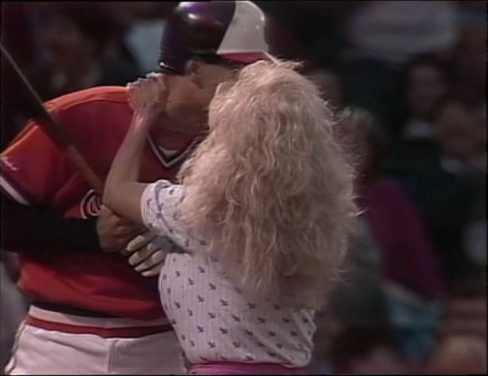
Cal Ripken, Jr.; Morganna. the Kissing Bandit

When the ’88 Orioles needed a little extra mojo after losing two straight following the end of their epic losing streak, Morganna the Kissing Bandit planted one on Hall of Famer Cal Ripken, Jr.—and they battered the Rangers for her trouble.

Said former White Sox manager Ozzie Guillen to Athletic reporter Jon Greenberg, after Greenberg suggested White Sox owner Jerry Reinsdorf and general manage Chris Getz were waiting for Grifol to manage one more win before executing him, “That means Pedro is 100 games under .500 since he got the job. Hoo, hoo boy.”

Said Robinson, told of a radio personality who promised to stay on the air until those Orioles finally won a game, “We’re gonna kill the poor guy.”

Come 29 April 1988, Baltimore’s old and long-gone Memorial Stadium was sold out, the crowd broke out the ancient championship-aspiring chant “O-R-I-O-L-E-S” . . . and the Orioles won at last, 9-0. Their opponent then? A different collection of White Sox. Out of whose starting pitcher Black Jack McDowell they pried five runs (four earned), out of whose bullpen they banged four more, in a game featuring two Hall of Famers on each side, with the Oriole Hall of Famers—Ripken and Eddie Murray—each hitting home runs and the whole team pounding eleven hits to the White Sox’s four.

After two straight Oriole losses to follow, Morganna the Kissing Bandit showed up to plant a wet one upon Ripken . . . and they battered the Rangers, 9-4. Ripken hit one out that day, too. It wasn’t enough to salvage an Oriole season in which they played below .500 ball in each month. (Morganna wasn’t about to become a single team’s attitude adjustment mascot, either.) But it might have kept the sting of 0-21 cauterised awhile.

Now, the White Sox don’t have someone else to confront them trying to end a losing streak. This time, the White Sox have to try again. They’re not finding laughs, they’re hearing that their own Hall of Fame legend Frank Thomas  is scolding them: “I don’t want to hear no more: ‘We’re trying.’ No more: ‘They’re working hard every day.’ No, it’s time to snap. It’s time to kick over the spread.”

The 1961 Phillies were managed by Gene Mauch, a man to whom kicking the postgame food spread over came as naturally as song to an oriole. Grifol doesn’t yet impress as a man ready to turn a table full of food and drink into a Jackson Pollock floor painting. Yet. But if the White Sox don’t escape Oakland with at least one win, don’t bet against the homecoming spread in Guaranteed Rate Park being served under armed guards.

Don’t look for Morganna to bring a little mojo. She’s been retired a quarter century and has no known intention of making a comeback. But upon whom would anyone suggest she plant one, if she did? Maybe upon Grifol, when he brings out the lineup card. If nothing else, it might loosen the manager up to the point where he can say, “It’s been lovely, but I have to scream now.”

A stupid anniversary

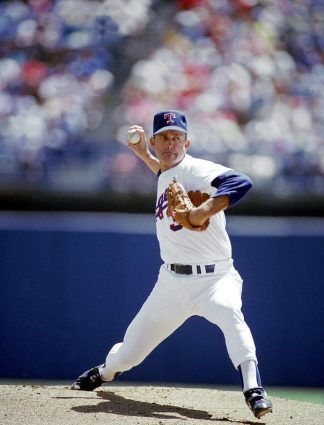
Nolan Ryan

This is the way to remember Nolan Ryan—as a great pitcher, not the guy who got buried alive in a nasty brawl with the White Sox.

At the rate it turns up on social media discussions, and not merely on its anniversary, Hall of Fame pitcher Nolan Ryan is going to be remembered purely for the day he drilled Robin Ventura into charging the mound. As if nothing else he accomplished in a quarter-century plus pitching career mattered half as much as putting a temporarily brain-damaged third baseman in his “place.”

As if Ventura got the worst in a Ryan headlock that triggered a bench-clearing brawl between Ryan’s Rangers and Ventura’s White Sox in which Ryan got far worse than he inflicted upon Ventura. As if Ryan, in what proved his final season, was some sort of saint and Ventura some sort of bandit. As if there hadn’t been tension between the two teams for going on four full years.

It’s time to put the whole damn business to bed where it belongs. There were far more important things to think about to open this August. Things like Blake Snell’s no-hitter, Jack Flaherty’s Dodger debut, the sad end to yet another season from yet another injury to Hall of Famer-in-waiting Mike Trout. Things like the White Sox losing a twentieth straight game. Things like José Abreu hitting two bombs his first game back from his grandmother’s death and Freddie Freeman’s Guillain-Barre syndrome-afflicted little son home from the hospital.

But no. Who needs those when you can bring up the Ryan-Ventura brawl, a textbook exercise in celebrating false masculinity and baseball brain damage, on its anniversary, which is rendered meaningless anyway for how often it gets brought up all year long on one or another social media outlet?

Ryan was of the school of thought that taught the outer half of home plate was the pitcher’s exclusive property. You won’t find that anywhere in baseball’s written rules, of course. Generations of pitchers have been taught that; generations of hitters have been taught likewise. Well, now.

The Ryan-Ventura brawl was impregnated by a 1990 White Sox rookie named Craig Grebeck. He’d go on to make a useful career as a defense-first utility infielder. But in spring training 1990 he shocked a lot of people—probably including Ryan, probably including his own team—when he homered against the Rangers on a first pitch. He pumped his fists rounding the bases.

Come the regular season, Ryan faced Grebeck and surrendered one of (read carefully) the nineteen major league home runs Grebeck would ever hit in a twelve-season career. Again, Grebeck pumped his fists rounding the bases. Back on the bench, Ryan asked pitching coach Tom House about him.

Told that it was Grebeck, a not so tall player who looked then like a boy entering middle school, Ryan is said to have told then-Rangers pitching coach Tom House, according to Ryan biographer Rob Goldman, “Well, I’m gonna put some age on the little squirt. He’s swinging like he isn’t afraid of me.” The next time Grebeck faced him, Ryan hit him in the back with a pitch. “Grebeck was 0-for the rest of the year off him,” House remembered.

Fat lot of good that did The Express: Grebeck actually finished his career with a .273/.429/.545 slash line and a .974 OPS against the Hall of Famer. It wasn’t exactly a powerful one (three singles, two walks, three strikeouts, but four runs batted in, somehow), but Ryan didn’t exactly age Grebeck with the first of only two drills he’d hand Grebeck lifetime, either.

What it did, though, was begin some very tense times between Ryan’s Rangers and Grebeck’s White Sox. The White Sox’s batting coach, Walter Hriniak, was teaching his charges to cover that outer half of the plate. House insisted that was a root but Ventura himself said otherwise. “At the time in baseball the (strike) zone was low and away, and that was where pitchers were getting you out,”he said. “We weren’t the only team doing it. It was the kind of pitch that was getting called, so you just had to be able to go out and get it.”

What followed:

17 August 1990: Ryan hit Grebeck with one out in the third, Grebeck’s first plate appearance of the game. Two innings later, White Sox starter Greg Hibbard hit Rangers third baseman Steve Buechele with two outs. (The game went to extras and the Rangers won, 1-0, when Ruben Sierra walked it off with a line drive RBI single in the thirteenth.)

6 September 1991: Ryan hit Ventura in the back on 1-2, also in Arlington, three innings and a ground out after Ventura doubled Hall of Famer Tim Raines home with nobody out in the top of the first and scored on Lance Johnson’s subsequent two-out single. It started a rough day for Ryan, who surrendered two more runs (both on third-inning sacrifice flies) en route an 11-6 White Sox win.

2 August 1993: This was two days before Ryan and Ventura’s rumble in the jungle: Rangers pitcher Roger Pavlik hit White Sox catcher Ron Karkovice with one out in the third. (Ventura posted a first-inning RBI single to open the scoring; Rangers left fielder Juan Gonzalez answered with a two-run homer in the bottom of the first. Subsequently, White Sox relievers Bobby Thigpen and Jason Bere each hit Rangers third baseman Dean Palmer, while Rangers shortstop Mario Díaz also took one from Thigpen.

Ventura and assorted White Sox teammates of the time insisted Ryan was throwing at hitters and often hitting them on a routine bases. Two days later, Ryan and Ventura went at it. Among the pleasured by Ventura charging Ryan was Sox pitcher Black Jack McDowell: “Ryan had been throwing at batters forever, and no one ever had the guts to do anything about it. Someone had to do it. He pulled that stuff wherever he goes.”
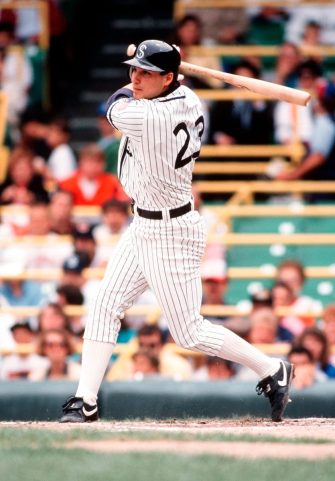
Robin Ventura

And this is the way to remember Robin Ventura—a great third baseman, not the guy who charged the mound indignantly when Ryan hit him with a 1993 pitch after a few seasons of White Sox-Ranger knockdown-and-plunk tensions.

“We had a lot of going back and forth that season,” says Ventura. “Guys were getting hit regularly, and it was just one of those things where something was going to eventually happen.” It probably involved other Rangers and White Sox pitchers, too.

Ryan was as notorious for his career-long wildness (he led his league six times and the entire Show three times in wild pitches, and averaged twelve per 162 games lifetime) as for his seven no-hitters, his 5,714 lifetime strikeouts, and his 2,795 walks. (They’re also number one on the Show hit parade.) He may have gotten away with throwing at hitters, but he was actually pretty stingy when it came to actually hitting them.

He retired averaging seven hit batsmen per 162 games. Seven. If he’d actually hit seven men a year for his entire career, it would give him 31 more drilled than he actually compiled (158). He actually had eleven seasons in which he hit five batters or fewer; hitting Ventura on that fine 4 August 1993 was the only hit batsman Ryan had in thirteen 1993 starts before he finally called it a career.

That doesn’t exactly sound like one of the most merciless drillers the game’s ever seen. Ryan only ever led his league in hit batsmen once (1982, when he was an Astro), and that’s one more than Hall of Famer Bob Gibson—too often the unjustified first name in, ahem, manly intimidation—ever did. Believe it, or not. Ryan is number sixteen at this writing on the all-time plunk parade. Gibson, you might care to note, is tied for 89th on the parade with (wait for it) 102. And he averaged (wait for it again!) . . . six per season.

“If you look at the replays, the ball wasn’t really that far inside,” House told Goldman.

It was just barely off the plate and it went off Ventura’s back. Robin was starting toward first base when he abruptly turns and charges the mound instead. And the closer he got to Nolan, the bigger he looked. If you watch it in stop action, you can see Ryan’s eyes were like a deer’s in a headlight. So everybody was surprised by what Nolan did next: Bam! Bam! Bam! Three punches right on Ventura’s noggin!

Actually it was about six. Now for the part everyone still gaping in awe over Ryan’s manly deliverance of a lesson to Ventura forgets: Both teams swarmed out of their dugouts, but the White Sox got to Ryan so swiftly that they drove him to the bottom of a pileup from which the White Sox’s Bo Jackson had to extricate Ryan before some serious damage was done to the veteran righthander.

“All I remember,” Ryan eventually told Goldman, “is that I couldn’t breathe. I thought I was going to black out and die, when all of a sudden I see two big arms tossing bodies off of me. It was Bo Jackson. He had come to my rescue, and I’m awful glad he did, because I was about to pass out. I called him that night and thanked him.” (The two were friendly rivals since then-Royal Jackson hit Ryan for a 1989 spring homer and his teammates hailed Ryan the next day—from the spot where Jackson’s bomb landed, as Ryan went through an exercise routine on the field.)

Ryan otherwise actually got the worst of it when all was said and done. Jackson extracted a man “visibly winded,” Goldman wrote. Ryan wasn’t the only one thankful for Jackson. “When Nolan didn’t come out of the pile, I got concerned,” said his wife, Ruth. “With his bad back, sore ribs, and other ailments, he could easily have suffered a career-ending injury.”

Somehow, Ryan remained in the game. Ventura was ejected for charging the mound. Of all people, his pinch runner was . . . Craig Grabeck. Ryan picked Grabeck off first before he threw a single pitch to the next batter, Steve Sax, who grounded out to end the inning.

The Rangers went on to win, 5-2. Ryan insists to this day that if Ventura had stopped shy of the mound rather than finish the pursuit and grab his jersey, “I wouldn’t have attacked him.” But he also felt embarrassed by the brawl. So much so that, Goldman recorded, when the Ryan family returned home from a postgame family dinner, Ryan declined when one of his sons—who’d videotaped the scrum—asked Dad if he wanted to see it again.

Ryan’s no, Goldman noted, was “firm.”

Said the Dallas Morning News headline the day after: Fight Gives Game a Big Black Eye.

Now, if rehashing that brawl isn’t to Nolan Ryan’s taste, it ought to be lacking likewise for the idiots who insist on reliving and re-viewing it on social media—and not just on its anniversary. I could be wrong, but it seems that social media outlets can’t last two weeks, and possibly less, without at least one jackass posting the video of the scrum.

Pitching to the inside part of the strike zone is part of the art, even if there’s no written rule saying the outer half of the plate is the pitcher’s exclusive property. You can delve as deep as you want and discover there were plenty of pitchers who lived so firmly on the inside that they, too, earned unfair reputations as headhunters.

Not everyone is as shameless as shameless as fellow Hall of Famer Early Wynn insisting he’d knock his grandmother down if she “dug in” against him. Well, guess what. Grandma’s Little Headhunter hit only 64 batters in a 23-season career and averaged only three per 162 games lifetime. He even had eleven seasons where he hit three batters or less.

Once upon a time, Bob Gibson signed an autograph for a fan who told him, in the earshot of baseball writer Joe Posnanski, “Oh, do I remember the way you pitched. I remember all those batters you hit. They were scared of you. The pitchers today, they couldn’t hold a candle to you.”

Gibson did want the edge every time he took the mound. He did look as ferocious as his reputation on the mound, though that may have been as much a byproduct of his nearsightedness as anything else he brought to the mound, including an innate and justifiable sense that a black pitcher in his time and place needed the edge just that much more. He did pitch inside as often as he thought he had to to keep batters off balance.

But when that fan departed with his autograph, Gibson turned to Posnanski and probably sounded wounded when he asked, “Is that all I did? Hit batters? Is that really all they remember?” (If it is, they didn’t see him pitch his way to the Hall of Fame.)

A few years ago, in another online forum, I was addressed directly by a fan who objected to my recording that, among other things, Gibson didn’t hit as many home run hitters after their bombs as people think they remember: He wasn’t just ‘brushing back’ batters—especially those who had hit a donga off him the time before. He was damn well trying to hit them. 

Well, I was crazy enough to look it up. Here’s what I wrote then:

Thirty-six times in 528 major league games Bob Gibson surrendered at least one home run and hit at least one batter in the same game. He only ever hit one such bombardier the next time the man batted in the game; he hit three such bombardiers not the next time up but in later plate appearances in games in which they homered first; and he surrendered home runs after hitting batters with pitches in fourteen lifetime games.

For the record, the one batter Gibson hit in the next plate appearance following the homer was Hall of Famer Duke Snider. The three bombers he’d hit later in those games but not in their most immediate following plate appearances: Hall of Famer Willie Stargell plus longtime outfielders Willie Crawford and Ron Fairly.

Is that all I did? Hit batters? Is that really all they remember?

Is that all I did? Sock Robin Ventura six times in a headlock before I got buried alive in the bottom of a pileup in my last year in the bigs and I needed Bo Jackson to save my sorry behind?

Ryan is a Hall of Fame pitcher. Ventura had an excellent career that shakes him out as the number 22 third baseman ever to play the game. They both deserve far better than to be remembered first for a hit-by-pitch and brawl that lowered both men’s dignity a few levels. The fans who “celebrate” the brawl every week or two, never mind on its anniversary? They deserve to be condemned.

“Down goes Anderson! Down goes Anderson!”

Tim Anderson

White Sox shortstop Tim Anderson hits the deck after Guardians third baseman José Ramírez (second from left, restrained further by a White Sox player) answered Anderson’s foolish challenge to fight with a flying right cross to the side of his head. White Sox first baseman Andrew Vaughn (25) would ultimately drag Anderson off the field as the two teams scrummed.

Once upon a time, Tim Anderson said he wanted to be today’s Jackie Robinson when it came to putting the fun back into baseball on the field. When the Yankees’ Josh Donaldson greeted him with, “Hi, Jackie,” during a game last year, the White Sox shortstop decided the joke’s shelf life expired not long after Donaldson first dropped it on him a couple of years earlier.

The benches and pens emptied, and Anderson’s White Sox teammates urged and nudged him back to the dugout before any serious damage could be done. The following day, Anderson—hammered with “Jack-ie, Jack-ie!” catcalls most of the day by the Yankee Stadium crowd—smashed a three-run homer that finished a doubleheader sweep, holding an index finger to his lips as a “shush” gesture to the catcallers.

But that was then and this was Saturday in Cleveland against the Guardians. In the sixth inning, Guards’ star José Ramírez went diving into second to beat a throw in from the outfield and finish his stretch into an RBI double. He slid right between Anderson’s legs.

Anderson had infuriated the Guards the night before with a tag knocking rookie Brayan Rocchio off the base, turning a double into an out when the original safe call was reversed rather controversially. Now, he seemed to try dropping a too-hard tag upon Ramírez to no avail. According to Ramírez, Anderson said he wanted to fight.

Ramírez held up his right arm as if hoping Anderson might help him up from the ground. Getting none, Ramírez rose on his own and pointed at Anderson, apparently objecting again to Anderson’s needlessly harsh tagging. Anderson assumed a boxing position as rookie umpire Malachi Moore tried to keep the pair separated.

Oops. Moore decided the better part of valour was to back away. Anderson threw a pair of rights as players on both sides approached. Then, somehow, some way, Ramírez swung a slightly wild right that caught Anderson flush on the left side of his face and knocked him to the ground. It was like Argentine boxing legend Oscar Bonavena’s wild punching style before Muhammad Ali outlasted him in 1970.

Guardians broadcaster Tom Hamilton couldn’t resist referencing another Ali fight when Ramírez connected: “Down goes Anderson! Down goes Anderson!” That went almost as viral as the scrum itself.

This wasn’t the usual bench-clearing incident in which the “brawl” was usually just a lot of hollering, shoving, more hollering, more shoving. This was two players swinging as if they’d mistaken themselves for hockey players. “It’s not funny,” said Guards manager Terry Francona post-game, “but coming [into the clubhouse] and listening to Hammy, it’s hard not to chuckle.”

It might have been Francona’s only chuckle of the evening. Not only did the White Sox finish what they started, a rather rare win, but Francona plus White Sox manager Pedro Grifol and their combatants Ramírex and Anderson were thrown out of the game post haste. So were Guards third-base coach Mike Sarbaugh and relief pitcher Emmanuel Clase.

Anderson wouldn’t talk to the press after the game, but Ramírez had plenty to say. “He’s been disrespecting the game for a while. It’s not from yesterday or from before,” the Cleveland third baseman began.

I even had the chance to tell him during the game, “Don’t do this stuff. That’s disrespectful. Don’t start tagging people like that.” In reality, we’re here trying to find ways to provide for our families. When he does the things he does on the bases, it can get somebody out of the game. So I was telling him to stop doing that and then as soon as the play happened, he tagged me again really hard, more than needed, and then he reacted and said, “I want to fight.” And if you want to fight, I have to defend myself.

Cynics suggest Anderson should get a two-week suspension for starting the fight in the first place. They say, not implausibly, that he shouldn’t exactly protest such a suspension, because his season—injuries contributed to his pre All-Star break .223/.259/.263 deflation, though he was bouncing back after the break—is much like that of the White Sox whole. Lost? Try disappeared.

Anderson has been admirable in the past for wanting baseball to be fun again, on the field and encouraging more black youth to consider the sport as a profession. He’s been capable of big moments, maybe none bigger than the game-winner he drove into the corn field behind the outfield in the first Field of Dreams game.

He wants to be remembered as an impact-delivering player. He overcame a lot to make himself a two-time All-Star. He looked like a classic baseball hero that night in Iowa. He may have thrown too much of that away Saturday night.

White Sox general manager Rick Hahn used the trade deadline to start dismantling the sorry enough team he’d built. Saturday night was actually the first White Sox win since the deadline itself. They’d lost thirteen of their previous seventeen until Saturday night. It’s not implausible to think Hahn will continue the remaking he began come the offseason.

But it’s also not implausible that Anderson, a player who’s meant plenty to the White Sox in the past, might be in his final days in their silks. If this proves the catalyst for that, it would negate enough of what he wants to mean to the team and to the game he loves. Far worse than his face or his ego getting dropped by a flying right in a foolish fight, that would hurt.

“We’re going to roll the dice and see what happens”

Lucas Giolito

The Angels hope Lucas Giolito fortifies their rotation (and Reynaldo López relieves the bullpen) for one more postseason run before Shohei Ohtani moves on. How sound are the hopes?

The good news is just as The Athletic‘s Tim Britton exhumed: two teams in the past ten years went into the trade deadline approach as buyers and ended up winning the pennant. One was the 2015 Mets; the other, last year’s Phillies.

The bad news is that this is still the Angels about whom we’re about to talk.

Maybe nobody was terribly surprised when the Angels let it be known Wednesday that they weren’t going to move unicorn Shohei Ohtani this deadline, either. But while baseball world wrapped around that, general manager Perry Minasian heeded owner Arte Moreno’s mandate and went in for a continuing potential postseason run.

The best available starting pitcher on the market who wasn’t named Ohtani is now an Angel. So is a relief pitcher who could provide a little breathing room for a bullpen not necessarily one of the American League’s most reliable.

White Sox teammates Lucas Giolito (RHP) and Reynaldo López (RHP) came west in exchange for the top two prospects in a farm system that isn’t overloaded with highly-attractive prospects otherwise. Giolito gives the Angels a reliable rotation workhorse to augment Ohtani. What López gives them out of the bullpen depends almost entirely on him.

That was last year: López was one of the stingiest relievers in the business, with a 1.93 fielding-independent pitching rate (FIP) showing his 2.76 ERA indicated a bit of hard luck. This has been this year: His 11.1 strikeout-to-walk ratio is undercut by walking over twice as many this year (4.7 per nine) as last (1.5), but . . . in his final five White Sox gigs before the trade, López struck eleven out in six innings while walking only three.

If that indicates returning to his 2022 form, the Angels will take it.

Giolito, of course, is a mid-rotation man at best, his 2020 no-hitter—the only no-no in White Sox history in which a pitcher struck ten or more batters out (he struck thirteen out)—notwithstanding. He does have a 3.12 strikeout-to-walk ratio this season, but he’s striking out shy of ten per nine but walking a shade over three per nine, almost exactly his career rates.

Pulling catcher Edgar Quero and projected reliever Ky Bush (LHP) in exchange is a plus for the White Sox, who’ve re-entered rebuilding after their last re-set didn’t quite get them where they wanted to go. They’re also hoisting pitchers Lance Lynn and Joe Kelly on the market hoping for another couple of reasonable prospects.

But did the Angels really do themselves such a big favour? Can they really iron up for one more postseason push while their unicorn (Ohtani) and their soon-to-be-returning veteran future Hall of Famer (Mike Trout) remain together? The smudge on the Angels has long enough been that they lacked what was needed behind those two to make their two greatest generational players, ever, postseason champions.

The deal for Giolito and López can prove to be either the jumpstart or the sugar in the fuel tank. Ask Britton, and his lack of optimism might prove alarming:

On the eve of the German invasion of Belgium in 1914, the Baron de Bassompierre summed up the feelings of his fellow Belgians: “If we are to be crushed,” he said, “let us be crushed gloriously.”

That’s the animating principle behind the Angels’ decisions on Wednesday night. Backed into a corner best described somewhere between “suboptimal” and “downright impossible” by a years-long inability to win with two transcendent stars, the Halos have decided to make one last stand with Ohtani.

His Athletic colleague Andy McCullough isn’t all terribly optimistic, either:

The phrase “moral hazard” comes to mind when considering the Angels emptying an already threadbare farm system on this quixotic quest for a wild-card spot this autumn. But you know what two other words come to mind? “Shohei” and “Ohtani.” Which leads to a different phrase: “moral obligation.” At least until October, the Angels plan to employ Ohtani, and Moreno has decided to maximize his franchise’s postseason chances, however remote. So the window is right here, right now, consequences be damned.

And so it is that the Angels shipped out two of their best prospects — an admittedly low bar — for Giolito, a mid-rotation starter who looks bound for some regression, and López, a reliever with a 4.29 ERA. As Britton mentioned, Giolito was the best pure rental starter on the market. He may benefit from leaving the White Sox, where little has gone well during the past two seasons. Even so, Giolito’s peripheral markers — all the knobs on Baseball Savant that were red in 2021 but blue in 2023 — are alarming. The Angels might have bought the dip. But, hey, when you’re a buyer, you buy what you can. López’s strikeout numbers have jumped in 2023 but so has his walk rate. He’s a reliever. Who knows if it’ll work out.

But, look, they decided to go for it. This is what going for it looks like. It’s going to be a heck of a ride.

Well, they said the California bullet train was going to be a heck of a ride, too. Until it wasn’t. We may yet end up trying to decide which was the bigger California boondoggle: the bullet train, or this and the past few years of Angels baseball.

That seems like a harsh thing to say about a team that’s won seven of their last nine games and now sits seven games out of first in the AL West, and four out of the final AL wild card slot, with the Red Sox and the Yankees just ahead of them there. But Minasian says of the Giolito-López acquisition that the Angels are “going to roll the dice and see what happens.”

They’re hoping to roll boxcars on two pitching rentals, while refusing yet again to let their extremely marketable unicorn bring back the prospects they need badly to begin re-seeding a farm whose drought won’t be saved by weeks of rain storms. And all three become free agents at season’s end.

Most of the Angels’ existence under the Moreno regime has equaled shooting craps. And, more often than not, crapping out.

Due diligence dropped over Clevinger?

Mike Clevinger, Olivia Finestead

White Sox pitcher Mike Clevinger  is accused of attacking  former girlfriend Olivia Finestead and their ten-month-old daughter. Was that why the Padres let him walk into free agency? Were the White Sox completely unaware of the MLB probe when they signed him?

Two major league teams sit on edge over righthanded pitcher Mike Clevinger. One is the White Sox, who signed him as a free agent over the offseason. The other is the Padres, who let him walk into the free agency pool.

The edge is a baseball government investigation into accusations that Clevinger slapped the mother of his ten-month-old daughter around, threw an iPad at her while she was pregnant, tried to strangle her, and threw a load of tobacco juice at the little girl herself.

Olivia Finestead told reporters Clevinger did both last June, while the Padres were in Los Angeles for a set against the Dodgers. She provided photographic evidence to support the accusation. She said she gave Clevinger “leeway” for a considerable period while trying to mediate to retrieve some of her possessions and establish parameters for supervised visitation between Clevinger and their daughter.

Clevinger himself faced the press on day one at the White Sox’s spring training compound in Glendale, Arizona. One moment, he said he wanted to address “the elephant in the room.” The next, he tried steering the presser back to baseball.

“I’m not going to hide away from it,” the righthander said. “I didn’t do anything wrong. It’s really embarrassing. It’s not who I am. Now I’ve got to sit here on my first day and answer questions about it like I am one of those people. It is devastating but I’m here to answer to the bell and I’m excited to see when the facts come out.”

That’s an intriguing way to put it. He’s “excited” to see when the facts come out? You can think of far less cavalier adjectives to apply to the net result of an MLB investigation training on whether you slapped a woman who gave birth to one of your three children and then threw what some might consider toxic waste at the little girl to whom she gave birth.

But no. Clevinger says wait until there’s “actual evidence . . . Just wait for there to be actual evidence before you start making judgments and stuff. This is about my children that I care about even more than this game.” (Clevinger has two older daughters with a different woman.)

Eyes fall upon the Padres, as San Diego Union-Tribune columnist Bryce Miller observed when the accusations were revealed last month, “because “[w]hat might concern fans and others trying to sift and sort what the Padres knew and could do about it sprung up when Finestead relayed that she had been talking to MLB’s Department of Investigations since the summer.”

Translation: What did the Padres really know, and how soon did they really know? Concurrently, what could they have done under MLB’s domestic violence protocol, which bars a club from disciplining an accused player without MLB permission. (Both MLB and the Dodgers put Trevor Bauer on ice in the first place, remember.)

“Were the allegations,” Miller asked, “part of the stew of reasoning for allowing Clevinger to wade into free agency, along with coughing up five runs in 2 2/3 innings against the Dodgers in the NLDS and failing to record an out against the Phillies in the NLCS? Were there character questions behind the scenes?”

Those questions turn into due diligence questions for the White Sox, who made Clevinger their first free agency addition this past offseason. Now, as the Chicago Tribune‘s Paul Sullivan wryly notes, he’s their number one albatross. “How much the Sox vetted Clevinger is another issue they need to examine but probably won’t,” Sullivan writes. “While they might not have known of the allegations when they signed Clevinger, as they said in a statement, the Sox obviously liked his character and believed he would be a good fit in the clubhouse.”

Put domestic violence to one side for one moment. The White Sox might have forgotten when Clevinger, then a Guardian (they were still known as the Indians at the time), violated COVID protocols in 2020. He and fellow pitcher Zack Plesac went out for a restaurant dinner and a card game with friends in Chicago without getting the team’s approval to go.

The team sent Plesac back to Cleveland in a private car but had no idea Clevinger was involved until he flew back to Cleveland with the team—including cancer-fighting pitcher Carlos Carrasco (a Met since 2021), who’d been immuno-compromised from his cancer treatments. Plesac decided it was all the media’s fault for reporting it, not his or Clevinger’s fault for doing it.

Then, Clevinger was merely immature and irresponsible. Now, he may have graduated from those to dangerous.

When White Sox general manager Rick Hahn was asked how the club could avoid walking eyes wide shut again into a situation involving a player under domestic violence investigation, the only thing missing from his word salad was dressing and croutons.

“We had several conversations at that time about what are we getting from a makeup standpoint,” Hahn told reporters. “There certainly were some positives in terms of work ethic and focus and desire to win and compete and understanding of his own mechanics and efforts to improve, which are positives. But there were maturity questions. He’d admit that probably by his own volition. That’s what I was referring to in terms of we’ve had similar guys who have had reputational questions.”

Most recently, it was Hall of Fame manager Tony La Russa, whom the White Sox brought back to the dugout despite a second DUI. Once a shrewd, forward-thinking skipper, La Russa’s in-game managing now drew him under fire enough despite a division title his first comeback season that, when his pacemaker barked, he retired after his second.

“That wasn’t a case of bad vetting but of Reinsdorf wanting La Russa to manage his team no matter what anyone else thought,” Sullivan writes. “La Russa could’ve bowed out once the news became public but didn’t feel the need . . . [He] never was going to get the benefit of the doubt from a large and vocal segment of Sox fans. Neither will Clevinger if he’s allowed to pitch in 2023. But unlike La Russa, Reinsdorf has no personal relationship with Clevinger, so there’s no need to pretend fans eventually will grow to like Clevinger.”

We should note in fairness that Finestead herself doesn’t look askance at the White Sox. “I was told the @whitesox didn’t have a clue of [Clevinger’s] investigation,” she posted online. “Can’t blame an organisation for something they don’t know.”

But there are still too many fans, baseball and other sports, who are too willing to overlook or forgive such grotesquery as domestic violence so long as those accused and exposed can get it done in the game. He beat/attacked his wife/child/girlfriend/one-night stand? The guy’s going to help pitch us to a World Series or quarterback us to the playoffs, so run along, old man, you bother us.

It should bother the Padres and their fans that they may have had little choice but to bite the bullet and wait until Clevinger left as a free agent.

It should bother the White Sox and their fans that they either got caught with their proverbial pants down signing him or that those in the front office responsible for vetting him fell short of full due diligence.

It should also bother Met fans that—after an offseason of bravery and boldness; wading into the free agency pool and coming up Justin Verlander, while turning away from Jacob deGrom and Carlos Correa over health concerns; re-upping keys Brandon Nimmo (outfield), Jeff McNeil (infield/outfield), and Edwin Diaz (relief pitching)—the Mets invited outfielder Kahlil Lee to spring training despite his own domestic violence issue. His former girlfriend, Keriwyn Hill, charges that he choked her and pulled her hair violently during an argument last May, while Lee played for the Mets’ Syracuse AAA team. (MLB is also investigating the Lee case.)

It should bother any decent human being. Just as it should bother us that there are still too many men who think touching a woman for any reason other than to express love is acceptable.