Ernie Broglio, RIP: Talk of the trade

2019-07-17 ErnieBroglioStanMusial

Ernie Broglio (right) enjoys some dugout levity with Hall of Famer Stan Musial. (Pitcher Larry Jackson is in the background.)

I wish I hadn’t waited. Now I can only say goodbye.

I’d found an address and contact information for Ernie Broglio, the one-time Cardinals pitcher who’d been dealt to the Cubs in the 1964 deal that made a Cardinal out of a talented kid named Lou Brock, with whom the Cubs didn’t seem to know what to do and learned the hard way that the Cardinals knew only too well.

My thought was to interview him not just about the trade that made it seem as though his real surname was BrockforBroglio. Even though I knew from much previous reading that Broglio rather enjoyed talking about it, laughing about it, and mixing in other stories from his baseball life and beyond. A genial man who didn’t take himself too seriously or curse God for any malfortune, he seemed.

“I congratulate all the Hall of Famers,” he once said, “Some I played with, and some I helped put there.” A greater self-valedictory for a pitching career that went from promise to breakdown you’d be hard pressed to find.

I wanted to ask Broglio other questions, too, including and especially about cortisone, shots of which he’d taken two years before the Brock deal. And, about the friendship he struck up with Hall of Famer Brock in the years that followed their very different careers. “I lost a ballgame but I gained a friend,” Ralph Branca once said about Bobby Thomson. Broglio could say plausibly, “I lost a team but I gained a friend.”

As my own cherished new Mets friend Bill Denehy can tell you, too many cortisone shots can portend disaster, as they did for Denehy, who’s now legally blind as a likely result. The smart medical thinking today is that any more than ten cortisone shots can create visual and other issues, but baseball and other sports still seem to rely a little too excessively on them for helping their athletes recover.

After a few delays thanks to other matters of work and life, I finally told myself I would reach out to Ernie Broglio this month. Now I won’t get the chance. He died Tuesday night of cancer at 83; his daughter announced it on social media.

“You live with it,” Broglio told a writer in 2016 about Brock-for-Broglio. “You go along with it. I mean, here you are fifty-some years later after the trade and we’re talking. And I’m thinking, ‘What trade is going to be remembered for 50-something years? I told Lou Brock, ‘I better go before you, because you’re in the Hall of Fame and well-remembered.’ I’m only remembered for the trade.”

Damn it, Broglio’s probably-half-kidding wish came true.

He was an El Cerrito, California product who was so well regarded as a promising pitcher that, in 1953, he went right from high school graduation to signing with the Oakland Oaks of the Pacific Coast League. The Reds signed him in 1954; the New York Giants bought him out of their system in 1956.

The Giants traded Broglio to the Cardinals with pitcher Marv Grissom (the winning pitcher in Game One, 1954 World Series—the game of Willie Mays’s legendary catch) for three spare parts in 1958. Broglio’s rookie 1959 wasn’t much to brag about, but in 1960 he knocked the National League over.

Armed with a curve ball Lou Brock himself once described as the best in the game at one time, perhaps until Sandy Koufax’s matured, Broglio in 1960 was credited with 21 wins to lead the entire Show; his 148 ERA+ and his 6.8 hits per nine rate were the best in Show as well.

He finished third in the Cy Young Award voting (the award was then given to one pitcher across the board) behind winner Vernon Law (Pirates) and runner-up Warren Spahn (Braves), but his ERA+ and his 7.1 wins above replacement-level (fourth of any player and tops among major league pitchers) make a case that Broglio should have won the Cy Young Award if not for Law’s team winning the pennant.

In 2016, Broglio was told of his position on 1960’s major league WAR list. Ahead of him were only Mays, Henry Aaron, and Ernie Banks. (Behind him, in descending order, were Roger Maris, Hall of Famers Eddie Mathews and Don Drysdale, his Cardinals teammate Ken Boyer, and Hall of Famers Jim Bunning and Mickey Mantle.)

“What? I’m in there? Holy cow,” he exclaimed to the San Jose Mercury News. “With all those great hitters! The Hall of Famers!”

Out of spring training in 1961 Broglio came down with shoulder tendinitis and was given eighteen cortisone shots (about one every other starting assignment) during the season. Several years later, Broglio told that to a doctor who told him, astonished, “That’s five years’ worth!”

He had a modestly successful 1962, but Broglio again came up shining again somewhat in 1963, with eighteen wins and a 2.99 ERA, but not all was well. His pitching elbow joined his shoulder in giving him trouble, perhaps from all those curve balls, which may explain the drops in his hits-per-nine rate (7.3) and his career-high 24 home runs surrendered.

The Cubs didn’t bother looking past his surfaces when they cast their lonely eyes upon him in 1964. They saw an eighteen-game winner who’d been a 21-game winner three years before that and, with an acute need for pitching, didn’t pay close attention to Broglio’s actual health.

“The Cubs didn’t know,” Broglio said a few years ago. “Nowadays, that trade never would have happened.” He was wrong. It wasn’t that the Cubs didn’t know, it was that they chose to ignore.

2019-07-17 ErnieBroglioCubs

Broglio relaxing in Wrigley Field after becoming a Cub . . .

Because about a month or so before Brock-for-Broglio, the Cubs acquired another pitcher from the Cardinals, Lew Burdette, the former longtime second banana (as a pitcher) to Spahn on the Braves. (As pranksters, Burdette and Spahn were equals.) And Burdette heard the whispers soon enough that the Cubs were itching to bring Broglio aboard and that they might have in mind sending Brock to get him.

Burdette told Bob Kennedy—then the top banana among the Cubs’ insane College of Coaches experiment—and anyone else who’d listen that Broglio had elbow trouble and was taking shots. Kennedy himself apparently tried to tell the Cubs front office to look before they leaped because the pool might prove empty.

Apparently, the Cubs thought of Brock as expendable because they simply didn’t know how to work with a center fielder who wasn’t really a power hitter but had speed to burn. (Brock’s signature power moment, unlikely as it was, was in 1962, when he became only the second major leaguer to hit a home run into the Polo Grounds bleachers 460something feet from home, against the Mets—the night before Aaron hit one to about the same spot.)

If the Cubs were willing to part with Brock, the Cardinals were only too happy to send them Broglio without saying a word about Broglio’s medical issues. They also sent the Cubs outfielder Doug Clemens and veteran pitcher Bobby Shantz and got Brock plus pitchers Jack Spring and Paul Toth.

Broglio believed the Cardinals knew exactly what they were doing in both coveting the expendable Brock and in deciding to move Broglio onward. He believed to the day he died, never mind in 2011 when he spoke to ESPN’s William Weinbaum, that the Cardinals knew they were sending the Cubs damaged goods.

“If I remember right, at one time I threw about four or five wild pitches in one ballgame,” Broglio told Weinbaum, “and Bob Uecker was catching and I kind of jokingly said, ‘How come you didn’t protect me?’ He couldn’t. He couldn’t have caught the ball or stopped the ball. They were so far in front of home plate that there was an indication that I had problems with my elbow.”

Broglio laughed while he recalled it, but the Cardinals ended up having the last laugh. They turned up the last men standing after the Phillies collapsed into a potential three-way pennant tie in 1964, and went on to win the World Series. They’ve won ten pennants and five World Series since Brock-for-Broglio. Brock went on to a Hall of Fame career breaking Ty Cobb’s lifetime stolen base record. The Cubs, with egg on their face over the deal, needed a mere five decades plus two years to return to, never mind win a World Series.

Hall of Famer Billy Williams learned of Broglio’s insistence that the Cardinals knew they were sending the Cubs a patient and not a pitcher. “That’s how the game was played then,” he told Weinbaum. “Any time a general manager felt he could put stuff on another organization, that’s what they did.”

Broglio pitched eighteen games for the 1964 Cubs looking nothing like the fellow whose ERA in 1960 was 2.74 or whose 1963 ERA was 2.98. After the season, he underwent ulnar nerve surgery and had bone chips removed from his pitching elbow. It didn’t help.

“I was back for spring training in February, which gave me a total of three months rest,” Broglio remembered. “Nowadays, for the same operation, they give you a year or more. That made my career shorter than I wanted it to be.” Indeed. His ERA for 1965 and 1966: 6.64.

2019-07-17 ErnieBroglioHome

Broglio at home, in more ways than one.

He took his wife, Barbara, and their four children home to San Jose, to the same home they’d bought in 1959, and went to work full-time and permanently in the liquor warehouse where he’d been working in the off-seasons. He also coached voluntarily at various area high schools, trying to teach young pitchers about avoiding arm trouble such as put paid to his career.

And he rooted with just about two thirds if not more of the country when the Cubs finally returned to the Promised Land in 2016.

Except for his son, Stephen’s, death at 52 in 2007, Broglio remained cheerful and friendly throughout, with a smile bright enough to walk half a city home when stricken with a power failure. He withstood the onset of type 2 diabetes. (Brock, who has enjoyed post-baseball success as a florist and the creator of a unique umbrella-shaped rain hat, has lost a leg to diabetes and survived (so far) multiple myeloma.)

And his friendship with Brock became one of the sweeter spots in his life. “Ernie is top of the charts,” the Hall of Famer told Weinbaum. “He is a good man, a man with integrity. We have a good relationship because we laugh, we talk, and people, for whatever reason, are still interested.”

Broglio cherished a 1990s Old-Timer’s Day appearance he made with Brock at Wrigley Field. “They introduced me next-to-last, and Lou was last. The Cub fans sure didn’t forget Brock-for-Broglio,” he said. “As I came out, everybody stood up and gave me a great ovation of boos. I started laughing, removed my cap, and took a bow. Then they introduced Lou, and my God, I thought Wrigley Field was going to collapse the way they cheered him.”

Broglio needed only his own good cheer to overcome and even appreciate the trade that made him infamous. That’s just one reason why I wish I hadn’t hesitated to call him. I might have made another new friend, who leaves a legacy of laughter, love, and acceptance, now gone to the Elysian Fields where I can only pray the Lord welcomed him home just as cheerfully.

Bird of prey or prey itself?

One of America’s most famous airport architectures was the TWA international terminal at New York’s Kennedy Airport. Designed by architectural legend Eero Saarinen, the terminal—eventually occupied by JetBlue as part of its terminal complex, but converted since May 2018 into the TWA Hotel—depicted the cleverly stylized image of an eagle’s majestic landing.

When you see Craig Kimbrel on the mound in a baseball game, he assumes a set position taking his catcher’s signs that causes him to perform the single most near-perfect depiction of Saarinen’s masterpiece any human being can perform. Arms bent and elbows up, chest down, the pitcher as bird of prey about to land in or atop the target’s head.

2019-06-26 KimbrelTWA

Craig Kimbrel–will the Cubs have the bird of prey he depicts a la Saarinen or the prey itself?

From all appearances, it looks as though Kimbrel will come up to the Cubs either Thursday or Friday, after pitching at their Iowa (AAA) affiliate since 16 June to finish rounding himself into game shape. The question before the house is which version of the 31-year-old righthander the Cubs will get.

Will they get the no-questions-asked shutdown reliever of 2010-2015 and 2017? Will they get the one whose 2016 looked like a single comparatively down season against that body of work? Will they get the 2018 version whose ERA as of that 23 July was 1.90 but swelled to a 2.74 by season’s end?

Or will they get the Kimbrel whose postseason helped inspire Worcester Telegram-Gazette writer Bill Ballou to resist submitting his Hall of Fame ballot—rather than send one without a vote for Hall of Famer Mariano Rivera (ultimately, he sent it anyway with a vote for The Mariano)—because Kimbrel exposed the worthlessness of the save as now defined, since when he pitched “Boston’s victories felt like defeats”?

Beneath the surface of six saves, Kimbrel allowed nineteen baserunners, posted a ghastly 6.18 ERA, and put the Red Sox on so high a tension wire that they didn’t dare think of him when they had the chance to put the World Series away once and for all.

Kimbrel’s misfortune was to enter free agency after the World Series rings the Red Sox reached almost in spite of him. With the memory of his meltdowns still too fresh despite the Red Sox getting to the Promised Land for the fourth time since the turn of this century. With the Red Sox either in Fenway Park or on the road that postseason needing to keep mobile crash cart units standing by.

Against the Yankees in Game One of the division series, Kimbrel suffered only what you might expect to suffer when the Yankees need a big blast, Aaron Judge leading off the top of the ninth with a launch into the right field bullpens, before striking out the side post haste.

He didn’t appear in the Yankees’ Game Two win or, back in Fenway Park, in the Red Sox’s 16-1 Game Three bludgeoning of the Empire Emeritus, but in Game Four the crash carts went from yellow to red alert. Kimbrel went out for the top of the ninth with a 4-1 lead to protect. That’s the last simple thing you can say about it.

He walked Judge to open and surrendered a single to Didi Gregorius almost immediately to follow. He struck out Giancarlo Stanton but walked Luke Voit to load the bases. He plunked pinch hitter Neil Walker on the first pitch to send Judge strolling home and keep the ducks on the pond. He may have been fortunate that Gary Sanchez hit nothing worse than a sacrifice fly, pulling the Yankees to within a run, and that Gleyber Torres grounded out to end it before the paddles had to be charged.

Against the Astros in the American League Championship Series, Kimbrel wasn’t a Game One thought when the Astros took a one-run lead to the top of the ninth and it fell to Brandon Workman to let the Astros put the game out of reach, thanks to a leadoff homer by Josh Reddick and a three-run bomb by Yuli Gurriel.

But Cardiac Craig came out to play in Game Two. He was asked to nail down a 7-4 Red Sox lead, and he ran Red Sox Nation’s temperatures into the life-threatening zone yet again.

He got two swift outs to open, getting Evan Gattis to pop out behind second base and striking out Reddick swinging. Then 2017 World Series MVP George Springer shot one through the hole at shortstop that ended up a double. With Jose Altuve at the plate Kimbrel wild-pitched Springer to third, before Altuve lofted what turned out a high single down the line and toward the Monster to score Springer. Alex Bregman flied out to end it.

The collective sigh of relief had enough thrust to qualify as a potential hurricane.

The Red Sox didn’t need Kimbrel to nail down an 8-2 Game Three win in Houston, but Kimbrel should buy Andrew Benintendi’s steak dinners for five years at least after Game Four. This time, Red Sox skipper Alex Cora asked Kimbrel for two innings. That was almost like asking a suicide bomber to get away with two attacks.

Cardiac Craig opened the eighth with: a single to right that turned into an out when Tony Kemp tried and failed to stretch it into a double; another plunk (Bregman); a double to right (Springer); and, a run-scoring ground out to the hole adjacent to third. (Altuve.) Then he shook off a steal of third to strike Marwin Gonzalez out swinging.

And that was just the overture to the ninth. When Gurriel popped out over the line behind first. When Reddick and Carlos Correa walked back-to-back. When Reddick took third on Brian McCann’s fly to right. When Kemp walked to set up the ducks on the pond. When Bregman sent a line drive to the deeper reach of the left field corner that might have tied the ALCS at two each if Benintendi hadn’t scampered in like a puppy spotting a toy in the short distance and taken the dive that resulted in the catch of the season, if not the decade, saving both Kimbrel’s and the Red Sox’s hides.

Game Five, in which Red Sox starter David Price re-discovered his changeup and pitched himself six scoreless, masterful innings while his mates found Justin Verlander’s vulnerabilities just often enough, saw Kimbrel on the mound yet again in the ninth. Call it defiance of the Red Sox gods if you must. But Cardiac Craig let them off easy this time, with only a one-out walk, two strikeouts, and the ALCS-winning fly out, almost appropriately, to Benintendi in left.

Those may not have been your grandfather’s Red Sox of outrageous misfortune. But the box scores alone say Kimbrel saved four in those first two sets while leaving you entirely on your own to remember or revisit the gory details behind the saves. Be still, your hearts and stomachs.

In the first two World Series Games against the Dodgers, he was the classic, not the cardiac Kimbrel, striking out two of three hitters in the former and, in the latter, retiring the side in order on a fly out and back-to-back ground outs. Then came Game Three—which ended up going to the bottom of the eighteenth before his Game One strikeout victim Max Muncy ended the marathon with a blast into the left center field bleachers.

Kimbrel shook off a walk to end the bottom of the eighth with a foul pop out behind the plate before getting two outs on a pop and a grounder to open the ninth, then shaking off a ground-rule double before ending the ninth with an infield pop. It may not have been enough to ring an alarm, but it wasn’t exactly calm and peaceful, either.

And in Game Four, brought in for the ninth despite a five-run Red Sox lead, Cardiac Craig came home to roost yet again. He opened with a walk to Brian Dozier before Enrique Hernandez hit a 1-1 service not far from where Muncy’s Game Three finisher landed. He got Muncy to ground out before Justin Turner singled on a dying liner to short left field, but Manny Machado grounded out and Cody Bellinger flied out to end the game before the Red Sox needed to call in the crash carts.

If the Red Sox let Kimbrel get anywhere near Game Five with the chance to slip on the rings, they would have been tried by jury for attempted mass murder. They turned instead to Chris Sale, normally a starting pitcher, to finish the Dodgers off. And Sale gave the Red Sox what they once thought Kimbrel was guaranteed to deliver, striking out the side for game, set, and their fourth return to the Promised Land in the new century.

Kimbrel still thought he had a decent chance at making himself baseball’s first $100 million reliever regardless. Baseball apparently thought through its none-too-discreet laughter that someone spiked his Series-celebratory champagne with one or another controlled substance.

It took him seven months and the June draft, after which any new employer wouldn’t have to surrender anything but his salary to sign him, before the Cubs did just that, for three years and a measly $45 million. He won’t exactly be heading for the welfare office any time soon.

It’s not that the Cubs don’t need a late-game reliever with Kimbrel’s overall flight jacket. Since losing Brandon Morrow after he looked to be posting a magnificent 2018, the Cubs’ bullpen this season has been an inconsistent presence. Steve Cishek, Brandon Kintzler, and Kyle Ryan have overall numbers that won’t make you reach for the rye bottle, but Cishek and Pedro Strop have received most of the game-finishing assignments, and Strop hasn’t been the same pitcher he’d been in the recent past, and they’re both suited better for setup duties.

The good news is that the Cubs right now are at the top of the National League Central heap. The bad news is that they’re there by a thread, a game ahead of the Brewers who still don’t know the meaning of the word “quit.” The worse news is that they’re 5-7 in twelve games including splitting a pair with the Braves in a four-game set.

When Kimbrel joins the Cubs, either for the set final with the Braves at Wrigley Field Thursday or against the Reds in Great American Ballpark to start a weekend series Friday, the Cubs can be forgiven if they ask which Kimbrel comes out to play.

Will it be the Kimbrel who resembles a stylized eagle landing after a majestic flight and pitched like one for a long enough time? Or will it be the bird of prey who becomes the prey itself? The Cubs’ season may turn considerably on the answer.

He can’t rant with the masters, either

2019-06-23 MickeyCallaway02

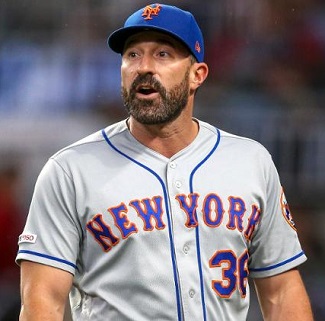
As postgame ranters go, Mickey Callaway won’t make anyone forget Tommy Lasorda or Lee Elia.

If the Mets do what seemingly three quarters of the Internet thinks has to be done and fire embattled manager Mickey Callaway after Sunday’s postgame profanities, so be it. But they may want to know that Callaway’s isn’t even close to the absolute worst outburst major league baseball people have been known to release after harsh losses.

After the Mets lost to the Cubs 5-3, Callaway—himself a former pitcher and pitching coach presumed to understand such things—should have expected the number one postgame question would be why he left not-so-strong reliever Seth Lugo in for a second inning after over-labouring a first one, long enough for the Cubs’ Javier Baez to drill a three-run homer that overthrew a Met lead and held up for a Cub win.

Just about everyone watching the game, including Mets broadcasters Gary Cohen and Ron Darling (himself a Mets pitcher on their 1986 World Series winner), knew Lugo barely got through his scoreless first inning’s work. Callaway warmed up Robert Gsellman but didn’t bring him in until after Baez’s blast.

And closer Edwin Diaz, who might have been asked for a five-out or even a two-inning save, since he’d only pitched a single inning Friday night (for a save) after five days without a game appearance, wasn’t even a topic. Until Callaway was asked about it postgame and insisted, a little snappishly, that five-out save opportunities weren’t a topic, either.

No matter how much pressure Callaway’s been under, reporters shouldn’t have had to expect him to throw down a couple of [maternal fornicators], or order his people to get another [maternal fornicator] out of the clubhouse. Or, when Mets pitcher Jason Vargas was asked in all innocence by reporter Tim Healey if he had something to say, as Healey swore Vargas appeared, Healey shouldn’t have had to have Vargas threaten to knock him the [fornicate] out, bro.

With Mets first-season general manager Brodie Van Wagenen said to be en route Philadelphia, where the Mets open a set with the teetering Phillies Monday, it might not be a shock if he greets Callaway by putting the manager’s head on a plate. As of this writing, nothing from inside the Mets yet appears to indicate its likelihood.

But if so, Sunday’s postgame behaviour was only the wick that ignited the powder keg. All season long it’s been a question of when, not whether Callaway would meet the guillotine. And wags could suggest plausibly that one reason to execute Callaway could be that, when it comes to postgame tirades, he can’t cut the mustard in Lee Elia’s or Tommy Lasorda’s parlours.

About the only thing Callaway has in common with those two is that their still-legendary, still-heard expletives-undeleted rants had something to do with the Cubs, too.

Elia was the Cubs’ manager on 29 April 1983, when the Cubs lost a one-run game to the Dodgers in Wrigley Field. The Cubs’ Hall of Fame closer Lee Smith threw an eighth-inning wild pitch to Pedro Guerrero with Ken Landreaux on third, allowing Landreaux to score what proved the winning run.

Aside from the season’s early losing—the game dropped the Cubs to 5-14 and dead last in the National League East—the sparse Wrigley audience, and a fan dropping a beer on Cubs outfielder Keith Moreland, left Elia in no mood to play nice, never mind accommodating, after the game. And never mind most of the press corps going to the Dodgers’ clubhouse because first baseman Mike Marshall played in Wrigley for the first time and homered in the fifth.

The unwitting provocateur was radio reporter Les Grobstein, who asked Elia about the Cubs’ fan support. Elia delivered a tirade in which he tried defending his players but ripped the boo birds, unloading 41 profanities before unloading the money quote: They oughta go out and get a [fornicating] job and find out what it’s like to go out and earn a [fornicating] living. Eighty-five percent of the [fornicating] world is working. The other fifteen percent come out here. (The Cubs still played strictly day games then.)

Elia by all accounts was lucky his [fornicating derriere] wasn’t fired almost on the spot; he happened to return to his Wrigley Field office to retrieve a set of keys when then-general manager Dallas Green, who’d just heard the recording of Elia’s rant, called the skipper’s office.

The mortified Elia apologised to the GM. He probably survived because, near the end of his bellowing, he did urge people to rip him and not his players if they were unhappy with the Cubs’ play. Unfortunately, Elia would be fired later in the season as the Cubs fell fifteen games under .500.

In due course he’d sell for a cancer charity autographed baseballs displayed in specially-made cases that included specially-made players that delivered a cleaned-up version of the infamous schpritz. He’d also manage the Phillies for a short period and eventually work in the Braves’ front office.

Five years earlier, the Cubs inadvertently seeded a postgame jewel by Hall of Fame manager Tommy Lasorda, after a fifteen-inning win in Dodger Stadium on 14 May 1978. The inadvertent provocateurs were Cubs slugger Dave Kingman—whose home runs were typically conversation pieces that approached earth orbit no matter the venue in which he swung at the plate—and Los Angeles radio station KLAC reporter Paul Olden.

Kingman was 1-for-2 when he batted in the sixth against Doug Rau and smashed a two-run homer to pull the Cubs back to within a run. An inning later, Kingman grounded into a run-scoring force out, but in the ninth he hit Dodger reliever Mike Garman for another two-run homer to tie the game at seven. In the fifteenth, though, Kingman squared off against Rick Rhoden and hit a three-run homer that proved the game winner.

Like just about everyone else in the stadium and among the press corps following that 10-7 Dodger loss, the number one subject on Olden’s mind when he met Lasorda was Kingman’s particular destruction that day. Olden might have had a simpler time asking Emperor Hirohito what he thought of the atomic bomb destruction of Hiroshima.

Some thought Lasorda still seethed over Hall of Famer Reggie Jackson’s three-bomb demolition of the Dodgers in Game Six of the previous fall’s World Series. Whether that was true or false only Lasorda knows for certain. Lasorda knew only that the last thing he wanted to talk about was Kingman’s mayhem:

What’s my opinion of Kingman’s performance? What the [fornicate] do you think is my opinion of it? I think it was [fornicating] horseshit. Put that in. I don’t [fornicating] . . . opinion of his performance? Jesus Christ, he beat us with three [fornicating] home runs. What the [fornicate] do you mean what is my opinion of his performance? How can you ask me a question like that? What is my opinion of his p – of his p-p-performance? Jesus Christ he hit three home runs. Jesus Christ. I’m [fornicating urinated] off to lose the [fornicating] game, and you ask me my opinion of his performance. Jesus Christ. I mean that’s a tough question to ask me, isn’t it? What is my opinion of his performance?

It’s entirely possible that Lasorda survived that rant because he’d just taken his Dodgers to a World Series and had his team in the thick of the National League West hunt they’d win in due course en route a second consecutive Series. (And, a second straight Series loss to the Bronx Zoo edition of the Yankees.)

Lasorda cooled down little by little, especially after Olden admitted he hadn’t necessarily asked a brilliant question. But the outburst was on tape, and in short order a copy fell into the hands of a rival radio station whose owner just so happened to be Angels owner Gene Autry.

Lasorda shook off his mood enough to attend a charity dinner for the Cystic Fibrosis Foundation. Either at the dinner or before it, Lasorda apologised to Olden. And in due course Lasorda was asked once to look back upon what was known as the Kingman Rant:

You know Paul said to me he was sorry he did that, I said “Hey, you did your job Paul. Don’t worry about it”. He asked me, ‘What is your opinion of Kingman’s performance?’ Nobody asked me about an opinion. They’ve always asked me, ‘Well, Kingman hit three home runs’, ‘What did he hit’, ‘What did it do to you’, so and so. This guy says, ‘What is your opinion’. So I proceeded to give him what was my opinion of Kingman’s performance. I’d like to have the rights on that, on that tape, because what happened, uh . . . was when it was first played on the Jim Healy show, I guess Gene Autry heard it and he wanted a copy of the real tape. And then all of a sudden, within a two week period, that tape had gone from the west coast to the east coast. Everybody had that tape. Within a month’s time, I couldn’t go anywhere without somebody telling me they had the tape—the real tape of that, uh, opinion. I think it was finally translated into Japanese.

Both the Elia and the Lasorda explosions have survived to get major play around the Internet. And Paul Olden ended up having a surrealistic last laugh: since 2009, Olden has been the once-removed successor to the legendary Bob Sheppard as Yankee Stadium’s public address announcer.

Jackson tagged Sheppard as “The Voice of God.” Lasorda can say the day he went Dodger blue on Olden sent Olden on his way to God’s perch. I’m pretty certain Callaway won’t be able to make the same claim. Whether he’s fired Monday or in time enough.

Don’t blame or curse the writers, bros

2019-06-23 SethLugo

Seth Lugo, who shouldn’t have been left in to start the eighth Sunday, after surrendering Javier Baez’s difference-making three-run homer.

Maybe the most frequent refrain around last year’s Mets was Jacob deGrom pitching like a virtuoso but his team losing for him regardless. It didn’t stop him from winning a deserved Cy Young Award then. But it stopped him and the Mets from banking a badly-needed win in Wrigley Field Sunday afternoon.

And it threatened to turn into a rumble in the clubhouse jungle after the game, after manager Mickey Callaway heard one too many questions around the likely theme, “What on earth were you thinking or not thinking when you let Seth Lugo go out for a second inning when he didn’t exactly have even his C+ game to work with?”

Not to mention Mets pitcher Jason Vargas challenging Newsday writer Timothy Healey to a fight as the postgame interviews ended. “I’ll knock you the [fornicate] out, bro,” Vargas snapped, when Healey first stood his ground after Callaway demanded team public relations people escort him away.

A man who surrenders four earned runs in four and two thirds innings, as Vargas did Friday in a game the Mets hung in to win 5-4, should spend more time thinking about knocking hitters out at the plate than knocking reporters out for doing nothing more than, you know, their jobs.

Because there was deGrom Sunday afternoon, with a nine-strikeout, two-run, six-hit start, shaving another point or two off his ERA, his breaking balls coming out to play very nicely with others starting in the second, playing a little too nice for the Cubs’ comfort, mostly, and coming out after six innings with a 3-2 Mets lead.

And there was Lugo—arguably the Mets’ most reliable bullpen bull this year so far, after shaking away some early-season struggling—unexpectedly laboring through the seventh, though the box score by itself won’t show it. He needed ten pitches to surrender a leadoff single to Victor Caratini and six to coax pinch hitter Daniel Descalso into dialing Area Code 5-4-3 before getting Albert Almora, Jr. to ground out for the side.

Listen up. It wasn’t the writers who decided it was better to send a less-than-fully-armed Lugo out to pitch the eighth instead of opening with a fresher Robert Gsellman, who’d been loosening up during the seventh.

It wasn’t Healey who fed Kyle Schwarber a sixth-pitch hanger on which Lugo was lucky The Schwarbinator didn’t hit across the street but rather up the middle for a none-too-deep base hit. Or, who walked Anthony Rizzo on 3-1 after Kris Bryant flied out to center. Or, who had Javier Baez in the hole 0-2 before serving him a slider that slid insufficiently enough to be sent into the right field bleachers.

Goodbye, 3-2 Mets lead. Hello, 5-3 Cubs lead to stay, after Pedro Strop took care of Robinson Cano and Carlos Gomez on back-to-back swinging strikeouts before pinch hitter Dom Smith lined out to right for game and series split.

And, goodbye for the time being to the good feelings of Rookie of the Year candidate Peter Alonso busting the National League’s record for home runs before the All-Star break Saturday and becoming the Mets’ all-time rookie home run leader Sunday when he sent Cole Hamels’s changeup seven or eight rows into the left field bleachers in the top of the fourth, leading off and tying the game at one.

Not to mention Tomas Nido—the backup catcher who isn’t much at the plate but is valued because he works so well with deGrom in spite of Callaway’s insistence that not even a Cy Young Award winner should have a personal catcher—surprising one and all in the top of the fourth with a 1-0 rip into the center field bleachers to give the Mets the lead they’d expand when deGrom himself snuck an RBI single through the middle later in the inning.

What did Callaway, Vargas, and any other earthly or otherwise being in Mets silks think the writers were going to ask about after a loss like that? Hall of Famer Ryne Sandberg’s performance leading the Wrigley faithful in “Take Me Out to the Ball Game” during the seventh-inning stretch?

Actually, the first subject was Edwin Diaz, the Mets’ closer. Why wasn’t Diaz considered for a five-out save at the earliest sign of eight-inning trouble? “Just because you think so?” Callaway retored to Yahoo! reporter Matt Ehalt, who asked the question. “Absolutely not. We have a very good plan, we know what we are doing and we’re going to stick to it.”

If that’s the case, why not send Gsellman out to work the eighth from the outset, since it wasn’t exactly hidden from plain sight that Lugo laboured through the seventh?

Then came the questions about Lugo starting the eighth, including from Healey, apparently, and then came the testiness from Callaway and, in time, Vargas, who needed Gomez and Noah Syndergaard to restrain him before Healey finally departed.

A manager who’s been considered on the hot seat over dubious in-game strategies and his bullpen management since just about the second week of the season is in no position to bark “Get this [maternal fornicator] out of the clubhouse” at anyone, never mind a reporter seeking clarification on the non-move that turned the game away from the Mets in the first place.

Callaway said he thought Healey was being sarcastic when saying “See you tomorrow, Mickey,” after the questionings ended. First the skipper told Healey not to be a smartass. Then came the expletives undeleted.

Healey tried to assure Callaway he wasn’t being sarcastic but Callaway wouldn’t quit. He said much later Sunday the testiness began with “See you tomorrow, Mickey,” a harmless pleasantry rendered unpleasant when Callaway snapped back with Vargas in earshot and, apparently staring at Healey for a considerable period. “(I) recalled asking him if everything was OK,” Healey said.

Apparently not. That was when Vargas threatened to knock Healey the [fornicate] out, bro. “[T]hen Vargas took a couple of steps toward me,” Healey said. “Some people said charged—charged is super-strong.”

Whether Healey was right or wrong, so long as he and the other writers in the postgame interviews weren’t insulting Callaway and Vargas and merely asking tough but reasonable questions about the critical moment in the Mets’ loss, Callaway and Vargas stepped over a line. Office holders holler “fake news” as much over reporting they simply don’t like as over false reporting. But even they’re not known customarily to throw obscenities in reporters’ faces under or after tough questioning. (We think.)

“No matter what the reporter did,” veteran reporter Ken Rosenthal of The Athletic said, “this can’t happen . . . The problem is Mickey Callaway probably should’ve been fired a month ago . . . ever since, this has been lingering over this team . . . everybody is simply waiting.”

“While Callaway has never had an outburst like this before with a reporter, the second-year manager has pushed back when asked critical questions,” Ehalt himself wrote later Sunday. “Vargas had not had an incident like this with a Mets reporter since he joined the team last year.”

Diaz himself also urged someone, anyone, to get Healey out of the area, but apparently Diaz and other Mets feared the altercation getting even more serious. They had to be unnerved already by their manager and one of their pitchers jumping all over Healey as it was. Especially if it was as much out of character for Vargas as seems to be the case.

After Healey finally disappeared, some reporters lingered to talk to Diaz. Without incident, apparently. But these Mets are a tense outfit right now and may have been long before Sunday afternoon’s follies.

The bullpen new general manager Brodie Van Vagenen built for this season is mostly mis-built. Some of his acquisitions have misfired. Former closer Jeurys Familia, re-acquired for this season, has proven an arsonist as as a setup man. And veteran second baseman Robinson Cano looks too vividly like an aging imitation of the one-time star who parlayed his Yankee success into glandular dollars in Seattle from whom the Mets took him in the deal that made Diaz himself a Met.

Under criticism this year for periodic loafing, Cano looked even more so Sunday, on a second-inning grounder that turned into a too-easy step-and-throw double play. And he showed his age in the fourth, unable to throw on to first while in mid-leap over a slide at second, to finish a likely double play.

And, there are still the Wilpons in the executive command post still unable or (Met fans and some writers accuse) unwilling to overhaul the organisation and allow a sound balance between analytics and game sense to take hold.

The Mets are good at jumping to apologise for their manager’s and pitcher’s out-of-line behaviour toward the reporters doing nothing worse than being reporters. If Callaway, Vargas, and any other Mets really thought no one would ask about why Lugo was left in to work the eighth after he was—by his own admission—less than at full power in the seventh, the question becomes whom among these Mets still have their heads in the game.

The team didn’t need to apologise. It should have been the manager and the pitcher doing it. No matter how beleaguered they are in fact or in supposition, no matter how out of character it might have been, they behaved out of bounds.

Callaway looked at first like he’d survive the vote of confidence he got publicly after the Mets suffered a weekend bushwhacking by the Marlins last month. Now the Mets may yet end up having to apologise for having engaged a manager as far in over his head as Callaway seems increasingly to be.


The joke’s on the Cubs

2019-06-01 MattCarpenter

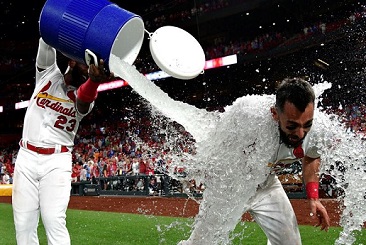
Marcel Ozuna (23) gives Matt Carpenter the icy spoils of thwarting the Cubs’ impersonation of the Chicago Bears’ defensive line Friday night.

Doing a comic sketch over the winter in which he referred to St. Louis (the city, not the Cardinals) as “boring” has gotten Cubs third baseman Kris Bryant a mouthful in Busch Stadium Friday night. It even got him a few from his own teammates, who apparently can go along with a gag.

But it wasn’t all that funny when what began as a rather admirable pitching duel between the Cardinals’ Mike Mikolas and the Cubs’ Yu Darvish ended in the bottom of the tenth with Matt Carpenter driving the winner home off Cubs reliever Steve Cishek with the bases loaded, one out, and the Cubs shooting themselves in the defensive foot.

“They had their entire 25-man roster on the right side of the field, so I just knew that hitting pull side on the ground—pull side in the air, that’s fine, we could still score—pull side on the ground was not an option,” Carpenter said after surviving a celebratory jersey-shredding and a big Gatorade ice dump on the infield. “So my approach in that at-bat was to look for something to hit the other way and get something in the air and was able to do it.”

The Cardinals’ third baseman exaggerated only slightly, of course. But the Cubs did line up four players along the edge of the grass on the right side of the infield and moved their outfield far enough right when Carpenter checked in at the plate. The infield looked more populated by the Chicago Bears’ offensive line than a baseball team.

And the Cubs looked even more ridiculous for putting that exaggerated an overshift upon a batter who’s far more of a line drive hitter than a ground baller. Carpenter may be struggling to get himself on track at the plate this year so far, but he’s a) a .283 hitter lifetime in high leverage situations; and, b) a .646 hitter when he gets something to hit on a line, standard or high.

Most likely the Cubs hoped Carpenter’s comparative weakness as a pure fly ball hitter (.194) and a ground ball hitter (.236) would work in their favour, maybe a double play to send the game to an eleventh inning. They misread their assailant almost completely, especially with Cishek starting Carpenter with nothing he could put on the ground if he’d been swinging an ax to chop the ball in half.

Cishek only got to throw two pitches to Carpenter. The first was a slider that climbed instead of slid up and in for ball one. The second landed almost right down the pipe, and Carpenter lifted it like a golfer with a five-iron, sending it down the left field line.

Where the Cubs’ Willson Contreras, a catcher by trade inserted into left field in a double switch, and about as swift as an earth mover, could only watch as the drive hit the grass a few feet away from his onrushing self and bounced into the corner left field stands.

The net result wasted a delightful pitching duel between Mikolas and Darvish. A duel that shook off an early one-all tie with both runs coming home on sacrifice flies, the Cardinals opening in the bottom of the first with left fielder Marcel Ozuna scoring Carpenter on an opposite field fly and Darvish, of all people, pulling a sac fly to left in the top of the second to score (Chris Berman, call your office) his catcher Victor (Beta) Caratini.

The Cubs managed six hits off Mikolas and the Cardinals three off Darvish, but both pitchers worked effectively enough with Darvish slightly better in six than Mikolas in seven, Darvish striking out six against three walks and pitching mostly to his defenders with somewhat surprising composure considering his continuing inconsistencies.

One minute, Darvish looks like a solid number three starter this year. The next, he looks like he can’t find the strike zone with a search party. His previous outing, against the Reds, saw him get six runs battered out of him in seven innings’ work, after a trio of starts in which he kept the other guys (including the Reds) to three or less.

On Friday night it was as if Darvish wanted revenge for the four-inning, five-run mugging the Cardinals laid on him on 4 May, in which he helped hand them the machetes with five walks. Realising in the shaky first that his fastball started asleep, Darvish went to an array of curve balls and cutters for the most part in the second before his four-seamer awoke.

Miklas had the opposite trouble: his breaking balls weren’t quite as effective as his fastballs early on; Darvish himself tagged a curve ball for that second-inning sac fly. But as the game went on Miklas’s fastballs came alive just enough for him to use as either out pitches or setup pitches for his breakers and the occasional changeup.

The Cubs were more than a little infuriated when young Dillon Maples, sent out to work the tenth, threw what looked at every angle like a full-count strike three to Harrison Bader, the Cardinals’ right fielder, with Cardinals infielder Kolten Wong (one-out double) on second. Except that Laz Diaz called it ball four. It was the type of slider no less than ESPN’s Stats and Information department says gets called a strike 92 percent of the time or better.

“That’s the kind of thing that bums me out,” the manager said after the game. “To have pitches taken away from him in a crucial moment . . . Now my guy has to go home and feel bad about himself tonight. And it wasn’t even a borderline pitch. It was a strike.

Maples tried to shake it off but he walked Jedd Gyorko to load the pads for Carpenter. “I just made a close pitch and obviously didn’t get the call I wanted,” the young reliever said after the game. “So I was a little upset, but you have to move on.”

But when he didn’t, Maddon went to Cishek and the Monsters of the Midway infield defense. And Carpenter de-fanged the beasts with one swing and one floating opposite field fly.

The Cubs didn’t have one of their better games even before Carpenter left them with the proverbial egg on their tenth-inning faces. They went 0-for-8 with men on second or better, officially. The Cardinals weren’t that much better, going 1-for-5 in the same situation.

But the Cubs at least had a few laughs when the game got underway and Bryant batted in the first. When the Busch Stadium audience let him have it as he walked up to the plate, Bryant was amused to see his buddy Anthony Rizzo leading the Cubs dugout and bullpen in a chorus of booing.

“It was pretty funny,” said Bryant after the game. “I wanted to look and see all who was doing it . . . I think he told the bullpen guys to get in on it.”

“I don’t think I’ve ever roundly booed one of my own guys before,” Maddon cracked. “I can check that off the list.”

Bryant hit Miklas’s first pitch to him past the infield for a base hit. It was the only hit Bryant got all night. The goal-line stand the Cubs tried in the tenth, alas, was about as funny as the proverbial pickpocket in the nudist colony. But it gave Carpenter and the Cardinals the last laugh.