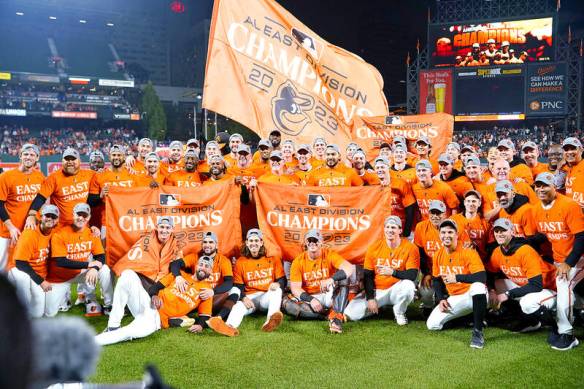
Party hearty, Baltimore, but . . .

Baltimore Orioles

Your American League East champions, who got here the hard, disgraceful way.

You hate to dump rain upon the Oriole parade just yet. But their clinch of both the American League East and home field advantage through the end of the American League Championship Series (if they get that far in the first place) isn’t exactly the early climax of a simon-pure story.

Of course it’s wonderful to see the Orioles at the top of their division heap and Baltimore going berserk in celebration. Of course it’s wonderful to see the first team in Show history ever to lose 100+ in a season flip the script and win 100 within three years.

Of course it’s wonderful that the Orioles are going to stay in Camden Yards for three more decades at least, an announcement that came in the third inning Thursday. It sent the audience almost as berserk as they’d go when Orioles third baseman Ramón Urias threw the Red Sox’s Trevor Story out off a tapper to secure the clinch.

Of course it’s wonderful that we don’t get to call them the Woe-rioles, or the Zer-Os anymore. And of course it’s going to feel like mad fun rooting for the Orioles to go deep in the postseason to come, even one that remains compromised by too many wild cards and too many fan bases thus lost in the thrills and chills of their teams fighting to the last breath to finish . . . in second place or even beyond for a nip at the October ciders.

Unfortunately, it’s not easy to forget how the Orioles got to this point in the first place. In plain language, they tanked their way here. There’s no way to sugarcoat it.

However marvelous and resilient they were all season, however much of a pleasure it’s been to see this year’s Orioles behaving like their illustrious predecessors of 1966, 1970, 1983, and numerous other division champions and pennant winners, they got here via tanking. That should never be forgotten. It should never happen again. To the Orioles or any other conscientious major league team.

It started after their 2016 season ended too dramatically. When then-manager Buck Showalter kept to his Book and his Role Assignments, declined to have his best relief pitcher Zack Britton ready and out there, because it wasn’t a quote save situation. Leaving faltering Ubaldo Jimenez on the mound to face Toronto’s Edwin Encarnación. Baltimore still won’t forget the three-run homer Encarnación parked in the second deck of Rogers Centre with the Blue Jays’ ticket to the division series attached.

They tanked from there forward, picking up from where they left off after 1988-2015. They finished dead. last. in the AL East in three of the four seasons to follow. (A fourth-place finish broke the monotony.) As of a hot August 2021 day when the Angels (of all people) bludgeoned them 14-8, including thirteen runs over three straight innings, they were 201-345—after having been the American League’s winningest regular-season team from 2012-2016.

Before the 2021-2022 owners lockout ended and spring training began, The Athletic‘s Dan Connolly came right out and said it, even though he admitted it didn’t really bother him: rebuilding the entire organisation, ground up, and giving almost all attention to the minors and the world baseball resources but so little to the parent club, “produces a tank job in the majors.”

They weren’t the only tankers in the Show by any means. Famously, or perhaps infamously, the Astros tanked their way to the 2017 World Series—which turned out to be tainted thanks to the eventual revelations that the 2017-18 Astros operated baseball’s most notorious illegal, off-field-based, electronic sign-stealing scheme.

They were preceded by the 2016 Cubs, who tanked their way to that staggering World Series conquest. Like the Astros, the Cubs came right out and said it: they were going into the tank in order to win in due course. The 2016 Cubs don’t have the 2017-18 Astros’ baggage, and their conquest was mad fun, but their fans endured a few seasons of deliberate abuse to get there.

Yes. I said it again. Just like Thomas Boswell did in July 2019. “It’s dumb enough to tear down a roster that is already rotten or old or both,” he wrote.

But it’s idiotic to rip up a team that has a chance to make the playoffs, even as a wild card, especially in the first era in MLB history when six teams already are trying to race to the bottom. With more to come? What is this, the shameless NBA, where tanking has been the dirty big lie for years?

. . . With the Orioles (on pace for 111 loses), Tigers (111), Royals (103), Blue Jays (101), Marlins (101) and Mariners (98) all in the same mud hole wrestling to get the same No. 1 draft pick next season, we’re watching a bull market in stupidity. And cupidity, too, since all those teams think they can still make a safe cynical profit, thanks to revenue sharing, no matter how bad they are . . .

. . . In the past 50 years, losing usually leads to more losing — a lot more losing. I’ve watched it up close too often in Baltimore. In 1987-88, the Birds lost 202 games. Full rebuild mode. In the 31 seasons since, the Orioles have won 90 games just three times. At one point, they had 14 straight losing seasons. Why did D.C. get a team? Because the Orioles devalued their brand so much that there was nothing for MLB’s other 29 owners to protect by keeping a team off Baltimore’s doorstep.

Baseball has seldom seen a darker hour for its core concept of maintaining the integrity of the game. Commissioner Rob Manfred is either asleep or complicit.

Too many teams are now breaking their implicit vows to the public. They’re making a profit through the back door as money gushes into the game from revenue streams, many of them generated over the Internet, which are divided 30 ways. For generations, fans have believed that they were “in it together” with their teams. Bad times made everybody miserable — fans, players and owners alike. Now, only the fans take it in the neck.

And in the back.

So this year’s Orioles, a genuinely fun and engaging team, with a lot of genuinely fun and engaging players, have won 100 games for the sixth time in their franchise history. They have the home field postseason advantage for as long as they endure through the end of the American League Championship Series. They’re liable to make things interesting for any team looking to dethrone them this postseason. Just like their former glory days.

It’s wonderful to see Camden Yards party like it’s 1969 again. Or 1970-71. Or 1979-80. Or the scattered good seasons between then and now. But it should be miserable to think of how they got here in the first place. It should be something no Oriole fan, no baseball fan, really, should wish to see again.

Tanking is fan abuse, plain and simple. It also abuses the game’s integrity. That integrity has taken more than enough shots in the head from other disgraces perpetuated by its lordships. Don’t pretend otherwise.

But now that we’ve got that out of our system, for the time being, let’s celebrate. The once-proud organisation that gave us the Brooks-and-Frank-Family Robinson era, The Oriole Way, and the era of Steady Eddie and Iron Man Cal (though beating the 1983 Philadelphia Wheeze Kids could have been called shooting fish in a barrel), is going back to the postseason at last.

And, this time, let’s pray, that when a true as opposed to a Role-or-Book “save situation” crops up in the most need-to-win postseason game, manager Brandon Hyde won’t leave his absolute best relief option in the pen—a dicey question, considering they’ve lost closer Félix Bautista (now to Tommy John surgery), even with Yennier Cano emerging to look like a grand candidate—waiting while a misplaced, faltering arm surrenders a season-ending three-run homer before their time.

Maybe these guys have what it takes to wrestle their way to a World Series showdown with that threshing machine out of Atlanta. Maybe they won’t just yet. Let’s let Baltimore and ourselves alike enjoy the Orioles’ October ride while it lasts, however long it lasts. The loveliest ballpark in the Show has baseball to match its beauty once again.

Phoenix rising—for one night in Baltimore

Over the entrance to old Memorial Stadium, it saluted Baltimore’s war fallen: “Time Will Not Dim The Glory of Their Deeds.” Over the entrance to Camden Yards, the temptation is powerful enough to hang a sign reading “Deed.” Singular.

This is how badly the Orioles wanted to snap their losing streak before it arrived into the Terrible Twenties: Catcher Austin Wynns had sage shipped to Camden Yards, which he and first baseman Trey Mancini paraded around the park before the game. Mancini bragged about his freshly-grown superstition mustache, and center fielder Cedric Mullins went the opposite way and shaved his beard.

You’ll do anything to break the spell. If you’d seen assorted Orioles conducting a clubhouse seance asking for kind permission to address Frank Robinson in the Elysian Fields, you wouldn’t have been terribly shocked—though you might have expected Robinson to pass the line to any St. Louis Browns who happened to be eavesdropping.

The Orioles entered Wednesday with the sixth-lowest season’s winning percentage of any team in franchise history. Of the other five, four were Browns . . . and one was the sadder-sack 2018 Orioles. The last thing these Birds wanted was to continue like cooked geese.

They finally put superstition, supernatural, and extraterrestrial to one side and decided the only way to do it was to play baseball. When Angels third baseman David Fletcher flied out to deepest right field in the top of the ninth Wednesday night, the ballpark audience already on its feet roaring let out a scream as though their Woe-rioles had just won the seventh game of the World Series.

That’s what ending a nineteen-game winning streak with a 10-6 win does for a crowd maybe half of whom actually came to the park to see the Angels’ two-way star Shohei Ohtani. As if they were half conceding the game before Orioles opener Chris Ellis threw his first pitch of the evening.

That’s what prying, pushing, and pounding a five-run eighth out of the Angels’ bullpen does, an inning after it looked as though the Orioles wasted their best chance to overthrow the Angels for good.

That’s what shoving back after an early two-run lead turned to a still-too-early four-run deficit closed back up to a pair does. That’s what playing in the end like anything but a team designed explicitly to go into the tank for who knows how long does, too.

That’s also what knowing damn well you need to atone for one of the least-timely wasted outs of the season when you have only six outs left to play with, which is just what the Orioles in the eighth had to do about the seventh. Two on, nobody out, is the time to shove with your shoulder, not nudge with your hip.

Damn lucky for the Orioles that they had an eighth-inning push, shove, and mind over matter with a pair of bases-loaded walks setting up a bigger shove and a punctuation mark to nail the win that would keep them short of the gates of infamy for the time being. They haven’t joined the 20+ loss in a row club occupied ignominiously by the 1961 Phillies (23), the 1988 Orioles (21), the 1969 Expos (20), the 1943 and 1916 A’s (20 each), or the 1906 Boston Americans (20).

Yet.

But when Orioles manager Brandon Hyde ordered Austin Wynns to sacrifice with Jahmei Jones (leadoff single) on second and Victor Gutierrez (plunked) on first, jaws should have dropped. And Hyde should have had his hide tanned. Why not reach for Jorge Mateo—hitting .356 as a part-timer—to pinch-hit for Wynns and take over at shortstop the rest of the game, and insert Pedro Severino behind the plate, when you might get a two-run base hit out of Mateo?

Oops. Wynns dropped his bunt right back to the box. The Orioles merely closed the deficit to a single run. They had a lot to atone for in the eighth.

Lucky for them Mancini greeted Angels reliever Jake Petricka with a base hit up the pipe. Lucky for them that Anthony Santander—he taking the American League’s best OPS in August into the game—doubled to the right field corner almost promptly for second and third. Lucky for them Petricka and the Angels decided to hand D.J. Stewart first on the house to load the pads.

Lucky for them Jose Urias and, one out later, Gutierrez caught Petricka unable to find the strike zone if he’d sent out a surveillance mission, sending Mancini and Santander strolling home with the tying and go-ahead runs. Very lucky for them pinch hitter Austin Hays introduced himself rudely to Petricka’s relief James Hoyt with a double off the left field fence, and that Mullins greeted yet another Angel bull, Sam Selman, with a sacrifice fly to left.

That all had to be far more satisfying than Mullins hitting Ohtani’s first pitch of the bottom of the first over the center field fence, or Santander sending an 0-1 fastball into the right field bleachers two outs later. Or, Stewart following Satander’s leadoff single in the bottom of the fourth with a blast over the left field fence.

The crash carts stayed on double red alert when the Angels tied at two with rookie Brandon Marsh lining a two-run single down the right field line. But after Marsh got thrown out stealing with Adell at the plate, and Juan Lagares lining out for the side, the game suddenly looked like a question of who’d outplay their own mistakes better.

When the Angels took the 6-2 lead in the fourth, it looked like the answer would be them. Ellis’s evening ended when Jared Walsh hit his inning-opening meatball into the right field bleachers. Reliever Marcos Diplan carried a 1.80 ERA over his past seven days in from the Oriole bullpen. Jose Iglesias was so unimpressed he whacked a double into the right field corner. Stassi was even less impressed, letting Diplan fail to find the strike zone even with a GPS and taking a leisurely walk up to first.

Up came Marsh, who resembles a young man with the life ambition to star in any future reboot of The Life and Times of Grizzly Adams. He cared about Diplan’s impressive week’s ERA the least, sending his first career home run over the left center field fence. Making him the sixth Angel to hit his premiere Show bomb in Camden Yards.

I’m rooting for the Orioles to lose two more games,” tweeted an Oriole fan, “not because I don’t like them, but because at this point it’s like, why not go for the history books?”

“”There was tension in our dugout, there was pressure,” Hyde told reporters after the game. “Everybody was on the top step. “Our guys just really wanted this one. We’re tired of hearing, tired of seeing it on TV. Everybody’s tired of it.”

“”It’s electric in there,” Mullins said of the post-game clubhouse, after Wells got Fletcher to hit the game-ending fly out and took a hug with (read carefully) ninth-inning catching insertion Severino, while their mates celebrated more casually on the playing field than the fans in the stands.

Conner Greene relieved Diplan after ball one to Lagares and got rid of him, Ohtani, and Fletcher almost in a blink. On a night the Orioles couldn’t afford too many blinks. As if to remind his mates, Stewart followed Satander’s leadoff single in the bottom of the fourth with his own launch over the left center field fence. And Greene kept the Angels quiet in the top of the fifth.

Yet another Oriole bull, Cole Susler, shook Marsh’s leadoff single off in the top of the sixth to lure Adell into forcing him out at second before striking Lagares and Ohtani out swinging. At minimum, the Orioles might at least brag that they sent Ohtani’s season ERA up to three after five full innings.

Dillon Tate picked up where Susler left off in the Los Angeles seventh. Oriole fan kept telling him- or herself that a two-run deficit wasn’t equal to trying to climb the Transamerica Tower in beach sandals. Tate shook a two-out walk (to Walsh) off and lured Iglesias into an inning-ending ground out to third. Nine outs left to close and overcome.

Tate got rid of Stassi on an inning-opening ground out in the top of the eighth, then yielded to Tanner Scott. Scott struck Marsh out and got Adell to ground out to third. Swift enough inning. The Orioles still had six outs to play with, with three reasonably loaded weapons—Mancini, Santander, and Stewart—due up in the bottom of the eighth.

Wynns ought to buy Hays chateaubriand for dinner for the rest of the year, after Hays performed his penance for that seventh-inning bunt. The Orioles might want to send Ohtani a bottle of wine—Wednesday was the first time any team hit two or more home runs off him in the same game.

“These guys have dealt with a lot,” said Hyde. “Call it rebuilding or what you want, but it’s not fun to lose. You want to show your fans that the big league club is going to be fun to watch and there’s pieces coming. That’s what’s been disappointing.” If only Hyde could pound that into the thick skulls of the Orioles’ ten-thumbed ownership and by-design-hobbled front office.

No. We’ve already made that argument. It’ll be made again come the off-season and the talks for a new collective bargaining agreement. Tanking is a disgrace. It’s fan abuse and unworthy of the game. Even Oriole fans know the difference between this year’s model and the team that opened 1988 0-21 is that that team, at least, wasn’t built to tank.

Let’s push that all away for other days. There’s no percentage or pleasure in it now. On Wednesday night, the Orioles played and stood beyond. They played like . . . anybody but the Orioles.

Sure they caught a few breaks and damn near wrecked their own cause themselves late. But they took fair advantage of the breaks they caught, atoned for their self-near-ruination in fine style, and looked for once in their lives like something resembling their well-storied forebears.

Cooked geese the night before, the Orioles became a phoenix for one night. For the first time in nineteen games, and maybe all season long, these built-for-failure Orioles found a way to play better than the way they were built.