NLCS Game Two: Was it loud enough?

Merrill Kelly

Arizona pitcher Merrill Kelly leaving NLCS Game Two in the sixth inning and hearing it from the Citizens Bank Park crowd whose sound he underestimated. He ended up bearing the least of the Phillies’ destruction on the night.

Maybe nobody gave Diamondbacks pitcher Merrill Kelly the memo. Maybe he missed the sign completely. Wherever Kelly happened to be, if and when he was warned not to poke the Philadelphia bear and his native habitat, he learned the hard way Tuesday night and the Diamondbacks whole were dragged into class.

Maybe the Braves sent him a message he never saw. You remember the Braves. The guys trolling Bryce Harper after their second division series game, when Harper got doubled up on a very close play following an impossible center field catch to end the game. They learned the hard way, too. They’re also on early winter vacation.

Before this National League Championship Series even began, Kelly was asked whether the heavy metal-loud Citizens Bank Park crowd might have a hand in the field proceedings. He practically shrugged it off, though in absolute fairness he wasn’t exactly trying to be mean or nasty.

“I haven’t obviously heard this place on the field, but I would be very surprised if it trumped that Venezuela game down in Miami [in the World Baseball Classic],” said Kelly, a righthander whose countenance bears a resemblance to comedian Chris Elliott and who’s considered a mild-mannered young man otherwise. “When Trea [Turner] hit that grand slam, I don’t think I’ve ever experienced—at least baseball-wise, I don’t think I’ve ever experienced an atmosphere like that so I hope that this isn’t louder than that.”

That grand slam jolted Team USA into the semifinal round. By the same Trea Turner who’d start Kelly’s Tuesday night with a jolt, hitting a one-out, one-strike pitch into the left center field seats in the bottom of the first. 

Kelly may not have been trying to be snarky, but The Bank let him have it early and often, first when he was introduced pre-game time and then when he took the mound for the bottom of the Game Two first. Loud, clear, and unmistakeable.

The only things Kelly faced louder and more clear than that were Turner’s score-starting blast, the one-ball, two-out laser Kyle Schwarber sent off Kelly’s best pitch, a changeup, into the right field seats in the third, and the 2-1 skyrocket Schwarber sent into the right center field seats leading off the bottom of the sixth.

“He’s really effective because he has a plus-plus changeup,” Schwarber said postgame. “He threw it 2-0 and kinda gave me the window. That’s what it looks like coming out of there. I think that was the first strike [on a] changeup I saw. [The home run pitch] was a little bit more down and away. But, I mean, it came out of the same height. So those are things that you look for.”

“They’re good big-league hitters,” Kelly said of the Phlogging Phillies postgame. “That’s what good big-league hitters do. They don’t miss mistakes.” Neither did The Bank’s crowd, serenading him with “Mer-rill! Mer-rill” chants at any available opportunity. But Kelly actually pitched decently despite the bombs. He only surrendered three hits, but walking three didn’t help despite his six strikeouts.

He’d also prove to have been handled mercifully compared to what the Phillies did to the Diamondbacks bullpen in a 10-0 Game Two blowout.

Once they pushed Kelly out of the game, with two out in the sixth and Turner aboard with a walk, they slapped reliever Joe (Be Fruitful and) Mantiply with a base hit (Bryson Stott), a two-run double (J.T. Realmuto), and another RBI double (Brandon Marsh). Just like that, the Phillies had a four-run sixth with six on the board and counting.

Then, Mantiply walked the Schwarbinator to open the Philadelphia seventh. Diamondbacks manager Torey Lovullo reached for Ryne Nelson. One out later, Harper singled Schwarber to third, Alec Bohm doubled them home with a drive that hit the track, Stott hit a floater that hit the infield grass between Nelson plus Diamondbacks third baseman Evan Longoria and catcher Gabriel Moreno, Realmuto singled Bohm home and Stott to third, and Nick Castellanos sent Stott home with a sacrifice fly.

This time they didn’t need Harper to provide the major dramatics. He’d done enough of that in Game One, hitting a first-inning, first-pitch-to-him, first-NLCS-swing, first-time-ever-on-his-own-birthday nuke one out after Schwarber hit his own first-pitch bomb. That game turned into a 5-3 Phillies win. On Tuesday night, they turned the Diamondbacks into rattlesnake stew.

They made life just as simple for Game Two starter Aaron Nola as for Game One starter Zack Wheeler. Wheeler gave the Phillies six innings of two-run, three-hit, eight-strikeout ball; Nola gave them six innings of three-hit, seven-strikeout, shutout ball. It was as if the Philadelphia Orchestra offered successive evenings of the Brahms Violin Concerto in D Major—featuring Isaac Stern one night and Itzhak Perlman the next.

“It’s a little more hostile and a little more engaging,” said Turner of the Bank crowd after the Phillies banked Game One. “I think [Kelly] can maybe tell you after tonight what it’s like, but I wouldn’t put anything past our fans. Our fans have been unbelievable. They’ve been great. I don’t know what decibels mean, but I guess we did something cool for AC/DC concert level decibels the other night . . . I would just wait and see and we’ll see what he says after [Game Two]”

“They’re up all game on their feet from pitch number one till the end,” said Nola postgame. “I feel like you don’t really see that too much around the league. That just shows you how passionate and into the game they are. They know what’s going on, and that helps us a lot.”

That was not necessarily what Lovullo wanted to hear before or after the Game Two massacre ended. “Everybody’s talking about coming into this environment,” he said, audibly frustrated, “and I don’t care.”

We’ve got to play better baseball. Start with the manager, and then trickle all the way down through the entire team. We’ve got to play Diamondback baseball . . . Diamondback baseball is grinding out at bats . . . driving up pitch counts, catching pop ups . . . win[ning] a baseball game by just being a really smart, stubborn baseball team in all areas.

That assumes the Phillies will just roll over and let them play it. The wild-card Diamondbacks who steamrolled two division winners in the earlier rounds to get here in the first place looked like anything except an unlikely juggernaut after getting manhandled in Philadelphia. They shouldn’t take the Phillies for granted once the set moves to Chase Field, either.

The Phillies might have been a one-game-over-.500 road team on the regular season, but they beat the Diamondbacks in Chase Field three out of four—a couple of weeks after the Snakes beat them two out of three in The Bank. Until this NLCS it was a little over three months since the two teams tangled. It certainly didn’t phaze the Phillies.

“I still think we’re real confident,” said Kelly. “I think there was a lot to be said about us after the All-Star break about how bad of a slump that we went into. I’ve seen in this clubhouse, I’ve seen from these guys that we haven’t gotten rattled all year. And I don’t want us to hang our heads and pout about it this time.”

But let’s say the Diamondbacks iron up and find ways to neutralise the Phillies’ offensive bludgeons and pitching scythes which, admittedly, might require a kidnapping or three. Let’s say they win all three games at Chase. They might become the only team to be at a disadvantage with a 3-2 series lead.

Because guess where the set would return then. And, unless my prowling has missed something this morning, Kelly didn’t have one word to say about that crowd after Game Two came to its merciful end. It must have been more than loud enough for him.

NLDS Game Three: Poke the Philly bear, pay the penalty

Bryce Harper, Orlando Arcia

“Stare downs aren’t an official stat (yet!), but we’re all in awe of Harper over here.”—The Elias Sports Bureau.

Memo to: Atlanta Braves, particularly shortstop Orlando Arcia. Subject: Poking the Philadelphia bear. Dear Braves; dear Orlando: just. don’t. do it. For real or allegedly.

Because the Philadelphia bear, whose human name is Bryce Harper, is liable to do to you what Yogi Bear only dreamed of doing with the contents of picnic baskets. He’s also liable to inspire similar destruction by his mates while he’s at it. And that Citizens Bank Park crowd in Philadelphia won’t let you live it down.

Whether Arcia really cracked “ha ha, attaboy, Harper” Monday—after Harper was doubled up by a hair to end National League division series Game Two, having rounded second on a long fly that looked as much like an extra base hit as an out before Michael Harris II’s stupefying catch—might have been speculative alone.

But it appeared in print, as you might expect when there might be three to five times more reporters in a postseason clubhouse than a regular season one. As Phillies manager Rob Thomson said Wednesday, after Harper and company demolished the Braves, 10-2, “If that adds to his motivation, then thank you.”

Affirming that the Monday mockery did indeed come from his postgame mouth, Arcia told reporters after Game Three, “He wasn’t supposed to hear.” Whether he meant Harper or the reporter(s) who put it into print wasn’t entirely clear, and hardly mattered. It wasn’t wise to poke a bear who had the entire Show’s second highest win probability added factor this year.

Harper swore he heard of Arcia’s trash talking from teammates. “They looked at me,” he said, “and they were like, ‘What are you going to do?’” It wouldn’t take too long before they got their answer.

With the game tied at one following Nick Castellanos’s leadoff bomb in the bottom of the third, Brandon Marsh singled promptly and Trea Turner pushed him to third beating out an infield single against Braves starter Bryce Elder, who can be a good pitcher but who’d spent the season’s second half struggling heavily.

Up stepped Harper. He took two low and away pitches after fouling off the first. Then, he ripped a hanging slider into the second deck behind right field. Rounding second, Harper gave Arcia a stare that would have meant a death sentence had it come from a Mafia caporegime.

“Stare downs aren’t an official stat (yet!),” Xtweeted the Elias Sports Bureau, “but we’re all in awe of Harper over here.”

The demolition that followed—including a second Harper homer—could be considered the Braves’ death sentence, depending upon how well they regroup and recoup behind Game One starter Spencer Strider on Thursday. And, whether Strider himself can handle the Phillies a little better than he had (eight strikeouts but two runs including a Harper smash) in Game One.

After Monday’s Braves one-run win, preserved by Harris’s acrobatic catch and third baseman Austin Riley’s swift throw across to nip Harper by a step and a half to finish the unlikely double play, Castellanos didn’t sound too worried. “We thrive after we get punched in the face,” he said.

Thrive? How about feeding frenzy. Right after Harper unloaded, Alec Bohm shot a base hit into left, Bryson Stott walked, and J.T. Realmuto pumped a two-run double to the back of left field. And every Braves fan in the nation probably asked why manager Brian Snitker—who started Elder with no better options available for this game—didn’t have anyone up in the pen yet.

“I thought maybe he would go five,” Snitker said of Elder, whose first two innings were deceptively masterful with six-up, six-down including four strikeouts, and who had a one-run lead after Ozzie Albies singled Ronald Acuña, Jr. (one-out double) home in the top of the third. “The way Bryce was throwing, I was thinking, ‘Man, he was really good.’ The slider was good. The changeup was good. It was the third inning of the game, with a lot to cover on the back end of it.”

It turned out the Braves had to find ways to cover a five-run Phillies lead after the bottom of the third’s demolition finally ended. But two innings later, leading off against veteran Brad Hand, the third Braves reliever of the day, Harper launched one parabolically over the center field fence. And gave Arcia a second stare down rounding second while he was at it.

Arcia extracted his own ounce of flesh when he singled Marcel Ozuna (one-out single) home against Phillies reliever Matt Strahm with two out in the top of the sixth. That’d teach him further. With two out in the bottom of that inning, Trea Turner shot one over the left center field fence off AJ Smith-Shawver, the fourth Braves pitcher on the night. Smith-Shawver endured long enough for Castellanos and Marsh to greet him rudely opening the bottom of the eighth with back-to-back solo bombs into the real estate Turner had reached.

Nothing—not even Phillies starter Aaron Nola’s nine-strikeout, five-and-two-thirds innings work, which somehow got pushed well into the background thanks to their offensive mayhem—quite equaled the magnitude of Harper’s first blast in the third, but when he hit the second in the fifth, he pushed himself into extremely elite territory—and pushed Hall of Famer in waiting Albert Pujols out of it.

Pujols was fifth in postseason OPS among men with at least 150 postseason plate appearances with .995; Harper shot his way past Pujols with what’s now 1.011. Ahead of him, in ascending order: Carlos Beltrán (1.021) and Hall of Famers George Brett (1.023), Babe Ruth (1.214), and Lou Gehrig (1.214). Harper also has a 1.132 OPS in this postseason alone thus far.

According to the reboutable MLB analyst Sarah Langs, Harper has also homered in eight postseason games since becoming a Phillie—and the team’s 8-0 in those games. Tying Harper with a longtime Brave, Javy Lopez, for the longest such postseason streak ever for a player starting his career with a particular team . . . but the longest for any player with a new team.

And what about this year’s Atlanta threshing machine, the team who smashed a record 307 home runs on the regular season and led the National League in runs, hits, team batting average, team on-base percentage, team slugging, and team OPS? Entering Game Three, the Braves were out-scored 7-5 while posting a team 150/.215/.250 slash line and a .465 OPS.

Now, the Braves are out-scored 15-9 for the set. They’ll need more than Strider being Strider on the mound this time, though the Phillies found ways to beat him in two prior postseason chances. (Last year, they sliced him for four runs in two and a third, charging a fifth to him when Harper—who else?—hit one over the right center field fence off Strider’s relief Dylan Lee with J.T. Realmuto aboard before Strider left the game.)

The Braves need their bats to find ways around scheduled Phillies Game Four starter Ranger Suárez and a better-positioned Phillies bullpen. They need Acuña to hit truly like the 40/70 player he was on the season. They need Snitker to do better in the bullpen management department.

Mostly, they need to find ways to keep Harper from Harpering. They also need to remind themselves that not even Harper takes them for granted.

“We know they’re really good, and they’re not going to fall down or die or anything like that,” Harper said after Game Three. “They’re a really, really good organization, a really good team, and we’ve seen that all year from them. But we have a crowd that’s 45 (thousand) strong, and we’re very excited to go into tomorrow and play a great game.”

If the Phillies are that excited, the Braves might be in more trouble than even Game Three made them look.

NLDS Games One: The Atlanta Chop Slop, the Los Angeles funeral parlour

Truist Park

Trash talk? Have at it. Trash the field over a call going against you? What was this, Braves fan?

Neither the Dodgers nor the Phillies expected simple National League division series this time around. Not with both teams coming in with what some call patchwork pitching. But one came out looking better in their Game One while the other came out looking like the remnant of a nuclear attack.

The Phillies and their pitching managed to keep the Atlanta threshing machine from threshing Saturday afternoon, winning 3-0. Starting with a first-inning nuking of future Hall of Famer Clayton Kershaw, the Diamondbacks laid waste to the Dodgers Saturday night, 11-2. On the arms of big enough bats and a starting pitcher who was usually close enough to Dodger batting practise.

Letting starter Ranger Suárez go no more than three and two thirds, knowing they’d have a day off between Games One and Two, the Phillies went to a bullpen game, essentially. And that bullpen finished what Suárez started, shutting the Braves out over the remaining five and a third. The Braves who hit a record 307 home runs on the regular season looked as though they had paper towel tubes for bats.

None more glaring than the founding father of the 40/70 club. Ronald Acuña, Jr. went 0-for-3 with a walk, and his evening’s futility included an embarrassing called strikeout in the fifth, when—with first and third and one out—the second Phillies reliever of the evening, Seranthony Domínguez, planted a fastball right on the low inside corner.

Small wonder that Braves manager Brian Snitker could and did say, postgame, “I think it was more their pitching than our hitting.” Indeed.

Braves starter Spencer Strider pitched boldly enough, striking eight out and scattering five hits in seven innings’ work. But the Phillies still pried two runs out of him, both with Bryce Harper the big factor. First, Strider threw wild enough trying to pick Harper off first in the top of the fourth, enabling Bryson Stott to single him home with the first run. Then, Strider threw Harper enough of a meatball to disappear into the Chop House seats behind right field with one out in the top of the sixth.

“Strider, man, he’s one of the best in the game. You know he’s going to come at you and throw his best at you,” Harper said postgame. “So just trying to get a pitch over and was able to get the slider up and do some damage.”

Except for Acuña’s surprising silence, and the eighth-inning catcher’s interference call with J.T. Realmuto at the plate and the Phillies with the bases loaded, enabling the third Phillie run home, the Braves at least looked stronger in Game One defeat than the Dodgers did. Even Strider, who became the first postseason pitcher ever to lose twice against a team against whom he’s well undefeated in the regular season.

The Diamondbacks didn’t let Clayton Kershaw—all 35 years old of him, with possible lingering shoulder issues plus eight days of rest leaving him with little enough to offer—get out of the first alive. Their 35-year-old journeyman starter Merrill Kelly, who didn’t turn up in the Show until age 30 in the first place, manhandled them for six and a third after the Snakes bit Kershaw deep in the first.

For the regular season’s final two months, with a 2.23 ERA over eight starts, Kershaw seemed to tell age and his shoulder alike where to stuff it. Then Kershaw took the ball Saturday night. What’s the saying about too much rest being as hazardous to a pitcher as too little rest can be?

Ketel Marte opened with a double to the back of left center field, and Corbin Carroll began showing why he’s in the Rookie of the Year conversation with a prompte RBI single. Tommy Pham—the same Tommy Pham who called out the lack of work ethic among second-tier Mets teammates with whom he played before the trade deadline—rapped a short single to left for first and second.

Then Christian Walker, a veteran first baseman who hadn’t been anything much special before 2022, hit one so far to the back of the left field bleachers some wondered how the ball didn’t leave the ballpark structure. Just like that, Dodger Stadium resembled a funeral parlour. And, just like that, Kershaw resembled the corpse for whom the audience came to mourn.

A ground out by Lourdes Gurriel, Jr. and a walk to Alek Thomas later, Evan Longoria sent Thomas all the way home with a double to deep center field, hammering the final nails into Kershaw’s coffin.

“Embarrassing,” the lefthander said postgame. “You just feel like you let everybody down. The guys, a whole organization, that looked to you to pitch well in Game One. It’s just embarrassing, really. So I just feel like I let everybody down. It’s a tough way to start the postseason. Obviously, we still have a chance at this thing, but that wasn’t the way it should’ve started for me.”

Kershaw’s postseason history is a direct contrast to the regular-season career that guarantees him a place in Cooperstown. Until Saturday night, enough of that sad history came by way of leaving him in too long or by circumstances above and beyond his control.

Entering Game One with a 5.49 ERA against the Dodgers lifetime but a 7.03 ERA against them when pitching in Dodger Stadium, Kelly pitched six and a third shutout innings before turning it over to a bullpen that kept the Dodgers to one hit. The bad news: the hit was a two-run triple by Will Smith off Miguel Castro. The good news: The Snakes could afford such generosity by then, since it cut an 11-0 lead by a measly two runs.

Kelly’s keys included forgetting how the Dodgers treated him like a piñata in regular season play. “I’m watching our guys beat up on one of the best pitchers that we’ve ever seen in our lives and watching them do it in the first game I’ve ever pitched in the playoffs,” he said postgame. “I felt if I gave those games any attention I was going out there behind the eight-ball before I even stepped on the mound.”

This time, Kelly went out there with a six-run cushion, then saw it padded to nine by a three-run second including Carroll leading off against Dodger reliever Emmet Sheehan with a drive into the right field bleachers. Kelly was now comfortable enough that he could have pitched from a high-backed leather office chair and incurred no damage.

The only thing that should have and apparently did embarrass the Braves was the Truist Park crowd throwing drinks onto the field after catcher Sean Murphy’s mitt grazed Realmuto’s bat by a thin hair. You could hear it on replays that didn’t exactly show it too clearly, but Murphy’s lack of challenging the call affirmed it.

Trea Turner—who started a spectacular double play with Acuña (leadoff walk) on third to end the bottom of the eighth, diving left for Ozzie Albies’s ground smash and backhanding to second baseman Stott—scored on the interference. The rain of drinks into the outfield annoyed both the Braves and their manager.

“There’s no excuse for that,” Snitker snapped postgame. “It’s scary because those water bottles, when they come, they’re like grenades. It could really seriously injure one of our players.”

That’s what the miscreants don’t stop to think about. Against a team whose fan base is usually considered one of the worst in the game. (Remember the Philadelphia wedding: the clergyman pronounces the happy couple husband and wife before telling the gathering, “You may now boo the bride.”) Be better, Braves fans.

Only the silence in Dodger Stadium following the Diamondbacks’ early and often abuse of Kershaw and Sheehan kept the big National League division series headlines elsewhere from reading, “Chop Slop.”

For safety’s sake on the mound and at the plate . . .

Josh Smith

Josh Smith took one for the team Monday—a slider in his face . . .

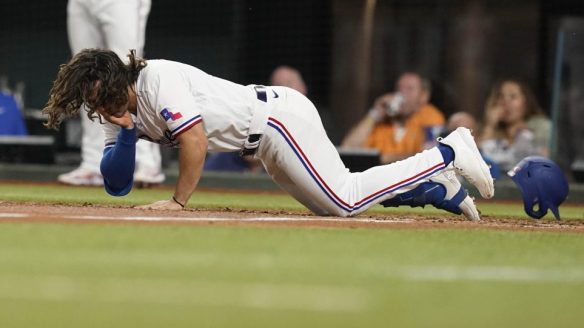
Maybe it depends upon your definition of “good news.” Rangers outfielder Josh Smith took one on the jaw in the third inning Monday, on an 89 mph slider from Orioles relief pitcher Danny Coloumbe. A Rangers trainer looked him over before he walked off the field under his own power, but Smith was sent to the hospital regardless.

“We did take him to the ER,” said Rangers manager Bruce Bochy, the former three-time World Series-winning Giants manager now in his first season out of retirement. “He had some CT tests. They came out clean. So, we got good news there. He’s feeling better as I’m speaking right now. Tomorrow, we’ll just reevaluate him.”

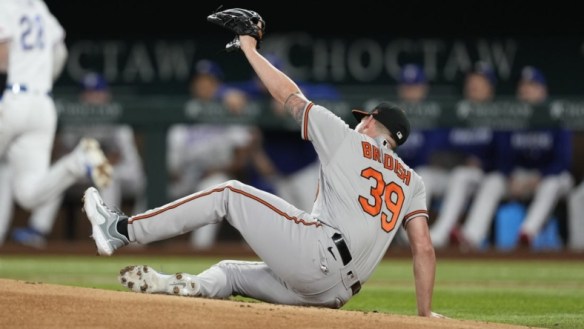
Coloumbe himself was in the game that early because Orioles starter Kyle Bradish was knocked out of the game an inning earlier. Not by a Rangers uprising—the Orioles held on to win, 2-0—but by a line drive off his right foot, courtesy of Rangers catcher Jonah Heim. Initial X-rays showed no fracture but Bradish is out for now with a bruise.

If you want to call it that, Bradish was a little more fortunate than Smith. Not just because Heim’s liner nailed his foot and not his face, but because the liner was measured as traveling 104 mph.

Go ahead and say baseball ain’t beanbag if you must. But at least acknowledge that batters injuring pitchers on bullet-train line drives back to the box aren’t trying to be cute or sending messages. Neither are pitchers injuring batters even on 89 mph sliders they’re not throwing as purpose pitches and may not be able to control.

There was also Boston’s Justin Turner and San Diego’s Austin Nola taking pitches in the face during spring training. There were Bryce Harper (Phillies) and Kevin Pillar (then a Met) each taking one in the face two seasons ago. There’ve been others. Too many others. On both sides of the ball.

Unless Commissioner ADD and his rules-changing fetishists take a hard look at another rule change or two, someone’s going to get killed, either by a pitch or a line drive in the head. Maybe the first change should be moving the pitching rubber back at least the equal distance to the length of home plate.

Kyle Bradish

. . . an inning after Orioles starter Kyle Bradish was hit in the right foot by a comeback line drive. Bradish was lucky—it could have been his face.

Right now, you think the rubber is 60’6″ from the plate. You’re wrong. As my cherished Mets/Senators/Tigers friend, former pitcher Bill Denehy, pointed out to me when we first talked four years ago, the actual distance is 59’1″ from the front of the plate. The 60’6″ is the distance from the rubber to the back point of the plate. Throw in a pitcher who can break three digits on the speedometer with a long stride, and the distance shortens. Dangerously.

Denehy was the player sent to the Senators to finish the agreement by which Hall of Famer Gil Hodges became the Mets’ manager. Today he’s almost as passionate about moving the rubber back for safety’s sake as he is about the struggle to get full major league pensions for himself and 500+ other pre-1980, short-career players frozen out when the owners and the players’ union re-aligned the pension plan in 1980.

“What baseball hasn’t seemed to take into account is, if you go back forty years ago, the average fastball back then was probably about 85 miles an hour,” the former righthander  said by phone from his Florida home Monday.

You had your exceptional pitchers who could throw at 95, or Nolan Ryan who was over 100. As the fastball has increased . . . they’re also not taking into account the size of the ballplayer. You now have several pitchers 6’8″ or 6’10”. When you look at a pitcher that tall, he’s going to take a stride as long as seven feet. If you take that closer to home plate, you’re throwing 100 mph not at 59’2″ but less than that because of the stride that person takes.

That’s looking from the mound side of the equation. Now, look at it from the batter’s box. Denehy is just as emphatic about it. As well you might expect of a pitcher who experienced two batted balls hitting him in the head, a hit just off his eye in college and once off the side of his face in the minors.

“Because of the strength and the velocity of the balls coming off the bat nowadays,” he said, “a pitcher, if he throws his all out fastball like the majority of the relief pitchers do today, he’s not going to be in that perfect fielding position. If a ball is hit around the head area, he’s not going to have the time to be able to get the glove up to deflect or move his head in one direction or the other to get out of the way of a line drive.”

The day before we spoke of it, the Yankees’ Giancarlo Stanton hit a home run that traveled 485 feet at 118 mph. Some drives, line and otherwise, have been measured traveling as fast as 122 mph. When you watch a game on television and note what the exit velocity of a batted ball is shown to be, picture that ball traveling not into the outfield or over the fence but up into the pitcher’s face.

Bill Denehy

Because of the strength and velocity of the balls coming off the bat nowadays, [a pitcher’s] not going to be in that perfect fielding position. If a ball is hit around the head area, he’s not going to have time to be able to get the glove up to deflect or move his head in one direction of the other to get out of the way of a line drive.—Bill Denehy, former major league pitcher.

Now do you get it? These aren’t all “glazing” or “glancing” blows as too many people want to think. These can be howitzer shells against which either a pitcher whose stride shortens an already deceptively-short distance from the plate, or a batter set to hit, has maybe minus a second to react and survive. You can’t just shake off a 118 mph bullet hit right back into your grille or a 101 mph bullet thrown up into it.

The control issue has two sides to it. Those tasked with finding fresh talent still seem to prize velocity uber alles. It’s no longer just a pleasant joke that an absolute control pitcher such as Hall of Famer Greg Maddux, who couldn’t throw a ball through a sheet of paper but knew what he was doing on the mound and knew where to put his pitches, wouldn’t get even half a second look as a prospect today.

Those who note the inconsistency of manufactured baseballs the past few years struggle to convince baseball’s government that too many of the inconsistently-made balls are difficult if not almost impossible for pitchers to control even if they’re not trying to throw bullet-train fastballs alone.

The independent Atlantic League tried moving the rubber back in 2021. Wrote Bleacher Report‘s Brett Taylor, “Unlike other changes that were met with skeptical acceptance, that one was never particularly popular, nor did the data bear out that it was getting the intended results (more balls in play, as batters should have a little more time to make contact).”

The cited link is a Ringer piece by The MVP Machine co-author Ben Lindbergh with Rob Arthur. The piece said the rule was designed to “increase action on the basepaths, create more balls in play, improve the pace and length of games, and reduce player injuries.” Notice which one was the last of four considerations noted.

Ray Chapman was killed by a fastball to his head in 1920; Hall of Famer Mickey Cochrane was nearly killed by one in 1937. It took several experiments, too many of which were laughed out of town, before batting helmets became mandatory between 1953 (when Branch Rickey’s Pirates began using them) and 1971 (when the last grandfathered such player retired).

But Herb Score may have been lucky to be alive after Gil McDougald’s line drive crashed into his face in 1957. His pitching career was compromised soon enough, after his elbow blew out while making an impressive early 1958 return. It left him never the same pitcher again, but he lived a full life after the mound as a beloved Cleveland baseball broadcaster from 1964-1997.

Hall of Famer Mike Mussina took one on the mound in 1998. Three years later, he called his injury “almost entirely mental,” as if saying that overcoming any fear that any ball he threw would be hit right back to him was harder than getting hit in the face. He was lucky a broken nose was all he got from it.

It’s no funnier when a pitcher gets drilled in the face than when a batter gets it. Spare us the mental toughness bit, please. Mental toughness is admirable but it should not be tested by injuries that can be made a little more preventable—and a lot less potentially fatal.

Do you want to see pitchers going to the mound and batters going to the plate with football helmets and facemasks on their heads? Didn’t think so. The absolute least you can do for their protection—screw basepath action, more balls in play, and paces of play—is move the damn rubber back another seventeen inches. (And, dammit, start making consistent baseballs fair to both pitchers and batters that even the speed-uber-alles pitchers can control.)

Baseball’s supposed to be the thinking person’s sport. It’s too long past time for the game’s thinking people to do some hard thinking and doing about this.

Now they have to do the impossible

Kyle Tucker, Chas McCormick

With Kyle Tucker backing him, Chas McCormick—who grew up a Phillies fan 35 miles away from Citizens Bank Park—made the possible catch of the Series off J.T. Realmuto’s eighth-inning drive to the right center field scoreboard wall in World Series Game Five Thursday night. 

This year’s Phillies, meet the 2019 Nationals. Sort of. Those Nats won every World Series game against that edition of Astros on the road including four in Houston. These Phillies split in Houston, then could win only once in their own cozy, stop-sign-shaped, noisy playpen. Now they have to do the kind of impossible those Nats did. If they can.

They have to win Game Six Saturday and then Game Seven Sunday. And if Game Five is evidence, they won’t get it without putting up a terrific battle. Better than the battle between the two that ended in a squeaker of a 3-2 Astros win Thursday night. Better than they were built to be.

Better than just half a collection of sluggers and a bullpen that can hang with any bullpen in the business. And enough to keep the Astros from saving themselves—until a forgotten Astro at first base and an Astro outfielder who grew up a Phillies fan saved the Astros’ lives in the bottom of the Game Five eighth and ninth, respectively.

Trey Mancini was a trade deadline acquisition from the Orioles but an 0-for-18 afterthought this postseason. Chas McCormick grew up 35 miles from Citizens Bank Park and never forgot the bloody nose then-Phillies outfielder Aaron Rowand incurred making a similar catch against the center field fence.

Mancini now found himself at first base after Astros veteran Yuli Gurriel had to come out a half inning after a collision resulting in a rundown out as he got trapped between third and the plate also resulted in a woozy head. With two out and Astros closer Ryan Pressly asked for an almost unheard-of-for-him five-out save, Kyle Schwarber loomed at the plate.

Schwarber electrified the ballpark in the bottom of the first when, with the Astros up 1-0 already, he drilled an 0-1 pitch from starter Justin Verlander into the right field seats to tie it. Now, with two out, first and third, and the Phillies back to within a run in the bottom of the eighth, Schwarber drilled one up the first base line on a single hop. The shot had extra bases down the line and the tying run home at least stamped on it.

Until it didn’t. Playing practically on the line as it was, Mancini hit his knees like a supplicant in prayer and the ball shot right into his mitt. While he was there, Mancini stepped on the pad. Side retired. In one flash Mancini went from self-made afterthought to the Astros’ man of the hour.

It’d take something even more stupefying to rob Mancini of that status. “That ball gets by him,” Pressly said postgame, “we’re looking at a different game.”

Something even more stupefying came along in the bottom of the ninth. When Phillies catcher J.T. Realmuto sent Pressly’s 1-1 slider high and far toward the right center field scoreboard wall, with at least a double and likely more the likely result, the wall notorious for creating odd rebounds.

Until it wasn’t. Until McCormick ran to his left, took a flying leap, and snapped the ball into his glove a second before he hit the wall and landed on the track, the ball still securely in his glove, and by his own postgame admission stared up at whatever he could see of the Bank crowd he’d just snapped silent.

“I wanted to lay there longer,” he admitted postgame. “If it were the last out, I would have laid there all night.”

Pressly’s jaw fell as he saw McCormick nail the catch. As he remembered after the game, the only thing he could think as his hands clutched his head in wonder was, “Holy [you-know-what].”

Until that moment, the Astros and the Phillies wrestled and tussled like alley cats all Game Five long. The bad news was that the Phillies, the Show’s best on the season with runners in scoring position, extended to a third-longest World Series string of 0-for-20 with men in such position.

“[S]ometimes you go through times when you don’t hit with runners in scoring position,” said Phillies manager Rob Thomson postgame. “Then, three days later, everybody’s getting hits. So we just got to keep battling, that’s all.”

The Phillies can’t wait three days for hits. They have two days before it might be curtains. Three days maximum, after squandering what half the world thought would be the remarkable and ear-splitting home field advantage they’d stolen with a Series-opening split in Houston.

The worse news Thursday began when Astros’ rookie shortstop Jeremy Peña started the scoring when he singled up the pipe to send Jose Altuve (leadoff double, taking third on Phillies center fielder Brandon Marsh’s carom bobble) home in the top of the first.

After Schwarber’s ballpark-jolting bomb leading off the bottom, both sides wrestled each other’s starting pitchers, Verlander and Noah Syndergaard, into and out of a few more dicey jams—especially the Phillies loading the bases on Verlander with two out in the second before the future Hall of Fame righthander struck Rhys Hoskins out swinging rather violently.

Syndergaard settled admirably after the first inning run and retired nine straight from that score forward. Verlander escaped another jam in the third, which might have been another bases-loaded escape but for Peña leaping to steal a base hit off Nick Castellanos’s hard liner, but after Alec Bohm spanked a single past shortstop to follow, Verlander got Phillies shortstop Bryson Stott to pop out to right for the side.

But Syndergaard—no longer the bullet-throwing Thor of old thanks to injuries, illnesses, and finally Tommy John surgery—ran out of luck in the top of the fourth, when Peña sent a 1-2 service into the left field seats. Connor Brogdon relieved him and shook off Alex Bregman’s one-out double while striking out the side.

Verlander pitched as clean a fourth as you could ask of a 39-year-old righthander with or without his particular career resume, then had to perform another escape act in the fifth after striking two out to open. Bryce Harper lined one to deep right that Astros right fielder Kyle Tucker bobbled toward the corner, ensuring Harper’s double. Castellanos wrestled Verlander to a full count before popping out to left center for the side.

From there, the bullpens wrestled each other. Then, top of the seventh, came Gurriel’s leadoff double. One out and a wild pitch later came McCormick with Gurriel on third. McCormick bounced one to third, with the infield in, and beginning with Phillies third baseman Alec Bohm they had Gurriel trapped like the top man on the FBI’s old ten most wanted list.

Bohm threw to Realmuto. Realmuto threw to Stott. Stott threw to first baseman Hoskins joining the party just in case, and Hoskins reached to tag Gurriel while tumbling over the veteran Astro. Gurriel landed awkwardly on his right knee as it was, but Hoskins’s knee on the tumble also jolted Gurriel’s head.

The elder first baseman—whose string of 48 straight postseason plate appearances without striking out ended at Brogdon’s hands in the fourth—managed to play his position in the top of the eighth but that was all he had left after the collision. “A little pain,” the sleepy-eyed first baseman tweeted postgame, A little pain but the win made my knee feel better fast . . . I will get some treatment to get ready for Saturday, thank you for the well wishes.”

But Altuve and Peña partnered on building the third Astro run in the top of the eighth, Altuve with a leadoff walk off Phillies reliever Seranthony Dominguez, and Peña shooting a base hit through the infield the other way to right, Altuve running on the pitch and helping himself to third easily. David Robertson relieved Dominguez but could only watch helplessly as Hoskins knocked Alvarez’s grounder up the line down and tag the Astro left fielder out while Altuve scampered home.

The best Robertston could do in the inning was keep the damage to a single run. He couldn’t stop the Astros’ defensive acrobatics in the bottom of the eighth and ninth. Nobody could. And even after McCormick’s robbery of Realmuto in the bottom of the ninth, the Phillies weren’t dead yet.

Pressly hit Harper in the foot on a 2-1 pitch. Up stepped Castellanos, who’d spent much of the game keeping his free-swinging in check and timing himself to a few hard hit outs and, then, the eighth-inning walk that turned into him scoring the second Phillies run on Jean Segura’s opposite-field base hit.

Now he wrestled Pressly to a full count with the Bank crowd as loud as conceivable. Then he bounced one to shortstop. Peña picked it clean, threw to first even more clean, and the Astros had it in the Bank. And Verlander—whom the Phillies abused in Game One—got credit for his first World Series win. Ever.

He’d sported an 0-6 won-lost record in the Series lifetime until Thursday night. And he  admitted postgame that Schwarber’s leadoff launch—the first such homer ever by a Phillie in postseason play—woke him up post haste.

“[A]s a starting pitcher, been there, done that,” Verlander told reporters after shaking off a particularly profound rookie-style celebratory shower in the clubhouse and savouring every moment of it. “It just sucks because of the moment and obviously all the questions and weight.

“You have to rely on the hundreds of starts and thousands of pitches I’ve thrown before and just kind of say, OK, I’ve given up leadoff home runs before,” the righthander continued. “It’s not going to be indicative of what’s going to happen the rest of this game, by any means. Let’s see what happens.”

What happened from there handed Verlander a win as moral as it was baseball and the Astros a Series return ticket home. And the Phillies—who’d gotten thatclose to fully avenging their having been no-hit in Game Four—another challenge to meet and conquer. If they can.

“What’s a better storybook ending than if we can go there and win this in Game Seven?” Castellanos asked postgame, well aware that the Phillies need to win Game Six first. So did the 2019 Nationals, in a Series in which neither team won at home but the Nats had to win the four they won in the Astros’ noisy-enough cape.

“We’re here, I think, because we trusted ourselves this far,” said Hoskins thoughtfully enough. “I don’t see why there is any reason to change that.”

They’re going to need that if they want just to come out of Game Six alive enough to play one more day. These Astros won’t exactly let them have it without making them work shields up, phasers on stun, for every degree of it.