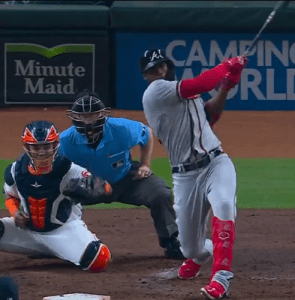
NLDS Games One: The Atlanta Chop Slop, the Los Angeles funeral parlour

Truist Park

Trash talk? Have at it. Trash the field over a call going against you? What was this, Braves fan?

Neither the Dodgers nor the Phillies expected simple National League division series this time around. Not with both teams coming in with what some call patchwork pitching. But one came out looking better in their Game One while the other came out looking like the remnant of a nuclear attack.

The Phillies and their pitching managed to keep the Atlanta threshing machine from threshing Saturday afternoon, winning 3-0. Starting with a first-inning nuking of future Hall of Famer Clayton Kershaw, the Diamondbacks laid waste to the Dodgers Saturday night, 11-2. On the arms of big enough bats and a starting pitcher who was usually close enough to Dodger batting practise.

Letting starter Ranger Suárez go no more than three and two thirds, knowing they’d have a day off between Games One and Two, the Phillies went to a bullpen game, essentially. And that bullpen finished what Suárez started, shutting the Braves out over the remaining five and a third. The Braves who hit a record 307 home runs on the regular season looked as though they had paper towel tubes for bats.

None more glaring than the founding father of the 40/70 club. Ronald Acuña, Jr. went 0-for-3 with a walk, and his evening’s futility included an embarrassing called strikeout in the fifth, when—with first and third and one out—the second Phillies reliever of the evening, Seranthony Domínguez, planted a fastball right on the low inside corner.

Small wonder that Braves manager Brian Snitker could and did say, postgame, “I think it was more their pitching than our hitting.” Indeed.

Braves starter Spencer Strider pitched boldly enough, striking eight out and scattering five hits in seven innings’ work. But the Phillies still pried two runs out of him, both with Bryce Harper the big factor. First, Strider threw wild enough trying to pick Harper off first in the top of the fourth, enabling Bryson Stott to single him home with the first run. Then, Strider threw Harper enough of a meatball to disappear into the Chop House seats behind right field with one out in the top of the sixth.

“Strider, man, he’s one of the best in the game. You know he’s going to come at you and throw his best at you,” Harper said postgame. “So just trying to get a pitch over and was able to get the slider up and do some damage.”

Except for Acuña’s surprising silence, and the eighth-inning catcher’s interference call with J.T. Realmuto at the plate and the Phillies with the bases loaded, enabling the third Phillie run home, the Braves at least looked stronger in Game One defeat than the Dodgers did. Even Strider, who became the first postseason pitcher ever to lose twice against a team against whom he’s well undefeated in the regular season.

The Diamondbacks didn’t let Clayton Kershaw—all 35 years old of him, with possible lingering shoulder issues plus eight days of rest leaving him with little enough to offer—get out of the first alive. Their 35-year-old journeyman starter Merrill Kelly, who didn’t turn up in the Show until age 30 in the first place, manhandled them for six and a third after the Snakes bit Kershaw deep in the first.

For the regular season’s final two months, with a 2.23 ERA over eight starts, Kershaw seemed to tell age and his shoulder alike where to stuff it. Then Kershaw took the ball Saturday night. What’s the saying about too much rest being as hazardous to a pitcher as too little rest can be?

Ketel Marte opened with a double to the back of left center field, and Corbin Carroll began showing why he’s in the Rookie of the Year conversation with a prompte RBI single. Tommy Pham—the same Tommy Pham who called out the lack of work ethic among second-tier Mets teammates with whom he played before the trade deadline—rapped a short single to left for first and second.

Then Christian Walker, a veteran first baseman who hadn’t been anything much special before 2022, hit one so far to the back of the left field bleachers some wondered how the ball didn’t leave the ballpark structure. Just like that, Dodger Stadium resembled a funeral parlour. And, just like that, Kershaw resembled the corpse for whom the audience came to mourn.

A ground out by Lourdes Gurriel, Jr. and a walk to Alek Thomas later, Evan Longoria sent Thomas all the way home with a double to deep center field, hammering the final nails into Kershaw’s coffin.

“Embarrassing,” the lefthander said postgame. “You just feel like you let everybody down. The guys, a whole organization, that looked to you to pitch well in Game One. It’s just embarrassing, really. So I just feel like I let everybody down. It’s a tough way to start the postseason. Obviously, we still have a chance at this thing, but that wasn’t the way it should’ve started for me.”

Kershaw’s postseason history is a direct contrast to the regular-season career that guarantees him a place in Cooperstown. Until Saturday night, enough of that sad history came by way of leaving him in too long or by circumstances above and beyond his control.

Entering Game One with a 5.49 ERA against the Dodgers lifetime but a 7.03 ERA against them when pitching in Dodger Stadium, Kelly pitched six and a third shutout innings before turning it over to a bullpen that kept the Dodgers to one hit. The bad news: the hit was a two-run triple by Will Smith off Miguel Castro. The good news: The Snakes could afford such generosity by then, since it cut an 11-0 lead by a measly two runs.

Kelly’s keys included forgetting how the Dodgers treated him like a piñata in regular season play. “I’m watching our guys beat up on one of the best pitchers that we’ve ever seen in our lives and watching them do it in the first game I’ve ever pitched in the playoffs,” he said postgame. “I felt if I gave those games any attention I was going out there behind the eight-ball before I even stepped on the mound.”

This time, Kelly went out there with a six-run cushion, then saw it padded to nine by a three-run second including Carroll leading off against Dodger reliever Emmet Sheehan with a drive into the right field bleachers. Kelly was now comfortable enough that he could have pitched from a high-backed leather office chair and incurred no damage.

The only thing that should have and apparently did embarrass the Braves was the Truist Park crowd throwing drinks onto the field after catcher Sean Murphy’s mitt grazed Realmuto’s bat by a thin hair. You could hear it on replays that didn’t exactly show it too clearly, but Murphy’s lack of challenging the call affirmed it.

Trea Turner—who started a spectacular double play with Acuña (leadoff walk) on third to end the bottom of the eighth, diving left for Ozzie Albies’s ground smash and backhanding to second baseman Stott—scored on the interference. The rain of drinks into the outfield annoyed both the Braves and their manager.

“There’s no excuse for that,” Snitker snapped postgame. “It’s scary because those water bottles, when they come, they’re like grenades. It could really seriously injure one of our players.”

That’s what the miscreants don’t stop to think about. Against a team whose fan base is usually considered one of the worst in the game. (Remember the Philadelphia wedding: the clergyman pronounces the happy couple husband and wife before telling the gathering, “You may now boo the bride.”) Be better, Braves fans.

Only the silence in Dodger Stadium following the Diamondbacks’ early and often abuse of Kershaw and Sheehan kept the big National League division series headlines elsewhere from reading, “Chop Slop.”

The phlinging, phlying, phlogging Phillies

Brandon Marsh

The Ides of Marsh—the Phillies’ center fielder launching the three-run homer that launched the Phillies toward burying the Braves and going to the NLCS Saturday afternoon.

“You’ve got to beat the champs to be the champs,” said Bryce Harper just minutes after the game ended. The Phillies aren’t exactly the champs just yet. But the way they dispatched the Braves once their National League division series shifted to Citizens Banks Park, it won’t be simple to bet against them now.

These are not the uncohesive, porous Phillies who were down 22-29 and threw out the first manager as June got underway. Since executing Joe Girardi and installing his bench coach Rob Thomson on the bridge, the Phillies were the third-winningest team in the National League, behind the Braves they just vanquished and the Mets who became 101 game-winning also-rans last weekend.

They ground their way to the postseason despite a key element or two missing significant injury time, a just-enough pitching reshuffle, and prognosticators who assumed the almighty Braves—who had to grind their own way back to snatch the National League East in the first place—would do to them what they just finished doing.

They flattened the Braves 8-3 Saturday afternoon. It’s rather amazing what a team who’d spent seventeen straight days for fourteen straight games on the road can do once they get to come home at last. By the time Phillies relief ace Seranthony Domínguez blew Travis d’Arnaud away with a wind-generating swinging strikeout to end the game, they’d outscored the Braves 17-4 in division series Games Three and Four.

The defending world champions who were second in the league in runs scored on the regular season couldn’t rent, buy, embezzle, or forge runs once they left their own playpen in this set. Their starting pitching, usually considered one of their deepest contingencies this year, had only Kyle Wright’s magnificent Game Two performance to show for it.

Once they got to playing Saturday afternoon, almost everything a Brave threw was found by a Phillie bat when it hurt the most, sometimes for measured-doses mischief and sometimes for long-distance landings. And, unless the Braves were hitting solo home runs, whatever they hit when not striking out to the tune of fifteen batters found a Phillie  glove.

This wasn’t exactly what the Braves planned to happen once they managed to overthrow the Mets and steal a division over half the world thought the Mets had in the safe deposit box.

“[T]he goal when we leave spring training is to win the division,” said manager Brian Snitker. “Until you win the division, you don’t have a chance to do anything special because you never know what’s going to happen, you don’t know what team’s going to get hot, what things have to go right for you to go deep into the postseason.”

The new postseason format may be the competition-diluting or compromising mishmash it happens to be, but one of the key reasons is that someone who doesn’t win the division—say, 25 or 6 someones in red or blue-on-red hats with big script Ps on the crowns—can do more than a few special things after they slip in through the second wild card door.

“They’re hitting on all cylinders at the right time,” said Snitker. “It’s a good club. They’ve got really good players, and they’re getting it going at the right time.”

Where to begin delineating the Braves’ engine seizure?

Maybe with poor Charlie Morton, who entered the game with a sub-one ERA in postseason elimination games but exited early with an elbow injury. But not before he was informed rudely that squirming out of one self-inflicted inning-opening jam is a reprieve, but squirming out of a second to follow immediately is not Phillies policy.

Bottom of the first—The wizened old righthander allowed the first two Phillies to reach base, Kyle Schwarber on an unintentional walk and Game Three hero Rhys Hoskins on a base hit, and escaped with his life and no score. Bottom of the second—Alec Bohm’s leadoff liner bounded off Morton’s forearm, then Morton struck Bryson Stott out before Jean Segura shot one past a diving Dansby Swanson at shortstop. First and third again.

No escape this time. Brandon Marsh, the Phillies center fielder whose long enough beard qualifies him well enough to audition for ZZ Top, saw a 2-2 curve ball arrive at the perfect level to send into the right field seats. One day after Hoskins hit a bat-spiking three-run homer to start the Phillie phun, Marsh equaled him for early drama if not for a celebratory gesture.

In the interim, Phillies starter Noah Syndergaard, last seen in postseason action throwing seven shutout innings at the Giants, in the 2016 NL wild card game the Mets ended up losing, didn’t let Orlando Arcia’s solo homer spoil his night. He sliced and diced the Braves  otherwise with a very un-Thor like array of breakers and three innings of shutout, three-strikeout ball.

As if to reward the remade/remodeled Syndergaard, who became a Phillie near the regular season trade deadline after a first half as a struggling free-agent Angel, his catcher J.T. Realmuto let Morton’s relief Collin McHugh—entering after Braves manager Brian Snitker saw Morton just uncomfortable enough warming back up to hook him—feel it where it really hurt.

Realmuto had a little help, admittedly, from Ronald Acuña, Jr. who either didn’t look in that big a hurry or misread the play. Acuña moved almost no muscle when Realmuto’s deep fly eluded Braves center fielder Michael Harris II, taking a carom off the lower portion of the State Farm sign on the center field fence and rolling almost halfway to the right field track.

It let Realmuto—maybe the fastest-running catcher in a game not known for swift-afoot backstops—run himself into an inside-the-park homer and a 4-1 Phillies lead. He also ran himself into becoming the eighteenth player and first catcher to deliver an inside-the-parker in postseason play.

He couldn’t contain himself when he dove home and sprang up whooping it up. “I’m not usually a guy that shows a lot of emotion,” he told reporters postgame. “When I slid into home, I couldn’t help myself. I was so excited. Excited for this city. Excited for this team. It was one of those moments I’ll definitely remember forever.” Him and everyone else including the concessionaires in the Bank.

Matt Olson made a small stand for the Braves in the top of the next inning, when he jerked the first pitch he saw from Phillies reliever Andrew Bellatti over the right field fence with one out, but Bellatti shook it off as if it were just a mildly annoying mosquito, striking both d’Arnaud and Austin Riley out swinging with remarkable aplomb.

The bullpens kept things quiet enough on the field, if not among the Bank crowd itching to see the Phillies take it the distance to the National League Championship Series, until the bottom of the sixth. With A.J Minter—whose fifth inning work was as lights-out as he’d been most of last year’s run to the Braves’ World Series title—taking on a second inning’s work. Uh-oh.

Segura rapped a single to center with one out and stole second almost too handily with Marsh at the plate. Minter caught Marsh looking at a third strike, but then his 2-2 changeup caught the Schwarbinator on the fingers around the bat and, after a review challenge, took his base.

Exit Minter, enter Raisel Igelsias. And enter the Phillies showing they could peck away at you with just as much ease and pleasure as they could detonate the nukes against you.

Hoskins fought one off to dump it into shallow right that fell for a base hit. When Acuña lost track of the ball after it bounded off his glove, Segura came home with the fifth Philadelphia run. Realmuto then bounced one slowly up the third base line, slow enough that Riley playing it in front of the base dirt on the grass couldn’t get a throw to first in time,   while Schwarber scored run number six and Hoskins held at second.

Then Bryce Harper—carrying a 1.674 series OPS to the plate with him—broke his bat while sneaking a base hit the other way left to send Hoskins home. Castellanos walked to load them up for Bohm but for the second time in the game the Phillies stranded the ducks on the pond. Not that it mattered. A 7-2 lead after a three-run pick-and-peck sixth was nothing to complain about.

D’Arnaud opened the Atlanta seventh with a first-pitch drive over the center field fence off Phillies reliever José Alvarado, starting a second inning’s work after a 32-minute rest during that bottom of the sixth. He then got two ground outs before yielding to Zack Eflin for the inning-ending swinging strikeout of William Contreras.

Eflin worked a one-two-three top of the eighth. Harper soon faced Kenley Jansen in an unusual-looking, from-far-enough-behind appearance, and had a that’s-what-you-think answer to d’Arnaud’s blast. He sliced Jansen’s fadeaway cutter the other way into the left field seats. Then it was time for Sir Anthony to ride in, dispatch the Braves by striking out the side, and let Philadelphia know the Phillies reached the next plateau.

“This is step two in what we’ve been through,” said Harper, whose regular season absence with a shoulder issue limiting him to the designated hitter role and then a thumb fracture could have deflated the Phillies but didn’t. “Step one being the wild card. This being step two and we’ve got two more (steps).”

Step three: either the Padres or the Dodgers in the NLCS. Step four: You have to ask? Taking things one step at a time works big for these Phillies hanging with the big boys. So far.

The All-Star Game was Clayton’s place

Clayton Kershaw, Blake Grice

National League All-Star starter Clayton Kershaw with fan Blake Grice, who touched Kershaw by telling the future Hall of Famer he was meeting him for Grandpa’s sake.

By right, this year’s All-Star Game start for the National League should have belonged to the Marlins’ Sandy Alcantara (he leads the Show’s pitchers with 5.3 wins above replacement level and his 1.76 ERA). And if the game were played someplace other than Dodger Stadium, it might have been Alcantara’s to start.

Braves manager Brian Snitker, managing the NL All-Stars as the previous season’s World Series skipper does, had his own idea. Especially since this was the first All-Star Game in Dodger Stadium since Jimmy Carter was still in the White House, and a Dodger icon was having an All-Star worthy season himself.

So Snitker elected to hand the opening ball to Clayton Kershaw. A Hall of Fame lock, approaching the sunset of an off-the-charts career, starting the All-Star Game in his home ballpark. You could imagine Snitker thinking to himself that you couldn’t pay to pre-arrange more serendipitous circumstances. Even with his own All-Star Max Fried among his pitching options.

It was a class gesture by the defending World Series-winning manager. Only one thing could have seen and raised, and that one thing was Kershaw himself. By most reports, one of the first things the 33-year-old lefthander did when Snitker called him to say the opening ball was his was to call Alcantara himself.

“He was awesome about it. I was really thankful about that,” Kershaw said, after the American League hung in for a 3-2 win through no fault of Kershaw’s own.

He let himself take the entire atmopshere in, even foregoing his usual pre-start intensity that compels teammates, coaches, and even his manager Dave Roberts to say nothing much more than “hello” to him. (He even let Roberts share lunch with him on Tuesday.) About the only thing Kershaw did remotely work-related was study some American League scouting reports.

One he didn’t have to study was Shohei Ohtani (Angels), whom Kershaw retired thrice when pitching last Friday. Wary of opening the All-Star Game with one of his signature breaking balls, Kershaw pumped a fastball that doesn’t have its former speed and Ohtani—interviewed before the game, promising to swing on the first pitch—smacked a broken-bat floater up the pipe into short left center for a leadoff single.

Then, having Aaron Judge (Yankees) 1-2, Kershaw suddenly couldn’t think of what to throw next. Some described him as buying time when he lobbed a throw to first. He bought more than he bargained for. He’d caught Ohtani having a snooze. Ohtani had drifted away from the pad and Kershaw’s lob turned into the first All-Star pickoff in fourteen years.

The two-way Angel could only laugh. Kershaw could only grin after first baseman Paul Goldschmidt (Cardinals) tagged Ohtani out. Dodger Stadium went nuclear. Kershaw finished striking Judge out, walked Rafael Devers (Red Sox), and lured Vladimir Gurrero, Jr. (Blue Jays) into an inning-ending ground out. The man who wanted to take it all in from start to finish then ducked out of sight and to a press podium under the ballpark.

Shohei Ohtani, Clayton Kershaw

All they could do was grin and laugh after Kershaw (right) picked Othani off first while working to Yankee bombardier Aaron Judge.

While the National League took an early 2-0 lead with Mookie Betts (Dodgers) singling home Ronald Acuña, Jr. (Braves; leadoff double off AL starter Shane McLanahan [Rays]) and—after a double play grounder by Manny Machado (Padres)—Goldschmidt hammering one into the left center field bleachers, Kershaw finished his press conference with a ten year old boy raising a hand.

“What’s up, dude?” Kershaw asked pleasantly.

The boy introduced himself as Blake Grice and told Kershaw how much his late grandfather loved both him and the Dodgers’ long-enough-retired broadcast deity Vin Scully and had wanted to meet them both. (His family had passes courtesy of MLB itself.) “So this moment is important to me,” the boy continued, “because I’m meeting you for him.”

The father of four children himself, Kershaw couldn’t resist when he heard that and saw the boy’s tears of likely gratitude for getting to do something for his grandpa in the presence of a Dodger icon who’s been the closest the Dodgers have had to longtime eminence Sandy Koufax.

“Come here, dude,” Kershaw beckoned. He hugged the boy, gave him a clap on the back, and said, “Great to meet you. Thanks for telling me. That took a lot of courage to tell me that. Your grandad sounded like an awesome guy.” When Kershaw asked Blake if he had a parent with him, the boy’s father held up his cell phone. Kershaw beckoned him forward and he snapped a photo of the pitcher and the boy speaking for Grandpa.

It was more than enough to atone for the prayers thousands of fans in the ballpark and perhaps the millions watching on television must have had that, despite going down to its ninth straight All-Star loss and 21st such loss in 25 such games, the National League didn’t tie the game in the bottom of the ninth.

That’s because the latest to emerge from baseball’s apparent laboratory of mad science would have had the game decided in favour of the Home Run Derby winner’s league if nine full innings ended in a dead heat. (On Tuesday it would have been the National League, thanks to Juan Soto [Nationals] winning the Derby.) Thank God and His servants Branch Rickey and Jackie Robinson that that didn’t come to pass.

The AL overthrew the NL lead with one out in the fourth when Giancarlo Stanton (Yankees) batted with Jose Ramírez [Guardians] aboard (leadoff single) and took Tony Gonsolin (Dodgers) far into the left center field bleachers. Byron Buxton (Twins) following at once found himself ahead in the count 2-1 when he caught hold of a Gonsolin fastball up and drilled it into the left field bleachers. Just like that, Gonsolin had surrendered 882 feet worth of home run travel.

Buxton admired game MVP Stanton’s blast from the on-deck circle and thought to himself, “I ain’t matching that.” Until he damn near did. “I don’t even know if you can put it in words how hard [Stanton] hit the baseball,” Buxton said after the game.

It made all the difference when the game otherwise became a pitching duel of sorts between eleven American League pitchers (including Framber Valdez [Astros] getting credit for the “win” despite striking nobody out in his inning’s work) and nine National League pitchers including the hapless Gonsolin tagged for the loss and, officially, a blown save.

For just the sixth time in four decades an All-Star pitcher got to start the game in his home ballpark. And for a few shining moments on the mound, Kershaw gave his home park’s audience a thrill topped only by the one he gave a ten-year-old boy looking to do his grandpa in the Elysian Fields a favour that couldn’t be done while the older man still lived on earth.

None of the highest highs or the comparatively few lows he’s endured in fifteen major league seasons have let Kershaw forget that baseball at core is about rooting, caring, loving. He had the parallel chance to remind a Dodger Stadium audience about it and to affirm it for a ten-year-old boy. He didn’t flinch at either opportunity.

WS Game Six: Bang!! Zoom!!!

Jorge Soler

Jorge Soler’s detonation in the bottom of the third. (Fox Sports screen capture.)

Blowhard bus driver Ralph Kramden only threatened to bang-zoom his acid but loving wife Alice to the moon in the days of old. (She might have clobbered him if he’d really hauled off.) The Braves may not have threatened to do it to the Astros, exactly, but that’s what they did to win the World Series Tuesday night.

The way Braves starting pitcher Max Fried and relief aces Tyler Matzek and Will Smith worked the Astros over, the Braves needed only one bang-zoom, after all. Getting three and a half was beyond gravy. It was a six course meal crowned with a baked Alaska dessert.

Shutting out the team that led the entire Show with 5.3 regular season runs per game averaged, and the postseason with 6.7 runs per game averaged, also does that for you. However brilliant Fried, Matzek, and Smith were on the mound, though, it goes for naught if you can’t bring anyone home.

But when Jorge Soler hit that monstrous three-run homer in the bottom of the third, it let the air out of Minute Maid Park almost as fast as it took away what wind remained to the Astros. Now . . . everybody, breathe again.

The sun didn’t fall. The heavens didn’t go to hell. The great oceans didn’t dry up and blow away. The stars didn’t go out. When Astros first baseman Yuli Gurriel grounded out to Braves shortstop Dansby Swanson, throwing right on the button to longtime Braves first baseman Freddie Freeman, for game, set, and Series, Armageddon didn’t begin.

But a few things that helped sour the Series for people who don’t live in either Atlanta or Houston ended, too. For now, anyway.

No more race-demeaning Tomahawk Chopping in the Truist Park stands or by traveling Braves fans present in Minute Maid Park. No more of the more stubbornly obnoxious among Astro fans acting and carping (falsely, on both counts) that their heroes were “scapegoated” when Astrogate exploded almost two full years ago.

But, also, there’ll be no more treating the entire Astros roster as barely-repentant cheaters because of the remaining presence of four Astrogaters. (Pitcher Lance McCullers, Jr. missed the entire postseason with an arm injury.) Even the Truist Park crowds for Games Three through Five isolated the point: they saved the “Cheater! Cheater!” chants purely for any of the four.

So now we can review and re-enjoy Fried surviving a near-disastrous near-ankle injury on a play at first base in the first inning to pitch six shutout innings. We can review and re-wonder about Luis (Rock-a-Bye Salsa) Garcia starting on short rest for the Astros, a move risky enough for manager Dusty Baker. He got away with it for two innings. In the third, disaster.

Now, we can re-enjoy Ozzie Albies poking his first base hit since Game Two. We can re-enjoy Fox Sports cameras captured a couple in the stands wearing makeshift World Series trophies for headdresses while Eddie Rosario waited out a five-pitch walk. We can re-enjoy Soler—the American League’s home run king in 2019, but somewhat lost this season, until two weeks before the Royals traded him to the Braves at this year’s deadline—hitting back-to-back, full-count liners foul out of play, before Garcia decided to sneak a cutter past him.

Dansby Swanson

Swanson reaching the Crawford Boxes in the fifth. (Fox Sports screen capture.)

And, we can re-enjoy Soler swinging as though trying to bring a great oak down but settling for bringing Garcia down instead, with the Minute Maid retractable roof open, and the ball flying over the left field seats, over the train tracks, out of the building, and rolling to the street off an awning outside.

Bang!! Zoom!!!

“I got to [full count],” Soler said postgame, “and I didn’t want the same thing to happen as the first inning at-bat, where I struck out on the off-speed pitch. So I was just kind of getting prepared for that.” That was like the Navy saying it didn’t want a Pearl Harbour rerun and was just kind of getting prepared for the Battle of Midway.

“He’s been swinging the bat so good,” said Braves manager Brian Snitker. “This whole World Series. Even just the walks he was taking were really big.”

Fried looked at last as though he had under complete control his familiar, nervous-looking glove-snapping around his hand on the ball when he takes his sign before delivering. He’d shaken off that first-inning play covering at first and getting thatclose to turning his right ankle, his landing ankle, to crumbs when Michael Brantley stepped on it crossing the pad on a ground ball.

A television replay closeup showed that not only had Fried’s foot missed touching the pad, Brantley never touched it either, even as Fried got the gloved ball on it as he fell backward. The Braves chose not to challenge the safe call. Fried picked himself up, dusted himself off, walked back to the mound, and sandwiched Jose Altuve’s runner-advancing ground out between two toasted strikeouts.

After swapping two scoreless innings to Astro reliever Cristian Javier’s one—they both  ended with slick double plays including the one he launched himself to end the bottom of the third—Fried had a breather and Javier went out for a second inning’s work. His first was three-and-three in the top of the fourth. He wouldn’t be that fortunate in the top of the fifth.

Not with Albies leading off with a walk, then taking second on a wild pitch. Not with a strikeout on Travis d’Arnaud proving the mere setup for Dansby Swanson smashing a down-the-pipe fastball into the Crawford Boxes. And, not with Freeman following a two-out walk to Soler by sending him all the way home with a double off the absolute rearmost center field wall.

Bang!! Zoom!!!

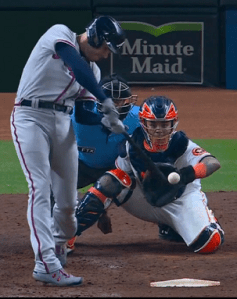
Two innings and three Astros relievers later, Freeman decided the Braves needed a little extra insurance, with the Astros down by a mere six. How to get it with two outs was the question. The answer proved simple enough. He caught hold of Ryne Stanek’s slightly dangling slider and drove it over the center field wall a little left of the Phillips 66 sign.

Bang!! Zoom!!!

“He’s been through good times. He’s been through the worst of times and now through the best of times,” said Swanson postgame of Freeman, the longtime Braves franchise face, who’s made no secret of his desire to stay with the team despite his free agency to come this winter. “Nobody deserves it on our team more than him. He stuck it out and really believed in the vision and mission that this place had. I’m just thankful for him to be on our team.”

Fried, Matzek (the seventh and eighth), and Smith (the ninth), kept the Astros so far in check there may have been suspicions that they’d been kidnapped and replaced with android replicas whose designers forgot to include batting eyes and arm strength.

As favoured sentimentally as his post-Astrogate Astros were disfavoured almost universally, Baker still doesn’t have that elusive World Series ring. Snitker, a Braves lifer who’s a mere six years Baker’s junior, has his first in five full seasons manning the Braves’ bridge.

Two old-school baseball men—who’ve learned and worked by the precept that analytics gives you what you need to know going in, but the moment in front of you and slightly ahead of you tells you what you should or shouldn’t do with that information—matched wits all Series long.
Freddie Freeman

Freeman, still the franchise face, going over the center field wall in the seventh. (Fox Sports screen capture.)

It took stout pitching and a little new old-fashioned long-range bombing to put the Braves over the top and to bury a collection of Astros with too little left in the tank,finally, to repel the invaders.

“First off, you’ve got to give a ton of credit to [the Braves],” said still-struggling Astros third baseman Alex Bregman postgame. “They were unbelievable. They pitched really well. They swung the bats, played good defense. We normally do hit a little bit more for power, and we didn’t. But you learn and move on. You use it as fuel during the off-season to get better and learn from it.”

What the Braves learned this season and taught or re-taught everyone else is that it’s possible to ride the arguable bumpiest road to the postseason and still come away from the ride hoisting the World Series trophy. “We hit every pothole, every bump you could possibly hit this year,” said the otherwise jubilant Freeman postgame, “and somehow the car still made it onto the other side.”

Potholes? Bumps? The Braves came out of a few nasty pileups. They lost franchise face heir apparent Ronald Acuna, Jr. to a season-ending knee injury in the outfield in early July. They entered the season without pitcher Mike Soroka, thanks to his re-injuring the Achilles tendon he’d barely finished rehabbing in the first place. They lost bombardier Marcell Ozuna to domestic violence charges and administrative leave.

The eventual rulers of the none-too-powerful National League East didn’t even have a winning record overall until 6 August. They broke the record for the latest season arrival above .500 they themselves held . . . since their 1914 “Miracle” ancestors arrived only on 3 August that year.

General manager Alex Anthopolous—who had to miss the Game Six and championship fun after being hit by COVID-19—swung four trade-deadline deals to land Soler, Rosario, Adam Duvall, and Joc Pederson. They went 36-14 in their final 55 regular season games. They still looked like postseason underdogs. Until.

They overthrew the NL Central-champion Brewers three straight after losing Game One of their division series. After getting blown out in National League Championship Series Game Five, they overthrew the wild card-winning Dodgers—owners of baseball’s second-best regular-season record with 106 wins—with their lights-out bullpen tandem Matzek and AJ Minter to win the pennant.

Then they lost starting pitcher Charlie Morton to a line drive off his leg in World Series Game One. And defied everyone who said losing the likeable, respected veteran for the rest of the set meant temporal and spiritual disaster for the upstarts.

When they finally reached the Promised Land, the Braves also defied several other factors. They became the first team ever to show a League Championship Series MVP and a World Series MVP who weren’t even with the team in the regular season’s first half. Their four outfield imports hit more postseason home runs together (twelve) than the rest of the team combined (eleven).

Bang!! Zoom!!!

Max Fried

Fried shook off a potentially shattering ankle injury in the first to shatter the Astros’ formidable offense.

When Sock-a-Bye Soler took Rock-a-Bye Samba downtown Tuesday night, only five men before him had ever hit three go-ahead home runs in a single World Series: Babe Ruth (1926), Lou Gehrig (1928), Gene Tenace (1972), Curtis Granderson (2015), and George Springer (2017). Soler joins Gehrig, Tenace, and Springer for doing it for World Series winners.

Only one other man ever got close to where Soler’s blast ended up. That was before the Astros became the team to be named later in the league swap that made a National League team out of the Brewers and sent the Astros to the American League.

The only thing keeping then-Cardinals superman Albert Pujols’s ninth-inning three-run homer from landing in Soler territory in 2005 NLCS Game Five was the closed roof. If the Minute Maid roof was open then, Pujols’s rip off then-Astros closer Brad Lidge might have bounded off the same awning—if not flown right to the street.

Somewhere in their Elysian Fields stomping grounds, the Braves’ late Hall of Famers Hank Aaron, Eddie Mathews, Phil Niekro, and Warren Spahn smiled down upon these rascally Braves while applauding madly.

The Astros went from steamrolling the White Sox and the Red Sox out of the postseason into spending most of this World Series being about as offensive as an ice cream sandwich. Except for stinging the possibly pitch-tipping Fried in Game Two, and overthrowing a first-inning battering in Game Five, the Astro offense either slept or turned up when it didn’t or couldn’t do them many favours.

“We just kind of ran out of gas pitching-wise,” Baker said postgame. “Our guys, nobody complained, nobody alibied. And I’m not going to alibi. We got outplayed. What can you do, except go home, take a shower, figure out how you’re going to come back and win it next year. Look, last year we got one game short of the World Series, and this year we were two games short of the championship.”

Baker was right about their spent pitching. Missing future Hall of Famer Justin Verlander to Tommy John surgery recuperation hurt. Being without their best 2021 starter, Lance McCullers, Jr., hurt. Baker bringing his should-have-been Game Six starter Jose Urquidy in for an inning of Game Five relief probably hurt. Veteran Zack Greinke starting to show his age at last hurt.

If you ask Minter, he’ll tell you the Braves transformed themselves from a small legion of also-rans into the guys who put the big boys into their places by hook, crook, and anything else they could think of so long as failure was no longer a dismaying, disgusting option.

“We are a bunch of misfits this year,” Minter said postgame. “I mean, we’re a group of failures. And that’s what makes this team special, because we know what it feels like to fail. We know what it feels like to lose, and we weren’t willing to accept failure this year. So we pulled it together somehow—and now we’re World Series champions. It’s cool, man.”

The Astros, of course, see themselves as anything but misfits. They were very gracious in World Series defeat. (“They deserve what they have,” said Altuve postgame.) But they see themselves now the way the Yankees did in the ancient, mid-20th Century. Shortstop Carlos Correa—one of their team leaders, one of the remaining Astrogate Five, and a possible departure in free agency this winter—said it right out postgame:

“Second place is not good enough for us. I know it’s not good enough for you guys. But it speaks volumes of how good our organization is, how talented our clubhouse is. Five ALCS in a row. Three World Series in five years. I don’t know what else you want to ask from a great ball club.”

Some might want to ask that they win a World Series without the taint of something like Astrogate.

They may yet win one, even next year, since the pitching remains deep even with Greinke and Verlander likely out of the picture and their youth includes a pair of solid stars in Kyle Tucker and Yordan Alvarez. Even if Alvarez was a one-man wrecking crew in the ALCS brought low in the World Series. Even if Altuve (32), Gurriel (37), and Michael Brantley (34) can’t keep Father Time from coming too much longer.

“People expect greatness when you talk about the Houston Astros,” said Correa, who still seems at once embarrassed by Astrogate yet unable to resist playing the rogue. “They expect us to make the playoffs every year. They expect us to be in the World Series every year.”

But now the guys nobody really expected at mid-season to be in the World Series have won it. With a pitcher defying those critics who thought he wasn’t really ready for center stage just yet. With three big swings having nothing to do with illegally stolen signs sent to the batter’s box by trash can transmission.

Bang!! Zoom!!!

WS Game Five: Winning in a walk

Martin Maldonado

Maldonado, you’re no longer the weakest link. For now.

The good news is, the Braves can win in Houston. They proved it in Game Two. The bad news is, they’ll need to win there to win the World Series now.

The Astros didn’t let a little thing like a four-run hole after a single Game Five inning on a single swing drive them into an early season’s grave Sunday night.

Not with manager Dusty Baker flipping his lineup a little bit. Not with proving there are times a bases-loaded walk and a well-timed single in the middle of a game are more powerful than a grand slam out of the gates.

Not with the Astros’ heretofore, mostly dormant longtime core finding their bats. And, not with the Braves’ heretofore impenetrable bullpen proving they’re only human, after all, while their own usually tenacious bats mostly went askew following their early slicing, slashing, and thundering.

Their early, incendiary Game Five lead turned into a 9-5 loss to the Astros—but doesn’t have them up against the wall just yet.

“When we won [Game Four], it made it easier, I guess, coming into this one — but we knew it was going to be tough,” said Braves manager Brian Snitker postgame. “That’s just a lot of innings to cover (by relievers) against a club like this that swings a bat so well. The good news is we’ll take a day off and be in good shape.”

Meaning, including and especially, a rested bullpen as well as a re-grouping lineup. But it’s the opposite now of where they stood after Game Five of the National League Championship Series, after the Dodgers flattened them 11-2 in Los Angeles and despite still holding a 3-2 lead in the set.

Then, the Braves’ longtime first baseman and leader Freddie Freeman said they were still in good shape, they still led the set, and they liked their chances going back home to Atlanta. Now, Snitker’s putting the Brave face on and saying, “I’ll take it anywhere. If we win the World Series, it doesn’t matter where it is.”

Two years ago the Nationals proved that in abundance against the Astros. The Braves won’t be winning all needed Series games on the road, but with their Series lead now they need to win only once. It sounds simple when you say it. It’ll be anything but simple when they play it starting Tuesday night.

You can’t get any more profound a reminder of how tough a World Series can be than the Braves got when they only thought they had the Astros buried alive in the bottom of the first Sunday night.

They loaded the bases on Astros starter Framber Valdez with a leadoff base hit by Jorge Soler, a two-out single by Austin Riley, and a 3-1 walk to Eddie Rosario. Then Adam Duvall couldn’t wait to drive Valdez’s first service to him into the seats above the right field wall.

Hindsight’s almost as wonderful as foresight. Snitker has both in abundance. This time, though, hindsight was his BFF. “I’d rather we scored those runs in the seventh inning when you don’t have so much time to cover,” the manager said postgame. “We knew we had a long, long way to go in that game and anything could happen.”

Anything did happen, right away.

Heretofore slumber bat Alex Bregman hit with first and second and one out in the second and lined Braves opener Tucker Davidson’s the other way, all the way to the right center field wall, scoring Yuli Gurriel (one-out, one-hop single to center). Heretofore macaroni bat Martin Maldonado sent Kyle Tucker (full-count walk) home with a sacrifice fly cutting the Braves’ lead in half.

The Astros might have gotten one more run home but for the next batter—Valdez himself. Two swinging strikes around a ball in the dirt, then looking frozen at strike three on the inside forner after a ball just low. You still don’t want the designated hitter in the National League’s parks, old farts? Imagine if the Astros didn’t have to bat Valdez there. They might only have had a one-run deficit to end the frame.

No matter. Their unraveling of the Braves began the very next inning, when Dansby Swanson at shortstop misplayed Jose Altuve’s leadoff hopper, bumping the ball from his glove, recovering too late to throw the swift Mighty Mouse out at first. The rest of the Series will prove whether or not that’ll be this postseason’s most egregious Braves mistake of all.

Davidson walked Michael Brantley on a 3-1 count and Carlos Correa—another of the formerly dormant-at-the-plate Astro core—doubled Altuve home. A fly out later, Brantley scored on Gurriel’s ground out to short. Tie game. The tie lasted long enough for Freeman to lead the bottom of the third off with a mammoth full-count, tiebreaking blast half way up the right center field seats.

The 5-4 Braves lead lasted until the bases loaded and two out in the top of the fifth. Checking in at the plate: Maldonado, the Astros catcher still vying for the title of the single most automatic Astro out, after the Braves ordered Bregman walked on the house to load the pads in the first place.

What came next may yet prove one of the ten most powerful walks of all time. Maldonado looked at ball four inside from Braves relief star AJ Minter, sending Correa (leadoff one-hop base hit to center) strolling home with the re-tying run. Martin, you’re no longer the weakest link. For now.

Not only did Maldonado get daring enough to stand right on top of the plate during the entire plate appearance, the better to get an edge against Minter’s cutter, he even showed bunt as ball four sailed in. He didn’t do it for a laugh, either.

“He came back to the dugout yelling at me, ‘You like my Little League bunt?'” said Astros hitting coach Alex Cintron postgame. “He was prepared before he stepped up to the plate. He was ready for that at-bat. That made the difference.”

“I thought of it in the moment,” said a grinning Maldonado. “I wasn’t going to swing until 3-2. Maybe it would throw him off.”

Then Baker sent Marwin Gonzalez—returned to the Astros after a detour through Minnesota and Boston when the Red Sox released him in August—out to pinch hit for Jose Urquidy, whose shutout fourth set him up to get the Game Five “win.” Gonzalez dumped a floating quail into left center that hit the grass with room enough to send Gurriel and Bregman home with a 7-5 Astro lead.

Maldonado lined Tucker home with a base hit off another Braves pen man, Drew Smyly, in the seventh, and Correa—perhaps sensing Smyly was really taking one for the team now—singled Altuve home with the ninth and last run in the eighth.

Baker made a few pre-game moves to shake his lineup a bit, particularly moving the previously slumping Bregman down to bat seventh. The third baseman’s struggles at the plate this postseason became that alarming—to the manager and to Bregman himself.

“I’ve got a really weak top hand right now,” he said. “I’m releasing the bat behind me, which is causing a ton of problems.” He spent pre-game batting practise all but forcing himself into a two-handed swing finish. It helped when he knocked that second-inning RBI double. It damn near helped him hit one out his next time up.

“The second at-bat, I just missed what would have been a three-run homer, just barely missed under it,” Bregman said. “I’ve got to fix a weak top hand. Normally I hold (the bat) tight and squeeze it, kind of. I’m not able to do that right now.” Missing more than two months of the regular season didn’t exactly do him many favours, either.

For Minter’s part, he credited the Astros with finding their swings when they looked pinned otherwise. “I felt my stuff was just as sharp tonight as it was in other outings,” the lefthander said postgame, denying any fatigue factor from his previous prominent presence. “I felt like I was 1-2, 0-2 on every hitter. Those guys made quality swings on two strikes.

“I guess I could have made some better pitches with two strikes,” he continued, “but with Correa, I got him 0-2, left a cutter up, base hit. Got a good strikeout against Alvarez. And then Gurriel — cutter, backdoor cutter. He stuck his bat out there and had a good hit as well.”

Minter and the Braves now have down time enough to regroup and refresh. They still have the Series lead, even if the Astros and their fans might prefer to think the Braves have the Astros right where the Astros want the Braves.

The better news is, at least we’re rid of that infernal, obnoxious, demeaning Tomahawk Chop for the rest of the calendar year and—barring unforeseen wisdom from baseball’s governors—at least until next spring’s exhibition games begin.

Now, if only we could get rid of the Big Ben tolling, bonging chime that rings in both Truist Park and Minute Maid Park for the rest of this Series. Ask not for whom the bell tolls. It tolls too early, too often, and it’s enough to drive a bat in the belfry bats.

Both parks’ public address people have a habit of sounding Big Ben before the home team has the win secured. It’s pretentious and presumptuous. Almost worse than the Truist Park organist’s too-insulting walk-up serenades to some Astro hitters. Good for perverse laughs among the home audience, good for Astro incentive at the plate. Brilliant.

Wise up, Braves and Astros. The Phillies’ people in Citzen’s Bank Park use Big Ben, too. But at least they have the brains to wait until the Phillies can take a win to the bank.