The BBWAA Hall ballot: The newcomers

Ryan Braun

If you’ll pardon the expression, Braun cheated himself out of a Hall of Fame case.

A few weeks ago, I had a look at the holdovers on the current Baseball Writers Association of America Hall of Fame ballot. Included in my analysis of their cases was a promise, which some might deem a threat, to look at the newcomers in short order.

Well, the order was short enough. In the interim, the Contemporary Baseball Era Committee elected Jeff Kent to the Hall. So It’s time. But I’m going to tell you going in that I have a sneaking suspicion that Kent may stand alone among players at the Cooperstown podium next summer.

Which would probably drive to the nearest drink well those writers still standing who saw Kent in his prime. The ones who remember his feuding with a certain Giants teammate. The ones who knew concurrently that, without that teammate in the lineup ahead of him, Kent’s only passage to the Hall of Fame might be as a paying customer.

I’m not going to say, “Be afraid. Be very afraid.” But, and we’ll take these ballot rookies alphabetically . . .

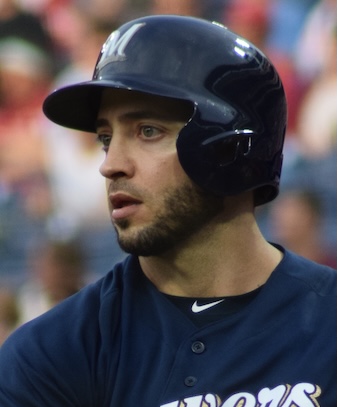
Ryan Braun—Like Álex Rodríguez, Braun got himself caught as a customer of actual or alleged performance-enhancing substances from Biogenesis. Unlike A-Rod, that didn’t provoke Braun to litigiousness. His litigiousness happened earlier, when he tried suing his way out of a suspension when testing caught him using synthetic testosterone. He even accused a sample collector of anti-Semitism.

After serving his Biogenesis suspension, Braun went out of his way to self-rehabilitate. He apologised publicly to the collector he smeared; he revived his charitable activities. But he was also never again the player he was before his PED issues, thanks largely to injuries.

In peak and career value terms, his performance papers fall too far short of Hall-worthiness. In trying to go scorched-earth when caught red-handed (and probably red-faced), placing his entire pre-test/pre-suspension career into question (fairly or unfairly), Braun cheated himself out of a Hall case. No.

Shin-soo Choo—The second Korean position player to make it to the U.S. major leagues (Hee Seop Choi preceded him), Choo was as talented as the day was long and just about as unfortunate. Injury bugs got to him too often. At his best and healthiest, he was as solid a tablesetter as a lineup could have. But it’s not enough to strike a plaque in Cooperstown. No.

Edwin Encarnación—As a Blue Jay in the middle of his fifteen-year career, he was one of the American League’s most feared sluggers. He was also a better baserunner than you might remember. His defensive liabilities probably did the most to keep his peak and career values below the Hall of Fame averages.

But he and Toronto will always have that monstrous three-run homer to send the Jays to an American League division series after Buck Showalter’s brain fart meant Encarnación wouldn’t have to get through the 2016 AL’s best reliever, Zach Britton. No.

Gio Gonzalez—Likeable. Durable. Dependable. And, according to Baseball Reference, the number 309 starting pitcher of all time. One fielding-independent championship isn’t enough to get you to the Hall after a thirteen-year career. Twice leading your league in walks won’t, either. But you kind of had to love this guy.

In the pre-universal DH era, Gonzalez had an all-time freak stat: he struck out more pitchers batting against him than any other pitcher in four decades preceding him. Not a Hall stat, but certainly something to warm the hearts of those who know baseball really is a funny game. No.

Alex Gordon—It would be easy to dismiss him because of his modest batting statistics, but Gordon was one whale of a defensive left fielder. He has eight Gold Gloves and two Platinums, and he didn’t get them as participation trophies, either. He is, in fact, the number three left fielder ever for run prevention.

The only guys ahead of him there? Some dude named Bonds, and some Hall of Famer named Yastrzemski. That’s bloody well elite company he’s keeping there.

I don’t know if that alone will get Gordon into the Hall in due course. But I say “in due course” because I think his case deserves deeper looks and I suspect he’ll last on the ballot for another couple of years at least. Not now.

Cole Hamels—He looked like a Hall of Famer once upon a time. Especially when he helped lead the 2008 Phillies to a World Series triumph with a 1.80 postseason ERA that year, not to mention bagging the Most Valuable Player awards in the National League Championship Series and the World Series.

Talent to burn and perfectionism likewise, seemed to be the cumulative assessment, whether in Philadelphia, Texas, or Chicago. He also dealt with enough injury issues to make it difficult to impossible to build the Hall of Fame case he looked to be beginning in the glory days with the Phillies. But I suspect he might linger on the ballot another year, at least. No.

Matt Kemp—He, too, looked like a Hall of Fame talent when he arrived. The bad news was a) Kemp’s dynamic style was offset by his frequent inabilities to re-adjust when pitchers caught onto his fastball dependency at the plate; and, b) he was a defensive liability as often as not.

He hit with staggering power when he was right, especially his career year 2011. But when measured against the rest of his career overall, that turned out to be kind of a fluke season. Kemp’s real problem might have been being a designated hitter type who played in the wrong league in the pre-universal DH era. No.

Howie Kendrick

Gallows pole: Kendrick’s power hitting helped the 2019 Nationals go all the way to the Promised Land.

Howie Kendrick—Eminently likeable, especially as his career neared its finish and he shone for the 2019 Nationals all the way through the postseason. Especially hitting a pair of ultimately game-winning home runs that paid the bill for every steak he might ever want to have in Washington for the rest of his life. (He also won that year’s NLCS MVP.)

Forgotten amidst those postseason heroics: Kendrick was a very solid second baseman, not quite an intergalactic presense there but in the plus column for run prevention. It won’t be enough to help him into Cooperstown, but when he was right he was a fine player and a terrific clubhouse element. No.

Nick Markakis—He’s one classic example of a terrific baseball player who was as solid as they came without being spectacular. (2,388 hits; 57 total zone runs as a right fielder.) Even as something of an on-base machine and a definite asset in right field, Markakis was the guy you couldn’t bear to replace, even if the rest of the world didn’t necessarily drop what it was doing when he checked in at the plate or ran down a right field fly. Not quite.

Daniel Murphy—A threshing machine at the plate for the pre-World Series 2015 postseason Mets, with those six consecutive games hitting a home run and breaking Hall of Famer Mike Piazza’s team record for total homers in a single postseason. Unfortunately, his Series fielding mishaps negated that hitting prowess on the way to the Mets’ Series loss to the Royals.

Murphy’s 2016 redemption (leading the NL in slugging and OPS) proved a one-off. His career overall was too far short of the Hall of Fame, but that pre-World Series postseason power display in 2015 keeps him a Met hero. No.

Hunter Pence—He got to play for two out of the three San Francisco Series winners in the 2010s. He was charmingly quirky, enough to earn a temporary trend of “ahhh, ya mother rides a vacuum cleaner” banners around the league. (Hunter Pence eats pizza with a fork! Hunter Pence says “Sorry” when he catches a fly! were typical.)

Well, Pence was a good, solid player when he wasn’t injured. That’s important and it counts, and if it’s married to a guy who’s delightfully flaky that’s a big plus. That might even keep him on an extra Hall ballot. Might. Not quite.

Rick Porcello—His 2016 American League Cy Young Award was an outlying season for him—especially since future Hall of Famer Justin Verlander should have won it. Porcello  opened the next season with a 1.40 ERA and 1.74 FIP in his first four games. That season ended with him showing a 4.65 ERA/4.60 FIP.

That was Porcello. Periodic short bursts of greatness, modest longer terms. He was smart on the mound and relied on his defenses. But that’s not always going to make a Hall of Famer, either. No.

First published at Sports Central.

BBWAA Hall ballot: Reviewing the holdovers

Carlos Beltran

Will this be Carlos Beltrán’s year? Or will he have to serve Astrogate penance a bit longer?

The Baseball Writers Association of America’s Hall of Fame ballot for 2026 includes fifteen return engagements. One of them remains a bit troublesome because of something foolish and illegal by baseball’s rules he did in his final season as a player. His voting support has increased since his first turn on the BBWAA ballot. Will all be forgiven this time?

I’ll address the ballot newcomers soon enough. For now, the holdovers . . .

Carlos Beltrán

Before the exposure of the Astro Intelligence Agency’s illegal, off-field-based, electronic sign-stealing operation of 2017-18, Carlos Beltrán figured to have ended his playing career (as the Astros’ 2017 designated hitter) looking forward to accepting a plaque in Cooperstown. That and managing in the major leagues.

The number-nine center fielder of all time (according to Baseball-Reference via Jay Jaffe) who’d been respected as a student of the game and managerial material in the making found himself having to yield the bridge of the Mets (for whom he’d once starred as a player)—before he had the chance even to manage a spring training exhibition.

Though Commissioner Rob Manfred handed all 2017-18 Astro players immunity from discipline in return for spilling AIA deets, Beltrán was the only player Manfred singled out by name in his Astrogate report. It was Beltrán who suggested the Astros needed to “upgrade” from mere replay room reconnaissance, prompting then-bench coach Alex Cora to arrange the long-infamous real-time camera feed to an extra clubhouse monitor for sign deciphering and the long-infamous trash can transmissions.

That was despite Manfred’s September 2017 warning against using replay room reconnaissance and other such off-field chicanery, after the Red Sox (eventually using their own Rogue Sox Replay Room Reconnaissance in 2018 regardless) and the Yankees were caught trying a few tricks from the dugouts.

Beltrán landed the Mets’ managing job twelve days before Ken Rosenthal and Evan Drellich (in The Athletic) dropped the first full Astrogate revelation in November 2019. Within 72 hours of Manfred’s January 2020 report, all three incumbent managers named in the Rosenthal-Drellich exposure—Beltrán, Cora (who managed the 2018 Red Sox to a World Series championship), and the Astros’ A.J. Hinch (who acted feebly at best when catching onto his AIA cheaters)—were out.

Hinch was fired by Astros owner Jim Crane in hand with general manager Jeff Luhnow, but after sitting out his Manfred-imposed season’s suspension and some very contrite interviews, he found new life on the Tigers’ bridge. Cora sat out his Manfred-imposed season’s suspension, gave a few interviews in which he expressed genuine remorse for his Astrogate role, and was brought back to manage the Red Sox.

Beltrán said little about his Astrogate culpability until he returned to baseball as an analyst for the Yankees’ YES cable television network. There, he owned up in an interview with YES colleague Michael Kay:

Looking back now—yes, we did cross the line. I made my statement about what happened in 2017, and I apologized . . . This happened in such an organic way for ourselves. We all did what we did. Looking back today, we were wrong. I wish I would have asked more questions about what we were doing, I wish the organization would have said to us, “What you guys are doing, we need to stop this.” Nobody really said anything—we’re winning.

Seemingly, Beltrán either didn’t know or chose not to know that “the organisation” as headed by Luhnow was in it up to its kishkes, having deployed the Codebreaker sign-stealing algorithim despite its creator’s warning that it was legal to use only before or after games but not during.

Had Astrogate never happened, Beltrán would have been a very likely first-ballot Hall of Famer. He played twenty seasons, and his peak with the Royals, the Astros (the first time, helping them reach a postseason with his second-half term there), the Mets (helping them to the 2006 postseason), and the Cardinals (two postseasons) was All-Star caliber or better. (He was actually a nine-time All-Star.)

He earned 67.6 wins above replacement-level (WAR) from his first full Kansas City season through the second of two with the Cardinals. That was despite missing significant time due to injuries in his final Met seasons. “Had he not missed substantial portions of three seasons, he might well have reached 3,000 hits,” Jay Jaffe (The Cooperstown Casebook) has written, “but even as it is, he put up impressive, Cooperstown-caliber career numbers. Not only is he one of just eight players with 300 home runs and 300 stolen bases, but he also owns the highest stolen base success rate (86.4%) of any player with at least 200 attempts.”

Beltrán is the number seven center fielder all-time for run prevention above his league average with +104. He was rangy, smart on the fielding lanes, and was a top of the line reader of batted balls from his position before Father Time finally began to exact a penalty.

Until Astrogate, of course, Beltrán had only one genuine black mark against him, especially so far as Met fans were concerned: frozen solid by an Adam Wainwright curve ball for strike three called—with the bases loaded, the Mets down two runs, and the pennant on the line in the bottom of the ninth—in Game Seven of the 2006 National League Championship Series.

You know something? It happens. Even to Hall of Famers. Beltrán wasn’t the first superstar to get himself tied up at the last minute of that critical a postseason set, and he won’t be the last. That’s not enough to damage a man’s Hall case. No eleventh-hour shortfall should have been. Not even for Babe Ruth.

You want to continue condemning Beltrán for that? How about The Big Fella getting himself caught stealing on a likely busted run-and-hit play to end the 1926 World Series in the Cardinals’ favour—with Bob Meusel at the plate and Hall of Famer Lou Gehrig on deck?

How about Willie McCovey—with second and third, two out, and the Giants down only 1-0—hitting a howitzer shot speared by Bobby Richardson to end the 1962 Series in the Yankees’ favour instead of sending the tying and maybe winning runs home?

How about Carl Yastrzemski fouling out with two out and the Red Sox down a single run to end the 1975 Series in the Reds’ favour?

How about Mariano Rivera surrendering a Series-losing base hit to Luis Gonzalez in 2001 or—after Dave Roberts stole second off a leadoff walk—an RBI single to Bill Mueller to tie the game at four when the Yankees were only three outs from a 2004 ALCS sweep?

None of those fatalities kept Ruth, McCovey, Yastrzemski, or The Mariano out of Cooperstown when their time eventually came. Getting frozen solid by a great pitch shouldn’t keep Beltrán out, either.

But it’s entirely realistic to suggest that, had Beltrán not gotten himself into the thick of the 21st Century’s worst major league cheating scandal, in his final season as a player, he’d probably be looking at unvarnished, uncontroversial first-ballot Hall of Fame election. Right now, we don’t know how many Hall-voting BBWAA writers will hold it against him enough to make him wait until after his third ballot appearance—or more.

Yes to anyone else?

Andruw Jones

To beat us, you had to go through the Jones boys.—Hall of Famer Chipper Jones on his Braves teammate Andruw Jones.

Andruw Jones—He’s the most run-preventive center fielder who ever played the game. He was a whale of a hitter as a Brave, too; injuries (and the sour attitude that emanated from them) once he left Atlanta turned him into a sadly declining shell of his former self. But those great Braves seasons should have been more than enough to enshrine him long before this. Yes.

Chase Utley—Maybe the most underrated middle infielder of his time. Deserved several Gold Gloves that he didn’t win. Hit with brains as well as skill and handled himself on the bases even more so. He was worth almost twice as many defensive runs as his Philadelphia double play partner Jimmy Rollins. His peak value is above the Hall standard; his career value only slightly below it, but Utley does deserve the honour. Yes.

The Rest of the Holdovers

Bobby Abreu—He’s a lot closer to being a bona fide Hall of Famer than you think or remember. He was a disciplined five-tooler and few of his time were as good as he was for wearing pitchers down. And he was a good, above-average defensive right fielder. But I wouldn’t be surprised if he doesn’t remain on the BBWAA ballot.

If not, a future Contemporary Era Committee just might give Abreu a review. His peak WAR is just too close to the Hall of Fame peak average. Maybe.

Mark Buehrle—He was a good pitcher who touched greatness occasionally; a no-hitter and a perfect game prove that. He used a deft off-speed mix and ground balls to thrive. He was also an excellent fielder. But the traditional and advanced numbers don’t get Buehrle through the gate, and his postseason record doesn’t help him. Neither do four league leaderships in most hits surrendered.

The number 79 starting pitcher overall, and still beloved on Chicago’s South Side, Buehrle still might linger on the ballot awhile. No.

Félix Hernández–King Felix pushed the door open that said a pitcher’s won-lost record was probably the least sensible way to judge his work. His heavy early workload took a toll on him; his questionable conditioning caught up to him his final four seasons.

He was a terrific pitcher for a good while, the best in the American League for five seasons. But it wasn’t enough to make him a peak value case, and losing both his fastball and his deadly changeup hurt too much. No.

Torii Hunter—He was good enough to play nineteen seasons. He was a decent hitter but not as run preventive a center field defender as you might have guessed. (Hunter earned nine Gold Gloves the last eight of which may have been off the rep he established in his one plus-run prevention defensive season.)

He’s also remembered as a good clubhouse guy whom teams almost couldn’t wait to add when he was available. But as employable as he was for nineteen years, he’s short enough of a plaque. No.

Dustin Pedroia—Career killed by injury, taking him out before he could finish solidifying the Hall case he was certainly making before that. P.S. You can also stop blaming Manny Machado for the end; by his own admission, Pedroia was foolish enough to try playing through that one and put paid to his career before it should have happened.

Regardless, he’s still the best second baseman in the history of the Red Sox, even if he’s barely the number 20 of all. Maybe.

Andy Pettitte—Jaffe says it better: Pettitte was a plow horse, not a race horse: [B]ased upon both traditional and advanced metrics, Pettitte would represent a rather weak choice for the Hall of Fame—and I say that as somebody who had a considerable emotional investment in his career as a fan and would like nothing more than to find a rationale for electing him . . . although he’s probably not a fit for Cooperstown, flags fly forever, and he’ll always be fondly remembered in the BronxNo.

Manny Ramirez—Pettitte’s hGH dalliance (to recover from an elbow injury) happened during the so-called Wild West Era, when the game and the world looked the other way. (So did the reputed indulgences of Barry Bonds and Roger Clemens.) Manny Being Manny included two failed tests for actual/alleged performance-enhancing substances after baseball started testing in earnest.

How foolish could you get? Not even at gunpoint or under presidential threat, whichever comes first.

Álex Rodríguez—Dubious as MLB’s handling of Biogenesis probably was, that didn’t mitigate A-Rod’s using their wares or threats to sue baseball to death to escape punishment, until he was slapped with that massive suspension. He’s rehabilitated his public image to a certain extent since, but I’m not convinced that’s enough to clear his way to Cooperstown yet. P.S. His ranking as a shortstop is almost entirely in his bat; Ozzie Smith he wasn’t. No.

Francisco Rodríguez—From his embryonic supersplash in the 2002 postseason through the rest of his Angels years, K-Rod looked like the very essence of a Hall of Fame reliever who wasn’t named Mariano Rivera, and it wasn’t just his saves count, either.

After he left the Angels, his career was stained when he became involved in a couple of unsavoury domestic violence incidents, one of which (as a Met) injured his thumb when he punched his girlfriend’s father repeatedly, and another (as a Brewer) in which he attacked his then-fiancée. (Case dismissed when she and a household staff member who saw the incident returned to Venezuela, according to numerous reports.)

After his major league life faded, he tried coming back via the independent and Mexican leagues before calling it a career. It’s a question of whether his domestic violence issues will block him, the way they may keep blocking Omar Vizquel. (Andruw Jones pleaded guilty without fuss, paid a hefty fine, and no other such incident seems known of him.) For me, being multiple, they do. No.

Jimmy Rollins—The goods: solid shortstop defense and speed on the bases. The bads: a 95 OPS+; a .330 on-base percentage that isn’t quite what you should find in a Hall of Fame leadoff hitter; and, his basepath larceny didn’t make him a Lou Brock Hall of Fame lookalike. Not to mention that his +38 defensive runs at shortstop are 53rd all-time.

You loved watching him play in his prime even if he was trying to beat you, though, and he was one of those trash talkers who made you laugh instead of scream. But still. Not quite.

Omar Vizquel–He may have been the outstanding defense-first shortstop of the 1990s, but 1) his highlight reels in the advent of widespread cable television masked that he wasn’t quite as good defensively as Cal Ripken, Jr., never mind Ozzie Smith; and, 2) splendid as his defense was, Vizquel still shakes out as the number 42 shortstop ever.

That’s not a Hall of Famer, and that’s not counting subsequent issues of domestic violence and sexual harassment that may keep him unemployed in the game. No.

David Wright—He’s the Mets’s version of Don Mattingly and Dale Murphy: A character-to-burn guy whose Hall of Fame case was snuffed by injuries. He was the heart and soul of the Mets before the injuries began blocking him, but they’ll never forget that 2015 World Series home run that surely qualifies as the biggest blast of his past.

Yes, Wright deserved better. His uniform number retirement should amplify that. No, with regret.

Some portions of this essay—first published by Sports Central—have been published previously.

On the BBWAA’s newly-minted Relief Pitcher of the Year Awards

Hoyt Wilhelm

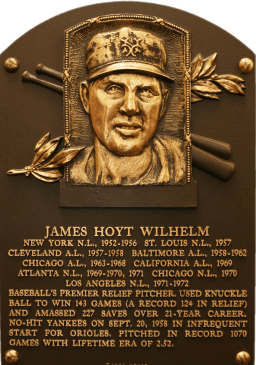
What’s this bland “Relief Pitcher of the Year” stuff? How about the BBWAA name their new (and overdue) reliever awards for Hall of Famers Billy Wagner (National League) and Hoyt Wilhelm (American League; yeah, I know he’s shown with a New York Giants hat, but he did pitch most of his career in the AL by a hair . . . )

Well. The Baseball Writers Association of America has decided that relief pitchers need a BBWAA award of their own. They’re calling it the Relief Pitcher of the Year Award. Maybe this is the one to which people will pay attention. Maybe not.

The name is about as inspired as when the BBWAA changed the name of the J.G. Taylor Spink Award for Hall of Fame baseball writers to the Career Excellence Award. At least MLB, which already awarded an annual prize to the men of the pen, named their awards for a pair of Hall of Fame relief pitchers, Trevor Hoffman (National League) and Mariano Rivera (American League).

Except that nobody pays real attention to the Hoffman and Rivera Awards, noted Jayson Stark (Hall of Fame writer), who’s been agitating for the Relief Pitcher of the Year Award for a very long time.

But Stark also noted that, well, nobody quite knew how to evaluate relief pitchers reasonably. “And why does that matter?” he asks, then answers:

Because if you look at Hall of Fame voting over the past couple of decades, it couldn’t be more obvious that voters can’t figure out how they’re supposed to go about determining what constitutes a dominant, Hall of Fame reliever.

We elected Rivera and Hoffman. We just elected Billy Wagner, but it took us 10 years to do that. So clearly, the voters need help. And the current awards aren’t providing any of that help because this trend is only getting worse.

This much we do know; or, at least, ought to know: the save statistic is close enough to useless. When writing Smart Baseball, Keith Law singled the save out for a chapter of its own to demonstrate it was nothing more than “[Jerome] Holtzman’s Folly,” named for the Chicago sportswriter who invented it in the first place. It was a classic case of the best intention yielding the worst result.*

“If anyone tried to introduce a statistic like the save today,” Law wrote, “he’d be laughed all the way to a cornfield in Iowa.”

The stat is an unholy mess of arbitrary conditions, and doesn’t actually measure anything, let alone what Holtzman seemed to think it measured. Yet the introduction of this statistic led to wholesale changes in how managers handle the final innings of close games and in how general managers build their rosters, all to the detriment of the sport on the field, and perhaps to pitcher health, as well.

Not to mention the health of common sense, what remains of it.

You think arguments involving Cy Young Awards to pitchers who “win” the most games instead of pitchers who were really the best pitchers in their leagues were somewhere between the ridiculous and the absurd? (Anyone who tells me Bartolo Colon deserved the 2005 American League Cy Young Award over Johan Santana had better come with stronger ammunition than Colon’s 21 “wins.” Colon’s fielding-independent pitching rate [FIP] of 3.75 and his ERA of 3.48 weren’t Santana’s major league-leading 2.80 FIP or his 2.87 ERA. There was also the little matter of Santana leading the Show with 238 strikeouts and the AL with an 0.97 walks/hits per inning pitched [WHIP] rate. Case closed.)

How about arguments over relief pitchers with a duffel bag full of “saves” versus the relief pitchers who actually pitched better? Remember Joe Borowski? As a Cleveland Indian in 2007, Borowski led the American League in “saves” with 45 . . . but his FIP was 4.12 and his ERA, 5.07. And that’s before you see where the guys at the plate hit .289 againat him. If that didn’t kill the save, Craig Kimbrel in the 2018 postseason should have.

Kimbrel pitched 10.2 innings and was 6-for-6 in save opportunities. Sounds like the future Hall of Famer he’s still seen to be by some, right? Now, look deeper: Cardiac Craig allowed nineteen baserunners, posted a 5.90 ERA, and a 5.07 FIP . . . and the World Series-winning Red Sox probably felt that was tantamount to the guy who threw the man overboard an anchor and then dove in to pull him out of the water.

Zach Britton

Zach Britton. Toronto still blesses then-Orioles skipper Buck Showalter for managing to the save stat instead of what was right in front of him in the 2016 AL wild card game, and leaving Britton—the 2016 season’s best relief pitcher—in the bullpen . . .

And I haven’t even mentioned the managers who take the nebulous save stat as such gospel they manage to it instead of to the game situation in front of them. The no — “save” situation kept Buck Showalter from even thinking about Zach Britton, baseball’s unarguable best relief pitcher in 2016, with two on and Edwin Encarnacion checking in at the plate in the bottom of the AL wild card game 11th in Toronto. Blue Jays fans still bless the name of Showalter when they remember the monstrous 3-run homer Encarnacion hit to send the Jays to the division series.

Based on what little has been revealed so far otherwise, my guess is that the voting writers will take anything but “saves” into consideration. As they should. If they were to ask me, I’d say it should be some sort of points combination based upon FIP, the batting averages against, their leverage situation pitching, their strikeout-to-walk ratios, and their WHIPs.

Let them have at it post haste.

Because the next time I hear someone tell me Chipper Flippersnapper was the best reliever in baseball because he got all those “saves” even if his ERA/FIP combination was higher than the moon, the batting average against him resembled Ralph Kramden’s weight, and he worked as though he’d learned leverage pitching at the Craig Kimbrel School of Anchor-Throwing, I’m going to throw an anchor or three. And a few other things.

(Maybe I’ll just throw two words out: Mike Williams. 2003: Williams, lifetime 4.49 FIP, named an All-Star because the rules said the woebegone Pirates needed one and he had 25 saves at the break. But he also walked three more than he struck out and carried a 6.44 ERA. One week later: ERA down to a mere 6.27; FIP down to a measly 5.55; the Pirates traded him to the Phillies for a rosin bag and Williams’s career ended after that season. )

And for God’s sake give the new BBWAA awards worthy names. How about the Billy Wagner Award for the National League? How about the Hoyt Wilhelm or Rollie Fingers Award for the American League? Relief Pitcher of the Year? That’s about as inspiring or spirited as a tub of chicken fat.

—————————————————————————————————–

* Historical revision: Longtime Pirates relief ace Elroy Face still inspires oohs-and-aaahs over his 1959, when he “won” eighteen games and “lost” only one. The aforementioned Jerome Holtzman dreamed up a save stat in the first place because of Face.

“Everybody thought he was great,” said Holtzman in 1992. “But when a relief pitcher gets a win, that’s not good, unless he came into a tie game. Face would come into the eighth inning and give up the tying run. Then Pittsburgh would come back to win in the ninth.”

According to Anthony Castrovince in A Fan’s Guide to Baseball Analytics, Holtzman “knew the dirty truth about Face: He had allowed the tying or go-ahead run in 10 of his 18 victories. In five of his eventual ‘wins,’ he had entered the game with a lead and left without one.”

It almost seems a tossup between which nebulous statistic is worse: the pitcher “win,” or the relief pitcher save. God bless all 97 years old of him still living, but Elroy Face’s 1959 is evidence on behalf of both.

—————————————————————————————————

First published in a slightly different version at Sports Central.

2023 BBWAA HOF Ballot: Three return with cases and controversies

Manny Ramírez

“A savant in the batter’s box . . . an idiot everywhere else.”—Jay Jaffe, on Manny Ramírez.

But wait . . . there’s more! Namely, the rest of the Baseball Writers Association of America Hall of Fame ballot, the candidates returning for another go-round. They’re not going to Cooperstown. Three in particular have actual Hall cases but aren’t likely to go this time, and maybe not for a few more times—if at all—before their BBWAA ballot eligibility expires.

Two were murderers at the plate. One was a shortstop acrobat. Two were considered head cases while they played; the acrobat’s days since his career ended have fallen into deep enough disrepute. The murderers at the plate are Manny Ramírez (LF) and Gary Sheffield (RF); the acrobat at shortstop is Omar Vizquel.

There are ten left fielders, eleven right fielders, and ten shortstops in the Hall of Fame who played their careers all or mostly in the post-World War II/post-integration/night-ball era. The following table shows Ramírez, Sheffield, and Vizquel according to my Real Batting Average (RBA) metric—total bases + walks + intentional walks + sacrifice flies + hit by pitches, divided by total plate appearances. The parenthetic numbers next to their names indicate their positioning among those Hall of Famers at their positions, if they do become Hall of Famers themselves:

Player PA TB BB IBB SF HBP RBA
Manny Ramírez (LF; 2) 9774 4826 1329 216 90 109 .672
Gary Sheffield (RF; 6) 10947 4737 1475 130 111 135 .602
Omar Vizquel (SS; 9) 12013 3727 1028 25 94 49 .409

Manny Being Manny

Manny Ramírez’s Hall of Fame case is entirely in his bat. He’s got the numbers at the plate for enshrinement. No questions asked. He also has the attitude history (Manny Being Manny) and issues that made him as big a pain in the butt to his own teams as he was to opposing pitchers.

First, we’ll address his defense. It all but didn’t exist. Ramírez wasn’t just below his league average for the traditional fielding percentage and range factors, his career finished with him being worth -109 defensive runs below his league average. He should have been a designated hitter. (And, was—for a mere fourteen percent of his 2,302 lifetime games.)

The best side of Ramírez was that, in Cleveland and Boston especially, he was known for a tremendous work ethic. He all but included that in his thinking when he said, so memorably, after winning the 2004 World Series MVP as those Red Sox swept the Cardinals to break the actual/alleged curse, “I don’t believe in curse, I believe you make your own destiny.”

That was the blessing. And, the big problem. Because Ramírez made his own destiny, all right, perhaps encapsulated best by The Cooperstown Casebook author Jay Jaffe: “A savant in the batter’s box, Manny Ramírez could be an idiot just about everywhere else—sometimes amusingly, sometimes much less so.”

Any amusement factor in Manny Being Manny died long before his playing career finally did. You can hark back to all the times he seemed to want out of Boston, and the time the Red Sox put him on irrevocable waivers after the 2003 season only to find no takers—even knowing a claiming team would have to surrender no talent in return.

The Yankees could have had afforded the remaining five years/$104 million on his contract, Jaffe noted; they reached for Gary Sheffield, instead, and Sheffield was seen as his own kind of head case. The Angels could have had afforded him, too; they reached, instead, for Hall of Famer Vladimir Guerrero, who became an Anaheim fan favourite his entire time there.

As Jaffe reminds us:

There was the time in 1997 that [Ramírez] “stole” first base, returning to the bag after a successful steal of second because he thought [Hall of Famer] Jim Thome had fouled off a pitch . . . the time in 2004 that he inexplicably cut off center fielder Johnny Damon’s relay throw from about thirty feet away, leading to an inside-the-park home run . . . the time in 2005 when he disappeared mid-inning to relieve himself inside Fenway Park’s Green Monster… the time in 2008 that he high-fived a fan mid-play between catching a fly ball and doubling a runner off first . . . and so much more.

. . . But there was also a darker side, one that, particularly after he left the Indians, went beyond the litany of late arrivals to spring training, questionable absences due to injury (particularly for the All-Star Game), and near-annual trade requests. Most notably, there was his shoving match with 64-year-old Red Sox traveling secretary Jack McCormick in 2008, which prefigured Ramirez’s trade to the Dodgers that summer, and a charge of misdemeanor domestic violence/battery in 2011 after his wife told an emergency operator that her husband had slapped her face, causing her to hit her head against the headboard of the bed. (That domestic violence charge was later dropped after his wife refused to testify.) Interspersed with those two incidents were a pair of suspensions for performance-enhancing drug use, the second of which ran him out of the majors.

Those suspensions for actual or alleged performance-enhancing substances were handed down to him after the so-called Wild West Era during which the rules were that there were no rules. They may also have handed down the final portion of his blockage from the Hall of Fame in the end.

But if you were to establish a Hall of Their Own Worst Enemies, Ramírez would likely be first ballot, unanimous. More’s the pity.

Sheffield of Dreams

Gary Sheffield

Gary Sheffield, a study in destruction at the plate whose defense undermines his Hall of Fame case drastically.

Strictly by his counting statistics, Gary Sheffield has a Hall of Fame case. His talent was as outsized as his reputation for self-centricity. He was a study in pending destruction at the plate and he had a concurrent one-for-one-and-all-for-Gary reputation. He also found himself mistrustful of team management after his first team, the Brewers, absolutely mishandled him starting with an injury first mis-detected.

Sheffield also had a very strange problem for a guy whose career came largely in a high-offense era and who could invoke terror with one swing: he played too much in home parks that didn’t really favour righthanded hitters. (His time in Dodger Stadium was an exception; he hit very well there.) That plus the nagging injuries he battled for much of his career land Sheffield in a strange position.

For all his home runs (509), for all that he sits in the top 25 for walks and runs created, his offensive winning percentage (.687) puts him just inside the top one hundred. A player that talented with his kind of stats should have pulled up a lot higher. Especially since he was far enough more difficult to strike out than to walk—lifetime, Sheffield walked exactly 300 times more than he struck out.

If you look at him according to wins above replacement-level player (WAR), Sheffield’s defensive deficiences slaughter him, fat worse than Ramírez’s do him. Sheffield had a fine throwing arm but his -195 fielding runs below league average left him the second lowest of all time. It’s the reason why his peak and career WAR are well below the Hall of Fame standard for right fielders.

In some ways Sheffield was a wronged man. When the Brewers sent him down early in his career after accusing him of faking an injury, he wanted out and badly. He tended to nuke more than burn bridges when he felt he was done wrong. He was also accused falsely of tanking plays with the Brewers after a hard wild throw in the minors caused a rift with a manager who subsequently apologised to him.

He got dinged by the BALCO case when it turned out he really might have been tricked into using an actual or alleged performance-enhancing substance. It’s also important to know that that occurred before baseball finally faced the issue and implemented testings and penalties, and Sheffield didn’t exactly make it his life’s indulgence.

Even the hardest-line writers against actual or alleged PEDs inclined to give Sheffield the benefit of the doubt, including and especially Tom Verducci of Sports Illustrated, a man not known to suffer actual or alleged PEDs and their users gladly:

Sheffield is the only star I know who, as an active player, without provocation admitted to using steroids; he did so in a 2004 SI story I wrote. Why would he make an admission? Because, he told me, he had testified under oath that he had been duped into using them.

Sheffield said he told the BALCO grand jury the previous year that [Barry] Bonds arranged for him to use “the cream,” “the clear” and “red beans,” which prosecutors identified as steroid pills from Mexico. Sheffield, however, said he was told the substances were legal arthritic balms or nutritional supplements . . . When he later learned that the BALCO products were steroids, he told me, “I was mad. I want everybody to be on an even playing field.”

That’s it; we have no evidence that ties Sheffield to steroids other than those several weeks before the 2002 season when Sheffield lived at Bonds’s home. Even during that 2002 season, when players were resisting the idea of steroid testing, Sheffield spoke out in favor of it [see here], saying, “I would like to see testing. I mean you see how much guys are using it. Unless you’ve got something to hide, you won’t mind testing, right?”

There are far more prickly men in the Hall of Fame than him. There are Hall of Famers who were their own worst enemies to a far greater extent. There are such players (see Ramírez, Manny, for one) who have been and will be kept out of Cooperstown. Sheffield may end up having to wait for the Contemporary Baseball Era Committee to send him there, but he wasn’t just a study in likely destruction at the plate. His terrible fielding undermines it far more, but he has a genuine Hall of Fame case.

If he makes it at last, Sheffield probably won’t be one hundredth as controversial a Hall of Famer as Harold Baines is (for his record, not his person) and Curt Schilling may yet become. (For his person, not his record, which is now before that Contemporary Era Committee.)

The Rubaiyat of Omar Vizquel

Omar Vizquel

Omar Vizquel, a Hall-worthy candidate as a defensive shortstop, but whose domestic abuse and sexual harassment issues may block his entry.

Even if I believe the Hall of Fame should pay a lot more attention to run prevention, and I do, I’m not settled firmly on either side of yes or no regarding Vizquel. But that’s taken strictly on field terms. The in-depth revelation of domestic violence accusations, plus subsequent sexual harassment accusations while he managed in the White Sox system, affected his Hall vote last year, may yet obstruct his path entirely, and leaves me with a taste in my mouth that’s comparable to a castor oil martini.

I once sketched a rather elaborate take on why you should vote for Vizquel if you’re going to vote for him. It hooked mostly around the impression a) that he wasn’t as close to being the second coming of Ozzie Smith as people remember him being, though he looked that way; but, b) that he was the outstanding defensive shortstop of the 1990s. If you’re talking about players whose major or sole selling point is defense and enough of it, and have the highlight reels to back them up, Vizquel in the ’90s certainly looks like The One.

His acrobatics happened often enough to convince lots of Gold Glove voters in those years. But the bad news is that Hall of Famer Cal Ripken, Jr. was better with the glove in that decade . . . and he didn’t play the position past 1996 except for three games in 1998. Even playing less of that decade than Vizquel played at shortstop, Ripken was worth a lot more defensive runs above the league average.

Ripken wasn’t quite the acrobat Vizquel often was, but Ripken did the job in the field very well above league average. Vizquel was worth +128 fielding runs lifetime; Ripken was worth that just from 1990-96. If you want to put a defense-first lineup out there, take the shortstop worth +181 lifetime fielding runs (third in history behind Mark Belanger and Ozzie Smith) over the one worth +128.

Now think of the two-way lineup, the lineup full of men who’d be Hall of Famers on both sides of the ball. Who are you really going to choose at shortstop—the guy with the 112 OPS+ (Ripken) or the guy with the 82 OPS+ (Vizquel)?

Vizquel turned up a few hits shy of 3,000 in 22 seasons. (He also walked only 58 fewer times than he struck out.) But it isn’t just milestones or totals that make a Hall of Famer. His real other apparent selling point is his longevity, and I’ve bumped into only too many people around the baseball forums who want to put him in on the Harold Baines factor: that the Hall of Fame won’t be soiled if it’s the Hall of the Gold Watch.

Well, yes it will. And, yes it is. That argument doesn’t fly. Just because one Era Committee was foolish enough to elect Baines it doesn’t mean he should be any sort of Hall of Fame standard. It’s rare enough for a player to get two decades in the big leagues, of course, but by itself that isn’t and shouldn’t be enough for the Hall of Fame.

The Hall of Fame is supposed to be about greatness, not time in service, other than the ten-season minimum for eligibility. Greatness, not mere acrobatics. (Anyone who thinks Brooks Robinson or Ozzie Smith got to Cooperstown merely by being acrobats on the left side of the infield doesn’t know their actual run-prevention records.) Greatness, not merely showing up for work every day. (Once and for all: there was a lot more to Cal Ripken, Jr. than just breaking Lou Gehrig’s consecutive games streak.)

Vizquel shakes out as the number 42 shortstop of all-time. Ripken, in case you wondered, shakes out as number three. Álex Rodríguez shakes out as number two, but he’s there strictly because of his hitting—he wasn’t anywhere near Vizquel or Ripken defensively. (A-Rod, of course, has his own controversies shadowing his Hall candidacy.)

You don’t have to compare Vizquel to Ripken exclusively to try making his Hall of Fame case. I’m not entirely convinced that being just inside the top fifty by eight equals a Hall of Famer, either. Just off that alone, I could be persuaded one way or another. But his  domestic violence/sexual harassment issues (before you think about feeling terrible for him, you should feel more terrible for his victims) make his Hall entry less likely than they might have been before those came to sad light.

————————————————————-

Some of the foregoing has been published previously.

2023 BBWAA Hall ballot: The ballad of Billy the Kid, plus two

Today we look at three Hall of Fame candidates returning on the Baseball Writers Association of America ballot, all three of whom have real Hall of Fame cases.* We’ll begin with the relief pitcher who has a bona-fide Hall case even if you thought it only snuck up upon you.

Billy Wagner

Billy Wagner—he was way better out of the bullpen than a lot of people might remember . . . enough to earn him a spot in the Hall of Fame.

The Ballad of Billy the Kid

Billy Wagner—Maybe the most underrated relief pitcher of his and just about any time. He was as lights out as relief pitchers got and then some, even allowing that nobody yet has really figured out a final objective and definitive way to rate relief pitchers of any era.

Wagner yanked himself to a pinnacle following a childhood about which “hard scrabble” might be an understatement. (Too-frequent home changes; poverty so profound that peanut butter on a cracker equaled dinner often enough.) He was a small man who made himself into a lefthanded assassin. (Two right arm fractures during his impoverished childhood compelled him to go portside.)

Billy the Kid finished his fifteen-year career with a 0.99 walks/hits per inning pitched rate; and, when it comes to win probability added, Wagner has only five relievers ahead of him, Hall of Famers all: in ascending order, Trevor Hoffman, Goose Gossage, Hoyt Wilhelm, Dennis Eckersley, and The Mariano. He was also on his own planet when it came to missing bats. In fifteen full major league seasons (he had a cup of coffee with the 1995 Astros), his strikeouts-per-nine innings rate fell below 10.0 only once; he retired with a lifetime 11.9 rate.

Nobody could hit this guy too often: the lifetime batting average against him is .187. Here’s how the hitters did against the other Hall of Fame relievers:

Lee Smith—.235.
Rollie Fingers—.232.
Bruce Sutter—.230.
Goose Gossage—.228.
Dennis Eckersley—.225.
Hoyt Wilhelm—.213.
Trevor Hoffman—.211.
Mariano Rivera—.211.

Would you like to be reminded whom among those men pitched in the most hitter-friendly times? That would be Smith (in the final third of his career), Hoffman, The Mariano, and Billy the Kid. It’s to wonder how much more stupefying the record might be if Wagner could have avoided assorted injuries including late-career Tommy John surgery.

Maybe his only flaw was a Sheffield-like tendency to nuke bridges once he left town, though for far different reasons. Wagner waged war against those he thought didn’t share his competitiveness and determination. But he finally admitted in his memoir, A Way Out, “I learned a lot about criticism and how not to be a leader when I was traded.”

When he walked away after 2010, he decided his family was a lot more important to him than whatever else he could accomplish as a pitcher. “There’s nothing left for me to do in baseball,” Wagner admitted after leaving the park one last time. “I’m not going to change anyone’s mind about whether I’m a Hall of Famer. People are either going to like me or hate me, and I can’t change their minds. Besides, life is about a lot more than this game.”

If you must, call Wagner the Bert Blyleven of relief pitchers, with a Hall case that kinda sorta sneaks up on you upon deeper analysis. But he does deserve the honour.

Last Time Around

Jeff Kent—Yes, Kent is the best-hitting second baseman of the expansion era so far. But despite his late settling-in (traded three times before he found a home with the Giants at 29), Kent was also product enough of a high-scoring era. For middle infielders, defense looms large enough, and Kent wasn’t a particularly great-fielding second baseman despite his deftness on the double play: -42 defensive runs below league average doesn’t bode well.

He was his own worst enemy with a personality often described as “prickly,” and he was caught in a few dubious incidents. The ones remembered most: 1) The notorious lie about falling while washing his truck, which turned out to be him trying to pop wheelies on his motorcycle; and, 2) the accusation that mercurial Milton Bradley dogged it on the bases as Kent swatted a double, before it came forth Bradley played through a balky knee—that turned into season-ending surgery after a hard slide into base.

A lot of Kent’s issues also came down to his own health. He incurred enough injuries later in his career that, married to his early-career mishandlings before reaching San Francisco, plus his below-average run prevention at second base, it puts him just outside the top twenty second basemen of all time. Still, his 351 home runs as a second baseman are the most for anyone playing that position. He has a fine postseason record overall, too.

The question becomes whether Kent’s once-notorious attitude problems remain enough to keep the writers from putting him in no matter the ballot crowd, and this time the lone big controversy is liable to be around Carlos Beltrán’s candidacy. Though Kent accommodated the baseball press during his playing days, he turned out to be one of those players who fit the longtime cliche about learning to say hello when it was time to say goodbye.

“I’ve learned to love and appreciate the fans, and I’ve learned to love and appreciate the Jeff Kent haters out there, too,” he said at a rather emotional retirement announcement.

I’m thankful for those people even more than the fans who gave me a hug every day, because those people motivate you . . . I leave this game proud that I have treated it with the utmost respect . . . I have tried to carry on a legacy of winning wherever I have gone. Any integrity that I have had in this game is something that I’m very, very proud of. I believe I played this game right, and I believe I’m leaving this game right.

I wasn’t exactly Kent’s biggest admirer myself for long enough, but he does deserve Hall election. If he doesn’t survive on this final BBWAA ballot, a future Contemporary Baseball Era Committee may give him a second and deeper look and elect him. May.

The Toddfather 

Todd Helton—Unlike Hall of Famer Larry Walker, the Toddfather never got the chance to show what he could do with a park other than Coors Field as his home park. Even with the width of his home/road splits, though, Helton hit respectably enough on the road that you’d have a hard time convincing anyone that he wasn’t as Hall of Fame as a first baseman gets.

Helton also crosses the average Hall of Famer’s batting threshold according to Bill James’s Monitor and Standards measures, and his peak value is a few points above the average Hall of Fame first baseman. He was a rare bird who walked more than he struck out, was an on-base machine (.414. lifetime on-base percentage), and he was actually deadlier at the plate with men in scoring position than he was with the bases empty.

His Hall case rests upon that peak value. At the plate, his 1998-2005 peak shows a 149 OPS+ and a .435 on-base percentage. His Real Batting Average (RBA) for that peak is a whopping .696. If you want to compare Helton to another Hall of Famer with a home/road split about as wide as his, be advised that Jim Rice’s peak RBA is .583.

He wasn’t the second coming of Keith Hernandez at first base, but he was a well above-average defender. But wait a minute: Maybe Helton wasn’t the obvious infield general Hernandez was—and believe me when I tell you Hernandez deserves a plaque in Cooperstown, too—but Helton was worth +107 defensive runs above his league average . . . second only to Hernandez (+120) himself.

Helton’s decline phase was accelerated by back and hip issues, but he was respected enough in the Rockies organisation to become the first player whose uniform number (17) was retired by the team. (Neat, that: Keith Hernandez also wore 17, with the Mets, who retired that number in his honour in 2022.)

“The mentality, the character, the work ethic of this team,” his one-time manager Jim Tracy once said of him, while he missed two months with an injury in a season, “it’s easy to have all that when the best player in the history of the franchise is the hardest worker on the team. It’s absolutely tearing him to pieces not to be involved with us, to not be the player we’ve known him to be.”

Helton’s complete package sounds like a Hall of Famer to me.

————————————————————-

* Some of the foregoing has been published previously.