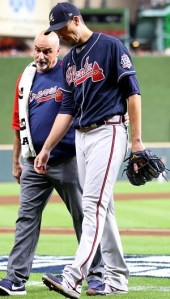
WS Game Five: Winning in a walk

Martin Maldonado

Maldonado, you’re no longer the weakest link. For now.

The good news is, the Braves can win in Houston. They proved it in Game Two. The bad news is, they’ll need to win there to win the World Series now.

The Astros didn’t let a little thing like a four-run hole after a single Game Five inning on a single swing drive them into an early season’s grave Sunday night.

Not with manager Dusty Baker flipping his lineup a little bit. Not with proving there are times a bases-loaded walk and a well-timed single in the middle of a game are more powerful than a grand slam out of the gates.

Not with the Astros’ heretofore, mostly dormant longtime core finding their bats. And, not with the Braves’ heretofore impenetrable bullpen proving they’re only human, after all, while their own usually tenacious bats mostly went askew following their early slicing, slashing, and thundering.

Their early, incendiary Game Five lead turned into a 9-5 loss to the Astros—but doesn’t have them up against the wall just yet.

“When we won [Game Four], it made it easier, I guess, coming into this one — but we knew it was going to be tough,” said Braves manager Brian Snitker postgame. “That’s just a lot of innings to cover (by relievers) against a club like this that swings a bat so well. The good news is we’ll take a day off and be in good shape.”

Meaning, including and especially, a rested bullpen as well as a re-grouping lineup. But it’s the opposite now of where they stood after Game Five of the National League Championship Series, after the Dodgers flattened them 11-2 in Los Angeles and despite still holding a 3-2 lead in the set.

Then, the Braves’ longtime first baseman and leader Freddie Freeman said they were still in good shape, they still led the set, and they liked their chances going back home to Atlanta. Now, Snitker’s putting the Brave face on and saying, “I’ll take it anywhere. If we win the World Series, it doesn’t matter where it is.”

Two years ago the Nationals proved that in abundance against the Astros. The Braves won’t be winning all needed Series games on the road, but with their Series lead now they need to win only once. It sounds simple when you say it. It’ll be anything but simple when they play it starting Tuesday night.

You can’t get any more profound a reminder of how tough a World Series can be than the Braves got when they only thought they had the Astros buried alive in the bottom of the first Sunday night.

They loaded the bases on Astros starter Framber Valdez with a leadoff base hit by Jorge Soler, a two-out single by Austin Riley, and a 3-1 walk to Eddie Rosario. Then Adam Duvall couldn’t wait to drive Valdez’s first service to him into the seats above the right field wall.

Hindsight’s almost as wonderful as foresight. Snitker has both in abundance. This time, though, hindsight was his BFF. “I’d rather we scored those runs in the seventh inning when you don’t have so much time to cover,” the manager said postgame. “We knew we had a long, long way to go in that game and anything could happen.”

Anything did happen, right away.

Heretofore slumber bat Alex Bregman hit with first and second and one out in the second and lined Braves opener Tucker Davidson’s the other way, all the way to the right center field wall, scoring Yuli Gurriel (one-out, one-hop single to center). Heretofore macaroni bat Martin Maldonado sent Kyle Tucker (full-count walk) home with a sacrifice fly cutting the Braves’ lead in half.

The Astros might have gotten one more run home but for the next batter—Valdez himself. Two swinging strikes around a ball in the dirt, then looking frozen at strike three on the inside forner after a ball just low. You still don’t want the designated hitter in the National League’s parks, old farts? Imagine if the Astros didn’t have to bat Valdez there. They might only have had a one-run deficit to end the frame.

No matter. Their unraveling of the Braves began the very next inning, when Dansby Swanson at shortstop misplayed Jose Altuve’s leadoff hopper, bumping the ball from his glove, recovering too late to throw the swift Mighty Mouse out at first. The rest of the Series will prove whether or not that’ll be this postseason’s most egregious Braves mistake of all.

Davidson walked Michael Brantley on a 3-1 count and Carlos Correa—another of the formerly dormant-at-the-plate Astro core—doubled Altuve home. A fly out later, Brantley scored on Gurriel’s ground out to short. Tie game. The tie lasted long enough for Freeman to lead the bottom of the third off with a mammoth full-count, tiebreaking blast half way up the right center field seats.

The 5-4 Braves lead lasted until the bases loaded and two out in the top of the fifth. Checking in at the plate: Maldonado, the Astros catcher still vying for the title of the single most automatic Astro out, after the Braves ordered Bregman walked on the house to load the pads in the first place.

What came next may yet prove one of the ten most powerful walks of all time. Maldonado looked at ball four inside from Braves relief star AJ Minter, sending Correa (leadoff one-hop base hit to center) strolling home with the re-tying run. Martin, you’re no longer the weakest link. For now.

Not only did Maldonado get daring enough to stand right on top of the plate during the entire plate appearance, the better to get an edge against Minter’s cutter, he even showed bunt as ball four sailed in. He didn’t do it for a laugh, either.

“He came back to the dugout yelling at me, ‘You like my Little League bunt?'” said Astros hitting coach Alex Cintron postgame. “He was prepared before he stepped up to the plate. He was ready for that at-bat. That made the difference.”

“I thought of it in the moment,” said a grinning Maldonado. “I wasn’t going to swing until 3-2. Maybe it would throw him off.”

Then Baker sent Marwin Gonzalez—returned to the Astros after a detour through Minnesota and Boston when the Red Sox released him in August—out to pinch hit for Jose Urquidy, whose shutout fourth set him up to get the Game Five “win.” Gonzalez dumped a floating quail into left center that hit the grass with room enough to send Gurriel and Bregman home with a 7-5 Astro lead.

Maldonado lined Tucker home with a base hit off another Braves pen man, Drew Smyly, in the seventh, and Correa—perhaps sensing Smyly was really taking one for the team now—singled Altuve home with the ninth and last run in the eighth.

Baker made a few pre-game moves to shake his lineup a bit, particularly moving the previously slumping Bregman down to bat seventh. The third baseman’s struggles at the plate this postseason became that alarming—to the manager and to Bregman himself.

“I’ve got a really weak top hand right now,” he said. “I’m releasing the bat behind me, which is causing a ton of problems.” He spent pre-game batting practise all but forcing himself into a two-handed swing finish. It helped when he knocked that second-inning RBI double. It damn near helped him hit one out his next time up.

“The second at-bat, I just missed what would have been a three-run homer, just barely missed under it,” Bregman said. “I’ve got to fix a weak top hand. Normally I hold (the bat) tight and squeeze it, kind of. I’m not able to do that right now.” Missing more than two months of the regular season didn’t exactly do him many favours, either.

For Minter’s part, he credited the Astros with finding their swings when they looked pinned otherwise. “I felt my stuff was just as sharp tonight as it was in other outings,” the lefthander said postgame, denying any fatigue factor from his previous prominent presence. “I felt like I was 1-2, 0-2 on every hitter. Those guys made quality swings on two strikes.

“I guess I could have made some better pitches with two strikes,” he continued, “but with Correa, I got him 0-2, left a cutter up, base hit. Got a good strikeout against Alvarez. And then Gurriel — cutter, backdoor cutter. He stuck his bat out there and had a good hit as well.”

Minter and the Braves now have down time enough to regroup and refresh. They still have the Series lead, even if the Astros and their fans might prefer to think the Braves have the Astros right where the Astros want the Braves.

The better news is, at least we’re rid of that infernal, obnoxious, demeaning Tomahawk Chop for the rest of the calendar year and—barring unforeseen wisdom from baseball’s governors—at least until next spring’s exhibition games begin.

Now, if only we could get rid of the Big Ben tolling, bonging chime that rings in both Truist Park and Minute Maid Park for the rest of this Series. Ask not for whom the bell tolls. It tolls too early, too often, and it’s enough to drive a bat in the belfry bats.

Both parks’ public address people have a habit of sounding Big Ben before the home team has the win secured. It’s pretentious and presumptuous. Almost worse than the Truist Park organist’s too-insulting walk-up serenades to some Astro hitters. Good for perverse laughs among the home audience, good for Astro incentive at the plate. Brilliant.

Wise up, Braves and Astros. The Phillies’ people in Citzen’s Bank Park use Big Ben, too. But at least they have the brains to wait until the Phillies can take a win to the bank.

WS Game Four: Here’s the catch . . .

Eddie Rosario

Eddie Rosario made the catch of the Series, stealing a likely Jose Altuve triple Saturday night in the eighth . . . (Fox Sports screen capture)

It’s not that the odds improved for the Braves after a 3-2 World Series Game Four win that turned imaginations inside out and back again. Against an opponent as formidable as the Astros, even a three games to one Series lead isn’t safe until they nail the final Game Five out for dead last certain.

But nobody seems all that willing to suggest it’s impossible now. Every time you think the Braves have shot themselves in the foot this Series, it turns out that all they did was shoot their feet with water pistols.

Every time you think these Braves might have stumbled their way into leaving the Astros room for mischief, these Astros continue to seize the opportunities to miss opportunities.

Everytime you think these Astros are about to puncture, stab, or shoot the Braves’ swelling, surreal fortune, these Braves find the appropriate armour or the freshly secured bullet-proof vest.

Forced to a bullpen game and sending a rookie who’s never started or opened one in his major league life out to get one out but leave with the bases loaded in the top of the first? Leave it to these Braves to call in fast relief and get it with a run-scoring ground out and a big swinging strikeout.

Let the Astros take a 2-0 lead when Jose Altuve, their little big man, sends his 23rd career postseason home run over the center field fence in the top of the fourth? Just let Austin Riley line a two-out RBI single to left in the bottom of the sixth, and wait for pinch-hitting Jorge Soler and incumbent shortstop Dansby Swanson to hit back-to-back solo bombs in the bottom of the seventh.

Then let Eddie Rosario, heretofore known for a live bat and a modest defensive jacket, make the play of the game and maybe the entire Series in the top of the eighth.

Let Rosario go from freezing with Swanson as they converged on a Game Three pop to shallow left, the better to avoid plowing each other after a missed call for the ball, to running down and then stealing with a backhand catch an otherwise certain triple by Altuve that might have pumped fresh adrenaline into the otherwise aimless Astro offense.

Even Rosario seemed a little more than just shocked that he’d stolen the drive. “I feel right now I am Super Rosario,” he said postgame. “I don’t see the ball. I throw the glove and catch the ball. Everybody’s happy. I’m happy. It’s unbelievable what I did tonight. Wow, what a catch.”

This was little Al Gionfriddo running down and stealing an extra-base hit from Joe DiMaggio in Game Six, 1947 Series. (You’ve probably heard broadcast legend Red Barber hollering, Back goes Gionfriddo, back, back, back, back, back, back, he—makes a one-handed catch against the bullpen!)

This was Willie Mays running down and stealing Vic Wertz’s long drive to dead center 460something feet from the plate, over the shoulders, in the ancient Polo Grounds in the 1954 Series. This was Sandy Amoros running Yogi Berra’s opposite field drive down for the one-handed extended basket catch in Game Seven of the 1955 Series.

This was Mickey Mantle running down and backhanding Gil Hodges’ drive to save Don Larsen’s perfect game in Game Five, 1956 Series. This was Tommie Agee and Ron Swoboda coming from Nowhere Lands to dive and catch Paul Blair’s bases-loaded liner to bail Nolan Ryan out (Game Three) and to dive and catch Brooks Robinson’s liner to right (Game Four) in the 1969 Series.

This was Dwight Evans one-handing Joe Morgan’s should-have-been home run over the right field fence in Fenway Park in Game Six, 1975 Series. This was Kirby Puckett stealing an extra-base hit from Ron Gant up against the Plexiglass in Game Six, 1991 Series.

This was Devon White crashing the center field fence to steal an extra-base hit from David Justice, Game Three, 1992 Series. (And damn near start a triple play.) This was Gary Sheffield stopping Jim Thome from an extra-base hit with a running leap against the right field fence, Game Three, 1997 Series.

Dansby Swanson

. . . after Dansby Swanson went long in the seventh . . . (Fox Sports screen capture)

At least Rosario didn’t steal the triple from Altuve with men on base. From Game Two through the end of Game Four the Astros have been 0-for-17 with men in scoring position and left eleven men on Saturday night. Including the three left stranded on the pond when Kyle Wright—relieving extremely shaky opener Dylan Lee—struck Kyle Tucker out to end the top of the first.

“We usually pick those runners up,” said Astros manager Dusty Baker postgame. “We left quite a few runners on base.”

“They’re not giving us a lot of pitches to hit,” said Altuve. “We’re trying hard as hitters. We’ve got a good lineup, we know, but sometimes you have to give credit to the other team as well.”

And what’s become of Yordan and Eddie Tonight? The show of shows that was supposed to put on a two-way exhibition of rips and bombs all Series long? Only half the main attraction has shown up so far. The only reason Alvarez has a .412 Series on-base percentage is five walks over his seventeen plate appearances married to his 1-for-11/.091 Series batting average. Rosario hasn’t hit one out yet, but he’s got a .313/.353/.438 slash line going 5-for-16 in the set.

The former League Championship Series threshing machines are liable to be remembered as one Series bust and another Series presence who turned up showing the most surreal leather of the set Saturday night. But Rosario’s NLCS demolition just might have been one-upped by Soler and Swanson in the eighth.

They called Roger Maris and Mickey Mantle the M&M Boys in 1961? Meet the Braves’ S&S Boys. They showed up against Cristian Javier, the Astros reliever who’d faced 37 previous men this postseason without surrendering a single run.

But with one out in the seventh, he fed Swanson a fat fastball on 0-2 and watched it fly over the right field wall to tie the game. Then, with Soler pinch hitting for Braves reliever Tyler Matzek, Javier fed Soler a 2-1 slider with just as much fat on it, and Soler lined it over the left field fence.

Swanson’s bomb was the Braves’ first go-ahead World Series launch in the seventh or later since Hall of Famer Eddie Mathews in the 1957 Series. Swanson and Soler were the first batters in the numbers eight and nine lineup slots at the moment to hit back-to-back homers in World Series history.

Jorge Soler

. . . and pinch-swinger Jorge Soler went long immediately after. (Fox Sports screen capture.)

Soler became not just the first Brave ever to hit one out as a World Series pinch hitter that late in the game, he became only third player anywhere to do it—after Dusty Rhodes (1954 Series), Kirk Gibson (1988 Series), and Ed Sprague (1992 Series). The S&S Boys are also just the third tandem to leave the yard back-to-back to tie and lead in a World Series since (wait for it) Babe Ruth and Lou Gehrig (1928), and Pedro Guerrero and Steve Yeager (1981).

“Baseball’s been around a long time,” Swanson said postgame. Thank you, Captain Obvious. “And for this to be the third time is pretty special. I feel like, when you’re in that moment, and you’re in between the lines, your only thought is on winning. So it’s kind of hard to wrap your mind around what just happened. Maybe if you would ask me in spring training next year, I might be able to give you a little bit of a better answer.”

Among the sad parts for the Astros Saturday night was starting pitcher Zack Greinke, who spent much of the regular season battling nagging neck issues. The good news was, Greinke—whom age and injury has turned from a power pitcher to a mind-over-matter pitcher—pitching four shutout innings, scattering four hits. The bad news was Greinke at the plate in the National League park without the designated hitter just yet.

Oh, sure, he lined a neat single into center field with one out in the top of the second. But fate decreed Greinke to bat with the bases loaded and two out in the top of the third. Mr. Boswell, call your retirement office yet again: The bases got loaded in the first place by walking Yuli Gurriel on the house so Wright could pitch to Greinke.

Greinke didn’t strike out. Of course, Baker was in no mood to pinch hit for Greinke that early in the game, never mind that it was a World Series entry and never mind that the Astros have found runs harder to find than the Hope Diamond since Game Two. But Greinke did ground out to Braves second baseman Ozzie Albies to strand the Astro ducks on the pond.

“Greinke swung the bat well,” said Baker postgame. “He got the pitch that he was looking for, and we really needed to stretch Greinke out some because we’ve been going to that bullpen like super early every day. You can second-guess all you want to . . . that was my decision. We had left some runners out there prior to that.”

And, after that. They had two on in the fifth including Tucker on third following a throwing error as he stole second . . . and Marwin Gonzalez pinch hitting for Greinke flied out to left. They had Michael Brantley aboard with a two-out single in the sixth . . . and Alex Bregman forced him out at second. They had Tucker aboard with a two-out single in the seventh . . . and Gurriel flied out to left.

Not quite as egregious as stranding the bases loaded in the first and the third, but close enough when they happened with the Astros ahead by a run and in dire need of insurance. Now they’re in a place they’ve seen before. Last year, they were down 3-0 to the Rays in the ALCS but forced the set to seven before succumbing. They may or may not have one more similar push in them now.

“You lean on that, and you lean on the other series that they’ve come back on,” said Baker, who’s still trying to land his first World Series ring in 24 years worth of major league managing. “You really don’t have any choice but that.”

Altuve thinks the Astros’ best survival chance is the old, reliable one-at-a-time stance. “If we win [Game Five], then try to win Game Six and see what happens,” said Mighty Mouse. “But we’ve got to focus on one game, and that game is [Sunday night].”

The Braves entered the Series as decisive underdogs. They’re on the threshold of overthrowing the overdogs. At home. Where they remain undefeated this entire postseason.

All they have to do is find a few more pocketfuls of miracles while keeping Astro lumber in its slumber during another by-necessity bullpen game. Maybe one more extra base hit-defying catch? Maybe another pair of late home runs from unlikely tandems?

In baseball, anything can happen—and usually does. These Braves would love to remain evidence for that truth Sunday night. With World Series rings the verdict.

WS Game Three: No history, just a Braves win

Ian Anderson

Ian Anderson—If you can’t do both, what’s your real choice . . . trying to make history, or trying to take a World Series advantage?

Let’s see. Yes, on a cool, mostly misty, on-and-off light rainy night in Truist Park, Ian Anderson took a no-hit bid through five innings of World Series Game Five.

He faced eighteen batters and threw eleven first pitch strikes. He also threw about as many balls as strikes; 39 strikes out of 76 pitches, meaning one more strike than ball Saturday night. While he was at it, he and his batters wrestled to seven full counts.

You still want to yell at Braves manager Brian Snitker for hooking Anderson after a measly five innings? You might actually have ended up yelling at Snitker for leaving Anderson in an inning too long if he waited until Anderson took that kind of balance into the sixth.

You might be flooding social media with demands for Snitker’s summary execution on the spot, instead of celebrating the Braves taking a 2-1 Series lead with a 2-0 combined two-hit shutout during which four innings separated the Braves’ only runs.

You might forget how much you were touched by that sweet pre-game ceremony doing the late Hall of Famer Henry Aaron honour, especially knowing that Astros manager Dusty Baker was mentored and befriended by Aaron when he first arose as a Braves outfielder over four cups of coffee before slotting in full in 1972.

You might forget what sad fun it was to hear the Truist Park audience serenading Astros second baseman Jose Altuve and third baseman Alex Bregman with chants of “cheater! cheater!” when they batted in the top of the first.

Fun because at least the crowd saved it strictly for two of the five remaining Astrogate team members. Sad because nobody’s really processed yet what Andy Martino isolated in Cheated: The Inside Story of the Astros Scandal and a Colorful History of Sign Stealing: Altuve actually spurned the illegally-stolen signs and even demanded whomever transmitted them with the trash can bangs to knock it the hell off when he was batting.

You might forget Anderson and Astros starter Luis Garcia having a fine pitching duel between them, until Braves third baseman Austin Riley—with Eddie Rosario (one-out walk) and Freddie Freeman (base hit lined over unoccupied shortstop defying a defensive overshift) aboard—ripped one inside the third base line, past a diving Bregman, and down the line further for an RBI double in the bottom of the third.

You might forget the Truist Park organist having a little cheerful troll when Garcia batted with one out in the top of the third . . . giving him “Rock-a-Bye Baby” for walkup music—a neat little salute to Garcia’s baby-rocking arms motion before he goes into that little back-and-forth salsa step to deliver to the plate. Garcia’s tiny little grin over the serenade? Priceless.

You might forget that the would-be no-no got broken up in the top of the eighth, with Tyler Matzek on the bump for the Braves, when Rosario scampering in from deep left field positioning and Braves shortstop Dansby Swanson scampering out managed to let pinch hitter Aledmys Diaz’s somewhat shallow pop fly hit the wet grass with a thunk! Most likely, because Swanson didn’t want to plow Rosario even if either one could have caught the ball clean, and Rosario didn’t want to plow Swanson thinking the shortstop couldn’t hear him call for it. Oops.

You might forget Braves catcher Travis d’Arnaud with one out in the bottom of the eighth, turning on Astro reliever Kendall Graveman’s unsinking sinker and sinking it over the center field fence.

You might also forget the Astros living up exactly to one of now-retired Thomas Boswell’s best arguments on behalf of the universal designated hitter, with the Braves at the plate with two out in the bottom of the second, and the DH still unavailable to either side in the National League ballpark.

D’Arnaud smashed Garcia’s full-count fastball high off the right field wall for a double. With Anderson on deck, the Astros handed Swanson an intentional walk and—what do you know—struck Anderson out to end the inning. Now, what was that Boswell wrote in February 2019?

It’s fun to see Max Scherzer slap a single to right field and run it out as if he thinks he’s Ty Cobb. But I’ll sacrifice that pleasure to get rid of the thousands of rallies I’ve seen killed when an inning ends with one pitcher working around a competent No. 8 hitter so he can then strike out the other pitcher. When you get in a jam in the AL, you must pitch your way out of it, not ‘pitch around’ your way out of it.

Travis d'Arnaud

Travis d’Arnaud taking Astros reliever Kendall Graveman over the center field fence in the eighth Friday night.

Swanson’s not exactly tearing it up at the plate in the Series; his .417 Series on-base percentage is the product of three walks to go with his two hits in twelve plate appearances. Would someone care to explain why the Astros pitched around a comparative spaghetti bat with four strikeouts in the Series to get to that dangerous, .054-hitting pitcher looming in the on-deck circle?

You want to yell at either Game Three manager, you might want to bark at Baker. Garcia probably had a great shot at getting rid of Swanson and assuring himself of an easy inning-opening out if Anderson and his pool-noodle bat were due to lead off the bottom of the third.

See the fun you’d have forgotten about if you’d decided putting Snitker on trial for hooking Anderson after five no-hit innings that rank as some of the sloppiest no-hit innings you might ever have seen? That’s assuming you were actually watching the game and paying close attention to the pitches instead of thinking “no-hitter!” without taking your eye and mind deep.

“He walked down and said, ‘That’s it. Heck of a job’,” Anderson said postgame about his removal. “You feel a little bit of, I had more to give, but it’s something that you understand and move forward . . . I knew he wasn’t going to budge. We’re very fortunate to have him, and the way he treats us is phenomenal. He’ll shake your hand after every outing, good or bad, and that goes a long way.”

It’s not as though Snitker made the move purely driven by those pesky (to you) analytics, either. “He was throwing a lot of pitches in the top half of that lineup,” the manager said post-game. “I thought the fourth inning he really had to work hard to get through that. He had a really good fifth inning. And then I told him because he was like, ‘Are you sure? Are you sure?’ But I was just like, ‘Ian, I’m going with my gut right here. Just my eyes, my gut’.”

Oho, but what about those upcoming bullpen games necessitated by the broken leg taking Charlie Morton down when he might have been available to start Game Four or Five without it?

“I just thought at that point in time, in a game of this magnitude and all, that [Anderson] had done his job,” Snitker said. “And we had a bullpen that all the guys we use had two days off, and they were only going to pitch an inning apiece, and that made them available for the next two games after if it went south.”

Four innings of shutout, three-strikeout, no-walk, two-hit relief by Matzek, AJ Minter and Luke Jackson preceding him, and Will Smith following with a three-lineout ninth shaking Bregman’s leadoff single to one side, kept things from going south.

So now Snitker has to crank the mental gears up a little further until he can have Max Fried back for Game Five? He’s probably had to crank them up further for more ticklish situations than this. Like his outfielder Joc Pederson, Snitker prefers to cast pearls before swine—or anyplace else he can think to cast them.

Go ahead. Rant your heads off about hooking Anderson with a freaking no-hitter going after (despite) five sloppy innings’ work. We’d all have loved to see it continue. We’d all have loved to see the Braves finish the combined no-no. Nobody would reject a clean shot at further history made—it would have been the third no-no in postseason history and the first such combined no-no at once.

Anderson made his history as it was. He was the first rook to throw five no-hit World Series innings in 99 years. He can dine out on that for the rest of his life.

But isn’t a Series advantage the better option?

WS Game Two: Hunted, pecked, pricked, poked

Max Fried

Max Fried—getting stung repeatedly in the second hurt almost worse than if he’d been bludgeoned.

If you look purely at the line score of World Series Game Two, you’d think the Braves had their heads handed to them in the bottom of the second. But if you watched the game, you know the Astros dismantled them, almost too simply, and with some inadvertent help from the Braves themselves, to win 7-2 Wednesday night.

As a matter of fact, when the game began you could have been forgiven for thinking it might turn into a bit of a pitching duel despite the teams swapping a run each between the bottom of the first and the top of the second—one on a solo home run, one on a sacrifice fly.

Overall that’s about how the game shook out—if you didn’t include the Astros’ hunt-peck-prick-and-poke of four runs out of Braves starter Max Fried in the bottom of the second, after he fooled Carlos Correa into looking at a particularly nasty third-strike curve ball. Jose Altuve’s eighth-inning home run almost seemed a by-the-way insurance run.

“We didn’t want to go to Atlanta down by two,” Altuve said postgame. “So we left everything we had in there tonight. Obviously, very important win to tie the Series to keep going from there.”

“Obviously, I’m not happy about it.” said Fried. “Playoffs is a big momentum game. You’ve got to do everything you can to keep the crooked number off the scoreboard.”

It might actually have hurt less if he’d been bludgeoned than it did the way he was pecked in the second. And, if Astros starter Jose Urquidy hadn’t brought his A game to the mound, leaving the Braves mostly unable to hit him even if they’d swung warehouse gates.

Fooling Correa into the strikeout must have seemed aberrant even to a pitcher who struck out six in five innings’ work and walked only one batter. The second inning made Fried’s outing look far worse than it was in the long run, but a true shelling it wasn’t. It was like getting stung by angry hornets one after the other a few times before he finally slithered out of it.

It started with Kyle Tucker spanking a base hit up the middle and Yuli Gurriel punching one through the shift-opened right side for a base hit to follow up at once, sending Tucker to third. Fried jammed Jose Siri into a slow tumbling grounder to the far left side of the mound, but Tucker came home when they couldn’t get the swift Siri at first.

Then Martin Maldonado, a catcher so prized for his work behind the plate that Astro manager Dusty Baker bears with his pool noodle of a bat, punched one through the left side for a base hit. The problem now was the Braves’ usually sure-handed, sure-armed defense.

Left fielder Eddie Rosario came up with the ball and threw to third in a bid to stop Siri if they couldn’t stop Gurriel from scoring. Only third baseman Austin Riley came trotting down the line to serve as the cutoff man, and shortstop Dansby Swanson got caught unable to get to third covering in time because he was in short left. Rosario’s throw thus sailed wild and Siri sailed home with the fourth Astro run of the night. Ouch!

Maldonado went to second on that throw and took third when Braves catcher Travis d’Arnaud let one escape with Altuve at the plate in an 0-2 count. Altuve flied out with Maldonado having to hold at third, but Michael Brantley pulled a base hit to right on which Maldonado could have walked home safely, making it 5-1.

Innings like that are as common to the Astros when they’re swinging right as you might think the big bombing innings would be. But they were the best in the game this year at avoiding strikeouts at the plate and hitting in most directions out to the field.

They may also have picked up on Fried tipping pitches. No, they’re not pulling another Astro Intelligence Agency trick or three. The rules since Astrogate’s explosion and aftermath include maximum replay room security. But the Astros were known without and before any Astrogate shenanigans for picking up even the tiniest tells from opposing pitchers and exploiting them mercilessly.

Fried’s habit of wiggling his glove fingers around the ball in his hand rapidly as he prepares to throw to the plate, like an amphetamine-driven lobster clawing its dinner down to manageable bites, may well have handed the Astros inadvertent but invaluable pitch  intelligence. After the second, Fried quit the glove snapping for the most part—and retired the next ten hitters he faced.

When Yordan Alvarez walked and Correa sent a base hit to left opening the bottom of the sixth, Braves manager Brian Snitker hooked Fried in favour of Dylan Lee. After Tucker forced Correa at second with Alvarez taking third, the Braves’ defense faltered into the sixth Astro run.

Gurriel grounded sharply to Swanson at shortstop. He threw to second baseman Ozzie Albies hoping to start an inning-ending double play. Albies lost the ball as he turned to throw on to first. Tucker was ruled safe until a review was called—did Albies have control of the ball to get the out while losing it as he drew the ball out of his glove to throw on?

Several television replays showed Albies lost control of the ball after all, but not by as much as first surmised. The safe call held, and Alvarez scored, but Albies’s throw wasn’t in time to get Gurriel at first. Lee shook off a rather daring double steal to set up second and third by striking Siri out. Snitker brought in Jesse Chavez, and Chavez got Maldonado to fly out for the side.

The Braves got their second run in the top of the fifth when Freddie Freeman singled d’Arnaud home. Other than that, both bullpens kept each side behaving itself except for Altuve sending Drew Smyly’s first pitch of the bottom of the seventh into the Crawford Boxes, before the veteran reliever fell into and squirmed out of his own bases-loaded jam with no further damage.

Maybe the true shock of the evening was the Braves handing the ball to Kyle Wright for the bottom of the eighth. Wright’s a 26-year-old pitcher with a 6.56 fielding-independent pitching rate in four seasons. He had a 9.64 FIP and a 9.95 ERA in two brief starts on the regular season while up and down from the minors.

Throwing that against the Astros was something like offering to assure Hall of Famer Henry Aaron would face nothing but batting practise pitchers by decree, right? Wrong. Wright shocked the entire ballpark by striking the side out in order—including Maldonado and Altuve looking at third strikes after Siri opened with a three-pitch swinging strikeout.

“It was so encouraging to see Kyle tonight,” said Snitker postgame, even if he was thrown up as a sacrificial lamb in a lost game. “Just getting in there for that one inning and getting him out there and experiencing this atmosphere because he could play a huge part going forward. I thought he threw the ball extremely well.”

Wright lived on effective curve balls and sinkers Wednesday night. Snitker was inspired enough to ponder possibilities for Wright to spot start or even open a bullpen game during the Atlanta leg. With Charlie Morton gone thanks to that fibula fracture, Snitker needs to get even more creative with his pitching arrays now. Wright’s surprise may lift some of that burden a hair or two.

“He was locating,” said catcher d’Arnaud postgame. “His sinker was moving a lot. His curveball was moving a lot. He did a tremendous job. When I caught him in a rehab game for me, he looked exactly the same as he did that day. It was fun working with him, and it was great seeing him have the success today, especially in the World Series.”

With the tied Series moving to Atlanta for three possible games, thus switching the Braves to a home field advantage, it’s comforting to know that near the end of a night the Braves were pecked to death they might have found the Wright stuff, for however long.

WS Game One: Flash! Bash! Alakazam!

Jorge Soler

Soler swings into history and toward a Game One Braves win . . .

Yordan and Eddie Tonight, the Miniseries? The show went on, but they weren’t exactly the stars of the show Tuesday night.

Oh, they performed rather splendidly. But they turned out the headliners blown off the stage by the fourth-lowest opening performer and a wild animal act.

Which is just what Jorge Soler did with the third pitch of World Series Game One from Astros starter Framber Valdez. And, what the Braves bullpen did to the Astros the rest of the way in an emphatic enough 6-2 Braves win.

Fresh off his marquee performance against the Red Sox toward the Astros’ American League pennant, Valdez could only watch with everyone else in the Minute Maid Park house as Soler became the first player in major league history to open a World Series opener with a home run.

The audience could only watch, too, with a hybrid of frustration broken up only occasionally by their usual racket while four Braves relief pitchers kept the Astros to their only runs of the game. Not to mention helping guarantee the Braves a temporary home field advantage at least.

Valdez fell behind Soler 2-0 when he threw a sinker that dumped enough ballast en route the plate that it had altitude enough for Soler to send it on hefty flight into the Crawford Boxes above the left field scoreboard. A ground out (Freddie Freeman), an infield single (Ozzie Albies, beating out a grounder wide of the mound’s left side), and a quick theft of second later, Austin Riley split the left center gap with the RBI double.

The game wasn’t even half an hour old, and already fans of both teams must have asked, Yordan who? Eddie what?

That was before the Braves more or less snuck a third run home in the second—back-to-back opposite-field singles (Travis d’Arnaud to right, Joc Pederson to left), a long fly to the center field wall enabling two tag-ups and second and third, and Soler’s grounder to short getting Pederson caught in a rundown while d’Arnaud crossed the plate.

And, before Eddie Rosario pulled a leadoff base hit to right in the third and—following a come-back-on-message visit to Valdez from Astros pitching coach Brent Strom—Adam Duvall turned a hanging changeup into a cruise missile straight into the Crawfords and sent Valdez out of the game.

“It was my first World Series game, so I’m not going to tell you that I didn’t feel the pressure,” Valdez admitted postgame. “I think just being behind in the count so much is what hurt me more than anything in this game.”

In between Soler’s Series-opening history mark and Duvall’s two-run rip, Morton too a hard smash from Yuli Gurriel off his leg to open the Houston second. The ball ricocheted to Freeman at first for a simple enough out. Morton pitched on, getting the next two outs to end the second and then striking Jose Altuve out called on a particularly nasty curve ball.

“That one got me good,” Morton’s said to have told his catcher d’Arnaud of the Gurriel comebacker that ended up ending his season. “I’m sorry,” Morton told any and everyone who happened by after his exit and after the game ended.

He’d looked distinctly uncomfortable before throwing Altuve that out pitch. He looked pained but determined after it. Pained enough to come out of the game. He turned out to have pitched to three Astros on a broken fibula that means the end of his postseason and the Braves having to do what they’ve done best in an injury-dominated year—skip out of the way at the last second when disaster comes careening down the street.

A 37-year-old veteran channeling his inner Bob Gibson (1967: tried to pitch on after fellow Hall of Famer Roberto Clemente ripped one off his leg; fracture kept him out thirteen weeks)—and apologising for it postgame. “[I]f that doesn’t tell you everything you need to know about Charlie Morton,” said Freeman postgame, “I’m not sure what does.

Morton’s been there, done that. His career’s first half was as much big and small injuries costing him a lot of his prime time as it was pitching like a craftsman in six postseasons with one World Series ring and a splendid-enough 3.35 lifetime postseason earned run average to show for it. The man is nothing if not a walking exercise in pain management.

“I didn’t think it was broken,” d’Arnaud said. “I just thought he took a line drive off of his leg. But to go out there and strike out the next guy with a broken leg, it blows my mind.” Actually, it turns out Morton’s first X-rays showed no break, but he probably stressed his leg into the break while working on Altuve.

This is the Braves’ lot in 2021 so far. They incurred, dodged, withstood, and found ways to sneak through disaster to get to the postseason in the first place, never mind the World Series. A leg fracture taking their elder starting pitcher out for the rest of the way? Tell them about it. It wouldn’t shock them if they woke up on Game Two day having been kidnapped for the unreachable ransom.

Charlie Morton

Charlie Morton, escorted from the field in the third.

“No kidding. I don’t want to know what’s next,” said manager Brian Snitker after Game One. “But this is what we do, right?” Right. Nothing to it. Hit them with a tidal wave. Send them another hurricane riding the oblivion express. To these Braves those are just sun showers and some autumn breezes.

So far. It’s not that the Braves push their luck by design or premeditation. But you can’t help wondering just how many times they can still just wave their magic bats, gloves, or arms, and—flash! bash! alakazam!—make the other guys disappear.

Snitker had to reach for one of those arms a lot sooner than he might have expected going in. He brought AJ Minter in to take over for Morton. Minter pitched two and two thirds that would have been shutout ball if shortstop Dansby Swanson, usually one of the most sure-handed, sure-footed of the breed, hadn’t inadvertently kicked Astro center fielder Chas McCormick’s hard one-out, first-and-third grounder aside, enabling Kyle Tucker (one-out double) to score the first Astro run.

Luke Jackson followed Minter with one and two-thirds scoreless pitching before handing off to Tyler Matzek with lefthanded swinger Michael Brantley coming up with two outs in the seventh. He shook Brantley’s base hit off to strike Alex Bregman out looking for the side. But he couldn’t do a thing about Alvarez’s leadoff triple to the rear of right center opening the bottom of the eighth.

Alverz came home almost predictably when the next Astro batter, Carlos Correa, grounded out to second. After Matzek struck Tucker out on a somewhat violent swing, Gurriel ripped a drive off the left center field wall whose carom Rosario played perfectly, before throwing in perfectly to nail Gurriel at second trying to stretch the hit.

Or was it? At first glance it looked as though Gurriel’s drive hit on or above the yellow line atop the wall, which would have meant home run. Several television replays confirmed what the umpires on review ruled for certain—the ball struck the wall clearly if just barely below the line. Hocus pocus!

Not that it would have mattered in the end. The Braves landed an extra insurance run in the top of the inning, when Swanson wrung himself into a one-out walk and Soler on a check swing squibbed one into no man’s land beyond the mound that Astros reliever Ryne Stanek couldn’t get on a dive. Enabling Swanson to take third, before Freeman popped out to short right with Swanson on the run home and sliding in safely around Astro catcher Martin Maldonado’s backswinging tag attempt. Shazam!

So the Braves’ M&M Bulls didn’t do it with quite the howitzer heft by which they pinned the Dodgers to the wall winning National League Championship Series Game Six. But they did just what they had to do and kept the Astros from even thinking about a Game One overthrow regardless.

Will Smith shook a leadoff walk to pinch-hitter Aledmys Diaz off in the bottom of the ninth to get three straight ground outs—two force outs at second base, and a ground out to second—and that ended the game.

Abracadabra!

“Our team doesn’t worry,” said Astros manager Dusty Baker postgame, “and our team’s very confident. We have the knack of bouncing back after losses, after tough losses because they don’t quit, they don’t give up, they don’t get down. That’s the secret of sports.”

Beware, Mr. Baker. Your very confident Astros are up against a team that’s had to bounce back from tougher losses than Game One.

These Braves had to bounce back from losing their junior franchise face to a season-ending injury, after losing key young pitcher to a re-injured Achilles tendon and a key bomber to domestic violence protocols. Not to mention losing their leadoff hitting right fielder to COVID for the entire division series and most of the NLCS.

So the Braves will have to find a few more creative ways to survive losing their elder starter and clubhouse sage for the rest of the Series, too? Big whoop. Bad as losing Morton is, this, too, comes right into this year’s wheel house. They’d surely rather not, but where other teams crumple under the weight of forced creativity, these Braves thrive on it. So far.