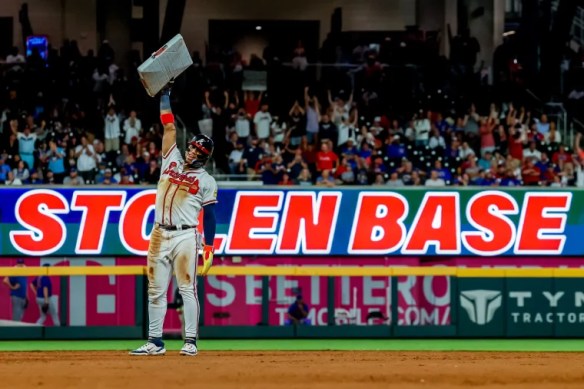
Grand opening of the 40/70 Club

Ronald Acuña, Jr.

Ronald Acuña, Jr. channeled his inner Rickey Henderson after stealing the base that opened the 40/70 club Wednesday night. Some social media scolds plus a Cub broadcaster or two were not amused.

When A. Bartlett Giamatti died unexpectedly in 1989, eight days after pronouncing Pete Rose persona non grata from baseball, the New York Times columnist George Vecsey observed that investigating the Rose case kept the commissioner—a lifelong baseball fan—from sitting in the stands too often.

But Giamatti was there when Hall of Famer Nolan Ryan nailed career strikeout five thousand, Vecsey remembered in his sweet, sad elegy, “ticking off least one Oakland player who thought he detected Giamatti rooting for Ryan.”

Giamatti knew that baseball is about rooting, about caring. Let us envision him on the edge of his seat, a smile softening his gray beard and somber eyes, his fists itching to pump the air as Ryan blew his heater past Rickey Henderson.

The milestone strikeout happened 22 August 1989, in the top of the fifth, during a stretch drive game in Arlington. The Express was already the first man to strike four thousand batters out in his career, never mind even thinking of five thousand, before he opened the inning dispatching the Man of Steal after a full count.

Surely Giamatti appreciated that he was seeing two sides of baseball history in that moment, one Hall of Famer-to-be going where no pitcher had ever gone before, and doing it at the expense of another Hall of Famer-to-be while he was at it. In a pennant race, yet.

Henderson’s Athletics beat Ryan’s Rangers, 2-0, that day, keeping the Rangers ten back in the American League West while keeping a two-game lead over the Angels. But the ovation in Arlington Stadium for Ryan’s milestone drowned out the Rangers’ broadcasters on television and the stadium’s P.A. announcer.

There may have been an A’s player ticked to think Giamatti was rooting for Ryan to land the milestone, but I don’t recall anyone else complaining about the broken flow of the game while Rangers fans cheered Ryan loudly enough to be heard across the Rio Grande.

There was also no social media as we know it today to allow such complaints then. Thus did Ronald Acuña, Jr. break a precedent Wednesday night in his home ballpark in Atlanta and incur some social media heat the following day over the on-the-spot celebration breaking the flow of the Braves’ contest against the Cubs.

Just as Ryan was the first man to strike five thousand batters out, Acuña became the first Showman to hit forty home runs or more in a season and steal seventy bases in the same season. The founding father of the 40/70 club, who’d also founded the 40/50 and 40/60 clubs.

With Ozzie Albies at the plate for the Braves, after Acuña opened the bottom of the tenth with a base hit to send free inning-opening second base cookie Kevin Pillar home with the re-tying fifth Braves run. Acuña took off on Daniel Palencia’s first pitch and dove into second under catcher Yan Gomes’s throw.

Acuña raised his arms acknowledging the Truist Park crowd going berserk in celebration. Then, Acuña wrested the base out of the dirt and hoisted it above his head. Just the way Henderson did in his 1991 moment when he passed fellow Hall of Famer Lou Brock, stealing third as baseball’s all-time theft champion.

“That’s about as good as it gets,” said Braves manager Brian Snitker, ejected from the game in the second when he argued that the Cubs’ Jeimer Candelario fouled a pitch that was ruled a checked swing. (Television replays showed Snitker had the blown call right.) “I thought it was great when he picked up the bag. The fans had to love that. We all did because it was a special moment.”

Maybe the fact that Acuña opened the 40/70 club in the bottom of an extra inning, instead of midway through a game, as Ryan and Henderson had done previously, had an impact on the social media scolds wanting to spank the Braves’ center fielder for taking time to bask in smashing another precedent. (He’s already gone where no leadoff man has gone before, hitting 41 home runs in the number one lineup slot, eight of which were hit when he was the first batter of a game, and eighteen of which were hit when he opened an inning.)

But the Braves, already the NL East champions, had something significant to play for as well, the top seed in the coming postseason, giving them home field advantage through the entire National League Championship Series if they make it there. Once the theft celebration ended, Albies rapped the next pitch down the right field line to send Acuña home with the winning Braves run.

Had Acuña not stolen second in the first place, he wouldn’t have been likely to get past third since the ball was hit sharply enough and fielded swiftly enough.

“It’s crazy what he’s done,” said Albies post-game. “I told myself I need to come through right here. Whatever it takes. I’m happy I came through in that spot and we won that game.”

“It’s one of those numbers that wasn’t impossible but seemed impossible,” said Acuña, referencing that a player could hit forty bombs or steal seventy bases but good luck finding the one man who could do both. Until Wednesday night.

Maybe some of the scolds were Cub fans anxious that the game proceed apace, knowing the Cubs hung by the thinnest thread in the NL wild card race. It would be neither impossible nor incomprehensible. Cubs broadcasters Boog Sciambi and Jim Deshaies were unamused at both Acuña removing the base and the Truist Park scoreboard people showing a quick montage of Acuña’s run to the milestone. Which, in turn, incurred some social media heat sent Sciambi’s way.

Somehow, one couldn’t shake the thought that, if it was a Cub swiping a base in Wrigley Field to establish a new club, that Cub would have given in and done precisely as Acuña did to celebrate the milestone. And no Cub broadcaster would have dared to scold him for breaking the game flow, regardless of inning.

Baseball is indeed about rooting and caring. That includes individual milestones regardless of the hour, day, week, or month. From wherever he happened to be in the Elysian Fields, rest assured A. Bartlett Giamatti gave in and pumped his fist the moment Acuña arrived safe at second. Good for him. Good for baseball.

A sort of homegoing for Jacob deGrom

Jacob deGrom

In the end, Jacob deGrom wanted to be closer to home for five years. The Rangers gave him what he wanted and with handsome dollars. But the second-best pitcher in Mets history will be missed in New York.

Of course it’ll be strange to think of and see Jacob deGrom in a Rangers uniform. And of course the social media universe, especially those whose baseball fealty belongs to the Mets, blew like a kitchen full of whistling tea kettles over the news that deGrom signed for five years, ages 35-39, and $185 million.

Assuming a return to health, and no such further rude interruptions along the way, deGrom gives the Rangers instant credibility and the Mets the accelerated need to fill a starting rotation hole about the size of Stonehenge. With deGrom off the free agency boards, Justin Verlander now looks more like a delicious Met target.

For the Rangers, of course, the question is whether deGrom’s health will allow him to pick up where he left off before the injury assault began in May 2021. The Mets seemed just leery enough of that question and its potential answer to hold the line at the three-year deal Craig Calcaterra—the former NBC Sports baseball analyst now journaling independently—says most assumed before the Rangers offered five.

As Joel Sherman of the New York Post reported the Mets’ last offer to deGrom was around three years and $120 million. I don’t get the sense that that was a final offer or that the Mets walked away or anything, though. It was likely just the case that Texas came in with five and deGrom grabbed it, likely knowing it wouldn’t be beat.

And why wouldn’t the Rangers go for it? Texas starters had a collective 4.63 ERA last season, which ranked 25th in the majors. With deGrom at the top of the marquee above supporting players Martín Perez, Jon Gray, Jake Odorizzi, and introducing Dane Dunning, things seem poised for an improvement. The big question, of course, is whether the Rangers are going to see the insanely dominant Jacob deGrom of 2018-21 during this deal.

Until that May 2021 side injury, followed by a shoulder and then elbow injury forcing his season’s end early that July, deGrom wasn’t just off the charts, he was somewhere in his own solar system on the mound. His right scapula stress reaction took him out this year until 2 August, after which he pitched like deGrom until the stretch—when he pitched well but not quite deGrominantly.

“Some of that,” Calcaterra reminds us, “might’ve been a function of stamina but one never knows. Obviously the Rangers have seen his medicals and wouldn’t have offered him this deal if there were red flags, but deGrom will turn 35 in the middle of the 2023 season and no pitcher lasts forever.”

Let’s get this out of the way once and for all. No baseball player asks for injuries while doing his job. (Those who get injured being foolish off the field are often another matter.) It wasn’t deGrom’s fault that his 2021 was derailed by three injuries; it wasn’t his fault that his right scapula elected to hand him five-sixths of the 2022 season off.

Neither is it the Mets’ fault that they were leery of giving deGrom the fourth and fifth years he wanted and that the Rangers were willing to risk. They had baseball’s arguable best pitcher in their silks but his body betrayed him often enough to give them pause. Even if their owner Steve Cohen bought the team as much from his lifelong Met fandom as for anything else, he didn’t become wealthy enough to buy it by acting from his heart alone.

And yet . . . and yet . . .

We’re beginning to learn a little more that not everything was entirely sweet between deGrom and the Mets. He never hinted publicly at discontent, and he had reason for discontent that few of his teammates did. Remember: this is the guy who’s still accused of not being a “winner” and not knowing how to “win” because, despite winning back-to-back Cy Young Awards in 2018-2019, he “won” only 21 games over both seasons.

“Jacob deGrom’s issue wasn’t that he ‘didn’t know how to win’,” wrote MLB.com’s Anthony Castrovince, in A Fan’s Guide to Baseball Analytics. “It was that he didn’t know how to not be on the 2018 New York Mets.”

They put up 3.57 runs per deGrom start, the third-lowest support average for any qualified pitcher in the majors that season. In the end, deGrom, owner of the league’s best ERA (1.70), finished 2018 with the same number of wins as the White Sox’s Lucas Giolito, owner of the league’s worst ERA (6.13). As the great Jayson Stark wrote of deGrom’s Cy Young case in The Athletic late in the season, “So are you still asking why we’re ignoring wins? It’s obvious, isn’t it? Because there isn’t a single entry on the stat sheet that tells us less about how this man has pitched than the entry that most people used to check first. That’s why.

He had the same problem not knowing how not to be on the 2019 Mets, too. That team put up 4.1 runs per deGrom start—but gave him only 3.6 runs to work with while he was in the game. For those two Cy Young seasons, deGrom’s fielding-independent pitching (you can consider it a man’s ERA when the defenses behind him are removed from the equation) was a sterling 2.32—and his 2018 1.98 FIP led the entire Show.

He could have sued his team plausibly for non-support, but to the public and even in his clubhouse deGrom was a chronic non-complainer. “Throughout deGrom’s career with the Mets,” writes ESPN’s Buster Olney, “he was a respected teammate, especially for how he handled a chronic lack of run support.”

But he also felt in some ways like an alienated man. deGrom may be a private young man but he’s not obscure. When he made known his intention to opt out of his Mets deal—which he had every right to do since the option to do it was in the deal—it was a sign that something between the pitcher and the organisation fell just enough out of whack to compel deGrom to think of continuing and finishing his career closer to home.

There isn’t a dollar amount on earth that can match that value in a man’s soul. Not that the Rangers aren’t trying.

It’s not unlikely that, giving him the fifth year he really wanted (plus an option for a sixth), deGrom’s average annual value of $37 million a year as a Ranger was still a bargain. Sometimes, the home town discount really means the man’s actual as opposed to baseball home town, or close enough thereto.

“[T]o some in the [Mets’] clubhouse,” Olney goes on to say, “he also became a little more distant from teammates over his years in the organization; he was a private person who seemed to become a little more private.”

It was a perception likely exacerbated by that time away from the field—391 days passed between his last start in 2021 to his first start in 2022. Some teammates . . . developed a relationship with Steve Cohen after Cohen bought the Mets the fall of 2020, but friends felt that deGrom wasn’t really interested in that.

deGrom also had reduced his interactions with the large contingent of media that descends upon the Mets’ clubhouse, regularly speaking to reporters after his starts but increasingly deflecting any other requests. Early in his career, deGrom had agreed to do in-game interviews in national broadcasts on the days he did not pitch. But as deGrom’s stature in the game grew, that practice ended.

Instead, deGrom preferred to just focus on pitching. He didn’t seem particularly interested in the pomp and circumstance that can come from playing baseball in New York, a sentiment conveyed to members of the Braves even before this offseason. Based on their conversations with deGrom, some Atlanta players felt certain that if given the chance, deGrom—who had grown up in Florida as a fan of the Braves—would prefer to sign with the team he rooted for as a kid.

Indeed the Braves put themselves in play for deGrom, but they, too, didn’t want to assume the risk of deGrom’s desired five years versus the chances of deGrom’s body betraying him (and them) yet again. The Rangers were not just willing, but they had a secret weapon when it came to landing deGrom: their new manager.

Bruce Bochy managed the 2015 National League All-Stars after winning the 2014 World Series with the Giants. deGrom was one of his pitchers, the league’s 2014 Rookie of the Year. Bochy, says Olney, was impressed by both deGrom’s humility and his sixth-inning performance of striking out the side with only ten pitches.

Freshly minted as the Rangers’ manager, Bochy now engaged deGrom on a Zoom call. “To Bochy,” Olney continues, “it was clear that deGrom’s focus was on family, on pitching, on competing. The Rangers continued to dig into deGrom’s background, his preparation; they learned that deGrom was already assessing the housing market in the Dallas area. Said one of deGrom’s friends from New York: ‘He’ll probably wind up on a ranch’.”

If the Rangers continue to reconstruct a team their newly-signed top pitcher can be proud to front on the mound, and if that newly-signed top pitcher can keep doing what he does without further injuries, things in the American League West will become more than merely interesting.

Having deGrom in Ranger silks isn’t exactly the ideal scenario or best interest for the ogres of the AL West, the world champion Astros. Their Cy Young Award-winning grand old man, Justin Verlander, is now a free agent. The Mets are now said to be all-in on making sure they can make Verlander a happy man for a season or maybe two, particularly re-uniting with his old Detroit teammate/rotation mate Max Scherzer.

“deGrom is the best pitcher in baseball when he’s healthy. There’s no replacement for his potential,” writes Smart Baseball author Keith Law in The Athletic.

There is, however, a way to replace his production, since he threw just 64 innings last year, and while they were, again, comically great innings–the man made eleven starts and walked eight guys, at least one of which was probably a clerical error–he was worth about two wins above replacement, and someone else had to make the 21 starts he didn’t make. The Mets could just throw $40 million at Justin Verlander for a year, tell him they give him as good a shot as anyone at getting him another 15-18 wins, after which he can go ply his trade for another team if they didn’t give him enough run support. If he really wants to get to 300 career wins, which would be fantastic to see, they’re a great choice.

The Astros don’t exactly lack for starting pitching; their rotation made a very distinct and vivid impression during the World Series and that’s without including Verlander in the picture. But losing Verlander to their fan base isn’t quite like losing deGrom is to the Mets’ fan base. Until he signed with the Rangers Friday night, the Mets’ long-anguishing, often-masochistic fan base thought and hoped deGrom would end up a Met for life.

They’ll have to settle for deGrom having been the second-best pitcher in Mets history, behind Hall of Famer Tom Seaver. (Jerry Koosman, you say? Dwight Gooden? Try again. As a Met, Koosman’s FIP is 3.26 and Gooden’s is 2.77. deGrom’s 2.62 as a Met beats them both. He’s also only five FIP points behind Seaver as a Met. He also has the best walks/hits per inning pitched rate as a Met of the four. Better not go further, lest we careen into heresy.)

They’ve had to settle for far worse. If you don’t believe them, they’ll be more than disgustingly happy to remind you—chapter and verse. At least until they see Justin Verlander shouldering into a Mets jersey at his introductory press conference, they may now dare to dream.

The phlinging, phlying, phlogging Phillies

Brandon Marsh

The Ides of Marsh—the Phillies’ center fielder launching the three-run homer that launched the Phillies toward burying the Braves and going to the NLCS Saturday afternoon.

“You’ve got to beat the champs to be the champs,” said Bryce Harper just minutes after the game ended. The Phillies aren’t exactly the champs just yet. But the way they dispatched the Braves once their National League division series shifted to Citizens Banks Park, it won’t be simple to bet against them now.

These are not the uncohesive, porous Phillies who were down 22-29 and threw out the first manager as June got underway. Since executing Joe Girardi and installing his bench coach Rob Thomson on the bridge, the Phillies were the third-winningest team in the National League, behind the Braves they just vanquished and the Mets who became 101 game-winning also-rans last weekend.

They ground their way to the postseason despite a key element or two missing significant injury time, a just-enough pitching reshuffle, and prognosticators who assumed the almighty Braves—who had to grind their own way back to snatch the National League East in the first place—would do to them what they just finished doing.

They flattened the Braves 8-3 Saturday afternoon. It’s rather amazing what a team who’d spent seventeen straight days for fourteen straight games on the road can do once they get to come home at last. By the time Phillies relief ace Seranthony Domínguez blew Travis d’Arnaud away with a wind-generating swinging strikeout to end the game, they’d outscored the Braves 17-4 in division series Games Three and Four.

The defending world champions who were second in the league in runs scored on the regular season couldn’t rent, buy, embezzle, or forge runs once they left their own playpen in this set. Their starting pitching, usually considered one of their deepest contingencies this year, had only Kyle Wright’s magnificent Game Two performance to show for it.

Once they got to playing Saturday afternoon, almost everything a Brave threw was found by a Phillie bat when it hurt the most, sometimes for measured-doses mischief and sometimes for long-distance landings. And, unless the Braves were hitting solo home runs, whatever they hit when not striking out to the tune of fifteen batters found a Phillie  glove.

This wasn’t exactly what the Braves planned to happen once they managed to overthrow the Mets and steal a division over half the world thought the Mets had in the safe deposit box.

“[T]he goal when we leave spring training is to win the division,” said manager Brian Snitker. “Until you win the division, you don’t have a chance to do anything special because you never know what’s going to happen, you don’t know what team’s going to get hot, what things have to go right for you to go deep into the postseason.”

The new postseason format may be the competition-diluting or compromising mishmash it happens to be, but one of the key reasons is that someone who doesn’t win the division—say, 25 or 6 someones in red or blue-on-red hats with big script Ps on the crowns—can do more than a few special things after they slip in through the second wild card door.

“They’re hitting on all cylinders at the right time,” said Snitker. “It’s a good club. They’ve got really good players, and they’re getting it going at the right time.”

Where to begin delineating the Braves’ engine seizure?

Maybe with poor Charlie Morton, who entered the game with a sub-one ERA in postseason elimination games but exited early with an elbow injury. But not before he was informed rudely that squirming out of one self-inflicted inning-opening jam is a reprieve, but squirming out of a second to follow immediately is not Phillies policy.

Bottom of the first—The wizened old righthander allowed the first two Phillies to reach base, Kyle Schwarber on an unintentional walk and Game Three hero Rhys Hoskins on a base hit, and escaped with his life and no score. Bottom of the second—Alec Bohm’s leadoff liner bounded off Morton’s forearm, then Morton struck Bryson Stott out before Jean Segura shot one past a diving Dansby Swanson at shortstop. First and third again.

No escape this time. Brandon Marsh, the Phillies center fielder whose long enough beard qualifies him well enough to audition for ZZ Top, saw a 2-2 curve ball arrive at the perfect level to send into the right field seats. One day after Hoskins hit a bat-spiking three-run homer to start the Phillie phun, Marsh equaled him for early drama if not for a celebratory gesture.

In the interim, Phillies starter Noah Syndergaard, last seen in postseason action throwing seven shutout innings at the Giants, in the 2016 NL wild card game the Mets ended up losing, didn’t let Orlando Arcia’s solo homer spoil his night. He sliced and diced the Braves  otherwise with a very un-Thor like array of breakers and three innings of shutout, three-strikeout ball.

As if to reward the remade/remodeled Syndergaard, who became a Phillie near the regular season trade deadline after a first half as a struggling free-agent Angel, his catcher J.T. Realmuto let Morton’s relief Collin McHugh—entering after Braves manager Brian Snitker saw Morton just uncomfortable enough warming back up to hook him—feel it where it really hurt.

Realmuto had a little help, admittedly, from Ronald Acuña, Jr. who either didn’t look in that big a hurry or misread the play. Acuña moved almost no muscle when Realmuto’s deep fly eluded Braves center fielder Michael Harris II, taking a carom off the lower portion of the State Farm sign on the center field fence and rolling almost halfway to the right field track.

It let Realmuto—maybe the fastest-running catcher in a game not known for swift-afoot backstops—run himself into an inside-the-park homer and a 4-1 Phillies lead. He also ran himself into becoming the eighteenth player and first catcher to deliver an inside-the-parker in postseason play.

He couldn’t contain himself when he dove home and sprang up whooping it up. “I’m not usually a guy that shows a lot of emotion,” he told reporters postgame. “When I slid into home, I couldn’t help myself. I was so excited. Excited for this city. Excited for this team. It was one of those moments I’ll definitely remember forever.” Him and everyone else including the concessionaires in the Bank.

Matt Olson made a small stand for the Braves in the top of the next inning, when he jerked the first pitch he saw from Phillies reliever Andrew Bellatti over the right field fence with one out, but Bellatti shook it off as if it were just a mildly annoying mosquito, striking both d’Arnaud and Austin Riley out swinging with remarkable aplomb.

The bullpens kept things quiet enough on the field, if not among the Bank crowd itching to see the Phillies take it the distance to the National League Championship Series, until the bottom of the sixth. With A.J Minter—whose fifth inning work was as lights-out as he’d been most of last year’s run to the Braves’ World Series title—taking on a second inning’s work. Uh-oh.

Segura rapped a single to center with one out and stole second almost too handily with Marsh at the plate. Minter caught Marsh looking at a third strike, but then his 2-2 changeup caught the Schwarbinator on the fingers around the bat and, after a review challenge, took his base.

Exit Minter, enter Raisel Igelsias. And enter the Phillies showing they could peck away at you with just as much ease and pleasure as they could detonate the nukes against you.

Hoskins fought one off to dump it into shallow right that fell for a base hit. When Acuña lost track of the ball after it bounded off his glove, Segura came home with the fifth Philadelphia run. Realmuto then bounced one slowly up the third base line, slow enough that Riley playing it in front of the base dirt on the grass couldn’t get a throw to first in time,   while Schwarber scored run number six and Hoskins held at second.

Then Bryce Harper—carrying a 1.674 series OPS to the plate with him—broke his bat while sneaking a base hit the other way left to send Hoskins home. Castellanos walked to load them up for Bohm but for the second time in the game the Phillies stranded the ducks on the pond. Not that it mattered. A 7-2 lead after a three-run pick-and-peck sixth was nothing to complain about.

D’Arnaud opened the Atlanta seventh with a first-pitch drive over the center field fence off Phillies reliever José Alvarado, starting a second inning’s work after a 32-minute rest during that bottom of the sixth. He then got two ground outs before yielding to Zack Eflin for the inning-ending swinging strikeout of William Contreras.

Eflin worked a one-two-three top of the eighth. Harper soon faced Kenley Jansen in an unusual-looking, from-far-enough-behind appearance, and had a that’s-what-you-think answer to d’Arnaud’s blast. He sliced Jansen’s fadeaway cutter the other way into the left field seats. Then it was time for Sir Anthony to ride in, dispatch the Braves by striking out the side, and let Philadelphia know the Phillies reached the next plateau.

“This is step two in what we’ve been through,” said Harper, whose regular season absence with a shoulder issue limiting him to the designated hitter role and then a thumb fracture could have deflated the Phillies but didn’t. “Step one being the wild card. This being step two and we’ve got two more (steps).”

Step three: either the Padres or the Dodgers in the NLCS. Step four: You have to ask? Taking things one step at a time works big for these Phillies hanging with the big boys. So far.

Bruce Sutter, RIP: Like skipping a rock

Hall of Fame relief pitcher Bruce Sutter with the Cardinals en route their 1982 World Series winner.

“It’s unhittable,” said Hall of Fame manager Dick Williams about Hall of Fame relief pitcher Bruce Sutter’s split-finger fastball, “unless he hangs it, and he never does. It’s worse than trying to hit a knuckleball.” Another Hall of Fame manager, Whitey Herzog, has said that Sutter would never have become injured if he’d remained a Cardinal.

Sutter, who died of cancer Thursday at 69, became a Cardinal in the first place, in 1980, because the Cubs with whom he’d arisen to become a groundbreaking relief pitcher in the first place got caught flatfoot, when the combination of salary arbitration and free agency smashed into a grave if unintended error by longtime owner Phil Wrigley.

The elder Wrigley’s mistake, according to Peter Golenbock in Wrigleyville: A Magical History Tour of the Chicago Cubs, was leaving half his estate to his wife, Helen, whose own death meant the Wrigley estate being taxed heavily twice and leaving son William III, who’d inherited the Cubs, strapped for running the team until or unless he could sell it.

In due course, Bill Wrigley’s financial picture would wreak havoc enough on the Cubs. Sutter himself would remember (to Golenbock) the Cubs having a good team or two followed by a disgruntled team full of veterans who came over from established winners and not liking the Cubs’ post-’79 decline.

About 1979, too, the husky righthander remembered, “That was the year . . . we lost a game to the [Phillies], 23-22. You’re going to ask who gave up the last run, aren’t you? It was a Mike Schmidt home run—off me.” Hitting his second bomb of the day, the Hall of Fame third baseman conked one off Sutter and up the left center field bleachers with two out in the top of the ninth. The Cubs—whose own bombardier Dave Kingman hit three out (one onto a Waveland Avenue porch while he was at it)—went down in order in the bottom against former Big Red Machine relief star Rawly Eastwick.

Sutter learned the split-finger fastball from a minor league coach named Fred Martin and rode it to a 2.33 fielding-independent pitching rate, a 3.42 strikeout-to-walk rate, and a 1.05 walks/hits per inning pitched rate as a Cub. He won the National League’s Cy Young Award for 1979 while he was at it. Then he won a $700,000 salary for 1980 in arbitration.

The only relief pitcher never to have started a major league game when inducted into the Hall of Fame in 2006, Sutter found himself one of the 1980 Cubs’ few leading lights, with a 2.64 ERA and a league-leading 28 saves. He also found himself a Cardinal after that season, after the Cubs under Wrigley’s financial distresses couldn’t pull the trigger on a longer-term deal with deferrable money.

Enter Herzog, who’d only coveted Sutter for half the time Sutter pitched for the Cubs. Only too acutely aware of what happens to even great teams without shutdown relief—he’d been purged as the Royals’ manager after front office disputes trying to get them better relief pitching, before All-Star reliever Dan Quisenberry came into his own—the White Rat, doubling as general manager, brought Sutter to St. Louis for Leon Durham and Ken Reitz plus a spare part named Ty Waller.

Sutter delivered in St. Louis—he nailed down Game Seven of the Cardinals’ 1982 World Series triumph— in large part because Herzog and his then-pitching coach Mike Roarke knew even more than the Cubs how to manage a pitcher whose money pitch just so happened to put arms and shoulders in danger if not handled properly. “[N]obody knew [Sutter’s] motion better than Mike Roarke,”  Herzog wrote in You’re Missin’ a Great Game:

I knew Bruce had to come back behind his ear, then straight over the top, with his delivery. He threw that nasty split-finger pitch, which made the ball look like a rock skipping on water—tough to pick up, let alone hit—but it puts a violent torque on the arm. When you think of the guys who live by that pitch . . . how many had a couple of great years, then dropped off the map?

. . . Well . . . Roarke and I were watching Sutter throw in [spring training] and I saw he was coming kind of three-quarters, bringing the ball out to the side and across. I said, “Holy moly, Mike, he’s all out of whack!” We got right on his ass about it, and he straightened it out. No harm, No foul. Bruce saved a lot of games for us; we saved him more damage than anybody knows.

You know what? If he’d stayed with the Cardinals, Bruce would never have gotten hurt.

Sutter left the Cardinals as a free agent after the 1984 season. Owner Gussie Busch decided to share the top decision making with two Anheuser-Busch leaders, Fred Kuhlmann and Lou Sussman, and they weren’t exactly as amenable to Herzog as Busch himself was, according to Golenbock’s The Spirit of St. Louis.

Herzog swore the pair “jerked” Sutter around over a no-trade clause; second baseman Tommy Herr swore Sussman angered Sutter during their talks. “Bruce wanted to stay in St. Louis,” remembered Herr.

I don’t think the money was that big of a deal. It became more of a personality conflict. Lou Sussman was handling the negotiations for the Cardinals. At some point, Lou rubbed Bruce the wrong way, and Bruce just said, “The heck with it. I’m going somewhere else.” Bruce did it just to spite Lou. And that was unfortunate, because we felt Bruce was just such a weapon for us.

Bruce Sutter

Before the beard: a portrait of the artist as a young Cub . . .

Braves owner Ted Turner showed Sutter a pile of money.` (Six years, $10 million, guaranteed contract.) But Turner couldn’t show Sutter a staff that knew how to manage his workload and keep him from letting his delivery and his bullpen warmups (he was warmed up far less judiciously in Atlanta than in St. Louis) wreck his shoulder at last.

He suffered inflammation in the final third of August 1985 plus a pinched nerve, the injury that almost kept him buried in the minors in the beginning, before Martin taught him the splitter. He would never be the same pitcher again. Had he not fallen under the Braves’ then-dubious care, Sutter’s percentage of inherited runs to score would have ended below 30 percent, splendid work for any relief pitcher.

He may have seen his career collapse in Atlanta, but the Pennsylvania native found Georgia life agreeable enough to stay there with his wife, Jayme, and their three sons. He was the only player inducted into the Hall of Fame in 2006 by way of the writers’ vote, an appropriate position considering how he’d helped to change his baseball craft.

His Hall of Fame teammate Ozzie Smith and Hall of Fame Reds catcher Johnny Bench needled him wearing fake, long gray beards as they escorted him to the podium. Sutter made hitters fear the beard from the bullpen long before anyone heard of one-time Giants bullpen stopper Brian Wilson, but he struggled to stay composed addressing and thanking his wife during his acceptance speech.

We were together through the minor leagues, through the major leagues, and now the Hall of Fame. I love you very much, I appreciate everything you have done and continue to do. I wouldn’t be here without you. I know we have some challenges to face in our future, but we’ll do ’em as we always have, together.

Their marriage was a love that endured almost as long as his love for baseball. So did several friendships Sutter made during his career, such as now-Hall of Fame teammate Jim Kaat, who ended his career as a Cardinal while Sutter anchored their bullpen.

“I feel like a brother passed away,” Kaat told a reporter. “I knew Bruce deeper than just about any other teammate. We spent a lot of time together, and as happens when your careers end, you go your separate ways. But we stayed in touch and considered each other great friends.”

The particular challenge didn’t scare Sutter. Whether throwing that rock-skipping splitter past fellow Hall of Famers out of the bullpen (let the record show that except for two homers each, Mike Schmidt and Willie Stargell, to name two, couldn’t hit him with a warehouse door), or making a half-century marriage raising three sons and becoming beloved grandparents to six in an often self-immolating world, there was no challenge to which Sutter seemed  allergic.

“Heaven needed a big time save,” tweeted longtime baseball analyst Dinn Mann. “Marvelous pitcher, even better person,” tweeted USA Today columnist Bob Nightengale. Baseball will miss him on earth only slightly less than his family will.

Two over the shoulder help tie an NLDS

Dansby Swanson, Austin Riley

Over the shoulders Wednesday night—Dansby Swanson hits the short left field turf to rob a bloop base hit from J.T. Realmuto; Austin Riley one-hands Bryson Stott’s foul over the tarp roll on which he might have turned his ribs to bone meal.

Well, I can’t decide, either. Atop a well-pitched National League division series Game Two, between the Braves and the Phillies, who put on the better defensive show between Braves shortstop Dansby Swanson and third baseman Austin Riley?

Don’t ask either one.

“I give him the credit,” Riley said, after the Braves banked the 3-0, series-tying win. “Just because running straight out, over the head is pretty tough.”

“I didn’t have to dodge a tarp,” Swanson said. “The guy, once again, a very under-appreciated defender, a lot more athletic than people give him credit for. The guy’s a gamer.”

That was like trying to choose between Lux Guardian and Lux Legacy vacuum cleaners. But come on, gentlemen. Quit being coy.

We might hand Swanson the slight advantage, though. With two out in the top of the sixth, Swanson ran out from shortstop into shallow left field chasing J.T. Realmuto’s bloop with center fielder Michael Harris II and left fielder Eddie Rosario pouring in from their positions. One false step or one body bump might have meant a base hit to a club that  isn’t terrible at turning two outs into a run-scoring chance.

Swanson took a small diving leap to nail it just before his glove hit the grass followed by the rest of him. “Play of the game, so far,” my game notes say. But if you press him on it, he’ll tell you he had a slightly unfair advantage going in.

“I should get my parents in here,” he said, “because they threw me a gajillion balls just like that all the time growing up over my head. I was the epitome of the kid that would throw a tennis ball off a wall and ricochet it and run, try to catch it over my shoulder. Probably threw a lot of tennis balls onto the field, too, to disrupt my brother’s baseball games. But I feel like I’ve been doing that since I was five.”

Two innings later, the Phillies had one out and Jean Segura aboard after a long drive to the left field wall that might have been a double was turned into a long single—thanks to Rosario playing the carom as if according to a script. He’s not the best defensive left fielder overall, but he has a powerful enough throwing arm that that kind of carom play keeps the other guy’s slugging percentage from creeping upward.

Then Phillies shortstop Bryson Stott popped a 1-2 service from Atlanta reliever Raisel Iglesias to the left side, beyond third base. Riley kicked his horse, ran it down, and reached to snap the ball into his glove above the Truist Park tarp roll—about a nanosecond before he would have hit that roll with a rib cage-cracking clank allowing Stott a reprieve.

“Couple of crazy catches,” said Braves first baseman Matt Olson. “Dansby going back, I think Rosario was going to have the play at it first. Rosario was pretty deep.”

“For me, that’s my best friend, is a good defense,” said Braves starter Kyle Wright, who kept the Phillies to a pair of hits and a walk while striking out six and turning his breaking balls loose enough to keep them out of balance. His only serious threat came when Bryce Harper, still in the Phillies’ designated hitter role, led off the second with an opposite-field double to left, took third when Nick Castellanos lined out to third, but was stranded by an unassisted ground out to first and a swinging strikeout.

“I try to get guys to put it on the ground. When they make catches like that, that’s good, too. That’s been one of my biggest weapons this year, I believe, is the defense.”

Phillies starter Zack Wheeler was almost as effective until he had two outs in the bottom of the sixth and perhaps got himself a little taken out of his game after his first pitch to Ronald Acuña, Jr. ran in hit the Braves’ right fielder on the inside part of his right elbow. Wheeler looked ashen on the mound as Braves trainers tended Acuña, who shook it off enough after about seven minutes to stay in the game and take first.

Swanson then worked out a full count walk to provide the Braves’ first man in scoring position all night to that point. Then Olson grounded one that took a tweener hop through Phillies first baseman Rhys Hoskins and sent Acuña home. With both starting pitchers working so stingily to that point, a single run must have felt like a three-run homer to the Braves.

Riley batted next. He hit a slow, small bouncer to the third base side of the mound, slow enough that Wheeler running to his right had no play to make when he speared the ball, but Swanson had a second Braves run to score on it. Then Travis d’Arnaud—the Braves catcher who’d caught Wheeler on days enough when the pair were Mets teammates—shot one sharply up the pipe for the single that sent Olson home with run number three.

A.J. Minter, Iglesias (with a little help from Riley), and Kenley Jansen kept the Phillies quiet to finish off. Andrew Bellotti and another former Met, Noah Syndergaard, kept the Braves quiet likewise to finish off. But their shoulders weren’t quite as burdened as those of the two Braves infielders who had to go over theirs to make plays that could have sent either one to the infirmary.

“[Swanson] had to readjust, get back on it and make an over the shoulder catch,” Olson said. “And then Riley going up against the tarp. Weird angle. Couple of great catches, and that’s the kind of game it was tonight.”

Game Three is set for Citizens Bank Park Friday. The Phillies had just played fourteen straight games on the road including the wild card set in which they swept the Cardinals to one side and future Hall of Famer Albert Pujols, plus ancient catcher Yadier Molina, into retirement well short of a shot at one more World Series ring.

“To leave here with a split,” said Phillies manager Rob Thomson, who had the interim tag removed well before the postseason began, “and go back home in front of a packed house of passionate people . . . I think will give our guys a little shot in the arm.”

Unless the Braves keep up the stingy pitching and luminous leather, of course. Then, that Philadelphia house packed with “passionate people” might want to give the Phillies a little shot in the head.