It’s deja vu all over again for the Mets

2020-07-24 YoenisCespedes

Cespedes went into the seats in his return but deGrom added just more evidence for a non-support case Friday.

Pandemic delay or no pandemic delay, the 2020 season finds the New York Mets picking up just about where they left off last year. Not that beating the Atlanta Braves 1-0 on Friday was a terrible thing for them, of course. And not that Yoenis Cespedes, too long among the Mets’ living dead on the injured list, going long his first day back was terrible, either.

But their neglect of theirs and the National League’s best pitcher two seasons running, pending Jack Flaherty’s continuing maturation, continues yet. He’s too much a team player to say it, but surely Jacob deGrom thinks of games like Friday’s and thinks to himself, “It’s been lovely, but I have to scream now.”

Defending back-to-back Cy Young Awards, pitching like a future Hall of Famer, eight strikeouts in five innings, one walk, and one measly hit. (The innings limit was the Mets taking no chances after deGrom’s back tightness last week.) And nothing to show for it other than an ERA opening at zero.

Last year, deGrom had twelve such quality starts, averaging seven innings per, and came out with nothing to show for those. If his team played the way he pitched, he’d have been a 23-game winner and the Mets might have ended up in the postseason. Him definitely; them, might. As a former Mets manager once said, it was deja vu all over again Friday afternoon in Citi Field.

The Braves’ starting pitcher, Mike Soroka, got a grand taste himself of how deGrom must feel at times. He pitched six innings and, while he wasn’t deGrom’s kind of strikeout pitcher Friday afternoon, he did punch out three, scatter four hits, and come away with nothing to show for it but handshakes from the boss and whatever equals a pat on the back in the social-distancing season.

His relief, Chris Martin, wasn’t so fortunate. After ridding himself of Michael Conforto to open the bottom of the seventh on a fly out to deep enough center field, Martin got Cespedes to look at a first-strike slider just above the middle of the plate. Then he threw Cespedes a fastball just off it, and Cespedes drove it parabolically into the empty left field seats.

The piped-in crowd noise at Citi Field drowned out the thunk! when the ball landed in no man, woman, or child’s land. It was the game’s only scoring, but the Mets’ bullpen had a surprise of their own in store once deGrom’s afternoon was done.

They left the matches, blow torches, gasoline cans, and incendiary devices behind. They performed no known impression of an arson squad. They cleaned up any mess they might have made swiftly enough.

Seth Lugo, maybe the Mets’ least incendiary reliever last year, shook off a double to left by newly minted Brave Marcell Ozuna, and his advance to third on a passed ball, to get Matt Adams—signed but let loose by the Mets and scooped up by the Braves—to ground out to third and Austin Riley to look at strike three. Crowning two innings relief in which Lugo also made strikeout work of Alex Jackson and Ronald Acuna, Jr.

Justin Wilson, taking over for the eighth and looking like he was finding the right slots last year, shook off Dansby Swanson’s leadoff single to strike Adam Duvall out looking, before luring pinch hitter Johan Comargo into grounding out to second and striking Acuna out for the side.

Then Edwin Diaz, the high-priced closer who vaporised last year, opened by getting Ozzie Albies to ground out, shook off a walk to Freddie Freeman, and struck Ozuna out looking and Adams out swinging for the game.

Already freshly minted Mets manager Luis Rojas looks like a genius, or at least unlike a lost explorer. And Cespedes—about whom it was reasonable to wonder if he’d ever play major league baseball again—made sure any complaints about this season’s universal DH were silenced for this game at least.

“The funny thing is I joked with him before the game,” deGrom told reporters postgame. “I said ‘why are you hitting for me?’ He went out and hit a home run for us which was big. I was inside doing some shoulder stuff, my normal after pitching routine and yeah I was really happy for him.”

It didn’t work out quite that well for the Braves, with Adams going 0-for-4 with two strikeouts on the afternoon. Neither side mustered an especially pestiferous or throw-weight offense other than Cespedes’s blast.

But you half expected a low-score, low-hit game out of both deGrom and Soroka considering the disrupted spring training, the oddity of “summer camp,” and perhaps just a little lingering unease over just how to keep playing baseball like living, breathing humans while keeping a solid eye and ear on social distancings and safety protocols.

In a sixty-game season it all counts even more acutely than it would have on a normal Opening Day. The Mets and the Braves were each expected to contend this season before the coronavirus world tour yanked MLB’s plans over-under-sideways-down. They’re not taking their eyes off that just yet.

Before the game began, the Mets and the Braves—like the New York Yankees and Washington Nationals in D.C., like the Los Angeles Dodgers and San Francisco Giants by the Bay Thursday night—lined up on the baselines and held a long, long, long black ribbon. This time, with nobody kneeling before “The Star Spangled Banner” was played.

Maybe athletes can remind people that it’s dead wrong for rogue police to do murder against black and all people without running into the buzz saws of explicit national anthem protests and fury over the protests, after all.

The Braves have other alarms, though. Freeman, of course, is recently recovered from COVID-19 but two of their three catchers—Tyler Flowers and former Met Travis d’Arnaud—showed COVID-19 symptoms and went to the injured list. The good news: both catchers tested negative for the virus.

But lefthanded pitcher Cole Hamels hit the IL with triceps tendinitis. Not good. Every live arm counts in a short season, especially for legitimate contenders. Just ask the Mets, who’ll be missing Marcus Stroman with a calf muscle tear, even if Stroman historically heals quickly.

You hope both teams recover swiftly enough. You also hope the Mets find a way to make deGrom’s won-lost record look as good as he pitches and fast. Those non-support filing papers don’t take that long to draw up.
 

A virus, a prayer, a return for Freeman

2020-07-19 FreddieFreeman

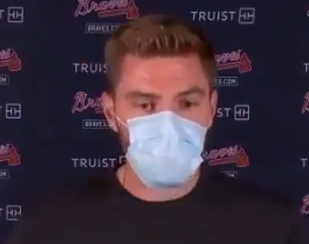
“I said, ‘Please don’t take me,’ because I wasn’t ready.”—Atlanta Braves first baseman Freddie Freeman, describing the worst night of his COVID-19 battle.

These days it’s fair to suggest first baseman Freddie Freeman is the face of the Atlanta Braves. He’s had a solid career thus far and— assuming baseball and American life re-discover normalcy if and when the coronavirus world tour finally dissipates—it’s safe to assume he’ll continue that way when healthy.

He’s had a few seasons interrupted by injuries and one truncated season-to-be interrupted rudely by COVID-19 itself. It was enough to make him thankful for his recovered health and the small things, considering the shake he incurred while suffering with the illness.

When baseball began its “summer camp” version of delayed spring training, Freeman was one of four Braves to test positive for the coronavirus. Pitcher Touki Toussaint showed no symptoms, though, and returned to the Braves on Friday. The other two—lefthanded relief pitcher Will Smith and utility infielder Pete Kozma—haven’t returned yet.

And, there came one point where Freeman feared he’d go from incumbent Brave to dead duck. That was the day his fever spiked to 104.5, usually the level at which you’d also suffer pneumonia. (Fair disclosure: your servant has fought and beaten pneumonia twice in his adult life.) It also spiked him into prayer.

“I said a little prayer that night,” he told a Saturday conference call. “I’ve never been that hot before. My body was really, really hot . . . I said ‘Please don’t take me,’ because I wasn’t ready.”

Freeman’s coronavirus adventure began when—after he “tested negative on the intake” and felt “great” on 30 June—he awoke two days later in the wee small hours feeling a swarm of body aches. “I didn’t know,” he said. “It didn’t cross my mind that it was coronavirus when I woke up that morning.”

It’d cross his mind soon enough, alas.

“I went to bed late and didn’t get enough sleep,” Freeman continued. “So I took some Tylenol, some ZzzQuil and finally got back to bed. Then I woke up around 11:30 and I immediately grabbed my phone and texted my wife and said, ‘Something is wrong. I need you to bring a thermometer.’ They gunned my forehead and it said 102 fever. I looked at it and said, ‘I think I need to call George (Poulis, the Braves’ trainer). I think something is different’.”

It was. The Braves got him a medical appointment, on 3 July, and the test came back positive.

“The crazy thing is, [that] Friday morning, I woke up in a pool of sweat, gunned my forehead and it said 98.2, so I had no fever that morning,” Freeman said. “That was 7:30 in the morning. So I went to the field because I was waiting for the test, I hit, I threw, I worked out and I ran at my house and felt completely fine. By 2 p.m., it hit me like a ton of bricks. I came back and I was like ‘Wow. I’m not feeling very good.’ It just snowballed after that.”

He spiked that shivery 104.5 that night. “Thankfully, George wasn’t awake when I texted him because I probably would’ve gone to the hospital,” he said. “Ten minutes after that, I gunned my forehead again and I was 103.8, then 103.2, then 103.6. So I was like, ‘If I go above 104 again, I’ll probably have to start ringing the phone and try to figure this out.”

That’s about when Freeman began to pray. Awakening the following morning with a mere 101.5 temperature, he figured that much he could take and feel relief. That Friday night, he said, was the worst of it, if you didn’t count that it interfered with fatherhood over the week that followed.

“I’d stand up, get dizzy and I’d have to sit back down. Trying to tell my 3-year-old not to come around me was difficult,” he said. “I wore masks, gloves, I was playing cars with them. Ten minutes after playing cars with them I’d have to sit down. I was a little fatigued and tired. Then, every three hours it felt like I had to take a nap.”

A week after those first symptoms, Freeman still didn’t feel great until he had yet another nap. When he awoke, though, he felt great enough to hail his wife, Chelsea, and ask for copious carbohydrates. She obliged with some Italian food. Come Saturday morning he’d gone nine days with no further symptoms, and a lot of gratitude.

So far, no more body aches, contradictory chills, and short losses of his senses of smell and taste. While his wife and an aunt continue recovering after they, too, tested positive, Freeman returned to Truist Park after a second consecutive negative test. He said his family did everything right to avoid the virus but “it still somehow got to me.”

The Braves would love to get to him as many plate appearances as possible before the truncated regular season begins, but Freeman isn’t entirely sure just how ready he’ll be. His manager, Brian Snitker, isn’t exactly worried. “I don’t think I have to look for anything,” Snitker told reporters. “If he’s out there he’s going to be ready.”

Despite sore legs the day after a Friday workout, Freeman bopped a run-scoring triple over the head of the Braves’ face-in-training, Ronald Acuna, Jr., in Saturday’s intrasquad game. He also made an over-the-shoulder running catch of a foul pop. You’d have been hard pressed to find any Brave happier to have their first base anchorman back than Freeman himself.

“I feel like I’m a kid in a candy store again,” he told that conference. “You forget sometimes how much you love this game. I did truly miss it. I was so excited when I got to the yard.”

It didn’t come without a few painful disruptions. When outfield mainstay Nick Markakis decided to opt out of playing in 2020, Freeman in the thick of COVID-19 was a huge factor after speaking to the first baseman by telephone. “Unfortunately,” Freeman said, “that was my worst day He just wasn’t into it, and I totally, totally get it.” The followup call between the two a couple of days later totally, totally affirmed Markakis’s decision. Freeman still gets it.

Surely he also gets that his return to the Braves was a badly-needed adrenaline shot. With Markakis out of this year’s picture, the Braves took a flyer on free agent outfielder Yasiel Puig—until Puig himself tested coronavirus positive. There went that idea. And, likely, there went Puig’s 2020, until he clears the medical protocols with two consecutive negative tests.

“I am sad that this has happened,” Puig tweeted, “but I believe that everything is in God’s timing and that my return to MLB will happen in His perfect timing.” He’ll need that kind of faith now, especially, unless God has a direct advance line on which teams might turn up needing experienced outfield help after Puig recovers and stays negative.

The cliche about waking up to smell the coffee has a certain resonance with Freeman now. “It didn’t dawn on me that I lost my taste and smell until my aunt went and got me a coffee and I couldn’t taste the coffee,” he said. “So we went and grabbed barbeque sauce and I put it up to my nose and couldn’t smell anything. I tried to taste it, couldn’t taste anything. So that lasted four days. Other than that, it was just bad the first three days for me.”

Freeman will be happier when his family is back to normal and he can be ready to go come Opening Day, when the Braves open against the New York Mets in Citi Field.

“We’re going to try. That’s the whole goal, for me to be ready Opening Day,” he said. “Thankfully, it’s not like a normal spring training. We can control the games. So the whole plan, talking to (Snitker), I’m going to be getting five or six at-bats for the next five days . . . I’m trying to get potentially thirty at-bats over the next five days. I did a full workout yesterday. We’re going to take it day by day.”

Day by day. MLB’s season watchword. With no guarantee for the time being that it will proceed without further nasty surprises. At least, whether just awakening or in the mood for a cup later in the day, Freeman can smell the coffee now. In more than one way.


From Piazza to Mets pitching coach?

2019-11-18 SteveKarsay

As a Brave, Steve Karsay served a home run pitch New York and the country will never forget. Now he may become the Mets’ pitching coach.

Steve Karsay has a unique place in Mets history thanks to a 21 September 2001 game in New York. Now he may become their next pitching coach, depending on whether 2019 interim Phil (The Vulture) Regan really doesn’t factor into the plan going forward.

Native to New York, growing up a Yankee fan in the College Point section of Queens, Karsay took over for Mike Remlinger to work the bottom of the eighth in the late Shea Stadium, right after the Braves broke a one-all tie in the top of the inning on an RBI double. It was only the second time Karsay saw action in Shea in his career at that point.

Future World Series-winning Nationals manager Dave Martinez, a pinch hitter in that inning, stayed in the game to play first base for the Braves. He didn’t know then that it would be the final month of his major league playing life: he’d miss all 2002 with a knee injury and retire after that season.

Karsay surrendered a one-out walk to Mets third baseman Edgardo Alfonzo and Mets manager Bobby Valentine sent Desi Relaford out to pinch run. Checking in at the plate: Hall of Famer Mike Piazza, who couldn’t keep the tears back when bagpipers walked across the pre-game field intoning “Amazing Grace,” among other small ceremonies for New York’s first sports event after the 9/11 atrocity.

“I think the baseball part was secondary until we started getting deeper into the game,” remembered then-Mets general manager Steve Phillips. And when Piazza stepped up to the plate the Shea Stadium audience rose to their feet waving small American flags and cheering as much for the will to endure after such an atrocity as for the Mets.

Karsay started Piazza with a fastball down and away hitting the corner for a strike. “I get back into strike mode as a pitcher,” the righthander would remember to The Atlantic a decade later. “I wanted to throw another fastball down and away, which I did.”

This time Piazza didn’t miss. He electrified the ballpark, the city, and maybe the country that needed all the electricity it could find when he hit it so far over the left center field fence it banged off the second level of a television camera scaffold posted behind that fence. The fact that Piazza’s bomb gave the Mets a 3-2 lead that held up for a win was almost secondary.

Karsay remembered the ball almost hitting the camera operator aboard that scaffold. Other than that, he didn’t give a full glance on the mound to the ball in flight. The crowd noise told him everything he needed to know. “It’s one of those shots that doesn’t leave my mind,” he said a decade after the game. “Not that it bothers me, because I feel like I threw a good pitch and he hit a good pitch.”

None of the Braves begrudged Piazza’s moment. “If there was any game in my career that I had to lose or take the loss, that’s the one I would have wanted it to happen,” Karsay said. “I don’t think you could portray it any better than how that situation occurred.”

“It wasn’t a competition against our most hated rivals,” remembered Valentine in due course. “It was so much bigger than anything I had ever been part of before. It was just inevitable that something really special was happening.”

“I think we all, as Braves, knew that night we were in trouble,” Hall of Famer Chipper Jones (who went 2-for-4 with a run scored that night) remembered. “Because we’re not only playing a very good baseball team, but you just had the feeling that God and every other baseball god was on New York’s side that night. The matinee idol Mike Piazza ends up hitting the storybook homer that sent everybody home feeling great, feeling wonderful. We’d done our jobs as baseball players to entertain people, but we’d gone I feel above and beyond just the normal day’s work.”

“When Piazza hit the home run, it was kind of like, ‘OK, that was supposed to be. These people needed this a whole lot more than we needed to win a game’, ” Hall of Famer Tom Glavine—who’d pitch for the Mets late in his career—remembered three months ago, on 9/11’s anniversary. “It was the only game that we played at that level where I felt that way.”

“[F]or the fans, it was an unbelievable breath of fresh air,” said Martinez on the 9/11 anniversary this year, too. “This country’s been through a lot, and we stuck together. So to be a part of that, and to be a part of this country, I’m just really happy to be an American.

“And those people that lost lives, my heart goes out to them, always . . . ,” he continued. “I just kind of stood back and just watched [Piazza] jog by me like, ‘Wow’. I just listened. And I could hear the fans. Look in the stands, and there were people crying. There were so many people from the fire department, the police department there, at the game. It was something.”

The one part Karsay might want to walk back was after he got the inning’s third out. He fumed at plate umpire Wally Bell over a borderline pitch he thought was a strike to Alfonzo that helped lead to the walk, and Bell ejected him from the game on the spot.

He was having his best major league season to date in an injury riddled career. He’d been an Athletic (after being traded out of the Blue Jays organisation so they could get  Hall of Famer Rickey Henderson) and an Indian (a trade for fellow relief pitcher Mike Fetters), before becoming a Brave three months before 9/11—in the trade that rid the Braves of misanthropic reliever John Rocker.

After the 2001 season Karsay signed as a free agent for four years and $22.5 million with the Yankees he grew up rooting for. The injuries continued (he missed all of 2003 following shoulder surgery) and, after a year in the Rangers’ system (where he combined on a perfect game in the minors), an aborted reunion with the Indians, and the A’s buying him back from there to no avail, Karsay retired in 2005.

He spent several years as a pitching coach in the Indians’s system before becoming the Brewers’ bullpen coach and, among other things, helping Drew Pomeranz finally find his groove as a reliever—Pomeranz posted a 2.39 ERA and 2.68 fielding-independent pitching rate as a Brewer following his deadline trade from the Giants this year.

That could be a key reason why Karsay’s now in the Mets’ sights if they’re uncertain about Regan continuing at 82. God only knew the 2019 Mets bullpen was described in charitable terms as a mess. Their solid rotation—two-time Cy Young Award-winning Jacob deGrom, Noah Syndergaard, Zack Wheeler (who may yet depart as a free agent), Marcus Stroman, and Steven Matz—was compromised too often by the arson squad.

Between the collapse of prize acquisition Edwin Diaz and the inconsistencies elsewhere, until Seth Lugo and Justin Wilson proved the steadiest bulls down the stretch, the most feared words in the English language around Met fans were “pitching change.”

But if Regan moves elsewhere within the Mets structure and Karsay becomes the new pitching coach, he might yet turn an arsonist or two into an executioner or two. The rotation and enduring Piazza’s post-9/11 surrealism are nothing compared to that.

Sore winners

2019-10-10 StLouisCardinals

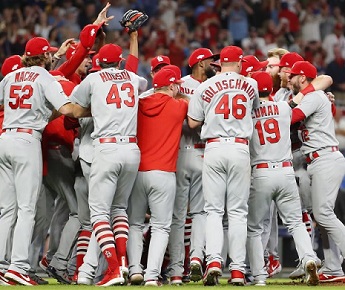
The Cardinals earned their coming NLCS berth . . . and their skipper earned them an image as unsportsmanlike winners with a postgame rant.

Until he was out-boxed and out-thought by Muhammad Ali in 1964, Sonny Liston was so brutal in the ring he inspired gags about knocking his opponents out before the weighing-in was finished. Forgive the Braves if they think they were stink bombed, pistol whipped, and machine-gunned before “Play ball!” finished escaping the umpire’s mouth.

In avian terms cardinals are seed-eaters by nature, not birds of prey. Don’t tell that to the Braves at any time from now until spring training. Because baseball’s Cardinals turned into glandular enough birds of prey in the top of the first Wednesday afternoon. Leaving no carrion behind.

The 13-1 final score almost didn’t matter. What the Braves incurred from the Cardinals not even Alfred Hitchcock could have conjured. Losing a tenth consecutive postseason set was bad enough. How the Braves were destroyed in Game Five of this National League division series was precedent setting.

No team in the history of division series play ever scored ten runs in a single inning until the Cardinals did it to open Game Five. They did it without one batter in Cardinals feathers hitting one into the seats. It went from small ball to medium ball. Not that the Braves cared, particularly. It hurt just as deep as if they’d been nuked.

Especially after they were four measly outs from going to the National League Championship Series themselves on Monday night. Before Yadier Molina singled home the tying run in the eighth and hit the game-ending sacrifice fly in the tenth in Game Four. Before the trip back to Atlanta. Before the early burial.

Before Cardinals center fielder Dexter Fowler, once a World Series-winning Cub whose St. Louis tenure hasn’t always been a joyful noise, got thatclose to striking out before wringing a game-opening seven-pitch walk out of Braves starter Mike Foltynewicz. Before the Cardinals sent ten runs across the plate without one single soul hitting one into the seats.

And before Cardinals manager Mike Shildt—who looks so prototypically like a nerd you’d think he knew no expletive stronger than deleted at first glance—delivered a postgame rant of the kind that usually comes when a team’s been battered, not the other way around.

Tommy Lasorda and Lee Elia, you’ve been upstaged. Meet Shildt, in one fateful moment he’d surely love to walk back now. Meet Shildt, the sorest winner on the planet.

Once upon a time another generation of Cardinals collapsed so thoroughly in Game Seven of the 1985 World Series after being jobbed by a blown call near the end of Game Six that they looked like unsportsmanlike chokers. Shildt made his 2019 Cardinals look like unsportsmanlike winners.

“They [the Braves] started some (excrement). We finished the (excrement),” Shildt growled. “And that’s how we roll. No one (fornicates) with us ever. Now, I don’t give a (feces) who we play. We’re gonna (fornicate) them up. We’re gonna take it right to them the whole (fornicating) way. We’re gonna kick their (fornicating) ass.”

Rookie Cardinals outfielder Randy Arozarena, a ninth-inning pinch hitter who finished Game Five playing right field, filmed Shildt’s rant and posted it to Instagram. That’ll teach him. He couldn’t delete the post or apologise fast enough once it hit the Internet flying. Too late. Way to soil your own achievement, boys.

Fowler may or may not have been lucky to survive long enough to wring that game-opening walk; on 1-2 he foul ticked a pitch by less than a hair. “Did I?” he cracked after the game. “That was so long ago I can’t even remember.”

Foltynewicz hadn’t walked a single soul in his Game Two start. Little did he know. And little did anyone in the joint know Cardinals second baseman Kolten Wong would even think about sacrificing Fowler to second, never mind doing it almost immediately. “After a good at-bat by Dex,” he’d say, “I told myself, ‘Just get him scoring position’.”

The Cardinals had one goal going in: take the Braves’ home audience out of the game as soon as possible. During the National Anthem if need be. They got close enough. After that, knowing they were sending Jack Flaherty to the mound, they figured a single run might be enough for the kid who pitched the National League’s ears off in the season’s second half.

“We know what kind of a pitcher Foltynewicz is and what he did to us last time and the way this series has been,” said first baseman Paul Goldschmidt, who beat out an infield hit right after Wong’s sacrifice. “We wanted to get on the board early.”

He forgot to mention the “often” part. And after left fielder Marcell Ozuna lofted a pitch that arrived around his toes into right to send Fowler home, Braves first baseman Freddie Freeman—as close to Old Reliable as the Braves have had since the retirement of Hall of Famer Chipper Jones—mishandled Yadier Molina’s hard grounder to load the bases.

Having the arguable worst week of his career as it was, en route a .200 NLDS batting average on four hits (including one homer and one double), six strikeouts, and one walk in 21 plate appearances, Freeman didn’t flinch after the massacre. “They got nine more runs,” he said. “That was pretty much the game right there.”

Matt Carpenter, penciled in to start at third base for the Cardinals, walked in a run. Tommy Edman, who’d taken Carpenter’s job during the season but was penciled in to start in the Game Five outfield, tore a two-run double down the right field line and chased Foltynewicz in favour of Max Fried. The Braves ordered a free pass to Cardinals shortstop Paul DeJong.

And Flaherty had the strange distinction of becoming the rarest breed of pitcher: one who gets to hit before he’s even thrown a single pitch. Not to mention facing his high school buddy and teammate Fried. And he walked Carpenter home.

“I’m laughing because Max is up there,” the righthanded boy wonder remembered after the game about approaching the plate. “I’m trying to keep a straight face. I looked up into the stands and saw my mom, which was great. She was smiling and all excited. I didn’t expect Max.” That’s nothing compared to what Fried didn’t expect.

He didn’t expect Fowler and Wong to hit back-to-back RBI doubles. He didn’t expect to throw a wild pitch to Ozuna for strike three enabling Wong to come home after Goldschmidt left Wong room enough to take third on a line out to right. You almost swore Molina grounded out to end the flood at last because he took pity on the Braves for one brief, shining moment.

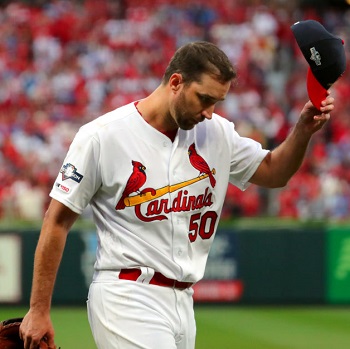
Adam Wainwright, who pitched heroically enough in Game Three only to see it laid to waste late, could barely believe what he saw from his seat in the Cardinal dugout. “Have you seen anything like that?” he asked before answering after the game. “We just kept the pedal to the metal . . . I was just trying to stay in the moment, but after that inning I came in to the guys and said, ‘I’ve never seen anything like that’.”

The rest of the game seemed almost ceremonial even if Flaherty didn’t exactly have an untroubled outing. He shook of first and second and one out in the first, shrugged off Josh Donaldson’s solo home run in the fourth, and survived a bases-loaded jam in the fifth when he lost control momentarily and hit Ronald Acuna, Jr. with a pitch.

Considering the testiness between Acuna and the Cardinals most of the series the easiest thought to indulge was Flaherty trying to send the Braves’ youthful center field star a message. Considering everything else by that time, there was no way Flaherty would send a message pitch with what was then a twelve-run cushion that should have felt more like a hot tub, especially since Flaherty faced Acuna in the first and walked him without so much as a thought of inside and tight.

Pitching coach Mike Maddux went out to the mound at once to settle Flaherty. He didn’t want his lad making the same mistake Foltynewicz made in that first-inning flood, crossing the line between pitching with emotion and emotionally pitching. Flaherty got the message and got rid of Freeman on a ground out to second for the side.

After the flood, the Cardinals flipped from opening with offense on the brain to pure defense. They moved Edman to third and Fowler to right and sent Harrison Bader out to center field immediately after they’d finished the ten-run opening act. As if to remind his team he knew good and bloody well he had more than a glove working for him, Edman tore one off the top of the right field wall for a one-out triple in the top of the second.

Paul DeJong didn’t give Fried a moment to breathe before he ripped the next pitch off the wall for an RBI double. And after Flaherty zipped through the Braves in order in the bottom, Luke Jackson relieved Fried. He walked Wong on a full count, struck out Goldschmidt, plunked Ozuna on the first pitch, and got a sharp grounder out of Molina.

A grounder Braves shortstop Dansby Swanson picked and shoveled to second baseman Ozzie Albies, and the ball hit Albies’s bare hand leaving all hands safe. Then Bader lined one up the middle to score Wong and, after Edman struck out, DeJong hit another first pitch right through the left side to score Ozuna.

Thirteen runs in three innings. The rest of the game felt like a plain formality. The Braves bullpen from Josh Tomlin forward kept the Cardinals so quiet the rest of the way you began to feel tempted toward asking Braves manager Brian Snitker whether he’d think about trying a purely bullpen game if he could get a Game Five do-over.

“I don’t know that I’ve seen that many guys hit in the first inning that quick in my entire life,” Snitker said. “I don’t know. It wasn’t how we drew it up, I know that. I don’t know. That thing just kept rolling and we couldn’t stop it.”

“Everyone had sky high confidence going into that game and them scoring ten runs, it’s hard to swallow,” said Freeman after the game. “Everything went wrong from the get-go.”

“You don’t expect something like that to happen,” Donaldson lamented, “especially with how well we played all season.”

Any more than you expected Shildt’s post-mortem potty-mouth.

Tony La Russa’s Cardinals beat the Dodgers in a 2004 division series and, after it ended, led his players across the field for a handshake-and-hug line with the Dodgers after the 3-1 triumph. (Effervescent Jose Lima’s Game Three shutout was the only Dodgers win.) It was a grand and entirely endearing gesture. And baseball’s then-chief of discipline Bob Watson reprimanded the Cardinals for it.

La Russa may have had his flaws, but ranting like a drunken sailor over the freshly vanquished wasn’t one of them. Where’s Joe Torre, fellow Hall of Fame manager who now has Watson’s job among his other duties out of the commissioner’s office, to reprimand Shildt?

Letting the kids play is one thing. Letting them enjoy the living daylights out of the moment when they do big things without being broiled by baseball’s Fun Police for it is another thing. But letting a manager get away with a Shildt-like rant after a win at all, never mind one as lopsided as the Cardinals’ on Wednesday? That’s [fornicating] something else entirely.

This wasn’t Yankee manager Aaron Boone going on his now-famous “savages” rant in support of his players after a couple of nasty arguments with a couple of questionable umpires. This was a manager whose team had just humiliated a worthy opponent but who couldn’t resist grinding his heel on their fallen necks.

Arozarena owned up to making a rookie mistake posting his manager’s postgame potty mouth. Shildt made his team look so juvenile that most other fan bases in baseball will forget how surreal their first inning achievement was and hope the Cardinals go down hard in the National League Championship Series.

And if they do, they’ll probably find Braves fans leading the anti-charge. With no jury in the land prepared to rule them unjustified. It’s the least they can be allowed now.

Sunday, bloody Sunday

2019 NLDS Game 3 - Atlanta Braves v. St. Louis Cardinals

Adam Wainwright’s Sunday virtuosity ended up going for naught.

Adam Wainwright had every reason on earth to feel nothing but a powerful desire to arrange Carlos Martinez’s necktie party Sunday. So did every citizen of Cardinal Country. So did every last baseball fan who prayed for and got an impeccable pitchers’ duel, with the Braves’ Mike Soroka playing Dickey Betts to Wainwright’s Duane Allman for virtuosity.

The duel that ended with Martinez’s Spike Jones sneaking explosives into the drums and the Braves standing one win from a National League Championship Series engagement. It’s a good thing for Martinez that Wainwright is a forgiving soul. He had no intention after the staggering 3-1 Braves win in Busch Stadium of doing anything but giving Martinez a big hug.

“And Carlos will be ready tomorrow,” the 38-year-old righthander who may be approaching the end of a solid if injury-compromised career. “Let’s hope one moment doesn’t define his season, because I’d like to see him get another chance.”

Unfortunately, Wainwright and Cardinals manager Mike Schildt may be the only one with that wish. “He’ll be in that spot [Monday],” the skipper said, “and I’ll have full confidence in him.” He says that now, but . . .

Even Braves closer Mark Melancon had Martinez’s back after the game. “You’re not looking to see guys fail,” he told a reporter. “You want to do it the right way, big on big and beat somebody. We’ve all been there. I can’t say that I didn’t want to win, but Carlos is an incredible pitcher. We’ve got to come back strong tomorrow because he’s going to come back, I’m sure.”

After opening with a leadoff double but two straight strikeouts Sunday afternoon, Martinez surrendering back-to-back RBI hits that broke the Cardinals’ backs and Cardinal Country’s hearts for the bottom of the ninth means nobody’s really sure. “There were some pitches that didn’t go where they were supposed to go,” the righthander said afterward. “I didn’t have the best grip on the slider. I tried to get that pitch to do what it was supposed to do and I didn’t get to it.”

The single greatest exhibition of pressure pitching of Wainwright’s life was laid to waste right there.

With an enviable enough postseason pitching record as it is—he has a lifetime 2.79 ERA and 1.03 walks/hits per inning pitched rate in October—Wainwright for seven innings couldn’t be stopped with a subpoena, never mind a S.W.A.T. team. Especially throwing the curve ball he calls King Charles, the way Mets legend Dwight Gooden’s curve was once known as Lord Charles.

If Wainwright wasn’t quite as masterly as the Astros’ Gerrit Cole the day before, he was close enough and too much so for the Braves’ discomfort. He nailed eight strikeouts, trusted his defenders just enough, didn’t let plate umpire Sam Holbrook’s microscopic strike zone faze him any more than Soroka did, didn’t let his own club’s lack of cash-in offense bother him, and made a 1-0 lead—acquired on a Marcell Ozuna double, a Yadier Molina ground out pushing Ozuna to third, and a Matt Carpenter sacrifice fly in the second inning—feel almost like a 10-0 lead.

Then, after Brian McCann popped out to the third base side near the plate to open the top of the eighth, Wainwright’s tank ran past E. Dansby Swanson shot one through the hole at short for a single. Soroka’s pinch hitter Adam Duvall lined out to third but Ronald Acuna, Jr. worked himself to a full-count walk, Wainwright’s first of the day. And Ozzie Albies walked on 3-1 to load the pads for Freddie Freeman.

Exit Wainwright, enter Andrew Miller, who hasn’t been the same as he was with the Indians thanks to their overworking him while he was hot and a couple of injuries to follow that have sapped his once-formidable repertoire if not his heart. The Cardinals needed it to be classic Miller Time in the worst way possible now.

And after a swinging strike to open, Miller got Freeman to fly out to Dexter Fowler in center field and strand the ducks on the pond.

The problem was, the Cardinals weren’t any better after pushing Soroka’s relief Max Fried in the bottom of the eighth. Fried walked Carpenter to open, with Schildt sending swift Harrison Bader out to run for the veteran. Bader distracted Fried enough to compel a walk to Tommy Edman before Paul DeJong flied out toward the right field line. Exit Fried, enter Darren O’Day.

Also enter Jose Martinez pinch hitting in Miller’s lineup slot. O’Day faked a throw over and Bader took off, only to get hung up between second and third before O’Day threw him out at third. Then Martinez hit a sinking liner to left that Duvall on his horse could only reach and trap. You could taste the RBI that wasn’t on a plate dipped in A-1 sauce.

Bader’s arrest for attempted grand theft loomed even larger after Sean Newcomb relieved Day and got Fowler to fly out to his center field counterpart Acuna for the side. Then Schildt put Bader into center field, moved Edman from right field to third base, shifted Fowler to right field, and called on Carlos Martinez.

Josh Donaldson might have ripped a double past the diving Edman at third and down the left field line into the corner for a leadoff double, but Martinez bagged Nick Markakis and pinch hitter Adeiny Hechevarria—who’d been 4-for-6 in that role since joining the Braves—back to back on swinging strikeouts.

The bad news was Donaldson’s pinch runner Billy Hamilton, whose road running on the bases is almost his only ability that enables him to play major league baseball, getting too much into Martinez’s head. So much so that when Hechevarria swung strike three Hamilton stole third without so much as a beat cop hollering “Stop, thief!”

“At the time you want to get to third with one out, so that was a bad break,” Hamilton told reporters after the game. “But getting to third even with two outs, what if Martinez bounces one in the dirt? I could score. And maybe he has to pitch the next guy differently.”

Then, after Molina and Martinez confabbed at the mound with Molina obviously upset and Schildt joining them to settle them down and get back to business, McCann—the potential go-ahead run—was awarded first on the house and Rafael Ortega assigned to pinch run for the prodigal Braves’ catcher.

Swanson checked in at the plate 0-for-6 lifetime against Martinez. Every star aligned in Martinez’s favour. “The Cardinals start doing game management,” said McCann after the game, “and then Dansby came up clutch.”

Clutch enough to send one off the left field fence and send Hamilton home to tie it at one. “God blessed me with good hand-eye coordination,” the Braves’ shortstop said after the game. “In those situations, you just try and breathe and relax. It’s easier said than done.”

And Duvall dumped a quail into short center down for a base hit, scoring Ortega readily with Bader throwing home but well off and over the third base line, enabling Swanson to score the third run.

Only after walking Acuna did Martinez escape, getting Albies to line out to right. And after Freeman made a sensational extension to hold a wide throw from shortstop and keep his toe on first base to nail Kolten Wong opening, Paul Goldschmidt banked a double off the right field side wall off Melancon. But Ozuna looked at strike three on the inside corner and Molina flied out to center.

It gave the Braves their first postseason series lead in seventeen years and gave the Cardinals a reminder of what they might have really lost when Jordan Hicks, their originally assigned closer, having a solid season to that point, went down with Tommy John surgery in late June. Might.

Maybe a healthy Hicks keeps the Braves pinned in the ninth Sunday. Maybe he doesn’t. Two days after Martinez barely survived to keep a Cardinal win a win, he didn’t survive. And the Cardinals get to host the Braves for Game Four on the fiftieth anniversary of making the trade that helped change baseball.

It was 7 October 1969 when they traded center field mainstay Curt Flood to the Phillies. The trade Flood rejected for the reserve clause challenge that went all the way to the Supreme Court before losing—yet pushing open the door through which Hall of Famer Catfish Hunter and then Andy Messersmith would escort free agency’s advent.

Fifty years ago, too, the Miracle Mets shocked the world with their division, pennant, and World Series triumphs. Their golden anniversary team couldn’t stay the distance even toward a wild card game spot. The Cardinals have bigger stakes to play for on the Flood trade’s golden anniversary.

And a lot to make up for to Adam Wainwright, who’d love nothing more than one more postseason start at minimum. He won’t say he’ll retire after the Cardinals’ season ends; he won’t say he won’t, either.

“(I)n my mind, I’ve got two more series to pitch through, you know?” Wainwright said Sunday evening. “We got the NLCS (and) the World Series pitch through. But first we got to win (Monday). That’s where my head’s at right now. But no, I never once felt like today was it. Either we’ve got more games to win, or I’ve got more games to pitch.”

If his injuries over the years keep him from thinking about the Hall of Fame, Wainwright at least thinks the way a Hall of Famer does. Against a group of Braves who don’t know the meaning of the word surrender just yet, that attitude needs to rub off a lot more on the Cardinals now.