The Braves get the lucky thirteenth

Freddie Freeman finally drives in the only run of the game . . . in the bottom of the thirteenth.

Put Commissioner Nero and his itch to fix what isn’t broken plus his allergy to fixing what might be to one side. The second loveliest word pair in the English language is “extra innings”—right there behind “play ball!” The Cincinnati Reds and the Atlanta Braves certainly believed in lovely word pairs Wednesday afternoon.

We just didn’t think they’d take it to a 12.5 inning shutout extreme while they were at it, before the Braves finally won 1-0 in the bottom of the thirteenth.

Neither did we think fourteen pitchers would combine for 37 strikeouts that only began with Braves starter Max Fried’s five in seven innings and Reds starter Trevor Bauer’s 12 in seven-and-two-thirds. That would mean twelve relief pitchers combining for 25 strikeouts.

It also meant history’s first Show postseason game that ever went scoreless for 12.5 innings. Not to mention Bauer become first in Show ever to throw seven-plus shutout innings with no walks and twelve or more strikeouts.

Now, Fried and Bauer were masterful. No question. But then they were also smart enough to exploit a pair of teams whose diets are dominated by long bombs. Teams who also spent six part of their first National League wild card game trying to hit eight-run homers and half a dozen parts running the bases like Dick Van Dyke trying and failing to avoid somersaulting over the ottoman after he’s only three steps through the front door.

Try not to miss the free cookie on second base to start each team’s extra half inning, either. It’s not part of the postseason, but still. Until Freddie Freeman knocked home the winning run in the bottom of the thirteenth, these Reds and these Braves spent the day proving that if they did have the cookies they still would have stranded them.

Except for the top of the tenth and the bottom of the eleventh in Truist Park, neither side could get anyone home even if they’d paid ransom remands. The Reds even stranded the bases loaded in the eleventh and the thirteenth. Atop an afternoon aboard which the Reds went 1-for-12 with runners in scoring position and the Braves went 1-for-10 likewise.

Freeman’s was the one that counted. With Amir Garrett on the mound for the Reds, and pinch runner Cristian Pache plus Ronald Acuna, Jr. aboard with one out, he lined a slightly hanging slider into right center field far enough for Pache to hit the plate unmolested.

For the Braves first baseman who prayed COVID-19 wouldn’t get him an early transfer to the Elysian Fields before the irregular season opened, it had to be the single most satisfying hit of his career to date.

It was the least Freeman and his mates could do after reliever Shane Greene left successor A.J. Minter with the bases loaded and one out in the top of the thirteenth. Thanks large for lunch, you could imagine Minter thinking as Aristedes Aquino checked in at the plate, I was dying for a jam sandwich, anyway.

Aquino wrestled Minter to 1-2 including four foul-offs before Minter lunged for and missed a changeup that broke so far low and away Aquino would have needed a search party to make serious contact. Then Minter served Jose Garcia just enough to hit a grounder up the middle that forced Mike Moustakas out for the side.

Memo to the Reds and the Braves hitters: When beasts like Fried and Bauer are on the mound, it’s wise men who heed the wise advisory, “Please don’t feed the animals.”

And, memo to everyone banging Reds manager David Bell for not putting Freeman aboard with a base open and only one out—Freeman may be the National League’s Most Valuable Player in waiting, but he’s far less effective against lefthanded pitchers (.250 batting average against portsiders this year) than righthanded. (.341.) And Garrett this year kept the lefthanded swingers to hitting .043 against him.

Lurking behind Freeman? Righthanded Marcell Ozuna, his 1.067 2020  OPS, and his penchant for demolishing lefthanders like condemned buildings and righthanders close enough to that. (.345 batting average against lefthanders this year; .333 against the starboard arms.) You want to pitch to that with the bases loaded, instead of chancing your man luring Freeman into a double play? Cream Puff the Magic Dragon Ozuna ain’t.

So Bell made the only move he could have made and left his lefthander in to face the lefthanded. You give Freeman all the credit on earth for jumping Garrett’s hanging slider. For better or worse there are times when doing the right thing isn’t as right as the other guy doing it.

Better that Reds fan is frustrated by Adam Duvall and Austin Riley collaborating on nailing Nick Castellanos at third in the sixth, when he tried taking the extra base on a single and Duvall thre the kind of strike requiring nothing but the best tag Riley could get down on Castellanos.

Or, by Aquino channeling his inner Little Leaguer with two out in the seventh, getting himself canned in a rundown between third and home. To think he reached base in the first place after a swing and a miss that dropped him on his can before singling to left with one out.

Now the Reds get to play Game Two hoping they can drop Ian Anderson and the Braves on their cans, instead of ending up singing, “It was a new day yesterday/but it’s an old day now.”

Fish fouled

Adam Duvall has just low-fives third base coach Ron Washington after helping the Braves to an eleven-run second and a 29-9 slaughter.

Not even Joe West’s umpiring crew working the game could prevent it. For all anybody knows, maybe even Country Joe himself took pity on the Miami Marlins and called the Hague–or, at least, the Georgia Department of Natural Resources—himself, to file on their behalf against the abuses they suffered in Atlanta Wednesday night.

Or, at least Marlins manager Don Mattingly might have slipped a note to Atlanta Braves manager Brian Snitker, asking only partially puckishly, “Brian, could we have the bottom of the second back? Pretty please? With tartar sauce on it?”

Call it the Fish Fricasee. But call the Braves’s 29-9 cleaning, scaling, and fileting the arguable nastiest combined attack of ground troops, close-cover strafing, aerial assault, and strategic bombing ever committed by them, their 29 runs setting a new franchise record.

Sure, the Milwaukee Brewers de-clawed the Detroit Tigers 19-0 in Comerica Park earlier in the day. Only they did it in gradual clips and snaps, a couple of runs here, a few there, a few more yonder. Who the hell needed that nonsense from rude guests when you had the hosts in Truist Park treating their oceanic guests like a shipment of cat food?

What started as a 2-0 Marlins lead got vaporised by fourteen Braves batters including four repeaters before Ender Inciarte showed the Fish mercy and cast his line for an inning-ending ground out to first base. The carnage only began with Dansby Swanson singling his way aboard against Marlins starter Pablo Lopez.

Lopez’s next two mistakes were back-to-back walks to Austin Riley and Adam Duvall. And then it began:

* Ozzie Albies returning from a month on the injured list pushed Swanson home with a ground out to first.

* Inciarte sent a sacrifice fly to the deeper region of left center field, tying the game at two.

* Duvall took third on the play and the Marlins called for a review to see whether third baseman Brian Anderson got the tag on the sliding Duvall’s leg before or after a) Duvall’s foot hit the pillow and b) Riley crossed the plate. The review said no, sir, umpire Hunter Wendelstedt making the emphatic safe sign.

* After Lopez walked Ronald Acuna, Jr., Freddie Freeman hit a line drive to right that diving Marlins right fielder Monte Harrison couldn’t grab, the ball bouncing under his blue glove, scoring Duvall and sending Acuna to third.

* Marcell Ozuna floated a pop to shallow left near the line that hit the grass before Miami left fielder Lewis Brinson could reach it, sending Acuna home. “And the Braves are first-and-thirding the Marlins to death,” crowed Braves broadcaster Chip Caray after the fourth run rang in.

* Travis d’Arnaud, the former Met, checked in with first and third yet again. He hit the first-pitch hanging changeup into the first empty row of the left field seats. The blast ended Lopez’s evening and it’s not impossible that the only thing the Marlins righthander could say when Mattingly came forth to end his misery was, “What took so long, Skip?”

Exit Lopez, enter Jordan Yamamoto for the Fish. Swanson greeted him with a base hit to left, then Riley shot one right between shortstop and third basemen trying to converge to send Swanson home. Then Duvall hit yet another first pitch into the right center field bullpen.

Yamamoto finally said too much was enough about the Braves’ first-pitch hitting and wrestled Albies to an eighth pitch. Unfortunately, it was finally ball three and a full count, forcing Yamamoto to throw a ninth pitch. And Albies drove it four rows up the empty center field seats.

A smooth-looking righthander otherwise, Yamamoto shares a surname with World War II’s Japanese Combined Fleet commander. What the U.S. Navy did to Admiral Yamamoto’s forces at Midway and beyond, the Braves did to the Marlins in the bottom of the second. They one-upped the ten-spot second under which they might have buried the Philadelphia Phillies two Sundays ago—but for the Phillies crawling back to make the Braves sweat out a 12-10 final.

Yamamoto the pitcher’s misery didn’t end when he and the Marlins finally escaped the second inning with what was left of their lives, unfortunately. He’d pitch two and two-thirds innings total and leave with twelve earned runs on his evening’s jacket. Making him only the second relief pitcher in seventy years to take twelve or more for the team, joining the sad company of Vin Mazzaro—who took fourteen from the Cleveland Indians for the Kansas City Royals in two and one third on 16 May 2011. He’d have had better survival odds if he was a World War II naval commander.

About the only thing the Braves didn’t do to the Marlins Wednesday night was drop the atomic bomb. Oops. Take that back. After a one-out single, a hit batsman, and a shallow base hit against another Marlins reliever, Josh A. Smith, Duvall—who also hit a three-run homer in the fifth—dropped the big one, slicing salami on an 0-1 meatball in the bottom of the seventh, for what proved the final four Atlanta runs.

Whoever files the report with the Hague, or with the Georgia department’s fisheries management, they’re going to have to include that. It might be the only time in history that a late atomic bomb did less damage and was less lethal than what happened earlier in the war.

Country Joe tosses the boss

Umpire Hunter Wendelstedt, unmasked, confabs (and points to Nats GM Mike Rizzo in the second deck) with masked crew chief Joe West Sunday.

Among many distinctions, not all of them affirmative, Joe West is now the man who threw out the first general manager of the season. The Washington Nationals aren’t the only ones among the barely amused.

What a weekend for Mike Rizzo. After entering spring training with his contract status unresolved beyond his own walk year this year, he finally landed the extension he deserved when all was said and done. He barely had time to savour it when he got into West’s crosshairs Sunday.

This pandemic-truncated season hasn’t exactly gone the way the defending world champions had in mind. They’re dead last in the National League East and next-to-last in this season’s crazed wild card picture. Their tragic number for elimination is sixteen. When the only National League outfit worse is the Pittsburgh Pirates, it’s enough to give last year’s self-resurrecting World Series conquerors pause going in.

Then the Nats spent the weekend with the Atlanta Braves and both sides seemed to spend much of it complaining that the umpiring was, shall we say, far less than exemplary or accurate. Rizzo all weekend was a particularly vocal complainer.

Thanks to pandemic-empty ballparks you can hear a lot more than perhaps you’d like to hear from the dugouts and even the men on the field or the coaching lines. There was Rizzo, all alone in a club box in the second deck of Atlanta’s Truist Park. Not a soul within a few hundred feet of him in either direction.

The next thing you knew, Rizzo was escorted from the premises by stadium security in the top of the seventh. That was as much a seventh-inning stretch as you could imagine in such surrealistic circumstances.

With the Braves up, 7-1 (they went on to win, 10-3), umpire Hunter Wendelstedt started pointing to the club level where Rizzo reposed and, apparently, objected to this or that call. “The umpiring crew, led by West, then went to call security,” writes Larry Brown. “The Braves’ announcers speculated that West might not have liked Rizzo complaining about balls and strikes. They also mentioned that Rizzo was not wearing a mask in the park.”

The mask issue seems a little like a red herring with no one within a hundred feet of Rizzo. Especially since a) West’s on record as thinking COVID-19 isn’t exactly a deadly enemy; and, b) Wendelstedt was unmasked while he confabbed with West, who was masked. They were probably ticked off most at Rizzo objecting to a strike call on a pitch that actually sailed in well enough off the plate while Nats infielder Asdrubal Cabrera batted.

Apparently, Rizzo kept barking over the pitch calls by the time first baseman Eric Thames batted on a 2-2 count. Then West pointed to the club boxes where Rizzo reposed and called stadium security after hollering, “You’re out! Get out!” Rizzo’s way.

“Should Rizzo be yelling at the ump audibly from his suite? Probably not, but it’s also the kind of thing that that happens every game,” deadpans Deadspin writer Sam Fels. “It’s the kind of thing that could probably be solved with a solitary look, or maybe a pointed finger. But no, that won’t due for hilljack Joe.”

You want to talk about delays of games? West held up the game so he could show Rizzo who’s boss around here. “Call security,” a voice hollered. You’d think objecting to dubious pitch calls equaled a small child refusing to go to bed when Mom and Dad so order. Unless Mom and Dad confuse proper parenting with tyranny for its own sake, they’re not Joe West.

“Joe West is the passenger on the plane who won’t let you out of the row to go to the bathroom because drink service will begin in five minutes,” Fels writes.

Joe West constantly tells the bartender when they’re low on ice. Joe West kettles protestors without informing them of curfew, then arrests them for violating curfew. It’s not so much that Joe West has to enforce the rules. He has to enforce that he knows the rules better than anyone. It’s not the order he’s after, but the acknowledgement, or more to the point the worshipping, of his knowledge and power.

West decided then and there it was time to show who knew the rules better than anyone. As His Holiness himself put it after the game, “I wouldn’t take that from a player. I wouldn’t take that from a manager. If it was Donald Trump, I’d eject him, too. But I’d still vote for him.”

Just let West try ejecting President Tweety. He’d be on the Trump tweetstorm target list faster than a base hit travels past the infield. And if West would have a GM thrown out of the ballpark for objecting to the umpiring, what’ll happen when fans—who aren’t exactly kind and gentle about questionable umpiring—are finally allowed to come back to the games?

Historically, umpires suffer neither fools nor protests gladly, even if they don’t always mind a little debate if the debator isn’t looking to show them up. The bad news is that even the best-humoured umpires lose their senses of humour when a questionable call is given.

The rules say players, managers, and coaches can’t argue ball and strike calls, and that if they head for the plate for such a protest they can be tossed. So can pitchers leaving the mound or batters stepping out of the box for such protests. But what about people in the stands, team personnel or otherwise? Umpires haven’t exactly been historically shy about throwing them out at certain times, either.

They’ve been known to eject ballpark organists or DJs for playing “Three Blind Mice” over bad calls. Or, for playing the theme from The Mickey Mouse Club. Or, for playing Bob Uecker’s sarcastic “Personally, I think we got hosed on that call” from Major League. They’ve been known to eject entire press boxes over catcalls coming down over questionable calls.

It’s one thing, too, for an ump to eject a fan suspected of doing a little sign-stealing on behalf of their hometown heroes. But good luck to the next fan who protests a pitch call by whipping up a placard that shows an eye test or performs a perfect impression of an optometrist’s business card.

Rule 4.06 bars managers, players, substitutes, coaches, trainers, and bat boys from “incit[ing] . . . by word or sign a demonstration by spectators.” (It also applies to broadcasters, technically, when fans cling to their radios in the ballpark as they’ve often done. Normally, though, such announcers escape with a mere warning.)

Rule 9.01(b) gives umps “the authority to order a player, coach, manager or club officer or employee to do or refrain from doing anything which affects the administering of these rules, and to enforce the prescribed penalties.”

Allow for pandemically empty ballparks allowing one and all on the field, in the dugouts, and even isolated singularly in the stands to hear every beef, debate, and expletive un-deleted. That said, just how could Mike Rizzo all alone in a second-deck club box objecting to pitch calls interfere with West and crew’s control of Sunday’s game?

If Rizzo was in that club box raining objections down with a full house of fans in the stands making their usual racket, only a dog could have heard it. The chances of West, Wendelstedt, and crew hearing his specific words would have been reduced to the margins and maybe further.

“We have already been in communication with the Nationals regarding what transpired during today’s game, and we will speak with the umpiring crew today,” said MLB’s government in a formal statement. “We will expect Joe West’s crew to provide a full account of their perspective, and we will follow up with them accordingly.”

Can you see the electronic strike zones and robo-umps coming a little more clearly in the rear-view mirror, too?

Sunday, bloody Sunday

2020-07-27 RickPorcello

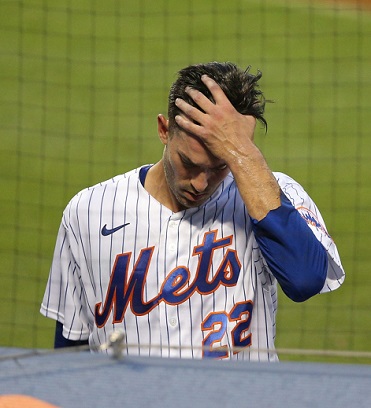
Rick Porcell wasn’t the only person in Citi Field smacking his head over Sunday’s carnage.

If the coronavirus doesn’t get the New York Mets, their pitching staff might based on Sunday’s lack of results. With apologies to Clark Griffith, Mets fans like home runs as much as the next fans, and—Jacob deGrom excepted—they seem to have assembled a pitching staff that is certain to please them.

Especially in the middle of the 14-1 massacre.

When Hunter Strickland, a relief pitcher who has surrendered a few significant launches in his past, is the first and only Mets pitcher to work an inning without surrendering anything more than a base hit that wasn’t cashed in one way or another by the Atlanta Braves, something is amiss.

Reviewing the Mets’ maiden season of 1962, Jimmy Breslin (in Can’t Anybody Here Play This Game?) ruefully observed, “For a Mets pitcher in 1962 only two things were certain. Either he was going to be hit for some of the longest home runs in baseball history, or he was going to have to stand helpless and watch his teammates make those amazing plays.”

Reviewing Sunday afternoon, any writer old enough to have seen the Original Mets is liable to write likewise. Except that Sunday’s Mets committed only one error through eight innings. They’re definitely not going to cut the mustard in Marvelous Marv Throneberry’s rumpus room at his Elysian Fields residence.

Four Braves hit for distance against the Mess Sunday, and they started that bombardment after the Mets already helped the Braves to a 7-1 score. The Braves started building that score on a pair of first-inning RBI singles and three RBI doubles in the third. The lone rude interruption was Brandon Nimmo doubling home Tomas Nido in the second. Why, the nerve of him.

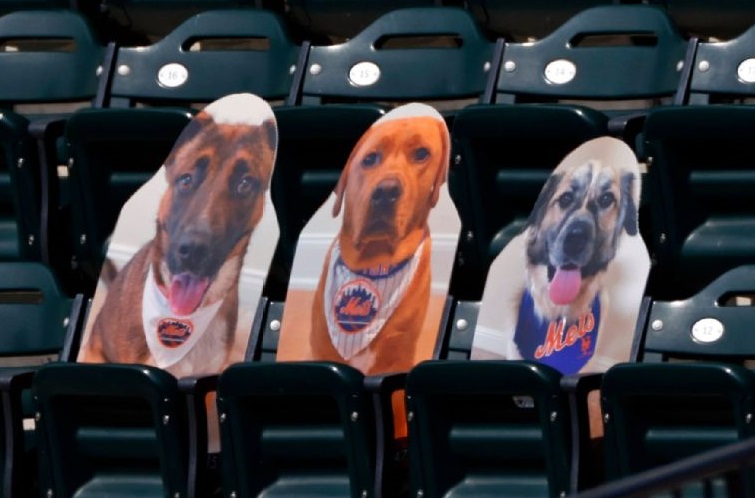
The cardboard cutout of Jeff McNeil’s Alaskan malamute pup, Willow, was joined by cutouts of five more Mets doggie friends. Maybe manager Luis Rojas should have sent Willow and her friends out there to pitch.

Instead, he started Rick Porcello, the erstwhile Boston Red Sox pitcher and very erstwhile Cy Young Award winner. The good news: Porcello didn’t give up a single home run. The bad news: His afternoon only began with those back-to-back RBI singles, with two out in the first, escaping only when former now-you-see-him/now-you-don’t Met Matt Adams—who hit one of those RBI singles through that delicious open meadow created by an infield overshift—was thrown out trying to take third on the second of those.

Porcello shook off back-to-back one-out singles in the second by tricking Ronald Acuna, Jr. into dialing Area Code 5-4-3. Nimmo returned the favour in the bottom of the inning when he drove Atlanta starter Sean Newcomb’s 1-2 meatball to the back of left field to send home Nido, who’d walked with two outs.

Then, after McNeil mishandled a throw from short on Ozzie Albies’s inning-opening grounder, the third inning is where the fun really began. For the Braves. With one RBI double to left center by Marcell Ozuna and, a walk to Adams later, a two-run double to the same neighbourhood by Dansby Swanson on a meatier meatball.

Rojas finally decided Porcello was punished enough for punishing the Mets and brought in Corey Oswalt to relieve him. Remember, the three-batter minimum for all relief pitchers this season, which can prove dangerous if the reliever in question hasn’t got much to deliver. Oswalt didn’t. Except as far as the Braves were concerned.

Did the Mets have to find a young pitcher who was especially certain to please the home run lovers among their fans? Oswalt was making his twentieth major league appearance. When it ended at last, he could claim to have given fans eighteen major league home runs worth of pleasure.

Met fans would prefer that he’d hit them instead of served them.

He fought Austin Riley to a full count before walking him. He threw Endier Inciarte a canteloupe down the middle and Inciarte ripped it to the rear end of right field, sending Adams and Swanson home on poor Porcello’s dollar. That’s how Porcello’s box score ledger shows seven earned runs allowed and only six outs obtained. Oswalt isn’t likely to appear on Porcello’s Christmas list this coming winter.

Then Oswalt got three straight outs to escape further use, misuse, and abuse. But the poor young man was sent out to pitch the fourth. Just when it looked as though he’d escape Freddie Freeman’s leadoff double, with two outs and a full count on Swanson, he threw Swanson a sinker that rose instead of sinking. And Swanson sunk it over the right field fence. Unlike his teammate Adam Duvall on Saturday, Swanson’s bomb didn’t hit a single doggie cutout in the seats. Oh, well.

Same old song and dance in the Atlanta fifth. Almost. Again Oswalt had two outs and a man on second. Only this time it was two outs to open the inning and Acuna doubling to left. This time, Oswalt threw the canteloupe to Albies for the RBI double to the back end of right.

The worse news was that Oswalt seemed too anxious to get the worst of it over with in the top of the sixth. Ozuna must have sensed it, too, because he drove a 2-1 service over the left field fence to open the inning. Oswalt then got two swift outs that looked soon enough as though he were just dying to serve up the next cantaloupe, this time to Riley, who sent it likewise over the left field fence.

Rojas finally decided Oswalt had suffered enough for his sins and sent Paul Sewald out to pitch the top of the seventh. We may be using “pitch” facetiously here.

Sewald had William Contreras 1-2 when he served something just enough for Contreras to whack into right for a leadoff hit. He tricked Acuna into forcing Contreras out at second on a grounder to third. To which Albies said, “It’s not nice to trick Junior Nature,” driving a 3-1 fastball over the center field fence.

Sewald escaped with a ground out, a walk, and a swinging strikeout. The scoring ended on the day. The final two and a half innings must have seemed like simply trying to put the Mets out of their misery once and for all. You didn’t even have the heart to tell them they’d faced four Atlanta pitchers, gone 1-for-8 with runners in scoring position, and left ten men on base.

Nor did you have the heart to remind them that Newcomb was taken out of the game after three and a third innings, despite an eight-run lead, because he was actually erratic enough to start seven of his first nine batters faced with balls instead of strikes, threw only slightly more than half his 82 pitches for strikes, plunked two, and threw a wild pitch. Because it would have reminded the Mets that they had but one run to show for such generosity.

The Mets didn’t waste any time after the game sending Oswalt to their alternate training site in Brooklyn after he worked those four horrific innings to be saddled with the official loss. Far as Oswalt’s concerned, it just might be the sweetest relief he experienced all Sunday long. Might.

The word emerged when the game was just about over that, presumably for safety’s sake, the Mets planned to travel to Boston for an engagement with the Red Sox aboard six chartered buses. Outfielder Michael Conforto said lots of Mets planned to bring their XBoxes and/or PlayStations for lots of Call of Duty play.

They may miss things like team dinners or dinners among groups of teammates on the road, but better to be safe than sorry and, anyway, they’ll have lots of Call of Duty players to help ease the burden. Except that what they need most in Boston is lots of baseball players. On Sunday afternoon, they didn’t seem to have many.

That’s the way the cookies crumble

2020-07-26 McNeil'sDog

I’ve heard of Bark in the Park but this was ridiculous, sort of: Cardboard cutouts of (left to right) Griffey (belonging to Michael Conforto), Kali (also Conforto’s), and Willow (belonging to Jeff McNeil), watching from the right field seats in Citi Field Saturday . . . moments before Adam Duvall’s home run caught Willow right in the snoot.

So you’re still not thrilled about those new rules this year about the free runner on second to open the extra inning or the three-batter minimum for relief pitchers? You’re not alone. Cleveland Indians righthander Mike Clevinger is on your side. (And mine.)

You could say Clevinger has solid reason. In the Indians’ second game of the new truncated season, after his rotation mate Shane Beiber came up one short of the Opening Day strikeout record, Clevinger saw his seven-inning Saturday start (ruined only by a pair of Kansas City Royals homers back to back in the first) laid waste by the cookie on second.

He also got to see the Royals’ new manager Mike Matheny roll serious dice and come up boxcars. The Royals got what proved the game-winning run without a single official at-bat on the ledger. We tried to warn you this kind of mischief was possible.

It went like this: Since the free cookie on second is the guy who batted last for the team, Kansas City veteran Alex Gordon opened the top of the tenth on second. Until he didn’t; Matheny sent reserve outfielder Brett Phillips to run for him to open. He ordered Erick Mejia to bunt Phillips to third, before Matt Franco sent Phillips home with a sacrifice fly to break the two-all tie.

After Royals second baseman Nicky Lopez walked, he got thrown out stealing with center fielder Bubba Starling at the plate. Then Greg Holland—the prodigal Royals reliever, far enough removed from the days he anchored their once-feared H-D-H bullpen (Holland, Wade Davis, Kelvim Herrera)—shook off plunking Indians center fielder Bradley Zimmer leading off and struck out the side in the bottom of the tenth.

Clevinger thought it was all about as amusing as a boom box aboard a hearse.

“This isn’t travel ball,” he told reporters after the game. “You know how hard it is to get a runner on second base off the back end of any bullpen, how incredibly hard that is? I’m not happy about it. I’m sure when other teams face the situation and this happens to them, you’re going to get similar reactions.”

Calling the New York Mets. They got burned but good Saturday afternoon. It was bad enough that closer Edwin Diaz followed an excellent save on Opening Day with having the Atlanta Braves down to their final strike—after he fell behind 3-0 on Marcell Ozuna—only to have Ozuna send one over the right field fence to send the game to the tenth tied likewise at two.

Then Mets manager Luis Rojas, knowing the three-batter minimum, sent Hunter Strickland (erstwhile Giant and National) out to pitch the tenth. This was something like naming Mrs. O’Leary’s cow the official mascot of the Chicago Fire Department.

The good news was that, unlike on outings past, Strickland didn’t have long balls to serve, a la carte or otherwise. The bad news was that, since the Braves didn’t exactly have bunts on their minds, Rojas didn’t think to order Strickland to put the inning’s leadoff hitter, Dansby Swanson, aboard—with Adam Duvall, the last Brave to bat in the ninth, as the free cookie on second—to set up a prompt double play.

Instead, Rojas let Strickland pitch to Swanson and the Braves’ shorstop lined a Strickland slider just above the middle floor of the strike zone into center field, sending Duvall home promptly with the tiebreaking run. Johan Comargo, the Braves’ lesser-hitting third baseman, bounced one up the middle that Mets late-insertion second baseman Andres Gimenez couldn’t spear to send Swanson to third.

If Rojas ordered Swanson a free pass to open the inning, Gimenez might instead have speared that bouncer for either a step-and-throw double play or a quick flip to shortstop Amed Rosario to dial Area Code 4-6-3. Leaving the Braves no recourse but a base hit to get Duvall home.

And the inning would have gone 3-2 to the bottom of the tenth, and the Mets’ run would have tied the game. Sending it to the eleventh and . . . oops. Free cookies on second and three-batter relief minimums to open each half inning there, too, if each skipper reached for a fresh bullpen bull.

Stuck now with Strickland having to face a third batter at minimum by current law, Rojas could only watch helplessly when Strickland got the Braves’ late-insertion center fielder Endier Inciarte to bounce one right back to the box but bobbled the ball before having to take the sure out at first. Now it was 4-2, Braves, and Rojas had all the legal room on earth to get Strickland out of there before playing with another match.

Oops.

Even with Drew Smith up and ready in the Mets’ bullpen, Rojas stuck with Strickland. And Strickland played with another match. William Contreras, the younger brother of Chicago Cubs catcher Willson Contreras, smashed a first-pitch slider to the back of right center for an RBI double.

Then Rojas brought in Smith. And Smith promptly got Ronald Acuna, Jr. to look at strike three before Ozzie Albies grounded out to first base for the side but a 5-3 deficit the Mets couldn’t overthrow in the bottom of the tenth. Not even with free cookie Jeff McNeil on second to open and Jake Marisnick (erstwhile Houston Astro) and Pete Alonso singling up the pipe to load the pads for pinch hitter Dominic Smith.

That was last year: Smith returning from the injured list for the Mets’ final regular season game, pinch-hitting with two on in the bottom of the eleventh, and hitting a game-winning three-run homer. This was Saturday afternoon: The best Smith could get this time was a measly sacrifice fly. Not enough. Mets catcher Wilson Ramos grounded to short to force Alonso at second for the game.

It only takes one game to make a manager go from resembling a genius, which Rojas resembled when the Mets beat the Braves on Opening Day, to a nut, which Rojas resembled trusting the top of the tenth—after his closer blew the ninth in the first place—to a once-decent relief pitcher whom the eventual world champion Washington Nationals practically ordered held hostage out of sight after he surrendered three homers in last year’s division series.

But if Braves manager Brian Snitker thinks he’s liking the extra-inning free runner and the three-batter relief minimum now, wait until his Braves get burned likewise by it in a game. He may have something different to say about it then.

I have something to say about it now: if commissioner Rob Manfred is still foolish enough to insist on using the free cookies on second to start the extra innings this season, then he should declare the three-batter-minimum for relief pitchers void for those innings. No questions asked.

At least there was one amusement for both sides before the game ended. Duvall smacked a home run off Mets starter Steven Matz in the top of the second. With Citi Field empty beyond a smattering of cardboard cutouts in the seats, Duvall’s blast sailed into the right field seats . . . where it smacked the cardboard cutout of one of McNeil’s dogs, an Alaskan Malamute puppy named Willow, sitting next to cutouts of outfielder Michael Conforto’s dogs, Griffey and Kali.

Right in the snoot.

If you’ll pardon the expression, the wags said it was the easiest game of fetch Willow played all year so far. The game result, however, had some thinking the poochie took such postgame requests as “Willow Weep for Me.”