ALCS Game One: Miller time for the Mariners

Bryce Miller, George Springer

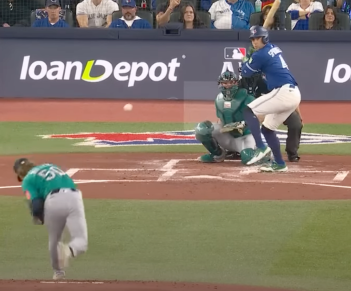
George Springer is about to demolish Bryce Miller’s first pitch of ALCS Game One. It was the only score Miller would allow over six otherwise spotless innings on short enough rest. (Fox Sports television capture.)

At the split second George Springer’s bat connected with Bryce Miller’s first pitch of this year’s American League Championship Series, you could be forgiven if you heard Mariners fans groaning. When the ball banged the Canada Dry sign above the right center field bullpen, you might have heard the groaning turn to moaning.

One pitch, one swing, the 21st postseason bomb of Springer’s career, and only the third leadoff bomb in League Championship Series history since pitch counting began in 1988, according to The Athletic‘s Jayson Stark. Just like that, the Blue Jays took a lead.

And Springer’s opposite-field smash on a fastball away, sending him past Hall of Famer Derek Jeter for fifth place on the all-time postseason bomb list, wasn’t the only reason Mariners fans groaned and moaned.

In the top of that first inning, they groaned, moaned, and fumed when the Mariners didn’t call for a review of that play at the plate on which Cal Raleigh (one-out hit, advancing to third on followup hit) was tagged out when it appeared he’d managed to get his foot on the plate through the legs of Jays catcher Alejandro Kirk. But television replays showed Raleigh’s foot landed a second or two after Kirk tagged his torso.

Were the Mariners unduly alarmed after Springer sprang?

Not after Miller wriggled out of further trouble in the form of a pair of walks courtesy of inducing a pair of line drive outs and a short fly out.

Not after Miller matched Jays starter Kevin Gausman point for point, dollar for dollar, from that point forward, until Raleigh atoned for missing the first inning score by squaring Gausman up, with two out in the top of the sixth, and driving a 2-2 service a little further than Springer’s traveled, about five rows up into the bleachers above that bullpen.

Not after Jays manager John Schneider decided that a followup walk to Julio Rodriguez should be he end of Gausman’s evening before he might incur jn any further damage. That came soon enough when Gausman’s relief Brendon Little wild-pitched Rodriguez to second and surrendered Jorge Polanco’s sharp opposite-field line RBI single to left to crack the one-all tie.

Not after Randy Arozarena wrung a leadoff walk out of Jays reliever Seranthony Dominguez in the top of the eighth, stole second and third while Raleigh suffered a called strikeout, then—after another walk to Rodriguez—came home on another Polanco steak, this time a spanker bouncing three times through the infield and a few more into right.

“I just choked up and wasn’t trying to do too much,” said Raleigh postgame about his bullpen-clearing blast. “I was just trying to get bat on ball and really put something in play, maybe find a hole. I didn’t want to punch out again.” He didn’t seem to mind putting that ball out of reach, out of play, and out of sight, either.

Kevin Gausman, Cal Raleigh

Raleigh is about to smoke Gausman’s splitter for a trip above the right field bullpen . . .

Aside from all that, it was Miller time. For a guy pitching on three days’ rest for the first time in his major league life. For six inning of one-run, two-hit baseball that including getting rid of seventeen of his final nineteen batters. He needed a little comfort from Raleigh at the mound while navigating his way out of that first-inning fire, but that was enough.

Miller went two innings longer than Mariners manager Dan Wilson expected him to go on short rest, only nobody told Miller until he was done for the night.

“They didn’t tell me anything, any plan,” said the lad who threw 27 pitches in the first inning and 49 the rest of his outing. “So I was going out there just letting it rip until they came out and got me.”

“That was incredible from him,” said Mariners reliever Matt Brash (now, there’s a classic name for a relief pitcher), who was one of three Mariners bullpen bulls along with Gabe Speier and Andres Munoz to pitch perfect innings once Miller’s time expired for the evening. Thus the 3-1 Mariners win Sunday night.

“I knew this was the biggest start of my career so far,” said Miller, whom one report revealed stood in Rogers Centre’s center field’s farthest location from the plate staring that direction to help focus, “and I just wanted to get out there and mentally kind of get in a zone and visualize having success on the mound.”

Miller’s season wasn’t always so simple. After a 2.94 ERA in 2004, he ran into elbow inflammation twice and an inflated ERA. He didn’t find himself on his horse fully until some time in August. Then he gave hints of his postseason potential in ALDS Game Four, pitching 4.1 shutout innings against the Tigers.

Remember: These Blue Jays are the ones who demolished the Yankees 34 runs worth in their American League division series and made the Bronx Bombers resemble the Bronx Broken. The Mariners got rid of 23 of the final 24 Jays hitters while they were at it. All of a sudden the Joltin’ Jays didn’t look all that intimidating despite Springer’s first-pitch flog.

Remember, too: These Mariners played fifteen innings Saturday to come out of their ALDS alive and reasonably well and leaving the Tigers for dead. They had to fly cross country and into Canada and endure a four-hour departure delay when mechanical issues forced their airline to get another plane up to Seattle from Los Angeles. They didn’t even have time for a Rogers Centre workout before ALCS Game One.

I’m not sure I’d recommend this as a continuous practise, but it seems as though now and then a team that should have been suffering exhaustion can turn one of the league’s howitzer corps to one side for one night. Now we’ll get to see if the Mariners can manhandle the Jays on a proper night’s sleep and with a proper pre-game workout.

We may even get to see Miller on the mound in a game that would mean the pennant for the Mariners if they win. The lad’s already proving that unthinkable isn’t necessarily impossible.

ALCS Game Five: Off, Guards

Juan Soto

Juan Soto and everyone in Progressive Field knew bloody well where what he just hit was going in the top of the tenth Saturday night . . .

A Guardian shortstop trying to will a tenth-inning double play before he had full control of the ball. A Yankee right fielder already in line for one of the biggest paydays in baseball history willing to wait for the fastball an off-speed-throwing Guardian reliever proved only too willing to provide.

Brayan Rocchio lost the handle on the toss leaving two Yankees aboard instead of side retired. Guards reliever Hunter Gaddis struck Gleyber Torres out but wrestled Juan Soto through six off-speed breakers and a 1-2 count before someone, who knows whom, thought Gaddis could sneak a fastball past Soto, if not lure him into an inning-ending out.

Good luck with that. Showing precisely why he’s in line for a mid-to-high nine-figure payday this winter to come, Soto got the fastball for which he probably prayed hard. Then, he launched it into the right center field seats with the Yankees’ fortieth American League pennant attached.

With one swing Cleveland’s Progressive Field went from extra-innings thrill to funeral parlour. If that was the ballpark mood, imagine the Guardians’ clubhouse mood when the game ended, the Yankees had a 5-2 ticket to the World Series in their pockets, and the Guardians could only think about how far they’d come in how little time only to feel the big wrench of having not quite enough.

“Because we were so close,” said left fielder Steven Kwan, referring to those in the Guards’ uniform, not necessarily the now-finished American League Championship Series, “it makes it sting a little bit more.”

For the Guardians and their respected rookie manager Stephen Vogt, it was the worst possible ending to an ALCS in which they’d made a better than decent showing—none of the five games was decided by a margin larger than two runs—but lacked the kind of putaway potency with which the Yankees seemed overendowed. On both sides of the ball.

Consider: Twice, in Games Four and Five, Vogt had the opportunity to keep Giancarlo Stanton from making mischief. He could have walked Stanton instead of pitching to him. He pitched to him. Stanton made him pay with interest.

Especially in Game Five, when Guardians starting pitcher Tanner Bibee kept Stanton in check in the sixth inning with nothing but pitches off the zone but not yet dispatched. That was the moment someone should have told Bibee one of two things: 1) Walk him, be done with it, then get rid of Jazz Chisholm, Jr., a far more feeble plate presence. 2) If you must pitch to Stanton, keep the damn ball off the zone.

Bibee tried. The slider aiming for the lower corner ended up hanging up under the middle. Stanton sent it hanging over the left center field fence. Tie game at two each.

Soto slammed home the pennant-clinching exclamation point (did anyone really doubt after that blast that the Guards would go quietly into that not-so-good gray night in the bottom of the tenth?), but there are reasons Stanton ended up as the ALCS Most Valuable Player award winner. In a word, he made it impossible for the Guards to contain him. Still.

This series: Four hits, every last one of them clearing the fences. Eight hits lifetime against the Guardians in the postseason, every last one of them bombs. Three set-clinching wins against the Guards (2020, 2022, Saturday night), and Stanton has dialed the Delta Quadrant in each one of them.

That was the last thing the Guardians needed in a set during which their biggest bopper, third baseman José (The Most Underrated Player in the League ) Ramírez, was practically the invisible man. Oh, he had two doubles and a homer in the series, scored a pair, sent three home, but on a Saturday night when the Guards needed every man to patch the sinking ship Ramírez went 0-for-4 with an intentional walk.

Ramírez wasn’t the number one Guard culprit, though. Their closer Emmanuel Clase recovered his regular season form too little, too late to make a big difference. Rocchio was a little too tentative at shortstop. The rest of the Guardian bullpen seemed gassed by the middle of Game Four.

None seemed more so than Cade Smith—who had the dubious honour of not being told to walk Stanton to set up a likely double play in the Game Four sixth, and being allowed instead to serve Stanton a rising fastball that didn’t rise enough for Stanton to miss planting it out of sight.

Those late home runs from Jhonkensy Noel and David Fry in Game Three sure seemed like last year’s news suddenly. And that Guardian bullpen dominance during the season sure seemed like a figment of somebody’s warped imagination now.

Clase and Smith didn’t surrender three homers all season—but they got ripped for three in this set. Gaddis couldn’t be touched with anything including subpoenas all season—but there he was on the wrong end of Soto’s proved-to-be-pennant-winning detonation.

The team called it, invariably, a season of growth. The Guardians did indeed grow into themselves this year, even if they now face of winter during which they may have to think of a tune-up or three. They own a generally weak AL Central division, but they can’t afford to perform a hot stove league disappearing act.

That they got here at all despite losing their ace starter Shane Bieber for the season to Tommy John surgery tells you something about their resilience and their will. Not to mention losing Triston McKenzie to so much struggling after his 2022 breakout that he was disappeared into the minors. Not to mention Logan Allen lost likewise. Alex Cobb and Matthew Boyd weren’t quite enough to make up for that.

So Vogt had to over-rely on his stellar bullpen. On the regular season they were bank. In the postseason their exhaustion collapsed them slowly but surely. To the point where there’s speculation now that Clase might be considered tradeable for some rotation reinforcement. Might.

The Guards needed more against these Yankees and simply couldn’t find or keep it. In Game Five, they needed more than the brothers Naylor collaborating on a run in the second and Kwan singling Andres Gimenez home in the fifth. A 2-0 lead with elimination on the line isn’t enough against these Yankees.

Not that the Yankees took them for granted. Just ask their oft-criticised general manager, who’s had his job so long some Yankee fans might actually believe he was the guy who first hired Miller Huggins away from the Cardinals to manage them.

“I remember just going, ‘Oh my God’,” said Brian Cashman when Soto dropped the big bomb. “Did the prayer sign. And then knew that we had to somehow put them down in the bottom of the inning, because these guys don’t go easy.” Not even when Lane Thomas hit into the final out of the set, a long fly ball . . . to Soto himself in right field.

All that without Aaron Judge swinging one of the big Yankee bats. He managed to hit a pair out this ALCS but the Leaning Tower of 161st Street was otherwise one of the sleepiest Yankees at the plate. (5-for-31; thirteen strikeouts; two double plays.) His awakening in the World Series would be anything but welcome in the opposing dugout.

On, Guards!

Cleveland Guardians

The Guardians celebrate their division series conquest. Ahead lay the Yankees for the pennant. Time for their star to be uncrossed at last?

The first time Cleveland went to the World Series? They were known as the Indians. And they won. (Yes. You can look it up.)

They edged to the 1920 pennant as the White Sox collapsed in the immediate wake of the Eight Men Out’s being suspended upon the Black Sox revelations. Then, they beat the Brooklyn Robins—your future Dodgers—in six games. (On the same day as the Series clinching game, ground for the Holland Tunnel joining New York to New Jersey was broken under the Hudson River. And, Man o’War, 1920’s Preakness Stakes and Belmont Stakes winner, beat 1919 Triple Crown winner Sir Barton in a match race in Ontario.)

The next time Cleveland went to the World Series? Still the Indians, and winning once again.

This time, they beat the Boston Braves, also in six games. Those Indians had a few Hall of Famers (Lou Boudreau, Larry Doby, Bob Feller, Bob Lemon, Satchel Paige) one of whom (Feller) provided a hand-held World War II spyglass with which he’d come home from World War II for through-the-scoreboard sign-stealing subterfuge down the stretch. Not very nice.

The next time Cleveland went to the World Series? Still the Indians. Burying the American League thoroughly in 1954.

So thoroughly that the usually triumphant Yankees could win 103 games and finish . . . second. As if to prove too decisively that no good deed remains unpunished, they were flattened in four straight by the New York Giants, a massacre that only began with a kid named Willie Mays and a certain play next to the Polo Grounds’ deep center field wall.

The next time Cleveland went to the World Series? It took slightly over four decades.

1995: A heartbreak loss to another team of Braves, this time roosted in Atlanta. Two years later: A worse heartbreak loss, off the bat of Edgar Renteria, swinging for a team barely entering kindergarten and destined to be dismantled posthaste, by their brain-frozen owner, before the champagne was barely washed from their hair.

The next time Cleveland went to the World Series? It took a sliver over two decades. Still the Indians.

They had the pleasure of tangling with another star-crossed team, out of Chicago. They had the 3-2 Series advantage. Those Cubs said, well, they have us right where we want them . . . and won the next pair, not without a lot of back-and-forth and wrestling. (And, one karmic Game Seven rain delay.)

Now, they are in their third year of life as the Guardians. They are about to begin an American League Championship Series against the Yankees, whose ancestors came up so short against them for the pennant exactly sixty years previous. And I find myself in an uncomfortable position.

You see, I have been a Met fan since the day they were born. The Mets are about to play the Dodgers in the National League Championship Series. Wouldn’t I just love to see the Mets elbow, shove, bop, wrestle, and shiv their way past the Dodgers to reach this Series? Of course I would.

The Mets haven’t won a Series in 38 years. That’s slightly more than half the time since the last Cleveland Series conquest. I have seen the Mets win two Series. I’ve also seen my Red Sox (fan since the 1967 pennant race) win four Series in this century. I’ve seen the Cubs finish a 108-year rebuilding effort with a Series win—against a team of Indians one of whom now co-leads the Mets in postseason field and batting mayhem. I’ve even seen Washington win its first non-Negro Leagues World Series since Calvin Coolidge had to finish Warren G. Harding’s term in the White House.

Far as I’m concerned, everyone else can just hurry up and wait a little longer. I don’t want my Mets to lose. But I don’t want the Guardians to lose, either.

The Guardians have been just as star crossed if not more so since 1954. You think being a Cub, a Red Sox, a Met, or a Dodger could be excercises in extraterrestrial heartache? (And, headaches?)

Ask any Cleveland fan about such curses as Rocky Colavito (traded as spring training 1960 was about to end) or disasters such as illness (physical and otherwise), injuries, or both, to such promising sprouts such as Max Alvis, Larry Brown, Tony Horton, Ray Fosse, and 1980 Rookie of the Year Super Joe Charboneau.

Ask any Cleveland fan about Ten-Cent Beer Night in ancient Municipal Stadium in 1994. (Also known as the Mistake on the Lake in the Mistake on the Lake.)

Ask any Cleveland fan what really happened to the team’s first major free agency pitching signing, Wayne Garland, after he signed a ten-year contract in 1977. (Answer: He injured his arm in his first spring training game, pitched through the injury anyway to prove he was worth his deal, but never regained the form that made him attractive to the team in the first place.)

Ask any Cleveland fan why the former Tribe lost future Hall of Fame pitcher Dennis Eckersley to a spring training 1978 trade. (Answer: a teammate having an affair with his wife.)

Ask any Cleveland fan about the year Sports Illustrated predicted they’d win the 1987 American League pennant . . . but went forth to finish dead last with 101 losses.

Ask any Cleveland fan about spring 1993. 1) Their new spring training home in Homestead, Florida was flattened by Hurricane Andrew. 2) They moved spring training to Winter Haven. 3) Relief pitchers Tim Crews and Steve Olin killed, and starter Bob Ojeda left alive with head injuries and long therapy to follow, when a legally-inebriated Crews drove his boat right into a Little Lake Nellie dock.

Ask any Cleveland fan if they’ve recovered from relief multi-instrumentalist Andrew Miller finally running out of fuel in Game Seven of that 2016 Series, then having one more stellar season in him despite a bad knee only to see the team fall to the Yankees in the 2017 division series.

It took five hard-played division series games and a Game Five dispatching of the Tigers’ best pitcher for the Guards to get to this ALCS in the first place. The exclamation point came from a guy acquired from the Nationals at the trade deadline. Lane Thomas went from the barely-known soldier to the man of the hour in the Game Five fifth when, with the bases loaded, he sent Tarik Skubal’s first pitch into the left field seats.

Now the Guards face the Yankees with key elements at full power. The side of Steven Kwan that suggested greatness has shown up thus far. José Ramírez, maybe the least appreciated superstar in baseball outside his home turf, is doing José Ramírez things. The Guards’ bullpen, maybe the best in the AL this season, suffers no fools gladly. Even those wearing Yankee uniforms.

These are the two best in the AL setting up to square off for the pennant. Almost like ancient times.

But I’ll put up with the usual hemming, hawing, gnashing, bellyaching, and execution demands from Yankee fans drunk deep of fractured entitlement (yes, they still think no World Series is legitimate without the Yankees in it) in order to see these Guards—perhaps the most star-crossed of this year’s LCS entrants and certainly one of the most star-crossed in major league history—come out of the coming skirmish with a World Series date and triumph.

Even if it might be against my Mets. (And it might be, even if the Mets didn’t look so wonderful being blown out by the Dodgers in NLCS Game One Sunday evening.) But I may sacrifice even that to see the stars uncrossed for Cleveland for once. Maybe.

Published originally at Sports Central.

ALCS Game Seven: Seriously!

Adolis García

García after scoring in the first after his own long RBI single. It was the prelude to a two-bomb, five-hit, five-steak night and nailing the ALCS MVP.

They may yet call the now-concluded American League Championship Series The Adolis García Show. And all it took was getting enraged over being hit by a Game Five pitch to kick the usually exuberant Rangers right fielder into overdrive that went to warp speed in Game Six then ludicrous speed in Game Seven. Seriously?

There are plenty who say the two sweetest words in a baseball fan’s vocabulary are “Game Seven.” They certainly were for the Rangers Monday night, blowing the Astros away from the ALCS, 11-4, taking all four games played in Houston while they were at it, and hoisting García as the ALCS Most Valuable Player while they were at it.

How do you possibly follow a dramatic late-Game Six grand slam after spending the earlier parts of that game striking out four times? García made the answer too easy in Game Seven: A first-inning RBI single for the second of three Ranger runs in the frame. A leadoff home run in the top of the third. A two-run single in the top of a four-run fifth. A one-out homer in the top of the eighth.

And, more than a little egg on the face of Astros relief pitcher Bryan Abreu, who’d drilled García so noisily in Game Five but came into Game Seven with the Astros already on life support. With one and all mindful that his two-game suspension wouldn’t be served until next season, after all, Abreu drilled the Rangers’ designated hitter Mitch Garver with one out in the top of the sixth, the out being (of all people) García popping out to Astros first baseman José Abreu.

One out later, Rangers first baseman Nathaniel Lowe hit a two-run homer to make things 10-2. García’s eighth-inning bomb might not have been absolutely necessary given the final outcome, but had to be as delicious an exclamation point to slam onto this set as anything else the Rangers might have found in making sure the Astros’ chances to become repeat World Series winners disappeared.

Seriously!

The Astros hardly helped themselves in the end. Bedeviled by injuries during the season and, almost inexplicably, playing below .500 at home while being a road powerhouse, manager Dusty Baker had to juggle and struggle to keep them in the races as well as take advantage of the Rangers’ September struggles to win the American League West by dint of having won the season series against the Rangers.

They knew the Rangers wouldn’t be pushovers. They had to know the Rangers made themselves more formidable with the five-game winning streak by which they opened their postseason. They simply didn’t bargain for how formidable the Rangers would prove in the ALCS despite the Astros winning all three games of the Arlington leg of the set.

In those three, the Astros out-scored the Rangers, 23-12 in Globe Life Field. But in Minute Maid Park, the Rangers out-scored them, 27-10, including back-to-back blowouts in Games Six and Seven. Any Astro fans thinking the road-warrior nature of the set would turn after Astros second baseman José Altuve’s dramatic three-run homer in the top of the Game Five ninth had that thinking yanked inside-out several times over.

The Astros only looked as though they seized the ALCS momentum there, and when DH Yordan Alvarez opened Game Six’s scoring with an RBI single in the top of the second. But Garver answered with a solo homer in the bottom of that inning, Rangers catcher Jonah Heim parked a two-run homer in the third, and—after another Houston run in the sixth—Garver whacked an RBI double in the eighth and García dropped his three-run bomb in the ninth.

And that bomb turned out to be just a prelude to García’s Game Seven destruction. On a night now-ancient Max Scherzer could have been had, but with only three runs to offer including veteran third baseman Alex Bregman’s third-inning, one-out solo homer, the Astros were had, instead.

They got nothing off Jordan Montgomery, usually a Rangers starter but coming out of the bullpen on an all-hands-on-deck night for both sides, over two innings despite pushing to first and second in the fourth. They could pry only one run out of Aroldis Chapman with Alvarez’s RBI single in the seventh; they could yank only one run out of Rangers finisher José Leclerc when Altuve hit Leclerc’s first pitch of the ninth down the line and over the right field fence.

This time Altuve’s eleventh-hour demolition went to no avail.

The Rangers jumped all over Astros starter Cristian Javier after Marcus Semien opened with an infield ground out. Corey Seager batted next and fired the opening salvo with a drive over the right center field fence. A walk and a theft of second later, García sent one flying toward the left field wall and stood a moment or two admiring it before it clanged off the wall and he was held to a single.

Before anyone had a chance to roast him for the moment’s admiration, García atoned for the extra base he didn’t take on that hit by stealing second himself, enabling Garver to send him home. By the time the evening ended, almost nobody was liable to remember that that first-inning drive might have just missed being a homer.

“He was hot,” Baker said postgame, “and he’s been hot the whole series. We did strike him out quite a few times. But he got us. There’s a whole bunch of stuff you can point to in that ballgame. And so we just got beat. Sometimes there’s no rhyme or reason. Sometimes you lose and sometimes you get beat. There’s a difference. We got beat.”

This time, no Astro pitcher even thought of letting García have it with a pitch his next time up after that long single. If anything, Astroworld and elsewhere was more likely to question why Baker didn’t elect to pitch around him the rest of the way. And, why Baker didn’t get one of his higher-leverage relief arms, Hector Neris, up and ready before Rangers left fielder Evan Carter’s two-run double started the Ranger runaway in the fourth.

First, they may have to finish questioning why he clung stubbornly to weak-hitting veteran catcher Martín Maldonado instead of reaching for better-hitting Yainer Díaz (whose season included 45 extra base hits) later in games.

They may also revisit questioning why owner Jim Crane and his front office pulled in no pitching depth last winter, letting Baker lean heavily on inconsistent Javier and Framber Valdez, and rookies Hunter Brown and J.P. France, while dealing with early-season injuries to Altuve and Alvarez. That’s where Crane felt enough of a pistol to his head that he gave the go signal when future Hall of Famer Justin Verlander was made available for trading by the Mets who’d signed him as a free agent last winter.

The Rangers didn’t make it easy for themselves to get here, starting September 1-6 and finishing it 2-4 to fall into a tie with the Astros after they were up in the AL West by as many as 6.5 games at one point in June. Keeping the proverbial eyes on the prize wasn’t exactly simple after that.

“When you get the right group of guys with the right leader in the dugout,” said general manager Chris Young, himself a former major league pitcher including for the Rangers his first two years, “you never underestimate a group’s talent and the way they come together and the way they pull for each other. It’s not always about the team with the most talent. It’s the team with the right talent.”

None more right, it turned out, than a guy on whom the Cardinals gave up and the Rangers almost did. García—who defected from Cuba on a flight layover in Paris following a not-so-successful stint in Japan—was signed by the Cardinals but designated for assignment by them. The Rangers signed him, designated him, but had to keep him when he found no takers.

Lucky they. García became a two-time All-Star including this season. Then, the Rangers came to this postseason and he turned it into his coming-out party. Especially Games Six and Seven. Especially setting a new postseason record with fifteen ALCS runs batted in, thirteen of which came in the set’s final four games.

But the Rangers and people around the team point to things that might have been obscured during his Game Five explosion over getting drilled his next time up after a three-run homer. They talk about his exuberance, yes, but they also use words and terms like “work ethic,” “a good leader,” and “empathy.” They’re not words just thrown around the way the Rangers threw the Astros around in the end.

“The ones who really dig in and lean in to the moment and enjoy it,” said Michael Young, a longtime favourite as a Rangers player who now works in their front office, “are the ones who have the most success. These last two games, there is nobody who had more fun than Adolis did. He enjoyed every last pitch. And it was obvious.”

The Rangers await whomever comes out on top between the Phillies and the Diamondbacks in National League Championship Series Game Seven Wednesday night in Philadelphia. The Astros go home to a few questions and few simple answers.

Their success in recent years, including six division titles in seven years, four pennants, and two World Series titles (the first of which will remain tainted forever, alas), may have spoiled them a little. Even to the point where they’ve started talking the way you expect out of the Yankees.

“Not a success,” Maldonado said of the year as a whole. “Of course not. I think for us a success is winning the World Series.”

“No,” Bregman said. “I think winning the World Series is a success.”

But now Baker has spoken of retiring at last. Altuve and Bregman enter the final season of their contracts. Veteran outfielder Michael Brantley—who missed most of the season recovering from shoulder surgery, then hit for a modest .653 OPS this postseason despite a home run helping the Astros nail their division series triumph—is thought to be considering retirement. There could be a few other changes coming.

Right now, the Rangers wouldn’t change a bloody thing. And their manager Bruce Bochy—who came out of retirement to take the bridge thinking a shot at the World Series was worth it, and who’s now managed thirteen postseason elimination games to wins as well as five pennants plus having three World Series rings managing the 2010s Giants—wouldn’t change a thing.

“So much heart and determination,” Bochy said of his Rangers as the champagne sprayed the clubhouse Tuesday night. Maybe none bigger than the outfielder who’d led the Rangers’ blast furnace all the way to a World Series engagement.

Seriously!

ALCS Game Six: Seriously?

Adolis García

That was Game Five: Adolis García at home, plunked and brawling over it. This was Game Six: García’s grand slam in Houston turning a tight Ranger lead into a blowout win.

Were the Elysian Fields demigods drunk Sunday night? Did Bryan Abreu appealing his two-game suspension, enabling him to pitch if called upon, absolutely have to mean he and Adolis García would square off again, in the top of the eighth, two nights after their confrontation turned into a bench-clearing brawl, three ejections, and the Astros taking a 3-2 American League Championship Series lead?

And did García just have to shake off his fourth swinging strikeout of the Game Six evening at Abreu’s hand only to turn a tight Ranger lead into a 9-2 blowout with a grand slam in the top of the ninth? Seriously?

Of course, to both. Because a) those demigods can rarely resist the opportunity for farce. And, b) because this is baseball, where (said before, saying again) anything can happen—and usually does.

The top of the ninth was absurd enough, with the Rangers loading the pillows on Astro reliever Rafael Montero with a leadoff walk (Josh Jung), a fielding error when José Altuve couldn’t handle Leodys Taveras’s high chopper charging in from second, and Marcus Semien setting García’s moveable feast table with a sharp base hit to left.

This is where you could see those Elysian demigods snickering behind their heavenly brewskis as Astros manager Dusty Baker brought Ryne Stanek in from the bullpen. Stanek got credit for the “win” when the Astros blew the Rangers out in Game Four, and now someone among the demigods had to have had the devil on the horn reminding him to collect his due.

First, Stanek hit Corey Seager with a pitch on 1-0 to send Jung strolling home with the fifth Rangers run. Then, Stanek had García at a 1-1 draw, before throwing him a fastball right atop the bull’s eye of the strike zone. It disappeared midway back into Minute Maid Park’s Crawford Boxes faster than any known American highway speed limit allows.

Thanks, Dev, you could hear the Elysians purring. Eff you, Ol’ Splitfoot, you could hear Astroworld fuming.

Two air outs to follow ended the inning but not García’s glory. On the night Abreu could pitch while appealing his two-game suspension for throwing at García in Game Five, García—who probably should have drawn a similar suspension for starting the brawl to follow when he got into Astro catcher Martín Maldonado’s grille over the driller—made himself the Rangers’ man of the hour.

Maybe even the entire ALCS, too. Even if Rangers starting pitcher Nathan Eovaldi could stake a claim with six and a thirds’ stout two-run, five hit pitching in which he struck out fourr and walked three. But Eovaldi, the solid defenders behind him, and the solid enough bullpen bulls to follow him, made you ponder whether they were merely toying with the Astros allowing a pair of runs on a first-inning RBI single (Yordan Alvarez) and a sixth-inning sacrifice fly (Mauricio Dubón).

Before García unloaded, he’d spent the night striking out swinging twice against Astro starter Framber Valdez, once against Astro reliever Phil Maton, and of course against Abreu. He looked so overmatched in those turns at the plate you could have forgiven him for wondering whether to carry a window, a door, or a great oak tree up to the plate his next time up.

Concurrently, Rangers designated hitter Mitch Garver enhanced one of his finest postseason nights—a game-tying solo bomb in the second; a two-out single telegraphing Josh Heim’s two-run homer in the fourth—by taking out late insurance for his team. After Abreu struck García out, Garver slashed a 3-1 slider on a high line to left that bounced once, ricocheted with a clang off the scoreboard wall, and enabled road-running mid-game Rangers left field insertion Evan Carter (leadoff infield hit; steal of second) to come home in the eighth with the fifth Rangers run.

The Minute Maid audience spent most of the evening booing lustily every time García checked in at the plate and cheering just as lustily every time he struck out. Then he sliced that ninth-inning salami. That was enough to quell the crowd’s appetite and send them starting to strike for the exits before the bottom of the ninth.

And, for Rangers reliever Andrew Heaney to throw four pitches for three ground outs to end the game. If you were an Astro fan still in the ballpark, those four pitches seemed like a mercy killing, no matter that the ALCS was now merely tied at three, but given this year’s Astros’ comparative weakness on the road including a 1-4 postseason record there so far.

Just don’t ask Astros left fielder Michael Brantley. “That doesn’t matter,” he said postgame. “It’s in the past. We need to turn the page and be ready for tomorrow.” They’ll need a lot more than page turning if precedent still matters—including the one saying that no team who lost more at home than on the road in the regular season has yet reached a World Series.

“It’s something you can’t explain,” Dubón said. “We could come tomorrow and win tomorrow and everybody would forget about it. It’s part of baseball. We win on the road. This year, we didn’t win at home and we have one more game to prove it.” Unfortunately, for this year’s Astros, that last remark could be taken two ways.

The Rangers probably couldn’t care less. They were a home powerhouse (.617 percentage) and just under .500 on the road during the season. Three of the four best road teams this year (the Braves, the Orioles, the Dodgers) were punted out of the postseason early.

The Astros, number four on the road overall, might be on the threshold of a postseason exit, but they’re still the Astros, and—in the phrasing of a one-time Astros coach—they’re not out of it until they’re out of it.

And the Rangers know it. Seriously.

Ask them why it’s been the visitors walking into the other guys’ houses and looting and plundering them, and Garver is stuck for an answer. “Seems a little odd nobody is winning at home,” he said postgame. “And I would like for it to stay that way.”

Stuck for an answer, too, is manager Bruce Bochy. “That’s the million dollar question,” said the man who managed the Giants to three World Series-winning games in five years on the road. Including the first of the lot—against a different collection of Rangers, in 2010. This group won’t take the Astros for granted no matter where they’re playing.

“I said it in August, it’s going to be a dogfight all the way to the end,” said Garver. “Really, really good ball club on both sides. They have pitching. They have hitting. But so do we. It’s one game to settle it all, and I think everyone is excited for that.”

Bochy is on record prominently as saying he doesn’t really like a lot of drama. Do you think Game Six changed his mind a little? He’d just been handed the Astros’ heads on a plate courtesy of one of the most dramatic late-game detonations in his team’s history.

“It’s been entertaining with me,” he said postgame. “It’s intense. There’s no getting around it. People ask you, ‘Are you having fun?’ Yeah, it’s fun, you try to enjoy it, but it’s intense out there. That’s what I came back for, to be in this situation. It’s exciting”

Seriously? What happened to the wish for little to no drama? Maybe Bochy knows that wish’s last stand disappeared the moment García’s salami did. Seriously.