A Stork hopes for delivery of pension redress

George Theodore

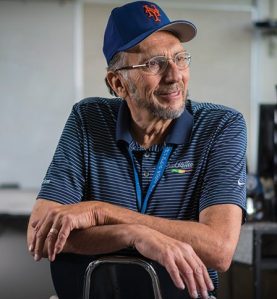
Just keeping this issue in the forefront is the best thing . . . Eventually, somebody who really has the power may say hey, I didn’t realise this was happening, let’s do something about it . . . Hopefully something can happen.”—George (The Stork) Theodore, a 1973 pennant-winning Met, shown here in 2016. (University of Utah photo.)

His major league playing career lasted 105 games, thanks largely to a 1973 outfield collision that resulted in a serious hip injury. But George (The Stork) Theodore remains a favourite among longtime Met fans and the organisation itself, invited to both the farewell of Shea Stadium and the opening of Citi Field, and invited to commemorations of the 1973 Mets’ pennant winner.

That was then: The 6’4″ Theodore endeared himself to fans with hustle when he got playing time, plus signing autographs amiably and talking to the sporting press with far more than mere boilerplate.

This is now: The Stork is a retired elementary school counselor, with a bachelor’s degree in psychology and master’s degree in social work, who’s been honoured for that work more than once, including an Educator of the Year award from the South Salt Lake Chamber of Commerce plus an Excel Teacher of the Year award.

“I was going to do that a few years. I was actually trained in medical social work,” said the 76-year-old former outfielder/first baseman, by phone from his Utah home, this week. “Then I found out that it was really my calling, and I enjoyed it, working with the young children in elementary school, and ended up with a career of 38 years there in the public schools.” About his awards as an educator, “I was honored at that, and humbled, because I didn’t feel I was any better than a lot of my compatriots.”

Drafted by the Mets in 1969, Theodore was a member of the ’73 pennant winner who had two World Series plate appearances, which he still calls “not bad” for a man who says he was on the Mets’ postseason roster mostly as a designated team cheerleader. But the Stork wishes only that the game he loved would favour himself and over five hundred more remaining players with short major league careers who played prior to 1980—and continue going without major league pensions.

He’s been interviewed often in the years since his playing career ended, but the pension issue isn’t always raised at those times. “It’s in a minor way,” he said of that subject, “but the interviews are basically about the ’73 team, though we try to sneak in something about the pension issue there.”

The issue, of course, is that when baseball’s owners and the Major League Baseball Players Association re-aligned the game’s player pension plan in 1980, they changed the vesting times to 43 days’ major league service time to qualify for full pensions and a single day’s service time to qualify for health benefits—but excluded such players as Theodore whose pre-1980 careers fell short of the former four-year vesting requirement.

Ask whether he could isolate whom among that year’s player representatives voted to exclude himself and his fellows—from each team’s player rep to then-league reps Steve Rogers (Expos pitcher, for the National League) and the late Sal Bando (Brewers third baseman, for the American League)—and Theodore isn’t entirely sure.

“I know they were kind of in a hurry to get [pension realignment] done to avoid a strike,” he said. “And I know that [original Players Association executive director] Marvin Miller—who was really the backbone of our union, getting all the wonderful things—was really disappointed that, as he looked back, that he didn’t pull in those people before and include them in that 1980 bargaining.”

The sole redress Theodore and the others have received since has been a stipend negotiated by the late Players Association executive director Michael Weiner with then-commissioner Bud Selig—$625 per 43-day service period, up to $10,000 a year before taxes. That amount was hiked fifteen percent as part of the 2021-22 owners’ lockout settlement. But the recipients still can’t pass those monies on to their families upon their deaths.

Had Weiner not died of brain cancer in 2013, would he have been able to go forward from the 2011 stipend deal to get something more? “That’s a good question,” Theodore  answered. “The whole system is not one of legality, but one of ethics. Baseball didn’t turn out to be what it is now just on it’s own. It’s been a slow, steady, building block process. And every player who played was a part of that.”

The Players Association formed originally to address pension issues in 1954. Its annual revenues now are believed to be $56.8 million. MLB’s annual revenues reached a reported $10.5 billion in 2022. Both the owners and the players kick into the players’ pension fund.

If those numbers are accurate, they add up to $10,556,800,000 per year. The union and the owners could agree to grant the remaining 500+ frozen-out, pre-1980 short-career players full pension status—based on their 43-day major league service periods—without going broke by a far longer shot than anything Shohei Ohtani can hit over the fence.

“I was just happy to be playing baseball and excited to get any opportunities,” Theodore said of his career. “I was one of the last people drafted.” [In 1969, round 31; one of the very few drafted out of the University of Utah.] “And so I knew my career was always in jeopardy. I knew many of my friends who signed at the same time, they’d have a bad week or two and they were gone.”

Because of that, he said, he wasn’t involved directly in Players Association actions, and credits A Bitter Cup of Coffee author Douglas Gladstone for helping to make him and numerous others of his short-term peers aware of the pension shortcoming.

Several pre-1980 short-termers have said they believe they were frozen out of the realignment because they were seen mostly as September callups. But most of the surviving 500+ either made teams out of spring training at least once or saw major league action in months prior to any September. Theodore himself made the Mets out of spring training in 1973.

The Stork was considered a strong defender with a good throwing arm and league-average range. “I was a fast runner, too,” he said. But the lack of game action didn’t bode well for his improvement as a major league hitter despite having recording solid batting marks in the minors. He had a splendid .817 OPS to show for his minor league seasons and posted a .972 OPS between A level and AA ball in 1971.

“I needed to play in order to be like that,” Theodore said. “Like many young players, playing once or twice a week, you don’t get your reflexes that you need.”

Deployed mostly as a left fielder in the majors, Theodore swears his better position was first base, where he played in eighteen major league games including twelve starts. “But we had John Milner there,” he said, “and Ed Kranepool, too. First base was really where I think I was the most effective because of my size and range. I could prevent bad throws just by stretching out.”

Still, Theodore became a fan favourite. “I always appreciated that,” he said. “I just know that I tried to give my best any time I played. Whether it would end up that way or not. And I responded to the fans, too. I enjoyed meeting fans and giving autographs. It was all new to me and I enjoyed every minute of it.”

His nickname didn’t hurt, either. Minor league teammate Jim Gosger—once with the Red Sox; an original Seattle Pilot;, and, very briefly, a 1969 Met when he completed an earlier trade (he didn’t make their postseason roster), before moving to two more teams and returning for brief spells with the ’73-’74 Mets—hung it on him. Theodore denies the longtime story that Gosger came up with the nickname when seeing the tall man holding a teammate’s baby.

“But he did call me the Stork, somehow” he said, chuckling. “I’m not sure why he decided on that nickname, but it stuck, and it endeared me to a lot of people.”
George Theodore

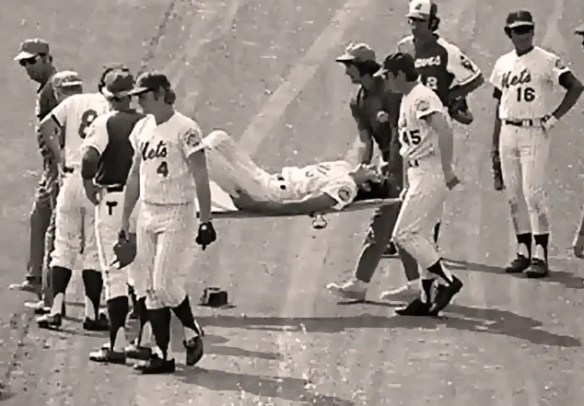
Theodore was carried off the field on a stretcher after a hip-dislocating collision with center fielder Don Hahn on 7 July 1973. Surrounding are (left to right) manager Yogi Berra (8), right fielder Rusty Staub (4), relief pitcher Tug McGraw (45), and second baseman Felix Millan (16). Braves center fielder Dusty Baker (12) looked on in concern.

But whatever further progress the Stork might have made ran into a thunderous obstruction on 7 July 1973. Atlanta’s Ralph Garr whacked a seventh-inning drive toward which Theodore and his close friend, Mets center fielder Don Hahn, converged in left center . . . and collided violently. Theodore suffered a dislocated hip while Garr ran out what proved an inside-the-park two-run homer, and missed most of the rest of the season.

Call it a classic Mets example of no good deed going unpunished. An inning earlier, Theodore led off with a walk, took second on a sacrifice bunt, and scored the game-tying run when Hahn doubled deep to left. The collision and Garr’s inside-the-parker in the seventh put the Braves up 5-3 (they’d scored on an RBI single just before Garr batted); the Braves eventually won, 9-8, in a game that changed leads twice more before it finished.

Theodore said he might have matured into a solid major leaguer had it not been for that injury, but he remains grateful that the Mets put him on their 1973 postseason roster. The ’73 Mets were an injury-riddled team until key regulars returned for the September drive that ended—under relief pitcher Tug McGraw’s rallying cry “You gotta believe!”—with them winning the National League East and then the National League Championship Series from the Reds.
George Theodore

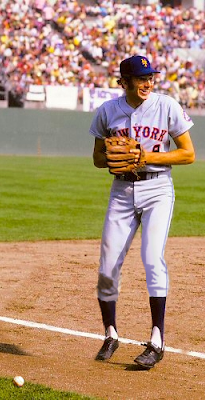
The Stork, tall and happy as a Met.

In the World Series, which the Athletics won in seven games, Theodore pinch-hit for Mets pitcher Ray Sadecki in Game Two in Oakland and grounded out to shortstop. In Game Four in New York, with the Mets up 6-1 (it proved the final score), Theodore was sent out to play left field in Cleon Jones’s stead for the top of the eighth, but he popped out to third base to end the bottom of the inning. Those were his only appearances that postseason.

“They didn’t have to do that,” he said of being on the postseason roster. “I hadn’t played for three months and I was more or less a cheerleader and emotional support for the team, until the World Series. Then all of a sudden I’m called to pinch hit and went into the outfield in another game.

“It’s funny how fate works,” the Stork continued. “Not playing for that long, and I felt very comfortable there. And then I went in for Cleon Jones, who was sick most of the game and throwing up out in left field, and it’s 35 degrees, I think. And [A’s third baseman] Sal Bando, hits a line drive out to left center field, and somehow I reacted and went and snagged that ball. It’s just kind of a surreal, you wonder, just who’s helping you make these moves.”

His days as a major league Met ended in 1974 (he’d retire after a 1975 at their Tidewater AAA farm), but that year handed him another kind of gift: he met a Met fan from Queens named Sabrina, who eventually became his wife and a Salt Lake City elementary school teacher.

Theodore cherishes his memories with the Mets, especially having as a teammate Hall of Famer Willie Mays in his final major league season until nagging injuries and age finally wore him down for good. And he cherishes likewise that Met fans still remember and appreciate him. But like his fellow pre-1980, short-career players, the Stork wishes only that some way, somehow, baseball will redress their pension shortfall more fully.

“We’re now in our 70s and 80s and maybe 90s, some players,” he said. “Just keeping this issue in the forefront is the best thing . . . Eventually, somebody who really has the power may say hey, I didn’t realise this was happening, let’s do something about it . . . Hopefully something can happen. If nothing more, the [Weiner-Selig] annuities can be increased. It’s amazing that we got the annuity in many ways.”

It would be more amazing if baseball awakened wide enough to understand Theodore and his fellow pre-1980, short-career players were frozen out of proper pensions wrongly in that 1980 re-alignment. At least as amazing as Theodore’s 1973 Mets turned out to be.

For eight departed, with one sad thing in common

Ed Bauta

Ed Bauta, the only MLB player to appear in both the final game played in the Polo Grounds and the first game played in Shea Stadium.

See if you can guess what the following players who left this island earth for the Elysian Fields in 2022 have in common, other than having particular moments in very brief major league playing careers.

These are only a few such players. Some had exemplary moments; some had moments they might have preferred to forget; but they, too, cracked the Show, however briefly.

Mike Adamson (RHP; died 7 May.) A relief pitcher who went directly from college to the Orioles after they drafted him in July 1967. He went directly from there to two innings’ relief against the Indians with the Orioles down four. A scoreless debut inning led to a pair of runs the next,  including Indians outfielder Chuck Hinton stealing home. Two more very short up and down seasons before a shoulder injury wrecked his pro career.

Ed Bauta (RHP; died 6 July.) A Pirate signing who went to the Cardinals in the 1960 deal landing the Cardinals their second baseman of the ’60s, Julián Javier. Knee issues got in his way; his lone full season was 1963. Bauta was the only player to appear in both the final major league game in the Polo Grounds and the first game in Shea Stadium, as a Met. The Mets sent him down for keeps in 1964; he pitched in the minors and the Mexican League until 1973.

Ethan Blackaby (OF-PH; d. 16 January.) He signed with the Braves in 1961, played in six 1962 games and nine 1964 games. He pinch hit for catcher/flake/broadcast legend Bob Uecker and swatted a double in his first major league plate appearance in September 1962, but he picked up only two singles the rest of his Show time.

Blackaby also played 1,073 games in the minors. Later, he was the part-owner and general manager of the Triple-A Phoenix Giants.

Carl Boles (LF-PH; died 8 April.) Major league career begun and ended in 1962. He came up to the Giants 2 August; he pinch ran for veteran catcher Ed Bailey and scored a tying run in the second game of a three-game pennant playoff between the Giants and the Dodgers. (The Giants lost the game 8-7.) Boles went from there back to the minors before playing in Japan from 1966-1971 and showed himself a power hitter, but never got another Show shot.

Bill Burbach

Bill Burbach—pitched the first no-hitter in Puerto Rico’s Hiram Bithorn Stadium during winter ball 1969-70 while trying to stay a Yankee.

Bill Burbach (RHP; died 20 July.) The first player picked by the Yankees in the first amateur draft in 1965. In the minors he faced ageless pitching legend Satchel Paige; Paige pitched one inning, Burbach struck out twelve—but walked eleven. Often pitching in hard luck, Burbach finally reached the Yankees in spring 1969. Second major league start: a five-hit shutout against Denny McLain and the Tigers on 20 April that year.

He pitched the first no-hitter ever delivered in Puerto Rico’s Hiram Bithorn Stadium that coming winter, but he only totaled 37 Show appearances (28 starts)—including a mere four in 1970 and two in 1971. Traded twice from there before deciding his baseball future had passed, he retired to work in the industrial lubricant business.

Leo Posada (OF; died 23 June.) A multi-sport star in Cuba before the Castro takeover. He arrived with the 1960 Kansas City Athletics and nailed his first major league base hit against Hall of Famer Jim Bunning, followed by a pair of three-hit games before the season ended. Had a somewhat solid 1961 (including leading the entire Show with twelve sacrifice flies), but manager Hank Bauer sent him down to the minors in 1962.

Posada never returned to the Show. But he played a few more years in the minors before becoming a respected minor league coach and manager whose charges including such future major league presences as Cesar Cedeño, Cliff Johnson, and John Mayberry. He also went on to spend sixteen years in the Dodger organisation . . . and, in due course,  he became his more fabled nephew’s personal swing doctor. You may have heard of that nephew: Yankee catching bellwether Jorge Posada.

Costen Shockley (1B; died 30 May.) If he’s remembered at all, Shockley is remembered for being sent (with pitcher Rudy May) from the Phillies to the Angels in the deal that sent legendary lefthanded pitcher/playboy Bo Belinsky to Philadelphia after the 1964 season . . . and for leaving baseball rather than keeping his wife and young child uprooted and nomadic on the West Coast.

“I took my family over baseball,” Shockley once said. “Do I think I could have played in the big leagues? Sure, I think I would have done well.”

Sad irony: 17 July was also the 1964 date Shockley made his first Show appearance, as a Phillie against the Reds, singling and scoring later in the seventh against Joey Jay. The following day, he hit his first of three major league home runs off John Tsitouris. After surviving the infamous Phillie Phlop, but realising the Angels planned to make him a minor league nomad, Shockley left the game in 1965 to work in construction and coach his son’s team to the Senior Little League World Series championship in 1981.

Bill Short

Bill Short’s Show career didn’t endure, but he made the International League’s Hall of Fame.

Bill Short (LHP; died 2 February.) The International League (AAA) Most Valuable Pitcher award winner, Short had an up-and-down, all-or-parts six-season Show life, including his only major league shutout (as an Oriole) on 1 July 1966, in the nightcap of a doubleheader against the Twins. That was the highlight of a 73-game Show career . . . but Short was inducted into the International League’s Hall of Fame in 2009.

What did those gentlemen have in common? They were among what are now about 505 short-career major leaguers who were frozen out of the 1980 pension plan realignment, a realignment that vested players for pension benefits after a mere 43 days’ major league service time and health benefits after a single day’s worth.

Various such pre-1980 short-career players to whom I’ve spoken over the past few years have told me the reason for their freeze-out may have been the perception that they were nothing more than September call-ups. As if that should have mattered, but these players saw major league time in months prior to September, even making teams out of spring training.

The only thing Adamson, Bauta, Blackaby, Boles, Burbach, Posada, Shockley, and Short received for their Show time while alive was a stipend swung between then-Major League Baseball Players Association director Michael Weiner and then-commissioner Bud Selig in 2011. It gave them and their fellow pre-1980 short-career men $625 per 43 days’ major league service time, up to $10,000 a year before taxes.

Last year’s owners’ lockout ended with those former players getting a fifteen-percent hike over five years to come in the Weiner-Selig stipend. Not only is it still insufficient, however grateful those players were to receive something, anything, but none of them—not Adamson, not Bauta, not Blackaby, not Boles, not Burbach, not Posada, not Shockley, not Short, not any of the remaining such short-career players, or others who went to the Elysian Fields this year—could pass the dollars on to their families upon their deaths.

The Major League Baseball Players Association continues to act as though those players no longer exist. The Major League Baseball Players Alumni Association continues to act likewise. Most of today’s major league players, several of whom earn the equivalent of a small island nation’s economy, are unaware of those pre-1980 short-career players and their freeze-out.

Legally, neither the MLBPA nor the MLBPAA are required to do a blessed thing. (Don’t get me started on the owners, most of whom didn’t own their teams in 1980.) Morally, of course, is another matter entirely.

Guest column: Gladstone—Pension shock for Shockley

Costen Shockley

Costen Shockley as a Phillie. After his trade to the Angels for 1965, he left baseball rather than return to the minors, fearing for his family’s discomfort.

By Douglas J. Gladstone

If you grew up rooting for the 1964 Philadelphia Phillies—and even if you didn’t, you’ve probably heard or read about the team because, by now, the story of that squad’s heartbreaking collapse over the last week of the season is etched in history—you probably remember Costen Shockley.

To countless Delawareans, Shockley was a legend. Not because he was one of the “Whiz Kids,” and not because he was all that great a player, but because he valued family first: he quit the game after being traded to the West Coast* so he wouldn’t have to abandon his wife and small child. He found jobs in construction and, by all accounts, never looked back or regretted his decision to place his family ahead of his career.

In a Society of American Baseball Research publication entitled The Year of Blue Show: The 1964 Philadelphia Phillies, the love Shockley had for his family was clearly in evidence. Authorr Mel Marmer quotes Shockley as having said the following:

In June (1965), when I approached (manager) Bill Rigney and asked if I was going to stay with the Angels, he said yes. So I moved my wife and baby out to California (from Delaware). Then (on June 12) they asked me to go to the minors instead, to Seattle. I wasn’t going to have my wife drive to Seattle. She didn’t know anything about the city. I never really adjusted to the big-league atmosphere. I wasn’t making any money then, only $1,000 a month. It cost me $600 to rent an apartment; I was using up my bonus money ($50,000); the major league minimum was only $6,000. . . So, I quit. I took my family over baseball. Do I think I could have played in the big leagues? Sure, I think I would have done well.

A resident of Georgetown, Shockley, who died on May 30, had his priorities straight.  Too bad neither Major League Baseball nor the union representing current players, the Major League Baseball Players’ Association, do.

See, Shockley was one of the ever dwindling group of retired men not receiving an MLB pension. As of this writing, there are only 511 left.

All these retirees don’t receive a traditional pension for having played the game they loved because the rules for receiving MLB pensions changed over the 1980 Memorial Day Weekend. None of these men accrued four years of service credit, which was what ballplayers who played between 1947–1979 needed to be eligible for a pension.

Instead, effective this past March, for every 43 game days of service a pre-1980 player accrued on an active MLB roster, all he receives is a yearly payment of up to $11,500.  That’s $718.75 for every 43 game days. By the way, that payment went up a whopping 15 percent. It used to be $625 for every 43 games on an active roster.

But now that he’s dead, Shockley’s loved ones won’t even get the $2,872 for his approximately four months of service; and that’s before taxes are taken out. Because if you’re a non-vested, pre-1980 player, the bone the league and union are throwing you cannot be passed on to a surviving spouse or designated beneficiary.

In rejecting the $300 million deal his former club, the Washington Nationals, offered him before signing with Philadelphia, current National League Most Valuable Player Bryce Harper famously rationalized that he didn’t want $100 million deferred on the back end of his contract. “What does that do for me?,” he asked. “What does that do for my family?”

Family means different things to different people, I suppose. The Pittsburgh Pirates embraced the concept of family when the team won the World Series in 1979. That is why MLB and MLBPA—Costen Shockley’s baseball family—need to do right by the remaining non-vested retirees now. Before it’s too late.

Douglas J. Gladstone is the author of A Bitter Cup of Coffee; How MLB & The Players Association Threw 874 Retirees a Curve.

* On 3 December 1964, Shockley was traded with pitcher Rudy May to the California Angels for notorious pitcher-playboy Bo Belinsky. May went on to enjoy a fine sixteen-season career for four major league teams, including the Yankees’ 1981 pennant winner.

Short-career pre-1980 players to whom I have spoken have attested that one reason for their freeze-out is that they were seen mostly as September call-ups. For the record, Shockley played his first major league game for the Phillies in July 1964; and, he made the Angels out of spring training 1965, playing in forty games before electing to leave baseball rather than go to the minors for his family’s sake.—JK.

Tiny sweetening for pre-1980, pension-less players

For 525 pre-1980 major leaguers, their cups of coffee are sweetened only slightly by a raise to their still-short-of-full-pensions annual stipend.

Once upon a time, a World War II-era radio commentator named Gabriel Heatter opened the lion’s share of his broadcasts with, “There’s good news tonight!” For 525 remaining pre-1980 short-career major league players denied pensions in the 1980 pension plan re-alignment, there was a small but significant spot of good news to start the week.

The New York Times‘s David Gardner, writing of one such player, Aaron Pointer, mentioned almost in passing that not only will Pointer and the others receive the annual stipend payments the now-solved lockout blocked in February, but the stipend will increase by fifteen percent over five years.

The stipend in question was arranged by the late Major League Baseball Players Association director Michael Weiner and then-commissioner Bud Selig in 2011. The original deal delivered $625 per 43 days’ major league service time for those players, up to $10,000 a year before taxes.

A fifteen-percent increase isn’t close to what those former players deserve, considering how unconscionably they were frozen out of the 1980 pension plan re-alignment, but it’s something. The bad news is that they still can’t pass their stipend to their families upon their deaths.

“That’s a good move, and I’m glad they remembered us,” says Pointer, the last full-season .400+ hitter when he did it in Class-D minors in 1961, to Gardner. “Although it could have happened earlier, and it should have happened earlier. A lot of guys who have passed won’t benefit, but it does help the guys who are still alive. It’s just a shame: It should have happened years ago.”

Several such players to whom I’ve spoken, since my first encounter with former Mets/Senators/Tigers pitcher Bill Denehy in 2019, have said they believe one key reason for their freeze-out was a perception that the bulk of them were only September call-ups, enjoying what journalist Douglas J. Gladstone termed—as the title of his book about these players and the freeze-out called it—A Bitter Cup of Coffee.

Denehy himself made all three of his major league rosters out of spring training, including as a rookie with the 1967 Mets. (His teammates included Hall of Famer Tom Seaver, with whom he shared a Topps rookie card that season.) A misdiganosed shoulder injury compromised his career; numerous, excessive cortisone shots have had the long-term effect of rendering him legally blind since early 2005.

The September question shouldn’t even have been an issue in the first place, particularly since the 1980 pension re-alignment changed pension vesting to 43 days’ major league service time, period, as opposed to the previous four years’ vesting time. It also changed the vesting time for qualifying for MLB’s health benefits plan to one day’s service time.

But I’ve begun examining the game logs at Baseball Reference of all remaining 525 such short-career, pre-1980 players. Running down in alphabetical order just the first 25 names on the list, none of those 25 were mere September call-ups.

Fourteen of the first 25 either came north with their major league clubs in at least one April or joined their teams during at least one April to play several games during that month. Three arrived in at least one May; four more, in at least one June; three more, in at least one July; and, one in at least one August. I suspect that, once I’ve seen the game logs of the remaining 500 names on the list, I’ll discover much the same.

Those players paid their MLBPA dues faithfully and supported any and all actions to begin prying players out of the abusive reserve era and toward their rightful free agency. Many of them had their moments in the sun of the Show even if they weren’t destined to become long-term players for assorted reasons, never mind superstars.

But you’ll be very hard pressed to find more than an extremely few sportswriters with national reach (Bill Madden of the New York Daily News has been a very notable and honourable one of them) who have written more than cursorily or by-the-way, if at all, about these men and their pension freeze-outs.

The Players Association’s first director, Marvin Miller, once told frozen-out players that in 1980 the money to cover them wasn’t yet available fully but he believed future labour agreements would repair that. Miller’s tenure ended in the early 1980s; Denehy, Clyde, and other such players have said Miller’s largest regret was that the union didn’t redress that 1980 mistake completely.

Those to whom I’ve spoken since 2019 have told me they believe that, if Weiner had lived (he died of an inoperable brain tumour in 2013), he would have worked to get further redress for themselves and their otherwise frozen-out short-career brethren.

But we’ll never truly know. And today’s major league players, flush as they are even in minimum-salary terms, seem barely aware if at all that these men, who helped make their justly-earned and not-begrudged riches possible in the first place, settle for a mere stipend instead of a full, just-as-deserved baseball pension.

Jack Smith, RIP: Haircut, shave, and pension throat cut

Jack Smith

Jack Smith, when he was a Dodger following seven years in their minor league system.

One of the last entries by longtime newspaper humourist Lewis Grizzard before his death in 1994 involved a haircut. Specifically, the one he received from “an old-school barber” whom he suddenly recognised as a one-time pitcher he’d seen with the 1960s Atlanta Crackers.

“THAT Jack Smith,” wrote Grizzard. “Hard to believe. There I was getting a haircut from a barber who was also a boyhood idol.”

Smith was a righthanded relief pitcher who’d bounced around the Dodgers system for seven years before he got a call-up in September 1962, when injuries sidelined reliever and former World Series MVP Larry Sherry temporarily. By his own admission, he was a hard thrower no matter what the pitch, but his number one issue was wildness.

He died at 85 on 7 April at the Westbury Health and Rehab facility in Conyers, Georgia, after a battle with Alzheimer’s disease. He was also one of the now 612 short-career major leaguers between 1949-1980 who were frozen out of baseball’s pension plan when the owners and the Major League Baseball Players Association re-aligned the plan in 1980.

That re-alignment changed pension vesting to 43 days major league time and health care vesting to a single day—excluding Smith and other short-career players during the time frame noted above. Their sole redress came by way of the 2011 deal between then-commissioner Bud Selig and then-players union director Michael Weiner: $625 per quarter for every 43 days major league time up to four years worth.

Weiner’s death in 2013 took further chances to get better redress for those players off the table, where the issue still remains, and where today’s players union director Tony Clark seems too little interested in revisiting it.

Once again, I find it unconscionable and morally repugnant that [the MLBPA] is turning its back on older men and their families,” said A Bitter Cup of Coffee author Douglas J. Gladstone, whose book first exposed the pension freezeout. “I’d love to know if Frances Clark and her three kids, Kiara, Jazzin and Aeneas, know how badly Tony is treating the men who ushered in free agency?”

A year after he won the Southern Association (AA) earned run average title with the Crackers, Smith appeared headed for another such title with Omaha (AAA) when the Dodgers called him up after Sherry’s injury. He appeared in eight games, finished two, saved one, and posted a 2.42 fielding-independent pitching rate that belied his 4.50 ERA.

The lone save was part of the Dodgers’ effort to stay in the pennant race and, in due course, force a playoff with the Giants. Smith relieved Hall of Famer Don Drysdale for the ninth. After walking Cubs second baseman Ken Hubbs and giving up a single to Hall of Famer Ernie Banks, he retired Hall of Famer Billy Williams on a fly out, surrendered a run on pinch hitter Nelson Mathews’s ground force out to shortstop, and shook off a second walk to get George Altman out on a pop foul near third base.

The effort sealed Drysdale’s 24th credited win of 1962, en route his only Cy Young Award, which kicked off a streak of five straight Cy Young Awards (then strictly a major league award) awarded to Los Angeles pitchers: Drysdale, fellow Hall of Famer Sandy Koufax thrice (1963, 1965-66) and Angels righthander Dean Chance (1964).

Smith appeared in the first two of the three 1962 pennant playoff games. In the first game, he got the sixth inning-ending double play after Sherry surrendered back-to-back home runs by Hall of Famers Willie Mays and Orlando Cepeda and pitched a shutout seventh, in a game the Dodgers lost 8-0. (Still struggling for a rhythm after a long layoff due to a finger circulation issue, Koufax himself got hit for a two-run homer by Mays in the first and a solo by Jim Davenport in the second.)

But Smith wasn’t quite so successful in the second game despite the Dodgers’ win. With the Dodgers up 7-5, he took over for Ron Perranoski after back-to-back singles (Davenport and Mays) opened the Giants’ eighth. He surrendered an RBI single to Ed Bailey and lost Cepeda when Frank Howard playing right field misplayed Cepeda’s fly.

Smith yielded to Stan Williams, who walked Felipe Alou and surrendered a sacrifice fly to John Orsino with the run charged to Smith, before getting Jose Pagan to ground out to third and getting the Giants out in order in the ninth. Ron Fairly won the game with a sacrifice fly. (The Giants won the third game and the pennant, 6-4.)

Jack Smith

Smith as a Brave; when they sent him down to the Atlanta Crackers, he decided to trade pitching for barbering after a final baseball season in 1965.

He made the Dodgers out of spring training 1963 and posted his arguable best major league effort on 28 April, against the Cardinals, with 4.1 innings of shutout ball, after the Cardinals jumped Johnny Podres for two in the first and reliever Ken Rowe for five in the second. The Dodgers managed to close the deficit to 7-4 while Smith was in the game; the Cardinals went on to win, 9-5.

After he relieved Pete Richert for the sixth, with the Dodgers in the hole 8-0 to the Pirates, the Pirates tore four runs out of him before he got the side out, a sacrifice fly by Smoky Burgess and a three-run homer by Bob Bailey. It was the last inning Smith pitched in a Dodger uniform; he was sent back to the minors, where the Milwaukee Braves claimed him in the subsequent Rule V draft.

He had a decent 1964 with the Braves, making 22 appearances, finishing nine games, and posting a 3.77 ERA and 3.70 FIP, but the Braves sent him down to the Denver (AAA) in the Pacific Coast League. In 1965, the Braves moved him to the Crackers, who’d moved to the AAA International League and become a Braves affiliate since he’d pitched for them last.

Smith had a solid 1965 in Atlanta (the Braves themselves, of course, moved there for 1966), but he decided he was tired at last of flying around the country playing baseball. He’d gone to barber college in the off-seasons and even brought some of his gear to the Braves clubhouse.

Smith opened an Atlanta barber shop, Smitty’s Bullpen, in a Marriott hotel while with the Crackers his second time. The place was so successful (then-Braves manager Bobby Bragan was a semi-regular customer) he decided to stay with it full time, retiring from baseball after the 1965 season, and finally retiring as a barber in 2016.

Some of those who follow the short-career player pension issue believe one reason they were frozen out was that they were viewed as little more than September call-ups. Smith was one in 1962, but he was on Opening Day rosters with the Dodgers in 1963 and the Braves in 1964.

His major league life didn’t last long enough to be part of the players union’s emergence as a serious force in the game. His career ended before a committee led by Hall of Fame pitchers Robin Roberts and Jim Bunning, plus veteran pitcher Bob Friend and outfielder Harvey Kuenn, led to Marvin Miller’s hiring as their first independent executive director.

Smith wasn’t there to be part of the Players Association pushes and actions that led in due course to Curt Flood’s courageous but failed reserve clause challenge; the bidding war that followed Catfish Hunter’s free agency after Charlie Finley reneged on a contracted-for insurance payment; and, Andy Messersmith’s pitching without signing a 1975 contract, then taking it to arbitration and winning the end of the reserve era, finishing what Flood started.

But Smith and his fellow 1949-80 short-career players weren’t allowed to pass the monies provided by the Selig-Weiner deal of 2011 on to their survivors after their passings. Smith is survived by his wife, Susan, three children, two stepchildren, six grandchildren, and four great-grandchildren. He may not have received grand dollars from the Selig-Weiner deal but they were something, after all. If any remained yet to come, they stopped with his death.

“It’s worth contemplating a reassessment of this,” wrote New York Post columnist Ken Davidoff, in an early February profile of a Smith contemporary, former Yankee reserve outfielder Jack Reed, “because these guys are part of the game’s tapestry and history that make it so special.”

When Hall of Fame manager Casey Stengel skippered the calamitous Original Mets, he once told his barber, “Haircut, shave, and don’t cut my throat, I may want to do that myself.” Smith’s post-baseball success as a barber doesn’t change the fact that he and his fellow short-career pre-1980 players had their throats cut.