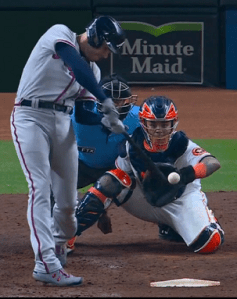
“A wonderful vessel, but not what defines you”

Buster Posey, Kristen Posey

As his wife, Kristen, looked and listened, Buster Posey announced his retirement officially Thursday afternoon.

When Sandy Koufax first re-appeared in a Dodger uniform, joining the team as a low-keyed organisation pitching coach in spring 1979, Thomas Boswell profiled him for a Washington Post Sunday magazine feature. He’d dropped out of sight just to live life several years after leaving a gig with NBC’s old Game of the Week, returning almost as quietly as he’d slipped away.

The return, and Koufax’s introspection, led Boswell to conclude, “Koufax has seen through the veil of his game. A sport can be extremely difficult without being extremely important. Baseball could fascinate him, but not control him.” This week, the still-young man who may yet prove the second-youngest Hall of Famer to retire at or near his peak gave a similar impression.

Just as with Koufax over half a century ago, you can pull a pocketful of definitions out when Buster Posey’s name is mentioned. They can begin with knowing both, generations apart, played only twelve seasons of major league baseball until walking away before the game could walk, push, or shove them away.

You can pull out all the individual honours (from a Most Valuable Player award to two Comeback Player of the Year awards), three World Series championships, catching a perfect game and a few mere no-hitters. But you can also join Posey’s hand to Koufax’s for having the heart, soul, and presence of mind to pass it on before it was passed on for them.

As a pitcher, Koufax is frozen in time, the thirty-year-old lefthander still at the mountaintop, leaving the game before the extreme pain through which he pitched could throw him into a ghastly decline. As a catcher, Posey is liable to be frozen likewise, a 34-year-old still within his peak, leaving the game before the extreme pain through which he caught and hit could do the same thing.

These two fundamentally decent men put baseball away in order to rediscover things called living.

For Koufax, who played the game as a low-keyed bachelor, it was a time to get to know more about and live as the quiet man with more individual interests and self-education than many who played the game with and even after him. For Posey, it’s time to get to know more about his family and about the family guy he’s always been anyway.

When Posey made official Thursday what was first reported Wednesday, he didn’t so much reveal it as remind us of it.

His wife, Kristen, sat next to him at the podium. Their sixteen-month-old adopted twin daughters, Livvi and Ada, accompanied the couple’s ten-year-old fraternal twins, daughter Addison and son Lee.

His former manager, Bruce Bochy, accompanied the family to Oracle Park for the press conference. “He gets it. He gets it,” said the skipper with whom Posey and their Giants won those three World Series in 2010, 2012, and 2014. “The game, the pitching side, everything. He was just born to play baseball.” But Posey gets an awful lot more than just the depth of his game.

“First of all,” he began, “I’d like to thank the woman sitting up here with me today . . . You know better than anybody how hard, sometimes, I would take not performing the way I wanted to. But your love and perspective about what was truly important helped me through those times . . . I’m so excited to continue sharing life with you and watching our kids grow.”

“He was there,” wrote Andrew Baggarly, the Giants writer for The Athletic who broke the story of Posey’s retirement, “to let go of a baseball life, to move forward with the next phase and to fully wrap arms around the only role that he ever allowed to define him: husband, father, family man.”

Like Koufax in 1966, it turned out Posey went to spring training 2021 intending it to be his final season, come what may. What came was staggering enough.

Koufax led his 1966 Dodgers to a World Series and won a third major league-version Cy Young Award. Posey helped lead this year’s Giants to a 107-win season; he posted his highest single-season slugging percentage since his MVP season; he was ten defensive runs saved above his league’s average for catchers; he landed that second Comeback Player award.

Koufax walked away from a six-figure income that was baseball’s highest for any player at the time. Posey left a $22 million option for 2022 that nobody believed the Giants would reject. There was a $3 million buyout in his contract, but Baggarly says Posey and the Giants are negotiating how to turn that into an as-yet determined role in the organisation itself.

The Georgia guy who grew up rooting for the Braves but plighted his baseball troth to the Giants wants to keep it that way, even as he returns to Georgia for a spell to re-connect with his roots.

As a catcher, Posey retired the way he wanted to retire, as a Giant. As a man, he wants to remain a Giant one way or another without putting his family behind him. Baseball’s arguable best all-around catcher of the 21st Century’s second decade, too, saw through baseball’s veil and accepted what he saw without regret.

When he thanked his parents at Thursday’s announcement, Posey made a point of saying they’d given him “the foundation of knowing that baseball is a vessel that can be used to create wonderful memories and impact people’s lives, but ultimately it’s not what defines you.”

Koufax told Boswell of playing the game, “You are part of an entertainment. But you are not an entertainer. That is unnatural. But I enjoyed doing it . . . probably even more than the fans enjoyed watching. I thank them for enjoying it with me.”

Posey was at once part and parcel of maybe the single greatest decade the Giants have known since moving to San Francisco in the first place and unable to call himself the common element. “To me,” he said, “this is what encapsulates baseball. It’s a lot more than just winning or losing games, although the wins do feel a lot better.”

It’s about the time spent with family, the countless nights and days, pulling for your team, riding the emotions of the highs, riding the emotions of the lows, and ultimately enjoying the people you’re with along the way and making great memories together. I’m so very humbled to play a part in some of those memories.

If Posey like Koufax walks away as much because the pain of his profession within a profession—the hip, back, knee, ankle injuries, the concussions—makes that profession impossible to practise properly anymore, he had a Koufaxian way or referencing it.

“I don’t regret one minute of the last twelve years,” Koufax said at his retirement press conference, “but I might regret one season too many.”

“It was just getting to the point where things that I was enjoying were not as joyful anymore,” Posey said. And that was it.

“Thursday’s gathering was not about adulation,” Baggarly wrote. “Posey didn’t need anyone to give him his flowers. His ego didn’t demand it. It felt more like a graduation of sorts, an acknowledgment that one part of his life was ending and an eagerness to embrace the fullness of his family. It’s someone else’s turn to slap the lectern at City Hall and say, ‘Let’s go win it again next year’.”

What remains—beyond a wish of Godspeed to Posey, his wife, his children—is a brief fantasy. The fantasy of a fully-matured Sandy Koufax going into that once-familiar windup, broad leg kick, and elegant, forward-snapping delivery, throwing one of his elusive fastballs or voluptuous curve balls to Buster Posey behind the plate.

Even Giant fans who’d rather be dead than Dodgers, even Dodger fans who’d rather be dead than Giants, might agree that these two inviolable men, knowing better than most of their contemporaries where they belonged in the game, knowing sooner than most when the game no longer belonged to them, would make a transcendent battery.
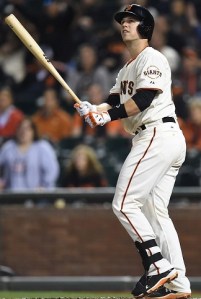
Buster Posey retiring with no tour, just class

Buster Posey

Buster Posey’s two-run blast in Game One of this year’s NLDS with the Dodgers has proven the last blast of a Hall of Fame career.

On Memorial Day 2017, Buster Posey displayed a lot of what made him above and beyond a mere elite catcher. He hadn’t exactly lacked for credentials prior to that game, but he showed the measure of the man as well as the backstop for three World Series-winning Giants teams.

In the top of the eighth, Giants relief pitcher Hunter Strickland retired the Nationals’ Trea Turner and Jayson Werth with Bryce Harper coming to the plate. The righthander hadn’t seen Harper at the plate since the 2014 division series in which Harper tagged him twice for home runs.

The second of the two blasts might have been the more telling one. It was a high, parabolic bomb down the right field line that nobody—not Harper watching as he stepped forward, not Strickland turned around watching from the mound, not Posey still in his crouch—knew would be fair until it sailed past the foul pole and into McCovey’s Cove.

No one but a boring old artery-hardened “purist” or a moron would have accused Harper of showboating a blast he clearly didn’t know was fair or foul until it was seen passing the pole on the fair side. And who knew what crept into and out of Strickland’s head in the times to follow, since the scheduling to come kept the Giants and the Nats apart from then until this Memorial Day.

Strickland threw right into Harper’s right hip on the first pitch. Posey stood almost motionless behind the plate as the enraged Harper charged the mound. In fact, not a single Giant left their dugout until after Harper and Strickland traded a few punches. Posey looked as though trying to tell Strickland, You’re on your own, dude, I didn’t call for that pitch.

He never thought about restraining Harper. He waited until plate umpire Brian Gorman arrived near the mound as Harper and Strickland traded their first punches. It took almost ten full seconds after Harper started his mound charge before Posey finally strode toward the mound and the Giants began pouring out followed by the Nats.

Posey remained almost entirely on the periphery of the brawl once it began in earnest. While Giants pitcher Jeff Samardzija and outfielder Michael Morse collided en route the center of the scrum, it took three more Giants—pitcher George Kontos, outfielders Hunter Pence and Mac Williamson—to get Strickland out of the crowd. Nats first baseman Ryan Zimmerman and third baseman Anthony Rendon got Harper away from damage.

Did Strickland tell Posey before the game that he planned to nail Harper if he had the chance? Did Posey answer him in the words his body language subsequently suggested? Some thought Posey was being cautious because of his history of concussions behind the plate. Some thought Posey was only too well aware that, if the Nats decided to retaliate, he’d be a target the next time he batted against them.

Others thought Posey simply had no taste for a temperamental pitcher exercising an almost three-year-old grudge for surrendering home runs in a series their team actually won. Still others saw it, as I did, as an exercise in just how much genuine class Posey brought to baseball and to the Giants.

And, how much class he carried to the end of his career. There’ll be none of that farewell tour jive for the backstop who still looks, somehow, as though he’s that friendly and boyish looking 23 year old Rookie of the Year who just anchored his Giants to the first of three World Series rings in five years.

Posey planned for Thursday what The Athletic‘s Giants writer, Andrew Baggarly, tweeted the day before, announcing his retirement at 34 after twelve major league seasons. It’s going to feel just as strange seeing the Giants without Posey behind the plate anymore as it felt at first seeing this century’s Red Sox without Dustin Pedroia manning second base.

He’d hinted toward it during the Giants’ brief postseason stay. “I’m definitely just going to take some time with my wife, talk with her, be able to be a full-time dad of four kids for the first time in a while,” he told reporters. “Yeah, just kind of take it slow and see how things progress.”

It’s not simple business to move forward when a franchise face, its arguable heart and soul, steps away from the game at all, never mind when he’s still either at the top of it or somewhere within reach of it. Posey anchored this year’s Giants and their somewhat surprising run to a 107-win regular season and the National League West title.

When he smashed a two-run homer off Dodgers ace Walker Buehler to open this year’s National League division series scoring between the two lifelong rivals (it bounced off a pillar into McCovey Cove), Giants fans hoped it meant the beginning of a run to the World Series. The Dodgers went on to win in five, only to be shoved to one side by the upstart Braves in the National League Championship Series.

Catching may be baseball’s most dangerous profession within a profession. Posey himself has evinced it. He’s incurred more than his share of concussions. He’s had surgery to repair a torn labrum. He got blasted so violently on a May 2011 play at the plate that a) he missed the rest of the season; and, b) baseball’s rulemakers augmented the rules to bar baserunners from leaving the baseline trying to score and to bar catchers from blocking the plate without the ball in their hands first.

He also sat out the pan-damn-ically shortened 2020 season voluntarily; the decision made as much for his adopted twin daughters born prematurely that summer as for the sake of his and his family’s health. (Posey and his wife, Kristen, are the parents of two pairs of twins; their fraternal twins, daughter Addison and son Lee, turned ten recently.)

In fact, Posey calling it a career after a mere twelve Show seasons at or near the top of his game lures a comparison to another great who once did likewise but at three years younger. “This is Koufaxian stuff,” writes The Cooperstown Casebook author Jay Jaffe at FanGraphs, “a player retiring despite still performing at an elite level.”

The parallel between Posey and Sandy Koufax isn’t perfect, though both played just twelve years in the majors, accumulated numerous individual honors and reached the pinnacle of their respective positions in helping their teams win three championships, then departed abruptly. So far as we know, Posey isn’t playing through anything as debilitating as the three-time Cy Young winner’s chronic arthritis, but the long-term effects of multiple concussions are nothing to trifle with, and Posey, already a father of two before the adoption, has two new reasons to want to make sure he enjoys his retirement years.

There were those who couldn’t understand Koufax walking away from the mound at his peak because the idea of crippling himself for life was not an option for a 30-year-old man. There may be those who can’t understand Posey walking away from his station behind the plate at or near his peak because the idea of one more shot in the head meaning the difference between keeping all or about an eight of his marbles isn’t an option for a 34-year-old man.

Playing in an era that produced extremely few truly elite all-around catchers, Posey is number eight all time for the runs saved he’s worth above his league average behind the plate (+76). In 2021 he was still worth 10 runs saved above the league average for catchers.

At the plate, as opposed to behind it, Posey was still a force, perhaps an above-average force considering his injury history and the normal wear inflicted upon catchers in their prime. The traditionalists will point to his .304 “batting average”; his fourteen home runs were solid power production for a 34-year-old catching regularly still; his .399 on-base percentage wasn’t top ten in the league but brilliant for a catcher at his age.

He didn’t qualify for the “batting title,” his 454 plate appearances falling 47 short of qualifying. But my Real Batting Average (RBA) metric—total bases + walks + intentional walks + sacrifice flies + hit by pitches, divided by total plate appearances—shows this for Posey’s 2021 at the plate:

PA TB BB IBB SF HBP RBA
Buster Posey, 2021 454 197 56 2 3 1 .570

In other words, Posey was a better batter by a single point this year than Mookie Betts (.569) and a single point below Paul Goldschmidt (.571).

If you were to put Posey’s career RBA into the pack of Hall of Fame catchers who played all or most of their careers in the post-World War II/post-reintegration/night-ball era, you might think a lot more kindly toward his Hall of Fame case—he lands smack dab in the middle:

Catchers PA TB BB IBB SF HBP RBA
Mike Piazza 7745 3768 759 146 45 30 .613
Roy Campanella 4815 2101 533 113 50* 30 .587
Johnny Bench 8674 3644 891 135 90 19 .551
Yogi Berra 8359 3643 704 91 95* 52 .549
Buster Posey 5,607 2,285 540 67 53 43 .533
Carlton Fisk 9853 3999 849 105 79 143 .525
Ted Simmons 9,685 3793 855 188 100 39 .514
Gary Carter 9019 3497 848 106 99 68 .512
Ivan Rodriguez 10270 4451 513 67 76 58 .503
HOF AVG .543

Think about that. Think about how much worse you could be than pulling up fifth behind Mike Piazza, Roy Campanella, Johnny Bench, and Yogi Berra.

We’ll never know how he would have shaken out had he continued his career, particularly since there’s been talk aplenty that the Giants planned to transition him toward playing first base more frequently. Posey’s short career may sway voters away from him, at least those who still don’t grok that the Hall of Fame should be about greatness, not arithmetic. (Shut the hell up about his lack of 2,000 lifetime hits, you boring old fart purists, you social media slop heads, you sports talk radio runts.) Greatness, not the gold watch.

There are Hall of Famers with quarter-century careers who don’t belong except as visitors. (Good evening, Harold Baines.) There are some not yet in Cooperstown whose careers weren’t half that long. (Be well in the Elysian Fields, Thurman Munson.)

Yadier Molina has had a third more career length than Posey, and he’s kept Posey from winning a couple more than one Gold Glove. He’s the superior defensive catcher by a wide enough margin; his Hall of Fame plaque will come primarily and appropriately because of his work behind the plate.

Yet the pair are almost exactly the same catcher when it comes to the position’s number-one job: handling a pitching staff. As of the end of the 2021 seasons, the pitchers throwing to Yadier Molina have posted a 3.70 earned run average . . . but those throwing to Buster Posey have posted a 3.68 ERA.

I don’t think you could find that many more tight similarities between two individual catchers playing their entire careers with two different teams. That’s without throwing in that Posey was the one who shepherded his pitchers to three World Series rings including Madison Bumgarner’s electrifying 2014 postseason performance. Molina has shepherded his pitchers to a pair.

But Posey’s been the better all-around catcher, and it isn’t even close. There’s no contest between Posey’s 129 OPS+ and Molina’s +97. RBA doesn’t do Molina any favours against Posey, either. (Do I have to say outright that, when he’s elected to Hall of Fame, Molina’s RBA will put him tenth in a class of ten?)

PA TB BB IBB SF HBP RBA
Buster Posey 5,607 2,285 540 67 53 43 .533
Yadier Molina 8284 3039 537 50 74 74 .456

That’s some difference in plate discipline there—Posey in twelve seasons taking three more walks than Molina has in eighteen seasons. It’s also taken eighteen seasons for Molina to draw seventeen fewer passes on the house. The bottom line there is that Molina’s greatness doesn’t include too much fear factor when he checks into the batter’s box but Posey’s does.

If you want to go the route of wins above replacement-level player (WAR), there’s only one player at any position with more WAR from 2012-2017 than Posey’s 43.0, a figure Jaffe says includes his isolated value as a pitch framer behind the plate. Hands up to everybody who guessed (correctly) that it’s Mike Trout.

Posey may not be quite the best all-around catcher who ever strapped it on in all major league baseball. But he’s no questions asked the best all-around catcher in the history of the Giants’ franchise. He wore the uniform with class, he played the game with class as well as greatness. He deserves both a pleasant and fulfilling baseball retirement and a plaque in Cooperstown.

—————————————————————

* – What’s with the asterisk next to Yogi Berra’s sacrifice flies? Simple enough: The sacrifice fly wasn’t an official stat until 1954. Berra played about half his major league career before that. So I needed a way to calculate the sac flies he might have hit if the rule took effect when his career began.

I took his number of recorded sac flies, divided that by the seasons he played under the rule, then took that result and multiplied it by the number of major league seasons he really played. The formula: Sac flies (SF) divided by sac fly rule seasons (SRS), multiplied by total MLB seasons. SF / SRS x YRS.

It was the best I could come to a total number of sacrifice flies you could have expected Yogi to hit all career long.

WS Game Six: Bang!! Zoom!!!

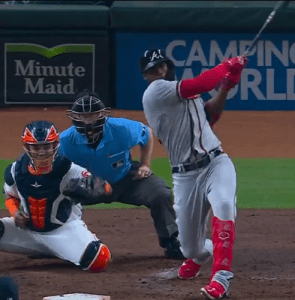
Jorge Soler

Jorge Soler’s detonation in the bottom of the third. (Fox Sports screen capture.)

Blowhard bus driver Ralph Kramden only threatened to bang-zoom his acid but loving wife Alice to the moon in the days of old. (She might have clobbered him if he’d really hauled off.) The Braves may not have threatened to do it to the Astros, exactly, but that’s what they did to win the World Series Tuesday night.

The way Braves starting pitcher Max Fried and relief aces Tyler Matzek and Will Smith worked the Astros over, the Braves needed only one bang-zoom, after all. Getting three and a half was beyond gravy. It was a six course meal crowned with a baked Alaska dessert.

Shutting out the team that led the entire Show with 5.3 regular season runs per game averaged, and the postseason with 6.7 runs per game averaged, also does that for you. However brilliant Fried, Matzek, and Smith were on the mound, though, it goes for naught if you can’t bring anyone home.

But when Jorge Soler hit that monstrous three-run homer in the bottom of the third, it let the air out of Minute Maid Park almost as fast as it took away what wind remained to the Astros. Now . . . everybody, breathe again.

The sun didn’t fall. The heavens didn’t go to hell. The great oceans didn’t dry up and blow away. The stars didn’t go out. When Astros first baseman Yuli Gurriel grounded out to Braves shortstop Dansby Swanson, throwing right on the button to longtime Braves first baseman Freddie Freeman, for game, set, and Series, Armageddon didn’t begin.

But a few things that helped sour the Series for people who don’t live in either Atlanta or Houston ended, too. For now, anyway.

No more race-demeaning Tomahawk Chopping in the Truist Park stands or by traveling Braves fans present in Minute Maid Park. No more of the more stubbornly obnoxious among Astro fans acting and carping (falsely, on both counts) that their heroes were “scapegoated” when Astrogate exploded almost two full years ago.

But, also, there’ll be no more treating the entire Astros roster as barely-repentant cheaters because of the remaining presence of four Astrogaters. (Pitcher Lance McCullers, Jr. missed the entire postseason with an arm injury.) Even the Truist Park crowds for Games Three through Five isolated the point: they saved the “Cheater! Cheater!” chants purely for any of the four.

So now we can review and re-enjoy Fried surviving a near-disastrous near-ankle injury on a play at first base in the first inning to pitch six shutout innings. We can review and re-wonder about Luis (Rock-a-Bye Salsa) Garcia starting on short rest for the Astros, a move risky enough for manager Dusty Baker. He got away with it for two innings. In the third, disaster.

Now, we can re-enjoy Ozzie Albies poking his first base hit since Game Two. We can re-enjoy Fox Sports cameras captured a couple in the stands wearing makeshift World Series trophies for headdresses while Eddie Rosario waited out a five-pitch walk. We can re-enjoy Soler—the American League’s home run king in 2019, but somewhat lost this season, until two weeks before the Royals traded him to the Braves at this year’s deadline—hitting back-to-back, full-count liners foul out of play, before Garcia decided to sneak a cutter past him.

Dansby Swanson

Swanson reaching the Crawford Boxes in the fifth. (Fox Sports screen capture.)

And, we can re-enjoy Soler swinging as though trying to bring a great oak down but settling for bringing Garcia down instead, with the Minute Maid retractable roof open, and the ball flying over the left field seats, over the train tracks, out of the building, and rolling to the street off an awning outside.

Bang!! Zoom!!!

“I got to [full count],” Soler said postgame, “and I didn’t want the same thing to happen as the first inning at-bat, where I struck out on the off-speed pitch. So I was just kind of getting prepared for that.” That was like the Navy saying it didn’t want a Pearl Harbour rerun and was just kind of getting prepared for the Battle of Midway.

“He’s been swinging the bat so good,” said Braves manager Brian Snitker. “This whole World Series. Even just the walks he was taking were really big.”

Fried looked at last as though he had under complete control his familiar, nervous-looking glove-snapping around his hand on the ball when he takes his sign before delivering. He’d shaken off that first-inning play covering at first and getting thatclose to turning his right ankle, his landing ankle, to crumbs when Michael Brantley stepped on it crossing the pad on a ground ball.

A television replay closeup showed that not only had Fried’s foot missed touching the pad, Brantley never touched it either, even as Fried got the gloved ball on it as he fell backward. The Braves chose not to challenge the safe call. Fried picked himself up, dusted himself off, walked back to the mound, and sandwiched Jose Altuve’s runner-advancing ground out between two toasted strikeouts.

After swapping two scoreless innings to Astro reliever Cristian Javier’s one—they both  ended with slick double plays including the one he launched himself to end the bottom of the third—Fried had a breather and Javier went out for a second inning’s work. His first was three-and-three in the top of the fourth. He wouldn’t be that fortunate in the top of the fifth.

Not with Albies leading off with a walk, then taking second on a wild pitch. Not with a strikeout on Travis d’Arnaud proving the mere setup for Dansby Swanson smashing a down-the-pipe fastball into the Crawford Boxes. And, not with Freeman following a two-out walk to Soler by sending him all the way home with a double off the absolute rearmost center field wall.

Bang!! Zoom!!!

Two innings and three Astros relievers later, Freeman decided the Braves needed a little extra insurance, with the Astros down by a mere six. How to get it with two outs was the question. The answer proved simple enough. He caught hold of Ryne Stanek’s slightly dangling slider and drove it over the center field wall a little left of the Phillips 66 sign.

Bang!! Zoom!!!

“He’s been through good times. He’s been through the worst of times and now through the best of times,” said Swanson postgame of Freeman, the longtime Braves franchise face, who’s made no secret of his desire to stay with the team despite his free agency to come this winter. “Nobody deserves it on our team more than him. He stuck it out and really believed in the vision and mission that this place had. I’m just thankful for him to be on our team.”

Fried, Matzek (the seventh and eighth), and Smith (the ninth), kept the Astros so far in check there may have been suspicions that they’d been kidnapped and replaced with android replicas whose designers forgot to include batting eyes and arm strength.

As favoured sentimentally as his post-Astrogate Astros were disfavoured almost universally, Baker still doesn’t have that elusive World Series ring. Snitker, a Braves lifer who’s a mere six years Baker’s junior, has his first in five full seasons manning the Braves’ bridge.

Two old-school baseball men—who’ve learned and worked by the precept that analytics gives you what you need to know going in, but the moment in front of you and slightly ahead of you tells you what you should or shouldn’t do with that information—matched wits all Series long.

Freddie Freeman

Freeman, still the franchise face, going over the center field wall in the seventh. (Fox Sports screen capture.)

It took stout pitching and a little new old-fashioned long-range bombing to put the Braves over the top and to bury a collection of Astros with too little left in the tank,finally, to repel the invaders.

“First off, you’ve got to give a ton of credit to [the Braves],” said still-struggling Astros third baseman Alex Bregman postgame. “They were unbelievable. They pitched really well. They swung the bats, played good defense. We normally do hit a little bit more for power, and we didn’t. But you learn and move on. You use it as fuel during the off-season to get better and learn from it.”

What the Braves learned this season and taught or re-taught everyone else is that it’s possible to ride the arguable bumpiest road to the postseason and still come away from the ride hoisting the World Series trophy. “We hit every pothole, every bump you could possibly hit this year,” said the otherwise jubilant Freeman postgame, “and somehow the car still made it onto the other side.”

Potholes? Bumps? The Braves came out of a few nasty pileups. They lost franchise face heir apparent Ronald Acuna, Jr. to a season-ending knee injury in the outfield in early July. They entered the season without pitcher Mike Soroka, thanks to his re-injuring the Achilles tendon he’d barely finished rehabbing in the first place. They lost bombardier Marcell Ozuna to domestic violence charges and administrative leave.

The eventual rulers of the none-too-powerful National League East didn’t even have a winning record overall until 6 August. They broke the record for the latest season arrival above .500 they themselves held . . . since their 1914 “Miracle” ancestors arrived only on 3 August that year.

General manager Alex Anthopolous—who had to miss the Game Six and championship fun after being hit by COVID-19—swung four trade-deadline deals to land Soler, Rosario, Adam Duvall, and Joc Pederson. They went 36-14 in their final 55 regular season games. They still looked like postseason underdogs. Until.

They overthrew the NL Central-champion Brewers three straight after losing Game One of their division series. After getting blown out in National League Championship Series Game Five, they overthrew the wild card-winning Dodgers—owners of baseball’s second-best regular-season record with 106 wins—with their lights-out bullpen tandem Matzek and AJ Minter to win the pennant.

Then they lost starting pitcher Charlie Morton to a line drive off his leg in World Series Game One. And defied everyone who said losing the likeable, respected veteran for the rest of the set meant temporal and spiritual disaster for the upstarts.

When they finally reached the Promised Land, the Braves also defied several other factors. They became the first team ever to show a League Championship Series MVP and a World Series MVP who weren’t even with the team in the regular season’s first half. Their four outfield imports hit more postseason home runs together (twelve) than the rest of the team combined (eleven).

Bang!! Zoom!!!

Max Fried

Fried shook off a potentially shattering ankle injury in the first to shatter the Astros’ formidable offense.

When Sock-a-Bye Soler took Rock-a-Bye Samba downtown Tuesday night, only five men before him had ever hit three go-ahead home runs in a single World Series: Babe Ruth (1926), Lou Gehrig (1928), Gene Tenace (1972), Curtis Granderson (2015), and George Springer (2017). Soler joins Gehrig, Tenace, and Springer for doing it for World Series winners.

Only one other man ever got close to where Soler’s blast ended up. That was before the Astros became the team to be named later in the league swap that made a National League team out of the Brewers and sent the Astros to the American League.

The only thing keeping then-Cardinals superman Albert Pujols’s ninth-inning three-run homer from landing in Soler territory in 2005 NLCS Game Five was the closed roof. If the Minute Maid roof was open then, Pujols’s rip off then-Astros closer Brad Lidge might have bounded off the same awning—if not flown right to the street.

Somewhere in their Elysian Fields stomping grounds, the Braves’ late Hall of Famers Hank Aaron, Eddie Mathews, Phil Niekro, and Warren Spahn smiled down upon these rascally Braves while applauding madly.

The Astros went from steamrolling the White Sox and the Red Sox out of the postseason into spending most of this World Series being about as offensive as an ice cream sandwich. Except for stinging the possibly pitch-tipping Fried in Game Two, and overthrowing a first-inning battering in Game Five, the Astro offense either slept or turned up when it didn’t or couldn’t do them many favours.

“We just kind of ran out of gas pitching-wise,” Baker said postgame. “Our guys, nobody complained, nobody alibied. And I’m not going to alibi. We got outplayed. What can you do, except go home, take a shower, figure out how you’re going to come back and win it next year. Look, last year we got one game short of the World Series, and this year we were two games short of the championship.”

Baker was right about their spent pitching. Missing future Hall of Famer Justin Verlander to Tommy John surgery recuperation hurt. Being without their best 2021 starter, Lance McCullers, Jr., hurt. Baker bringing his should-have-been Game Six starter Jose Urquidy in for an inning of Game Five relief probably hurt. Veteran Zack Greinke starting to show his age at last hurt.

If you ask Minter, he’ll tell you the Braves transformed themselves from a small legion of also-rans into the guys who put the big boys into their places by hook, crook, and anything else they could think of so long as failure was no longer a dismaying, disgusting option.

“We are a bunch of misfits this year,” Minter said postgame. “I mean, we’re a group of failures. And that’s what makes this team special, because we know what it feels like to fail. We know what it feels like to lose, and we weren’t willing to accept failure this year. So we pulled it together somehow—and now we’re World Series champions. It’s cool, man.”

The Astros, of course, see themselves as anything but misfits. They were very gracious in World Series defeat. (“They deserve what they have,” said Altuve postgame.) But they see themselves now the way the Yankees did in the ancient, mid-20th Century. Shortstop Carlos Correa—one of their team leaders, one of the remaining Astrogate Five, and a possible departure in free agency this winter—said it right out postgame:

“Second place is not good enough for us. I know it’s not good enough for you guys. But it speaks volumes of how good our organization is, how talented our clubhouse is. Five ALCS in a row. Three World Series in five years. I don’t know what else you want to ask from a great ball club.”

Some might want to ask that they win a World Series without the taint of something like Astrogate.

They may yet win one, even next year, since the pitching remains deep even with Greinke and Verlander likely out of the picture and their youth includes a pair of solid stars in Kyle Tucker and Yordan Alvarez. Even if Alvarez was a one-man wrecking crew in the ALCS brought low in the World Series. Even if Altuve (32), Gurriel (37), and Michael Brantley (34) can’t keep Father Time from coming too much longer.

“People expect greatness when you talk about the Houston Astros,” said Correa, who still seems at once embarrassed by Astrogate yet unable to resist playing the rogue. “They expect us to make the playoffs every year. They expect us to be in the World Series every year.”

But now the guys nobody really expected at mid-season to be in the World Series have won it. With a pitcher defying those critics who thought he wasn’t really ready for center stage just yet. With three big swings having nothing to do with illegally stolen signs sent to the batter’s box by trash can transmission.

Bang!! Zoom!!!

Baker Agonistes

Dusty Baker

Even people who still despise the Astros can’t bring themselves to wish ill upon post-Astrogate manager Dusty Baker.

Tuesday night won’t be virgin territory for the Astros. Two years ago, they came home to play out a World Series in the hole 3-2, too. That was then: They lost twice to the Nationals, who’d beaten them in Games One and Two in Houston as well.

This is now: Having the home field advantage hasn’t exactly helped the Astros yet. They split Games One and Two in Minute Maid Park. Then, they lost two of three to the Braves in Atlanta. They may have put a sanguine public face on approaching Game Six, but second baseman Jose Altuve isn’t exactly ready to pull the champagne corks just yet.

“I don’t feel like going home is any guarantee,” he told ESPN’s Jeff Passan. “We’ve got to go out there and fight. It’s not like, OK, we go home, we got them. No. We’re playing a really, really good team. Those guys take really good at-bats, they know how to pitch, they can do everything. And we got to go out there and fight.”

The Astros lost that 2019 Series a fortnight before the Astrogate whistle was blown at last. They’ve played since with the justly-earned reputation for having been baseball’s most egregious and extreme electronic cheaters, and they haven’t always helped their own cause trying to move past it since.

One minute, they’ve embraced the villain role. The next, they’ve seemed as close to contrite as you’d expect of any team who first thought their well-exposed competitive amorality wasn’t as big a deal as everyone else made it.

Altuve’s sober realism about returning the Series home to one side, Passan has it right when he observes that embracing the bad-guys role goes only so far: “[W]hile some may see the Astros’ use of others’ loathing as backward—the reaction to your misdeed becoming a source of fuel is rather twisted—what’s the alternative?”

One alternative would be winning a World Series to climax a postseason in which the Astros really have played it straight, no chaser. So far. Disdain and contempt will remain attached to them until the last Astrogate team member no longer wears an Astros uniform. That a genuinely great team went rogue above and beyond is nobody’s fault but theirs.

The Truist Park crowds in Atlanta serenaded Altuve, Alex Bregman, and Carlos Correa with singsong chants of “Cheater! Cheater!” every time those three checked in at the plate. (It’s to wonder why the fourth member of the remaining Astrogate infield, first baseman Yuli Gurriel, escaped the serenades.) Those crowds didn’t hammer the entire team over the transgressions of the few remaining. To their eternal credit.

Nobody’s suspected or come up with any evidence that the Astros have been up to no good this fall. They blew the White Sox out of a division series after getting blown out in Game Three. They overthrew the Red Sox in the American League Championship Series after a 13-3 blowout put the Red Sox up 2-1 in the set. They answered Braves center fielder Adam Duvall’s nuke of a first-inning grand slam to beat the Braves 9-5 in Game Five Sunday night and force the World Series back to Minute Maid Park. Straight, no chaser.

But they enter Game Six with a couple of red flags flying regardless. Just what was manager Dusty Baker thinking when he sent Jose Urquidy out to pitch the Game Five fourth, when he had enough capable and available bullpen arms and really needed Urquidy to start Game Six?

Did Baker thus force himself to roll the wrong dice starting Luis Garcia on short rest against a fully-rested Max Fried, whom the Astros pecked apart early but without quite nuking him in Game Two?

Did Baker—who steadied the Astrogate-broiled clubhouse when coming aboard in its immediate wake; whose long and winning resume, historic shortfalls, and personal respect made him the sentimental favourite to win it all at last—really sacrifice a season to send set back to Houston?

Was Baker being canny in Game Five? Too clever by half? Does he know something about Rock-a-Bye-Samba Garcia that nobody else knows yet? Or, will Game Six end up another entry in Baker’s too long, too sad, often rotten-luck roll of postseason fate?

His critics often say he should have known better. His admirers say he’s been as much a victim of surrealistic dumb luck as anything else. Baker is either a big-hearted overthinker or the one-man resurrection of every hard luck team that ever reached the mountaintop and tripped to the rocks on the Jordan’s banks.

The man who’s managed more winning games than any skipper who’s never won a World Series is either Gene Mauch redux; or, he’s a one-man 1908 Giants, 1960 Yankees, 1969 Cubs, 1978 and 1986 Red Sox, 1987 Blue Jays, 2006-07 Mets, and almost every St. Louis Brown or Washington Senator, ever.

2002 World Series, Game Six: Baker lifted his Giants starter Russ Ortiz after the Anaheim Angels (as they were known then) swatted a pair of singles to open the bottom of the seventh with the Giants leading 5-0. With all good intention and heart, Baker handed Ortiz the “game ball” before turning it over to Felix Rodriguez. The Angels weren’t exactly indifferent to that.

Bing! Scott Spiezio hit a prompt three-run homer. The Angels finished handing the Giants’ pen their heads on plates to win at the eleventh hour, then won Game Seven decisively.

2003 National League Championship Series Game Six: Baker’s Cubs stood five outs from the World Series in the top of the eighth. He left a gassed starter Mark Prior in to take it on the chin and off a shortstop’s double play error, opening up what proved an eight-run Marlins eighth.

Then, in Game Seven, Baker inexplicably let Kerry Wood live long enough to surrender seven runs as the Marlins went to the World Series they’d win in six.

Baker’s often been accused of managing certain postseason games as though he’s just taking regular-season target practise against his league’s also-rans. But it wasn’t exactly his fault that his 2017 Nationals lost NLDS Game Five after swapping wins the first four games with the Cubs, either.

He didn’t ask Max Scherzer in relief to surrender a two-run double before Matt Wieters turned a passed ball into a ghastly run-scoring throwing error up the first base line. He didn’t ask Max the Knife to hit a batter with the bases loaded to finish that four-run Cubs seventh, leading to the 9-8 Cubs win.

That doesn’t exactly keep the second guessers in line, of course. I’ve second-guessed Baker often enough in the past, and I know it wasn’t his fault that that inning swallowed him alive—and cost him his job. He’s taken five different teams to postseasons; he’s been fired after 90+ win teams he managed ended postseasons in agony.

There are reasons teams have turned to him over the years, especially the one that wandered into scandal all by itself and needed an untainted human to take their game bridge, while they remade/remodeled the front office almost completely, and figure out how to steer them past it without being buried by it.

It hasn’t been perfect by any means. Baker didn’t look great at this season’s beginning, when road fans now allowed back to the ballparks after the 2020 pan-damn-ic absences trolled his Astros to make up for lost outrage time, and Baker played the whatabout card in return. He was better than that, he knew better than that, and we knew better than that.

The Astros needed heart, dignity, class, and soul to lead them out of their self-inflicted disgrace. That’s why they turned to Baker last year. But one of his 2003 Cubs, Doug Glanville, outfielder turned instructive and respected ESPN writer, has isolated perhaps the best reason Baker now has one more chance to land that ever-elusive claim to the Promised Land.

“Dusty always had time to talk to players to bring them together,” Glanville began, in a piece he published the day before World Series Game Five.

It was a priority that he not only get the biographical notes of your life, but he wanted to put himself in your shoes. Listen to your music, read about your perspective and embrace your culture. Not just as a company-wide initiative but as an evolution of life. He lets you change him, openly trying to grow. And he pushes you to do the same.

These were life lessons, not just baseball lessons. He wanted to take the gift of a lifetime of playing baseball and share it to make us all better. It went way beyond learning how to hit a curve ball or figuring out when Greg Maddux was going to throw his back-up slider. This was real life, and teammates were family. Every day was a celebration, a chance to get together over something joyous. And he was the Godfather, inheriting sons with the humility to know he can learn from them just as much as he can impart his own wisdom.

Does this make a manager better at running a bullpen or using his bench? I can’t say. But 18 years after I played for him, I still apply the lessons I learned from him as a father and a husband.

The Astros could force this World Series to a seventh game. They’d still have to win that. And Altuve is right when he suggests these Braves are no pushovers, no matter how Game Five shook out.

You may think still that an Astro loss would be nothing less than extraterrestrial justice. But you may think as well what a shame it would be that Baker has to be on the bridge incurring it if it happens. And you’d be right.

WS Game Five: Winning in a walk

Martin Maldonado

Maldonado, you’re no longer the weakest link. For now.

The good news is, the Braves can win in Houston. They proved it in Game Two. The bad news is, they’ll need to win there to win the World Series now.

The Astros didn’t let a little thing like a four-run hole after a single Game Five inning on a single swing drive them into an early season’s grave Sunday night.

Not with manager Dusty Baker flipping his lineup a little bit. Not with proving there are times a bases-loaded walk and a well-timed single in the middle of a game are more powerful than a grand slam out of the gates.

Not with the Astros’ heretofore, mostly dormant longtime core finding their bats. And, not with the Braves’ heretofore impenetrable bullpen proving they’re only human, after all, while their own usually tenacious bats mostly went askew following their early slicing, slashing, and thundering.

Their early, incendiary Game Five lead turned into a 9-5 loss to the Astros—but doesn’t have them up against the wall just yet.

“When we won [Game Four], it made it easier, I guess, coming into this one — but we knew it was going to be tough,” said Braves manager Brian Snitker postgame. “That’s just a lot of innings to cover (by relievers) against a club like this that swings a bat so well. The good news is we’ll take a day off and be in good shape.”

Meaning, including and especially, a rested bullpen as well as a re-grouping lineup. But it’s the opposite now of where they stood after Game Five of the National League Championship Series, after the Dodgers flattened them 11-2 in Los Angeles and despite still holding a 3-2 lead in the set.

Then, the Braves’ longtime first baseman and leader Freddie Freeman said they were still in good shape, they still led the set, and they liked their chances going back home to Atlanta. Now, Snitker’s putting the Brave face on and saying, “I’ll take it anywhere. If we win the World Series, it doesn’t matter where it is.”

Two years ago the Nationals proved that in abundance against the Astros. The Braves won’t be winning all needed Series games on the road, but with their Series lead now they need to win only once. It sounds simple when you say it. It’ll be anything but simple when they play it starting Tuesday night.

You can’t get any more profound a reminder of how tough a World Series can be than the Braves got when they only thought they had the Astros buried alive in the bottom of the first Sunday night.

They loaded the bases on Astros starter Framber Valdez with a leadoff base hit by Jorge Soler, a two-out single by Austin Riley, and a 3-1 walk to Eddie Rosario. Then Adam Duvall couldn’t wait to drive Valdez’s first service to him into the seats above the right field wall.

Hindsight’s almost as wonderful as foresight. Snitker has both in abundance. This time, though, hindsight was his BFF. “I’d rather we scored those runs in the seventh inning when you don’t have so much time to cover,” the manager said postgame. “We knew we had a long, long way to go in that game and anything could happen.”

Anything did happen, right away.

Heretofore slumber bat Alex Bregman hit with first and second and one out in the second and lined Braves opener Tucker Davidson’s the other way, all the way to the right center field wall, scoring Yuli Gurriel (one-out, one-hop single to center). Heretofore macaroni bat Martin Maldonado sent Kyle Tucker (full-count walk) home with a sacrifice fly cutting the Braves’ lead in half.

The Astros might have gotten one more run home but for the next batter—Valdez himself. Two swinging strikes around a ball in the dirt, then looking frozen at strike three on the inside forner after a ball just low. You still don’t want the designated hitter in the National League’s parks, old farts? Imagine if the Astros didn’t have to bat Valdez there. They might only have had a one-run deficit to end the frame.

No matter. Their unraveling of the Braves began the very next inning, when Dansby Swanson at shortstop misplayed Jose Altuve’s leadoff hopper, bumping the ball from his glove, recovering too late to throw the swift Mighty Mouse out at first. The rest of the Series will prove whether or not that’ll be this postseason’s most egregious Braves mistake of all.

Davidson walked Michael Brantley on a 3-1 count and Carlos Correa—another of the formerly dormant-at-the-plate Astro core—doubled Altuve home. A fly out later, Brantley scored on Gurriel’s ground out to short. Tie game. The tie lasted long enough for Freeman to lead the bottom of the third off with a mammoth full-count, tiebreaking blast half way up the right center field seats.

The 5-4 Braves lead lasted until the bases loaded and two out in the top of the fifth. Checking in at the plate: Maldonado, the Astros catcher still vying for the title of the single most automatic Astro out, after the Braves ordered Bregman walked on the house to load the pads in the first place.

What came next may yet prove one of the ten most powerful walks of all time. Maldonado looked at ball four inside from Braves relief star AJ Minter, sending Correa (leadoff one-hop base hit to center) strolling home with the re-tying run. Martin, you’re no longer the weakest link. For now.

Not only did Maldonado get daring enough to stand right on top of the plate during the entire plate appearance, the better to get an edge against Minter’s cutter, he even showed bunt as ball four sailed in. He didn’t do it for a laugh, either.

“He came back to the dugout yelling at me, ‘You like my Little League bunt?'” said Astros hitting coach Alex Cintron postgame. “He was prepared before he stepped up to the plate. He was ready for that at-bat. That made the difference.”

“I thought of it in the moment,” said a grinning Maldonado. “I wasn’t going to swing until 3-2. Maybe it would throw him off.”

Then Baker sent Marwin Gonzalez—returned to the Astros after a detour through Minnesota and Boston when the Red Sox released him in August—out to pinch hit for Jose Urquidy, whose shutout fourth set him up to get the Game Five “win.” Gonzalez dumped a floating quail into left center that hit the grass with room enough to send Gurriel and Bregman home with a 7-5 Astro lead.

Maldonado lined Tucker home with a base hit off another Braves pen man, Drew Smyly, in the seventh, and Correa—perhaps sensing Smyly was really taking one for the team now—singled Altuve home with the ninth and last run in the eighth.

Baker made a few pre-game moves to shake his lineup a bit, particularly moving the previously slumping Bregman down to bat seventh. The third baseman’s struggles at the plate this postseason became that alarming—to the manager and to Bregman himself.

“I’ve got a really weak top hand right now,” he said. “I’m releasing the bat behind me, which is causing a ton of problems.” He spent pre-game batting practise all but forcing himself into a two-handed swing finish. It helped when he knocked that second-inning RBI double. It damn near helped him hit one out his next time up.

“The second at-bat, I just missed what would have been a three-run homer, just barely missed under it,” Bregman said. “I’ve got to fix a weak top hand. Normally I hold (the bat) tight and squeeze it, kind of. I’m not able to do that right now.” Missing more than two months of the regular season didn’t exactly do him many favours, either.

For Minter’s part, he credited the Astros with finding their swings when they looked pinned otherwise. “I felt my stuff was just as sharp tonight as it was in other outings,” the lefthander said postgame, denying any fatigue factor from his previous prominent presence. “I felt like I was 1-2, 0-2 on every hitter. Those guys made quality swings on two strikes.

“I guess I could have made some better pitches with two strikes,” he continued, “but with Correa, I got him 0-2, left a cutter up, base hit. Got a good strikeout against Alvarez. And then Gurriel — cutter, backdoor cutter. He stuck his bat out there and had a good hit as well.”

Minter and the Braves now have down time enough to regroup and refresh. They still have the Series lead, even if the Astros and their fans might prefer to think the Braves have the Astros right where the Astros want the Braves.

The better news is, at least we’re rid of that infernal, obnoxious, demeaning Tomahawk Chop for the rest of the calendar year and—barring unforeseen wisdom from baseball’s governors—at least until next spring’s exhibition games begin.

Now, if only we could get rid of the Big Ben tolling, bonging chime that rings in both Truist Park and Minute Maid Park for the rest of this Series. Ask not for whom the bell tolls. It tolls too early, too often, and it’s enough to drive a bat in the belfry bats.

Both parks’ public address people have a habit of sounding Big Ben before the home team has the win secured. It’s pretentious and presumptuous. Almost worse than the Truist Park organist’s too-insulting walk-up serenades to some Astro hitters. Good for perverse laughs among the home audience, good for Astro incentive at the plate. Brilliant.

Wise up, Braves and Astros. The Phillies’ people in Citzen’s Bank Park use Big Ben, too. But at least they have the brains to wait until the Phillies can take a win to the bank.