A little wit, a lot of reflection at the Hall of Fame

Hall of Fame Induction

Sunday at Cooperstown. Back, left to right: Hall of Fame president Josh Rawitch holding pitcher/catcher Bud Fowler’s plaque; pitcher Jim Kaat; outfielder Tony Oliva; designated hitter/first baseman David Ortiz. Front, left to right: Irene Hodges for her father, first baseman/manager Gil; Dr. Angela Terry for her uncle, first baseman/manager/coach/scout Buck O’Neil; Sharon Miñoso for her late husband, outfielder Minnie.

They had as many people turn up at the Hall of Fame’s induction ceremonies Sunday as fill Fenway Park for a sellout Red Sox home game. And the man who brought enough of those Fenway crowds to their feet in the years the Red Sox finally buried the accursed Curse and hammered the coffin shut twice more gave them more.

And he didn’t even think about hollering, at whatever the choice point might have been, This is our [fornicating] Hall of Fame! either.

The only thing wrong with David Ortiz’s induction speech is that his fellow inductees Minnie Miñoso and Buck O’Neil weren’t still alive on earth to see and maybe raise. But those two men who loved the game as deeply as Ortiz does surely looked upon the stage from their Elysian Fields roosts and hollered camino a seguir—way to go.

With the “Papi! Papi!” chants pouring forth well before he took the podium, it would have been tempting for the first Hall of Fame designated hitter to get there on the first ballot to fall all the way into his public persona as a big, laugh-hunting, laugh-indulging eternal kid. He let some of it come forth. But for the most part he stayed on the side not always accounted for when his name comes up.

The side of soul.

Ortiz felt as reflective and as emotional as anything else after his daughter Alexandra, a college music student, opened the proceedings with a stirring singing of “The Star-Spangled Banner.” He also had a country to thank, the United States, for “welcoming me with open arms since I was practically a child, and giving me the opportunity to develop and fulfill all my dreams and then some more.”

Under ordinary circumstances, that would have been Hall of Fame boilerplate. Out of Ortiz’s usually garrulous mouth, it was as heartfelt and honest as when he thanked his family for standing by their man during the career that brought him to this point—even his wife, Tiffany, despite the couple’s separation last December.

If Big Papi indulged any of his wit he used it simply to segue into the next thanks, the next acknowledgements, whether to the coaches and evaluators who encouraged and mentored him, the teammates who engaged him, the managers who didn’t let him let any slump swallow him alive, the family who braced him, the country that embraced him.

There were times you thought Ortiz’s voice might crack from emotion, but—just as he didn’t flinch when swinging big with postseason advances or World Series rings on the line; just as he didn’t flinch achieving a .947 OPS in 85 postseason games that would have been half a career season for lesser men (his World Series OPS of 1.372 is a jaw-dropper, too)—he didn’t let himself flinch now.

“I’m always joking around, I’m always being me,” he told a news conference after the induction. But you had the whole planet, the whole nation watching you and you have to deliver a message, especially the way life is going these days. You want to deliver a positive message, the words, that people can understand that we need to stay together, we need to be more humble, we need to be sharing love, that’s what we need. Because a lot of bad things are happening nowadays.”

A lot of bad things happened to keep Miñoso from entering the Show before his cup of coffee with the Indians at 25 and his full rookie season at 27. (Eight games with the Indians before being traded to the White Sox in a three-team, seven-player deal.) He did for black Latinos what Jackie Robinson did for African-Americans and he let his effervescent personality diffuse bigots and engage teammates as well as he played.

But a lot of good things might have come forth Sunday afternoon if Miñoso could have lived to accept his plaque. The man who once said his last dream in the game he loved was to make it to Cooperstown (he died in 2015) would have made the crowd his own just the way Ortiz did. “As Minnie would say,” his widow, Sharon, told the gathering, “‘Thank you, my friend, from the bottom of my heart’.”

So would O’Neil, maybe the only one among Sunday’s Hall inductees—including Miñoso’s successor Cuban-born star Tony Oliva—who could have made Miñoso resemble a clinical depressive.

I once wrote that getting O’Neil to shut up about baseball (and it holds about life, too, if you’ve ever read the book he wrote [I Was Right on Time] or the best written about him [The Soul of Baseball]) was like taking the alto sax out of Charlie Parker’s mouth. (“People feel sorry for me? Man! I heard Charlie Parker!” he once said.) The only problem anyone would have had with him Sunday would have been holding him back.

After he was spurned for the Hall by a single vote in 2006, O’Neil graciously accepted the invitation to introduce seventeen Negro Leagues inductees, a few months before his death. He even got all the Hall of Famers on the podium and the crowd on the lawn to sing with him, “The greatest thing in all my life is loving you.”

His niece, Dr. Angela Terry, may have joked that she got to accept her uncle’s plaque because she holds the longest membership in the AARP, but she nailed home gently and firmly that Uncle John (as she called him throughout) belonged above and beyond his splendid Negro Leagues playing and managing stats, above and beyond his scouting, coaching, and mentoring after.

Which he does. What Pete Rose only thinks he is, O’Neil was: the best ambassador baseball had before he was taken home to the Elysian Fields. You could imagine O’Neil ending his induction speech the way he ended his memoir: “I think it’s about time to close the book on this book before I start boring you. Besides, I’ve got a game to go to. I just might see for the first time the next Josh Gibson or Satchel Paige.”

Hall of Famer Dave Winfield inducted Bud Fowler, considered the first black man to play professional baseball prior to the imposition of the disgraceful colour line. It seemed fitting since Fowler himself was a Cooperstown-area native. “There was something magical about this game that caught his eye and imagination,” Winfield said, “so much so that he’d spend the rest of his life playing and managing this game.”

He pitched, caught, ducked and eluded the game’s racists, and created the black barnstorm teams that led to the formal creation of the Negro Leagues in the first place. A rib injury led in due course to his premature death, but Fowler’s impact on the game was literally nationwide. The time’s conditions and the advent of the colour line compelled Fowler to play and oversee the game in the minors in almost all states—while he worked as a barber on the side, something he learned from his father, to supplement what he earned in the game.

Tony Oliva remembered his own pre-Castro Cuban youth as he looked out around the Hall of Fame lawn and crowd. “I’m looking to the left, I’m looking to the right, and it is bringing memories,” the longtime Twins bat virtuoso and righ fielder told them. “This place right here looks like my home in Cuba, where my father built a field where the young kids were able to play baseball. Exactly like.”

His Twins teammate, lefthanded pitcher Jim Kaat, remembered taking his father’s advice and spurning a $25,000 bonus from the White Sox—it would have kept him on the parent club bench two years under the bonus rule of the time—to take a lesser $4000 bonus from the ancient Washington Senators (on the threshold of moving to Minnesota) so he could be seasoned right.

Haans Kaat wanted his son to learn the professional game properly. (In case you wonder about such things, Kaat’s induction makes for two Dutch-stock former Twins in Cooperstown, joining Bert Blyleven.)

“My dad made $72 a week in 1957,” Kaat told the crowd after accepting his plaque. “You can do the math, figure out what he sacrificed so his son could start his career at the right level.” And, highlight it by pitching his best baseball when someone else was having a career year while outlasting Hall of Famer Sandy Koufax in Game Two of the 1965 World Series—the only time Koufax would come up short in that seven-game set.

Remembering another father was a little different for Irene Hodges. When her father, Gil, died of a second heart attack in 1972, Jackie Robinson said through his grief, “Gil was always a calming presence. I always thought I’d be the first [of the “Boys of Summer” Brooklyn Dodgers] to go.”

“Nothing was more important to my dad than giving Jackie all of his support,” she said Sunday afternoon, accepting her father’s plaque. “We were like family with the Robinsons. Jackie’s kids played in our house, and we played in theirs. My dad was not only teammates with Jackie, but they were family. My father made everyone comfortable and accepting of Jackie when he came to the big leagues.”

He did it for Japanese children, too, even in Okinawa where he earned a Bronze Star. “During his time in Okinawa,” his daughter said, “he would befriend the Japanese children who were so frightened by the American soldiers. My father would gather the children from the village, along with his fellow Marines, and teach them baseball. He gave them some joy back in their life that the war had robbed them of.”

That was the same elemental decency that provoked Brooklyn not to boo but to warm up even more to the quiet first baseman, the National League’s best of the 1950s, when he fell into a ferocious batting slump starting in the 1952 World Series—so much so that even a priest who wasn’t of Hodges’s own church ended a Sunday mass saying, “It’s too hot for a sermon, so everyone just say a prayer for Gil Hodges.”

Hodges’ experience with Robinson surely played into how well prepared he kept his 1969 Mets as their manager, after learning on the job with the expansion Senators from 1963-67. Injuries and growing pains kept those Mets from repeating their miracle feat while Hodges managed them. But he remained a firm but engaged boss who loved to teach or re-teach, gave players room to vent privately when need be.

He kept everyone from the merest spare part to the most obvious Hall of Famer in waiting ready to go when needed. He never denounced the injured as quitters and, whenever the tough love was needed, he did it behind closed doors and not in the press.

On Sunday afternoon, Hodges’s daughter re-introduced her father to baseball in a near-perfect bookend to the outsized bombardier who kept himself in check enough to make it about the game to which he’d contributed an outsize share of grandeur when he swung, swayed, and put a city sickened by atrocity on his back.

“If my story can remind you of anything,” Ortiz said, “let it remind you that when you believe in someone, you can change their world; you can change their future.” A man who believes that is a man Hodges, Miñoso, and O’Neil would have loved playing with or coaching in another time, another place, even as Kaat and Oliva had chances to mentor him in his earliest seasons.

This was their [fornicating] Hall of Fame.

The All-Star Game was Clayton’s place

Clayton Kershaw, Blake Grice

National League All-Star starter Clayton Kershaw with fan Blake Grice, who touched Kershaw by telling the future Hall of Famer he was meeting him for Grandpa’s sake.

By right, this year’s All-Star Game start for the National League should have belonged to the Marlins’ Sandy Alcantara (he leads the Show’s pitchers with 5.3 wins above replacement level and his 1.76 ERA). And if the game were played someplace other than Dodger Stadium, it might have been Alcantara’s to start.

Braves manager Brian Snitker, managing the NL All-Stars as the previous season’s World Series skipper does, had his own idea. Especially since this was the first All-Star Game in Dodger Stadium since Jimmy Carter was still in the White House, and a Dodger icon was having an All-Star worthy season himself.

So Snitker elected to hand the opening ball to Clayton Kershaw. A Hall of Fame lock, approaching the sunset of an off-the-charts career, starting the All-Star Game in his home ballpark. You could imagine Snitker thinking to himself that you couldn’t pay to pre-arrange more serendipitous circumstances. Even with his own All-Star Max Fried among his pitching options.

It was a class gesture by the defending World Series-winning manager. Only one thing could have seen and raised, and that one thing was Kershaw himself. By most reports, one of the first things the 33-year-old lefthander did when Snitker called him to say the opening ball was his was to call Alcantara himself.

“He was awesome about it. I was really thankful about that,” Kershaw said, after the American League hung in for a 3-2 win through no fault of Kershaw’s own.

He let himself take the entire atmopshere in, even foregoing his usual pre-start intensity that compels teammates, coaches, and even his manager Dave Roberts to say nothing much more than “hello” to him. (He even let Roberts share lunch with him on Tuesday.) About the only thing Kershaw did remotely work-related was study some American League scouting reports.

One he didn’t have to study was Shohei Ohtani (Angels), whom Kershaw retired thrice when pitching last Friday. Wary of opening the All-Star Game with one of his signature breaking balls, Kershaw pumped a fastball that doesn’t have its former speed and Ohtani—interviewed before the game, promising to swing on the first pitch—smacked a broken-bat floater up the pipe into short left center for a leadoff single.

Then, having Aaron Judge (Yankees) 1-2, Kershaw suddenly couldn’t think of what to throw next. Some described him as buying time when he lobbed a throw to first. He bought more than he bargained for. He’d caught Ohtani having a snooze. Ohtani had drifted away from the pad and Kershaw’s lob turned into the first All-Star pickoff in fourteen years.

The two-way Angel could only laugh. Kershaw could only grin after first baseman Paul Goldschmidt (Cardinals) tagged Ohtani out. Dodger Stadium went nuclear. Kershaw finished striking Judge out, walked Rafael Devers (Red Sox), and lured Vladimir Gurrero, Jr. (Blue Jays) into an inning-ending ground out. The man who wanted to take it all in from start to finish then ducked out of sight and to a press podium under the ballpark.

Shohei Ohtani, Clayton Kershaw

All they could do was grin and laugh after Kershaw (right) picked Othani off first while working to Yankee bombardier Aaron Judge.

While the National League took an early 2-0 lead with Mookie Betts (Dodgers) singling home Ronald Acuña, Jr. (Braves; leadoff double off AL starter Shane McLanahan [Rays]) and—after a double play grounder by Manny Machado (Padres)—Goldschmidt hammering one into the left center field bleachers, Kershaw finished his press conference with a ten year old boy raising a hand.

“What’s up, dude?” Kershaw asked pleasantly.

The boy introduced himself as Blake Grice and told Kershaw how much his late grandfather loved both him and the Dodgers’ long-enough-retired broadcast deity Vin Scully and had wanted to meet them both. (His family had passes courtesy of MLB itself.) “So this moment is important to me,” the boy continued, “because I’m meeting you for him.”

The father of four children himself, Kershaw couldn’t resist when he heard that and saw the boy’s tears of likely gratitude for getting to do something for his grandpa in the presence of a Dodger icon who’s been the closest the Dodgers have had to longtime eminence Sandy Koufax.

“Come here, dude,” Kershaw beckoned. He hugged the boy, gave him a clap on the back, and said, “Great to meet you. Thanks for telling me. That took a lot of courage to tell me that. Your grandad sounded like an awesome guy.” When Kershaw asked Blake if he had a parent with him, the boy’s father held up his cell phone. Kershaw beckoned him forward and he snapped a photo of the pitcher and the boy speaking for Grandpa.

It was more than enough to atone for the prayers thousands of fans in the ballpark and perhaps the millions watching on television must have had that, despite going down to its ninth straight All-Star loss and 21st such loss in 25 such games, the National League didn’t tie the game in the bottom of the ninth.

That’s because the latest to emerge from baseball’s apparent laboratory of mad science would have had the game decided in favour of the Home Run Derby winner’s league if nine full innings ended in a dead heat. (On Tuesday it would have been the National League, thanks to Juan Soto [Nationals] winning the Derby.) Thank God and His servants Branch Rickey and Jackie Robinson that that didn’t come to pass.

The AL overthrew the NL lead with one out in the fourth when Giancarlo Stanton (Yankees) batted with Jose Ramírez [Guardians] aboard (leadoff single) and took Tony Gonsolin (Dodgers) far into the left center field bleachers. Byron Buxton (Twins) following at once found himself ahead in the count 2-1 when he caught hold of a Gonsolin fastball up and drilled it into the left field bleachers. Just like that, Gonsolin had surrendered 882 feet worth of home run travel.

Buxton admired game MVP Stanton’s blast from the on-deck circle and thought to himself, “I ain’t matching that.” Until he damn near did. “I don’t even know if you can put it in words how hard [Stanton] hit the baseball,” Buxton said after the game.

It made all the difference when the game otherwise became a pitching duel of sorts between eleven American League pitchers (including Framber Valdez [Astros] getting credit for the “win” despite striking nobody out in his inning’s work) and nine National League pitchers including the hapless Gonsolin tagged for the loss and, officially, a blown save.

For just the sixth time in four decades an All-Star pitcher got to start the game in his home ballpark. And for a few shining moments on the mound, Kershaw gave his home park’s audience a thrill topped only by the one he gave a ten-year-old boy looking to do his grandpa in the Elysian Fields a favour that couldn’t be done while the older man still lived on earth.

None of the highest highs or the comparatively few lows he’s endured in fifteen major league seasons have let Kershaw forget that baseball at core is about rooting, caring, loving. He had the parallel chance to remind a Dodger Stadium audience about it and to affirm it for a ten-year-old boy. He didn’t flinch at either opportunity.

Juan gone?

Juan Soto

Juan Soto stole the show in Game One of the 2019 World Series and helped his Nats reach the Promised Land that fall. That was then, this is now, and the still-top-flight Soto spurned a glandular contract offer, prompting trade speculation almost all around.

Almost three years ago, the Nationals sat atop baseball’s pyramid. They’d won a World Series entirely on the road. And a kid who wasn’t old enough to drink legally until the Series began had a big enough hand in the triumph.

Juan Soto stole the show in Game One with a mammoth fourth-inning home run and a long two-run double an inning later. He had Astros catcher Martin Maldonado dazed. I feel like, in the last twenty-four hours, I’ve seen Soto more than my wife,” Maldonado cracked post-game.

Then, in Game Seven, Soto helped push Astros starter Zack Greinke out of the game in the seventh, after Anthony Rendon crashed one into the Crawford Boxes to cut the Astros’ 2-0 lead in half, when he hung in on 3-1 and wrung out the walk.

Exit Greinke, enter Will Harris, and home came Soto when Howie Kendrick somehow got hold of Harris’s cutter coming in off the middle and to the lower outside corner and rang it off the right field foul pole—an inning before Soto drove Adam Eaton home for an insurance run and two before Eaton sent two more home with a bases-loaded single.

From there Soto simply got better. Just the way those watching him make his bones in the first place suspected he would. In the pan-damn-ic shortened 2020 he led the entire Show in on-base percentage, slugging percentage, and OPS; in 2021 he led with 145 walks, a .465 OBP, and with almost twice as many intentional walks (23) as he led in 2020 (12).

Soto’s also going to his second All-Star Game and leading the Show with his 79 walks thus far. He took awhile to round himself up this season but he got heated up in earnest this month. Under Nationals team control through the end of the 2025 season, Soto turned down a fifteen-year, $440 million offer this week.

He wasn’t exactly thrilled that it got into the press. “It feels really bad to see stuff going out like that because I’m a guy who keeps everything on my side,” Soto told reporters before  the Nats fell to the Braves 6-3 Saturday. “I keep everything quiet . . . I keep everything quiet and try to keep it just me. But they just [made] the decision and do whatever they need to do.”

Now, Soto is also the undisputed Show leader in trade speculation. The split second it became known he turned that offer down, the trade fantasies hit ludicrous speed. Show me a contender, show me a rebuilder right on the threshold of contention, and I’ll show you fan bases tabulating what it would take for their teams to wrap Soto in their silks.

I’ll also show you a Nationals team whose general manager Mike Rizzo said as late as the beginning of June that the Nats planned to reconstruct in their usual fashion but almost entirely around Soto himself. And, unlike an entity such as the Angels, whose deep-pocket owner can’t seem to install general managers who can think like Rizzo or operate without said owner’s meddling hands around their throats, Rizzo is one GM who can get it done without breaking a sweat.

Soto spurning fifteen years and $440 million must have given Rizzo the worst sweats of his year. It also must have given several teams dreams of not just a final piece of the proverbial puzzle but a nice, long, wide, multiple-season window of opportunity.

The Nats don’t have to trade the left fielder, but they’d be close to irresponsible if they didn’t listen to trade offers. Right now the Nats have the Show’s worst record. But they can think with pleasure about the haul Soto’s likely to return if they decide after all that turning down $440 million leaves them little choice but to unload him.

What prompted Soto to turn it down? According to Washington Post writer Jesse Dougherty (whose chronicle of the Nats’ 2019 back-from-the-dead conquest, Buzz Saw, is the best read you’ll find on that season), it was two-out-of-three-ain’t-good-enough: Soto wanted the years and got them; he wanted the total dollars and got them; but the average annual value of the deal wasn’t quite enough for him.

“While $440 million would be the biggest contract in the sport’s history by total value, the annual value of $29.3 million would rank 20th,” Dougherty writes.

Soto is looking for both double-digit years and an average annual value that is significantly higher, according to multiple people with knowledge of his camp’s thinking. When [future Hall of Famer Mike] Trout signed his extension with the Angels in March 2019, he was 27 and set records for total value ($426.5 million) and AAV (about $36 million). Trout remains baseball’s highest-paid position player.

Like Trout before the injury bug began nipping, tucking, and biting at him, Soto’s a player whom observers love to compare to Hall of Famer Ted Williams. Like Trout, Soto isn’t self-congratulatory about his talent or his performances. But there’s the issue. Soto would like to be like Trout in the bank account. So how does he compare to Trout through age 23?

My Real Batting Average metric shows them damn near the same player at the plate . . .

Through 23 PA TB BB IBB SF HBP RBA
Mike Trout 2877 1368 361 34 31 37 .636
Juan Soto 2392 1037 452 52 11 8 .652

They’ve both played in home parks favouring pitching, but through age 23 Trout’s 167 OPS+ is seven points higher than Soto’s, while he also slugged a few points higher. (Soto through 23: .540; Trout through 23: .549.) They have about the same volume of black ink  and the same percentage of hits going for extra bases: 41.

And while Soto walks a little more than he strikes out while Trout strikes out a bit more than he walks, Soto’s more prone to being lured to hitting into double plays: seven a season for Trout through his twelfth major league season; sixteen a season for Soto through today.

Trout also won the first of his three Most Valuable Player awards at age 23. Soto has a pair of top ten finishes and one top five finish. But if Soto believes he’s as valuable overall right now as Trout through age 23, he’s got a reasonable case. Absent unforeseen circumstances beyond his control, Soto stands to continue playing at a Trout-like level for a lot of years to come.

Remember: The Lerner family is looking to sell the team. “[T]hey wanted to clarify their position with Soto for prospective buyers,” writes The Athletic‘s Ken Rosenthal. “Soto is an asset, but not if his contract is so big that it would make it difficult for the Nationals to build around him.”

Hark back to that fine 2001 day when the Rangers—who were at least as pitching strapped then as today’s Angels have been for nigh on a decade, but without the truly deep pockets the Angels now have—decided that the cure for their Show-worst team ERA was to spend the equivalent of a solid pitching staff on . . . one shortstop named Álex Rodríguez.

It made A-Rod mega-rich but also kept the Rangers throttled while stirring insecurities enough into baseball’s then-best all-around shortstop—pounding himself inside to live up to that deal—that he waded into the dubious waters of actual/alleged performance-enhancing substances in the first place. And the Rangers didn’t return to the postseaon until well after A-Rod moved on to the Yankees.

Soto’s agent Scott Boras is well known for preferring his clients test their open markets as soon as they’re eligible to have them. Soto isn’t averse to testing his market value when the time comes with or without Boras. Any team able to deal for him would have to part with delicious enough Show players and prospects. (The Nats now have the third-worst farm system, according to Athletic analyst Keith Law.) And, prepare to either sign him big long-term or watch him walk in a little over three years.

If the Nats really are making him available for the right price, don’t be shocked to discover the Nats’ front office phones ringing courtesy of the Mets, the Dodgers, the Giants, the Cardinals, the Braves, the Red Sox, maybe even the Astros on the pretext that if you couldn’t beat him, make him join you.

Maybe the Padres will get into the mix. “Such a move would be bold, perhaps borderline nuts,” says The Athletic, “but [GM A.J.] Preller is not one to shy away from a splash.” Maybe even the Yankees, who don’t look like they need help just by the American League East standings, might rather have a Soto who can hit all around over a Joey Gallo who can bomb but little else at the plate and isn’t really doing much bombing now.

Technically, It wasn’t that long ago that Soto had a big enough hand in the Nats reaching the Promised Land. But a spurned contract extension and trade speculation suddenly make it feel like eons past.

Sorry, Charlie

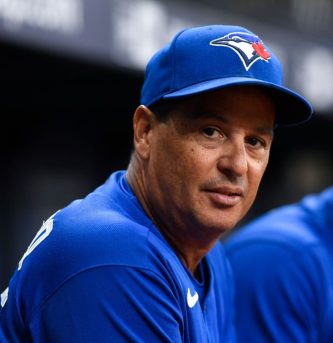
Charlie Montoyo

Montoyo takes the fall for somewhat less than gets other managers executed.

Let’s see. The Phillies sat 22-29 and having lost 11 of their previous 17 when they executed manager Joe Girardi in favour of Rob Thomson—whose team has gone 24-14 since.

The Angels went from 27-17 to 27-29, the first team in major league history to plunge from  ten games over .500 to a twelve-game losing streak, and sent manager Joe Maddon to the guillotine in favour of Phil Nevin. Nevin’s crew has gone 12-21 since, including 2-11 to open July.

The Blue Jays went 46-42 through Wednesday morning but suffered a five-game losing streak after opening July with a win, went 1-7 against one American League West wild-card contender and one of the division’s weaker teams, and awoke Wednesday at 2-12 for the month to date. Thus did they decide manager Charlie Montoya had a date with the firing squad despite the Jays beating those Phillies Tuesday.

Bench coach John Schneider was handed the bridge with the usual “interim” tag. The Blue Jays’ first act under their interim commander was to beat the Phillies to sweep a two-game set. Thomson’s been a steady skipper thus far; Nevin’s been little more than an apprentice seaman. One win isn’t enough to make the call on Schneider.

But something stunk about Montoya’s firing at first that was a little more profound than the fragrances surrounding the Girardi and Maddon executions. The timing especially.

Earlier this month first base coach Mark Budzinski’s seventeen-year-old daughter Julia was killed in a tubing accident. On Monday, Montoyo—who’d left the dugout with Budzinski in the middle of a doubleheader on receiving the news—joined other team reps in attending Julia Budzinski’s funeral.

Maybe collapsing to a 2-12 July opening gave the Jays enough reason to think Montoyo had to go, but with the All-Star break approaching it’s not unreasonable to think they might have waited just a short while longer, maybe on the eve of the break itself, to align the firing squad.

This may have been the second most cold-blooded managerial firing in modern major league history. The first would have to have been the Yankees dumping pennant-winning manager Yogi Berra in favour of the man who beat him in the 1964 World Series, the Cardinals’ Johnny Keane, the day after the Cardinals won in seven, a move that was planned back-channel before the Yankees put on the stretch drive (going 30-13) that nailed their pennant in the first place.

It looked even worse if you thought about was Montoyo having managed the Jays to 91 wins and a near-miss to the 2021 postseason despite the continuing coronavirus pan-damn-ic compelling the team to make three different cities the site of their home games.

But as Ken Rosenthal of The Athletic pointed out in the immediacy of Montoyo’s execution, the Jays may have their still-euphemistic “compelling reasons” to give the command to fire. If that’s true, maybe they shouldn’t have let him stay on the bridge with a one-year extension and a couple of option years to follow to open the season in the first place.

Like Girardi and Maddon before him, Montoya bore the burden of a misconstructed team even if it’s a team still in the new but dubious wild card hunt. It wasn’t Montoya who delivered a bullpen that finds as many bats as it misses or a starting rotation whose rear end resembles the northbound end of a southbound moose.

They opened July in second place in the tough American League East, but hitting the skid let the re-horsing Red Sox and the Rays pass them in the division standings while letting the Mariners match them for the third wild card thus far.

Now it comes forth, too, that some in the Jays clubhouse thought they needed a somewhat firmer hand when they hit the skid and Montoyo, as loved and popular as he was on the bridge, wasn’t quite the man to offer that hand.

Athletic Blue Jays beat reporter Kaitlyn McGrath found at least two players willing to talk about the clubhouse atmosphere, one anonymously but another willing to go on the record. Of course.

The anonymous Jay told McGrath that hitting the skid required what Montoyo apparently lacked. “When you’re [in a] 1-9 [slump], you’re looking for someone to come in and either kick you in the ass or pump you up, just something, some guidance,” the player said. “And you could have it as players, for sure, and we did, but you really do need it coming from the top and that just wasn’t happening . . . If we were playing better, this wouldn’t have been as much of an issue, but we weren’t, so you’re looking for leadership and a lot of us felt like it wasn’t really there.”

But even that didn’t erode the respect the Jays’ players have for Montoyo the man, if you take the word of pitcher Ross Stripling, who earned the Wednesday win against the Phillies with six strikouts but eight ground outs and ten fly outs in seven innings during which he surrendered two earned runs on two hits.

“I don’t think anyone would ever think that he doesn’t want us to have success individually or as a team, the whole Blue Jays organization,” Stripling told McGrath.

He had our backs all the time and wanted us to win baseball games. And it’s a shame—he’s been here since 2019, when this kind of young core got going—that he’s not going to be there to see a lot of their success and where they go and where we go as a team. But I think everyone would say thank you to him and the effort that he gave us for the years that he did and that we love him and wish him well.

General manager Ross Atkins, who carried the execution forth, said it’s not “necessarily” good starting pitching and good bullpens alone that contend and win. “Look at the history of the game,” he said, “good teams win championships. The person to look to is me. I’m the one that needs to be accountable. And we will continue to work hard in every area of our team to improve.”

In other words, don’t blame me because Charlie couldn’t make do with shallow starting and bullpen bulls.

For now the Phillies have lived a somewhat charmed team life since Girardi’s dismissal, even while losing Bryce Harper to a thumb fracture after the right fielder was limited to DH duty thanks to an elbow injury. They’re only nine games out of first in the National League East, though they have a formidable wall to climb with the first-place Mets and the second-place (and defending World Series champion) Braves making life none too simple.

The Angels? They could bring Casey Stengel back from the dead and still sputter. Especially since, in addition to their still-usual pitching problems not named Shohei Ohtani, the bottom of their order became such a trainwreck that it didn’t matter what the bigger bats did. It comes into sadder play when such bigger bats hit the slumps to which all bats are prone, even those of future Hall of Famers.

Nevin’s tenure has been a plane crash thus far. Especially when he landed himself a ten-game suspension for being none too subtle about looking to avenge a ninth-inning Mike Trout head hunt the night before and sending an opener to start the game and exact revenge. The Mariners may have had it coming, but one behind-the-back pitch and a subsequent plunk was out of line.

And while the umpires sounded mealymouthed in not starting the game with warnings after Trout was inches from decapitation in the ninth the night before, the ensuing brawl after Andrew Wantz hit Jesse Winker in the hip cost Nevin a key relief pitcher (Archie Bradley) for a month, at least, when he hopped over the rail to join the fracas and broke a bone in his pitching elbow.

It’s gotten to the point where the published calls for the Angels to start thinking about the once-impossible: trading both Trout at this year’s trade deadline and Ohtani before he reaches his first free agency, the better to get a replenishing return (hopefully, with pitching slightly above the level of arthritic cleaning crews) while the getting is prime—aren’t waiting until their season is all but officially dead.

So the Blue Jays aren’t exactly that bad off just yet. It’s still too soon to call a single win under a new bridge commander the beginning of an in-season resurgence. Who knows what Atkins might move upon as the trade deadline approaches? But there’s still something badly disconcerting about the Montoya execution. The man’s been a class act who’ll probably get another chance to take another major league bridge soon enough.

There may yet be more to come in the way of deeper details. As often as not, there usually are. And it’s not impossible to ponder whether Atkins himself might now be on a seat whose temperature rises a little more as the season goes forward.

“What have you gotten yourself into?”

Keith Hernandez

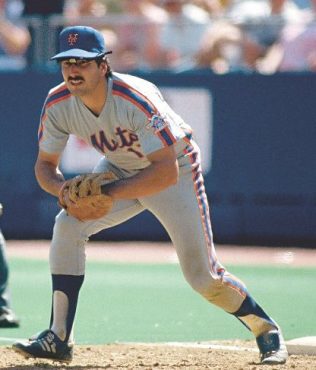
An on-base machine at the plate, Keith Hernandez’s real baseball genius was revolutionising first base as a command infield position.

Almost four decades ago, the Mets’ general manager Frank Cashen thought he’d laid the foundation for the Taj Mahal. The Cardinals’ transcendent but troubled first baseman, Keith Hernandez, thought the roof fell in on him.

A mainstay of a defending world champion, who’d driven Cashen to drink almost every time he played against the Mets, was about to become a Met.

From the moment a previous Met regime traded Hall of Famer Tom Seaver because he seemed a little too uppity about how the team should spend their money (a few parts upon himself as baseball’s best pitcher; a lot more parts on the free agency market and replenishing the farm), the Mets reverted to their original losing ways. And they weren’t half as funny about it.

It was one thing for the best first baseman in baseball to run afoul of his manager Whitey Herzog because a small morass of off-field issues sent him into the cocaine netherworld and, in 1983, into a few lazy baseball habits. It was something else to be sent to what was then, still, the National League’s version of the seventh circle of hell.

Herzog and Hernandez weren’t exactly Damon and Pythias. The White Rat was earthily thoughtful; Mex was cerebral. Where Herzog preferred the George Brett prototype right down to the pinch of Skoal in that Hall of Famer’s cheek, Hernandez smoked cigarettes and engaged Civil War period fiction and the New York Times crossword puzzle, for openers.

The thinking person’s sport had an actual thinking person in its ranks, who just so happened to be an on-base machine and a first base revolutionary. Herzog forgot the thinking side of himself and also listened to the whispers about Hernandez’s cocaine dalliance. (At the 1985 Pittsburgh drug trials, Hernandez would call cocaine “the devil on earth.”)

Herzog asked Cashen if he’d be willing to deal talented reliever Neil Allen. “[Allen’s] well-known drinking problem,” Jeff Pearlman noted in The Bad Guys Won, “didn’t seem to bother Herzog.” When Cashen said he hadn’t thought about it, Herzog replied, “If you think about Neil Allen and another pitcher, we’ll give you Keith Hernandez.”

To St. Louis, which roasted the Cardinals for years to follow over the trade, it was rather like Capitol Records sending Frank Sinatra to Dot Records in exchange for two spare session musicians and a tape operator. (“He came right into our kitchen and rattled our pans for about four years,” Herzog has written, “burned the Cardinals with a lot of big hits.)

Only Hernandez was probably less amused than the Chairman of the Board would have been. The first call he made when told he was about to become a Met was to his agent, Jack Childers. Hernandez wanted to know if he could afford to retire and live off his deferred income. Childers counseled his client not to even think about it. Hernandez resigned himself. Oops.

His Met tenure began with a classic, almost Metsian screwup. According to Pearlman, he caught a flight to Montreal, where the Mets were playing the Expos. The Mets’ media relations man, Jay Horwitz, sent a limousine to meet Hernandez. The limo went to the wrong gate, compelling Hernandez to catch a cab.

“When he first got there, I remember looking across the clubhouse at him,” says Ed Lynch, a pitcher on the 1983 Mets. “He was unpacking his bags, I think we’re in Montreal, and I’m thinking, ‘Boy, you poor son of a bitch. What have you gotten yourself into?’”

It took a little romancing and a lot of tour guidance from popular veteran Mets pinch hitter Rusty Staub to convince Hernandez he hadn’t exactly been sentenced to Sing-Sing. Staub showed Hernandez enough of the city’s best—the theater, the museums, the eateries, the libraries, the clubs, the lovely ladies on every street corner, seemingly—to convince the first baseman, “I’ll make a brand-new start of it, New York, New York.”

Hernandez became about 3,200 degrees more. After playing out the 1983 string, Hernandez was convinced enough to sign a five-year deal with the Mets. In his six full seaons as a Met—five solid, the sixth showing the toll the injuries and age took at last—the Mets won more games than any team in the entire Show.

As a Met, he posted a 131 OPS+ upon a slash line of .301/.388/.437, an OPS of .825, and a Real Batting Average (total bases + walks + intentional walks + sacrifice flies + hit by pitches, divided by total plate appearances) of .530. Lifetime, his RBA is .528.

Among postwar, post-integration, night ball-era Hall of Fame first basemen it would put Hernandez two points above Tony Perez and in seventh place. But being an on-base machine was only part of his presence. He remains the single most run-preventive first baseman in baseball history. (+120 total zone runs above league average.) It isn’t close. (Should-be Hall of Famer Todd Helton is a distance +107 in second place.)

He wasn’t the lumbering, big-bopping first base cliche. He played the position as though a third or second baseman, not just going for the tough plays and not just his expertise at neutralising bunts, but making himself the on-field infield commander.

“Not only he would tell you what you need to do,” says Lynch, “but he’s going to tell you how the pitchers going to try to prevent you from doing it. So he gave you not only the result, but he gave you the plan to get to that result.”

“The knowledge of the league, which he’d been in for a while, the knowledge of the other hitters, the willingness to know about the other manager’s strategy, the nuances of the game, the minutiae of who’s hitting, who’s running, their tendencies—it all added up to a wealth of knowledge over there that you could draw on,” says Bob Ojeda, the best lefthanded pitcher on the World Series-winning 1986 Mets. “And I did draw on it at times, no question.”

Keith Hernandez

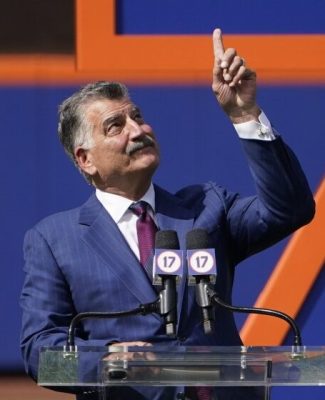
Now a respected, popular longtime Mets game broadcaster, Keith Hernandez points up to where his 17 hangs as a newly-retired Met uniform number.

It was hardly Hernandez’s fault that the Mets climbed the National League East ladder, reached the Promised Land, and finished his tenure with only one World Series ring and two pennants to show for a run of first or second place division finishes.

It wasn’t Hernandez’s idea to fool with Dwight Gooden’s repertoire in spring 1986, a foolery that would turn him in due course from beyond this earth to journeyman pitcher while he battled with his own drug addiction. It wasn’t Hernandez’s idea that Darryl Strawberry should spend most of the rest of his Mets life at war with himself, with substance abuse, and with his own team time and again.

It wasn’t Hernandez’s idea that Cashen should break the team apart little by little, or that he and Hall of Famer Gary Carter (Winning brings opposites together, Hernandez once said of Carter, an intelligent catcher but not in Hernandez’s cerebral league) should hit decline phases accelerated to somewhat warp speed by injuries atop their years of hard labour on the field.

Hernandez might have begun giving the Mets “a swashbuckling, devil-may-care, damn the torpedoes, full-speed ahead image,” as Lynch phrases it, an image New York loved but the rest of the league didn’t, but it didn’t exactly mean he wanted swashbuckling confused with recklessness as happened with too many of those 1986 Mets.

It took the Mets a very long time to come to terms with both the best and the most controversial team in their long, surrealistic history. The beginnings of those terms included bringing Hernandez into the broadcast booth, first as a part-time colour commentator, then a full-time partner to longtime mainstay Gary Cohen plus Hernandez’s 1980s Mets teammate, equally cerebral pitcher Ron Darling.

“You do the pitching, I do the hitting,” Hernandez told Darling when completing the trio.

The most vivid continuation of that coming to terms was the Mets retiring Hernandez’s uniform number 17 Saturday, before the Mets beat the Marlins in ten innings, 5-4, in a fashion that must have reminded Hernandez of his own good old days, almost: a two-out double sending the inning-opening zombie runner home; and, a throwing error on a dying ball on the front infield grass allowing the winning run to score.

“He asked for No. 37; that was his number with the Cardinals,” Lynch remembers of Hernandez’s original arrival. “And they told him no. He looked at them funny. And they said, ‘That’s Casey Stengel’s number.’ So now he comes over, he takes 17, and that’s getting retired also.”

“I never dreamed I’d be here this long, in the organization,” the Young Perfesser told a packed Citi Field Saturday. “I am absolutely humbled and proud that my number will be up in the rafters for eternity.” With the Ol’ Perfesser and The Franchise, among others.

Perhaps another humbling day will come Hernandez’s way, in due course, if the newly-aligned Contemporary Baseball Era Committee sees fit to give his career the thorough review it merits and gives first base’s greatest defender ever and one of its steadiest on-base machines a berth in the Hall of Fame.

“I got traded to a last-place team and no one at the ballpark,” Hernandez says. “And it turned out to be such a life-changing event for me in such a positive way.” For him and, for a few glorious if not always controversy-free seasons, New York itself.