Queen Elizabeth II, RIP: Take her out to the ballgame

Tony La Russa, Queen Elizabeth

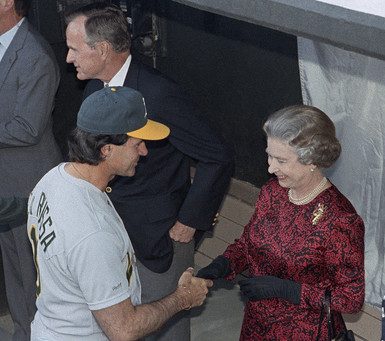
Hall of Fame manager Tony La Russa greeting Queen Elizabeth II in the dugout (with President George H.W. Bush in the background) before the A’s played the Orioles in May 1991, during the queen’s visit to the U.S. On that day, La Russa’s pitcher Dave Stewart threw HRH a nyukleball.

Her late majesty Queen Elizabeth II had something not customarily associated with royalty, namely a fair sense of humour. Dave Stewart, then an  Athletics pitcher, sort of learned when Elizabeth and her husband Prince Phillip visited the United States in 1991 and attended a game between the A’s and the Orioles.

The game was 15 May 1991 at Baltimore’s old Memorial Stadium. Stewart didn’t start the game for the A’s but Bob Welch did. Before the game, the royal couple visited the dugouts and chatted with assorted players, including Stewart, a pitcher whose success on the mound with the A’s was equal only to his countenance taking a sign. The countenance that suggested he might bite your bat barrel or your head off before trying to bust one past you.

Stewart discovered Her Royal Highness’s good humour even if decorum compelled her not to let it loose too readily. “I remember like it was yesterday,” the former righthander whose uniform number 34 becomes a retired number come Sunday told USA Today‘s Bob Nightengale.

We were all lined up to meet her in that procession. So Three Stooges was one my favorite comedies . . . So when she passed (in line), I did like a Three Stooges thing: ‘Queenie, nyuk nyuk.’ She laughed. Well, cracked a smile . . . Put it like that. The rest of the team was cracking up. It was cool for me. I’m sure it was for everybody too, but I had to go act like a god-dang fool.

Let the record show the A’s beat the Orioles 6-3, despite Orioles first baseman Randy Milligan hitting a pair out against Welch, a pair of leadoff blasts in the fourth and sixth innings; and, with a little help from Oriole starter Jeff Ballard picking Hall of Famer Rickey Henderson off second only to see it turn into a run on a dubious fielding error.

Let the record show further that Prince Philip may have had a better time at the game than his wife. Sitting in a luxury box with then-president George H.W. Bush, defense secretary Dick Cheney and then-baseball commissioner Fay Vincent, according to the San Jose Mercury-News, Philip pored through a media guide and kept binoculars in front of his eyes as he scanned the field and the play. Elizabeth “sat primly and looked bored.”

If you’re my age, you may remember enough of the world thought she was kidding around when she named the Beatles as members of the Order of the British Empire in 1965. I can remember enough hoopla indicating enough among the British political and social class objected anywhere from strenuously to amusingly to returning their own M.B.E.s.

My thought approaching age ten was that Her Majesty must have been tempted to breach her well-known composed self and style to slap the twits silly. Ed Sullivan, through whom the Beatles graduated from mere phenomenon to universe shakers in early 1964, did it for her, when he introduced the Beatles at Shea Stadium in August 1965: Honoured by their country . . . decorated by their Queen . . . and loved here in America!

Twelve years after Sullivan’s bouquet came the espionage novel that probably provoked both mirth and melancholia in the former motherland, William F. Buckley, Jr.’s Saving the Queen. His protagonist—a CIA operative on assignment to plug up the Buckingham Palace leaks through which American atomic secrets were being snuck—included in his operation a sexual tryst with a fictitious British queen.

Well, now. I’ll let the late Mr. Buckley himself take it from here, from an essay republished in A Hymnal: The Controversial Arts (1979):

There is something wonderfully American, it struck me, about bedding down a British queen: a kind of arrant but lovable presumption. But always on the understanding that it is done decorously, and that there is no aftertaste of the gigolo in the encounter. I remember, even now with some trepidation, when [Saving the Queen] came out in the British edition. The first questioner at the press conference . . . was, no less, the editor of The Economist, and he said with, I thought, a quite un-British lack of circumspection, “Mr. Buckley, would you like to sleep with the Queen?” Now, such a question poses quite awful responsibilities. There being a most conspicuous incumbent, one could hardly wrinkle up one’s nose as if the question evoked the vision of an evening with Queen Victoria on her Diamond Jubilee. The American with taste has to guard against a lack of gallantry, so that the first order of business becomes the assertion of an emancipating perspective which leads Queen Elizabeth II gently out of the room before she is embarrassed. This was accomplished by saying, just a little sheepishly, as [protagonist] Blackford Oakes would have done, “Which queen?”—and then quickly, before the interrogator could lug his monarch back into the smoker—“Judging from historical experience, I would need to consult my lawyer before risking an affair with just any British queen.”

The reaction of monarch with the subdued but not invisible sense of humour is not on record to the best of my knowledge, though I’d be happy if proven wrong. Especially so considering that in the novel itself the queen is the seductress and the spy the seduced. Elizabeth was known discreetly for playfulness with her husband but not believed to have been anything on the make in her premarital youth.

A consummation even more devoutly to be wished might be her response to Mr. Buckley’s eventual revelation that his friend David Niven, the distinguished British actor, answered his request for a blurb to appear with the novel’s paperback edition: Probably the best novel ever written about fucking the Queen.

Needless to say, the blurb never appeared except in a Buckley recollection or three. I suspect Elizabeth’s good humour might have deflected contortions enough, remembering she probably confronted far more grave lapses of decorum over her unprecedented seventy-year reign.

Including too many among her own offspring, for one of whom it would be high praise if nyuklehead was the worst sobriquet attached to him. The good news is that he’s not the one who ascended the predominantly ceremonial British throne upon his mother’s death. If the sins of the parents be visited not upon their children, surely the sins of the children should not be visited upon their parents.

Which enables Elizabeth to an eternal reward I pray includes frequent escort to the Elysian Fields and an afterlife education telling her that, unlike what she seems to have thought that 1991 day in Baltimore, a queen renowned as something of a thinking person should appreciate the thinking person’s sport.
He can drive 55

Aaron Judge

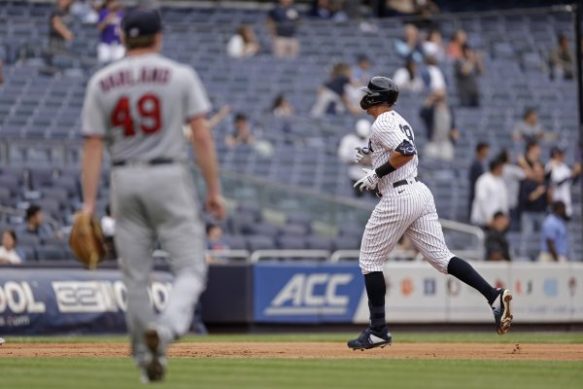
Judge runs it out after driving 55 at Twins rookie Louie Varland’s expense Wednesday.

If you consider a sixty home run season the Promised Land for a power hitter, Aaron Judge awoke Thursday morning five bombs from crossing the Jordan River. And yet . . . and yet . . . the philistine contingencies continue asking the wrong questions about whether Judge will have done it, ahem, “legitimately.”

The Leaning Tower of 161st Street parked number 55—a fourth inning, leadoff blast off Twins starter Louie Varland—in the first game of a Yankee doubleheader sweep of the Twins Wednesday. Among the first notes on the blast was that it gave Judge two more homers after 136 games than Roger Maris in 1961.

If that’s among the only thing that impresses you about what Judge is trying to accomplish, so be it. If it’s second to whether and if Judge hits 60 or more by game 154, since Babe Ruth did that in 1927, so be it, too. The length of season factor was settled long enough ago. It remains far less relevant than other things.

Some of those things have been broken down and analysed splendidly by an MLB.com writer, Mike Petriello. Like me, Petriello has the audacity to look at the deepest data available, refusing to accept that the thinking person’s sport, which is also the deepest sport, should be allergic to thinking and depth.

Petriello goes above and beyond the primary truth that still discomfits enough even today,  Ruth never having faced the truly best available competition in official league play, through no fault of his own and all fault of (ahem) Organised Baseball of the era. (The biracial Judge would have been persona non grata in Ruth’s game.) But Petriello makes the parallel note that in 1927 only five players were born outside the United States, while 2022 includes 418 such players.

The Babe also didn’t face a third of the volume of pitchers Judge has faced, fresh or otherwise. In 1927, Ruth faced 67 pitchers all season long; Maris in 1961 faced 101. Judge faced 224 entering Wednesday and 232 by the time the twin bill ended. The rookie Varland was 225. The poor guy had the honour of being welcomed rather rudely to the majors by a seven-year veteran advancing upon history with a roundhouse punch into the left field seats.

“With series remaining against two teams he’s not seen yet (Milwaukee and Pittsburgh) and the usual September roster shenanigans,” Petriello writes, “Judge might get up to around 240 or so pitchers faced, all with their own arm slots, repertoires and approaches. It will be nearly four times what Ruth saw, and more than twice what Maris saw.” Variety is the life of spice, and a challenge to the bombardier.

In Ruth’s day, too, the idea of relief pitching as we came to know it barely took hold, if at all, above and beyond the Washington Senators’ Firpo Marberry and maybe one or two more. That was then: most relievers not named Marberry were brought in only upon injury or disaster. (Sometimes both.) This is now: relief pitching is a long-sanctioned, time-enough-honoured element in baseball’s art and craft.

Ruth got to enjoy a privilege about which Judge can only fantasise now, seeing a pitcher for a third or even fourth time in a game. Petrillo then sees and raises himself: Ruth got to face a pitcher for a third time or more 35 percent of the time in 1927; Maris, 30 percent in 1961. Judge? Seventeen percent.

Even Mark McGwire, Sammy Sosa, and Barry Bonds among the 60+ home run club got to face pitchers a third time around more often, from Sosa’s 20 percent in 2001 to his (1998), Bonds (2001), and McGwire’s (1998) 22 percent, then to McGwire’s and Sosa’s 24 percent (1999).

It gets a little more bizarre, Petriello notes: Judge has seen only one starter a fourth time around this year, twice—and both times, it was Max Scherzer. Judge does have one bomb off Scherzer, a third-inning blast on 22 August, but he flied out the third time he faced Scherzer that day. Almost a month earlier, Judge faced Scherzer in a 6-3 Yankee loss, and Max the Knife struck him out thrice after surrendering a first inning fly out.

Petriello’s deep dive also exhumed that Ruth in 1927 hit nine home runs off relievers he got to see a second time in a game, and over half his home runs came at the expense of either starters he saw a third time or more or relievers he saw a second time around or more. Judge should be so lucky: it’s only happened to him 19 percent of the time this year.

“If [Judge] saw starters being used the same way the Babe did,” Petriello writes dryly, “he might be looking at an 80-homer season at this point.” The flip side to the coin is that if Ruth saw the volume of quality pitching Judge sees, he might have been lucky to break his own original record of 29 in 1919. (For all you 154-game season chauvinists, 1919 was a 140-game season. Shall we declare Ruth the original “illegitimate” record-breaker because he had a 154-game season to hit 54 for a new record in 1920?)

Judge has 25 games to go to pass Ruth, Maris, and the rest. His season’s average is one bomb every 2.5 games. If he stays on the pace, he might hit 65. It would be one short of Sosa’s best, five short of McGwire’s, eight shy of Bonds, and all alone atop Yankee history. For now, the Leaning Tower of 161st Street is the most prolific single-season righthanded home run hitter ever to wear the Yankee pinstripes.

“The baseball world has changed considerably since 2001, or 1961, or 1927,” Petriello writes, blissfully unconcerned for the philistine contingency which persists in thinking that the game had no business changing at all, never mind that some changes over all those decades have been nothing but beneficial to baseball’s health while others amount to calling repairmen to fix what wasn’t actually broken.

Almost all of it has changed in a way to make hitting more difficult, for any number of reasons, most revolving around velocity, pitch movement, and the endless streams of high-octane arms who don’t worry about pacing themselves to go deep into games. This, above all else, is why the strikeout rate keeps going up; the next time a batter from a half-century ago complains about today’s hitters, remember that their task is immeasurably more difficult than his was. (Emphasis added.)

Remember, too, that Judge is playing in a season in which nobody’s still really dead certain whether he’ll get to swing on a rabbit ball or a miniature medicine ball. But it almost doesn’t matter. (Almost.) You can throw Judge a ball of seaweed, and he can hit it into the upper deck.

But he might hit more than ten more homers, too. Continuing to put the lie to manager Trey Wilson (in Bull Durham) telling his stumbling team, “This—is a simple game. You throw the ball, you hit the ball, you catch the ball.” If it was that simple, Judge’s height would be the only large thing about him.

“I can’t drive 55,” rocker Sammy Hagar once sang for a top-thirty hit. Judge can drive 55, and maybe a lot more before the regular season ends. There won’t be a traffic cop or highway patrolman alive who can stop him.

An epic Yankee fall?

Aaron Boone

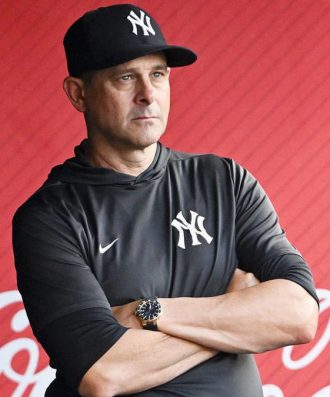
Aaron Boone—how often does a four-game division lead feel like the next rung down of a collapse?

“If we don’t dig ourselves out,” Yankee manager Aaron Boone told reporters after the Yankees lost to the Rays 2-1 Saturday night, “you’ll have a great story to write.” Sometimes, greatness is in the eye of the beholder. If the beholder is a typical Yankee fan, this kind of greatness is the last thing the Yankees need.

There’s always been a trunk full of cliches about the Yankees. The two most significant have been a) they don’t like to lose; and, b) their fans consider no postseason legitimate unless the Yankees are in it. (The third most significant, at least since a certain man bought the team in 1973: To err is human; to forgive is not Yankee policy.)

Even the terminally optimistic Boone feels the weight. If he’s telling reporters they’ll have a “great” story to write unless the Yankees find a way out of their current spinout, there’s no joy in half of New York. The other half is hanging with the Mets, who may have a mere two-game lead in the National League East but whose fans aren’t exactly ready to call for summary executions despite their team having ended May 10.5 games ahead of their divisional pack.

The Mets’ faithful learned from the crib that there’s no such thing as an entitlement to success. (Quick: Name any Yankee team ever called a miracle team.) The Yankee faithful were spoiled so rotten by their 20th Century success that their descendants still think the World Series trophy is fraudulent unless it has the Yankee name on it.

Maybe the Yankees will dig themselves out of their present funk. But maybe they won’t. They’re 15-16 in the second half so far and went 10-18 in August alone, but they awoke Sunday morning having lost six of nine. Dropping the first pair of a weekend set with the second-place Rays is one thing, but entering that set splitting four with the sad-sack Athletics and two of three to the equally sad-sack Angels is not the look the Yankees wanted going in.

Their toughest opponents the rest of the way will be those same Rays for a three-game set in Yankee Stadium starting 9 September. They return home from Tampa Bay to host the Twins for four, and the Twins are no pushovers, but they’re not exactly up to the Rays’ performance level just yet. They’re also not quite up to the level of the suddenly-amazing Orioles, whom the Yankees host to end September and open October.

The Orioles—who looked as though they’d surrendered their heart and soul when trading Trey Mancini at the trade deadline, which could have threatened their unlikely sightline to the wild card picture. While almost nobody was looking, the Orioles not only finished July with a 16-9 month but they consummated a 17-10 August and opened September with three straight wins—one against the AL Central-leading Guardians and two against the A’s. Once upon a time the victims of a miracle team (in 1969), these Orioles may yet <em>become</em> a miracle team themselves.

They were as deep as 23 games in the AL East hole as of 2 July. They were 35-44. They’ve since gone 36-25. This regular season may yet finish with a debate over which was greater, the Yankees’ collapse from a one-time 15.5 game AL East lead or the Orioles’ resurrection from a 23-game divisional deficit to a postseason berth.

Yankee and other eyes concurrently train upon Aaron Judge’s pursuit of the 60 home run barrier across which two Yankees have gone (Hall of Famer Babe Ruth’s 60 in 1927; Roger Maris’s 61 in ’61) and—after a healthy leadoff belt in the top of the ninth off Rays reliever Jason Adam Saturday night—Judge himself is only eight shy of meeting. Some think Judge is so locked in he may even meet the 70-bomb single-season barrier head-on before the regular season expires. He’d be the first player to reach it without being under suspicion of actual/alleged performance-enhancing substances, anyway.

But Yankee cynics make note that, for thirty days including Saturday night, the Yankees’ team slash line of .213/.289/.325 is only that high with Judge, himself the possessor of a .279/.446/.593 slash for the same span. Without him, they’d be .208/.268./.295. Their Lost Decade of 1965-75 looked better than that.

How on earth did the Yankees get here? Easy enough. Hal Steinbrenner isn’t the man his father was, good and bad. The good side: Prince Hal isn’t exactly the type to decide one bad inning is enough to demand heads on plates, and if he fires a manager he wouldn’t have the gall to say, “I didn’t fire him. The players did.” The bad side: He doesn’t like to invest half as much as his father did.

Say what you will about George Steinbrenner, but the man didn’t care how much he had to spend, either on the free agency market or on keeping the farm reasonably fresh. Prince Hal’s running the most profitable franchise in the American League as if they were a minor league outlier or the A’s, whichever comes first. Nobody wants the bad side of The Boss resurrected, no matter how often Yankee fans demand it now. But nobody wants the good side buried interminably, either.

Which means general manager Brian Cashman, the longest-tenured man in his job in baseball, had little choice but to cobble a roster with one proverbial hand tied behind his back. But that acknowledgement goes only so far. Cashman’s eye for diamonds in the rough has failed him long enough. The present Yankee roster makes some rebuilding teams (the Orioles, anyone?) resemble threshing machines.

Which also means Boone—the only man in Yankee history to manage back-to-back 100-game winners in his first two seasons on the bridge—looks a lot larger for his faltering in-game urgency managing and getting less than the best of the men not named Judge or (relief pitcher) Clay Holmes on his roster. So do the three Yankee hitting coaches who can’t seem to shake the non-Judge bats out of what one of them is quoted as calling the wrong case of the “[fornicate]-its.”

The definition to which those coaches hold is translated admirably by strongman designated hitter Giancarlo Stanton: “We’ve just got to give whoever is on the mound a tough at-bat, even if we get out. We’ve just gotta wear ’em down a little bit. Just be a little tougher on them.” The definition to which the Yankee bats have held mostly of late seems to be unintentional surrender.

Yes, the Yankees have been injury-addled. Yes, they’ve been playing a curious chess game with minor leaguers brought up to the club to the point where they had to send two promising pitchers back down because the roster was about as flexible as an iron gate. But the lack of urgency the Yankees seemed to feel when they looked like AL East runaways hasn’t been resolved just yet with the team looking as though they can be overtaken before this is over.

Once upon a time, New York was rocked by a Brooklyn Dodgers team that looked as though it was shooting the lights out in the National League but found itself overtaken into a pennant tie by a New York Giants team that was 13 games out at one point. That tie and subsequent playoff, of course, turned out to be as tainted as the day was long. (The Giants stole the pennant! The Giants stole the pennant!)

To the best of anyone’s knowledge, nobody’s cheated their way back into the AL East race. If the Yankees keep up their current malaise, nobody would have to. Collapsing entirely from a 15.5 game lead would stand very much alone on the roll of Yankee infamy.

The spirit of 74

Aaron Judge

Hitting number 51 against the Angels Tuesday, Aaron Judge may yet break the single-season home run record. May.

We’re well enough past the point where looking at the scores to see how the Yankees are doing has nothing to do with a certain Yankee’s performance. If you turn to see the latest in any Yankee game without checking first on Aaron Judge’s in-game doings to that point, you’re going to flunk a polygraph hooked upon that question.

The Leaning Tower of River Avenue (how the mind’s eye produces fantasies of him squaring off against such lamp post-tall pitchers as Hall of Famer Randy Johnson and the late J.R. Richard) is having his best unimpeded (yet) season since his Rookie of the Year campaign five years ago. But nobody cares a whit about anything other than what he hits over the fence.

This year, the baseballs may still come having been consciously deadened but Judge couldn’t care less. He’s sent 51 of the miniature medicine balls into the seats through this writing. Those who care will note that he did that fourteen days before Babe Ruth reached 51 in 1927 and four days after Roger Maris reached it in 1961.

That’s talking purely about single-season home run record held by Yankees, about which there was once and still often enough not always cheerful insanity. Yankee chauvinists insist that and just about any other slugging record lack legitimacy unless set or held by Yankee batters. Which is almost (underline, please) as obnoxious as their (frequent enough) insistence that the postseason is illegitimate without a Yankee team in it.

Judge is one of the most likeable players on a team with which baseball fans not roosted in New York (and enough who are) have had, shall we say, a mixed relationship. The Yankees’ history is respected and even admired, however grudgingly, but the team is not always beloved. What’s true of several other teams is true exponentially about them.

But now and then even such parochial rooting or anti-rooting steps to one side when an individual Yankee threatens to launch himself into the precincts of the gods. That polygraph’s needles will jump right off the machine and onto the floor the moment you say that you don’t care if Judge hits a hundred home runs by the time this regular season ends just as long as the Yankees don’t win.

He’s not going to hit a hundred, of course. Seventy isn’t an unrealistic expectation at his pace. Seventy-four, which is what Judge would need to become the undisputed all-time single-season home run champion, may not be as much of a pipe dream as you think.

Judge doesn’t play under the witless lash of a commissioner who insisted without true authority to do so that the record would be illegitimate if broken after 154 games. He does play under the eye of a considerable crowd praying he gets to 74, the better to knock a suspect player out of the way. The incumbent record holder was a) not a Yankee and b) suspected of using actual or alleged performance-enhancing substances to get there.

And that record holder took the record from another who was not a Yankee and suspected of actual or alleged PEDs. The point that they were quite the outliers, in a generation where numerous players using or suspected of using such substances actually saw statistical dips instead of spikes (and, yes, you can look it up), usually escapes the usually self-appointed arbiters of sports morality.

It won’t condone those users or elevate those accusers if and when Judge parks number 74. But it would be nice to remember that baseball government did nothing about the plague until that government bumped into the government government. And the government government seemed far more interested in leading players on the perp walk than they were in sending swell if hypocritical messages to kids.

Without all that, we might be allowed to watch the Judge pursuit with more joy. Without all that, we might have nothing more grave to consider than this: If Judge can send baseballs that might as well be miniature medicine balls into earth orbit, what incentive does the sport’s administration have to iron up, remove its blinders, and insist upon a uniformly made baseball that allows both pitchers and hitters a fair shake?

The only blemish I can think of that attaches to Judge was his extremely rare attack of hubris in trolling Red Sox fans after the Yankees tied their 2018 American League division series, blasting Frank Sinatra singing “New York, New York” (a staple in Yankee Stadium after Yankee wins) from his boom box as he departed Fenway Park.

That’d teach him. In New York, the Red Sox destroyed the Yankees in the third division series game (16-4) and hung in despite a Craig Kimbrel meltdown in the bottom of the ninth to take it with a 4-3 Game Four win. Yankee fans were grateful that, to the best of anyone’s knowledge, none of those Red Sox (who went on to win the World Series) trolled them with boom boxes blasting the Standells’s garage band classic “Dirty Water.” (Boston, you’re my home . . .)

If that’s the only crime against common sense Judge has committed in his career, it’s not exactly a rap sheet on which to hang a man. Facing his first free agency this coming off-season, Judge stands to reap a payday equal to the value of some companies and a few tiny nations. He couldn’t have made a more powerful case in his dreams.

But this is the same player who was made aware of a Blue Jays fan handing one of his mammoth-blasted balls to another Rogers Centre fan who’d made no secret of Judge being his baseball idol and hoping to have a ball hit by Judge himself.

“That’s what’s special about this game, man,” he told reporters, after learning video of the moment went viral. “It doesn’t matter what jersey you wear, everybody is fans, everybody appreciates this game. That’s pretty cool. I’ve got to check out that video. That’s special.”

He did more than check the video out. The following say, before the game, he made a point of meeting the boy and his family and the fan who handed the ball to the boy, signing the home run ball for him and giving him the batting gloves he wore while hitting it.

Judge still resembles an eager nine-year-old boy himself when he flashes his familiar snaggle-toothed grin. But in the batter’s box he resembles the Jolly Green Giant when he pumps his bat and turns a pitcher’s mistake into another long bomb. Where he does it from hardly matters. His 199 OPS+ through this writing indicates he could clear several zip codes from the Grand Canyon or the last known surviving telephone booth.

If the Leaning Tower of River Avenue does it 23 more times between this writing and the regular season’s conclusion, there shouldn’t be a single baseball fan (even of the Yankee-hating variety) declining to stand up and cheer. If he doesn’t make it, stand up and cheer, anyway. Between his pursuit of 74 and Albert Pujols’s renaissance pursuit of career number 700, they’ve made the home run fun again.

“Your credibility is further impacted . . .”

Jeff Luhnow

An excerpt from the forthcoming Astrogate book by the reporter who co-broke the scandal story originally makes deposed Astros GM Jeff Luhnow look even worse.

“Winning fixes everything” became a catch phrase around the Astros in the wake of Astrogate’s presumed denouement. It also became the title of a forthcoming book examining the Astros’ organisational culture that fostered, enabled, and entrenched the team’s illegal, off-field based, highest-tech electronic sign-stealing in 2017-18.

The author is Evan Drellich, one of the two Athletic reporters (partnered with Ken Rosenthal) who first exposed Astrogate in depth by way of whistleblowing former 2017 Astro pitcher Mike Fiers in late November 2019—after the Astros lost the World Series to the Nationals in seven games none of which were won by the home team.

First, the book was to be called Winning Fixes Everything: The Rise and Fall of the Houston Astros and published a year ago. That would have been on the seventieth anniversary of the off-field based telescopic sign-stealing cheating by which the New York Giants mounted the staggering stretch drive comeback from the dead to force the fabled 1951 National League pennant playoff.

Then, the publication date changed to this past March. Then, to last month. I actually messaged Drellich via Twitter after the beginning of this year to ask the wherefore of the delays. Quite kindly, he answered that the book ended up taking longer to report out and write up than he thought going in, not to mention pan-damn-ically inspired supply chain issues prompting a possible July arrival.

But now, the book will arrive in due course under the title Winning Fixes Everything: How Baseball’s Brightest Minds Created Sports’ Biggest Mess. The newly scheduled publication date: next Valentine’s Day. Astro fans still divided between sorrow and whataboutism about the now-long-tainted 2017-18 Astros won’t necessarily consider it a love letter.

If an excerpt published in The Athletic Thursday suggests nothing else, it suggests that the ultimate mastermind of what would become Astrogate in the first place outsmarted himself when Fiers exposed the Astro Intelligence Agency and thus prompted commissioner Rob Manfred to launch a complete investigation into the AIA.

Jeff Luhnow’s organisational culture when he ran the Astro show already lacked for what enough who escaped one way or the other described as basic humanness. It went beyond the team’s newly data-driven approach to tanking in order to rebuild a winner.

“In Casablanca,” Major Strasser said infamously, “human life is cheap.” In Luhnow’s Astroblanca, people learned the hard way that human decency was cost prohibitive. And Luhnow appears to have been willing to launch a high-tech coverup to keep Manfred and his bloodhounds from unlocking the Astrogate.

“In any investigation,” Drellich wrote, “the league notifies people of interest in writing that they need to preserve their cell phones . . . Luhnow, investigators learned, had instructed one of his lieutenants, Bill Firkus, to give a personal heads up to others with the team that MLB might collect their devices, a person with direct knowledge of the league’s investigation said.”

In a “quick and hurried manner,” Luhnow asked Firkus to tell “others” not necessarily to wipe their cell phones but ‘let them know their phone might be confiscated, and that they should be comfortable with what was on there.’ But the same sources having such deep knowledge of the Manfred probe said the Astros’ then-manager of pro scouting analysis, Matt Hogan, believed Firkus’s heads-up translated as, “MLB is coming, and that there’s a chance they can take your phone, so if you have things you don’t want anyone to see, I would get rid of them.”

Maybe nobody can isolate the actual language by which Luhnow counseled Firkus and what he did or didn’t actually suggest. But MLB, Drellich wrote, thinks it found only one individual wiping a cell phone after ordering Astro personnel to preserve those phones: Luhnow.

Manfred himself sent Luhnow a letter dated 2 January 2020, slightly over a month before the notorious spring training presser at which the Astros either apologised non-apologetically or non-apologised apologetically, depending on your translation. It laid out the evidence against the AIA. When the Wall Street Journal (which also exposed the Codebreaker algorithim that paved the path to Astrogate in the first place) published a story about the letter, it didn’t mention the cell phone wipes.

But Drellich revealed that the Manfred letter spanked Luhnow for the attempted Astrogate coverup. From the letter itself:

Your credibility is further impacted by the fact that you permanently deleted information from your phone and its backups in anticipation that my investigators would seek to search your phone. You did not tell my investigators that you had done this until they confronted you about it in your second interview. While you explained that you were simply deleting sensitive personal photographs, I have no way to confirm that you did not delete incriminating evidence.

“According to people with knowledge of the league’s investigation, the GM of the Astros had wiped every back-up from his phone, besides one, and other data was missing as well,” Drellich wrote.

. . . Investigators found that Luhnow’s phone had no standard call logs, even though Luhnow had known phone calls with A.J. Hinch that should have been there. MLB also could not locate known email exchanges that should have been on his phone that were found on others’ devices. But as MLB’s investigators saw it, if Luhnow had been trying to delete a large amount of information, he didn’t do a perfect job: the phone had Skype and WhatsApp call logs dating back to 2009.

When Luhnow offered a kind of apology for Astrogate in October 2020, he told a reporter for Houston’s NBC affiliate, Vanessa Richardson, that by God nobody told him about the illegally installed extra center field camera in Minute Maid Park, nobody told him it was sending real-time imagery to a clubhouse monitor illegally, nobody told him someone figured out what to bang on the can after deciphering that illegal intelligence, and by God he’d have told them no, nein, nyet if they’d gone to him asking permission.

Sure. Just the way Albert Fall told Harry Sinclair where to stuff it with his presents in exchange for getting to bid low and win the right to draw oil from Teapot Dome. Just as Lyndon Johnson told his pal/adviser Bobby Baker to quit swapping sex partnerships for Congressional votes. Just as Richard Nixon demanded names and heads on plates when he learned about a burglary at the Watergate Hotel.

Drellich never pretended other major league teams weren’t up to electronic chicanery. Neither did Cheated author Andy Martino, whose Astrogate book detailed how the Yankees and the Red Sox and others took to anything from AppleWatches in the dugout to replay room reconnaissance for sign stealing.

But the AIA was something newer, far more advanced, and far more disturbing. It continued even as Manfred formally wrist-slapped both the Yankees and the Red Sox for swapping electronic sign stealings in 2017 and warned all teams simultaneously not to even think about it. It went above and beyond the 2018 Rogue Sox’s replay room reconnaissance ring.

It went above and beyond such telescopic cheaters as the 1899 Phillies, the 1909-1910 Highlanders (Yankees), the 1940 Tigers, the 1948 Indians, the 1951 Giants (stole the pennant! The Giants stole the pennant!), and the 1961 Reds.

MLB handed the replay room reconnaissance ringers the replay rooms they discovered could be used for espionage. It didn’t hand the Astros a license to operate their own sign-stealing closed-circuit television station.

A commenter on The Athletic‘s page publishing the Drellich excerpt asked, “Why are we still talking about [Astrogate]?” News bulletin: Baseball fans and historians haven’t stopped talking about the Black Sox scandal, the ’51 Giants, the 1957 Cincinnati All-Star ballot-box stuffing scandal, the political chicaneries driving the Dodgers and the Giants out of New York, the 1985 Pittsburgh drug trials, the Pete Rose scandal, the Steinbrenner/Spira scandal, or the scandals around actual/alleged performance-enhancing substances, either.

I’ve said it before but I’ll say it again. Astrogate won’t go away at last until the last member of the Astrogate teams standing no longer wears the Astro uniform. Even, then, books such as Martino’s and, in due course, Drellich’s, won’t let the scandal die the death the most stubborn Astro fans wish.