I surrender—let the NL have the DH

Philadelphia Phillies v Chicago Cubs

They once said, “There’ll sooner be night games at Wrigley than the DH in the NL,” didn’t they? Well, now . . .

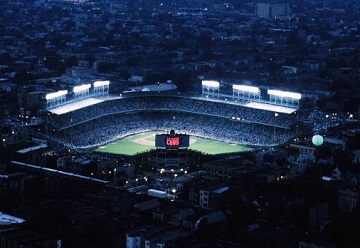
There was a time you would think the world would implode if the National League adopted the designated hitter, as the American League did in 1973 and as the Major League Baseball Players Association wants the National League to do soon. And some people still believe it. Well, there was also a time (and a rather noisy contingency arguing either way) when you would have thought the world would implode if the lights finally went on at Wrigley Field, which they did on 8 August 1988.

You still may find Cub fans who think that was a date equal in infamy only to the St. Valentine’s Day Massacre, the Chicago Fire, or the 1968 Democratic National Convention riots. The only thing in Chicago infamous about the night the lights went on at Wrigley was the game between the Cubs and the Phillies being rained out before the fourth inning was finished.

Surely there were enough Cub traditionalists who believed the rains were God expressing His displeasure, as if decades of losing baseball with only the occasional rude interruption were worth the preservation of the great daytime at the Friendly Confines. All the rainout did was delay the inevitable. The following night, the lights went on at Wrigley Field again. And the Cubs beat the Mets, 6-4.

That and the world failing to implode on cue was the good news. The bad news was that the presidential campaign, the Preppie vs. Zorba the Clerk, continued apace. Little by little, from that day forward, Cub Country began assimilating the idea that some traditions weren’t worth keeping if they secured other distasteful traditions—like losing baseball. They finally won their first World Series since the Roosevelt Administration (Theodore’s) at night, too.

“Lovely, just lovely. The park is lovelier than my team,” Mets manager Casey Stengel said when he saw Shea Stadium for the first time. Cub fans finally figured out that their ballpark was lovelier than their team even under the lights. And maybe National League traditionalists are figuring out that the designated hitter isn’t the spawn of Satan, after all.

Sure it’s fun when Madison Bumgarner hits those home runs every couple of blue moons, the way he did twice on Opening Day once. But as NBC Sports’s Craig Calcaterra reminds us, Bumgarner’s lifetime slash line as a hitter is .183/.228/.313, with a 54 OPS+. If you think the Giants pay Bumgarner for the seventeen home runs he’s hit in ten major league seasons, hurry up before you miss the Orioles moving back to St. Louis.

Oho, but the NL’s lack of a DH “adds value to guys like Bumgarner and Kershaw and Scherzer who are good at all of baseball, not just part of it,” says one tweeting responder to Calcaterra’s reminder. “And it also adds strategy to the late innings.”

If Bumgarner’s batting slash line indicates he’s good at “all” of baseball, then I’ve been learning about law enforcement from Bonnie and Clyde. Clayton Kershaw’s batting slash is .163/.209/.188 with a 14 OPS+. Max Scherzer’s lifetime slash is .194/.227/.220 with a 22 OPS+. All you have so far is Bumgarner out-slugging two fellow pitchers, as well as batting lines like that indicating that none of the three is good at all of baseball. And they’re only being paid to be good at one thing which is a full-time job.

The late-inning strategic argument now makes as much sense as trying to put out a factory fire with water pistols. For longer than you might care to think, managers haven’t been lifting as many pitchers as once upon a time for pinch hitters; assuming their incumbents and their defenses are getting the jobs done otherwise, the managers have been going to the bullpens to begin late innings, and they’re going to pinch hitters for other than pitchers (depending on the depth of their position playing roster) more often.

Incidentally, pitchers overall in 2018 batted .115. Those who think bringing the DH to the National League would reduce it to the “kiddie league” they think the American League is with it should ponder Thomas Boswell: “It’s fun to see Max Scherzer slap a single to right field and run it out like he thinks he’s Ty Cobb. But I’ll sacrifice that pleasure to get rid of the thousands of rallies I’ve seen killed when an inning ends with one pitcher working around a competent No. 8 hitter so he can then strike out the other pitcher. When you get in a jam in the AL, you must pitch your way out of it, not ‘pitch around’ your way out of it.”

Did you know that the first three World Series after the American League adopted the DH were played without it? It didn’t show up in the Series until 1976, when baseball decided all Series games would feature a DH. The Mustache Gang Athletics won the 1973 and 1974 Series (and the ’73 Series was closer than even its seven-game length suggests: the A’s scored only three runs more than the Mets); the Reds beat the Red Sox in the 1975 thriller.

Then came the 1976 Series with Dan Driessen, the Reds’ first baseman, as the National League’s first-ever designated hitter. He did that job for all four games of the Big Red Machine’s sweep of the revived Yankees. (He did it well enough to post a 1.152 OPS for the Series—second only to Series MVP and Hall of Famer Johnny Bench.) The Series featured the DH for all until 1986, when it was applied strictly in the American League park. Red Sox pitcher Bruce Hurst looked so inept trying to bat in Game One of that Series (in Shea Stadium, and Hurst struck out in all three plate appearances) that even the umpires fought not to laugh too hard.

Another question is why on earth would you care to risk a pitcher being injured while swinging a bat or running the bases? Stop laughing and remember Adam Wainwright. In his seventh game of 2015, in late April, Wainwright popped his Achilles tendon . . . while batting. He lost the rest of that season, the Cardinals lost the division series to the Cubs, and he’s never been the same pitcher since that he was before the injury.

Stop laughing and remember Chien-Ming Wang. He looked like a Yankee mainstay in the making, until a 2008 interleague game against the Astros, before the Astros were moved to the American League. Wang reached base as a batter and was rounding for home on a subsequent play when he tore the lisfranc ligament in his right foot.

He missed the rest of the season and never again looked like the pitcher who was the fastest Yankee to reach fifty pitching wins since Ron Guidry. His injury-pockmarked-from-there career ended in 2016, after three more major league teams tried to revive him and failed. But boy wasn’t it fun to see one of those American League pitchers have to run the bases and play real baseball!

(Don’t even think about uttering “Shohei Ohtani.” The Angels never let him bat on the days he pitched last year, and they never let him pitch on the days they plugged him into the lineup as the DH. Ohtani is an outlier, albeit an extremely talented one who earned his Rookie of the Year award.)

Sandy Koufax’s Hall of Fame career was shortened by elbow arthritis when he was, well, not at his peak but about ten dimensions beyond it. Do you remember how that arthritis made itself manifest after who knew how long it merely festered in gestation? It started in August 1964—on the bases. On a pickoff attempt. (I looked it up for you: Koufax only once ever tried to steal a base and was caught red handed, and probably red faced.)

If you remember how futile Koufax was with a bat in his hands overall, you’d think the idea of him on base at all, never mind trying to pick him off, was tantamount to sending Willie Mays out to pitch a no-hitter. When Koufax scrambled back (he was safe), he made a perfect four point landing on his elbows and knees, jamming his left elbow a little. Two starts and wins later, he awoke to a pitching elbow the size of his knee. Career days numbered, even if nobody realised it in the moment.

Koufax, Wainwright, and Wang are just three examples. You can also remember Randy Johnson’s career finish—four mere relief appearances in 2009 with the Giants. Until he made those, Johnson spent about a third of that season on the disabled list with a torn rotator cuff—incurred while he was batting. Was that the way you wanted to see a great pitcher mosey off into the proverbial sunset of a Hall of Fame career?

Sure, we all had a blast when Bartolo Colon, then a Met, bombed James Shields into the left field seats in 2016, in San Diego, for Colon’s first major league home run. It was a laugh and a half of pleasure watching Colon run the bases like a cement truck with a flat inner rear tire, and watching the Mets empty the dugout before he arrived after touching the plate.

It was such a blast we almost forgot Colon was 43 years old, in his nineteenth major league season, in only his 226th lifetime at-bat since he spent the big bulk of his career in the American League. His lifetime slash: .084/.092/.107, and an OPS+ of minus-45. And I didn’t notice the Mets in any big hurry to have him grab a bat and starting loosening up to pinch hit in the wild card game they lost that year.

You’ve probably heard it said often enough that American League teams with the DH can put what amounts to an extra leadoff hitter into the number nine batting lineup slot. Why would it be so terrible for National League teams to do that? Especially since sliding in an extra leadoff hitter might move the line appropriately enough for them to slide an extra potential run producer into the number two slot?

America is a country that has had growing pains enough in its comparatively young life that several traditions have died to no regret. Some died very hard, though die they must. (We fought a civil war over one of them.) Some died over longer and more cumulatively painful times, though die they must. Enough of them absolutely had to die and we are by and large better for that. The question to ask of tradition is not whether tradition qua tradition is to be preferred, it’s whether there are those traditions that are hazardous to a nation’s core principles or a game’s health.

Baseball’s had some growing pains, too. There was once a time when the nation and some of the game’s leading figures thought the home run would destroy the game. Ty Cobb and John McGraw objected to its impediment (so they alleged) to “scientific baseball.” (Which didn’t stop McGraw from nurturing and turning Hall of Famer Mel Ott loose when that National League home run king came under his wing and of age.) Ring Lardner once said the advent of the live ball and the home run ruined baseball for him far more than the Black Sox scandal could.

There was once a time when baseball feared such things as broadcasting, night ball (and remember, again, how long the Cubs held out against it), and shifting franchise locations would be the end of the game as we know it.

They thought free agency would make the game competitively imbalanced, too. As if the game was in perfect competitive balance when the Yankees won all those 20th Century reserve-era pennants and there were only two exceptions to New York World Series winners (the 1957 Braves, the 1959 Dodgers) during the 1950s.

The National League has held out against the DH about as long as the Cubs once held out against night ball. (The Cubs actually started planning night ball before Pearl Harbour and the world war to come compelled then-owner Phil Wrigley to send the planned lights and support structure materials away on behalf of the war effort.) And like the Cubs and their faithful regarding the lights, the DH in the National League won’t inflict  curved spines, hairy hands, or erectile dysfunction.

Baseball suffers more profound compromisings. Things like tanking teams. Things like hitters obsessed with launch angles. Things like hitters and coaches un-obsessed with busting the shifts by thinking about hitting into the wide-open spaces even (especially?) when there’s a no-hitter in the making against them. (You’re fool enough to leave that wide open a space for me when your guy’s pitching a no-hitter, you’ve bought your own busted no-no.) Things like the so-called “unwritten rules” to which too many players keep clinging. (I say again: you want to play baseball like businessmen, wear three piece suits on the field.)

The Opening Day Bumgarners and the Twilight Zone Colons are the extremely rare exceptions, not the rules. What would you prefer, really, the thrill that appears as frequently as Halley’s Comet; or, the thrills that come every day from men doing their proper jobs for nine innings or more, without risking losing one of them to injuries doing things they’re not being paid to do? (Speaking of thrills, I’m sure even die-hard National League fans weren’t immune to those provided by David Ortiz, to name one, for several postseason Red Sox conquerors.)

“We try every way we can think of to kill this game, but for some reason nothing nobody does never hurts it,” said Sparky Anderson, once upon a time. The sun will still rise, the moon will still shine, the flora will still bloom, the fauna will still roam, and life as we know it will go ever onward, even when the National League accepts reality and the designated hitter.
The union wants baseball out of the tank

2019-02-06 CamdenYards

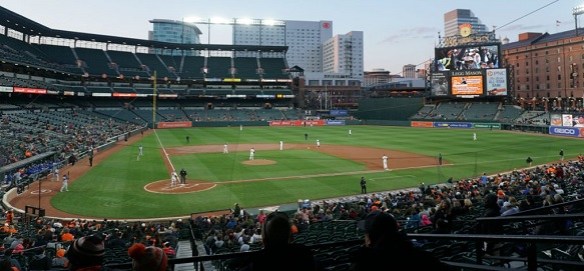
The Orioles’ beautiful ballpark and too many others look this empty too often. Fans don’t really like tanking teams. The Players’ Association has a great idea to put a stop to it.

What would you say if you knew that, before the parking lots, the turnstiles, the concession stands, and the team stores at any major league baseball park open for the season, each team in each league is guaranteed about $60 million dollars into its kitty? And, that none of those teams has to do one thing to get it other than exist in the first place?

The Major League Baseball Players Association actually has a pretty good idea about what to say. About that $60 million, about the additional likely $100 million more each year that each team pulls down through sources that only include ticket sales. Not to mention that baseball’s total revenues in 2018 amounted to $10.8 billion; or, about $343 million per team if distributed evenly among them. More about all that anon.

And the MLBPA is saying it now. With baseball government and the union now talking about game changes, some sound and some foolish, the union proposes a kind of tax against clubs who, seemingly, couldn’t care less about putting at least a mildly competent and entertaining team on the field as long as they’re making all that money anyway: costing them prime draft pick positions if they continue losing (or, at least not trying to win all that much) past a particular threshold over certain periods.

“It is unclear if the suggestion is that a team must hit at least X wins once in a span of Y years, or an aggregate total of Z wins over Y years,” writes NBC Sports’s Bill Baer. “Either way, incentivizing teams to be at least somewhat competitive is a good thing. It will reduce teams shamelessly tanking and it very likely would also prevent teams from shamelessly manipulating the service time of their top prospects. Ah, who are we kidding? Teams are going to game players’ service time until there’s an explicit rule changing it.”

If commissioner Rob Manfred is as bent on implementing changes that really won’t do a thing for the pace of play—the pitch clock, limited mound visits, and the like (you want to step up pace of play for real, get rid of the television commercials for every pitching change and do away with relief pitchers throwing eight warmups when they come into the game since they’ve already thrown enough warmups in the bullpen to equal the volume of a quality start most of the time)—the players’ association needs to push back with the tank tax. It’s one of the smartest ideas they’ve come up with in years.

Because tanking isn’t fun. Not for the team putting itself in the tank no matter how much money they’re not spending, and not for the fans who know that long suffering is relative. They can tolerate long suffering (really) when they know in their hearts that it’s not for lack of trying. (I’m talking about you, Red Sox.) They’re not going to endure it if they suspect the team couldn’t care less as long as it’s making money anyway. (I’m talking about you, Marlins.)

The real Curse of the Bambino had nothing to do with selling Babe Ruth and everything to do with half competent front-office management married to a few dubious in-game managing decisions and, of course, just enough entries of plain bad (or dumb) luck. The Marlins have made going into the tank their M.O. most of the time. Unless they’re as comical as the 1962 Mets, nobody wants to see the Marlins play against the Rays this year. And they’re about as comical as a cigarette vendor at Sloan-Kettering.

Back to following the money, beginning with that $60 million dropping into each team’s kitty before a single regular season pitch is thrown. “That money comes in,” says longtime baseball writer (co-founder of Baseball Prospectus; Sports Illustrated contributor) Joe Sheehan, “whether you win 100 or lose 100, whether you draw four million people or 400,000. It comes in whether you work every day in the offseason to get the fans excited, or whether you announce in November that you’re keeping focus on 2020 with all the kids coming through your farm system. It comes in whether you appear on the networks spending that money, or if they’d rather air color bars than your team colors.”

Nice lack of work if you can get it. Who wouldn’t want to pocket $60 million right out of the box regardless of whether their team gets to the postseason or waits till next year? (Stop snarling, Marlins fans, we know this year is next year.) That’s what big television money married to shares of the profits generated by MLBAdvancedMedia (MLBAM) does for you.

That’s also before the approximate $20 million minimum teams take in in local broadcasting monies, with a few taking in as high as $30 million or better. So we’re talking about a major league team banking as much as $90 million before the season’s first pitch is thrown, if not before spring training camps open. Married to ticket sales all season long—and in 2018 each team sold a minimum of 800,000 tickets while, as Sheehan needles, every team outside Florida sold a minimum 1.4 million tickets—and you have teams making another none-too-shabby $100 million or more regardless of what’s on the field every day.

Fans grouse over the prices of tickets and ballpark concessions, and they think spending less on playing talent should start nudging those prices down. They might as well start bidding on that cheap old ballpark for sale—at Coogan’s Bluff. Because there isn’t much indication that the owners are putting all that free money back into their teams. Marry it to baseball’s total 2018 revenues and what they’d mean for each team if they were divided evenly among them.

Now, who do you think you’re paying your hard earned money to see when you go to watch a game at the ballpark? You didn’t buy those tickets to see the owners. You didn’t buy them to see the umpires, no matter how much of the show Joe West thinks he is. You didn’t buy them to see the managers, since there isn’t one manager in the game today with half the charisma of Casey Stengel, Whitey Herzog, or Tommy Lasorda. And you didn’t buy them to see the coaches.

If you own a team, and you pull down $343.3 million a year, with practically half of it coming your way free before the season even begins, and before every other consideration, wouldn’t you think that you could put a minimally entertaining team on the field, building or re-building a viable farm system, and trading for or buying reasonably capable major league talent to rebuild, essentially, every year?

That’s what I thought. And we haven’t even thought about those teams ponying up revenue shares after doing their level best to win to clubs who seem comparatively indifferent to putting even a mildly entertaining team on the field as long as they’re making money anyway.

How many clubs are actively trying to win, not just this year but every year they can think of? How many farm systems have we been reading about that are called, charitably, parched? The Giants are thought to be one such aging and farm-parched team on the verge of a rebuild if they haven’t actually begun one. I don’t know about you, but I’d be willing to bet that $343.3 million a year that the Giants could yank their farm inside out, leave plenty to put a more competitive team into AT&T—oops! Oracle—Park this year, and still turn their owners a tidy profit.

It’s one thing to look at the past couple of off-seasons as market corrections. You can’t blame teams for being wary of signing players to more than five-year deals anymore. But you can’t forget what’s unique about professional sports, as opposed to an ordinary business. In professional sports, the product is the people who play the games. The Ford Motor Company isn’t selling the people who conceive and assemble their cars and trucks, they’re selling those vehicles. Hoover isn’t selling the people who conceive and execute their vacuum cleaners, they’re selling the vacuum cleaners.

But when you go to the ballpark, you’re paying your hard-earned dough to see a minimum of eighteen young men or more play baseball—depending on how many are emptied from the bench or the bullpens during a game; and, twenty if you’re watching an American League game with the designated hitter. Those people are the product. You’re buying food and drink and a few souvenirs because of the men who play the game, never mind the risk of getting caught on a concession stand line during a six-run rally. If you’re into wearing replicas of the team’s uniforms, you might be buying one with a number and a name on it—and it won’t be the number and name of any owner, general manager (unless he’s an ex-player you rooted for, maybe), umpire, or coach. (Again, unless the coach is a former player you rooted for.)

Few teams are more storied than the Orioles. Time was when the Orioles were either awesome or competing long and hard to be. They’re in the tank now. Do you really think it’s good for baseball that a franchise like that—with their tradition, their still-beautiful ballpark, and their litany of heroes and Hall of Famers (two Robinsons, a Palmer, a Ripken, a Murray, an Alomar, a Weaver on the managing side, a Mussina now)—is going in the tank for who knows how long, just because you’re itching to take those greed-headed players down a few pegs? (How come nobody talks about the greed-headed owners who couldn’t care less about empty seats as long as they’re making big money regardless of whether their teams win a thing?)

Once upon a time the sweetest words of tongue or pen for the fans of teams who didn’t quite make it to the Promised Land despite a whale of a stab at it were, “Wait ’till next year!” For too many baseball fans today, the sourest words of tongue or pen about their teams might actually be, “This year is next year. Again.” And there’s no assurance that all today’s tankers are doing it with eyes upon just how the Cubs and the Astros did it (top down organisational intelligence made their tanks easier to bear for their fans) before ending their protracted lack of World Series championships and going to each postseason after those Series conquests so far.

Say what you will about those imperialist Yankees, but two things remain true: 1) Of every cliche about or around them, the single most truthful is that they don’t like to lose. (Admit it, Yankee haters: even you find something admirable about that.) 2) They may have (count it!) only one World Series ring in the new century, to the Red Sox’s four, but it sure hasn’t been for lack of trying. The Yankees try everything they can think of to win, short of larceny. (Very short: the team stole only 63 bases last year; the top thieves in the American League were the Indians, with 135.) You don’t have to be a Yankee fan to admit or respect that.

The flip side of that coin might be the Athletics. They’re not as well-endowed financially as the Yankees after all the free money to open a season. They’ve had a few dead-last finishes in the AL West in this century. But they’ve rarely gone into a season trying to do it in the tank for whatever foolish reasons. They’ve been to eight postseasons since the turn of this century. They haven’t returned to the Promised Land just yet. But they try everything they can think of within their hard resources and limits (their ballpark plus their coffers) to win. (Short of larceny, alas: the A’s were dead last in the league in stolen bases last year, with 35.)

That’s one big difference between a merely struggling team and a tanking team. The players’ union proposal would begin the end of tanking as we know it if baseball government is smart enough to see that light. Teams want prime draft positions? Put in the effort to make what’s on the field now at least entertaining. Manfred wants pitch clocks? Let him close the tanks. Of course it means the players making a little more money. It also means the owners making a little more money. And there’s no such thing as a baseball owner allergic to making money. Yet.

Now, if only the Players’ Association would begin work concurrently on repairing one of the most bonehead decisions it ever made—the 1980 pension eligibility change that deprived several hundred former players, whose careers were between 1947 and 1979, and who might have had extremely short careers for various reasons, of even small amounts of pension and health benefit dollars.

The pension eligibility became one day’s major league time for health benefits, and 43 days of major league time for a pension allowance, but the 1947-1979 players were excluded from that new eligibility. Douglas J. Gladstone, journalist, baseball fan, and gadfly, is about to publish an updated edition of his seminal book about the issue, A Bitter Cup of Coffee. It’s past time to add cream to those players’ coffees.

A lot of those players joined the actions despite tiny resources and career risks to help usher in free agency and other things that have been great for the game when all is said and done. They deserve better, too.


The Last Man Standing

2019-02-04 JerryReinsdorfHaroldBaines

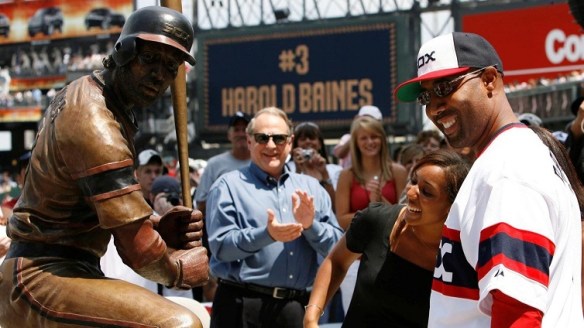
White Sox owner Jerry Reinsdorf applauds at the 2008 dedication of future Hall of Famer Harold Baines’s statue at U.S. Cellular Field.

Jerry Reinsdorf, a baseball owner once described as a man with “about as much serenity as someone facing a dentist’s drill,” has at least one unique position among baseball’s baronage. He’s the last man standing of the owners who got caught with their pants down over 1980s collusion and those who pushed for and got the 1994 players’ strike.

And, as Jay Jaffe now writes at FanGraphs, he’s a big market owner who prefers to think, act, and spend like a small market owner. Depending entirely upon immediate circumstances, of course.

His White Sox have been tied to this winter’s market for Manny Machado. They became an especially acute tie-in after signing both Machado’s brother-in-law, Yonder Alonso, and his friend Jon Jay. Those who’ve followed Reinsdorf’s tenure as the White Sox’s owner ponder that being in that market is out of character for Reinsdorf, until it isn’t.

The speculation had it that the White Sox were ready to offer Machado seven years and $175 million, which agent Dan Lozano torpedoed as a “reckless” speculation, but Jaffe wonders whether it was actually “the guaranteed core of a deal containing options and other wingdings that would push its total well above $200 million—if not all the way to $300 million—while also giving the team greater protection than they might otherwise have in such a long-term deal.”

And, as Jaffe observes further, if the seven-year/$175 million report really is the whole package, “I think we can all agree that $175 million, at $25 million per year, won’t get the job done for either [Machado or Bryce Harper], even in this apparently depressed market—not with the Padres entering the fray and the Phillies still lurking.” (At this writing, the Padres are thought to be going all-in on Harper. And, a ticklish Monday tweet had a Phillies’ corporate jet on the tarmac at McCarran International Airport, in Las Vegas, Harper’s native territory, almost a month after meeting Harper and his wife in Vegas.)

How much of a shock would it be if the White Sox land Machado at or close enough to his thought-to-be-sought total package? It may depend upon how you define “shock” and apply it to Reinsdorf.

It was Reinsdorf, after all, who was in the middle of baseball’s salary-suppression collusion mess of the 1980s. He’s the owner who called then-Phillies owner Bill Giles to remind him of his fiduciary duty (translation: help kill the market) while Giles tried a first time to sign free agent Tigers catcher Lance Parrish. (Giles eventually did get his man.) He’s also the owner who wrote to both the Tigers and then-commissioner Peter Ueberroth to say he had no intention of even thinking about signing another free agent Tiger, future Hall of Fame pitcher Jack Morris.

He was one of the reasons the owners ended up handing $280 million in November 1990 to all the players affected by those shenanigans, including Parrish and Morris. “The single biggest reality you guys have to face up to is collusion,” then-commissioner Fay Vincent told the owners. “You stole $280 million from the players, and the players are unified to a man around that issue, because you got caught and many of you are still involved.”

A few years later, it was Reinsdorf more than any other owner, including then-Brewers owner/then-acting commissioner Bud Selig, who hammered away at the mantra of putting the Major League Baseball Players Association in their place and jamming a twice-rejected salary cap down their throats, passing a three-fourths majority rule for the owners agreeing to any labour pact, and forcing the 1994 strike. He was the labour hawks’ labour hawk. Until he wasn’t.

Because not long after the strike settled, Reinsdorf (possibly urged by his future Hall of Famer Frank Thomas) decided that sticking it to the American League Central rival Indians was more important than real or imagined fiscal sanity when November 1996 came around. Whitey Herzog, in You’re Missin’ a Great Game, described it a lot more colourfully than I ever could:

Here’s the biggest antilabor hawk of all time, the guy who spent years lecturing [former Angels co-owner] Jackie Autry and the other owners on fiscal restraint. He wanted to force a strike and he wanted to cancel a World Series, if only just to break the players’ backs. He got his way in ’94 and put the game on a respirator. Yet the second the thing was settled, who was there backing the Brinks truck up to Albert Belle’s house? Reinsdorf gave him so much money it bent the whole salary structure out of whack. He needed a big-name draw. He didn’t want his division rivals, the Indians, to keep Belle. He wanted what he wanted and screw the rest of it.

As a matter of fact, Ebenezer Scrooge got so damned excited he forgot how to count. The top salary at the time, in 1996, was $8 million. Reinsdorf skipped past nine and ten and went straight to $11 million a year! That was the biggest fast-forward in the history of the salary spiral.

Making Belle baseball’s first $11 million-a-year man didn’t do the White Sox any favours. For one thing, the deal included both a $5 million buyout if the team didn’t pick up a sixth-year option and a clause guaranteeing Belle’s would be one of the top three salaries in the game for the full life of the deal. That was Reinshawk’s handiwork, folks.

When Belle’s annual salary was passed by Mo Vaughn (with the Angels) and Hall of Famers Randy Johnson (with the Diamondbacks) and Mike Piazza (with the Mets) in 1998, and Reinsdorf refused to re-work Belle’s contract to continue conforming to that clause, it made Belle a free agent again. The Orioles signed him for five years and $65 million, equal, Jaffe noted, to Piazza’s average annual value. The bad news: Belle developed a degenerative hip condition that forced his retirement at 34, following the 2000 season.

Before losing Belle, Reinsdorf ordered his then-general manager, Ron Schueler, to deliver what Chicago Tribune writer Paul Sullivan calls “the infamous white flag trade“: trading pitchers Wilson Alvarez, Danny Darwin, and Roberto Hernandez to the Giants, approaching the non-waiver trade deadline, for a trio of then-unknowns, two of whom—pitchers Bob Howry and Keith Foulke—wouldn’t remain unknown for very long. Particularly Foulke, the last man standing (on the mound) when the Red Sox finally busted eight decades of star-crossed disasters to win the 2004 World Series.

“We didn’t realise August 1 was the end of the season,” fumed White Sox third base star Robin Ventura. “What can you say when you have an owner who doesn’t believe you can catch Cleveland?” asked Darwin, referring to Reinsdorf’s telling the Chicago Sun-Times, “Anybody who thinks we can catch Cleveland is crazy.” Before the White Flag Trade, the White Sox were a measly three and a half games out of first place in the AL Central.

The non-waiver trade deadline has long since become a sport in and of itself, with teams over here pondering a push of the reset button in-season, teams over yonder pondering a renewed postseason push, and teams further out there just blowing the damn thing up in panic button mode, among other reasons known or suspected. Reinsdorf may have pioneered the non-waiver blow-up.

But he has had other spells of fiscal amiability even if none of them proved as game compromising or hypocrisy exposing as the Albert Belle deal. It took awhile before Reinsdorf and the White Sox would hand a player something better than Hall of Famer Frank Thomas’s 1997 extension. But the John Danks extension (five years, $65 million, signed in December 2011) imploded when the lefthander missed most of 2012 after surgery to repair torn anterior capsule and rotator cuff. He returned, but the White Sox released him before the final year of the deal ended. With 2.5 wins above a replacement-level pitcher to show for the full life of the extension.

The White Sox haven’t been burned by Jose Abreu’s still-operating six years and $68 million, though. Not yet. The Cuban defector who got a somewhat late major league start at 27 has given them the American League’s Rookie of the Year award, two All-Star teams, and per-162 games averages of 194 runs produced with 32 home runs and 107 runs batted in. His down 2018 was thanks to a groin issue that culminated in early September surgery that ended his season below his career par; he becomes a free agent after the 2019 season.

Abreu says he’d like to continue and finish his career with the White Sox. A healthy 2019 would go a long way toward making that wish come true. Perhaps unless the White Sox decided to plunge in on Machado after all. Which might be out of character for Reinsdorf—until it isn’t, if it isn’t.

Reinsdorf is not quite as sinister as Charlie Finley was when Finley owned the Athletics, but no few of Reinsdorf’s critics would go as far as as A’s outfielder Joe Rudi once did advising incoming A’s outfielder/DH Don Baylor about Finley, “Any time you hear him clearing his throat, he’s lying.” Yet Reinsdorf is also the man who, before letting his then-new GM Ken Harrelson execute then-White Sox manager Tony La Russa in 1986, accepted his personal assistant’s suggestion and called the A’s, about to change managers, to ask if they’d like to hire La Russa, whom their then-president Roy Eisenhardt admired. The answer was yes.

Maybe it’s not to wonder much that Reinsdorf has drawn occasional comparisons to the late George Steinbrenner, about whom Reinsdorf could never decide whether he was an ally, an enemy, a nuisance, or a mountebank. But Steinbrenner was equally renowned for arbitrary executions followed by handing the beheaded assorted lucrative jobs elsewhere within the Yankees’ structure. Reinsdorf and Steinbrenner were frequent player trading partners at one time, and it’s to wonder whether they were just trying to out-smart each other rather than make sound baseball swaps.

Like Steinbrenner often enough, Reinsdorf inspires enough to advise: Trust as far as you can throw. Stay tuned.

Bob Friend, RIP: He helped pitch a game changer

2019-02-03 BobFriend01

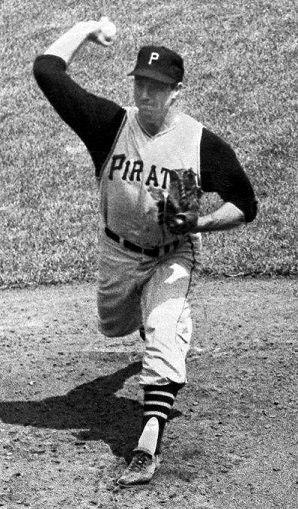
Bob Friend on the mound during the 1960s.

Today’s baseball free agents and every one who preceded them back to the first such class, following the Messersmith-McNally ruling of 1975, may not know that they owe former Pirates pitcher Bob Friend a partial debt for the Players’ Association’s ultimate growth and triumphs. Even if Friend, who died on Super Bowl Sunday at 88, wouldn’t have been likely to take a bow for his role.

A durable if somewhat hard-luck pitcher during a sixteen-year career, Friend just so happened to be the National League’s overall player representative in 1965 when his predecessor, Hall of Fame pitcher Robin Roberts, asked a small favour: could he, Roberts, attend a meeting of player representatives in Houston late that year?

Roberts had something to give the player reps: his own analysis of the picture around the pension plan due to expire in early 1967, especially what he saw (correctly, as things turned out) as a metastasis of baseball’s television revenues and a question of whether or not the players—who then funded 40 percent of the pension plan to the owners’ kicking in 60 percent—would see a dime of it.

The only television money the players saw for themselves at the time tied to the All-Star Game and the World Series; ABC fed baseball $5.7 million for Game of the Week broadcasts starting in 1965, and the players didn’t get a nickel of it.

Though he was no longer a team’s player rep nor either league’s, Roberts—winding down his career with the Astros, though he’d be dealt to the Cubs to finish a year later—wanted to pitch the reps an idea: it was high time the nascent players’ union found themselves an executive director who could negotiate effectively. Friend was only too willing to let Roberts make his case.

What alarmed Friend at first was player militancy, even though he got Roberts’ message when the former Phillies ace said, “Things are getting more complicated. There’s going to be a lot of money involved, and without a negotiator we won’t get our share. I think we need someone full time to do two things: work on the next pension contract and do more with group licensing.”

An incumbent Phillies ace, Hall of Fame pitcher Jim Bunning, threw another factor into the mix. “The nature of ownership groups was changing dramatically,” Bunning would remember. “We wanted to make sure we knew where we were going even if management didn’t.” Indeed. Baseball’s transformation to mostly corporate ownership had only just begun when CBS bought the Yankees controversially enough in 1964; CBS would have an uneasy time of it with the Yankees and it would take several decades for the transformation to be complete.

The player reps got the message and authorised a search committee to find an executive director/negotiator. The committee would be Friend, Roberts, Bunning, and veteran outfielder Harvey Kuenn. And it meant that Judge Robert Cannon, the owner-imposed director, wasn’t going to be long in that seat. Even though Cannon got the owners to fund a director and office for the Players’ Association, the player reps quaked when Cannon refused to move to New York, where the owners wanted the office.

Friend was a particular ally of Cannon, who happened to have the ear of then-Pirates owner John Galbreath, who also happened to lend Friend and his players an equal ear—as long as it meant Cannon would get the full-time directorship. (Galbreath, in fairness, also agreed with Friend that they needed full-time representation on pension and other issues.) Marvin Miller came into the picture when Roberts approached Kaiser Committee labour negotiator George Taylor to help find a candidate. Taylor suggested Miller.

At first, Miller had only one champion among the four-man search committee: Roberts. Kuenn was nervous about the players’ association becoming more like a trade union; Bunning preferred an attorney who’d once handled a lawsuit for him successfully; and, Friend was still in favour of Cannon, assuming they could find a compromise on the office issue. Miller at first was voted down.

But Cannon decided to resign altogether if the players were as bent as they were (and the owners apparently agreed on this point) on the MLBPA office being in New York. They were, and he did. That enabled Roberts to re-submit Miller for consideration. And Roberts now had a key ally: Friend, who’d seen the light about Cannon versus Miller, realised Miller wasn’t either an owners’ plant or what Jim Bouton eventually referred to as “a knuckle-dragging, ‘deze and doze’ guy with a cigar out of the corner of his mouth’,” and talked to Miller, who’d felt burned over the original vote.

“If the players elect me,” Miller told Friend, “I’ll accept the job.”

It got easier when, little by little, the owners’ attempts to intimidate players out of picking Miller began to dissipate the closer a look the players actually got at Miller, whose mild manner, understated style, and willingness to shoot straight, no chaser changed a lot of minds, just as he had Friend’s.

The players voted for Miller. It would take time, hiccups, and a few nasty surprises to come before Miller and the union found their surest footings and could shepherd the bone-rattling changes to come—mostly for the better, but now and then a shot in their own feet, especially the amended pension plan change of 1980 that left 874 retired short-career players from 1947-1979 devoid of both a pension allowance and health benefits.

2019-02-03 BobFriend02

Friend in the 1950s, before the Pirates switched to vest jerseys.

Friend retired as a pitcher after a 1966 season divided between the hapless Mets and the sinking Yankees. (Kuenn and Roberts retired  after the same season; Bunning pitched until 1971.) The first Pirate pitcher to lead the National League in earned run average with 2.83 in 1955, when the Pirates finished dead last, Friend led the league in wins with 22 in 1958, only to lead in losses with 19 in 1959. He retired holding Pirates records for career starts (477), innings pitched (3,480.3), and strikeouts. (1,682.) He’s fourth on the franchise’s pitching wins list (191) but first on its pitching losses list. (218.)

His rubber arm (as they used to refer to seemingly unbreakable pitchers) wasn’t always rewarded with the right results, especially pitching for so many ill-endowed Pirates teams of the 1950s then the teams who couldn’t stay competitive after their dramatic 1960 World Series triumph.

Friend unfortunately was murdered in that Series, starting twice, relieving a third time, and surrendering ten runs (nine earned) and thirteen hits in six innings’ work. The saddest part was how good he was on the 1960 regular season: he led the National League with a 4.07 strikeout-to-walk rate and a 2.54 fielding-independent pitching (ERA with defense removed from the equation), the only season his FIP was under 3.00.

After his pitching career ended, Friend—who looked and acted like his family name except when he was on the mound, and who earned a degree in economics from Purdue University over several off-seasons—kept a home in Pittsburgh, becoming Allegheny County’s controller for eight years before going into the insurance business and becoming an agency vice president. (He was also a delegate to three Republican National Conventions.) He also helped found the Pirates’ Alumni Association and stayed active on its board.

“Friend is articulate, cooperative and knowledgable,” sportswriter Leonard Koppett once wrote of him. “His blue eyes twinkle with a humor that’s softer than Whitey Ford’s, but rich enough. And if there is such a thing as big league atmosphere, Friend exudes it.”

“I never met anyone in my entire life who had every quality that makes a man a man,” said his son, Bob, a longtime PGA golfer. “He was loyal. He was smart. And he worked hard. He had incredible character, and had a great sense of humor. He was a man’s man and a gentleman who stood whenever a lady entered the room and held doors open for ladies.”

He also held a door for the hiring that changed the Players Association and baseball itself irrevocably.

God bless you please, Mr. Robinson

2019-01-31jackierobinson

Jackie Robinson celebrating in the Dodger clubhouse with (left) Hall of Fame shortstop Pee Wee Reese, the Kentuckian whose refusal to sign a petition against calling up Robinson was invaluable in helping ease his acceptance; and (right), lefthanded pitcher Preacher Roe, whose money pitch was a discreet spitball.

Jackie Robinson, whose centenary baseball as a whole plans to celebrate this season, had a playful side that isn’t often discussed when discussing the player and the man. After a few struggles with Connecticut realtors who flinched at the thought of a black family buying and building in some of the state’s more comfortable environs, two bankers rolled the dice for Robinson, his wife, Rachel, and their three children.

“Finally,” Rachel Robinson told Roger Kahn, “we found one builder, Ben Gunner, a bank operated by two Jewish brothers, and they’d take the chance. Ben Gunner and I used to sit out and watch the water and talk and one day I told him I’d always wanted a fireplace for the bedroom. To surprise me, he built one. Then Ben thought children should have a secret staircase. He put one in, and a fireman’s pole . . . to slide down and so many extra things, for which he didn’t charge, he may have gone broke building this house for us. Nothing shakes it.”

Not long afterward, the Robinsons’ eldest son—a troubled young man singed by his experience in the Vietnam War, but trying to remake himself by working with addicts as a counselor at a treatment center called Daytop—was attacked when someone poleaxed him with a board, splitting his forehead open. At the time, his sister, Sharon, was married and living and working in Washington, D.C. (After a career as a nurse and teacher, like her mother, she has since written nine books and is an education consultant to MLB.) His younger brother, David, crossed the country to attend Stanford University. (He is now a longtime coffee farmer in Tanzania.) As Mrs. Robinson spoke to Kahn of the attack and Jack, Jr.’s brief hospitalisation, her husband occupied himself with Kahn’s young children before having to retrieve his son from the hospital.

“When Robinson found [my] older boy wanted to become an architect,” Kahn wrote in The Boys of Summer, “he showed him something of how the house was built. My younger son wanted to fish. Robinson found him a pole and baited the hook and pointed out a rock. ‘That’s the best place to fish from.’ He was playing peek-a-boo with my three year old daughter when the time came for him to leave. ‘You and the children stay,’ he pleaded. ‘I wish Rachel could see them playing. That’s what this house was built for, children’.”

Robinson himself at the time dealt with rising health issues. Now white-haired somewhat prematurely, perhaps a crown for a baseball prince who had to play the game harder while at first suppressing much as he began eroding its de facto segregation, Robinson was now under strict doctors’ orders. “I lost weight on doctor’s orders,” he told Kahn. “I have diabetes, high blood pressure, and I’ve had a heart attack. That’s because I never drink and I don’t smoke.”

Diabetes in fairness ran in his family; his brothers also dealt with it. His heart and diabetic issues would leave him almost blind and facing a likely leg amputation. The first heart attack left him bedridden for three weeks. A second heart attack would kill him in 1972, at 53, months after his old Dodgers teammate Gil Hodges died of his own second heart attack. Robinson was among those at the Hodges funeral and said, “Gil was always a calming presence. I always thought I’d be the first to go,” the first meaning from among the men he played with in ten Dodger seasons.

He retired from baseball at 37 thanks to the knees he’d punished for ten seasons finally resigning their commission. And he couldn’t retire without one last shenanigan thrown his way. Before he made his retirement public, the Dodgers traded him to the Giants, of all people, after the 1956 World Series loss, while Robinson accepted a commission to write about his retirement for Look. Unable as always he’d been to say “No comment,” Robinson then had to deal with a more generous contract offer from the Giants, until Dodgers general manager Buzzie Bavasi told reporters he was sure Robinson would play no matter Look because “I know the guy and he likes money.”

Right then and there Robinson knew the retirement would hold, any lingering doubt erased when he awoke one morning to a knee swollen to the point where he couldn’t get out of bed. He entered the corporate world, working for Chock Full o’Nuts, the coffee company who’d created a chain of lunch counters staffed mostly by black people, before trying the insurance business and then food franchising. Before his death, Robinson assembled an enterprise he intended to build low-income housing using black capital and integrated builders and workmen.

He refused to surrender his belief in integration even in the face of rising militancy in the 1960s and 1970s civil rights movement. At a protest near a new state office building in Harlem, which was aimed at encouraging integration, Robinson—who warned the young black protestors that they’d lose if the project failed—assisted an elderly white man who’d been flattened from behind and knocked down by a pair of young black militants and listened to the young blacks hound him as an Oreo.

2019-01-31jackierobinson02

Tossing out a ceremonial first pitch at the 1972 World Series just prior to his death. Robinson said he longed for the day a black man would be a manager; three years later, the Indians named Hall of Famer Frank Robinson to be the first.

“They see me in a suit and tie and they look at my white hair and they’re too young to remember what I did or they don’t care,” he told Kahn. “I began to talk and someone shouted ‘Oreo.’ You know. The cookie that’s black on the outside and white underneath.” His Dodgers teammate Carl Erskine (“Oisk” to Brooklyn fans) understood.

“Now I hear people putting him down,” Erskine told Kahn, also for The Boys of Summer. “To [them] he’s a period piece. When I hear that, I feel sorry for them. [They] can never understand what Robinson did. How hard it was. What a great victory. But he can understand them. He was a young black man once, and mad and hurt. He knows their feeling, and their ignorance must hurt him more.”

Robinson often flinched when people pointed out that his business life proved unequal to his baseball life, but his baseball life was just that overwhelming. His major league career was a short one at ten seasons, for which you could thank the colour line plus World War II service. (Where he prevailed at an Army court martial after refusing to move to the back of an Army bus.)

But at this writing he rates as the number twelve second baseman ever to play the game according to the wins above replacement-level metric, which shows him at a peak value 8.4 points above the average Hall of Fame second baseman. He played all four infield positions and two outfield positions during his career, but he played far more at second and was rated there when elected to the Hall of Fame in 1962 with Bob Feller.

He was a solid hitter and turned baserunning into guerrilla warfare that only begins with leading his league twice in stolen bases (in 1947 and 1949, a clear opening to returning the running game to baseball) and merely includes his having stolen home sixteen times in his career. He drove pitchers and defenders out of their thinkings; he averaged 197 runs produced per 162 games almost more with his basepath tactics than with his bat.

“You want a guy that comes to play? This guy didn’t just come to play,” crowed Leo Durocher, who would have been Robinson’s first major league manager but for his suspension over consorting with gamblers in 1947. “He come to beat you. He come to stuff the goddam bat right up your ass.”

Said one of Durocher’s coaches and eventual Dodger manager Charlie Dressen, “Now on this team there’s some guys, they don’t like Robi’son. But that don’t mean shit because we’re gonna win the pennant and when they see it’s Robi’son getting them World Series money, he’s gonna look awful white awful fast.” Robinson helped get his Dodgers World Series money for six pennants and the only World Series championship of their life in Brooklyn.

During the fiftieth anniversary of Robinson’s major league debut there were those baseball writers writing against Robinson’s Hall of Fame credentials in terms of strictly baseball play, one particularly grotesque such observation being, “If Jackie Robinson had been white he wouldn’t be in the Hall of Fame today, but . . .” Rejoined Allen Barra, in Clearing the Bases: The Greatest Baseball Debates of the Last Century, “Is it possible that anyone without brain damage could make a statement more asinine? If Jackie Robinson had been white, he probably would have been one of the most obvious and popular choices for the Hall of Fame of the 1950s, or, if he had retired later, the 1960s.”

You could argue his Hall of Fame induction was six parts his actual play and half a dozen parts his pioneer position, and you won’t get too ferocious an argument. If you strip the pioneer position from him a moment, you get a bona fide Hall of Fame infielder who was better than eleven second basemen elected to the Hall but fell short of another eight. Being smack dab in the middle of a pack of Hall of Famers is no shame.

(He was another kind of pioneer, by the way: he won the first baseball Rookie of the Year award, a prize awarded to one rookie across the board, in 1947. The leagues began awarding it separately in 1949. In 1987, it was renamed formally as the Jackie Robinson Award.)

But you restore the pioneer position and discover that he was man enough to leave it outside the door when he came home though the temptation to fume over the external indignities and grotesqueries must have been overwhelming.

“My husband underplays things,” Rachel Robinson once said. “That’s his style, Don’t let him fool you. What he came up against, and we all came up against, was very, very rough. He was explosive on the field, and reporters used to ask if he was explosive at home. Of course he wasn’t. No matter what he’d been called, or how sarcastic or bigoted others had been to him, he never took it out on any of us.”

When the Dodgers acquired pitcher Russ Meyer, who’d tangled no end of tough against Robinson, Meyer admitted he was very nervous about joining Robinson. Until Robinson greeted him in the clubhouse for the first time, held out a hand, and smiled while saying, “We’ve been fighting each other. Now let’s fight them together.”

“OK, pal,” Meyer replied. “You just made it easier for me.” In the same remembrance, for Peter Golenbock’s Bums: An Oral History of the Brooklyn Dodgers, Meyer looked back with admiration. “Jackie,” he said, “was a competitor. He played the goddam game the way it’s supposed to be played. He played to win.” Meyer could have been talking about life itself as the man himself lived it, shattering barriers but never remaining less than a man.