Two Bs and a Tuck

Alex Bregman

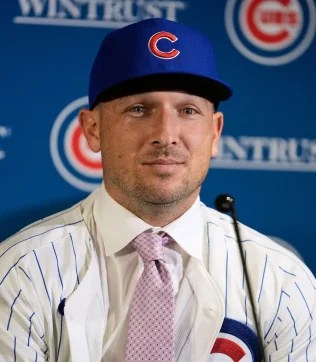
“There’s an excitement in the air about Cubs baseball,” said their new $175 million third baseman Alex Bregman after signing with the team last week.

What a week, right? Just like that, three of the more luminous members of this winter’s free agency class found new homes for varying dollars.

The usual suspects scream blue murder. A few unusual suspects pick up Dodger manager Dave Roberts’s expressed equal adoration for a salary cap and a salary floor. So, who’s coming out how, where, and why? Let’s look with sober eyes.

Da Bear Market Dept.—Think about it: On the same evening the NFL’s Chicago Bears shoved the Green Bay Packers to one side and out of the race for the Super Bowl, in Soldier Field, the Cubs made erstwhile Astro/Red Sox third baseman Alex Bregman a rather wealthy man.

With the Red Sox thought to be pushing a bit extra to bring Bregman back, the Cubs pushed enough to land Bregman on a five-year, $175 million that includes a mutually agreed-upon $70 million worth of deferred money.

You think Bregman’s new teammates weren’t enthused about the deal and their new mate? “I texted him when the news broke: ‘Dude, let’s freaking go’,” said pitcher Jameson Taillon, an Arizona neighbour of Bregman’s according to The Athletic. “He FaceTimed me. He was like, ‘Hey, we’re just finishing up dinner. Can I come over?’”

He wasn’t alone, wrote the journal’s Patrick Mooney: “Pete Crow-Armstrong, the All-Star center fielder, was in attendance at Soldier Field when he found out that Bregman would be a new teammate. Immediately after seeing the reports, Gold Glove shortstop Dansby Swanson called Bregman from a friend’s wedding.”

The Cubs made a run for the postseason last year. After a few years behaving like the big city kid who seemed to be seduced by the outskirts of Four Corners, Nowhere in Particular, they started behaving like the bigger market team they’re supposed to be once the postseason run ended.

“There’s an excitement in the air about Cubs baseball,” said Bregman while he made a bit of a whirl-around Chicago tour last week. “I can’t wait to get after it.” Pause. “After it” means “pennant race” and “World Series trip” for a man who now picked uniform number 3 to indicate he’d like a third World Series ring as well as stability for his family.

He’s known as a student of the game, a disciplined hitter, a sharp-fielding third baseman, and a clubhouse godsend. All Bregman has to do is live up to all that as best a 31-year-old with more than a few miles on him can, as he did when his body allowed in Boston last year. Da Cubs will make sure his appreciation is far, wide, and deep.

Tucker, the Man and His Team Dept.—Meanwhile, an erstwhile Cub lit the fuse on fresh screaming over the big, bad, behemoth Dodgers and their big, bad, behemoth platinum vault. The erstwhile Cub is Kyle Tucker, considered the number one free agent in the winter class by those who thought Bregman was the class’s second banana.

Tucker signed up for four years, $240 million, and opt-outs after years two and three. The deal also includes $30 million in deferred dollars. If Tucker helps the Dodgers to a third straight World Series title, Dodger City will consider it all very wisely spent. If he doesn’t or can’t, well . . .

That screaming won’t be limited to denunciations of the Dodgers as the new Evil Empire. It’ll include audible-in-the-Klingon-Empire demands for explanations as to why a no-doubt talent but with 27.3 wins above replacement-level in eight season is pulling down $17 million a year more than Aaron Judge, Yankee bombardier first class, who earned about 3.0 more WAR just over three of the past four years.

The Dodgers are betting on Tucker’s future coming somewhere near Judge’s present, of course. Aside from the dollars, the Dodgers could offer something far deeper to the low-keyed Tucker. He can do Tucker things without the floodlights baking him too heavily compared to the rest of the Dodgers’ star power.

He might have been the star of this free agency market, when Bregman and Bo Bichette weren’t, but that’s about as far as Tucker seems to care to go when it comes to attracting attention with anything beyond his still-growing bat and his virtuosity playing right field.

What’s Bo Know Dept.—Bo Bichette is a Met. Roll the rhyme around awhile, Metsropolitan New York. Savour the possibilities to come with a healthy Bichette helping the Mets ride all the way to a postseason. (Remember: He came off the injured list to be one of the shining time Blue Jays in last year’s World Series.)

Now, be afraid. Be very afraid. Because the Mets plan for their new $126 million infield toy is to move him from his normal shortstop to third base. Every Met fan since the day they were born will warn you. The Mets don’t have a sterling history of third base conversions. (Mets legend David Wright was born to the position, you may remember.)

Ask what happened when they traded a talented but still-erratic arm named Nolan Ryan to the Angels for a veteran elite shortstop named Jim Fregosi . . . and decided to turn that veteran elite shortstop into a third baseman. Case closed.

Bichette can hit. The only population that doesn’t know that might be a colony of Arctic walruses. But with the glove? He’s 36 defensive zone runs below his league average as a shortstop, and his range factors per game are below the average, too. He played a little second base in the minors but not a lick of third base in the Show.

The Mets turned toward Bichette more seriously (they’d been talking previously) when Tucker went California bound the night before. The Phillies saw the Mets embrace Bichette and elected to reunite with veteran catcher J.T. Realmuto after all.

Now all the Mets have to do is get a read on whether Bichette will be the second coming of poor Jim Fregosi or the first coming of Bo Bichette, third base maven. Not to mention whether Brett Baty, the incumbent third base Met, will have a reasonable future moving to the corner outfield, as some reports speculate.

Well, the Mets have been many things over the decades. Boring has rarely been one of them.

Manfred’s just thinking aloud. Isn’t he?

Rob Manfred

Manfred insists he’s done when his contract is. What manner of mischief might he wreak before then?

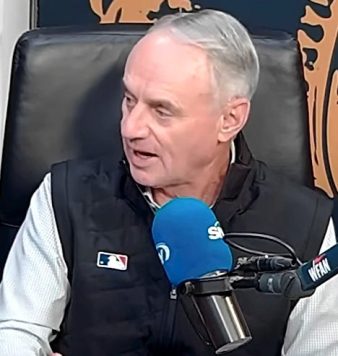
This is commissioner Rob Manfred’s story and he’s sticking to it. For now. Ask him whether he’s going to want to rethink his previously-enunciated intent to retire when his current contract expires in three years, and he digs in like a batter who knows he’s facing not Bob Gibson but Bobo Garglebargle.

“I’m done at the end of this contract. I’ve told [the owners] that, and I’m gonna stick to it,” Manfred insisted in a WFAN radio interview last week. “I’ll be 70. It is enough . . . You have a certain period of time when you have things that you want to accomplish, you take your best shot, you try to get as much done as possible. And then it’s sort of time for the next guy with his set of things. And I think that’s healthy and good for this.”

So far, so good. So, what does the most inveterate tinkerer who ever held the commissioner’s office want to get done before he moseys off into the sunset?

Without saying he’s committed to it—yet—Manfred mentioned discussions about inflicting a split season and in-season tournaments upon major league baseball. “We do understand that 162 (games) is a long pull,” he said. “I think the difficulty to accomplish those sort of in-season events, you almost inevitably start talking about fewer regular-season games.”

But not fewer postseason rounds and games, of course. Manfred isn’t that sensible. “It is a much more complicated thing in our sport than it is in other sports,” he continued. “Because of all of our season-long records, you’re playing around with something that people care a lot about.”

You’re playing around with a lot more than that, Commissioner Pepperwinkle.

Wait until it gets to the part where he speaks of bringing MLB to 32 teams. And, realigning baseball into eight divisions of four teams each. Presuming it’s going to be one new team in each league, would it do to suggest something a lot more sensible?

You guessed it. I’m going there again. Instead of eight divisions of four teams each, how about four divisions of eight teams each? How about two such divisions in each league? If you wish, you can keep them named the National League East and West, and the American League East and West. Goodbye three-division lunacy and wild-card whackadoodling.

Think of the benefits that would come forth. I’ve made the argument before, but it’s worth making it yet again. Four divisions, eight teams each, and you don’t get to play for a championship unless your butts were parked in first place at season’s end. Let’s not forget to put an end to the farce of regular-season interleague play, either. Save that for where it really belongs, the All-Star Game and the World Series.

And won’t it be fun to have something we haven’t really had in this century—namely, real pennant races again. No more of this Bizarro World nonsense of the thrills, spills, and chills of teams fighting to the last breath to finish the season . . . in second place.

Come to think of it, let’s be done at long enough last with those hideous All-Star and City Connect uniforms. They go from ugly to disgusting and back to repulsive before turning nauseating. Haven’t you missed seeing All-Stars wearing their own uniforms, the fatigues of the teams they represent in the game?

And we haven’t arrived until now at the truly fun part. You want to get rid of postseason saturation as much as I do? You want to make the postseason both meaningful and fun again? You want more World Series such as last fall, when a) the only combatants were teams who finished first in their divisions, anyway; and, b) those two went tooth, fang, claw, and anything else they could think of until somebody finally won it? You want to relieve Manfred’s discomfort over the long season?

Of course you do. So . . .

We’ve simplified the game’s alignment to two divisions each for each league. We’ve made for real pennant races again. Now we get to call for best-of-five League Championship Series. That’s the way they played it from divisional play’s birth in 1969 through 1984. Now, you restore the World Series’s primacy by keeping it a best-of-seven. Did I mention that it also means no baseball under snow or November watch anymore?

You also have postseasons of—maximum—seventeen games under the foregoing back-to-the-future remake/remodel. Meaning you have yearly totals of—maximum, again—179 major league games for each league. You can’t tell me that’s not plenty of baseball. And who says an earlier opening to the Hot Stove League won’t be a little more fun, either?

Speaking of which, beware. Maybe the only thing worse than Manfred pondering in-season tournaments would be landing a hard deadline for free agency signing. Athletics outfielder/designated hitter Brent Rooker called it the most anti-player idea Manfred could have. So, naturally, Commissioner Pepperwinkle started stumping for it harder the day after Rooker spoke against it.

“I think there’s going to be some more conversation about it, because I do believe that there’s a marketing opportunity,” Manfred told WFAN. “Let’s face it, we operate in a really competitive environment. Just put entertainment, generally, to one side—just sports, right? It’s really competitive. And I think that you make a mistake, particularly during the offseason, when you don’t take every advantage to push your sport out in front of your fans during that down period.”

Some think you make more of a mistake taking the fun out of the Hot Stove League. For owners and players alike. The owners aren’t saints, but they’re not wholly brainless. The ones who can (will) spend love the chase. The ones who can’t (won’t) spend love to bitch about the ones who can. Fans who kvetch one moment about swelling player dollars cheer the next when their team lands an Alex Bregman.

(By the way, don’t pity the Red Sox for failing to convince Bregman to stay. Not when they seem to have quaked over including a no-trade clause in his new deal but the Cubs had no problem giving him one. Well, there’s still Bo Bichette to whom the Red Sox might turn, within reason.)

“[W]hat they said back was, they thought that kind of [signing] deadline would work to the disadvantage of the players,” Manfred said of player reaction to the idea. “And you know, I just—I don’t put much credence in this.” Shocker.

At least, Manfred promised that any realignment would not include forcing two-team cities into the same division. But the bad news is that, historically, it was easier for pitchers to hold Hall of Famer Rickey (The Man of Steal) Henderson on base than it is to put most commissioners’s promises in the bank.

“I don’t really get the owners pinching pennies . . . “

So what is with A’s owner John Fisher suddenly opening his purse?

Dave Roberts supports a players’ salary cap and a salary floor. Clayton Kershaw probably thinks his now-former manager could use a little extra enlightenment. It would have made for some lively discussions in the Dodger clubhouse if Kershaw hadn’t retired after the World Series.

“You know what? I’m all right with (a salary cap),” Roberts told Amazon Prime’s Good Sports a month ago. “I think the NBA has done a nice job of revenue sharing with the players and the owners. But if you’re going to kind of suppress spending at the top, I think that you got to raise the floor to make those bottom-feeders spend money too.”

Kershaw picked a slightly showier place to say he thinks the owners bleating for salary caps are talking through their scalps, actor Rob Lowe’s Literally! podcast. But it ain’t the venue, it’s the verdict. “I don’t understand some of the ownerships’ arguments with this stuff,” the future Hall of Fame lefthander began near December’s end.

Because there’s probably hundreds of multi-billionaires that would love to own a professional baseball team. I bet we could get a list of 100 guys right now that are uber-wealthy, that would love to run a baseball team . . . It might not make the money you would want it to make, but over time it’s just like a stock. It’s going to continue to appreciate.

It’s just like anything else. [The Dodgers are now] worth 3x of what it was . . . I don’t really get that part of it, of the owners pinching pennies.

Grammar aside, Kershaw has the amplifier of Roberts’s second point. But what he doesn’t quite get is that the penny-pinchers have one view of baseball. They think, and they have a commissioner who behaves accordingly, that the good of the game is nothing more than making money for themselves.

My Internet Baseball Writers Association of America newsletter colleague Bill Pruden says responsible baseball ownership begins with a full commitment to fielding a competitive team, but you don’t have to look fast to see that’s not exactly every team’s aspiration. “The A’s and the Pirates immediately come to mind,” he continues, “when one thinks of teams that have, for years, offered little evidence of a real commitment to winning.”

It depends upon what your definition of “winning” is.

For years, A’s owner John Fisher wanted nothing more than to dump Oakland like an inconvenient wife. He let his A’s shrink to compost but failed to strong-arm Oakland and its home county into handing them a new home almost entirely on the house. He finished what was started long enough ago and let the Coliseum and his team finish becoming compost. He said it was the fans’ fault for not wanting to watch scrap heap baseball.

Then Las Vegas’s mouse-like political (lack of) class signed off on $380 million tax dollars with no public hearings or votes toward building the A’s a garish new playpen on the Strip. The owners rubber stamped Fisher’s betrayal while agreeing to waive the normal $1 billion relocation fee.

Fisher got off the way wealthy husbands only dream of getting off when dumping their aging wives for younger mates. While playing in Sacramento’s minor league playpen awaiting the finish of their glass house, we wonder reasonably whether Las Vegas bought the proverbial pig in the proverbial poke.

But lo! As Buffalo Springfield’s Stephen Stills once wrote and sang, there’s something happening here, and what it is ain’t exactly clear. Or is it? All of a sudden, the A’s are spending. In the past year, Fisher’s purse has opened wide and said, “Aaahhhhhhhhh.” Sort of.

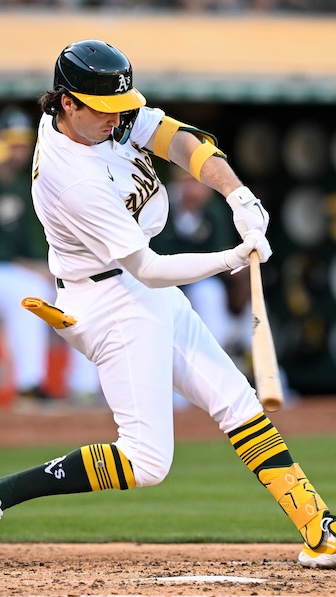
* The A’s extended right fielder Lawrence Butler with seven years at $65.5 million.

* They extended designated hitter/outfielder Brent Rooker with five years at $60 million.

* Most recently, they extended left fielder Tyler Soderstrom to seven years at $86 million, with an eighth-year team option that includes escalators which could hike the value as high as $131 million, according to The Athletic‘s Devon Henderson and Will Sammon. It’s the largest guaranteed deal in the history of the A’s.

No, those aren’t exactly the kind of glandular long-term deals bestowed upon the Shohei Ohtanis, Bryce Harpers, and Mike Trouts of the game. Bo Bichette could land a more valuable deal than those three combined. And optimists think the A’s are prepping for 2028, when their new playpen is supposed to open where the Tropicana Hotel and Resort used to stand.

But $256.5 million is money not heretofore seen flying out from the A’s piggy banks, even if it’s less than a) some teams’ entire payrolls, and b) a third the full value of Ohtani’s ten-year contract. And it might be hard to remember Fisher speaking the way he did to another Athletic writer, Evan Drellich, earlier this offseason.

“At the end of the day,” Fisher told Drellich, “our goal is to put the greatest team on the field that we can and payroll is an important part of that. But our [front office has] demonstrated over decades now that they can see things in players that other teams don’t see . . . We’re going to sign our guys to longer-term deals, as well as sign free agents who can make our team better.”

Until they aren’t?

Those three extensions, wrote Yahoo! Sports’s Mark Powell, were “a stark reminder that [Fisher] always had the money, but chose not to spend it.” Tell the abandoned wife named Oakland what she didn’t know.

Real cynics think you can tell most baseball owners lying when you see their lips move. The current collective bargaining agreement’s coming finish at the end of the 2026 season already has “salary cap” on those lips, with “salary floor” seeming to be a sotto voce side or afterthought.

Maybe few to none among those owners might dare to ponder Kershaw’s thought about wealthy men and women willing to buy in and actually invest in building competitive teams. They might sooner respond to him, now that he’s retired with only his Hall of Fame election ahead of him so far, “Beat it, buster.”

Ask Oakland whether Fisher’s words are his bonds. They’re liable to demand polygraph proof.

First published at Sports Central.

Our 2025 Dodger Sym-Phony Awards for Extinguished Foolishness

Dodgers Sym-Phony Band

Cacophony in Blue: the Dodgers Sym-Phony Band, plus a pair of unidentified Dodgers, one of whom seems determined to show he has only a slightly lesser sense of time and beat.

When Mr. Cartwright first laid forth the basic dimensions of a baseball field, he had no idea that the game to which he lent his landscape eye would be capable of pastoral play, bursts of excitement, spells of intellect, and . . . enough tomfoolery, foolhardiness, and fool’s gold to inspire poets, pundits, and professional mischief makers alike. The poor man.

Said tomfoolery, foolhardiness, and fool’s gold are not restricted to the field, of course. Baseball’s fans have been (mostly) an agreeable gathering of the aforementioned poets, pundits, and professional mischief makers (not to mention amatuers), patrician and plebeian alike. Baseball’s players have not been immune to mischief making, either.

In regards to which, I hereby open the envelopes and reveal the 2025 winners of the Dodgers Sym-Phony Awards. Named for that crew of Ebbets Field fans who couldn’t carry tunes in backpacks or briefcases alike, but whose clattering, splattering cacophony charmed the living brains out of those who once packed the Brooklyn bandbox on behalf of slapstick one generation and social groundbreaking pennant contention the next.

Animal House

Donald Trump played Douglas (We now consecrate the bond of obedience) Neidermeyer to Rob Manfred’s Chip Diller when it came to the late Pete Rose . . .

The Animal House Thank You, Sir, and May I Have Another Iron Paddle—To Commissioner Rob Manfred. When a certain president threatened to pardon the late Pete Rose and demanded Rose’s immediate Hall of Fame enshrinement, Manfred met said president in due course. After which, he reached into his heart of hearts, prayed hard, and decided . . . that “permanent” meant mere “lifetime,” after all.

Never mind Rose’s too-well-known violations of Rule 21(d). Never mind his decades of lying about it until or unless it was time to sell yet another autobiography. Never mind the aforesaid president’s erroneous insistence that Rose only bet on his own team to win. (The days Rose didn’t bet were construable by the gambling underground as hints not to bet the Reds those days.)

Once upon a time, such behaviour was believed to be beyond a president and beneath a commissioner. Even if by belief alone. Mr. Trump is not the first and probably won’t be the last president to stand athwart common sense and the law, yelling, “Just try to stop me!” But Mr. Manfred was under no legal, moral, or ethical obligation to satisfy Mr. Trump’s witless hankering, either.

The PT 73, whose crew sometimes managed to make real patrols when not making real mischief.

The Quinton McHale PT-73 Crest—To everyone who thought (erroneously) that the too-much publicised torpedo bats of the early 2025 season were, with apologies to George Carlin, going to curve your spine, grow hair on your hands, and keep the country from . . . who the hell knew exactly what?

It didn’t help that the Yankees spent an early season weekend demolishing the Brewers with a few of their batters using the torps.

“Torpedo bats were the talk of MLB in April and May in 2025 and then were never heard from again,” wrote my IBWAA Here’s the Pitch colleague and Almost Cooperstown writer Mark Kolier. “The opening Yankee series versus the Brewers was an anomaly. And players who had great early season success while using a torpedo bat were unable to sustain that success . . . The torpedo bat panacea was fun to talk about while it lasted. But now that’s over.”

We think.

The Maier’s Trophy for Interference Above, Beyond, and Beneath—To Austin Capobianco and John P. Hansen, Yankee fans with onion juice for brains. Banned from all major league ballparks and other facilities indefinitely in January. The crime: Grabbing the wrist of Dodger right fielder Mookie Betts and trying to pry a long foul out of Betts’s glove. Game Four, 2024 World Series.

Dishonourable mention: Barstool Sports writer Tommy Smokes, writing: “The Yankees were down 3-0 in the World Series and you do whatever it takes to extend the at-bat for your guy at the plate.” Today, wrist-grabbing and attempted ball snatching. Tomorrow, shooting when you see the whites of their balls?

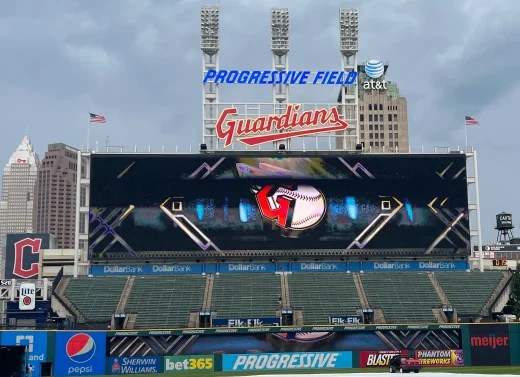
The Rose “Make Your Bet and Lie In It” Golden Thorn—To Emmanuel Clase and Luis Ortiz, Guardians pitchers, accused of a pitch-rigging scheme involving throwing particular pitches for particular counts to enable betting on those pitches (it’s called proposition betting) and financial rewards for the bettors.

Reputedly, gamblers won almost half a million on what the pair threw. Clase and Ortiz are charged, too, with earning kickbacks for their, ahem, pitching in.

The Chicken Little Flying Fickle Finger of Fake—To everyone who bleated the sky is falling, it’s the end of the world as we know it, and we don’t feel fine, when Robby the Umpbot made his major league debut last spring training. Robby answered the call of duty when Cubs pitcher Cody Poteet called for his help with one on and Max Muncy (Dodgers) at the plate.

Robby ruled an 0-1 fastball at the knees, called ball one by plate umpire Tony Randazzo, was in fact strike two. Nobody threw lightning bolts down from the Elysian Fields.

The Clarence Bethen-Wile E. Coyote Brass Stethoscope for Injuries Straight Outta Looney Tunes—Named in honour of 1) the pitcher who forgot his false teeth were in his back pocket and slid into second base with a bite on his butt; and, 2) the clod of a canine (Famishius slobbius) who kept Acme in business for eons buying their constantly-backfiring weapons and traps:

Mookie Betts (Dodgers)—A nocturnal stroll to the reading room turned into a toe fracture. The Mookie Monster missed four games as a result. He opined that he thought we’ve all suffered toe fractures from nocturnal bathroom breaks. I’d like to see the roll call first. And, whom among them might have sung “Midnight Stroll.”

* Zack Littell (Rays)—He learned (or re-learned) the hard way how not to use your head while parenting. Chasing his son around an inflatable slide park, he plowed into scaffolding not padded for play. Let’s guess his favourite song wouldn’t be “Ring My Bell” for a long enough while.

* Jose Miranda (Twins)—Sent back to AAA after a viral baserunning mishap, he went to Target first. (Bad name, in this instance.) He needed bottled water. He reached high for a case of it. He couldn’t stop it from tumbling down. Four weeks on the injured list with a strained left hand, then cut loose entirely when he returned without hitting much else. I submit that nobody had the nerve to play him “I Want to Hold Your Hand.”

* Mariano Rivera (Old-Timers)—The Hall of Fame Yankee relief legend suffered a torn Achilles tendon . . . while pitching in a Yankees Old-Timer’s Day game. You guessed it: I don’t think his favourite song last year was “Things Ain’t What They Used to Be.”

* Ryan Weathers (Marlins)—His pre-game stroll around the mound brought foul weather. He’d thrown his final warmup toss, then turned right to take the stroll. His catcher Nick Fortes threw up the middle to start the round-the-horn routine. The ball didn’t make it. It hit Weathers flush on the left side of the head.

Then, when he shook it off and pitched three innings, Weathers strained his lat and missed three months. I’m going to guess the poor guy’s favourite song is not “Stormy Weather.”

Wishing them and all no further embarrassing wounds, pinpricks, or fractures. And, wishing you from there (and here) a happy New Year, a damn-sight-better-than-the-old-one New Year, and a 2026 baseball season to come in which there’s no foolishness like (mostly) harmless foolishness.

The BBWAA Hall ballot: The newcomers

Ryan Braun

If you’ll pardon the expression, Braun cheated himself out of a Hall of Fame case.

A few weeks ago, I had a look at the holdovers on the current Baseball Writers Association of America Hall of Fame ballot. Included in my analysis of their cases was a promise, which some might deem a threat, to look at the newcomers in short order.

Well, the order was short enough. In the interim, the Contemporary Baseball Era Committee elected Jeff Kent to the Hall. So It’s time. But I’m going to tell you going in that I have a sneaking suspicion that Kent may stand alone among players at the Cooperstown podium next summer.

Which would probably drive to the nearest drink well those writers still standing who saw Kent in his prime. The ones who remember his feuding with a certain Giants teammate. The ones who knew concurrently that, without that teammate in the lineup ahead of him, Kent’s only passage to the Hall of Fame might be as a paying customer.

I’m not going to say, “Be afraid. Be very afraid.” But, and we’ll take these ballot rookies alphabetically . . .

Ryan Braun—Like Álex Rodríguez, Braun got himself caught as a customer of actual or alleged performance-enhancing substances from Biogenesis. Unlike A-Rod, that didn’t provoke Braun to litigiousness. His litigiousness happened earlier, when he tried suing his way out of a suspension when testing caught him using synthetic testosterone. He even accused a sample collector of anti-Semitism.

After serving his Biogenesis suspension, Braun went out of his way to self-rehabilitate. He apologised publicly to the collector he smeared; he revived his charitable activities. But he was also never again the player he was before his PED issues, thanks largely to injuries.

In peak and career value terms, his performance papers fall too far short of Hall-worthiness. In trying to go scorched-earth when caught red-handed (and probably red-faced), placing his entire pre-test/pre-suspension career into question (fairly or unfairly), Braun cheated himself out of a Hall case. No.

Shin-soo Choo—The second Korean position player to make it to the U.S. major leagues (Hee Seop Choi preceded him), Choo was as talented as the day was long and just about as unfortunate. Injury bugs got to him too often. At his best and healthiest, he was as solid a tablesetter as a lineup could have. But it’s not enough to strike a plaque in Cooperstown. No.

Edwin Encarnación—As a Blue Jay in the middle of his fifteen-year career, he was one of the American League’s most feared sluggers. He was also a better baserunner than you might remember. His defensive liabilities probably did the most to keep his peak and career values below the Hall of Fame averages.

But he and Toronto will always have that monstrous three-run homer to send the Jays to an American League division series after Buck Showalter’s brain fart meant Encarnación wouldn’t have to get through the 2016 AL’s best reliever, Zach Britton. No.

Gio Gonzalez—Likeable. Durable. Dependable. And, according to Baseball Reference, the number 309 starting pitcher of all time. One fielding-independent championship isn’t enough to get you to the Hall after a thirteen-year career. Twice leading your league in walks won’t, either. But you kind of had to love this guy.

In the pre-universal DH era, Gonzalez had an all-time freak stat: he struck out more pitchers batting against him than any other pitcher in four decades preceding him. Not a Hall stat, but certainly something to warm the hearts of those who know baseball really is a funny game. No.

Alex Gordon—It would be easy to dismiss him because of his modest batting statistics, but Gordon was one whale of a defensive left fielder. He has eight Gold Gloves and two Platinums, and he didn’t get them as participation trophies, either. He is, in fact, the number three left fielder ever for run prevention.

The only guys ahead of him there? Some dude named Bonds, and some Hall of Famer named Yastrzemski. That’s bloody well elite company he’s keeping there.

I don’t know if that alone will get Gordon into the Hall in due course. But I say “in due course” because I think his case deserves deeper looks and I suspect he’ll last on the ballot for another couple of years at least. Not now.

Cole Hamels—He looked like a Hall of Famer once upon a time. Especially when he helped lead the 2008 Phillies to a World Series triumph with a 1.80 postseason ERA that year, not to mention bagging the Most Valuable Player awards in the National League Championship Series and the World Series.

Talent to burn and perfectionism likewise, seemed to be the cumulative assessment, whether in Philadelphia, Texas, or Chicago. He also dealt with enough injury issues to make it difficult to impossible to build the Hall of Fame case he looked to be beginning in the glory days with the Phillies. But I suspect he might linger on the ballot another year, at least. No.

Matt Kemp—He, too, looked like a Hall of Fame talent when he arrived. The bad news was a) Kemp’s dynamic style was offset by his frequent inabilities to re-adjust when pitchers caught onto his fastball dependency at the plate; and, b) he was a defensive liability as often as not.

He hit with staggering power when he was right, especially his career year 2011. But when measured against the rest of his career overall, that turned out to be kind of a fluke season. Kemp’s real problem might have been being a designated hitter type who played in the wrong league in the pre-universal DH era. No.

Howie Kendrick

Gallows pole: Kendrick’s power hitting helped the 2019 Nationals go all the way to the Promised Land.

Howie Kendrick—Eminently likeable, especially as his career neared its finish and he shone for the 2019 Nationals all the way through the postseason. Especially hitting a pair of ultimately game-winning home runs that paid the bill for every steak he might ever want to have in Washington for the rest of his life. (He also won that year’s NLCS MVP.)

Forgotten amidst those postseason heroics: Kendrick was a very solid second baseman, not quite an intergalactic presense there but in the plus column for run prevention. It won’t be enough to help him into Cooperstown, but when he was right he was a fine player and a terrific clubhouse element. No.

Nick Markakis—He’s one classic example of a terrific baseball player who was as solid as they came without being spectacular. (2,388 hits; 57 total zone runs as a right fielder.) Even as something of an on-base machine and a definite asset in right field, Markakis was the guy you couldn’t bear to replace, even if the rest of the world didn’t necessarily drop what it was doing when he checked in at the plate or ran down a right field fly. Not quite.

Daniel Murphy—A threshing machine at the plate for the pre-World Series 2015 postseason Mets, with those six consecutive games hitting a home run and breaking Hall of Famer Mike Piazza’s team record for total homers in a single postseason. Unfortunately, his Series fielding mishaps negated that hitting prowess on the way to the Mets’ Series loss to the Royals.

Murphy’s 2016 redemption (leading the NL in slugging and OPS) proved a one-off. His career overall was too far short of the Hall of Fame, but that pre-World Series postseason power display in 2015 keeps him a Met hero. No.

Hunter Pence—He got to play for two out of the three San Francisco Series winners in the 2010s. He was charmingly quirky, enough to earn a temporary trend of “ahhh, ya mother rides a vacuum cleaner” banners around the league. (Hunter Pence eats pizza with a fork! Hunter Pence says “Sorry” when he catches a fly! were typical.)

Well, Pence was a good, solid player when he wasn’t injured. That’s important and it counts, and if it’s married to a guy who’s delightfully flaky that’s a big plus. That might even keep him on an extra Hall ballot. Might. Not quite.

Rick Porcello—His 2016 American League Cy Young Award was an outlying season for him—especially since future Hall of Famer Justin Verlander should have won it. Porcello  opened the next season with a 1.40 ERA and 1.74 FIP in his first four games. That season ended with him showing a 4.65 ERA/4.60 FIP.

That was Porcello. Periodic short bursts of greatness, modest longer terms. He was smart on the mound and relied on his defenses. But that’s not always going to make a Hall of Famer, either. No.

First published at Sports Central.