Wounded cops and battered Cubs

2019-08-17 BryceHarperRhysHoskins

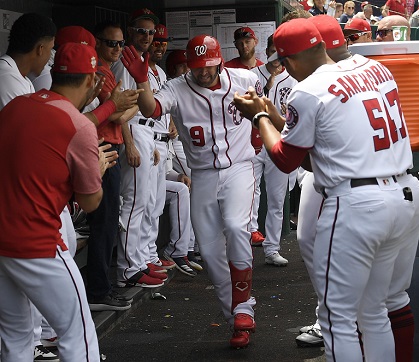
Bryce Harper gives Rhys Hoskins props after Harper’s first-inning bomb started a Wednesday night Phillies blowout . . . unaware, likely, that six Philly cops were wounded in gunfire with a barricaded suspect.

A self-barricaded narcotics suspect in a home on the north side of Philadelphia. A standoff with police involving over an hour’s worth of gunfire exchanges, maybe more, and six  officers wounded.

The standoff began shortly before the Phillies faced the Cubs at Citizens Bank Park Wednesday night. It was still ongoing after the Phillies delivered a far less fatal kind of gunfire at the Cubs good for ten runs before the third full inning expired. It was still ongoing after Bryce Harper hit his second home run of the night.

And it was still ongoing, apparently, after the Phillies finished what they started, an 11-1 blowout of the National League Central leaders.

None of the six wounded cops was injured gravely, thankfully, though the city’s police commissioner Richard Ross said several of the cops who responded to the barricader and got into the house had to escape by jumping through windows. At one point the standoff that began late in the Philadelphia afternoon had nearby Temple University’s Health Sciences Center on lockdown.

Cole Hamels made his third start since returning from the injured list and his first in Philadelphia since leaving the Phillies in a then non-waiver trade deadline deal with the Rangers four years earlier. The audience cheered him appreciatively when he batted in the top of the third, but it was hard to tell whether it was thanks for the memories past or thanks for the clobbering the Phillies were giving him this night.

While police continued trying to resolve the standoff without any further injury or damage, and word emerged that there was a second narcotics suspect in the house aside from the shooter, the Phillies came to bat after starting pitcher Aaron Nola rid himself of the Cubs in the top of the first with a ground out sandwiching a pair of swinging strikeouts.

They didn’t give Hamels a chance to settle into any groove remotely similar in the bottom of the first. Rhys Hoskins singled with one out and an old nemesis named Bryce Harper stepped up to the plate. It’s not that Harper has that impressive a set of past performance papers against Hamels, it’s that Hamels knocked Harper down notoriously during Harper’s rookie season in Washington.

But this time Harper delivered the knock. After looking at a changeup on the low inside corner for an opening strike, he drove a fastball away into middle of the left center field seats. Just like that the Phillies had a 2-0 advantage. Hamels had no way of knowing what was to follow from there. By the time he learned, he must have been shaking his head in the clubhouse muttering, Wha’happened?

Wha’happened was the opening result of Charlie Manuel, returning to the dugout as the Phillies’ hitting coach for the rest of the season, taking the Phillies by the horns and all but ordering them to lighten up, inhale at the plate. Sort of.

They had all the data they could possibly need to help them. But unless they could relax while measuring the situations and the pitches, they weren’t going to hit anything but the pine after returning to the dugout.

“We have to get back to enjoy playing the game and enjoy situational hitting, do things correct, move the runners, have a lot of fun,” said Manuel, taking over for John Mallee, a hitting coach who knew and delivered the data but couldn’t seem to marry it to the hitters properly.

“I think the environment can be different as far as talking to the guys and letting them talk to me,” Manuel continued. “We need to get better. We have a talented team.”

They’d beaten the Cubs 4-2 on Tuesday night to begin Manuel’s sort of homecoming. But what they did to continue the celebration Wednesday night defied practically everything else attached to the Phillies this year. Logic was only the first victim of that defiance.

Hoskins and Harper wasted no time proving Manuel right in the first. More Phillies saw and raised in the bottom of the second. When Roman Quinn led off taking a full-count walk and Cesar Hernandez hit Hamels’s first service for a double to the back of center field. When Nola himself, following a swinging strikeout, shot an arrow through the left side of the infield to send Quinn home. When Hoskins sent home Hernandez with a sacrifice fly and J.T. Realmuto doubled Nola to third.

The bad news was Harper working out a walk to load the bases but the Phillies stranding the ducks on the pond when Jean Segura struck out. The good news was the Phillies wasting no time atoning for that in the bottom of the third.

Three straight pitches from Hamels—who got a nice ovation from his former home fans when he batted in the third—and it was a double off the left center field padding by Scott Kingery, Quinn dropping a clumsy looking bunt but still beating it out for a base hit, and Hernandez dumping the proverbial quail into center to score Kingery.

With Adam Haseley at the plate the Phillies got a little more daring, executing a flawless double steal to set up second and third. And Haseley thanked his mates for their derring-do by beating out a grounder to first allowing Quinn to score and Hernandez to third.

Hamels’s Philadelphia homecoming ended almost before it began, and Alec Mills came in for the Cubs with Nola himself coming to the plate.

And despite showing bunt briefly Nola walked on four pitches to load up the pads once again. Hoskins slashed a hard enough grounder that Cubs shortstop Baez could throw home to force Hernandez at the plate for the first out. But there was no defense for Realmuto fouling himself into an 0-2 count before launching a cruise missile into the left field seats, just past the foul pole.

Almost out of nowhere, the Phillies jumped all over the Cubs for ten runs before three full innings were in the books. The Citizens Bank Park crowd began chanting Manuel’s first name gleefully.

If you can’t have fun while you’re dropping ten on the other guys, you’ve got problems even Manuel can’t fix. The Phillies broadcast team was having even more fun after that than they already had stationed behind the Phillies’ dugout for the evening. They even let the Phillie Phanatic plop Village People-like headgear onto their domes as the sides changed for the eighth as “Y.M.C.A.” pounded around the ballpark.

After two comparatively quiet innings during which Nola stayed in cruise control and Mills gamely held fort for the Cubs since Realmuto’s salami, Harper—who’d singled near the end of the third, before being wasted by a followup Area Code 6-4-3—looked at two high and outside pitches before sending a middle low fastball into the second deck behind right field to lead off the bottom of the sixth.

For the most part Nola cruised his way through the first six innings. He blended his breaking balls and his fastball into a cocktail all but guaranteed to send the Cubs into a stupor at the plate. About the only thing close to a real battle came to open the top of the seventh, when Kris Bryant wrestled him to a full count, including three straight foul offs, before sending a slightly hanging breaker to the near rear of the lower left field seats.

Nola could afford to be generous by then if that was his mood. That was only the third Cub hit off him all night long. The first one, a leadoff single by Anthony Rizzo in the top of the second, turned into Javier Baez forcing Rizzo at second and deciding rather futilely that it was worth challenging Realmuto’s throwing arm, Realmuto springing out of his crouch faster than a jack-in-the-box to throw a dead-on tracer, nailing Baez with the reply, “Ain’t worth it, bro.”

You felt sorry for Mills. Mop-up relief? Mills had to clean up a chemical spill, comfortable perhaps only in the thought that it wasn’t his bright idea to have ducks on the pond when Realmuto drilled him in the third. He was a one-man hazmat team for the Cubs otherwise, if you didn’t count Harper’s sixth inning-opening smash, and it went for so little there must have been moments when he felt like the last man standing on the planet.

It was both the tenth time the Phillies scored in double figures on the year and only the second time Hamels didn’t get past three innings on the year. But somehow, some way, it seemed to mean a lot more to both the Phillies and the home audience this time.

Before Juan Nicasio came on to pitch the top of the ninth as rain began hitting the ballpark and the field, the news came that the final two Philadelphia police still inside the north side house were now out of the house alive and reasonably well, considering, extracted by S.W.A.T. team members “with stealth,” Ross told reporters near the scene.

The rain came down a little more firmly as the Cubs’ trade deadline acquisition Nick Castellanos rapped a one-out base hit to right center. But Nicasio struck Bryant out while Castellanos took second on defensive indifference. Castellanos then took third on further defensive indifference as Rizzo looked at ball two. But then Rizzo flied out to the left field corner to put the blowout firmly in the bank.

The six wounded cops, meanwhile, were reported treated and released from a hospital about half an hour after the game ended.

On the assumption that very few if anyone in the ballpark knew what was happening on the north side of town, both the Phillies and their fans were going to walk from a house of pleasure through a not so gentle, not so good gray night, into news about which the most positive thing to say was thank God it wasn’t far worse. So far.


UPDATE: The suspect who stood off and exchanged gunfire with Philadelphia police, identified as Maurice Hill, was finally apprehended around midnight Eastern time. Philadelphia police commissioner Richard Ross himself took the unusual step of joining Hill’s attorney in trying to negotiate Hill out of the house in which he barricaded himself.

News reports indicated the standoff began at 4:30 Eastern time, when police attempted to serve Hill with an arrest warrant on narcotics related charges. The Phillies and the Cubs were preparing to play Wednesday night’s game at the time.

On the harping about Harper

2019-08-13 BryceHarper

Playfully shushing Giants fans last weekend (after shushing them with a three-run homer) is one thing, but a lot of Bryce Harper’s critics might want to shush, too, if they look at his season a little deeper.

The old schoolers can’t decide whether to be thrilled or dismayed that Bryce Harper’s “only” a .250 hitter this year. It figures, in a way. Too many people still can’t get past their first impressions of Harper. Even seven years after the fact. They can’t see the talent for the real or imagined ego.

They won’t always admit it but that .250 batting average gives them a thrill at seeing what they still consider an insolent punk cut down to size. But they also hope, regardless, that the Phillies bringing former manager Charlie Manuel back as their hitting coach for the rest of 2019—after John Mallee couldn’t seem to grok how to marry analytics to individual hitters—gets Harper to hit “better.”

Suggest they look a little more deeply and see what they can’t see beyond the .250, or the National League-leading 139 strikeouts, and they just don’t have time for such nonsense. Not even if taking that deeper look might tell them what FanGraphs has figured out: Harper this season may be the most clutch hitter in baseball.

Clutch hitting seems at once definable and a little elusive. In Smart Baseball, ESPN analyst Keith Law says there are such things as clutch hits but not clutch hitters: “the idea that a certain hitter is somehow better in these close and late situations—or even that some hitters are demonstrably worse in said situations—is not based in fact, nor has it withstood dozens of attempts to verify it . . . if you’re a good hitter, you’re a good clutch hitter, and if you’re a good clutch hitter, you were just a good hitter to begin with.”

“Statistically,” writes ESPN’s Sam Miller, “‘clutch’ means a player hits better in the highest-leverage moments than he does in lower-leverage ones. It means his impact on his team’s win probability is greater than his overall numbers alone would suggest.” And hitting in the Phillies’ highest leverage situations in 2019, Harper’s numbers look a lot different than his basic slash line.

As a matter of fact, Harper’s high-leverage slash line (read carefully) is .322/.385/.655. He just spent a weekend going 3-for-14 against the Giants, and on the surface that doesn’t look terribly impressive, never mind “clutch” . . . but guess what those three hits were?

1) A three-run homer when the Phillies trailed by a run in the seventh inning. (Making it a little more delicious: a Giants fan chanting “Overrated!” at Harper loudly as he checked in at the plate that time up.) 2) A bases-loaded single that sent home a pair and turned a deficit into a one-run lead in the second. 3) A home run that turned a one-run lead into a two-run advantage.

Harper is also among 2019’s top hitters for win probability added. If you use Baseball Reference‘s WPA measure, Harper’s seventh; if you use FanGraphs‘s, he’s sixth. He’s in the mix with several players on better teams, including a pair of Dodgers (Cody Bellinger, Max Muncy), a pair of Braves (Freddie Freeman, Ronald Acuna, Jr.), and a pair of Red Sox (Xander Bogaerts, Mookie Betts). Not to mention Mike Trout, who’s next to the top despite his team not being as good as even Harper’s is this year.

It’s Harper’s statistics in low-leverage situations, Miller writes, that’s pulling his overall performance papers down. The cynic to whom Harper’s been a boil on baseball’s butt from the moment he arrived won’t give the deeper look.

Or, listen to Harper himself. The mature Harper who still thinks baseball ought to be fun, doesn’t apologise for having fun, but doesn’t put his foot in his mouth as often as he did when he was a kid who thought the world was his for the possessing.

When Harper signed that thirteen-year contract that’s going to pay him about three times the equivalent of a small state economy, he never promised anyone rose gardens. But how many really paid attention to what he said when he faced the press after signing the deal?

Being able to be part of an organization for 13 years, and to be able to put all my faith and trust into everybody in this organization, I’m very excited about it. I’m not going to tell you I’m going to win MVP every single year. Is that my goal? Absolutely, I want to do that every single year. But there’s going to be down years, there’s going to be big years, there’s going to be years that are just OK. We’re gonna go in, we’re gonna try to do everything we can to win and play hard and play well — that’s what it’s all about.

You can argue (I have) that a sizeable enough piece of Harper is doing just what the Phillies’ Hall of Fame legend Mike Schmidt also did after signing his first big money contract: pressing, trying too hard to live up to the bucks the first time out of the chute. More players than Joe and Jan Fan want to think about have been there, done that.

But Harper is too realistic, too self-aware, to know that even if he could blow Ted Williams out of the water the Phillies wouldn’t and couldn’t possibly live by him alone. He shifted his emphases from himself to the team more frequently than you’d admit if you still couldn’t get past the image of Harper as a self-possessed egomaniac.

“If I’m 0-for-4 or 4-for-4, that doesn’t really matter,” he said under the post-signing questioning. “It’s about what we can do to get that extra run to win the game . . . The thing about the (NL) East is it’s a juggernaut. I’m not going to tell you that we’re going to come in this year and win the World Series or win the division this year. That’s the goal. But good things take time, as well.”

Carp all you want about Harper’s cumulatively down 2019. But then confront that .322/.385/.655 high-leverage slash line. And ponder these among Harper’s situational isolated slash lines:

Bryce Harper, 2019 PA AVG OBP SLG OPS
Men on base at all 235 .342 .434 .628 1.062
Runners in scoring position 121 .378 .479 .653 1.132
Second and third/two out 11 .333 .636 1.000 1.636
Bases loaded 15 .333 .333 .667 1.000

This guy is an offensive dominator overall in the moments when it absolutely matters the most to a Phillies team on which he sits, as Miller also notes, with double the win probability added of their second best hitter and over triple their third-best.

The question now shouldn’t be whether Harper’s let the Phillies (or anyone else) down. As Miller says, “They’ve let Harper down.” If you’re still going to be foolish enough to see nothing beyond his .250 traditional batting average, maybe you’ll at least give him his due as the most powerful and most clutch .250 hitter in baseball this season.

At minimum, give Harper his due as a young man with a heart and a conscience, too. The North Camden (New Jersey) Little League, presumably chock full of young players who include some Phillies fans, was robbed in June. Harper just donated Under Armour 4 cleats and other Under Armour equipment, plus signed baseballs, to players in that league. In person, at a local Dick’s Sporting Goods store.

“Growing up that’s what it was all about, looking up to the heroes I did, the guys I loved to watch play,” he told Forbes. “To be able to do that and be that guy now for these kids means the world. Being able to start that process of giving back to them and being able to put a new pair of cleats on their feet, new batting gloves on their hands, and being there today was a lot of fun. That’s what it’s all about.”

Hitting in the highest leverage ain’t half bad, either.


Impatience is no virtue

2019-08-14 RonaldAcunaJr

Ronald Acuna, Jr.’s fourth-inning bomb was almost half as important as bagging Todd Frazier trying to score in the sixth Tuesday night.

Zack Wheeler took the blame himself. The Mets pulled into heat-hammered Atlanta Tuesday and came up short against the National League East-leading Braves. Wheeler simply said he didn’t have it. But he had lots of help along the way to the 5-3 loss.

“It stinks,” Wheeler lamented after the game. “We’re on this run and I really didn’t give us a chance. This one’s on me.” Not entirely. A lot of the help Wheeler got came through the kindness of Braves left fielder Ronald Acuna, Jr.’s heart.

And if there’s justice in baseball world, Acuna should extend that kindness to Mets third base coach Gary DiSarcina and credit him with a major assist.

Because no sooner did Todd Frazier atone for a rally-compromising double play in the top of the sixth, whacking a double to the back of center field off Braves starter Max Fried, than Mets center fielder Juan Lagares lined a single right to Acuna playing in a none-too-deep left field positioning.

Frazier isn’t as swift afoot as he was earlier in his career, but even Hall of Fame road runner Rickey Henderson would have resembled Wile E. Coyote on a hit that shallow against a left fielder with an arm like Acuna’s.

You get why Frazier had eyes on the plate with the Mets down four runs at the moment. But DiSarcina should have thrown up a stop sign post haste. With the pitcher’s spot due to follow Lagares, and Wheeler’s evening over with recent acquisition Brad Brach up and throwing in the pen, the Mets were certain to send up a pinch hitter with Jeff McNeil, their leadoff man, due to follow if the pinch swinger could swing.

The light never even changed to yellow. Frazier rounded third at just about the moment Acuna let fly. Frazier was such a dead pigeon sliding toward the plate you got the impression Braves catcher Brian McCann tagged him out as a mere formality. And a grand chance to close the distance escaped the Mets.

“His arm,” said Acuna’s manager Brian Snitker, “is a weapon.” Disrespecting that weapon equals disaster.

Coming off taking two of three from the Nationals last weekend, winning the two in almost anti-textbook examples of doing things the hard way, the Mets let Fried and the Braves compel them to try doing it the hard way again. I said it before, I’ll say it again: crisis addiction only wins you so many games.

All night long, whenever they swung the bat the Mets swung as if they thought they could hit the ball right out of Fried’s hand. With Fried pitching exactly the way you’d expect a guy with a 1.38 walks/hits per inning pitched rate, patience would have been the Mets’ virtue. Tuesday night they approached Fried as though patience were what you saw in the doctor’s waiting room.

And the Mets better hope they duck another kind of crisis, after McNeil tweaked his left hamstring trying to hustle out a leadoff ground out in the top of the ninth. He flung his helmet to the ground in obvious discomfort, let a trainer escort him back to the dugout, and said after the game he didn’t feel anything pop.

“Just a little snag,” said McNeil, who undergoes an MRI Wednesday. “Nothing crazy.” He and the Mets better hope it’s nothing “crazy.” Things have been crazy enough for them this year.

The Braves are deep enough that they could withstand life without shortstop Dansby Swanson and rookie slugger Austin Riley for a spell, even if they have been only 17-13 since the All-Star break. And they’re deep enough that even that post-break record doesn’t hurt them after spending the first half eluding everyone else in their division at 54-37.

The Mets aren’t that deep no matter how they’ve looked since the break. They can’t afford to lose McNeil for any appreciable time. And they know it.

“It’s tough. He’s a huge part of this team. He brings fire every day to the field,” said Wheeler. “He’s a ballplayer and you need those type of guys on your team and you need them in the lineup. It’s unfortunate that happened, hopefully it’s not too serious and he can get back decently quick. We need his bat, that’s for sure.” His bat, and his passion.

Recently minted Joe Panik’s going to play a lot more second base now, and he can still whip his leather with authority as well as postseason experience. Bringing back prodigal veteran Ruben Tejada—whom the Mets re-signed in March, but who hasn’t played a major league game since he was a 2017 Oriole while hitting .337 at Syracuse this year—is a band-aid.

There wasn’t much Wheeler could do on a night he admits was an off night from keeping the Braves off the bases and the scoreboard. Acuna himself opened the proceedings with a base hit in the bottom of the first and, after Freddie Freeman sent him to third with a one-out single, Josh Donaldson singled him home. A fly out later, Matt Joyce singled to deep enough right to score Freeman.

The Mets were in a 2-0 hole before they got a second crack at Fried. They’d squandered the first one brilliantly. Pete Alonso and J.D. Davis wrung back-to-back walks out of the Braves lefthander, but Ramos with a near-perfect inner zone pitch to handle and pull whacked it instead to Charlie Culberson, the former Dodger now pressed into shortstop service until Swanson returns from the injured list. Culberson tossed to second for the inning-ending force.

They looked like they’d get to Fried in the top of the second when, after two quick enough outs, Lagares singled up the pipe and, of all people, Wheeler himself got plunked to set up first and second. Never one to look a gift horse in the proverbial mouth, McNeil drilled a single deep enough to left to send Lagares home and cut the deficit in half. But Mets shortstop Amed Rosario let Fried fool him with a slider that broke right under his bat for the side-retiring strikeout.

Freeman put things a tick further out of reach in the bottom of the inning with an RBI single. After the Mets wasted two-out baserunners in the third and the fourth, Acuna made it a little more tough to catch up in the bottom of the fourth. With one out and nobody aboard, Acuna wrestled his way back from 0-2, caught Wheeler’s two-seamer traveling right down Main Street, and sent it traveling over the left field wall.

Ender Inciarte turned a three-run Atlanta edge into a four-run distance in the bottom of the fifth, after Wheeler wild-pitched McCann (leadoff single) to second, hitting a double into the right field corner to send McCann home with the fifth and final Braves run.

But come the top of the seventh, it was Sun Trust Park’s scattered audience now in need of oxygen above and beyond the oppressive heat: the Braves went to the bullpen. And in came Luke Jackson, whose recent misadventures may not have spelled final disaster but were misadventures enough to make Braves fans wonder if he hadn’t been taking lessons in pressure pitching from last postseason’s version of Craig Kimbrel.

Now the Mets went to pinch hitter Luis Guillorme in the pitcher’s hole to lead off the seventh. And Jackson gave the home audience a better reason to put the nitro pills under their tongues. He got Guillorme to pop out to Culberson out from shortstop, then caught McNeil and Rosario overanxious enough to strike them out swinging back to back.

But then Snitker went to Shane Greene, the new toy from Detroit who was supposed to step into the lockdown job out of the Braves’ pen but whose ERA since joining the Braves is a ghastly 14.54. If even one fan in the stands pondered thoughts of Snitker taking pity on the Mets with this move, you couldn’t blame him or her.

Right off the bat, Alonso and Davis singled back to back to open the top of the eighth. And after Ramos forced Davis at second, Snitker took no more chances, bringing in former Met Jerry Blevins. Michael Conforto grounded one to first that got rid of Ramos at second but sent Alonso home with the well overdue second Mets run.

Out came Blevins and in came another former Met, Anthony Swarzak. Frazier singled Conforto to second promptly, and Lagares beat out a grounder to the back of first base to score Conforto almost as promptly, pushing Frazier to second, and suddenly the Mets were back to a mere two-run deficit. But pinch-hitter Panik, swinging a little over anxiously himself, grounded out to short for the side.

Drew Gagnon, recalled from Syracuse (AAA) for his third spell with the Mets this year, got rid of pinch hitter Rafael Ortega, Acuna, and Ozzie Albies almost in a blink in the top of the ninth. But after McNeil’s ham snagged, another trade deadline-minted Brave reliever, Mark Melancon, shaking off his Miami disaster admirably, struck out Rosario and Alonso swinging to end it.

There are teams up and down the standings against whom you can go into crisis and come out with your heads intact and triumphant. The Mets were reminded Monday night that the Braves aren’t one of them.

Neither is Acuna’s throwing arm. Give it even a fraction of an inch, and he’ll take as much distance as you let him get away with. Not to mention his trying and having an excellent chance of becoming only the third player 22 or under to hit forty or more into the seats in a season—behind Hall of Famers Mel Ott and Eddie Mathews, the latter a Braves legend in his own right.

If the Mets want to remain baseball’s hottest post-All Star break team and stay in the postseason hunt, they’d better not dismiss that reminder lightly. Especially against these Braves, who almost never show mercy to those asleep at the switch.

An old skipper asked to be a bat fixer

2019-08-13 CharlieManuel

Once a hitting guru, former World Series-winning Phillies skipper Charlie Manuel is now asked to fix the Phillies’ errant bats.

Before he managed the Phillies to National League East dominance, a couple of pennants, and a World Series ring in 2008, Charlie Manuel was known around baseball as a great teacher and shepherd of hitting. And with this year’s Phillies under-hitting while threatening to drop out of even the wild card race entirely, the team brought Manuel back as . . . their hitting coach, at least for the rest of the season.

This happened just a day after the Phillies executed John Mallee, perhaps to the dismay of manager Gabe Kapler. And bringing back Manuel is rich enough. The man who took the ultimate fall for the beyond-control aging of his NL East owners, but was brought back to the organisation as mostly a glad-hander, is now being asked to save their bats.

Already the old schoolers are having a kind of field day with Manuel’s return, seeing it as an overdue triumph over heavy analytics and an object lesson to all those data nerds. They’re not necessarily seeing that it wasn’t analytics, heavy or otherwise, by themselves that put the crimp into the Phillies’ bats.

Analytics applied and operated the right way gives you the Astros since their rebuild. As in, the World Series-winning, American League West-owning, excellent-chance-of-returning-to-the-World-Series-this-year Astros. Analytics applied and operated the wrong way gives you, among other things, this year’s first half Mets and most-of-the-year Phillies.

Mallee’s mistake wasn’t in analytics qua analytics. His mistake was delivering what the Philadelphia Inquirer‘s Scott Lauber called a message of “selected aggressive” hitting. And, implementing it up and down the organisation, never mind to the parent club. Aside from the obvious, the big error in such a hitting message is that it didn’t (and doesn’t) marry the data as it should be married, to the individual psyches of the hitters.

To state only the obvious: Bryce Harper has needed someone to remind him that it’s an exercise in futility trying to come right out of the chute living up to the mammoth decade-plus contract you’ve just signed. Because you’re going to be pressing at the plate no matter your periodic jaw-dropping moments. And the Phillies had to look no further to their own Hall of Fame legend Mike Schmidt: Schmidt, too, spent his first season after signing his first big contract pressing at the plate.

Someone needed to tell Harper, Rhys Hoskins, and other Phillie swingers that not only is the data just another tool in their boxes but that you shouldn’t let the data knock you off your game. The data’s telling you you should be looking for this or that pitch in this or that zone slot? “Selected aggressive” hitting is just as liable to keep you from hitting the pitch when you get it. It’s also liable to put you in a place where you’re not as comfortable at the plate as you should be.

Just as good scouting marries the data to the makeup of the prospect, sound analytics marries the data to the makeup of the player. That’s where Mallee seems to have made his mistake. Even the most stubborn among the analytics minded know there’s no such thing as one size fits all when it comes to hitters. Or pitchers, if you nod toward the Astros’ astonishing ability to either remake pitchers successfully or get proven pitchers back to where they once belonged.

And when you apply and operate all the analyses and data the wrong way, you need a Charlie Manuel to come in and apply enough of a fix to stand you in good enough stead for the rest of the season and next year. If anyone in baseball can turn what the analytically overfed Phillies have been fed into practical execution, it may just be Manuel. He may not be of the analytics school, but he can sure as hell get these Phillies back to using that information sensibly.

“Selective aggressive” hitting, my foot. Get them to jump when they get the pitch they’re most likely to hit, or get them back to working toward forcing the pitcher to throw it to them. Manuel is an established virtuoso at developing or straightening out major league hitters.

If he decides to use the Phillies’s analytics after all and conform it to his knowledge that no one size fits every hitter, he’s going to leave the Phillies in a better frame no matter whether he sticks around after this season or not. If he decides the Phillies’ hitters have all the data they can digest without him, and just sticks to bringing them back into their individual sweet spots, he’ll have done them a huge favour.

Sure it hurt when the Phillies lost leadoff man Andrew McCutchen for the year. But these Phillies were beginning to look a little lost at the plate anyway and stayed there. Sharp teams overcome a loss like McCutchen. The Phillies’ batters were about as sharp as a bag of marshmallows.

Harper isn’t the totally lost cause you’re foolish enough to think his .250 traditional batting average this year indicates. His real batting average in 2019—total bases + walks + intentional walks + sacrifices divided by plate appearances—is a healthy enough .572. Which is fifteen points below his career RBA. Only Rhys Hoskins has a higher RBA for 2019 (.586) among Phillies hitters; Hoskins and Harper are also the only Phillies regulars with 80+ walks.

But with nobody else on the Phillies reaching base often enough since McCutchen’s injury Harper and Hoskins aren’t getting the RBI opportunities they should get. And under Mallee’s “selective aggressive” approach, they weren’t giving anyone else that many chances to drive them in, either. Seemingly, “selective aggression” gives more extra advantages to pitchers facing Philadelphia bats than to Philadelphia bats facing the pitchers.

Why else bring Manuel back even as a hitting coach? Possibly to send a message to manager Gabe Kapler, who’s much like his now-former hitting coach in that he’s not exactly the Astros’ kind of smart about analytics (not many analytically minded teams are) or the most deft situational tactician, either.

On the other hand, it wasn’t anybody’s fault that the Phillies’ bullpen, which wasn’t exactly one of the top pens in the league as it was, was decimated by injuries near the middle of the season, either. Whenever there was something to protect, or something for which the other guys needed to be throttled while giving the Phillies time to revive, wherever you looked another bullpen bull joined the walking wounded—Pat Neshek’s shoulder troubles, Tommy Hunter’s pending elbow surgery.

And, in the case of David Robertson, uncertainty over whether it’ll be his elbow flexor tendon requiring surgery or his ulnar collateral ligament requiring Tommy John surgery. If it’s the former, Robertson could be back for 2020. If it’s the latter, it could be career over for a 34-year-old relief pitcher who’s worked a heavy load in his career even by today’s short relief standards.

But it’s also not impossible to believe that Manuel’s return even in this capacity might be the Phillies’ backhanded way of saying they made a big mistake making him the fall guy for things beyond his control. Things like the injuries that wrecked and finally ended Ryan Howard’s career and put paid to the late Roy Halladay’s career. Things like the aging of middle infield commanders Jimmy Rollins and Chase Utley.

Might.

Manuel once shepherded the likes of Hall of Famer Jim Thome plus Manny Ramirez and Albert Belle in Cleveland as a hitting scientist, either making or steadying them as dangerous hitters. (Ramirez and Belle, for different reasons, had themselves to blame in the end for missing out on Hall of Fame election.) He’ll have the rest of this season at least to get Harper, Hoskins, and other Phillies batters steadied back.

Beyond this season? Excellent question.

An Indian August, so far . . .

Carlos Santana

Back-to-back days, back-to-back game winning home runs for Carlos Santana, and a half game lead in the AL Central for the Indians . . .

Don’t look now, but the Twins’ runaway train has hit an obstruction on the tracks. The obstruction came from Cleveland. Whose Indians have been—unexpectedly but just as profoundly—baseball’s second-hottest team since the All-Star break, just behind the self-resurrected Mets.

The Twins were bludgeoning their way to the American League Central title, no? The Indians were an injury, inconsistency, and sometimes indifference-addled mess who were lucky to be tied with the rebuilding White Sox eleven and a half games out in second in the Central, no?

While baseball world paid closest attention to what looked like the self-imploding Mets turning into a self-resurrecting surprise after the All-Star break, and the Twins and their thumping boppers sending home runs flying at a volume unfathomable by even this season’s supposed Year of the Big Yank, the Indians took more than a little advantage of the chance to sneak back into the thick of things.

So the Mets jerked themselves right back into the National League’s wild card picture? With a chance to make the National League East a race of it again while they’re at it with a three-set in Atlanta starting tonight? Don’t look now, but the Indians jerked themselves right back into the AL Central race.

And, a half game beyond.

That’s the Tribe sitting in first place this morning. They followed a weekend taking three out of four from the Twins by taking advantage of a Twins off day Monday and walking it off against the Red Sox—the defending World Series champions now staggering their way through a season looking more lost as the days go by.

Well, specifically, switch-hitting smasher Carlos Santana walked it off. He led off the bottom of the ninth in Progressive Field Monday night, after Xander Bogaerts tied it at five in the top with an RBI double to blow a save for Indians reliever Brad Hand. Batting lefthanded he saw a 2-2 slider from Red Sox reliever Marcus Walden coming right into his wheel house. And he wheeled his 200th career home run over the center field fence.

That was one day Hand blew a two-run lead in the bottom of the ninth at Target Field. Leaving Santana to bail him out in the top of the tenth. With the bases loaded and nobody out against Twins reliever Taylor Rogers. Rogers fed Santana batting righthanded a 2-1 fastball that didn’t elude the middle of the zone entirely, and Santana sent that one into the left center field bullpen.

On the far, far, far other side of the power coin there were the beyond hapless Orioles. While Santana bombed the Indians to a half game lead over the Twins Monday, the Orioles set the record no team wanted to set, the most home runs surrendered by a team on a season. They had the Yankees to thank for that on Monday, the Yankees—somehow continuing to possess the American League East despite resembling a season-long M*A*S*H post-op population—hitting seven out to make it 248 at the Orioles’ expense this year.

The Indians appreciate what Santana—a prodigal son returning to the Tribe after a 2018 with the Phillies—is doing lately. “Right when you get punched in the stomach he takes a swing like that,” said manager Terry Francona after Santana hammered the Red Sox Monday. “I mean, that was a gorgeous swing. I know the last two days, but he’s been doing it all year.”

They just hope the next time Santana hits one out it won’t be solely to save Hand’s hide after another blown save. Hand hadn’t blown one until 25 June; he’s now blown four including that one.

“You guys know Carlos is a damage guy, a really dangerous guy,” says Indians outfielder Franmil Reyes, who’s been an Indian for two weeks, “and you have to watch out every time he is up there.”

Especially when it’s late in the game this year. Santana’s 26 bombs on the season include twelve putting the Indians into the lead, and five of them have been hit in the seventh or later. That puts Santana second to Reyes’ former San Diego teammate Hunter Renfroe’s six seventh-inning-or-later lead-taking homers this year.

And to think that it was only yesterday (figuratively speaking) when talking about the Indians meant reminding yourself which pitcher(s) occupied the injured list and which bats were missing in action a little too often. Corey Kluber, their ace of the recent past, is due back this month. Carlos Carrasco is still working through his leukemia diagnosis. Hunter Wood left Monday’s game with a calf contusion and is day-to-day. And that’s just a cursory look.

Just as the Indians might have been better than their first half results showed, the Twins may not have been as powerful as their looked. “Finally, some relative normalcy,” wrote The Athletic‘s Grant Brisbee after Sunday’s game. “The Twins aren’t a super team. They’re just a well-constructed group of sluggers and starters who have a chance to make some October noise. If they can ignore those heavy, clomping footsteps coming from behind them and . . . ”

Aren’t a super team? The Twins are 23-23 since they had baseball’s best record and a ten-game AL Central lead on 18 June, and they’re 15-14 since the All-Star break. And, since the trading deadline?

They added nothing big at the deadline but settled for Sam Dyson as a bullpen boost. Dyson got torn for three earned runs each on 1 and 2 August, against the bottom-feeding Marlins and Royals.

They lost two out of three to the Braves before the Indians hit town, and about the only positive the Twins took out of that thumping was manager Rocco Baldelli—who’d looked like a Manager of the Year candidate in his first-ever season commanding from such a bridge—managing somehow not to burn his bullpen in advance of the Indians’ arrival. If you’re a Twins fan and you saw that set as an October preview, it wasn’t exactly encouraging.

But if you’re an Indians fan, you’re sitting with dessert in your mouth practically every day. They didn’t hurt their rotation when they dealt talented but mercurial Trevor Bauer to the Reds in the three-way swap that bagged them Reyes and Yasiel Puig, a pair of fun lovers who are now good for clubhouses regardless of what they do in the field or at the plate. Puig’s hit .333 as an Indian so far with six runs batted in and five scored; Reyes is beginning to find his stroke again.

All-Star sophomore Shane Bieber (a Twins fan of my acquaintance refers to him as “Chained Beaver,” swearing that’s how it sounds when announcers say his name) has been a continuing pleasant surprise with his walks/hits-per-inning-pitched rate under 1.00. Rookie Zach Plesac has been a plain surprise on the mound even if he’s depending a little too much on his defenses. Veteran Mike Clevinger came off the injured list in June and has a 3.13 ERA since.

And Jose Ramirez, the third base mainstay, has shaken off that grotesque first half slump at the plate. He has a .328/.354/.681 slash line in his past thirty games, and when you bring that back to a lineup already featuring Santana, Puig, Reyes, Francisco Lindor, and rookie surprise Oscar Mercado, all you need is for one and all to hit and play the way they’re capable of hitting and playing.

If so, these Indians are no pushovers. And these Twins should have known better than to think they’d turned their division into the proverbial walk in the park.

Who’s going to have it worse over the final 44 games?

With the Brewers and the Red Sox reeling more than a little bit, the Twins have only one bona fide contender to deal with down the stretch, when they have three home dates with the somehow-self-revived Nationals 10-12 September. And those are sandwiched by a pair of three-game sets with the Indians.

The Indians have another pair with the Red Sox starting tonight. But then they get to test themselves with a very long week in New York—against the Yankees and the Mets, one after the other. It’ll be a big test for the Mets, too, depending on whether they can make a solid stand against the Braves this week. If they make it, this coming weekend against the Royals will be target practise. If they don’t, it’ll be time to re-charge.

Like the Mets against the Braves this week, the Indians need to make a solid stand against the Empire Emeritus this weekend. But if the Mets prove they’re still the real second-half deal by the time the Indians visit, the Indians may have a real battle on their hands.

They still have to be careful. For all Santana’s heroics. Kluber has to return to his ace form when he returns. Bieber and Plesac need to be handled adroitly enough not to exhaust themselves down the stretch. Puig and Ramirez can’t afford to be too streaky. And that mostly soft schedule for the Twins could mean the northern thumpers getting their groove back for keeps.

Will it be a treat or a soul sacrifice for Santana and his Indians?

Any resurrected inconsistency on their part and their current overthrow of the Twins will turn into a pleasant memory before its time. But let’s just savour the pleasant part, for now. We’ll know soon enough whether it’s singing winds or crying beasts.