Astrogate’s gut check for Manfred and baseball

2019-11-20 RobManfred

Rob Manfred must broaden the Astrogate probe, even if it means he’s a dead duck with the owners who’ve extended him only through 2024.

Baseball commissioner Robert Manfred says he’s going to throw the book, drop the hammer, lower the boom, and call curtains on the Astros if his investigators find they really did rig a real-time, beyond-center-field camera to a clubhouse television set to steal opponents’ pitch signs in 2017 and beyond. And then he’s really going to get mad.

Except for one little detail. “I’m not going to speculate on whether other people are going to be involved,” the commissioner said as the owners’ meetings began in Arlington, Texas Tuesday. “We’ll deal with that if it happens, but I’m not going to speculate about that. I have no reason to believe it extends beyond the Astros at this point in time.”

Not so fast, warns The Athletic‘s Ken Rosenthal, who first exposed Astrogate with Evan Dillich a week before the owners’ meetings, when through them former Astros pitcher Mike Fiers blew the whistle on and the covers off the Astros’ illegal 2017 surveillance theft.

For one thing, Rosenthal and Dillich wrote in their first story, “Electronic sign stealing is not a single-team issue.” And that, Rosenthal reminds us now, was before they even mentioned the Astros.

I’ve made the point of saying that the Astros may be just the most flagrant about it but they’re hardly the only ones trying it. Last week, I wrote, “Reality check: The Astros—or whomever among them created their [Astros Intelligence Agency]—aren’t the only such electronic thieves, merely the latest to be caught red Octobered.” The Red Sox tried it with an AppleWatch, also in 2017, and got fined for their trouble.

Manfred then said in no uncertain terms that “future violations of [that] type will be subject to more serious sanctions, including the possible loss of draft picks.” And last February Manfred announced augmented rules clarifying: no off-field electronic camera sign stealing, which was already against the rules in the first place.

Apparently, that part still needs to be made clear to a lot of people. I’ve said it before, I’ll say it again. Stealing signs while running the bases or on the coaching lines or in the shallow outfield* is old-fashioned gamesmanship. Stealing them by way of off-the-field devices was long against the rules and amounted to genuine baseball crime. And that was before anyone though of technology beyond binoculars or spy glasses.

The new rules this year also meant no monitors in clubhouses and tunnels, and every team required to audit every in-house camera, its purpose, its wiring, and where it can be viewed. Rosenthal and Dillich exposed the Astros’ 2017 techno-shenanigans. Manfred’s investigation may well turn up 2018 and even 2019 electro-chicanery.

Astrogate shouldn’t stop with the Astros no matter how brazen their operation or how unapologetic their Twitterpated. Or, no matter how risky it might actually be for Manfred to expand the probe, discover more franchises actually doing something close to the AIA, but make enemies enough among the owners who employ him that he could be dumped in due course.

The commissioner’s official powers to act in the best interest of baseball, installed from the creation of the job in the wake of the Black Sox scandal, aren’t exactly the same as getting away with it when he does act that way. It only began when Happy Chandler’s employers cashiered him in 1950.

You never quite know which unnerved that generation of owners more, Chandler allowing the Dodgers to sign Jackie Robinson and break baseball’s colour line or Chandler inadvertently screwing up baseball’s first big television deal two years later: he sold World Series rights to the Gillette shaving products company for $1 million a year over six years, but Gillette in turn sold the rights to NBC for $4 million a year.

Fay Vincent eventually learned the hard way that acting in baseball’s best interest still meant his head on a plate, or at least resigning before he could be executed. The owners weren’t thrilled over his intervention in the 1990 spring lockout, his direct involvement in labour issues, and (perhaps especially) his bid to strong-arm three Yankee officials including manager Buck Showalter out of baseball over standing up for drug-troubled relief pitcher Steve Howe despite Howe’s seventh such violation.

The owners in Chander’s, Vincent’s, and Manfred’s times still share one trait: the commissioner’s powers to enforce the good of the game won’t always get past the idea that the good of the game means making money for the owners. Or not costing them serious money, if Manfred’s serious about heavy Astrogate fines for now.

There’ve been times Manfred appeared to be in somewhat over his head. He’s cracked down impressively enough on domestic violence involving baseball people, but he hasn’t exactly been a tower of strength when it comes to things like umpire accountability. But if he finds his surety enough to go all the way in finding extra-legal espionage is more rampant than just the Astros or even just one or two other teams, Manfred risks skipping lame duck status (he’s been extended through 2024) and going right to dead duck. Do not pass Go, do not collect $200.

“To do the job without angering an owner is impossible,” Vincent said as he left office and Brewers owner Bud Selig became “interim” commissioner. “I can’t make all twenty-eight of my bosses happy. People have told me I’m the last commissioner. If so, it’s a sad thing. I hope [the owners] learn this lesson before too much damage is done.”

Another problem is that Manfred’s bloodhounds probably can’t expose every last extra-legal sign stealing operation by every last major league team, as Rosenthal notes. “Is it possible the Astros were the most flagrant violators? Of course,” Rosenthal writes. “But the risk in making an example of the Astros is that other franchises almost certainly stole signs illegally. Baseball potentially would face accusations of selective punishment.”

Why focus so hard on the Astros in the first place, then? “[B]ecause the information we had was on the Astros,” Rosenthal continues. “We also heard—and continue to hear—about possible violations by a number of other clubs. But hearing is one thing; confirming is another. We do not report gossip. We report only what we confirm, from multiple sources with first-hand knowledge.”

To revisit questions I asked early in Astrogate, which players will come to expose which teams’ extralegal sign intelligence in Fiers’s wake? Who’ll be the Astros’ or any other teams’ Alexander Butterfield, the man who installed but subsequently exposed the Nixon White House’s taping system?

Reported whisperings from the Astros’ circles indicate a belief that any Astro espionage was nothing more than countering what the other guys were doing. If that’s why the Astros did it, Rosenthal writes, “their people need to tell baseball’s investigators what they know, or else hold their peace.”

Does it matter, as some Astro defenders suggest in various social media places, that the AIA didn’t produce a better 2017 home record than road record? That they won five less at home than on the road in ’17? That they scored only 61 more runs at home in 2017 than in 2016 against 111 more runs on the road? Actually, it doesn’t matter. Rifle through volumes of history and discover some of its most notorious crimes were committed on behalf of goals that weren’t achieved but weren’t considered crimes any the less.

The Watergate burglaries didn’t deliver the desired results, but that didn’t legalise burglary or obstruction of justice, either. Whatever the Astros wanted to accomplish as they became the powerhouse they’ve become, the rules then and now say they did it not with old-fashioned, on-the-field gamesmanship but old-fashioned, off-the-field high-tech cheating. Remember—baseball’s history is littered with teams attempting off-the-field cheating with binoculars, rifle sights, hand-held telescopes, and hidden-wire buzzers. The 1951 National League pennant race was only the most notorious until now.

Some think Manfred wouldn’t dare discipline other marquee franchises if he and his investigators discover they, too, tried more than a little applied advanced electronic theft. Except that he did just that to the Red Sox and the Yankees in August 2017 over Applegate, even if it was just a wrist slap. And, to the Cardinals a year earlier, over then-scouting director Chris Correa’s hacking into the Astros’ scouting computer database. Manfred banned Correa from baseball for life and ordered the Cardinals to hand the Astros $2 million and two choice draft picks over Correa’s hacking. (It wasn’t just a baseball violation, either: Correa also went to the calaboose for 46 months for his trouble.)

Manfred may have to walk a fine tightrope investigating Astrogate, but when he wants to be he’s not afraid to throw the book, drop the hammer, lower the boom, and call curtains on baseball’s marquee or legacy franchises if need be. The key is, “when he wants to be.” Whether it’s the Astros alone, or several more teams operating their own versions of the AIA, the punishments can’t be mere wrist slaps this time. Even at the risk of Manfred’s long-term job survival.

And there’s that not so little matter of baseball’s integrity. “People want the game played consistent with our rules,” Manfred said Tuesday, “and feel it’s important that we figure out exactly what happened here and take steps to make sure that it doesn’t happen in the future by imposing appropriate discipline.” Not exactly as eloquent as A. Bartlett Giamatti was about cheating, but certainly to the point.

Manfred’s suggested heavy fines as well as taking away choice draft positions and picks and suspending offenders from international scouting. He’s done it before, and in 2017 to boot. That’s when he slapped the Braves by stripping them of thirteen international prospects (a $16.48 million loss) and banning freshly resigned general manager John Coppolella for life, over illegal signing bonus arrangements and trying to sign an underage player.

So, what if Manfred and his Astrogate bloodhounds do turn up unlawful electronic sign espionage from far more than just the Astros? What if it is more than just one, two, or three other teams? What if the hounds find those culprits and learn they did it because they really thought everyone else did it? Since when does everybody doing it make it right, for the Astros or anyone else?

Talk about a gut check. Astrogate’s giving one hell of a gut check to Manfred. And, to baseball itself.

—————————————————————–

* Sign stealing or relaying isn’t just for hitters, sometimes. Once in awhile it isn’t even for the opposing team. Just ask former Red Sox right fielder Dwight Evans—now a Modern Era Committee candidate for the Hall of Fame—and former Red Sox second baseman Marty Barrett . . . who were sort of stealing their own signs once upon a time.

Evans once wanted a little extra field positioning help, so he and Barrett had a brilliant idea: Barrett would relay the Red Sox’s pitch signs behind his back to Evans from second base, and Evans, knowing which way the pitch was liable to be hit, would adjust his positioning accordingly.

Except that one fine day the Blue Jays’ bullpen caught onto the Evans/Barrett positioning signals . . . and started stealing Barrett’s signs and relaying them to their hitters! This is comparable to the bank robber discovering the bank empty but the vault wide open.
Minor league contraction loses home

20190411_193442

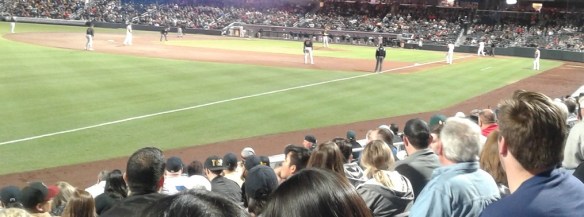
Las Vegas Ballpark, 11 April 2019, taken by the author while watching a game between the Sacramento River Cats and the Las Vegas Aviators.

Minor league baseball is an apprenticeship rough as often as ready for professional baseball players, coaches, and managers alike. But for fans it’s a pleasure that still evokes simplicity and the absence of the country’s and the world’s cacophonies and calamities.

I’ve had that pleasure numerous times in my sixty-four years. I’ve had it seeing the Omaha Royals (long since re-named the Storm Chasers) in the 1980s; the Scranton/Wilkes-Barre Red Barons (known since 2007 as the SWB Yankees) in the early 1990s; the now-defunct Fullerton Flyers (in Goodwin Field, on the campus of Cal State Fullerton) in the Aughts; and, since 2009, the Las Vegas 51s-turned-Aviators, first in creaky Cashman Field and, as of this year, in spanking new Las Vegas Ballpark.

You watch a game and its pleasures and pangs and remind yourself now and then that you’re seeing guys do something that afternoon or evening that mean the fateful phone call bringing them up to the Show. You think to yourself that, God and His servant Stengel willing, there just might be a future Hall of Famer on that field, on that mound, at that plate.

You think that a win for your team would be wonderful fun but it won’t grant them a place in the Elysian Fields’ honour roll of eternal grand champions. But neither do you think that, when your team loses, it means what it meant to too many a Phillie, a Cub, or a Red Sox fan for too many generations—“They came for our fathers, and now the sons of bitches are coming for us.”

Chattanooga, Tennessee baseball fans have had those pleasures since the year (1909) the Hudson Motor Car Company was born. A fan contest named the team the Lookouts, after adjacent Lookout Mountain. Hudson died in 1957. The Lookouts and 41 more of minor league baseball’s 160 teams may die like Hudson (the Cars film series notwithstanding) after next season if the Show has its way.

If you saw or heard about plans to exterminate those teams and you were unamused by the prospect, as many are, you may not be happy knowing the plot was another Astros brainchild. I didn’t know that, either, until I had a gander at Bill Madden in the New York Daily News, who wrote of it last Friday morning with the same lack of amusement.

Baseball commissioner Rob Manfred showed major league owners the plan “a few months ago,” Madden wrote, with the approving vote unanimous. Madden wrote that  the idea was conceived by Astros general manager Jeff Luhnow and supported swiftly enough by two teams whose general managers once worked under Luhnow in Houston: the Brewers (Mike Elias) and the Orioles (David Stearns).

Brilliant. Not only are the Astros at the core of a scandal involving unlawful high-tech, electronic, from-off-the-field cheating, they’re at the bottom of a plan to vaporise 26 percent of grass roots baseball in four short-season rookie- and A-level leagues (the New York-Penn League, the Appalachian League, the Northwest League, and the Pioneer League) and several more at the A and AA levels.

“The rest of the [major league] teams,” Madden wrote, “apparently just said ‘OK’ without any discussion of the ramifications of such a drastic attack on the minor leagues and all these communities across the country.”

The Astros themselves stepped ahead of that particular curve after their 2017 World Series triumph, cutting their minor league affliated teams from nine to seven with the elimination of one of two Dominican Summer League affiliates and their Greenville (Tennessee) Astros in the Appalachian League.

Aside from those mentioned, these are the teams on the hit list:

Appalachian League (Rookie, advanced)—Bluefield Blue Jays, Bristol Pirates, Burlington Royals, Danville Braves, Elizabethton Twins, Greeneville Reds, Johnson City Cardinals, Kingsport Mets, Princeton Rays.

California League (A, advanced)—Lancaster Jethawks.

Carolina League (advanced A)—Frederick Keys.

Florida State League (advanced A)—Daytona Tortugas, Florida Fire Frogs.

Midwest League (A, full season)—Burlington Bees, Clinton LumberKings, Quad Cities River Bandits.

New York-Penn League (A, short season)—Auburn Doubledays, Batavia Muckdogs, Connecticut Tigers, Lowell Spinners, Mahoning Valley Scrappers, State College Spikes, Staten Island Yankees, Vermont Lake Monsters, Williamsport Crosscutters.

Northwest League (A, short season)—Salem-Keizer Volcanoes, Tri-City Dust Devils.

Pioneer League (Rookie, advances)—Billings Mustangs, Grand Junction Rockies, Great Falls Voyagers, Idaho Falls Chukars, Missoula PaddleHeads, Ogden Raptors, Orem Owlz, Rocky Mountain Vibes.

Southern League (AA)—Jackson Generals.

South Atlantic League (A, full season)—Hagerstown Suns, Lexington Legends, West Virginia Power.

Madden wrote that that, according to calculations from minor league baseball itself, would amount to disappearing over two thousand combined years of minor league baseball history. Peabody and Sherman never bypassed that much of the world’s doings and undoings on their Waybac Machine travels.

What made the Astros think about it in the first place? Analytics. The very thing that helped turn them from also-rans to the powerhouse they are. They’ve exposed the side of analytics that its critics abhor and makes even supporters of sabermetrics (like me) cringe. I can find no better description than that from Field of Schemes writer Neil deMause:

As the Astros execs’ thinking went, advanced analytics (i.e., grading players based on such things as using high-speed cameras to measure body mechanics) could replace watching young players play actual baseball, saving the trouble of having to pay so many of them to do so. (Not that this is a huge expense — an entire single-A roster can be had for about $600,000 a year—but again, the Astros are all about exploiting every advantage.) And . . . why should they have to compete against teams like the New York Yankees whose owners were willing to keep minor league teams stacked up like cordwood?

The common good of the game is seen too often as making money for it. Now comes a curlicue once the reserve of science fiction, the common good of the game reduced to applied science and reducing the volume of actual baseball games. This isn’t exactly what Hall of Fame manager John McGraw had in mind when he rhapsodised about “scientific baseball.”

Applying advanced analysis toward helping players improve their games and thus teams improve their competitive standings is one thing. So is applying it sabermetrically toward giving you, Joe and Jane Fan, the most complete possible view of players and games you didn’t get to see. (Ponder: 2,430 major league baseball games are played every season. Maybe five times that many are played in the minors now.)

But they won’t tell you about the people playing those games. They won’t tell you why baseball isn’t really a game of seventy percent failure (seek and ye shall find, I promise you) and, most important, why some baseball players know how to shake away their shortfalls and others don’t. Lessons learned or re-learned in the minor leagues, most of the time.

Minor league crowds are a far more accepting, far less judgmental lot than Show audiences tend to be. And you may also think, above and beyond the game you watch on the field, that the guys on those teams are learning things other than the play itself. Things like why some minor league teachers miss when it comes to teaching players what minor league fans usually understand, that failure isn’t mortal sin.

A minor league team that doesn’t teach those things in hand with the play of the game is a minor league team that gets overhauled, not contracted. And when they don’t teach those things, it means disaster in the Show, where to err is human but to forgive isn’t always Joe and Jane Fan’s (or Journalist’s) policy.

Do you remember Calvin Schiraldi? Once a Met, then a Red Sox. Promising relief pitcher. Came back up late 1986 as the Sox’s bullpen stopper. Imploded fatefully in the World Series. Hung with the no-heart label.

When Mike Sowell wrote One Pitch Away: The Players’ Stories of the 1986 LCS and World Series, one of the players Schiraldi, as textbook a case of self-punishment for failure as you can find from his time. Sowell probably should have won some sort of prize for getting Schiraldi to talk at all, considering the former righthander liked reporters as much as Donald Trump likes criticism.

Sowell got Schiraldi to own up to his wounding flaw, the one flaw above all that kept him from sustained pitching success: “I liked it when I did well. But when I did bad, I took more things to heart than just blowing games off. I mean, if you lose, I took it to heart. Or, if I blew a save for a starter, I took it to heart. That’s probably what hurt me the most.”

That wasn’t exactly uncommon knowledge before Sowell. But it came second hand, so far as I knew. Months after that 1986 Series ended, Thomas Boswell ultimately revealed there was one Red Sox determined not to let Schiraldi sink himself after an earlier playoff loss. “It’s Schiraldi who got so down on himself that it worried me,” said fellow Red Sox (and fellow ex-Met) reliever Joe Sambito. “After he lost . . . I told him, ‘Calvin, you’re the best we have. Put it out of your mind. You can be the hero tomorrow.’ And he was.”

Sambito referred to Schiraldi’s blown save in Game Four of the ’86 ALCS against the Angels. The following night, Schiraldi nailed the extra-inning save set up when ill-fated Donnie Moore—whose eventual suicide came from far more than just one unforgiven (by Angel fans or himself) game failure—surrendered a tying two-run homer to Dave Henderson when the Angels were a strike away from going to the Series.

With the Red Sox an out from winning Game Six and the ’86 Series, Schiraldi gave up three softly-hit Mets singles in a row, the third of which brought the Mets to within a run of tying. Schiraldi was lifted for Bob Stanley. Stanley threw the wild pitch that should have been ruled a passed ball to let the tying run score. And then came the grounder heard ’round the world, skipping through Bill Buckner’s ankle-ruined legs to score the winning Met run. “So what happened after Schiraldi’s defeat in [World Series] Game Six?” Boswell wrote the following February in spring training.

He came back the next day ready to redeem himself. And it rained. He had a day to sit in a New York hotel room and think. When Schiraldi took the mound in the seventh inning of the seventh game, score tied, he was a wreck. Ray Knight, the first batter, hit a home run.

Things like that usually get tended, treated, and re-tended and re-treated in the minors, before you get to the Show—if you get there. Bad enough that Schiraldi’s minor league coaches may have missed them. Things like that are beyond the pay grade of the most deft analyst, technician, or applied scientist, on the Astros’ or any other baseball organisation staff. If the ’86 Red Sox were that advanced, they still couldn’t have saved Schiraldi from himself.

Maybe that’s why Ken Giles went from outstanding closer to 2017 World Series failure to wreck and to Toronto during the following season. The Astros could and probably did give him every analytical edge possible to take to the mound. When Corey Seager, Justin Turner, and Cody Bellinger ruined him in World Series Game Four to break a one-all tie in the ninth, Giles was shattered.

And, maybe alone, no matter that no less than George Springer sprang to his defense after the game. “This game’s hard. They’re not out there trying to fail,” Springer said after that game. “I hope [manager A.J. Hinch] keeps giving ’em the ball. I have the utmost confidence in them, and I’m glad they’re on my team.” Springer might have but Hinch didn’t. Giles was never seen again in that Series.

The following season, a couple of bad outings turned into a couple of bad meltdowns and Giles’s trade to the Blue Jays (for, controversially, Roberto Osuna), where he regrouped and posted an enviable 2019 despite a couple of injuries.

Don’t make the mistake of saying the pressure of the games or the postseason themselves got to either Giles or Schiraldi. Young men who don’t get taught or re-taught that failing in a game isn’t a mortal sin beat themselves no matter whether it’s a season opening series or the World Series.

Maybe Henderson was onto something when he once said, “This is a game. It’s not life and death. It should be fun.” Hell, he’d had to remind himself in that very ALCS Game Six: earlier, before his dramatic bomb, he tried snagging Bobby Grich’s fly with a flying leap, but the ball tipped off his glove and over the center field fence for a two-run homer.

Henderson wasn’t really the superstar he appeared for brief moments in that postseason; he was a useful journeyman in a respectable fourteen-season major league career. But he endured precisely because he knew failure didn’t have to be the end of the world as he knew it. And just maybe the easygoing Hendu got the proper reinforcement on that approach in the minors.

If you think that’s just a voice from the grave (Henderson died of a heart attack two months after a kidney transplant in 2015), maybe you’ll listen to Casey Mize, 2018’s number one draft pick overall. “I think failure is part of it and needs to be part of it,” said Mize—after throwing eight shutout innings at the Bowie Bay Sox for the Erie Sea Wolves (AA, Tigers affiliate)—about player development. “I see positives in being forced to fail.”

The minors aren’t anywhere near perfect. There’ll always be those players who don’t advance for assorted reasons and those reasons don’t all include analytic failure. There are injuries that curtail careers, there are boundless external issues, and there are mindsets that let the sense of fun die too soon when they realise professional baseball is the serious work of play.

One of the issues believed to be animating the contraction plan is ballpark conditions. As in, ballparks not up to major league standards. As in, the distinct whiff of potential litigation from minor league towns where taxpayers got the bill for upgrading the parks or building new ones entirely. But as Madden observed, if so many minor league parks aren’t up to snuff, why did the Show let the Cubs and the Pirates play a regular-season game in Williamsport last year? And why would they let the Red Sox and the Orioles do likewise next year?

Another may well be minor league conditions. The Show’s spinning, as Madden calls it, includes that the contraction plan is also aimed at “improv[ing] ‘wellness’ for the minor leaguers in terms of travel and living conditions,” though noticeably not in terms of their salaries, which should be redressed.

Many of the teams targeted for contraction, Madden added, “are grass roots baseball towns where most of baseball’s biggest stars passed through (and developed a forever fan base) on their way to the majors.”

An official from one of the teams in the Pioneer League, where most of the teams are in Montana, Idaho, and Wyoming, put it to me this way: “This is the only way people in these towns can see baseball. They can’t afford to drive a thousand miles to Seattle. And you’re talking about young fans . . . You take their teams away and baseball has lost them forever.

Dodger pitcher Walker Buehler thinks one key minor league issue is too many players there. “At any affiliate, there are three players who have a chance to play in the majors,” he told FiveThirtyEight. “The rest of the players are there so they so they can play. I don’t think that’s fair. You are preying on their dreams.”

It may not be as simple a scenario as Buehler seems to think, that minor league teams and their major league overseers prey on too many dreams unlikely to come true. And speaking of dreams, the Show has a plan for those minor league owners who lose their teams if the contraction plan flies: what it calls a Dream League, an independent league operated by the Show at minimal cost.

Madden, however, noticed a big problem with that idea:

In addition to stadium maintenance and taxes which they’re already paying, the cost of players, managers, coaches, trainers, and equipment people’s salaries and workers comp insurance would now all fall on the owners—between $350,000-$450,000 per year. When it was pointed out by minor league negotiators there was no way these minor league owners, after losing all the equity in their teams, could then afford to own a “Dream League” team, the MLB response was: “Well, they didn’t pay all that much for their teams in the first place, so it’s only paper money.” Tell that to David Glass, who bought the Kansas City Royals in 2000 for $96 million and recently sold them for $1 billion. Or as one minor league negotiator told me: “I guess that means it’s OK they should be punished for being good business operators.”

They and their fans will be punished just by losing their teams at all. Bristol, Tennessee has been in business in the minors since the sinking of the Lusitania. (1918.) Assorted South Atlantic Leagues (known colloquially as the Sally Leagues) have existed since Hoover Dam. (1936, though the dam was born as Boulder Dam.)

The Jackson Generals were once known as the Memphis Chicks—born with the Southern Association in the year (1901) New York became first in the nation to mandate license plates and the American League declared itself a major league; producing the Southern Association’s one-armed league Most Valuable Player, Pete Gray, in 1944.

That’s just a peek at the history that stands to be lost, in hand with the pleasures of baseball itself on the field, for millions of fans who can’t reach the Show except on television or radio or the Internet.

“Baseball is quintessentially American,” wrote A. Bartlett Giamatti before he became a baseball official himself,

in the way it tells us that much as you travel and far as you go, out to the green frontier, the purpose is to get home, back to where the others are, the pioneer ever striving to come back to the common place. A nation of migrants always, for all their wandering, remembers what every immigrant never forgets: that you may leave home but if you forget where home is, you are truly lost and without hope.

The Show’s minor league contraction can be taken, then, as evidence that those who run it forget where home is for millions of fans, and that it takes more than scoring runs to come home.

From Piazza to Mets pitching coach?

2019-11-18 SteveKarsay

As a Brave, Steve Karsay served a home run pitch New York and the country will never forget. Now he may become the Mets’ pitching coach.

Steve Karsay has a unique place in Mets history thanks to a 21 September 2001 game in New York. Now he may become their next pitching coach, depending on whether 2019 interim Phil (The Vulture) Regan really doesn’t factor into the plan going forward.

Native to New York, growing up a Yankee fan in the College Point section of Queens, Karsay took over for Mike Remlinger to work the bottom of the eighth in the late Shea Stadium, right after the Braves broke a one-all tie in the top of the inning on an RBI double. It was only the second time Karsay saw action in Shea in his career at that point.

Future World Series-winning Nationals manager Dave Martinez, a pinch hitter in that inning, stayed in the game to play first base for the Braves. He didn’t know then that it would be the final month of his major league playing life: he’d miss all 2002 with a knee injury and retire after that season.

Karsay surrendered a one-out walk to Mets third baseman Edgardo Alfonzo and Mets manager Bobby Valentine sent Desi Relaford out to pinch run. Checking in at the plate: Hall of Famer Mike Piazza, who couldn’t keep the tears back when bagpipers walked across the pre-game field intoning “Amazing Grace,” among other small ceremonies for New York’s first sports event after the 9/11 atrocity.

“I think the baseball part was secondary until we started getting deeper into the game,” remembered then-Mets general manager Steve Phillips. And when Piazza stepped up to the plate the Shea Stadium audience rose to their feet waving small American flags and cheering as much for the will to endure after such an atrocity as for the Mets.

Karsay started Piazza with a fastball down and away hitting the corner for a strike. “I get back into strike mode as a pitcher,” the righthander would remember to The Atlantic a decade later. “I wanted to throw another fastball down and away, which I did.”

This time Piazza didn’t miss. He electrified the ballpark, the city, and maybe the country that needed all the electricity it could find when he hit it so far over the left center field fence it banged off the second level of a television camera scaffold posted behind that fence. The fact that Piazza’s bomb gave the Mets a 3-2 lead that held up for a win was almost secondary.

Karsay remembered the ball almost hitting the camera operator aboard that scaffold. Other than that, he didn’t give a full glance on the mound to the ball in flight. The crowd noise told him everything he needed to know. “It’s one of those shots that doesn’t leave my mind,” he said a decade after the game. “Not that it bothers me, because I feel like I threw a good pitch and he hit a good pitch.”

None of the Braves begrudged Piazza’s moment. “If there was any game in my career that I had to lose or take the loss, that’s the one I would have wanted it to happen,” Karsay said. “I don’t think you could portray it any better than how that situation occurred.”

“It wasn’t a competition against our most hated rivals,” remembered Valentine in due course. “It was so much bigger than anything I had ever been part of before. It was just inevitable that something really special was happening.”

“I think we all, as Braves, knew that night we were in trouble,” Hall of Famer Chipper Jones (who went 2-for-4 with a run scored that night) remembered. “Because we’re not only playing a very good baseball team, but you just had the feeling that God and every other baseball god was on New York’s side that night. The matinee idol Mike Piazza ends up hitting the storybook homer that sent everybody home feeling great, feeling wonderful. We’d done our jobs as baseball players to entertain people, but we’d gone I feel above and beyond just the normal day’s work.”

“When Piazza hit the home run, it was kind of like, ‘OK, that was supposed to be. These people needed this a whole lot more than we needed to win a game’, ” Hall of Famer Tom Glavine—who’d pitch for the Mets late in his career—remembered three months ago, on 9/11’s anniversary. “It was the only game that we played at that level where I felt that way.”

“[F]or the fans, it was an unbelievable breath of fresh air,” said Martinez on the 9/11 anniversary this year, too. “This country’s been through a lot, and we stuck together. So to be a part of that, and to be a part of this country, I’m just really happy to be an American.

“And those people that lost lives, my heart goes out to them, always . . . ,” he continued. “I just kind of stood back and just watched [Piazza] jog by me like, ‘Wow’. I just listened. And I could hear the fans. Look in the stands, and there were people crying. There were so many people from the fire department, the police department there, at the game. It was something.”

The one part Karsay might want to walk back was after he got the inning’s third out. He fumed at plate umpire Wally Bell over a borderline pitch he thought was a strike to Alfonzo that helped lead to the walk, and Bell ejected him from the game on the spot.

He was having his best major league season to date in an injury riddled career. He’d been an Athletic (after being traded out of the Blue Jays organisation so they could get  Hall of Famer Rickey Henderson) and an Indian (a trade for fellow relief pitcher Mike Fetters), before becoming a Brave three months before 9/11—in the trade that rid the Braves of misanthropic reliever John Rocker.

After the 2001 season Karsay signed as a free agent for four years and $22.5 million with the Yankees he grew up rooting for. The injuries continued (he missed all of 2003 following shoulder surgery) and, after a year in the Rangers’ system (where he combined on a perfect game in the minors), an aborted reunion with the Indians, and the A’s buying him back from there to no avail, Karsay retired in 2005.

He spent several years as a pitching coach in the Indians’s system before becoming the Brewers’ bullpen coach and, among other things, helping Drew Pomeranz finally find his groove as a reliever—Pomeranz posted a 2.39 ERA and 2.68 fielding-independent pitching rate as a Brewer following his deadline trade from the Giants this year.

That could be a key reason why Karsay’s now in the Mets’ sights if they’re uncertain about Regan continuing at 82. God only knew the 2019 Mets bullpen was described in charitable terms as a mess. Their solid rotation—two-time Cy Young Award-winning Jacob deGrom, Noah Syndergaard, Zack Wheeler (who may yet depart as a free agent), Marcus Stroman, and Steven Matz—was compromised too often by the arson squad.

Between the collapse of prize acquisition Edwin Diaz and the inconsistencies elsewhere, until Seth Lugo and Justin Wilson proved the steadiest bulls down the stretch, the most feared words in the English language around Met fans were “pitching change.”

But if Regan moves elsewhere within the Mets structure and Karsay becomes the new pitching coach, he might yet turn an arsonist or two into an executioner or two. The rotation and enduring Piazza’s post-9/11 surrealism are nothing compared to that.

Astrogate: Scouts’ dishonour?

2019-11-17 MinuteMaidParkAstrogate went from bad to worse this weekend. As in, it may not have been enough for them merely to train a center field camera toward the plate so someone in the clubhouse could steal signs watching television and send them out to the hitters by banging the can.

Now we learn an assistant to general manager Jeff Luhnow suggested, in a August 2017 e-mail, that not only might advance scouts test out stealing signs from the stands, but that they might have wanted to think about using cameras to do it.

And it’s going to prove what ESPN analyst Buster Olney says: the litmus test for whether baseball commissioner Rob Manfred will prove a strong commissioner capable of securing and truly upholding the game’s integrity or “a white-belted high-school crossing guard either incapable of controlling [teams], or someone they believe will be unwilling to come down with a disciplinary hammer.”

On Saturday night, the two Athletic writers to whom former Astro pitcher Mike Fiers blew the Astrogate whistle last week, Ken Rosenthal and Evan Dillich, reported that they received a copy of the August 2017 e-mail asking the Astro scouts to look into picking up signs from dugouts.

Rosenthal and Dillich emphasised they were sent the e-mail on condition the sender and the author’s identity not be revealed just yet. But ESPN’s Jeff Passan, citing assorted sources in positions to know, wrote Sunday morning that Kevin Goldstein, special assistant to Luhnow, was the e-mail’s author. And the text of the e-mail, in which Goldstein urged Astro scouts to go video in figuring out new ways to steal opposition signs, is damning:

One thing in specific we are looking for is picking up signs coming out of the dugout. What we are looking for is how much we can see, how we would log things, if we need cameras/binoculars, etc. So go to game, see what you can (or can’t) do and report back your findings.

Both Passan and the Rosenthal-Dillich duo emphasise the idea didn’t exactly receive unanimous approval from the scouts in question. To read their description is to surmiser that many of those scouts probably wanted to throw up.

“Scouts discussed sign stealing with the executive outside of email as well, on phone calls and in a group Slack channel,” wrote Rosenthal and Dillich. “Multiple Astros scouts said they were appalled by the possibility they would be asked to use a camera—and said that some scouts indeed voiced as much to management. Another scout noted a generally confounded feeling amongst the group by the overall request.”

“Some [scouts] were intrigued by the idea, sources who received the email said,” Passan wrote, “while others were bothered by the thought of pointing cameras from the stands toward opposing teams’ dugouts, a plan that could have earned them scorn within the scouting community if caught.”

Once upon a time, as Watergate unfurled further, the question became what did then-President Richard Nixon know and when did he know it. No less than Nixon’s fellow Republican, Arizona senator Barry Goldwater, would remember thinking even in the early Watergate going, “This is beginning to smell like Teapot Dome.”

As of Sunday morning, Astrogate unfurls even further and the question now becomes what Luhnow knew and when did the GM know it. Don’t be shocked if a lot of baseball people start saying of Astrogate, “This is beginning to smell like the Black Sox scandal.”

When Astrogate first broke early last week, Luhnow responded with this, as cited by Forbes: “I know in the last couple of weeks there’s been a lot of news surrounding the Houston Astros and it’s not been good news. I’m disappointed in that. I think these incidents and topics are not tied together, but they obviously have come one after another, it seems like. It is disappointing and if there is an issue we need to address we will address it.”

Somehow, calling something like Astrogate merely “disappointing” resonates the same as would someone calling the Hindenburg disaster a little flare-up. And neither Goldstein, Luhnow, the Astros as an organisation, nor Major League Baseball would comment when asked by The Athletic, ESPN, or Yahoo! Sports.

Officially, and also when Astrogate first broke, the Astros said only this in a formal statement: “Regarding the story posted by The Athletic earlier today, the Houston Astros organization has begun an investigation in cooperation with Major League Baseball. It would not be appropriate to comment further on this matter at this time.”

Teapot Dome was a bribery scandal involving choice Navy oil reserves, a Cabinet official in President Warren Harding’s administration, and a once-fabled oil magnate, not breaking into a major party’s national headquarters. The Black Sox scandal involved players throwing the 1919 World Series for fun and profit, not off-the-field sign espionage.

But they, too, included coverup attempts. It took two years and Harding’s death before Interior Secretary Albert Fall’s Teapot Dome profiteering by bribe was exposed in full. It took almost the entire 1920 season before the 1919 World Series fix was confirmed and exposed. It took a little more than two years to expose the apparent depth of the Watergate coverup.

The Black Sox scandal could have destroyed baseball, which was buffeted long enough by gambling elements including players and even coaches fixing games for fun and profit and not in that order. Astrogate threatens baseball in a time when the Astros probably aren’t the only team engaging in electronic espionage but may just be the most flagrant at it.

What’s missing among other things is who was the Astros’ Alexander Butterfield, who installed but in due course revealed the Nixon White House taping system. Whom among the Astros’ people, at whose instigation, installed the center field camera tied to the clubhouse television set from which stolen signs could be sent to Astro hitters with a bang? And which one of them might become the one to own up to it?

Understand this much: Scouts in the stands can pick off signs on the field any old time they choose, so long as it’s with their own eyes or even a pair of binoculars. They do it on behalf of giving their team an edge in games to come, not the games they’re watching that involve coming opponents. But using cameras for sign deciphering in the stands even for scouts doing advance oppo research is verboten, formally.

When Manfred fined both the Red Sox and the Yankees in August 2017 over high-tech cheating attempts—the Red Sox were caught using an Apple Watch to steal Yankee signs; the Yankees were found using an inappropriate dugout telephone the previous year—he included in his decision, “Moreover, all 30 Clubs have been notified that future violations of this type will be subject to more serious sanctions, including the possible loss of draft picks.”

That means the Astros got the word about technocheating and continued flouting it anyway. Which means that the Astro Intelligence Agency behaved as a baseball law unto itself, thumbing its nose to Manfred with one hand while flipping him the proverbial bird with the other.

In that August 2017 ruling, Manfred made clear that neither the Red Sox nor the Yankee administrations knew of the chicaneries down below. But the commissioner now has no choice otherwise with Goldstein being a Luhnow aide. He has to step up, step out, and demand to know, for openers, whether Luhnow knew, what did he know, and when did he know. He may even have to ask the same of Astros owner Jim Crane.

Manfred also has to demand a complete accounting elsewhere around the game on behalf of the principle enunciated by his predecessor twice removed—at the time the man was president of the National League—when denying the suspension appeal of a pitcher caught with ball doctoring material in his glove:

[Cheating is] not the result of impulse, borne of frustration or anger or zeal as violence is, but are rather acts of a cool, deliberate, premeditated kind. Unlike acts of impulse or violence, intended at the moment to vent frustration or abuse another, acts of cheating are intended to alter the very conditions of play to favour one person. They are secretive, covert acts that strike at and seek to undermine the basic foundation of any contest declaring the winner—that all participants play under identical rules and conditions. Acts of cheating destroy that necessary foundation and thus strike at the essence of a contest. They destroy faith in the games’ integrity and fairness; if participants and spectators alike cannot assume integrity and fairness and proceed from there, the contest cannot in its essence exist . . . Cheating is contrary to the whole purpose of playing to determine a winner fairly and cannot be simply contained; if the game is to flourish and engage public confidence, cheating must be clearly condemned with an eye to expunging it.

—A. Bartlett Giamatti, “Decision in the Appeal of Kevin Gross,” 1987. (Emphases added.)

It’s not a stretch to imagine Goldstein acting entirely on his own in suggesting scouts wield cameras for sign stealing research. If he did, he put Luhnow and maybe even Crane into the hapless position of knowing no more about the underlings’ chicaneries than Richard Nixon knew about the Watergate break-in that happened the night before he picked up a Florida newspaper at his Key Biscayne retreat to read all about it.

If Luhnow and even Crane knew nothing about the Astro Intelligence Agency until Fiers blew the whistle last week, are the GM and the owner really working in-house to get to the nuts, bolts, and bytes of it? Did they really start the moment Rosenthal and Dillich first sent forth Fiers’ shot to be heard ’round the world?

Who would it be if it went down to that? Scouting director Pete Putila? Manager A.J. Hinch? Former Astros bench coach/current Red Sox manager Alex Cora, who’s already thought to have had a hand in the Astros’ 2017 sign stealing? Former 2017 Astros designated hitter/newly-hired Mets manager Carlos Beltran, who’s also suspected of having a role in setting the system up?

Fiers himself hasn’t named names yet. Cora and Beltran are now said to be cooperating “fully” with the Manfred administration’s probe; Cora was interviewed last week. Beltran is due to be interviewed. It won’t affect the Red Sox unless it turns out they tried a little espionage themselves during the season that ended in their 2018 World Series championship. It won’t affect the Mets unless Beltran is found culpable and suspended to open the season.

“There’s nothing illegal about studying your opposite team,” Beltran told reporters in New York. “We all have the same opportunity to look out for information and tendencies. I love and respect the game. I will be a student of it and apply all the lessons.” Studying the opposition isn’t illegal, but deploying off-field technology to steal signs during the game you’re playing is, according to baseball’s rules.

Someone else is bound to turn a name or two over sooner or later, either to a baseball investigator, to Rosenthal and Dillich, to Passan, to someone. It could be someone still in the Astro apparatus. It could be someone formerly in it. It could be someone else digging as arduously as Rosenthal, Dillich, Passan, and others.

Luhnow and the Astros administration already looked terrible in the Brandon Taubman affair before last month’s World Series, when they first reacted to the then-assistant GM’s taunting of women reporters over relief pitcher Roberto Osuna’s previous domestic violence suspension by trying to shoot and smear the Sports Illustrated messenger.

Now they look even worse regarding Astrogate. The since-fired Taubman is still being questioned by the Manfred administration over being so fornicating glad the Astros got Osuna while still under domestic violence suspension, but he’s also liable to be questioned about what if anything he, too, knew about Astrogate.

Do Luhnow and Crane realise this entire scheme has already compromised their rebuilding of the Astros into the powerhouse they’ve become? For an organisation priding itself on getting in front of several curves, the Astros’ leadership still leaves the appearance that they’re letting everyone else get ahead of the one that could prove their knockdown pitch.

The deeper goes Astrogate, the deeper run perceptions already running amok that the Astros don’t trust even the top-of-the-line players they have to play winning baseball without extracurricular subterfuge. There are probably other teams around the Show watching Astrogate unfurl further and wondering when their in-house intelligence operatives will be caught, if they have them.

And, no, going after those Astro players who accepted the electronically stolen signs won’t really help. It would be the same as New York police legend Frank Serpico once described about his department’s rampant corruption in the 1960s and early 1970s: going after a few flunky cops (players) wasn’t the same as going after a culture that allowed it in the first place.

Astro fans deserve your sympathy. Memory runs to the long, sad years when their futilities and shortfalls provoked even the most stubborn among them to call them the Lastros. Now, in an era when few fans have had as much to savour as Astro fans have, Astrogate and other fooleries are liable to leave them calling the team something else—the Disastros.

Except that it’s not just the Astros’s disaster. It’s baseball’s, too.

Yu’re kidding, right?

2019-11-16 YuDarvish

Yu Darvish looking staggered after surrendering the 2017 World Series homer that knocked him out of Game Seven after an inning and two thirds.

Practically from the moment Mike Fiers triggered Astrogate, there came a swell of blended rage and remorse from Dodger fans still smarting over Yu Darvish getting battered twice in the World Series, especially Game Seven. A lot of which fans now wanted to apologise. To Darvish.

All of a sudden a high-tech cheating scandal made a hero out of a pitcher whom we thought was caught tipping his pitches and battered accordingly, while any Dodger who was supposed to spot those things didn’t spot them. And who still felt the compulsion to apologise on the record just a couple of days later.

Just two years ago Darvish was Public Enemy Number One. Now, all of a sudden, he was embraced as another possible victim of the Astro Intelligence Agency. As God and His servant Branch Rickey are my witnesses, I swear sports fans take a back seat to few for absurdism.

You could have been Los Angeles’s most notorious wanted criminal, and you wouldn’t have inspired half the dragnet Dodger fans wanted to run to capture, draw, and quarter Darvish. And whatever was left of him. Now the guy who was compelled wrongly to a public apology in the first place gets a lavish bubble bath of apologies from the same fans.

“Why am I trending [sic]?” Darvish tweeted on Day One of Astrogate. “Do people finally realize I’m cool?” Priceless.

He’s too polite to reject them directly, but he’s too self-aware to accept them sight unseen. “I’m not looking for that,” he said in a post on his YouTube channel. “I don’t want them to change their minds.” Be careful what Yu wish for.

A simple “I stunk, that’s all” from Darvish on Twitter wasn’t enough. Nor, perhaps, is his further YouTube demurral. “If you ask me if I got hit in Game Seven because they stole signs, I don’t think so,” he said, in a translation by the Los Angeles Times columnist Dylan Hernandez. “The Astros have great players who don’t have to do that. So I think that whether or not they stole signs, the results wouldn’t have changed.”

Notice Darvish’s phrasing. I said more or less the same thing myself in a previous Astrogate entry. About the Astros having great players who don’t have to resort to crime, high tech or otherwise. Which is almost as much of what makes Astrogate such an outrage as the fact that they so flagrantly broke the actual rules about off-field electronic surveillance in the first place.

These Astros needed high tech spying to win about as much as Richard Nixon’s re-election campaign CREEPs needed whatever they were looking for—while so ineptly bugging Democratic National Committee headquarters in the Watergate complex—for their man to win by a landslide in 1972.

And the Astros are accused only of operating the AIA in Minute Maid Park. So far. Nobody’s yet suggested they sent the agency on surveillance missions in road ballparks in the first place, never mind gotten away with it if they had.

Unless there’s evidence yet to be exhumed, it’s not very likely that the Astros bugged Dodger Stadium to get the drop on Darvish. Unless they had a mole among the stadium personnel, any Astro personnel trying to set up electronic surveillance in the road ballpark would have been caught, thrown out of the stadium, and maybe have to answer to la policia in the bargain.

Wouldn’t they?

Even Darvish himself let the suggestion enter his mind for a moment. “What’s been reported up to this point is that they used cameras at their home field,” he said, “so I don’t know if there was anything like that. But what they were doing was so high-level that I can’t honestly say there’s no chance they were also doing it on the road.”

Dodger fans wanting to make it up to Darvish should stop right at the point of apologising for wanting to hang him after the 2017 World Series. Especially since he wasn’t the only reason the Astros won Game Seven, and getting sent to bed without his supper after an inning and two thirds still left the Dodgers plenty of time to overthrow the 5-0 hole the Dodgers were in when he departed.

Memory time, boys and girls. Darvish’s Game Seven evening began with a leadoff double by George Springer and Springer coming home on a throwing error in the infield, allowing Alex Bregman aboard to reach second on the play. Then Bregman stole third with Jose Altuve at the plate, and Altuve pushed Bregman home on an unassisted ground out to first. Two runs, unearned, in the top of the first.

Top of the second? Brian McCann opened with a full-count walk. Marwin Gonzalez doubled him to third. Josh Reddick grounded out to second. And Astros starting pitcher Lance McCullers, Jr. pushed McCann home and Gonzalez to third on another ground out to second, before Springer hit a full-count pitch into the left field bleachers.

Where were the Dodger brain trusters who didn’t catch him tipping pitches and fix it before the Astros could do any more damage than the Dodgers gifted them in the top of the first?

Where were the Dodger hitters who looked McCullers’s gift horse in the mouth, putting two or more on against him the first few innings including ducks on the pond in the bottom of the first, but swinging like Little Leaguers trying to hit six-run homers on every pitch and leaving the runners grounds for court martials, charges desertion?

The only reward Dodger fans got for Brandon Morrow (ending the second), Clayton Kershaw (four scoreless in relief), Kenley Jansen (a scoreless seventh), and Alex Wood (scoreless eighth and ninth) stopping the bleeding was a one-out RBI single from Andre Ethier in the sixth. The Dodgers had two or better on and men on second or better in five of the first six innings, and Ethier was the only man to cash in.

Now the Dodgers deny pitch tipping was the issue. Their roster included now-retired Chase Utley, said to be expert at catching pitch tipping. “[He] watched the Darvish outings,” says team president Andrew Friedman, “and said you couldn’t sell out on something that Darvish was doing.”

Darvish’s ERA in the first two 2017 postseason rounds was 1.62. His Series ERA: 21.60. The 2017 Dodgers won three more regular season games than the Astros despite the Astros out-hitting them—the Dodgers’ team ERA on that season was 3.38; the Astros’, 4.12. And you don’t need me to tell you the flip side of, “Good pitching beats good hitting.”

Was Darvish more right saying “I stunk?” Or did the Astros find some way to take the AIA on the road with them, after all? Were they that nervous about the Dodgers’ potential to out-pitch them?

I’ve written until I was blue in the fingers about baseball’s goats and fans inane enough to try making their lives to follow nightmares. The last time was in the immediate wake of Bill Buckner’s death on Memorial Day. I inadvertently omitted Darvish from the roll of those who really needed no forgiveness because there wasn’t a damn thing to forgive in the first place.

When Thomas Boswell eulogised Donnie Moore, after Moore’s shocking suicide in 1989, he wrote with no small indignation, “Many of us wish that, just once, we could be in your shoes and have a chance to fail so grandly. Although, if we really had to live the experience and its aftermath, which sometimes lasts a lifetime, maybe we would not.”

So Darvish had five runs torn out of him before he could get a third out in the Game Seven second? That didn’t make him a criminal. It made him a pitcher who tried and failed. The most successful people on earth try and fail, usually before their successes and more often than you think after them.

And they don’t all go to work with 50,000+ plus waiting to watch them in the office and millions more eavesdropping in front of television or radio, either.

Angel fans refused to forgive Moore for throwing a great pitch that Dave Henderson managed somehow to send over the left field fence to tie a game when the Angels were a strike away from the 1986 World Series. Haunted as it was, Moore was finally driven to shoot his wife and then himself. Only his wife survived.

He was only preceded by Fred Merkle, Freddie Lindstrom, Ernie Lombardi, Johnny Pesky, Ralph Branca, Gene Mauch, Willie Davis, Curt Flood, Luis Aparicio, Mike Torrez, Tom Niedenfeuer, and Don Denkinger. He was only followed by Buckner (in the ’86 World Series), Mitch Williams, Alex Gonzalez, Grady Little, and—so far as Astro fans are concerned (wrongly, I might add)—A.J. Hinch.

Come to think of it, if the Astros ended up losing the 2017 Series Ken Giles might have had the goat horns plopped on his head. His crimes included surrendering a fisted cue shot to Corey Seager on an inside fastball, walking Justin Turner on five pitches four of which were borderline corner calls, and throwing Cody Bellinger a fastball off the middle that was driven to deep left center to break a one-all Game Four tie in the top of the ninth.

Hinch brought in Joe Musgrove, who struck Yasiel Puig out and put Logan Forsythe aboard to load the pads for a double play, then surrendered a sacrifice fly before throwing Joc Pederson a slightly up, slightly in fastball on 0-1 and watching it sail into the right field seats.

But Giles took the abuse. Despite owning up after the game: “I didn’t do my job. Plain and simple. I let my team down.” Despite George Springer springing to his and Musgrove’s defense concurrently: “This game’s hard. They’re not out there trying to fail. I hope [Hinch] keeps giving ’em the ball. I have the utmost confidence in them, and I’m glad they’re on my team.”

Giles didn’t see another inning’s work in that Series. And it may have gotten to him a little more in the long run. He struggled in early 2018 and fumed when being lifted after a bad outing against the Athletics. He was demoted to the minors, then traded—in classic adding insult-to-injury style—to the Blue Jays . . . for then domestic violence-suspended Robert Osuna.

The Astros took a public relations beating over acquiring Osuna. And during this year’s World Series, assistant GM Brandon Taubman was fired after the Astros embarrassed themselves trying to defend his indefensible hollering with women reporters in post-ALCS triumph earshot that he was so fornicating glad they got Osuna.

Already still under questioning by baseball government over that incident, Taubman is now liable to face Astrogate questioning—as in, what did he know about the AIA and to what extent did he know it—while he’s at it.

Giles, meanwhile, regrouped entirely in Toronto. Though he finished 2018 on the down side, in 2019 he had a breathtaking comeback—a 2.27 fielding-independent pitching rate and a 1.87 ERA. Except that since he was in Toronto, nobody other than Blue Jays fans cared—if you didn’t count the trade deadline interest he drew before elbow inflammation put him on the injured list before the All-Star break.

Darvish went on to sign a mega-deal with the Cubs. He struggled out of the 2018 chute before going down for the season thanks to a triceps strain and concurrent elbow stress reactions. It’s not impossible that he put pressure on himself trying to live up to his new contract. Wasn’t the first, won’t be the last.

This year, Darvish struggled to regain his form—indignant Cub fans referred to him too often as “Flu Garbage”—before going mostly lights out in August and September: he was still prone to the long ball (well, so was American League Cy Young Award winner Justin Verlander), but his ERA for those two months was 2.99.

And he really doesn’t want to think that the AIA did him in in Game Seven two years ago. “I feel that if I absolve myself and say it was the Astros’ fault . . . I can’t develop as a person,” he said in his YouTube posting.

“In life, I think huge failures are extremely important. I’ve had a few up to this point,” he continued. “The World Series was one of them. I think it will remain a point of reference for me. I’ve already learned a lot from it. So regarding that, I can’t view myself charitably. I think I have to continue to accept the results.”

That makes him an even better man than he already showed himself to be. But we’re going to learn soon enough whether Astrogate involves robbing their road hosts. And if it does, who were their Bonnie and Clyde?