The financial not-so-merry-go-round goes round

2020-06-04 ManfredBaseballsMaybe Hall of Fame pitcher Tom Glavine was wrong when he said last month that, if major league baseball doesn’t return, the players are going to look bad no matter how right they might be. The deeper goes the impasse between the owners and the players, the more the owners resemble the people to whom the good of the game equals nothing but the bottom line.

The owners and the players agreed in March to play any shortened season with the players paid their signed-for 2020 salaries on a pro-rated basis—until the owners said not so fast. The owners tried for a 50-50 revenue split knowing it would cost a lot of players a lot more money than just playing under their pro-rated 2020 salaries—and the players said not so fast.

Now the players, as if they needed further evidence for the defense that yes, they’d rather be playing baseball, proposed a 114-game season. The owners, who first thought of an 82-game season, said, essentially . . . not so fast. They rejected that proposal almost out of hand, then decided that negotiating further meant nothing when they could find a way to impose a 50-game season and, by the way, the players were perfectly free to negotiate against themselves.

That’s the way Yahoo! Sports columnist Hannah Keyser phrased it, more or less. MLB “believes that language in that agreement around ‘economic feasibility’ of restarting a season allows them to negotiate a further pay cut for the players now it’s become clear that games will be played without fans, at least at first,” she writes. “The union disagrees with that interpretation, as well as the league’s assertion that owners will lose money on every regular season game.”

By comparison it’s been simpler for the owners and the players to agree on such details as playing this season with a universal designated hitter (and it should be kept when things become normal again in 2021), a one-time-only postseason expansion, and wringing out the fine details of proper health protocols.

Where they demur mostly is about money. The owners, who’ve rarely passed on a chance to try suppressing player pay in the past, are using the coronavirus-triggered season delay to try it now. The players, who know they have a March deal to play pro-rated, have the unmitigated gall to insist the owners live up to the deal to which they themselves agreed.

Oh, sure, the owners harrumph that they’ll still pay pro-rated 2020 salaries under a 50-game season. Don’t fool yourselves: it means the players earning less thanks to drastically slashed time on the job. Talk about a de facto salary cap.

It means, as Keyser writes, that commissioner Rob Manfred and the owners “would declare the negotiations a failure and effectively cut the hours of their employees who refused to agree to lower wages. All of which they seemingly can do, and it would be a success . . . ”

That is an almost embarrassingly trite and self-evident thing to say based on the behavior of Major League Baseball owners over the past few years. Of course they’re more concerned with minimizing costs than retaining top talent or paying minor league players a living wage. But it’s worth emphasizing that they just announced they’re also more concerned with savings than even hosting baseball games. They’re betraying more than the spirit of competitive balance with their cheapness now, they’re also depriving fans of the very product they’re trying to sell.

Speaking of paying minor league players living wages, it’s worth noting that major league players have embarrassed a few teams out of trying to cut their minor leaguers off. Without even throwing a single regular season pitch in the uniform, Los Angeles Dodgers pitcher David Price elected to hand each minor leaguer in the Dodger system $1,000 out of his own pocket.

When the world champion Washington Nationals thought about cutting their minor league players off at the pass, their players—as announced by relief pitcher Sean Doolittle last weekend—said not so fast, and prepared to pool their own monies to take care of those minor leaguers, prompting the organisation to keep their farm players on the payroll after all. Doolittle subsequently announced the Nats’ major leaguers would continue offering the team’s farm players financial help.

Remember: The major league players may not be impoverished, exactly, but the owners are impoverished far, far, less. When Chicago Cubs owner Tom Ricketts says it’s not like they can just move money around at will—given that the virus shutdown has wreaked losses at a “biblical” scale and MLB doesn’t exactly “make a lot of cash”— even his fellow owners know he’s talking through his chapeau.

For the seventeenth year in a row, 2019 saw MLB set a new revenue record. Forbes recorded it as $10.7 billion. “In accounting, revenues are calculated before factoring in expenses,” writes NBC Sports’s Bill Baer, “but unless the league has $10 billion in expenses, I cannot think of a way in which Ricketts’ statement can be true.”

Something else to ponder as well, if the owners aren’t going to the poorhouse and are trying to game the players yet again, and if the players are willing to extend financial helping hands to their teams’ minor leaguers: What about going the extra few miles and extending helping hands to 600+ short-career pre-1980 major leaguers who were frozen out when baseball’s pension plan was realigned that year to shorten up the time in MLB service required for a full MLB pension to vest?

Remember: The late players union director Marvin Miller said in due course that not revisiting and remodeling that realignment to include those pre-1980 short-career players was his biggest mistake and regret. The players in question do receive some monies from a deal worked out between former commissioner Bud Selig and the late players union director Michael Weiner—but they can’t pass that $625-per-quarter-of-MLB-service to their families when they pass on.

Today’s players union director Tony Clark has been (phrased politely) cool about the matter. The Major League Baseball Players Alumni Association has been likewise, unfortunately. Amplified especially since three of the players who’d been involved actively in the pension redress cause—former pitchers David Clyde and Gary Niebauer, and former first baseman/longtime coach Eddie Robinson—were squeezed off the association’s pension services committee.

Maybe today’s players, if they can be made further aware, might think of pitching in likewise for those short-career men who also supported their union in actions that helped pry open the door to free agency and tackle other pertinent issues involving major league players, and sacrificed considerable income despite earning less than princely salaries for assorted reasons.

Maybe. First, let’s find the right way to get a 2020 season played at all, about which the owners seem less concerned than about preserving whatever they think remains of their bottom lines. You don’t want to know what might emanate if the owners get away with imposing a too-short season for no better reason than to cut the players off at the financial pass.

Dykstra’s race cards, clarified

2020-06-02 LennyDykstra

Lenny Dykstra hitting his game-opening  home run against Oil Can Boyd in Game Three of the 1986 World Series; fellow Mets legend Keith Hernandez is seen on deck.

The New York State Supreme Court may have ruled Lenny Dykstra libel-proof, in granting his 1986 Mets teammate Ron Darling’s request to dismiss Dykstra’s defamation lawsuit. But one question before the house post mortem remains—is or was Dykstra an actual racist?

Darling’s book 108 Stitches cited Dykstra having hollered racial epithets at Boston Red Sox pitcher Dennis (Oil Can) Boyd before leading off against Boyd to open Game Three of the 1986 World Series. Boyd himself doesn’t remember hearing them, though he also admits that hearing about them in due course disturbed him, especially since he’d played with and liked Dykstra when the pair were once in Japan.

The justice who ruled in Darling’s favour last Friday, Robert D. Kalish, cited several  instances of Dykstra using racial insults in years following his baseball playing days and during the business activities that ultimately exploded in Dykstra’s face almost repeatedly.

Darling’s and Dykstra’s African-American Mets teammates, including pitcher Dwight Gooden, and outfielders Kevin Mitchell and Darryl Strawberry, don’t remember hearing Dykstra hammering Boyd racially before hammering a leadoff bomb in that game, either. But Darling, himself a former pitcher, didn’t limit his criticism of Dykstra to the World Series incident, and Kalish observed as much in writing his dismissal opinion.

Kalish didn’t rule singularly on the grounds that Dykstra was or is a demonstrable racist or at least leaned toward racial insults in an actual or alleged effort to rattle Oil Can Boyd or any opponent. (I should have made that point a lot more clear when writing about the ruling on Monday.)

What Kalish ruled was that Dykstra’s overall reputation collapsed so profoundly that libeling or defaming him is legally impossible. A man who delivers himself into that kind of clutch as Dykstra ultimately did deserves a certain degree of pity.

It’s likely, that Darling mis-remembered Dykstra awaiting his turn at bat to open Game Three. as you’ll see in due course. It’s also likely, that Dykstra was so reckless a young man that any thought of him using race to try rattling a black pitcher he was about to face, since he was a young man who’d do just about anything for an edge including living on and over it, made sad enough sense.

Dykstra’s complaint against Darling and 108 Stitches may have specified that the reference “forever branded [him] a racist,” as Kalish noted. But it didn’t necessarily limit itself to that question alone. On Monday, I cited what I was certain was the money quote that tripped Dykstra’s litigious trigger, which began with the racial epithet accusation but continued thus:

You know how there always seems to be a guy in every organization, in every walk of life, who gets away with murder –murder being a figurative term in this case? That was Lenny. He was a criminal in every sense, although during his playing days his crimes were mostly of an interpersonal nature. He treated people like shit, walked around like his shit didn’t stink and was generally a shitty human being –and, just maybe, the most confident, cocky player I would ever encounter. It was after he left the game, though, that his behavior took a truly criminal turn; he ended up being sentenced to house arrest on a bankruptcy fraud indictment, and he was also up on drug possession and grand-theft-auto charges, for which he received a three-year prison sentence. Not exactly the poster boy for America’s game, huh?

Kalish made a point of citing Dykstra’s entire calamitous post-baseball life even when alluding to or specifying race issues:

Based on the papers submitted on this motion, prior to the publication of the book, Dykstra was infamous for being, among other things, racist, misogynist, and anti-gay, as well as a sexual predator, a drug-abuser, a thief, and an embezzler. Further, Dykstra had a reputation—largely due to his autobiography—of being willing to do anything to benefit himself and his team, including using steroids and blackmailing umpires* . . . Considering this information, which was presumably known to the average reader of the book, this Court finds that, as a matter of law, the reference in the book has not exposed Dykstra to any further “public contempt, ridicule, aversion or disgrace,” or “evil opinion of him in the minds of right-thinking persons,” or “deprivation of friendly intercourse in society.

The roll of Dykstra’s racial bombs during his post-baseball business collapse  remains troubling enough to have Dykstra branded as a racist long before Darling wrote his book:

In a 2009 GQ magazine article, Dykstra’s former employee Kevin Coughlin . . . wrote about his time working for Dykstra and asserted that Dykstra would use the terms “darkies” and “spearchuckers” to refer to African-American athletes featured in Dykstra’s magazine the Players Club . . . These claims were also reported by other media outlets such as ESPN.com, the New York Daily News,and the Philadelphia Inquirer . . . Moreover, in a 2013 book, Dykstra’s former magazine editor for the Players Club Christopher Frankie . . . detailed his account of working with Dykstra and asserted that Dykstra described Willie Mays as “his field n—-r,” Venus and Serena Williams as “baboons,” and Celtics coach Doc Rivers as a “spear-chucker.” In his book, Frankie tells the story of how Dykstra allegedly said that the staff at the Carlyle Hotel “had been offended when [Dykstra] loudly used the word ‘n—-r’ in the lobby and had booted him out” . . .  Dykstra undisputedly has never brought a libel suit against Coughlin, Frankie, or other media outlets for such reporting . . .

The aforementioned Christopher Frankie account is Nailed: The Improbable Rise and Spectacular Fall of Lenny Dykstra. It’s sickening enough to learn Dykstra could call a Hall of Famer against whom every center fielder since is judged—who tangled with racism surprisingly and bitterly when trying to buy his first San Francisco home, and who tended lovingly to his Alzheimer’s-stricken second wife until her death seven years ago—his “field n—-r.”

In the aforementioned GQ article (“You Think Your Job Sucks? Try Working for Lenny Dykstra”), Coughlin recalled taking a phone call from Dykstra about possible Players Club cover subjects, with Coughlin’s wife hearing the convo on speaker. Dykstra said, “Nobody can call me a racist—I put three darkies and a bitch on my first four covers.” When Coughlin replied, “What was that, Lenny,” Dykstra answered, “I said I put three spearchuckers on the cover!”

In Macho Row, William C. Kashatus’s splendid, candid, and often troublesome chronicle of the 1993 Phillies, for whom Dykstra was a critical element, Kashatus reviewed Dykstra’s issues with PEDs (actual or alleged), his marital collapse, and his “increasingly erratic” behaviour after his Players Club collapse and his divorce: “He used offensive terms when speaking about blacks, women, and homosexuals.” (Coughlin recorded that Dykstra dismissed a particular suggested Players Club page layout as “faggy”—even as the gay page designer was within earshot in the room.)

Kashatus also made a point of citing Dykstra’s 2016 memoir, House of Nails, including this passage: “While at times [my] brash, arrogant style served me well in the game of life, it was eventually instrumental in my undoing.” An undoing that finally made Dykstra libel-proof in the eyes of the New York State Supreme Court.

When Jeff Pearlman wrote The Bad Guys Won, his engaging and too-revelatory 2004 review of the 1986 Mets, he recalled Boyd’s pre-Game Three boast, “When I first looked at the Mets, I saw they had good power in the middle. But I feel I can master those guys.” Pearlman also exhumed that former Met Tom Paciorek, by then a Texas Rangers outfielder attending the Series as a commentator, chatted before the game with Mets Keith Hernandez (first baseman) and Wally Backman (second baseman) with a little extra counsel about facing the Red Sox’s slender righthander:

Paciorek knew Boyd well, and his advice was sound: “When you guys start the game, just keep screaming shit at Oil Can from the dugout, because he’s got rabbit ears,” Paciorek said. “He hears everything and it really gets him frustrated. He’ll start hanging shit, and then he’ll start looking at you. He’ll point at you when he strikes someone out. If that happens, you’ve got him.”

Hernandez didn’t have to be told twice. As soon as Boyd strolled to the mound to start his warmup pitches, the assault began. The players kneeled on towels lined up in front of the dugout’s top step, just to be as close as possible. “Hey, Shit Can! Is that all you’ve got!? C’mon, throw harder than that, you pussy! Hey, Shit Can! You’re nothing!”

In House of Nails, Dykstra remembered telling his wife, Terri, before the game,  that he “was going to try to go yard with one of Oil Can’s garbage batting-practise fastballs in my first at-bat.” Boyd remembers leaving a slider out over the plate enough for Dykstra to send into the corner right field seats. Pearlman recorded the Mets’ bench jockeys hollering “Shit Can! Shit Can!” as Dykstra rounded the bases.

The Mets scored four in that first inning. Boyd pounded the mound’s rosin bag, paced around the mound, and glared toward the Mets dugout as the first-inning merry-go-round went ’round. The Mets went on to win the game, 7-1.

Dykstra wasn’t exactly the only wild, crazy, and reckless dude on the notorious 1986 Mets, whose clean contingent membership might be countable on one hand. The bad news further is that he is threatening a future day of reckoning for those Mets he swears done him dirty. (When you [fornicate] with Nails, you get the [fornicating] hammer, you hear me?)

The Mets may not have been innocent, and Dykstra may be trying to remake and remodel his life at last.** But Dykstra making a threat like that may yet prove pot calling out kettle. “Careless” may be the best way to describe Dykstra when all is said and done. Carelessness carries its own stains and inflicts them upon more than just the careless.

Ron Darling may have misremembered Dykstra pre-Game Three, but he didn’t write the overall script that made Dykstra legally libel-proof. And, very much to my regret, I’d forgotten Pearlman’s Game Three descriptions when sitting down to write on Monday.

At the very least, it appears that neither Dykstra nor any other Met played race cards trying to rattle Oil Can Boyd, unless you think a mere juvenile play on his nickname carries more sinister undertones. I owe it to Dykstra (and to you, gentle readers—all ten of you) to say that much, at least.

———————

* In House of Nails, Dykstra revealed he spent six figures to hire private investigators to dig into umpires’ lives and used embarrassing information thus exhumed to convince umpires to give him more favourable pitch calls at the plate. In 1992-93, as a Phillie, when he said he began using such expensively gathered intelligence, Dykstra saw a 6.5 point spike in his rate of bases on balls.

An analysis of whether Dykstra could have been held legally liable for such efforts and acts appears at FanGraphs, by Sheryl Ring.

** Dykstra told a story in House of Nails that I hope to God is true: When his youngest son turned eighteen, his baseball pension reverted to him under the terms of his divorce agreement. It amounted to $6,000 a month, money Dykstra certainly could have used considering his notorious business collapse.

Dykstra wrote that he thought about it hard, then called for and received legal documents to sign ordering the money to continue going to his former wife, Terri, for the rest of her life. “Why should she be penalised for my transgressions?” he wrote. “She did not contribute to my downfall . . . She’s a wonderful person who certainly did not deserve the fallout caused by my actions.”

If that’s true, it indicates that even Dykstra is not beyond redemption.


NYS Supreme Court: Dykstra libel-proof

2020-06-01 LennyDykstraRonDarling

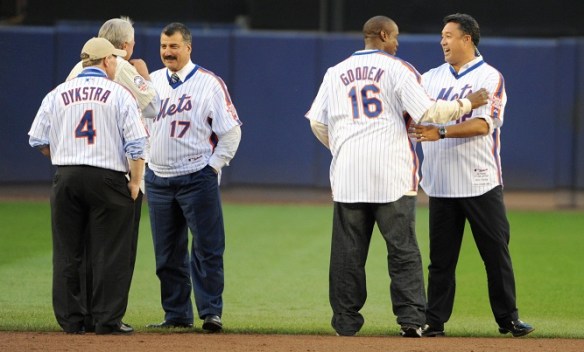
Lenny Dykstra (with Keith Hernandez, left) and Ron Darling (right, with Dwight Gooden), seen at a distance, joined other 1986 Mets for Shea Stadium’s closing over a decade ago. Dykstra’s defamation suit against Darling for remarks in a memoir has been thrown out by a New York State Supreme Court justice who ruled that Dykstra’s reputation preceded him only too well.

Can your reputation go so far beneath even the most grimy sewer that you can’t be libeled or defamed? Asked and answered by a New York State Supreme Court justice last Friday, while throwing Lenny Dykstra’s suit against his 1986 Mets teammate Ron Darling out of court.

Essentially, Justice Robert D. Kalish ruled, in Dykstra v.St. Martin’s Press LL.C., Macmillan Publishing Group, LL.C, Ronald Darling, and Daniel Paisner, that calling Dykstra a misogynistic racist predator thief and embezzler means only that you’ve read Dykstra’s autobiography.

Last year, Darling published 108 Stitches: Loose Threads, Ripping Yarns, and the Darndest Characters from My Time in the Game. (Paisner was his ghostwriter.) Among other things, Darling wrote that, when the Mets squared off against Dennis (Oil Can) Boyd in Fenway Park during Game Three of the 1986 World Series, Dykstra—the Mets’ leadoff hitter in the game—hammered Boyd with a round of racial epithets even before facing the slim righthander.

Boyd himself had no memory of Dykstra’s verbal abuse. Neither did two African-American Mets stars, Darryl Strawberry and Dwight Gooden. Darling swore the abuse happened and lamented aloud that he hadn’t taken a stronger stand against it at the time. Dykstra was not amused to see it in print, denying every syllable of it, and sued Darling, his ghost, and his publisher and its parent.

This was what Dykstra thought especially would prove the money quote with no value except putting mucho millions into his bank account once he got through with Darling in court:

In Game 3 of the 1986 World Series, though, Oil Can was on the receiving end of the ugliest piece of vitriol I’ve ever heard –in a bar, on a baseball diamond … anywhere. It was right up there with one of the worst, most shameful moments I ever experienced in the game, and one of the great shames of the exchange was that I sat there with my teammates and didn’t do a damn thing about it. In fact, it resulted in a momentum shift that probably turned the Series around for us, and like most of the other guys on the bench, I stood and cheered at the positive outcome . . .

. . . The hero of Game 3 for us was also the asshole of the game –Lenny Dykstra, one of baseball’s all-time thugs. You know how there always seems to be a guy in every organization, in every walk of life, who gets away with murder –murder being a figurative term in this case? That was Lenny. He was a criminal in every sense, although during his playing days his crimes were mostly of an interpersonal nature. He treated people like shit, walked around like his shit didn’t stink and was generally a shitty human being –and, just maybe, the most confident, cocky player I would ever encounter. It was after he left the game, though, that his behavior took a truly criminal turn; he ended up being sentenced to house arrest on a bankruptcy fraud indictment, and he was also up on drug possession and grand-theft-auto charges, for which he received a three-year prison sentence. Not exactly the poster boy for America’s game, huh?

2020-06-01 OilCanBoyd

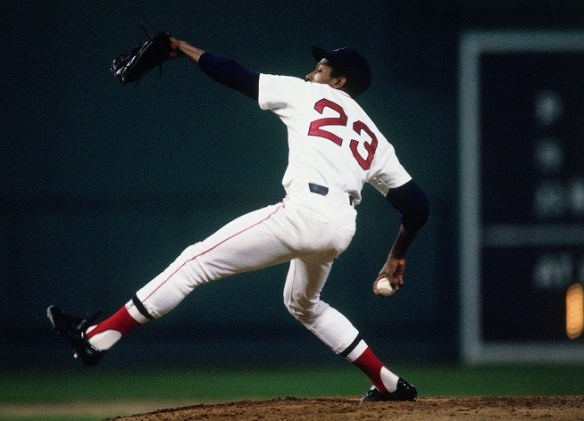
Oil Can Boyd, on the mound at Fenway Park.

“Based on the papers submitted on this motion, prior to the publication of the book, Dykstra was infamous for being, among other things, racist, misogynist, and anti-gay, as well as a sexual predator, a drug-abuser, a thief, and an embezzler,” Kalish wrote in his opinion.

Further, Dykstra had a reputation—largely due to his autobiography—of being willing to do anything to benefit himself and his team, including using steroids and blackmailing umpires . . . Considering this information, which was presumably known to the average reader of the book, this Court finds that, as a matter of law, the reference in the book has not exposed Dykstra to any further “public contempt, ridicule, aversion or disgrace,” or “evil opinion of him in the minds of right-thinking persons,” or “deprivation of friendly intercourse in society.

The nature and seriousness of Dykstra’s criminal offenses, which include fraud, embezzlement, grand theft, and lewd conduct and assault with a deadly weapon, and notably the degree of publicity they received, have already established his general bad reputation for fairness and decency far worse than the alleged racially charged bench-jockeying in the reference could . . .

. . . Given the aforesaid litany of stories concerning Dykstra’s poor and mean-spirited behavior particularly toward various groups including racial minorities, women, and the LGBTQ community—this Court finds that, as a matter of law, the reference cannot “induce an evil opinion of [Dykstra] in the minds of right-thinking persons” or “deprive him of their friendly intercourse in society,” as that “evil opinion” has long existed.

Now a Mets broadcaster working next to another ’86 Mets teammate, Keith Hernandez, Darling has no illusions about that notorious bunch. With a small group of exceptions, including Hall of Famer Gary Carter, the ’86 Mets were baseball’s Hell’s Angels without the motorcycles. They made the 1934-35 Cardinals’ Gas House Gang resemble a group of lawn bowlers.

“This team was arrogant, always believed it would win it all, never mind what it said on the scoreboard or in the box score,” Darling wrote in 108 Stitches. “Still and all, [Game Three] was a must-win for the good guys, only we didn’t exactly come across as good guys on this.” Having fewer illusions about Dykstra, whose reputation went from merely dubious to downright grotesque after the century turned, doesn’t exactly make Darling  an outlier.

With the Mets down to the Red Sox two games to none as the series shifted to Fenway, Dykstra opened Game Three by hitting the righthanded Boyd’s hanging slider on 1-1 over the right field fence. With two on to follow at once, Carter doubled them home, and two outs later Danny Heep singled Hernandez home, and just like that the Mets had a 4-0 lead.

They tacked on two more in the seventh (a two-run single by Carter) and one in the eighth (eventual Series MVP Ray Knight doubling Strawberry home), and the only thing the Red Sox had in reply against Mets starting lefthander Bob Ojeda that night was Marty Barrett singling Dave Henderson home in the third.

To this day Boyd denies he was rattled when he threw Dykstra the home run pitch. “I’m kind of disturbed about [the allegations of racial epithets],” he told a radio interviewer last year. “I’m also kind of hurt about it because I have been around Lenny and I played ball with Lenny in Japan, and he didn’t seem to come off as that type of a person . . . The person I saw, I liked. The person that I talked to, I liked. So I’m quite disturbed about it.”

The worst anyone ever said about Darling in his pitching days was his Mets manager Davey Johnson complaining that Darling—a Yale graduate with a dual degree in French and Southeast Asian history—“was just so goddamned intellectual, he thought he could figure everything out himself.” Darling, who tried to live on the corners until it cut down the sharp movements of his pitches, admitted he wanted to pitch as well as Gooden but “didn’t have his gifts, so I thought way too much.”

Not even his worst enemies thought Darling was reckless at minimum. Not even when he overthought himself into so many high pitch-count games that Johnson was compelled to go to his bullpen more frequently than he desired. Calling Dykstra reckless was the second-biggest understatement in 1980s-1990s baseball.

Darling moved in court to dismiss the Dykstra lawsuit. Citing a 1987 precedent in another publishing case, Kalish ruled that Dykstra had no standing against the doctrine of the libel-proof plaintiff  that “bars relief in a defamation action,as a matter of law to a plaintiff whose ‘reputation with respect to a specific subject may be so badly tarnished that he cannot be further injured by allegedly false statements on that subject’.”

All the court had to do was decide whether Dykstra could claim libel or defamation, and he “must have had a reputation capable of further injury when the reference was published. This Court finds that Dykstra lacked such a reputation at the time of publication.” That may have been a far too polite way to phrase it.

Overwork wrecked the Top Tanana

California Angels

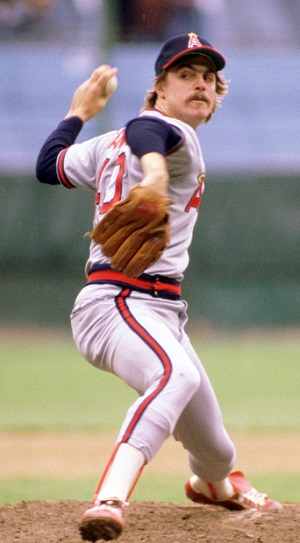
Frank Tanana—despite pre-Show injuries he was allowed to throw 1055.2 major league innings and 71 complete games from ages 20-23. Are you still surprised he was broken into a journeyman by 25?

When Hall of Famer Dennis Eckersley threw a no-hitter for the Cleveland Indians on today’s date in 1977, he beat the California Angels, 1-0. The Angels opposed him with lefthander Frank Tanana going the distance against him. And all Hall of Fame writer Tracy Ringolsby can think about is both pitchers going the distance in the same game.

Based on a pair of tweets Saturday morning, the anniversary of the Eckersley no-hitter, Ringolsby thinks Tanana’s arm and shoulder issues—the ones that turned him from a howitzer to a journeyman seemingly overnight—were caused by nothing more than an unwarranted change in his mechanics.

He couldn’t bring himself to acknowledge that the Top Tanana was badly overworked by age 24-25.

Dennis the Menace had to work his tail off for the no-no, the only run scoring on a first-inning triple and a squeeze bunt. He nailed twelve strikeouts and walked only one, while Tanana—who led the Show in strikeouts and strikeout-to-walk ratio two seasons before—struck out six and scattered five hits.

You mean a pitcher can work nine innings in the same game? Wow,” tweeted Ringolsby Saturday, recalling the game. A short time later, a p.s. tweet: “Tanana—best LH’d pitcher I have seen before arm problem created when after establishing himself as dominating a pitching coach decided he needed to change his mechanics. Body had adapted to old method and balked at new approach.

Not quite. Tanana had issues that prompted the change in the first place, elbow and shoulder issues a genuinely smart baseball person or team would have spotted and adjusted to overcome from almost the word go. Tanana was 23 years old in 1977 and worked beyond the bone before that season began.

It’s true that he enjoyed too much of the high life in those younger seasons. Also by his own eventual admission, he was as cocky as the day was long. With apologies to Jim McCarty, the drummer for the Yardbirds who said it about their guitarist Jeff Beck, it was often said that Frank Tanana was one of the American League’s hottest young guns and many were inclined to agree with him.

Then he became the journeyman nobody—including himself—predicted he’d become when he first hit the American League running at age 20. In fact, you can ask if the Angels should have been surprised, after all. Tanana didn’t exactly come injury-free in the first place.

As a high school senior, he injured his shoulder throwing sidearm to a batter, pitched with the injury the rest of his senior season, but took himself out of a championship game after four innings because the pain was too great. Then he dealt with shoulder tendinitis in his first minor league season. Was the Angels’ radar miscalibrated?

Pay close attention to what follows from that with a pitcher who already had a history of shoulder trouble. Now, tell me what turned Tanana from a Hall of Famer in the making (maybe you had to be there, but that’s just about how he and they talked about this kid) to a mere survivor living on smarts instead of a nasty fastball and deceptive curve ball for the last sixteen years of his career:

Age 20—268.2 innings pitched, 12 complete games in 35 starts; 3.12 ERA, 3.49 fielding-independent pitching (FIP); pitched better than his 14-19 won-lost record. If you can tell me what a 20-year-old with an early injury history is doing pitching that many innings at all (he averaged seven innings plus per appearance), never mind his first major league season, you’re a better manperson than I.

Age 21—With a 2.62 ERA and a 2.49 FIP (leading the American League), Tanana pitched arguably the best season of his life. He also had 16 complete games in 33 starts and 257.1 innings pitched. That makes 526 innings and 28 complete games in two seasons before he was 22.

Age 22—Tanana led the majors in walks/hits per inning pitched (WHIP) with 0.99 and led the American League with a 3.58 strikeout-to-walk rate. (His 3.68 the year before led the entire Show.) Now the bad news: He pitched 288.1 innings and threw 23 complete games in 34 starts.

That’s 51 complete games in three seasons from ages 20-22, not to mention 814.1 innings pitched, in a time frame in which a sensible organisation would be developing a pitcher that age reasonably. The star-crossed Angels had nobody substantial behind Tanana and Hall of Famer Nolan Ryan to relieve the pitching workloads, and they weren’t exactly run producing machines enough to let Ryan and Tanana pitch with less mental stress, while we’re at it.

So they worked the pair almost unconscionably. Now, repeat: Nolan Ryan’s was one-of-a-kind durability. In almost any baseball era. You cannot use Ryan’s endurance as the measurement for every professional pitcher. No two of them are built the same, and we’re not talking mental makeup. No two pitchers have the same arm, shoulder, and body capacities.

Whether Tanana or the Angels or both believed Tanana could be that kind of durable despite his early injuries, what they believed wasn’t the same as what was proved. The warning signs were there early and often. At age 20 Tanana even pitched through a bothersome elbow for a seven-loss streak, and it’s not unlikely that he dealt with elbow and shoulder discomforts consistently enough the next few years.

Now comes Tanana’s age-23 1977. The good news: he led the American League with seven shutouts and a 2.54 ERA, and his 2.97 FIP still had him at the top of the league’s pitching line. But also came the bad news: He pitched 20 complete games including fourteen straight—and in three of the fourteen he worked on only three days’ rest, and in two of which he pitched ten and eleven innings.

He also developed tendinitis in his left arm. His season ended early. So did his life as the Top Tanana.

Because look what happened in 1978. His FIP jumped over 3.00 and never came below that mark again. He feared that elbow tendinitis returning and altered his motion to block any more such stress . . . only to develop shoulder tendinitis. That got him shut down near season’s end and cost him two months in 1979.

Seventy-one complete games, 1055.2 innings from ages 20-23 (it works out to an average 264 innings a year), and several times pitching through elbow or shoulder pain. (Pitch counts weren’t kept then. But it shouldn’t surprise you if it’s proven Tanana might have thrown 120+ pitches or worse in too many of those games.) Should we really have been surprised that Tanana was practically broken in half before he was 25?

All that and more knocked the cockiness right out of him as well as the early weight of that fastball and curve ball. (The murder of his Angels teammate Lyman Bostock in 1978 also affected him deeply.) He surrendered his former wild style off the field—the style that once prompted him to say the best night of his life was “last night” and a teammate to chime in, “I saw her. And he’s right.”

Tanana swapped all that for life as a gainfully employed back-end-of-the-rotation man and a spiritual, happily married father and grandfather who swore his time and quiet success with his hometown Detroit Tigers—after bouncing from the Angels to the Boston Red Sox to the Texas Rangers—was what really turned his career around.

Eckersley survived a battle with the bottle to remake his career from eventually fading starter to lights-out closer who pioneered the single-inning save machine under his Hall of Fame manager Tony La Russa. A different physical specimen, Eckersley from ages 20-23 pitched 901 innings himself but he’d been built up gradually, from 186.2 to 199.1 to 247.1 to 268.1. He wasn’t ridden terribly hard from the beginning.

Tanana managed to survive on the mound as a useful, deceptive junkballer until he was 39. His mechanical change didn’t cause the arm and shoulder trouble, Mr. Ringolsby. The arm and shoulder trouble inspired the mechanical change. It remains to wonder what if Tanana was managed more prudently as a young howitzer. And, when the old school will finally wake up and learn.

“Stop us before we mal-spend again”

2020-05-28 MaxScherzer

Max Scherzer isn’t buying the owners’ bid to renege on a March agreement to pay players their 2020 salaries pro-rated if baseball returns this summer.

Most of major league baseball’s labour issues have come down, historically and factually, to the owners trying to order the players to stop them before they overspend, misspend, or mal-spend yet again. And, again. Despise Scott Boras to your heart’s content, but he has a point when he calls upon players to decline bailing the owners out for their financial follies.

The players seem to want nothing more but nothing less than for the owners to live up to the agreement they secured in March, that the players would play a shortened 2020 with their regularly-due 2020 salaries pro-rated accordingly. The owners want the players to forget that deal and pitch and swing for less.

“If this was just about baseball, playing games would give the owners enough money to pay the players their full prorated salaries and run the baseball organization,” says the uber agent in a memo obtained by the Associated Press. But, of course, this isn’t just about playing baseball.

“The owners’ current problem is a result of the money they borrowed when they purchased their franchises, renovated their stadiums or developed land around their ballparks,” Boras continues.

This type of financing is allowed and encouraged by MLB because it has resulted in significant franchise valuations.

Owners now want players to take additional pay cuts to help them pay these loans. They want a bailout. They are not offering players a share of the stadiums, ballpark villages or the club itself, even though salary reductions would help owners pay for these valuable franchise assets. These billionaires want the money for free. No bank would do that. Banks demand loans be repaid with interest. Players should be entitled to the same respect.

Under normal circumstances such borrowings might have made a certain level of sense and seem unnecessary at certain points, as Boras and others who wheel and deal in the game understand well enough.

I’m hard pressed to recall what occupied Joe and Jane Fan’s mind more, the deficit financings by which the Ricketts family bought the Cubs and redeveloped Wrigley Field in the first place, or the Cubs reaching the Promised Land at long enough last four years ago. Uh, oh. It’s been four years since the Cubs won the World Series. Will their next Series drought last even half of 116 years?

Whatever you think of him, Boras—and he’s hardly alone—would like to remind you appropriately that it wasn’t the players who counseled the owners to borrow big buying their teams, and the players benefit comparatively small from baseball’s recent record revenues and profits.

Beware the rat, Boras advises: the Rickettses [and other owners likewise] “will be able to claim that they never had any profits because those profits went to pay off their loans. However, the end result is that the Ricketts will own improved assets that significantly increases the value of the Cubs — value that is not shared with the players.”

Before the AP made the Boras memo public, Washington Nationals pitcher Max Scherzer tweeted, “We have previously negotiated a pay cut in the version of prorated salaries, and there’s no justification to accept a 2nd pay cut based upon the current information the union has received. I’m glad to hear other players voicing the same viewpoint and believe MLB’s economic strategy would completely change if all documentation were to become public information.”

Remember: An awful lot of public misinformation accompanied the runup to and the duration of the 1994 players’ strike. Hall of Famer Tom Glavine was there. Last week, he reminded one and all, “If it were to come down to an economic issue and that’s the reason baseball didn’t come back, you’re looking at a situation similar to the strike of ’94 and ’95 as far as fans are concerned. Even if players were 100% justified in what they were complaining about, they’re still going to look bad.”

The players association “has held firm that a March 27 agreement between the parties ensures the players their prorated share, while the league believes that language in the agreement calls for a good-faith negotiation in the event that games are played in empty stadiums,” notes ESPN’s Jeff Passan.

Good faith, indeed. The players, with good contemporary and historical reason, Passan continues, are “skeptical of the data the league shared that showed significant losses across the sport and recently submitted additional document requests to the league in search of information about local television revenue, national television revenue, sponsorship revenue and projections from teams.”

With the coronavirus pandemic still in play, too, the players and the owners have health concerns to address and secure to the best extent possible if they want to play ball this summer. You may think the players are being greed heads for insisting that the owners live up to the March agreement and cut the shenanigans, but what does it say for the owners looking to use the pandemic still in play to force the players yet again to stop them before they overspend, misspend, or mal-spend—again?

There will always be the folks who blame the players no matter what,” tweets The Athletic‘s Marc Carig. “But let there be no mistake about it. The blame will also fall to the owners, who seem to have made weakening the union a priority over getting baseball back on the field.”

Part of that, of course, is an availability issue. It’s headlines when players sign bazillion-dollar contracts, but it’s crickets when the owners are asked to provide complete, undoctored financial disclosures that would indicate how much they actually as opposed to allegedly invest in actual baseball activity.

Do yourselves a couple of favours, dear readers. (All ten of you). Don’t let yourselves fall into the trap of thinking this is all a bunch of hooey over playing a kid’s game, for crying out loud! Remember whom you pay your hard-earned money to see at the ballpark. (Hint: it isn’t the owners, or even the general managers, no matter how dubious was that lopsided trade for which your team’s GM got the short end of the stick.)

Then, ask yourselves, if it’s just a kid’s game, for crying out loud, whether you, too, could really handle going to work every day knowing there’ll be about fifty thousand people watching you do your job at the office, on the loading bay, or along the conveyors—never mind whether you, too, could really hit Scherzer, Jacob deGrom, or Jack Flaherty into the bleachers or sneak a meatball past Mike Trout, Christian Yelich, or Cody Bellinger.

Now, put the dollar amounts to one side, and ask yourselves how you’d feel if you had a deal with your employer and your employer decided you need to renegotiate it down, because said employer needs a bailout after borrowing up and out the kazoo despite having the wherewithal to carry on without debt financing.

Thought so.