Perspective on stats lost to a virus

2020-07-01 TedWilliams

Ted Williams lost a lot more statistical enhancement serving in two wars than this year’s players stand to lose in a short or cancelled coronavirus season.

So you think you and the objects of your baseball affections will lose things irretrievable by the time the Show re-opens for regular if truncated season business? You think a pandemic bringing out the best in you and your fellow citizens but the worst in your local, state, and national leadership has robbed you and your baseball loved ones?

Viruses come, viruses go, some more stubborn than others. Wars come and go, too, but guess which of the two is easier to fight. Writing shortly before his death as World War II wound to its formal finish, the bellettrist Albert Jay Nock reminded a correspondent, “You are not going to stop war until you can change man.”

So perhaps this would be a fine time to think for a moment about what some of your baseball forebears lost when the game and their play or management of it was rudely interrupted by war:

Yogi Berra—He spent three years in the Navy and earned a number of medals for his D-Day performances on a rocket boat during and immediately after the landings at Normandy. (He was afraid to put in for his Purple Heart, though, because he feared causing his already-nervous mother a purple heart attack.)

Yogi’s Navy service cost him valuable minor league development. He might have blossomed as the Hall of Fame catcher he became a couple of years sooner than he finally did.

Lou Brissie—This lefthanded pitcher would have signed with the Philadelphia Athletics in 1941 if his father hadn’t insisted he finish school first. He enlisted in the Army in 1942, after a year at Presbyterian College, and was with the 88th Infantry when an artillery shell exploded close to him. The blast shattered most of his lower left leg.

Brissie begged Army doctors to save his leg even if it might cost his life—because he had a shot in major league baseball. Two years and 23 surgeries later, Brissie with a metal brace signed with the A’s in late 1946 and earned a September 1947 call-up. He had two fine seasons as a starting pitcher, including an All-Star team, before becoming a decent reliever, over a six-season career with the A’s and the Cleveland Indians.

We’ll never know what Brissie would have been as a pitcher if he finished college and then signed with the A’s instead of going to war? Especially since he was a mere 20 when his lower leg was almost blown off in the first place.

Hank Bauer—After a tryout and contract with a Chicago White Sox minor league affiliate, Bauer enlisted in the Marines a month after Pearl Harbour. He was deployed to the Pacific and felled by malaria on Guadalcanal. After his recovery, Bauer earned eleven campaign ribbons, two Bronze Stars, and two Purple Hearts—the second on Okinawa.

That injury got Bauer shipped back to the United States. After his recovery, he was signed by a Yankee scout for one of their lowest-level minor league affiliates in his native Illinois. He eventually made a fine career as a Yankee outfielder and, in due course, a World Series-winning Baltimore Orioles manager. He might have remained a White Sox, though, if not for the war; he might also have made the Show far sooner.
2020-07-01 ChristyMathewson

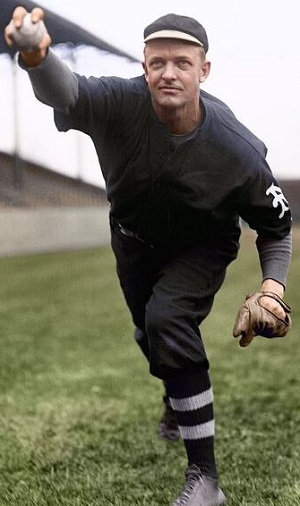
Christy Mathewson–The Big Six didn’t lose his pitching credentials, but his accidental gassing in World War I stopped his managing career and cost the Boston Braves a principal owner.

Bob Feller—The first professional American athlete to enlist for World War II, Feller was made a Navy physical fitness instructor before he volunteered for combat. He became a gun boat petty officer serving near Britain and in the Pacific Theater, earning six campaign ribbons and eight battle stars.

Feller lost his ages 23-25 seasons to the war. He resumed life as the American League’s strikeout king for a few years to follow (he set the major league season record his first full season back, the record Sandy Koufax smashed in 1965), but he might have finished his career with over 3,000 or even close to 4,000 punchouts had he not gone to war.

Christy Mathewson—The Hall of Fame pitcher looked to have a promising career as a major league manager, until duty compelled him to enlist in the Army for what proved the tail end of World War I. Oops. Mathewson was mustard-gassed accidentially during a training exercise, leaving him prone to the tuberculosis that killed him seven years later.

Among other things, the gassing and the disease it invited left Mathewson unable to remain as the principal owner and president of the Boston Braves, the team he bought with Emil Fuchs two years before his death at 45.

Warren Spahn—This Hall of Fame lefthander enlisted for World War II after a brief cup of coffee with the Braves—where then-manager Casey Stengel shipped him back to the minors after he refused to brush back the Brooklyn Dodgers’ Hall of Fame shortstop Pee Wee Reese. It was a send-down Stengel lived to regret:

I said “no guts” to a kid who went on to become a war hero and one of the greatest lefthanded pitchers you ever saw. You can’t say I don’t miss ’em when I miss ’em.

Spahn earned a battlefield commission and decorations for service in the Battle of the Bulge and at the Ludendorff Bridge. He lost his ages 22-24 seasons to the war. Some speculate it cost him a shot at 400 pitching wins, but Spahn himself was never sure about that:

I matured a lot in three years, and I think I was better equipped to handle major league hitters at 25 than I was at 22. Also, I pitched until I was 44. Maybe I wouldn’t have been able to do that otherwise.

Ted Williams—Teddy Ballgame entered the Naval Reserve in May 1942, went on active duty in 1943, and was commissioned a Marine second lieutenant as an aviator in May 1944. He awaited orders as a replacement pilot when World War II ended in August 1945. Then, come the Korean War, Williams suited up and flew for the Marines, including 37 combat missions—about half of which involved flying wing for a pilot named John H. Glenn, Jr.

Proud enough of his Marine services, the Hall of Famer lost his ages 24-26 seasons to World War II and much of his ages 33-34 seasons to the Korean War.

Babe Ruth is said to have met Williams once and hoped to his face that he’d be the one to break the Babe’s home run records. Williams might well have gotten extremely close to breaking the career mark, at least, had he been able to play during those lost seasons. (Sports Illustrated‘s Tom Verducci has speculated the wartime absences kept Williams from hitting 675 or more.)

All that is before mentioning twelve players (Tom Burr, Elmer Gedeon, Harry Glenn, Eddie Grant*, Newt Halliday, Bob Neighbors, Harry O’Neill, Ralph Sharman, Bill Stearns, Bun Troy) at various levels of major league accomplisment who were killed in war. And, without mentioning players (Joe DiMaggio, Whitey Ford, Willie Mays, others) who went into the military in wartime during their careers but didn’t see combat.

Yes, this nation’s leadership from top to bottom has handled the coronavirus world tour about as deftly as batted balls were handled by Dick (Dr. Strangeglove) Stuart. But do you really think today’s Mike Trouts or Justin Verlanders losing one season’s statistical time to a virus disruption compares to those who lost more than that kind of time to war?

—————-

* Eddie Grant, who’d retired in 1915, was the first former player to die in World War I, killed in action in the Argonne Forest. Grant was memorialised in his former home ballpark: the Giants erected a monument in his memory in the Polo Grounds’ center field, with a bronze plaque centered on the stone listing his baseball career and military service and death, with the rank of captain.

The stone sat 470 feet from home plate but was still considered in fair territory under the Polo Grounds ground rules. The stone stayed there, beneath the elevated clubhouse/offices structure, until the park closed for keeps after the Mets’ 1963 season.

The plaque on the stone went first to a New York police officer, somehow, whose duty involved foot patrols around the Polo Grounds area. When another New Jersey family bought his home there in due course, they discovered the plaque wrapped in blankets in the attic. They contacted the Baseball Reliquary, who have had possession of the plaque since 1999.
Re-name the MVP the Chandler Award

2020-06-30 HappyChandlerJackieRobinson

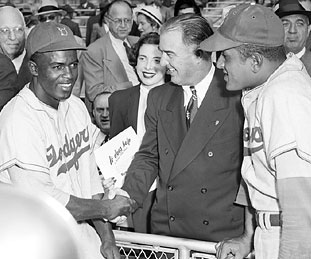
Baseball commissioner Happy Chandler with Hall of Famer Jackie Robinson (left) and pitcher Don Newcombe (right) at the 1949 World Series.

Baseball’s Most Valuable Player Awards remain named for baseball’s first commissioner. The good news: Kenesaw Mountain Landis administered justice in baseball’s first and most jarring gambling scandal. The bad news: Landis also obstructed the game’s integration until the day he died.

It begs the question as to whether one of the game’s highest single-season honours should continue bearing his name. Especially since it puts baseball at war with itself by way of the Rookie of the Year Award now bearing the name of the black man who won the first ROY  award, when it was born as a major league and not a separate-leagues award.

“If you’re looking to expose individuals in baseball’s history who promoted racism by continuing to close baseball’s doors to men of color, Kenesaw Landis would be a candidate,” says Hall of Famer Mike Schmidt, who knows something about MVP awards. (He won three.) “Looking back to baseball in the early 1900s, this was the norm. It doesn’t make it right, though. Removing his name from the MVP [plaque] would expose the injustice of that era. I’d gladly replace the engraving on my [plaques].”

Landis loved baseball, despised gambling, and sounded duplicitous at best about whether “organised baseball” should be open to others beside white men. Leo Durocher found out the hard way in 1942. Say what you will about Durocher otherwise, and there’s plenty to be said against the man, but when it came to who should be allowed to play the game no matter what the Lip could be and often was the essence of enlightenment.

In 1942, Landis blocked a fourth exhibition game between the Kansas City Monarchs of the Negro American League and a team of all-stars assembled by Hall of Famer Dizzy Dean, because the three prior games out-drew Show games at the gates. The same year, Durocher was quoted as telling a reporter he knew several talented black players he’d sign in a heartbeat if blacks were allowed to play major league baseball.

Not so fast, Landis harrumphed. He called Durocher onto the carpet. Then, he told Durocher, according to the New York Herald-Tribune, “that he could hire one Negro ball player, or 25 Negro ball players, just the same as whites. Negroes are not barred from Organized Baseball by the Commissioner and never have been in the 21 years I have served.” Sure, and Custer defeated Sitting Bull.

As Larry Moffi wrote in The Conscience of the Game: Baseball’s Commissioners from Landis to Selig, “Landis reminded anyone who might want to believe that racism was already so ingrained into American life that a formal rule prohibiting black ballplayers from competing in Organized Baseball would have been redundant.”

Landis died in office of heart failure in November 1944. Not long before that, Wendell Smith, a sportswriting legend with the black newspaper the Pittsburgh Courier, talked about integrating baseball with Landis, and Landis’s final words to Smith were, “There is nothing further to discuss.”

World War II stopped baseball from choosing a new commissioner until April 1945. After choosing sitting U.S. Senator Albert B. (Happy) Chandler of Kentucky, Chandler refused to assume his new duties until the war was over later in the year. But in due course he had plenty (to Peter Golenbock, for Bums: An Oral History of the Brooklyn Dodgers) to say about Landis’s kind of racism:

For twenty-four years Judge Landis wouldn’t let a black man play. I had his records, and I read them, and for twenty-four years Landis consistently blocked any attempts to put blacks and whites together on a big league field. He even refused to let them play exhibition games. Now, see, I had known Josh Gibson and Buck Leonard and Satchel Paige, and of course, Josh died without having his chance, and I lamented that, because he was one of the greatest players I ever saw, a great catcher and a great hitter, and I thought that was an injustice.

For twenty-four years the record will show that my predecessor said, ‘If you’re black, you can’t play.’ Why? Because that’s what the owners wanted him to do. Landis has a reputation as an independent commissioner that he doesn’t deserve.

Ponder the irony. Kenesaw Mountain Landis, Ohio born, judicial reputation established in Chicago, refused to allow “organised baseball’s” integration. Happy Chandler, a man of the South, wasting no time telling Smith and fellow Courier writer Rick Roberts, “I’m for the Four Freedoms, and if a black boy can make it at Okinawa and go to Guadalcanal, he can make it in baseball.”

One of those who saw the new commissioner’s words was a certain team president in Brooklyn. Branch Rickey—who’d waited a couple of decades for the chance he knew he wouldn’t have so long as Landis ran the show—“began making plans,” Chandler remembered, the moment he saw that Courier edition and quote.

Chandler took office formally in October 1945. According to the Society for American Baseball Research, a week before Chandler began his new job Rickey signed Hall of Famer Jackie Robinson, the Monarchs’ shortstop, to a contract with the Dodgers’ AAA farm in Montreal, hoping to break Robinson in in 1946 before calling him up to the Dodgers for 1947.

The commissioner’s powers included voiding contracts. Chandler never moved so much as a pinkie to void Robinson’s. Thus encouraged, and despite his fellow National League bosses quaking, Rickey signed two more Negro Leagues comers—pitcher Don Newcombe and Hall of Fame catcher Roy Campanella—to the Dodger system while Robinson began his 1946 season in Montreal.

The Montreal Royals won their pennant and went to Chandler’s Kentucky itself to play the Louisville Colonels in the 1946 Little World Series. Chandler warned the Colonels that racial protests against the Royals wouldn’t be tolerated. When Robinson came up to the Dodgers in 1947, and Ben Chapman led his Phillies in racial taunting brutal by anyone’s standard, Chandler threatened disciplinary action. Nobody in baseball on whatever side doubted Chandler meant it.

Chandler and Rickey met on Chandler’s turf prior to Robinson’s call-up to the Dodgers. Rickey asked point blank where Chandler stood. “All I had to do is say, ‘I’m not going to get into it. Why should I?’ and Rickey’s dead. Bury him, lay him down, because he’s whipped fifteen to one with his own fellows,” Chandler would remember.

I told Rickey, “If Landis was still commissioner, he wouldn’t let this boy play, and you wouldn’t ask him.” I said, “Mr. Rickey, I’m going to have to meet my Maker some day. If He asked me why I didn’t let this boy play, and I answered, ‘Because he’s a Negro,’ that might not be a sufficient answer. I will approve the transfer of Robinson’s contract from Montreal to Brooklyn, and we’ll make a fight with you. So you bring him on in.”

. . . I have nothing to be ashamed of. I had the respect of the respectable people in baseball, and I protected the integrity of the game, and that’s just the truth, pardner.

Chandler was ousted in a 1950 vote. We’ll never know if it was because the owners wanted payback for what enough of them might have seen as jamming integration down their throats. Or, whether Chandler’s suspension of Leo Durocher for 1947 over his continuing associations with professional gamblers—after Durocher exploded publicly over Yankee boss Larry MacPhail having similar if not quite such deep associations—rolled them the wrong way.

Or, whether Chandler’s inadvertent mishap with the game’s first major television contract got him into the owners’ electric chair. In the same year, he sold World Series broadcasting rights to Gillette for $6 million ($1 million a year over six years), but the safety razor/shaving cream company flipped the rights to NBC promptly for $16 million ($4 million over four years). Ouch.

Chandler probably also got into the owners’ bad graces by just having the temerity to act like an independent commissioner. He had continuing support from Dodgers owner Walter O’Malley (around the same time he squeezed Rickey out of the Dodgers, though at a large cost thanks to a stock buyback clause Rickey exercised), Washington Senators owner Clark Griffith (who once feared integration not because of bias but because the legendary Homestead Grays—playing home games in Griffith Stadium—were actually more profitable to him than the Old Nats), and New York Giants owner Horace Stoneham. But Chandler won only a 9-7 vote and was out.

The commissioner needed a 75 percent supermajority to stay aboard. “It’s the first time I ever won a majority but lost an election,” he said.

SABR writer Terry Bohn has said, “Rather than one specific incident, his failure to secure a second term seems to reflect how he often sided with the interests of the players instead of the owners. For this, he was often called the ‘players’ commissioner’. Chandler was a baseball fan at heart, and bemoaned how the owners treated the game that he loved as a big business.”

Chandler opening the door Landis kept tight shut didn’t exactly mean baseball’s integration would proceed en masse, or even smoothly. Not even if Bill Veeck followed Rickey in 1947 and signed outfielder Larry Doby (Newark Eagles in the Negro National League) for the Cleveland Indians whom he then owned. It took over a decade for the last major league team to do so (the Boston Red Sox) to admit a black player to the parent roster. “Organised baseball” formally is open to all races and ethnicities, but even today the organisations are slow enough on the uptake to find more players, coaches, managers, and executives from non-white races and ethnicities.

That’s not Chandler’s fault, of course. Remember those words to Smith and Roberts: If a black boy can make it at Okinawa and go to Guadalcanal, he can make it in baseball. Note that he didn’t specify “playing” baseball. You don’t have to just reach out for token signings or deny a qualified white person to find, sign, and promote well-qualified black, Latino, Oriental, and other ethnics in a baseball organisation, whether a coach, manager, farm or scouting director, or other front-office leader.

When Chandler’s term in office expired in 1951, he went from there to resume his political career, ultimately becoming again what he was once before becoming a senator and a baseball official, the state’s governor. He had presidential aspirations that came to nothing. Baseball ignored him for the most part until the Veterans Committee steered him into the Hall of Fame in 1981.

Whose name would you rather see on the Most Valuable Player Award, then? The commissioner who talked through both sides of his mouth about baseball integration and blocked it from happening for too long? Or the commissioner who talked straight, no chaser about letting it happen, defied portion enough of his native grounds, and put his and baseball’s money where his mouth was?

The Albert Benjamin Chandler Most Valuable Player Award. Bring it on in.

Skin depth vs. Globe Life Field

2020-06-25 GlobeLifeParkActuality

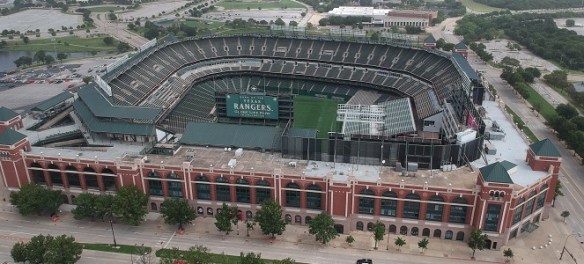
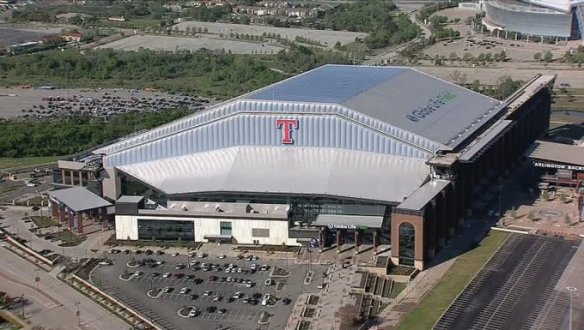
Considering its appearance, should the naming rights to the Rangers’ new home have been sold to an airline instead?

In 1964, crooning and caressing lyrics by songwriting legend Eddie Holland, the Temptations’ singularly gifted and ultimately troubled co-lead singer David Ruffin sang, “if you’re lookin’ for a lover/don’t judge a book by its cover/she may be fine on the outside/but so untrue on the inside.” Around him, his fellow Temptations chimed, “Oh, yeah.”

Neither Holland nor Ruffin and his four singing partners foresaw Globe Life Field, the new home facility of the Texas Rangers. The joint (it’s extremely difficult to call it a field, never mind a ballpark) is a monument to both architectural prankishness and taxpayer gullibility.

Inside, the place looks as agreeable as Houston’s Minute Maid Park, or Baltimore’s Oriole Park at Camden Yards. Even without the pleasurably nutty home run train behind the stands in Houston or the asthetics-enhancing old railroad building behind the Yards. Surely the retractable roof was a dire necessity considering the climate. So far, so good.

But outside, the place looks like anything from a Goodyear blimp or Boeing 747 hangar to a lidded barbeque grill . . . for Paul Bunyan. The Rangers seem to have studied Minute Maid Park—which looks like a hangar only on its sectional retractable roof, atop a rather more classic and handsome ballpark-like external building—and decided the Astros didn’t go far enough marrying baseball to aviation.

Texas summers are not renowned for gentleness. The Rangers’ previous home, known first as the Ballpark in Arlington and then Globe Life Park in Arlington, was an oasis of splendor in the middle of oppressive summer heat and humidity. Beautiful to behold but often too smothering in which to play baseball, the Rangers abandoned the park after a mere 26 years.

Put that into perspective. Connie Mack Stadium (the former Shibe Park) was 67 years old when the Philadelphia Phillies moved from there into the washing machine tub known as Veterans Memorial Stadium. Pittsburgh’s Forbes Field (known occasionally as the Old Lady of Schenley Park) was 61 when the Pirates threw her over for a similar tub known as Three Rivers Stadium—which lived a whopping thirty years. (The Vet made it to 32.)

Cleveland Municipal Stadium (known colloquially to Indians fans as the Mistake on the Lake) was 63 when the Tribe moved into Jacobs Field (since re-named Progressive Field). Crosley Field in Cincinnati was 68 when the Reds sent her into the history books in favour of a bowl named Riverfront Stadium, which lived to 32 before the Reds moved into Great American Ballpark.

The Polo Grounds as last seen (three previous structures wore the name) was 52 when the New York Mets moved out of the New York Giants’ former home and into the Flushing Meadows multipurpose stadium longtime New York building tyrant Robert Moses once hoped to jam down Brooklyn Dodgers owner Walter O’Malley’s throat.

Ebbets Field was 46 when the Dodgers moved to Los Angeles. The park was no longer expandable and Brooklyn, like much of the country, grew metastatically after World War II. It hemmed in the park Dodger fans often called God’s Little Acre. O’Malley planned to build a new Brooklyn ballpark with what would have been sports’ first retractable roof.

Moses—who’d sworn no privately-owned sports facility would ever rise again so long as he decided New York’s building future—said, “Not so fast, buster.” O’Malley built Dodger Stadium (the Dodgers still own the park) and the place has out-lived Ebbets Field by twelve years and counting.

Metropolitan Stadium in Minnesota was a measly 26 and still looking young and pretty enough when the Twins dumped her for a gasbag known as the Hubert H. Humphrey Metrodome. The city fathers of Bloomington built the Met in the first place hoping to attract a major league team, either by relocation or major league expansion. (They got the former, courtesy of the Washington Senators.) That’d teach them.

Detroit Tigers fans often called Tiger Stadium (formerly Navin Field and Briggs Stadium) “The Old Girl.” When ancient former Tigers pitcher Elden Auker joined the closing ceremonies, his home newspaper in Florida headlined it, “Auker Says Goodbye to Old Girl”—jolting his maid, who asked his bemused wife just when her husband started stepping out and for how long, amusing Auker no end.

Well, now. The Old Girl was 89 when the Tigers moved from there into Comerica Park. Comerica Park is now a ripe young 20. If the current trend is to become the rule, Comerica should have six more years before someone in Detroit decides it’s time to dump the old bat in favour of prying fresh meat out of already-drained taxpayers.

Turner Field in Atlanta got hers slightly younger: she was only nineteen when the Braves decided she was far too expensive to keep. A combination of swelling capital maintenance costs and Atlanta’s suffocating traffic congestion turned her into a overpriced date, said the Braves—whose owner, Liberty Media, paid $400 million to buy them in 2007 and is only into $181 million over thirty years to pay off the remaining county bonds for Truist Park (born SunTrust Park).

2020-06-29 TheBallparkInArlington

The Ballpark in Arlington/Globe Life Park in Arlington: Granting the harsh summer peak, you still can’t help asking, “The Rangers dumped this for that?!?”

The Rangers may have found the Ballpark in Arlington/Globe Life Park trying in the peak of summer but Ranger fans found the park wholly agreeable. Agreeable enough that enough such fans hollered “foul!” and formed Citizens for a Better Arlington to oppose the city throwing half a billion dollars toward a fresh young thing when their baseball home was a measly twelve. That’s how old the BAA/GLP was in 2016, when the ballot initiative approving the bonds passed.

At least when husbands or wives throw their incumbent but aging spouses over for younger, fresher produce, they pay the price out of their own pockets. Arlington’s mayor in 2016 was Jeff Williams, elected the year before after running as a tax cutter and modest spender and winning accordingly. Then he actually had to do the job. Oops.

As a new documentary, Throw a Billion Dollars From a Helicopter, demonstrates, Williams had barely assumed his oath of office when he began “pimping for taxpayers to cover half the cost of a new billion-dollar stadium” for the team once co-owned by former President George W. Bush, as Reason writer Nick Gillespie phrases it.

Williams expertly works the levers of local boosterism, and [the film’s director Michael] Bertin relishes showing the mayor and other stadium supporters invoking the phrase “world-class city” over and over again. The new ballpark will feature a retractable roof! It will be not just a stadium but a family “destination” with bars, restaurants, and concert venues! All of which will be “world class” and make Arlington a “world-class city”! Smaller cities—Arlington has about 400,000 residents and is part of the Dallas-Forth Worth metro area—often have inferiority complexes, and sports leagues and national chains know how to take advantage of that when looking for sweetheart subsidy deals.

Williams’s schmoozing is one of two storylines Bertin pursues. The other, Gillespie writes, is “the phoney-baloney economic analysis that gets mustered up every time a team owner and pliant politicians want to sell a stadium to wary taxpayers.”

The Stanford economist Roger Noll compares stadiums to pyramids in ancient Egypt, structures built to honor dead pharaohs but paid for by the sweat and toil of living, breathing people. Noll and others point out that entertainment spending is generally a fixed pie and that local residents substitute one option for another. Teams thus don’t create new spending; they take it from other businesses, most of whom are actually paying property and other taxes. Bertin drives home the fact that most stadium boosters talk about the “economic impact” of having a team, not the actual economic benefits. Invariably, when you factor in the costs of building and financing a stadium and all the extra giveaways to team owners (who keep most or all revenue from parking, concessions, and the like), stadium projects are municipal money pits.

That multipurpose stadium Robert Moses wanted to jam down Walter O’Malley’s throat ultimately became Shea Stadium. The Big Shea was 44 when the Mets moved next door to retro-looking Citi Field. The Mets themselves agreed to pay about two-thirds of her price, and New York City still owns the joint. That’s like dumping your wife to marry that comely young debutante and discovering her father’s calling the marital shots until death do he and your new child bride part.

The coronavirus-delayed major league baseball season isn’t going to get there gently, if at all. Not with several affirmed COVID-19 cases among some teams’ players and personnel, including several among Rangers personnel that have the team jolted to speak politely. That seems a lot larger crisis than the ugliness of and around the Rangers’ new home.

Gillespie observes that Bertin was a devout and diehard baseball fan before he took up the making of Throw a Billion Dollars from a Helicopter. Globe Life Field—whose skin-deep beauty requires deeper drilling to appreciate than David Ruffin knew was required for his newfound love—stands as the newest monument to a too-classic baseball contradiction, the ugliness of its business versus the beauty of its play.

The free cookie on second and the bunt

2020-06-26 KetelMarte

This is not what a Diamondbacks fan should want to see if run-productive Ketel Marte leads off the tenth with the free cookie on second base to start the inning.

Depending upon where you spend time on social media, you can say that no sooner did the free man on second to open extra innings this year arise than at least two lines of discourse opened. 1) It makes major league baseball resemble the Nursery League. 2) To quote one such denizen directly, “[E]very player will have to learn to bunt.”

To the second came the reply, “I hope they teach them not to bunt foul on the third strike.” So I couldn’t resist with what I’m about to write, especially since it might put a finish to such nonsense as the free cookie on second to start.

I can count on one hand the bunts I’ve absolutely loved but I’d need more than two hands to count the theoretical bunt situations that weren’t, or didn’t stay that way. And, as Keith Law once wrote (in Smart Baseball), “I have yet to meet the fan who bought a ticket to a major league game because she really wanted to see guys drop some sac bunts.”

The two greatest bunts that weren’t happened in the mid-1980s.

When Pete Rose was pressured to figure out a way to save the Tying Knock—the hit where he’d meet Ty Cobb on the all-time hit list—for the home folks, he went up to hit late in a game at Wrigley Field, one swat away, with men on first and second in the top of the ninth in a tie game, the last of the set before Rose’s Reds returned to Cincinnati.

Everyone in the game including then-commissioner Peter Ueberroth thought Rose the manager would send Rose the player up only to pinch hit in that Chicago series. Or, in a situation such as he now faced, you could hear every other Reds fan and their nebulous owner (Marge Schott) at the time screaming “BUNT!” Rarely at a loss, Rose would remember, “I had thirty thousand people yelling here and one lady back in Cincinnati, every time I got a hit, kicking her dog.”

Rose the manager had his Reds eight games out of first place and Dave Parker on deck. With his owner, so many Reds fans, and Joe and Jane Fan elsewhere demanding otherwise, Rose the manager didn’t have to remind Rose the player what 23 seasons of major league experience told him: A sacrifice means the Cubs then putting Parker aboard intentionally to load the pads and leaving the bigger hitting to smaller bats.

So Rose the manager, knowing the Reds had that much better chance to win, told Rose the player to swing. (It would have been mad fun if Rose the manager could have told Rose the player, “I’ll fine your ass ten large if you even think about a bunt.”) That was probably the single most most honourable plate appearance and swinging strikeout of the baseball life Rose ultimately dishonoured.

He still got the Big Knock, passing Cobb, when the Reds went home. He got there in the first place by playing the game right, refusing to bunt because it would have taken the bat out of his best clutch hitter’s hands anyway. If you’re going to lose (the Reds did that night), you don’t just roll over and play dead for the other guys.

A year later, New York Mets relief pitcher Jesse Orosco batted in the bottom of the eighth of Game Seven in the 1986 World Series. Darryl Strawberry opened the inning with a parabolic home run to give the Mets a badly needed insurance run, but a two-run lead against those star-crossed but still-tenacious Boston Red Sox wasn’t quite enough.

“I’ll bet the house,” crooned NBC colour commentator Joe Garagiola as Orosco checked in at the plate. “He’s got to bunt.”

With one out and Mets Ray Knight on second and Rafael Santana on first, the Red Sox played Orosco to bunt and put on the rotation or “wheel” play: corner infielders charging down the base lines, middle infielders charging to cover the corner bases. What happened next made you wonder why nobody else thought of it too often, if at all.

On 1-1 Orosco squared to bunt as Red Sox pitcher Al Nipper kicked to deliver. The wheel play was on. And Orosco pulled his bat back, swung gently, and . . . “Swinging!” hollered play-by-play virtuoso Vin Scully. “And a ground ball into center field! In comes Knight, it is 8-5 Mets, and Joe, you just lost your house!”

Rose and Orosco in different ways testified to the wisdom of refusing to hand the other guys outs on trays and gift-wrapped. (With the DH universal this year, a pitcher bunting is moot for now.) Now, a lot of those otherwise dismayed at the free cookie on second to open an extra inning can’t wait to see some leadoff bunts dropped.

Except that you might be, say, the Milwaukee Brewers going to extra innings, and you might have Christian Yelich due to lead off your half of the tenth. Or, you might be the Houston Astros, and you might have Jose Altuve or Alex Bregman due to lead off the tenth. Or, you might be the Los Angeles Angels, with all-universe Mike Trout due to lead off the tenth. Or, you might be the Arizona Diamondbacks, with Ketel Marte to open. Or, you might be the Atlanta Braves, and either Freddie Freeman or Ronald Acuna, Jr. is your scheduled leadoff man.

You’re not going to take the bat out of the hands of those guys and order one of them to take a good loving look at the free cookie on second base and bunt him to third. (Not unless you’ve got someone behind them whom you can trust to deliver the clutch hit—and even then.) If you are, you’d better not be surprised when your bosses want to hang you in effigy, chase you clear across the state line, and then get really mad.

If you’re in the top of the tenth, you want to get ahead as swiftly as possible and with one of those guys leading off you’ve got a better than 50-50 chance of getting the free cookie across the plate and putting another man on base at minimum. At maximum, of course, you’ve got an excellent chance that Yelich, Altuve, Bregman, Trout, Marte, Freeman, or Acuna is going to hit for extra bases, maybe even a two-run homer. Either way, you’ve put the burden on the other guys to tie and win.

If you’re in the bottom of the tenth, you want to win just as swiftly if not more so. Do you still want to take the bats out of the hands of a Yelich, an Altuve, a Bregman, a Trout, a Marte, a Freeman, or an Acuna, and order them to drop a measly bunt when your odds of a game-winning base hit are that much more in your favour with bats like that opening your inning?

OK, you’re foolish enough to want to bunt the cookie to third leading off. Swell. In the bottom of the tenth, you’ve given yourself one less out to work with and your best bat is out of the picture. You might get lucky from there; you might not. In the top of the tenth, maybe a sacrifice fly brings the cookie home but you’ve got only a one-run lead that’s easier to overcome—and, with only one out left to play with, the bases empty and your best bat’s still out of the picture.

Yelich, Altuve, Bregman, Trout, Marte, Freeman, and Acuna might be sitting on the bench scratching their heads if not thirsting for a stiff one over that.

What about the other guys? I’ll guarantee it. If you think about bunting to open with the free cookie on second, be prepared for the other guys’ pitcher being prepared to let you bunt. Be prepared for him making you bunt. Maybe with a big grin on his face. The other guys like gift-wrapped presents, too, you know.

Because that smart a pitcher will throw your opening hitter nothing but something he can only bunt to the third base side, enabling that pitcher to pounce on the ball and throw the cookie out. If your opening hitter doesn’t exactly have enough speed to out-race a cement mixer with a flat tire, be prepared further for Area Code 1-5-3 or, if the third baseman was coming down the line and the shortstop’s moving to cover third, an Area Code 1-6-3.

Brilliant. You just outsmarted yourself into two outs and nobody on.

You think I just brewed that idea alchemically in the dungeon? It’s right out of the book of Casey Stengel, courtesy of his Mets pitcher Al Jackson:

There were men on first and second and you knew the other team wanted to bunt them over. Casey would say, “Here’s what I would do. I would let him bunt. I would throw him a little slider, and I would break toward the third base side, and I would throw his ass out at third.” Casey had the guts to tell you what he’d do in a certain situation when it came up on the ball field.

By the way, Jackson never once allowed men on second to be sacrificed to third.

If they don’t think about letting you bunt, they may think about putting Yelich, Altuve, Bregman, Trout, Marte, Freeman, or Acuna aboard on the house to lead off and giving themselves a shot at an instant double play. Leaving you a man on third, two outs in the hole, and a lesser bat to do your run production.

Giving outs away is unsound baseball as it is. The free cookie on second base to open the extra innings is foolish enough without bringing the bunt back. Under normal circumstances, the only time you ever ought to want to bunt is if your man leads off with nobody on and a) he has speed to burn, it’s one out or less, and he can bunt for a base hit; b) he has a lame infielder (say, Miguel Cabrera) to exploit; or, c) he has a wide-open half infield to play with thanks to a defensive shift.

You give me that extra free space? I’m accepting that gift, with no intention whatsoever of seeking a refund—even when you’re a couple of outs from finishing a no-hitter but I’m only down two or three runs. In that position, I still have a chance to get runs across the plate and win. Why the hell are you giving me a free hit? (If I’m down more than three runs, maybe I don’t even think about it. And maybe you don’t, either.)

If you’re that foolish, you’re paying the penalty. Sure, I respect what your guy’s trying to accomplish, but I also respect that he didn’t pitch his kishkes off just for you to play with fire on his dollar. If my batter sees that yummy wide-open space, and he doesn’t take advantage of it and drop himself a bunt for a free base hit, he’d better have his flight out of the country booked, reserved, and boarding-passed. Because, silly me, I have a job to do too—win.

And I’ve got a future Hall of Famer on my side there. Once upon a time in his life as a Detroit Tiger, Justin Verlander took a perfect game bid into the sixth with one out and a 4-0 lead. Seattle’s Jarrod Dyson dropped a bunt and beat it out for a hit. Tiger Territory screamed blue murder—about Dyson’s bunt more than the three-run rally it launched to help send the Mariners to a 7-5 win. Verlander was more troubled by the three-run rally and eventual loss than he could ever have been about Dyson’s bunt:

It was a perfect bunt. That’s part of his game. I don’t think it was quite too late in the game given the situation to bunt, especially being how it’s a major part of what he does. So I didn’t really have any issues with it. It wasn’t like I got upset about it.

The book of unwritten rules is at least half foolish and maybe more. Just wait until you see someone deciding the unwritten rules include not even thinking about bunting with the free cookie on second base. But you don’t have to play that card to know that that, like too many bunting orders, is the fool’s errand of gifting the other guys precious outs.

The cookie on second and Harvey Haddix

2020-06-25 HarveyHaddix

Harvey Haddix on the mound 26 May 1959. Pitched this year, his perfecto bid would have been broken in the tenth, not the thirteenth . . .

Pittsburgh Pirates lefthanded pitcher Harvey Haddix became immortal for the perfect game he lost in extra innings on 26 May 1959. The Milwaukee Braves ended the perfecto and beat the Pirates in the bottom of the thirteenth, wrecking* one of the greatest single pitching performances in baseball history.

Braves infielder Felix Mantilla reached leading off on an error at third base. Hall of Famer Henry Aaron was handed an intentional walk. Braves first baseman Joe Adcock smashed what he only thought was no-hitter-ending/game-ending three-run homer; Aaron’s baserunning mistake—he thought the ball hit the wall for the game-ending hit and turned off the basepath toward the dugout after crossing second—got it ruled a single-RBI double.

Imagine if those teams could have played that game this season. Haddix’s perfecto bid could have been busted as soon as the tenth inning, thanks to that stupid new experimental rule (the minor leagues used it for the last three seasons) placing a free man on second to open each extra inning for each side.

In the actual Haddix game, both sides went scoreless in the tenth with only one base hit by the Pirates. Now, let’s imagine how that tenth inning goes if played this year and with the Pirates in the top and the Braves in the bottom getting the free cookie at second base to start their halves:

The actual top of the tenth saw the Pirates’ Hall of Fame second baseman Bill Mazeroski grounding out to second base to lead off, third baseman Don Hoak (whose actual thirteenth-inning error ruined the actual Haddix perfecto) swatting a base hit to left, pinch hitter Dick (Dr. Strangeglove) Stuart flying out to center field, and Haddix himself grounding out to second base.

This year, however, with the free cookie on second opening the frame, Mazeroski’s ground out pushes the cookie to third and Hoak’s base hit sends it home. 1-0, Pirates going to the bottom of the tenth.

The actual bottom of the tenth involved Braves pinch hitter Del Rice leading off with a fly out to deep center field and Hall of Fame third baseman Eddie Mathews flying out likewise to follow, before Aaron grounded out to Pirates shortstop Dick Schofield for the side.

Now, put the inning-opening cookie on second for the Braves. Rice’s fly would be deep enough for the cookie to advance to third, and Mathews would have a game-tying sacrifice fly. Assuming Pirates manager Danny Murtaugh lets Haddix stay in the game after the perfecto is broken and the game tied at one each, let’s move forward.

The actual top of the eleventh—Schofield opened for the Pirates with a base hit to left. Gazelle center fielder Bill Virdon forced Schofield out at second, and Pirates catcher/pinch-hitter extraordinaire Smoky Burgess hit into a double play. The cookie top of the eleventh—Assuming the free man on second swift afoot, Schofield’s leadoff single scores him, making it 2-1, Pirates.

And, oh yes. The runs are unearned because, if the inning-opening cookie scores under the new experiment, he’s considered to have reached on an error . . . but the error won’t be charged to the opposing team.

The actual bottom of the eleventh—Adcock grounded out to shortstop, Braves left fielder Wes Covington lined out to centerfield, and catcher Del Crandall flied out to center. The cookie bottom of the eleventh—The cookie on second wouldn’t go anywhere on Adcock’s grounder, unless he has a suicide complex. The liner to center would likely keep him there if he’s smart enough to know trying for third means death, too. And Crandall’s fly out would strand him.

The Pirates would win the game, 2-1, if played today. Harvey Haddix would be remembered for taking a perfect game into the mere tenth but pitching a no-hitter and winning. Anybody (sort of) can win a measly no-no in extra innings. (Ask Jim Maloney, the Cincinnati Reds pitcher who did it to the Cubs in a ten-inning, ten-walk, 1-0 no-no in Wrigley Field in 1965.)

It would also deprive Braves pitcher Lew Burdette—who went the distance and finally got the win—of the classic crack he actually gave his bosses during his actual next contract negotiation: That guy pitched the greatest game in baseball history and he still couldn’t beat me—so I must be the greatest pitcher who ever lived! That logic wouldn’t fly over a measly ten-inning perfecto break. (P.S. Burdette got his laugh—and his raise.)

“All I know is we lost,” Haddix said after the game. “What is so historic about that?”

In the event that another such perfect game bid goes to the tenth inning this year, you can only wonder what the pitcher making the attempt might think if his game ends the way it looks as though the Haddix game would end if played this year, under the free-man-on-second extra-inning rule.

And, whether you can publish more than half his answer without bleeps.

————————-

* The Haddix game also killed Hall of Famer Harmon Killebrew’s shot at a Life cover story.

According to Storied Stadiums author Curt Smith, the magazine trailed Killebrew awhile until that day, hoping to capture the genial Washington Senator’s breathtaking power. Killebrew actually slumped during Life‘s pursuit, but then he finally hit one out on 26 May ’59.

The problem: Life got the word about what Haddix was trying to achieve, and the magazine ordered its Killebrew hounds to Milwaukee post-haste.