Mediocrity might get World Series representation

Yes, let’s root-root-root for the 29-31 Brewers to meet the 29-31 Astros in the World Series. Stop snarling, there is a method to such madness.

Almost half a century ago, U.S. Senator Roman Hruska of Nebraska offered a defense for Richard Nixon’s dubious Supreme Court nominee G. Harrold Carswell. It proved that with friends like Hruska the hapless Carswell didn’t need enemies. Just the way baseball proves that with friends or commissioners like Rob Manfred, it doesn’t need enemies, either.

“Even if [Carswell] were mediocre,” said Hruska, “there are a lot of mediocre judges and people and lawyers. They are entitled to a little representation, aren’t they? We can’t have all Brandeises and Frankfurters and Cardozos.”

Hruska, meet Manfred and today’s major league baseball owners. For the first time since 1981’s strike-resolution postseason experiment, at least one team with a losing record enters the rounds that will end in someone winning the World Series. This time, though, it turns out to be two such teams.

Ladies and gentlemen, your 29-31, final wild card-holding Houston Astros and Milwaukee Brewers. Whose joint appearance in the World Series to come (baseball law: anything can happen—and usually does) might be less hazardous to the nation’s health than a questionable Supreme Court justice.

Manfred and the owners dreamed up this sixteen-team/twelve wild-card postseason as a way to take the financial sting out of the owners agreeing to any sort of baseball season during a pandemic that’s stung the economy overall. So far as most of us knew, it would be a one-time thing.

Well, so was the postseason resolution of the 1981 strike. It put first-and-second-half division winners against each other in division series. But it also put the overall 50-53 Kansas City Royals (second-half American League West winners) into the postseason and kept the 66-42 Cincinnati Reds (neither-half National League West winners) and the best overall season record out.

Who knew then that, a decade and a half later, the owners and the players union alike would go all-in on three-division leagues and a wild card that took the first bite of championship dilution, allowing teams who didn’t finish in first place to play into the postseason in the first place?

Manfred’s predecessor, Bud Selig, then pushed for and got the second wild card in each league starting in 2012. Until this season, only two World Series featured combatants who got into the postseason by way of the wild card, in 2002 (the Anaheim Angels beat the San Francisco Giants) and 2014. (The Giants beat the Royals.) There’s an excellent chance of it happening again next month.

Almost two weeks ago, Manfred let slip that he’d like to see this sixteen-team postseason format stick past the anomaly of the pandemic-shortened season. That happened five days after Sports Illustrated writer Stephanie Apstein said she hoped as many losing teams as possible got here this time only.

The reasonings between the two couldn’t be more opposed. Manfred told a Hofstra University virtual panel that “there was a lot to commend” this setup “and it is one of those changes I hope will become a permanent part of our landscape,” adding that “an overwhelming majority” of the owners agree.

Apstein called the setup a disgrace: “This setup dissuades teams from trying to be good. The clearer that is this year, the more likely it is that we can go back to normal next year.” She dares to dream, as does her SI colleague, Emma Baccalieri, who said, “In a non-pandemic-restricted year, ‘tolerable weirdness’ shouldn’t be the bar.”

In absolute fairness, assorted teams this year didn’t look good for assorted reasons running the spread from aborted spring training and near rush-designed “summer camps” with a three-month-plus interruption to assorted injuries, health-related opt-outs, a few COVID-19 test panics and postponements, and the usual assortment of foul balls.

But assorted teams looked good in spite of those, too. More than a few teams made baseball fun and feel-good again. Atlanta’s Freddie Freeman went from scared to death that COVID might wipe him out to likely winning the National League’s Most Valuable Player award. The Reds, the Chicago White Sox, and the Slam Diego Padres made friends and fans all over.

Well, at least the White Sox did until they went from letting the kids play (Tim Anderson especially) to Fun Police, drilling Willson Contreras for the bat flip of the century last Friday night. Must be something in the franchise water. The White Sox may have an apparent institutional genius for going from fun-fun-fun to phooey-on-you in practically a blink.

So why on earth should we pray for a World Series featuring a pair of losing season records?  There’s still the outside chance that the very sight of two losing records playing for the Promised Land might yank even Commissioner Nero’s head out from being so far up his ass he can give you the live play-by-play of his own root canal procedure. Might.

With identical losing records, and assuming they both get past the earlier rounds on the theory that even the also-rans can and do go nuclear for short spells, the Astros and the Brewers could make real that once-infamous observation that mediocrity deserved “a little” representation, too.

The Supreme Court can’t have all Brandeises, Frankfurters, and Cardozos? Well, baseball can’t be all the A’s, the Braves, the Chicago Cubs, the Los Angeles Dodgers, the Minnesota Twins, and the Tampa Bay Rays, to name this pandemic season’s division winners, either.

They can’t even be all the White Sox, the Padres, the Cleveland Indians, or whoever—under normal two-card circumstances—might win a playoff game between the Reds and (surprise!) the Miami Marlins. (They’d have done it tying for the second National League wild card if this had been a normal season.)

Under normal conditions the rest of the pack, never mind the bottom of it, wouldn’t be entitled to play for a little representation before baseball’s highest court. Except in their wait-till-next-year dreams.

This year’s Astros and Brewers sank from winning 2019 teams (the Astros winning the AL West, the Brewers going to the NL wild card game) to 2020 also-rans. They were compromised predominantly by the injured list, particularly as it riddled their pitching staffs and a few key position players. If mediocrity deserves representation, their pandemic season’s records mean these two playing in the World Series would be as representative as it gets.

What if it leaves Manfred still giving the live play-by-play of his own root canal work? What if it doesn’t awaken him, and those owners he says are all-in, to the abject degeneracy of a baseball postseason that invited the mediocre to play on the same field (to open, anyway) as the teams who did overcome any and all pandemic or other disruptions to rise and shine?

What if Commissioner Nero and those supporters lack the brains to ask themselves, “What’s wrong with this picture? Why did the Dodgers, the Rays, the Twins, the A’s, the Braves, and the Cubs fight tooth, fang, claw, and coronavirus to finish on top, just to have to run through most of the rest of the lesser pack all over again to play in the World Series?” And, “Why did we remove the real incentives for teams to compete just so we could still make money and lots of it?”

It’s tempting to pray that the Astros and the Brewers do find ways to meet in the Series. (Tough openings: the Astros face the Twins in this wild card round; the Brewers have to survive the Dodgers. David had better odds pitching to Goliath.) Just for the outrage factor alone. An outrage factor that would be multiplied exponentially considering the scandal-ridden Astros in Year One following the exposure and non-disciplines of Astrogate.

It might make the Brewers—who haven’t been in the World Series since Epcot opened, Marvin Gaye released the final album of his lifetime, Cats started an eighteen-year run on Broadway, and then-Communist Poland barred the Solidarity labour union—objects of affection far beyond the Milwaukee that made Schlitz famous.

The Astros may have only eight men left (Justin Verlander, pitcher, is gone to undergo and recuperate from late-life Tommy John surgery) from the Astrogate teams of 2017 and part of 2018. But that hasn’t stopped the brickbats, catcalls, and stadium seat cutout punkings from reminding them it’s not nice to commit espionage above and beyond the temptations handed down by MLB itself in the replay rooms.

Maybe an Astros-Brewers World Series would leave Manfred and his minions to answer why they thought mediocrity deserved a little postseason representation, too. Big maybe. And maybe I’ll win the Nobel Prize.

But maybe it should also make you pray that the Indians find a way through this mess to play in and win the Series at long enough last. If 2020 were a normal season, the Indians—whose tenacious righthander Shane Bieber looks like the absolute lock for the American League’s Cy Young Award this pandemic season—might have played a 163rd game against the White Sox to see who got wild card numbers one and two. (The Yankees, the Buffalonto Blue Jays, and the Astros would have been out.)

Well, as Casey Stengel once said, now wait a minute fer crissakes. Suppose this pandemic postseason shakes out to the Indians playing the Padres in the Series. The Indians haven’t won the Series since the Berlin Airlift. The last time they got to try, they lost a Game Seven thriller to the Cubs—who hadn’t won a Series since the Roosevelt Administration. (Theodore’s.)

The Padres have yet to hoist their first piece of World Series metal. The last time they got to try, Jose Samarago became Portugal’s first Nobel literature laureate, Richard Pryor won the first Mark Twain Prize for humour, Bill Clinton faced impeachment, and the Yankees weren’t anywhere near as inclined to roll over and play dead for the Padres as the Senate was for Clinton.

These words appear after Yom Kippur, the Jewish Day of Atonement. It almost figures that the first entry into baseball’s book of life for the year to come could make the Mad Hatter’s tea party resemble a Social Register cotillion. This time, if the proverbial cream rises to the top, a Dodgers-Rays World Series would likely do nothing but compel Manfred to proclaim validation. Told ya!

So let’s root, root, root for an Astros-Brewers World Series, no matter how you feel about the Astros otherwise. Not because mediocrity deserves a little representation, but because it might re-awaken the owners. Maybe enough to stop Commissioner Nero from consecrating the poisonous precept that a franchise doesn’t even have to try to be particularly good to earn the right to play for the Promised Land.

#BatFlippersMatter (and other fun thoughts)

Jimmy Cordero–ejected promptly for hitting Willson Contreras over a four-inning-old bat flip Friday night, suspended Saturday for three games.

Jimmy Cordero drilling Willson Contreras over the season’s (and maybe the century’s) most artistic home run-hitting bat flip Friday night got himself a three-game suspension Saturday. At this writing, he plans to appeal. It’s not that Cordero knows me from Adam (Dunn or otherwise), but I’d like to make a suggestion to him for future reference.

Bat flippers matter. And they’re not the only ones who should be given such license when we talk about Letting the Kids Play. But almost never do we see anyone suggesting that if it’s ok for a home run hitter to send his bat into orbit it ought to be ok for a pitcher to celebrate a big strikeout.

I’ve said it before—they’d done it before. Hall of Famer Dennis Eckersley used to make like he was fanning a pistol in his hand after (as he might have said in his old Dial-Eck jive talk) showing them the high cheese before punching them out with the yakker.

Pistol-fanning in the real Old West was something usually frowned upon—except in Hollywood. Wyatt Earp himself once said, “the gun fanner and the hip shooter stood small chance to live against a man who . . . took his time and pulled the trigger once.” In the Old West, it might get you killed. On the mound, it might get you laughs.

If you’re the hitter who doesn’t like it, just wait for your next time up and for the yakker that hangs. Then, have a yakker after you show him the high cheese . . . sailing into the bleachers, or the next county, whichever comes first. Yak for the Morticia is yak for the Gomez, you know.

If you’re a pitcher but you don’t want to be seen as a gun nut, you could always try wielding an imaginary bullwhip. Or a butterfly net. Or your best Al Bundy called bowling strike—roll your ball, pirouette, pump your fist, jerk your knee bend, and holler “steeee-rike!” before you know the ball’s half way to hitting the pins in the first place.

How about the pantomime fading basketball jump shot? Like the one Jim Carrey delivered in court in Liar, Liar. You could even run clubhouse surveys on who does it better—or funnier: a 6’8″ galoot like Dellin Betances, or a 5’7″ peanut like Marcus Stroman. And challenge each other to put that galoot or that peanut to shame.

One thing missed about this year’s Washington Nationals—2,000 year old man Fernando Rodney bending, aiming, and shooting arrows at the sky after nailing a good inning or, especially, a relief save, the latter being a lifelong habit. Now and then, of course, Rodney received tastes of his own medicine, which he didn’t really seem to mind.

Case in point: a 2014 game against the Los Angeles Angels, while he pitched for the Seattle Mariners. Rodney finished a scoreless eighth by shooting his invisible arrow right into the Angels dugout. That’d teach him.

In the ninth, he surrendered a walk to Mike Trout and a prompt RBI double to Albert Pujols. Pujols and Trout shot invisible arrows back and forth between second base and the dugout. The Angels’ Grant Green shot a game-winning RBI arrow through Rodney’s heart and into center field for the 6-5 win. All in good fun, we presume.

But why should the hitters and the pitchers have all the fun? If Willson Contreras can flip a bat spinning up equal to the Guaranteed Rate Field roof line, or Dennis Eckersley can shoot bullets after he’s thrown a few for a strikeout, why can’t the middle infielders have a little mad fun?

Kolten Wong (second base) and Paul DeJong (shortstop) turn double plays smoother than short-order cooks turn pancakes or pizza makers flip and spin the dough, right? (Now that I mention it, Contreras’s Friday night flip did kind of spin as high as some pizza makers spin the dough, at least when they’re spinning it in the front window and they’ve got an audience.)

Often as not, it’s Wong grabbing a hopper close enough to the middle of the infield and flinging inside-out to DeJong to turn and whip one to first base. Especially to retire the side. Why shouldn’t Wong and DeJong face each other, crouch, and juggle imaginary . . . well, anything—bats, balls, knives, garden shovels, meat cleavers, take your pick?

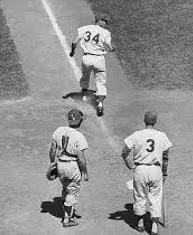
Jim Piersall (34) had his 100th home run trot backwards. (Looking haplessly: Phillies catcher Clay Dalrymple, Mets first baseman Tim Harkness.)

Come to think of it, with a name pair like theirs they could take that act on the road and bring down the house. Unless, of course, they bring down the wrath of a Fun Police pitcher and get to dance erroneously to a little chin music, maestro.

Even in the ancient days, the ones the Fun Police say meant respect, there were those who knew how to have fun. Even the almighty imperial New York Yankees. They had the perfect answer for Bill Veeck’s exploding scoreboard in Comiskey Park. As it happened, they also had the perfect manager for it—Casey Stengel.

Led by the Ol’ Perfesser himself, the Yankees answered one of their own hitting one out by sending up that scoreboard—prancing around the front of the dugout holding Fourth of July sparklers aloft for the Comiskey crowd to see.

And wouldn’t you just love to see a batter hit a milestone home run and celebrate it by trotting around the bases backward? Jim Piersall thought of that, in 1963, when he hit the 100th home run of his major league career, as a Met. Only he learned the hard way that even Stengel’s vaunted sense of humour had its limits.

Piersall led off against Philadelphia Phillies pitcher Dallas Green (future major league manager) in the bottom of the fifth, with the Mets holding a 1-0 lead, and drilled Green’s first service into the Polo Grounds’ right field seats. He took two steps out of the box, did an about face, and backpedaled his way around the bases.

The Phillies were probably too stunned to think of anything other than a few snickers. Piersall’s home run shuffle has yet to be topped even by today’s flippers, fanners, and jugglers. It was Piersall’s first home run as a Met. It was also Piersall’s last home run as a Met.

Stengel—the man who once flipped the bird out from under his hat during a game—was so amused by Piersall’s backpedaling he made sure the veteran outfielder was cut two days later, only to be signed by the tender mercies of the then-toddling Los Angeles Angels.

But I got $6,000 severance pay for one month,” Piersall remembered much later, “which made it my best payday in baseball, although I’d hit only .194 for the Mets. He did me a favor.” Who had the last laugh now?

Put a meal and a stewardess on that flip

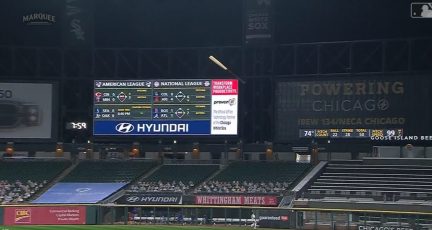
You’re not seeing things. That’s Willson Contreras’s bat in flight after the Cubs’ DH sent a three-run homer about that high en route the right field bleachers Friday night.

If you’re taking tallies to determine the bat flip of the year, Chicago Cubs designated hitter Willson Contreras should be among your top finalists. His Friday night flip in the ballpark formerly known as Comiskey Park, in the top of the third, was an absolute work of art. Enough to make Tim Anderson, Jose Bautista, Bryce Harper, and Tom Lawless resemble nursery school finger painters.

If you’re taking concurrent tallies to determine the most brain-damaged delayed over-reaction to Dali-esque flips, Chicago White Sox pitcher Jimmy Cordero should hold a place among the finalists likewise. He threw a pair of high inside pitches to Contreras and the second caught Contreras flush enough in the back, just off the C that begins the spelling of Contreras’s surname on his uniform back.

Flipped his bat high in the air? Contreras’s flip off the three-run homer he smashed on White Sox starter Dylan Cease (and Desist)’s dollar was the only flip yet where you were tempted to say what you used to holler watching a titanic home run fly out: “Put a meal and a stewardess on that one!”

If you’re going to be Fun Police enough to want retribution for a bat flip that looked as though it took off from O’Hare International and not Contreras’s hands, the time to go for it was Contreras’s next plate appearance in the top of the fifth. Cease walked Contreras on ball one up and a little in, ball two up and away, ball three inside middle, and ball four down and away.

There was no way Cease wanted to feed Contreras anything resembling the fastball that arrived just off the middle of the plate and flew the other way into the right field bleachers two innings earlier.

There was also no way Cease was trying to throw one through Contreras’s assorted anatomy, even if you could make a case that ball one up and in might have been a subtle nastygram reminding Contreras it’s not nice to channel your inner Michelangelo when you’ve already hit a ball through the equivalent of the Sistine Chapel ceiling. Might.

Maybe Cease got it when Contreras defended himself after the game. “I’m not going to change anything,” he told reporters. “I play hard for my team. I always want to do the best for my team. But if they don’t like me, that’s fine. I don’t play for other teams to like me, anyways. And if I have to do it again, I will do it again.”

But there was every way the White Sox—clinchers of a postseason berth at least, hopefuls toward snatching the American League Central title, even in this pandemic-truncated season of surreal—were feeling just a little over-punished on the night.

You tend to feel that way when Yu Darvish and company are shutting you out, Darvish not quite so nail driving as he’s been most of this season—during which he’s redeemed himself to the tenth power and into the Cy Young Award conversation—but effective enough to keep you to three hits and one walk and only two runners getting as far as second base under his command.

You feel even more that way, after Contreras’s bomb flip put the Cubs up 4-0 and Javier Baez’s leadoff launch over the left center field wall made it 5-0 in the top of the fourth, after Victor Caratini wrestled your relief option Gio Gonzalez to a seventh-pitch sinker that didn’t have enough weight to pull it quite to the bottom, and Caratini sunk it into the same bleachers Contreras reached three innings earlier. Not to mention Kyle Schwarber’s second-inning blast, making for the Cubs a four-bomb evening.

“The dog ate his homework,” pleaded White Sox skipper Rick Renteria. “Detention!” replied the umps.

When Contreras got drilled, the Cubs got riled. They hollered mightily from their dugout, enough to get the umpires into a confab that resulted in Cordero, White Sox manager Rick Renteria, and pitching coach Don Cooper the rest of the night off for bad behaviour.

Renteria tried the dog-ate-my-homework excuse after the game. A second-grade child had a better chance of making it stick. “The ball got away from him,” he insisted of Cordero’s cone job. “We couldn’t convince [the umpire] of that . . . There was no warning. They just gathered and ejected him.” As if a second straight up-and-in pitch was inadmissible evidence.

Cordero tried the same excuse. “It was just a bad pitch, a bad pitch to him,” he said after the game. “The ball sunk a lot, and that happened.” Sorry. Attempted sinkers that rise enough to get a man in the back don’t sunk a lot. Detention for you.

Understand that Cubs manager David Ross is just old school enough that it wasn’t programmed into his own playing software to deliver as Contreras did after hitting a hefty home run. But the man whose first major league home run came off an ex-Cubs first baseman named Mark Grace in Arizona late in a blowout, and whose last major league home run put the Cubs up by three in an eventual World Series-winning Game Seven, wouldn’t throw his man under the proverbial bus for his exuberance.

“It wasn’t to disrespect the other group,” Ross told reporters after the Cubs finished what they started, a 10-0 shut-and-blowout. “It was because we’ve been struggling offensively and he brought some swagger. He brought some edge. I loved every second of it. I don’t think he deserved to get hit at all.”

Why, Grandpa Rossy even had the pleasant audacity of comparing Contreras’s orbital flip to the one Anderson delivered a year ago April. When Anderson ripped Kansas City pitcher Brad Keller’s canteloupe over the fence and made of his bat a helicopter rotor while he was at it, got drilled in the rump roast by Keller his next time up, and objected vociferously. Drawing his teammates out of the dugout, getting both Keller and Anderson ejected by Country Joe West—who may or may not have remembered Anderson zapping him over an unwarranted ejection the previous season.

“All the hype is on the guy on the other side when he bat-flipped, right?” said Ross. “I thought Tim Anderson’s bat flip last year where he flipped it and looked in his dugout, that’s what you want. That’s what Willson did.”

Making the White Sox resemble hypocritical flip-floppers is also what Willson did. Their Andersons can flip until the flock flies home, but the opposing flock better not even think about it. The Fun Police are now reduced to the dog eating their homework. The dog looks better than the White Sox.

Down and out—but still looking up

Juan Soto and the Nationals hope to kick up their heels from 2020 deflation to 2021 redemption and beyond. Is it false hope?

Don’t look now, but baseball is about to wrap its twentieth season without a repeat World Series champion. What’s sadder about it is that last year’s world champions were so damn much fun but spent this year proving that no good deed goes unpunished.

Lots of teams get battered during any season, never mind truncated ones, but the Washington Nationals passed that practically before this one settled in through its early shakes, rattles, and COVID-19 rolls.

Until Daniel Hudson struck Michael Brantley out swinging on a full count, Washington hadn’t had a major league World Series champion since the Coolidge Administration or any kind of world champion since the final Negro Leagues World Series—during the Berlin Airlift.

Now the Nats have gone from baseball’s best between 23 May 2019 and the last men standing in the World Series toward the second-worst winning percentage ever for a defending Series winner. That was last year: They opened 19-31 and closed with the keys to the Promised Land. This was this year: They opened 19-31 and head for a closing with the keys to the tunnels beneath the sewers under the basement.

The worst, in case you wondered, were the 1998 Florida Marlins. (.333.) The team the Nats are about to push to one side in second place? The 2014 Boston Red Sox. (.438.) This is a very dubious elite club for which to aim at the top of the dubious the heap. NBC Sports Washington’s Chase Hughes reminds us that only 14.9 percent out of all 114 World Series winners had losing records. If you remove this year’s Nats from the picture, the dishonour roll looks thus:

1998 Marlins—.333.
2014 Red Sox—.438.
1991 Cincinnati Reds—.457.
1918 Chicago White Sox—.460.
1932 St. Louis Cardinals—.468.
Tie: 1986 Kansas City Royals; 2013 San Francisco Giants—.469.
1967 Baltimore Orioles—.472.
2003 Anaheim Angels—.475.
1994 Toronto Blue Jays—.478.
2007 St. Louis Cardinals—.481.

The Nats woke up this morning at .411. The good news, if you want to call it that: They get to finish this Alfred Hitchcock Presents Quiet, Please: The Inner Sanctum of the Outer Limits of the Twilight Zone of a season with four games against the New York Mess. (Er, Mets.) Who were supposed to be in the thick of this season’s races with or without the pandemic but had one thing in common with their comic 1962 ancestors: they never had a winning streak bigger than two games.

Assume for argument and humour’s sake that the Mets iron up and sweep the Nats to put paid to a season the Nats and the Mets would each love nothing more than to forget. Such a sweep would leave the Nats with a .383 winning percentage. Not quite enough to knock the Marlins off the highest of those low perches, but only the second defending World Champion to have a sub-.400 winning percentage trying to defend the title.

It’s not that the Nats lack for any remaining pride. Taking three out of four this week from even this year’s Philadelphia Phillies and especially their arsonic bullpen, including a doubleheader sweep Tuesday, shows they’ve got plenty enough of that left.

Maybe they don’t let themselves stay demoralised by the 12-3 smothering the Phillies dropped on them Wednesday night. Including and especially by old friend Bryce Harper—who’s been silly enough to play through back issues this year, and didn’t the Nats used to reach for the whiskey bottles over Harper trying to play through injuries when he wore their silks, too?— hitting a pair out on a night the Phillies sent five into the barren seats.

It’s what they didn’t have that picked these Nats up by the back of their necks and threw them downstairs this year. Last season, and especially last October, Sean Doolittle, Adam Eaton, Howie Kendrick, Tanner Rainey, and especially Stephen Strasburg owned numerous postseason conversations. This season they’ve owned too-choice seats on the injured list.

Last year, they had Anthony Rendon. Last winter, they decided (maybe foolishly, maybe not) that they couldn’t afford to keep both Rendon and Strasburg, and let Rendon walk into the Los Angeles Angels’ free agency arms—where, as of this morning, he leads the American League in on-base percentage.

The Nats thought signing Starlin Castro would ease that pain. Castro and his right wrist hit the IL in mid-August after he broke it on a diving play at second base. The Nats also didn’t expect that only three players would play up to even minimum expectations while the rest of the roster got injured, played at barely replacement-level, or just plain collapsed.

The three are Juan Soto, Trea Turner, and Luis Garcia. The third of that group is a rookie. The first is the young man who shook off what he still believes a false-positive COVID test to sport a 1.190 OPS as of Thursday morning and a real batting average (RBA: total bases + walks + intentional walks + sacrifice flies + hit by pitches, divided by total plate appearances) of .830.

It’s even more of a shame that this truncated season’s Nats deflated so profoundly. A performance like Soto’s over a full season might have “Most Valuable Player” stamped on the papers without that deflation.

Perspective: Atlanta’s Freddie Freeman, the presumptive MVP this season, has an RBA 101 points lower than Soto’s. (.729.) The Yankees’ D.J. LeMahieu, who leads the American League “batting race” as Soto does the National League’s, has a .635 RBA. Tim Anderson, second in the AL “batting race”: .596 RBA. Turner, who’s third in the NL “batting race”: .624 RBA.

The Nats also didn’t anticipate Max Scherzer and Patrick Corbin being only human this year, pandemic or no pandemic, disrupted spring training and bizarro summer camp or no disrupted spring training and bizarro summer camp. Hands up to everyone who expected the pair would combine for a 4.20 ERA and 3.59 fielding-independent pitching. Neither did they. Neither did I.

Nobody thought their up-and-comers would shrink when handed their opportunities to come forth and be counted in. Nobody thought so many veterans would look more ancient than merely veteran. And nobody thought the Lerner ownership would wait as long as they did to hand general manager Mike Rizzo his very hard-earned due of a contract extension.

But they still don’t have manager Dave Martinez’s situation resolved. Rizzo’s promised to sign Martinez to a long-term deal to keep him on the Nats’ bridge.The Lerners should at least think about atoning for keeping Rizzo in too-long-limbo and ordering Rizzo to get Martinez’s deal done the sooner the better.

Reality check: The Nats’ morale probably wasn’t helped by Rizzo’s long-enough lame duck status before he finally got his extension, and it probably isn’t helped by Martinez’s lack of new or at least extended deal. It’s no fun when two men you respect and admire and forgive their occasional hiccups and mishaps have to lead you through a season phantasmagoric going in with question marks instead of security on their heads.

They know Rizzo worked his tail off a very long time to make them winners and finally world champions, and they withstood Rizzo’s occasional stumbles on behalf of the bigger picture. They know Martinez didn’t let that 19-31 opening last year put premature paid to that season and bought into his “It’s a beautiful day, let’s win one” philosophy without waiting for it to go on sale.

They know this year’s an aberration. They hope.

“What I do like is our potential for 2021,” Martinez told reporters Wednesday. “I’ll say it again: Our starting pitching, the horses are coming back. The back end of our bullpen is shaped up and those guys will be fresh and ready to go. We have some really young talent; we’ve got some other young talent that hopefully we’ll see in spring training.”

All they have to do is a very mild re-tooling. (Six Nats either face free agency or option rejection, they’re not really keys to the future, and letting them go or just keeping one leaves room to sign, oh, a solid fourth starter, a decent bat, maybe even a bullpen fortifier.) Also, avoid the injury list and pray that 2021 will be a normal spring training and season.

Not to mention reminding themselves that World Series winners since 1995 also tend to get back to the postseason two years after slipping the rings onto their fingers. Those 2019 memories are eternal. But the Nats don’t have to think they’ll end up becoming outliers, either.

First some look for the curse

Eenie, meanie, chili beanie, the spirits are about to speak! (Photo: New York Yankees.)

Just when you think you’ve seen every last exercise in abject stupidity a sports fan can indulge, you get disabused swiftly and sickeningly. Case in point: the Twitter user (I won’t dignify him by mentioning him by handle) who offered up, quote, “if you could curse any MLB player for all of October who would you choose.” The lack of question mark is his.

He even had the temerity to use a once-famous portrait of Casey Stengel, freshly hired to manage the New York Yankees for 1949, gazing agape at a baseball backlit for the viewer, as if gazing into a job-appropriate crystal ball seeking his and the Yankees’ future. The concept of putting a hex on the Yankees’ opponents wasn’t exactly the idea.

At the very least, the Twitter twit in question must have a thing for provoking observers to think about flogging dead horses. I thought I’d written my last words for a very long time about baseball curses and goats, actual or alleged, and how truly un-funny the sports goat business really is. So much for that idea.

When the Dodgers gave Vin Scully a tribute night in his final season at the microphones, Hall of Famer Sandy Koufax addressed the Dodger Stadium throng. Koufax remembered Scully slipping into church the day before a World Series and praying—not “for a win, but there would be only heroes in the World Series, no goats. He didn’t want anybody in the future to be tarnished with the fact that they lost the World Series for their team.”

Whomever Scully affected over his long and impeccable broadcasting career, Twitter Twit couldn’t possibly have been among them. A man or woman who invites you to curse the MLB player of your choice for all October isn’t someone who’d pray that the postseason would have heroes and not goats.

Later the same day as that dubious invitation, the Los Angeles Dodgers clinched the National League West. They slapped the American League West champion Oakland Athletics 7-2 Tuesday after entering the game with a magic number of two. Their freeway rivals the Los Angeles Angels, who’ve clinched yet another losing season in Mike Trout’s all-universe prime, lent them a helping hand by beating the San Diego Padres, 4-2.

Thanks largely to home runs from Max Muncy, Chris Taylor, A.J. Pollock, and Corey Seager, that’s eight straight Dodger division titles. They’d like very much not to make it an eighth straight postseason of heartbreak. Heartbreak that includes back-to-back World Series losses to a couple of teams exposed in due course as illegal, off-field-based, sign-stealing cheaters.

Even their storied Brooklyn ancestors never had it that bad. Did they?

Will the Dodgers’ rotten postseason fortune continue? Will the worst among fans continue reveling in it when not abusing them for it? (Los Angeles Daily News photo.)

Things were smaller and somewhat simpler then, but the Boys of Summer’s final decade in Brooklyn shows six pennants and one World Series triumph. Before they were those bold, colour line-breaking teams, the Dodgers spent two decades plus between World Series appearances (1920, 1941) either in or around the old National League lower division.

Those were teams that inspired sports cartoon legend Willard Mullin to represent them as circus legend Emmett Kelly’s Weary Willie hobo, after a cabbie taking Mullin to Ebbets Field asked how those bums were doing this time. The Dodgers haven’t been called the Bums since moving to Los Angeles. But no World Series rings since the Reagan Administration leaves them stuck somewhere between the Bums of 1920-1941 and the Boys of Summer who seemed to assemble great teams unable to stop the Yankee wrecking balls.

And you’d be hard pressed to find another franchise winning eight straight division titles with nothing to show for them except two pennants. Even the Atlanta Braves winning eleven straight NL Easts won three pennants and a World Series during that 1995-2005 streak. The Yankees won nine straight American League Easts from 1997-2006 and have five pennants and three World Series rings to show for it.

The Dodgers have done what some people would have thought impossible once upon a time. They’ve become baseball’s most snakebitten 21st Century team.

Sure, it’s easy to look at the ones who don’t get to win even the occasional division title. Sure, it’s easy to look back at the legendary poor boys of the 20th Century. Sure, it’s easy to lament for every St. Louis Brown and Washington Senator ever, or for every Cub from 1945 forward, every Red Sox from 1946 forward, every Phillie from 1950 forward.

Futile, Greek-tragic, or star-crossed, none of them bear the Dodgers’ surrealistic iniquity. They even have a Hall of Fame-bound pitcher who’s been the best of his generation and who wrestles inside his own formidable baseball mind with the paradox of the pitcher who once owned the earth in the regular season but shone one moment only to be murdered the next in the postseason.

Sure enough, Clayton Kershaw was one of the suggestions proffered when Twitter Twit extended his nasty invitation. As if Kershaw doesn’t have enough to overcome entering this postseason.

Including his arguable darkest postseason hour last year, when his manager Dave Roberts—not content to give him a pat on the fanny for a well-done job striking Adam Eaton out to escape a seventh-inning division series Game Five jam—sent him out for the eighth instead of his admitted choice Kenta Maeda.

When, instead, Kershaw watched Anthony Rendon send one pitch just over the left field fence and Juan Soto send his very next pitch halfway up the right field bleachers. When Roberts then reached for Maeda—and watched as sickeningly as every Dodger fan in creation when Maeda struck out the side. Too much, too little, too late.

After that division series loss, indignant Dodger fans made a show of running over Kershaw jerseys in the parking lots. On Tuesday, at Twitter Twit’s invitation, there really were those now praying for the continuing postseason takedown of a man who’s been that rarity, an off-the-charts pitcher otherwise who also happens to be a decent, nice man hard pressed to deal with off-field catcalls and snark without entertaining thoughts of manslaughter.

Point out Kershaw’s 2.15 ERA and 2.94 fielding-independent pitching this truncated season—second on the club only to Tony Gonsolin’s 1.77/2.44—and the snarkers break out the October voodoo dolls. Kershaw may be tempted to forget his unostentatious Christian faith and go to the mound with a rabbit’s foot or a good-luck troll in his pocket.

Twitter Twit and his ilk probably don’t have much awareness that baseball’s presumed goats haven’t always been allowed to put the boos and catcalls behind them when leaving the ballpark, either. In some ways, Kershaw jerseys being run over by angry Dodger fans may be one of the more polite such exercises.

How would they like to have been Bill Buckner, playing catch with the young son not yet born when he had his rendezvous with ill destiny in Game Six of the 1986 World Series? When one of the boy’s throws bounced past and, thinking only that he was being polite, said, “That’s okay, Dad, I know you have trouble with grounders.”

That’s how Buckner learned the nastiest among long-suffering Red Sox fans extended their foul play to children. He packed his family up, high-tailed it out of New England, and made for Idaho, where he went into the real estate business. His eventual reconciliation to Red Sox Nation didn’t necessarily mean he’d forget while he forgave. Not until he was stricken with the Lewy Body dementia that took his life last year.

Another ill-fated Red Sox from the same Series, relief pitcher Calvin Schiraldi, struggled enough with his punishing self-criticism and his Games Six and Seven burdens without having to run into a father and son one day in the future, the son cursing Schiraldi to his face over that Series loss, and Schiraldi horrified that the father did nothing to discipline his son for it.

A year before that Series, Don Denkinger got his after he called Kansas City’s Jorge Orta safe at first when everyone saw clearly that Orta was out by two full steps or so on the play. The St. Louis Cardinals imploded from there, of course. But the outrage over that blown call included a mental case of a radio disc jockey revealing Denkinger’s address and phone number on the air and Denkinger dealing with vandalism and death threats enough to warrant FBI protection for a spell.

Mitch (Wild Thing) Williams blew a 1993 World Series save and spent a sleepless night with his rifle in his arms over death threats (not to mention assorted carpentry nails left under the tires of his and his wife’s cars in their home driveway)—and that was before he entered Game Six and served the pitch Toronto’s Joe Carter clobbered for game, set, and World Series.

Before Buckner and Schiraldi’s ill fates, California Angels relief pitcher Donnie Moore, already a deeply troubled soul as it was, surrendered a home run to Boston’s Dave Henderson when the Angels were a strike away from going to that World Series. The sensitive righthander finally cracked under continuing abuse from fans while his career from there dissipated under injury and his marriage cracked up. In 1989 he shot his estranged wife before shooting himself. His wife survived. He didn’t.

Hall of Famer Ernie Lombardi was handed the goat horns for the 1939 World Series after the Yankees’ Charlie Keller blasted him at the plate with the score tied in the bottom of the tenth. What they called Lombardi’s Snooze was Keller built like the tank Lombardi was but nailing his groin on the play, unwittingly knocking the hapless catcher out while Hall of Famer Joe DiMaggio scored behind Keller.

They also forgot Lombardi couldn’t have cost the Reds that Series—the Yankees were en route a sweep and it was Game Four. Lombardi was a gentle giant with a self-deprecating sense of humour about himself. He was also a lifelong depressive who eventually tried but failed to commit suicide in 1953.

You still think the curse/goat business is all that funny? It might have made for a small library worth of amusing and even semi-classic writing, but I’ve been to funnier muggings. (Including my own, in Washington, in December 1990.) It’s also made for unrealistic views of long-term futility. Curse of the Black Sox? Curse of the Bambino? Curse of the Billy Goat? Curse of Rocky Colavito? How about the curses of myopic or boneheaded management and administration?

Sometimes even the heroes learn the hard way that with certain brain-damaged fans achievement is a crime. Hall of Famer Babe Ruth’s two successful home run record pursuers learned the hard way. Roger Maris (single-season) and Hall of Famer Henry Aaron (career) dealt with death threats from miscreants who didn’t want either an “interloper” (Maris, as enough Yankee and other fans saw him) or a black man (Aaron) knocking the Sacred Babe to one side.

Let’s ask Twitter Twit what I often asked Joe and Jane Fan in general. Do you really think you could have done better? Do you really think you could go to your job every day with 55,000 plus at your office or your warehouse or your store or your farm surrounding you—and maybe 550 million watching you live on television?

Do you think you could make a fateful mistake or get beaten at the wrong time in front of crowds like that and just pick yourselves up, dust yourselves off, and start all over again? Would you like to go to work knowing that some other tweeter asked whom his followers would like to put a curse on at your place of business?

Don’t try telling me or anyone else you’re just going for a laugh. It isn’t all that funny to the poor soul who comes up short in the biggest of the big moment and knows his name will become synonymous with disaster for the rest of his mortal life.

We need a lot less Twitter Twit. And a lot more Vin Scully. Maybe there can’t be strictly heroes in any postseason, but maybe even today’s too-polarised Americans might think for once about putting their worst to one side and telling the Twitter Twits among us to wise up or clam up.

This bizarro postseason array to come means especially that the division champions still have to navigate—with no days off, yet—the lessers who might heat up suddenly and give them a war, if not a conquest. Once upon a time the dead-last New York Mets got thatclose to knocking the Cardinals out of a pennant on the final weekend. There’s still an outside shot of a team entering this postseason with a losing record . . . and the potential to knock a division winner out if not go all the way to the Promised Land. Funsie.

The Dodgers especially have excessive baggage to carry in without having to steel themselves for that. They’d love to make a postseason winner at last out of themselves and their Hall of Famer to be, but they know too well that one of baseball’s most irrevocable laws is, “Anything can happen—and usually does.”

So maybe the most polarised and least genial among us might yet summon up our better angel, congratulate the eventual winner, and offer the eventual defeated nothing more than, “Hey, you did your best, you came up short, it doesn’t mean we want you to have the next seat in the electric chair.”

Sure. And maybe I’ll be elected to succeed Rob Manfred.