They were a little hard on the Bieber last night

Aaron Judge runs out the bomb he detonated off Shane Bieber on the fourth pitch of the game Tuesday night.

New York Yankees manager Aaron Boone is fond of saying his team can turn on a dime. He’d much rather they keep turning on the Cleveland Indians the way they did to open their American League wild card set. As a matter of fact, Boone’s wards were a little hard on the Bieber Tuesday night.

The Yankees and the Indians opened in Cleveland the same night the first debate between Donald Trump and Joe Biden went down. Depending upon where you peeked, the country had a hard time determining which wildfire was worse—the allegedly presidential debate, or the Yankees’ 12-3 demolition. The jury may be out until Election Day.

The Yankees could be seen as having had less time to prepare for Indians starter Shane Bieber than Trump and Biden had to face each other. They hadn’t faced the presumptive American League Cy Young Award winner all irregular season long, anywhere. They also went in having lost six of their last seven irregular season games and compiled an 11-18 road record.

Bieber had twelve season starts and faced four postseason teams—three of whom had winning records—seven times. Nobody took him long in any of his starts. Only once all year did he surrender a single run in the first or fifth innings. Nobody scored on his dollar at home all year.

Then the Yankees caught hold of him Tuesday night.

They needed only four straight fastballs to rip two runs out of him in the top of the first. American League batting champion D.J. LeMahieu saw a third straight fastball and lined a single to right field. Aaron Judge started his first plate appearance to follow seeing a fourth straight Bieber fastball. He finished it with that fastball, too, sending it over the right center field wall.

“We had a big, long hitter’s meeting,” Judge said after the game, “about all sticking to the same plan and just trying to work counts, get pitches to drive and I think, as a whole, we did that. That’s when this team is dangerous, when we go out there and we can just grind out at-bats. Any mistakes that are thrown up there, we hammer them.”

Bieber’s fastball sat so easily up or under in the zone to open that LeMahieu wouldn’t exactly call a three-pitch plate appearance a hard grind when pitch three sat right in the middle. Then the slender righthander who hadn’t surrendered a home run at home all irregular season long made the same mistake to Judge over the middle of the plate.

“The first inning didn’t go as planned,” said Bieber, showing a gift for understatement lacking too vividly in the presidential debate hall. “I wish I would have been with my off-speed stuff in the zone, and challenged those guys a little more. I forced myself into some bad situations and some bad counts on top of not having my best stuff and making mistakes. No excuses. It was not good.”

Neither was the rest of Bieber’s outing on a night Gerrit Cole struck out thirteen Indians in seven innings while walking nobody, had only one truly shaky inning (the third) and escaped with only an RBI double by Indians third baseman Jose Ramirez, then surrendered his only other run an inning after that, when left fielder Josh Naylor hit one over the right center field wall.

Cole otherwise looked even better than the guy who didn’t let five walks stop him from beating the Yankees in Game Four of last year’s American League Championship Series. The guy the Houston Astros let walk into free agency and right into the Yankees’ $324 million arms last winter.

In case you were wondering, only one pitcher before Cole ever struck out thirteen without walking a man in a postseason assignment—the late Hall of Famer Tom Seaver, in Game One of the 1973 National League Championship Series, and that was a game Seaver lost to the Cincinnati Reds, 2-1.

When he blew away the Indians’ middle infield, Francisco Lindor and Cesar Hernandez, on swinging strikeouts, before convincing Ramirez his only recourse was to pop one out to Torres behind shortstop, Cole let the Indians know early enough and often enough that they weren’t going to have a simple evening’s baseball to play.

Only nobody paid as much attention to Cole’s work or his marriage with postseason history as they might have paid if the Yankees hadn’t turned Bieber and a couple of Indians relievers into their personal batting practise pitchers.

They slapped Bieber for a single run in the third, two each in the fourth and the fifth. In order, it was AL home run champion Luke Voit doubling Aaron Hicks home with two out in the third, Brett Gardner doubling home Gleyber Torres and LeMahieu catching the Indian infield asleep with an infield RBI single pushing Gardner home in the fourth, and Torres with Gio Urshela aboard hitting one out in the fifth.

That was the 105th pitch of Bieber’s evening, corroborating Judge’s observation of the Yankee game plan at last. By that point, Bieber was probably itching to tell the Yankees what Biden told Trump during one of the president’s more insistent of his nightlong harangues, “Will you shut up, man?”

Interim manager Sandy Alomar, filling in for ailing Terry Francona, was kind enough to lift Bieber after that 105th pitch of the outing traveled from Torres’s bat to the bleachers. He didn’t tell the Yankees to shut up, man, on a night nobody could. But Alomar—whose guidance of the Indians into the postseason in the first place may actually get him Manager of the Year votes despite his interim status—did speak kindly of his still-young pitcher.

“Seems to be he was too excited,” Alomar said after the demolition ended at last. “He was the best pitcher in the American League this year. He had a bad game tonight.” That was like saying the Japanese navy had a bad set at Midway.

Even injury-hobbled Giancarlo Stanton joined in the fun. After striking out twice in four previous plate appearances on the night, the Yankee designated hitter squared off against reliever Cam Hill with one out in the top of the of the ninth and tore a 1-0 fastball—also arriving in the meatiest part of the zone—over the left center field fence.

The Yankee assault and battery almost wiped Chicago White Sox pitcher Lucas Giolito out of the day’s memory bank, thirty-four days after Giolito pitched a no-hitter the too-easy way against the Pittsburgh Pirates. He went into the top of the seventh threatening to become the only pitcher other than Hall of Famer Roy Halladay to pitch a regular-season no-hitter (that was Halladay’s perfect game) and a postseason no-no the same year.

Former Cardinal/Angel Tommy La Stella said not so fast leading off the bottom of the seventh in the Oakland Athletics’ ramshackle ballpark. With the White Sox up 3-0 already, La Stella took what he could get on a 2-2 service and snuck a base hit right through the middle.

Even playing without their best all-around player, Matt Chapman, the A’s made things a little too easy for Giolito and the White Sox. It only began when they were foolish enough to send lefthander Jesus Luzardo, young, gifted, but inconsistent, against a lineup so full of righthanded bats it’s a wonder the Oakland Coliseum didn’t list when they batted.

“Nothing against him,” said White Sox shortstop Tim Anderson when learning they’d face Luzardo, “but we have been doing good against lefties. I guess they haven’t done their homework so hopefully we can go out and continue to do what we’ve been doing against lefties.”

They did. They got six of their nine Game One hits off Luzardo and chased him in the fourth inning. In the third, they had Anderson on second with two out, Jose Abreu at the plate with a 2-0 count, first base open, and previous called strikeout victim James McCann on deck, and A’s manager Bob Melvin elected to let Luzardo keep pitching to Abreu.

Abreu elected to hit the next pitch, a fastball Luzardo intended to sail toward the outer edge of the plate but disobeyed orders and arrived smack dab in the middle. The ball disappeared smack dab over the left field fence. “Obviously,” Luzardo said post-game, “the guy’s an MVP-caliber type hitter, so you’ve got to be careful. I made a mistake. That’s not where I intended to put it.”

An inning before that, Luzardo intended to throw Adam Engel an 0-2 fastball up and in, and the ball disobeyed orders then, too. That disobedient ball went up, out, and into the bleachers.

It’s been that way for the Billy Beane-era A’s every time they reach the postseason. His A’s have been a second-guesser’s delight. This time, the second-guessers get to guess why Melvin insisted on starting Luzardo instead of rested righthander Mike Fiers against the starboard-hitting White Sox. Saying as the manager did that the White Sox hadn’t seen a lefty with Luzardo’s kind of stuff all year won’t fly half as far as Engel’s and Abreu’s home runs did.

This year’s bizarro-world postseason is barely a game old and the A’s and the Indians face elimination games Wednesday. So do the American League Central-winning Minnesota Twins after the 29-31 Houston Astros beat them 4-1 in Target Field Tuesday. So do the Buffalonto Blue Jays (third) after the AL East-winning Tampa Bay Rays edged them 3-1 in Tropicana Field.

The only solace for the A’s, the Twins, and the Jays is that none of them suffered anything close to the assault with deadly weapons the Indians suffered. Those three aren’t presumed to be half as cursed as the Indians—the last time the Indians won the World Series was during the Berlin Airlift.

With the same pairs playing Wednesday, plus the National League’s wild card sets beginning the same day, it’s to wonder only what further strange brews are liable to boil and which boils get lanced. At least there won’t be a presidential schoolyard argument to detract from the main events.

Monty Johnstone’s flying circus

Jay Johnstone (left) with fellow prankster Don (Stan the Man Unusual) Stanhouse (center) and frequent victim Tommy Lasorda, in spring training.

I first saw the news around social media, though with no apparent formal verification. Even Wikipedia updated his page showing the date. Then, it updated swiftly by removing it. Did Jay Johnstone really pass away at 74 last Saturday?

The way things progressed as Monday went onward, I thought to myself, then said aloud to acquaintances, that if the rumour of Johnstone’s death was slightly exaggerated it could have been 93-year-old Tommy Lasorda’s revenge for myriad pranks the fun-loving utility outfielder pulled at Lasorda’s and others’ expense.

The bad news is that Johnstone’s family affirmed the sad news later Monday. The concurrent news turned out to have been Dodger Stadium’s power failing at around the time of Johnstone’s death. You couldn’t resist wondering if Johnstone hadn’t delivered one more practical joke en route the Elysian Fields. And you knew it would have figured if he had.

“He may have had a hand in it,” said his former Dodger teammate Rick Monday, now one of the Dodger broadcast team. “Or a victory lap of remembrance.”

Baseball’s allegedly dying breeds include its merry pranksters, and few owned it as unapologetically as Johnstone, who called his memoirs Temporary Insanity, Over the Edge, and Some of My Best Friends are Crazy. He played for eight major league teams, was a member of two World Series winners (the 1978 Yankees, the 1981 Dodgers), and any timely hits or plays he delivered played second fiddle to his unapologetic sense of humour.

Johnstone may have been the last of baseball’s permanent kids, though rumours today include that Yankee outfielder/nuclear bomber Aaron Judge is a pretty good practical joker. I hope it’s true. Baseball needs its comedians now more than ever. Let the kids play? How about let the kids prank?

Johnstone never stopped looking the part, either, right down to the big smile that suggested six parts pure joy and half a dozen parts look out below because that hotfoot was about to explode up your heel to your calf. Nobody deserves to endure dementia and, as things turned out, COVID-19. But Johnstone, especially not.

Boyish looking enough that his first baseball card suggested the California Angels might have been cradle-robbing when they brought him up to the Show in 1966, Johnstone then was 20 and looked thirteen. When he retired after a final go-round with the Dodgers in 1985, he was 39—and still looked thirteen.

There may have been those who’d swear under oath that, when his Australian-born mother went into labour with him, the medical staff anesthetised her with a cocktail of St. Vitus Dance and laughing gas. Johnstone earned his place in baseball’s Hall of Insane.

His plaque would be as likely to feature a whoopee cushion as a glove. (He was actually a fine defensive outfielder.) It would hang gloriously along with such diamond jokers as Arlie Latham, Casey Stengel, Lefty Gomez, Mickey Mantle, Jimmy Piersall, Bo Belinsky, Moe Drabowsky, Doug Rader (as a player; as a manager, he apparently got religion and became a Fun Police lieutenant), Pete Richert and Eddie Watt (Richert and Watt liked to prank opposing bullpens by slipping live goldfish into their water coolers while hosting wienie roasts in their own), and Roger McDowell (once voted the Met most likely to be committed).

“Sadly, there are fewer creative thinkers these days in baseball,” lamented Baseball Digest writer Dave Joseph in 2003. “There are fewer flakes, if you will, who break up the monotony of an endless season played, for the most part, by robotic athletes afraid to express opinion or originality.”

We’re not talking about malcontents, clubhouse lawyers, or smugger-than-thou Fun Policemen here. We’re talking about the guys who’d light candles atop the dugout to force the issue of calling a game for darkness in prehistoric times. (Latham with the St. Louis Browns—the ones who eventually became the Cardinals, not the eventual sad sacks of the American League—thought of that one in 1887.)

Or, guys who could mimic opposing managers so well they’d call the opposition bullpen to order relievers warming up—rattling and unraveling the incumbent pitcher who’d been working on an easy shutout. (Drabowsky, Orioles relief pitcher, pranking the Kansas City Athletics with his dead-on impression of their manager Alvin Dark. The ultimate victim: A’s starter Jim Nash.)

Or, guys who’d have lawyer friends draw up realistic-looking paternity suits against teammates (Seattle Pilots catcher Merritt Ranew once scared his pitching roommate Fred Talbot out of ten years’ life with a gag like that) or run the bases in reverse after hitting a milestone home run. (Piersall thought of that as a very brief 1963 Met.)

The guys who’d tweak their manager’s penchant for celebrity hanging by swapping out all the photos of the skipper with his glitterati pals and gals for photos of themselves all around the office. Johnstone enlisted Dodger pitchers Jerry Reuss and Don (Stan the Man Unusual) Stanhouse to treat Lasorda to that one often enough.

Johnstone also thought nothing of seizing an occasional Lasorda off day by donning Lasorda’s uniform, stuffing it appropriately, and walking out to the mound to talk to a pitcher—extending a can of Slim-Fast diet drink, which Lasorda endorsed at the time. Or, convincing Reuss to join him dressing as groundskeepers and joining the crew to drag the infield.

Lasorda was so amused he fined the pair on the spot. Then, he inserted Johnstone into the game as a pinch hitter—and Johnstone hit one into the bleachers. “Jay came back,” Monday remembered, “and wanted to know if he could get a discount on the fine.”

“What makes Jay Johnstone unusual,” said his manager during a tour with the Phillies, Danny Ozark, “is that he thinks he’s normal and everyone else is nuts.”

Teammates weren’t immune to Johnstone’s deviltry. When not cutting the crotch out of pitcher Rick Sutcliffe’s underwear, or leaving a particularly soft and gooey chocolate brownie in first baseman Steve Garvey’s glove (and nonchalantly brushing a spot of chocolate on Reuss’s pant leg to trick Garvey into blaming the wrong culprit), he shortened the locker of third baseman Ron Cey—to penguin size, in honour of Cey’s nickname, complete with placing a tiny stool in front of it.

He even took it to the broadcast booth, where he once worked as a Yankees and Phillies radio commentator. On one occasion, he interviewed Yankees Deion Sanders and Mel Hall. He presented them with a covered bread basket to help relax them. When they removed the cover, they were greeted by a living snake and relieved promptly of their skins.

Johnstone knew where to draw the line between player and prankster, though. When his Angels teammate Clyde Wright threw a no-hitter against Oakland in 1970, Johnstone saved it for him with a spectacular at-the-wall running catch to rob Reggie Jackson of a likely extra-base hit.

And, in Game Four of the 1981 World Series, Johnstone squared off as a pinch hitter against Yankee reliever Ron Davis in the sixth in Dodger Stadium, with Mike Scioscia aboard, hitting a 1-2 service the other way into the right field bleachers to close a Dodger deficit to a single run. Bill Russell’s RBI single later in the inning tied the game, and the Dodgers went on to win, 8-7, tying the Series at two each.

“When the game was on the line,” Monday said, “he was able to transform that little 7-year-old child that was always in a playful mood into serious. “Jay was always bigger than life. If the team was in a spot where you felt your backs were against the wall, he was one of the reliable guys.”

Johnstone stopped writing books when his collaborator, the Chicago Tribune‘s Rick Talley, suffered the brain aneurysm that ended his writing career and, too soon from there, his life in 1995. “Johnstone had felt Talley . . . was the only writer who could truly capture his voice,” wrote the Pasadena Weekly in 2011. “He recalls telling Talley he never wanted to have his stories embellished because they were already wildly entertaining, and he never wanted to deal with ballplayers angry at what he wrote.”

He also had a side serious enough to visit American military personnel around the world, raise money for children in need, and help form Hope4Heroes, a non-profit that aids military veterans. (The son of a World War II Army combat veteran who met his mother while in the South Pacific, Johnstone himself was a Marine reservist during his early baseball career.)

“He spoke at Little League banquets, gave impromptu batting tips to kids, made other appearances when no one else was available and was there when a friend needed a helping hand,” Reuss told the Los Angeles Times. “That’s also Jay Johnstone.”

Johnstone’s lunacy didn’t stay at the ballpark or in the broadcast booth. His daughter, Mary Jayne Sarah, has said her father thought nothing of filling their pool with rubberised creepy creatures and getting laughs from her and her friends. “He wanted to find the humor in life no matter how serious things got,” she told a reporter. “That was his motto to everything, bring a smile to people’s faces. Everyone loved him.”

Especially his wife, former actress Mary Jayne Saunders. Her television credits included comedies such as The Danny Thomas Show, The Donna Reed Show, and Petticoat Junction. She ended her career when she married Johnstone in 1967. She settled happily for playing straight woman to baseball’s version of Monty Python’s Flying Circus.

Life as such a wife must have been many things with dull not being one of them. We can only imagine her bereavement until they meet again in the Elysian Fields, though if he greets her there with anything short of a gag accompanying a kiss, surely the lady will feel something very amiss. May her husband rest in peace with all the Lord’s angels in pieces from laughter until that happy reunion.

Mediocrity might get World Series representation

Yes, let’s root-root-root for the 29-31 Brewers to meet the 29-31 Astros in the World Series. Stop snarling, there is a method to such madness.

Almost half a century ago, U.S. Senator Roman Hruska of Nebraska offered a defense for Richard Nixon’s dubious Supreme Court nominee G. Harrold Carswell. It proved that with friends like Hruska the hapless Carswell didn’t need enemies. Just the way baseball proves that with friends or commissioners like Rob Manfred, it doesn’t need enemies, either.

“Even if [Carswell] were mediocre,” said Hruska, “there are a lot of mediocre judges and people and lawyers. They are entitled to a little representation, aren’t they? We can’t have all Brandeises and Frankfurters and Cardozos.”

Hruska, meet Manfred and today’s major league baseball owners. For the first time since 1981’s strike-resolution postseason experiment, at least one team with a losing record enters the rounds that will end in someone winning the World Series. This time, though, it turns out to be two such teams.

Ladies and gentlemen, your 29-31, final wild card-holding Houston Astros and Milwaukee Brewers. Whose joint appearance in the World Series to come (baseball law: anything can happen—and usually does) might be less hazardous to the nation’s health than a questionable Supreme Court justice.

Manfred and the owners dreamed up this sixteen-team/twelve wild-card postseason as a way to take the financial sting out of the owners agreeing to any sort of baseball season during a pandemic that’s stung the economy overall. So far as most of us knew, it would be a one-time thing.

Well, so was the postseason resolution of the 1981 strike. It put first-and-second-half division winners against each other in division series. But it also put the overall 50-53 Kansas City Royals (second-half American League West winners) into the postseason and kept the 66-42 Cincinnati Reds (neither-half National League West winners) and the best overall season record out.

Who knew then that, a decade and a half later, the owners and the players union alike would go all-in on three-division leagues and a wild card that took the first bite of championship dilution, allowing teams who didn’t finish in first place to play into the postseason in the first place?

Manfred’s predecessor, Bud Selig, then pushed for and got the second wild card in each league starting in 2012. Until this season, only two World Series featured combatants who got into the postseason by way of the wild card, in 2002 (the Anaheim Angels beat the San Francisco Giants) and 2014. (The Giants beat the Royals.) There’s an excellent chance of it happening again next month.

Almost two weeks ago, Manfred let slip that he’d like to see this sixteen-team postseason format stick past the anomaly of the pandemic-shortened season. That happened five days after Sports Illustrated writer Stephanie Apstein said she hoped as many losing teams as possible got here this time only.

The reasonings between the two couldn’t be more opposed. Manfred told a Hofstra University virtual panel that “there was a lot to commend” this setup “and it is one of those changes I hope will become a permanent part of our landscape,” adding that “an overwhelming majority” of the owners agree.

Apstein called the setup a disgrace: “This setup dissuades teams from trying to be good. The clearer that is this year, the more likely it is that we can go back to normal next year.” She dares to dream, as does her SI colleague, Emma Baccalieri, who said, “In a non-pandemic-restricted year, ‘tolerable weirdness’ shouldn’t be the bar.”

In absolute fairness, assorted teams this year didn’t look good for assorted reasons running the spread from aborted spring training and near rush-designed “summer camps” with a three-month-plus interruption to assorted injuries, health-related opt-outs, a few COVID-19 test panics and postponements, and the usual assortment of foul balls.

But assorted teams looked good in spite of those, too. More than a few teams made baseball fun and feel-good again. Atlanta’s Freddie Freeman went from scared to death that COVID might wipe him out to likely winning the National League’s Most Valuable Player award. The Reds, the Chicago White Sox, and the Slam Diego Padres made friends and fans all over.

Well, at least the White Sox did until they went from letting the kids play (Tim Anderson especially) to Fun Police, drilling Willson Contreras for the bat flip of the century last Friday night. Must be something in the franchise water. The White Sox may have an apparent institutional genius for going from fun-fun-fun to phooey-on-you in practically a blink.

So why on earth should we pray for a World Series featuring a pair of losing season records?  There’s still the outside chance that the very sight of two losing records playing for the Promised Land might yank even Commissioner Nero’s head out from being so far up his ass he can give you the live play-by-play of his own root canal procedure. Might.

With identical losing records, and assuming they both get past the earlier rounds on the theory that even the also-rans can and do go nuclear for short spells, the Astros and the Brewers could make real that once-infamous observation that mediocrity deserved “a little” representation, too.

The Supreme Court can’t have all Brandeises, Frankfurters, and Cardozos? Well, baseball can’t be all the A’s, the Braves, the Chicago Cubs, the Los Angeles Dodgers, the Minnesota Twins, and the Tampa Bay Rays, to name this pandemic season’s division winners, either.

They can’t even be all the White Sox, the Padres, the Cleveland Indians, or whoever—under normal two-card circumstances—might win a playoff game between the Reds and (surprise!) the Miami Marlins. (They’d have done it tying for the second National League wild card if this had been a normal season.)

Under normal conditions the rest of the pack, never mind the bottom of it, wouldn’t be entitled to play for a little representation before baseball’s highest court. Except in their wait-till-next-year dreams.

This year’s Astros and Brewers sank from winning 2019 teams (the Astros winning the AL West, the Brewers going to the NL wild card game) to 2020 also-rans. They were compromised predominantly by the injured list, particularly as it riddled their pitching staffs and a few key position players. If mediocrity deserves representation, their pandemic season’s records mean these two playing in the World Series would be as representative as it gets.

What if it leaves Manfred still giving the live play-by-play of his own root canal work? What if it doesn’t awaken him, and those owners he says are all-in, to the abject degeneracy of a baseball postseason that invited the mediocre to play on the same field (to open, anyway) as the teams who did overcome any and all pandemic or other disruptions to rise and shine?

What if Commissioner Nero and those supporters lack the brains to ask themselves, “What’s wrong with this picture? Why did the Dodgers, the Rays, the Twins, the A’s, the Braves, and the Cubs fight tooth, fang, claw, and coronavirus to finish on top, just to have to run through most of the rest of the lesser pack all over again to play in the World Series?” And, “Why did we remove the real incentives for teams to compete just so we could still make money and lots of it?”

It’s tempting to pray that the Astros and the Brewers do find ways to meet in the Series. (Tough openings: the Astros face the Twins in this wild card round; the Brewers have to survive the Dodgers. David had better odds pitching to Goliath.) Just for the outrage factor alone. An outrage factor that would be multiplied exponentially considering the scandal-ridden Astros in Year One following the exposure and non-disciplines of Astrogate.

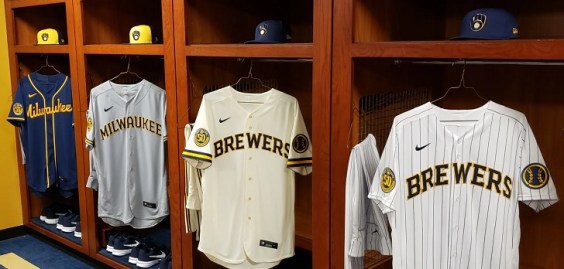
It might make the Brewers—who haven’t been in the World Series since Epcot opened, Marvin Gaye released the final album of his lifetime, Cats started an eighteen-year run on Broadway, and then-Communist Poland barred the Solidarity labour union—objects of affection far beyond the Milwaukee that made Schlitz famous.

The Astros may have only eight men left (Justin Verlander, pitcher, is gone to undergo and recuperate from late-life Tommy John surgery) from the Astrogate teams of 2017 and part of 2018. But that hasn’t stopped the brickbats, catcalls, and stadium seat cutout punkings from reminding them it’s not nice to commit espionage above and beyond the temptations handed down by MLB itself in the replay rooms.

Maybe an Astros-Brewers World Series would leave Manfred and his minions to answer why they thought mediocrity deserved a little postseason representation, too. Big maybe. And maybe I’ll win the Nobel Prize.

But maybe it should also make you pray that the Indians find a way through this mess to play in and win the Series at long enough last. If 2020 were a normal season, the Indians—whose tenacious righthander Shane Bieber looks like the absolute lock for the American League’s Cy Young Award this pandemic season—might have played a 163rd game against the White Sox to see who got wild card numbers one and two. (The Yankees, the Buffalonto Blue Jays, and the Astros would have been out.)

Well, as Casey Stengel once said, now wait a minute fer crissakes. Suppose this pandemic postseason shakes out to the Indians playing the Padres in the Series. The Indians haven’t won the Series since the Berlin Airlift. The last time they got to try, they lost a Game Seven thriller to the Cubs—who hadn’t won a Series since the Roosevelt Administration. (Theodore’s.)

The Padres have yet to hoist their first piece of World Series metal. The last time they got to try, Jose Samarago became Portugal’s first Nobel literature laureate, Richard Pryor won the first Mark Twain Prize for humour, Bill Clinton faced impeachment, and the Yankees weren’t anywhere near as inclined to roll over and play dead for the Padres as the Senate was for Clinton.

These words appear after Yom Kippur, the Jewish Day of Atonement. It almost figures that the first entry into baseball’s book of life for the year to come could make the Mad Hatter’s tea party resemble a Social Register cotillion. This time, if the proverbial cream rises to the top, a Dodgers-Rays World Series would likely do nothing but compel Manfred to proclaim validation. Told ya!

So let’s root, root, root for an Astros-Brewers World Series, no matter how you feel about the Astros otherwise. Not because mediocrity deserves a little representation, but because it might re-awaken the owners. Maybe enough to stop Commissioner Nero from consecrating the poisonous precept that a franchise doesn’t even have to try to be particularly good to earn the right to play for the Promised Land.

#BatFlippersMatter (and other fun thoughts)

Jimmy Cordero–ejected promptly for hitting Willson Contreras over a four-inning-old bat flip Friday night, suspended Saturday for three games.

Jimmy Cordero drilling Willson Contreras over the season’s (and maybe the century’s) most artistic home run-hitting bat flip Friday night got himself a three-game suspension Saturday. At this writing, he plans to appeal. It’s not that Cordero knows me from Adam (Dunn or otherwise), but I’d like to make a suggestion to him for future reference.

Bat flippers matter. And they’re not the only ones who should be given such license when we talk about Letting the Kids Play. But almost never do we see anyone suggesting that if it’s ok for a home run hitter to send his bat into orbit it ought to be ok for a pitcher to celebrate a big strikeout.

I’ve said it before—they’d done it before. Hall of Famer Dennis Eckersley used to make like he was fanning a pistol in his hand after (as he might have said in his old Dial-Eck jive talk) showing them the high cheese before punching them out with the yakker.

Pistol-fanning in the real Old West was something usually frowned upon—except in Hollywood. Wyatt Earp himself once said, “the gun fanner and the hip shooter stood small chance to live against a man who . . . took his time and pulled the trigger once.” In the Old West, it might get you killed. On the mound, it might get you laughs.

If you’re the hitter who doesn’t like it, just wait for your next time up and for the yakker that hangs. Then, have a yakker after you show him the high cheese . . . sailing into the bleachers, or the next county, whichever comes first. Yak for the Morticia is yak for the Gomez, you know.

If you’re a pitcher but you don’t want to be seen as a gun nut, you could always try wielding an imaginary bullwhip. Or a butterfly net. Or your best Al Bundy called bowling strike—roll your ball, pirouette, pump your fist, jerk your knee bend, and holler “steeee-rike!” before you know the ball’s half way to hitting the pins in the first place.

How about the pantomime fading basketball jump shot? Like the one Jim Carrey delivered in court in Liar, Liar. You could even run clubhouse surveys on who does it better—or funnier: a 6’8″ galoot like Dellin Betances, or a 5’7″ peanut like Marcus Stroman. And challenge each other to put that galoot or that peanut to shame.

One thing missed about this year’s Washington Nationals—2,000 year old man Fernando Rodney bending, aiming, and shooting arrows at the sky after nailing a good inning or, especially, a relief save, the latter being a lifelong habit. Now and then, of course, Rodney received tastes of his own medicine, which he didn’t really seem to mind.

Case in point: a 2014 game against the Los Angeles Angels, while he pitched for the Seattle Mariners. Rodney finished a scoreless eighth by shooting his invisible arrow right into the Angels dugout. That’d teach him.

In the ninth, he surrendered a walk to Mike Trout and a prompt RBI double to Albert Pujols. Pujols and Trout shot invisible arrows back and forth between second base and the dugout. The Angels’ Grant Green shot a game-winning RBI arrow through Rodney’s heart and into center field for the 6-5 win. All in good fun, we presume.

But why should the hitters and the pitchers have all the fun? If Willson Contreras can flip a bat spinning up equal to the Guaranteed Rate Field roof line, or Dennis Eckersley can shoot bullets after he’s thrown a few for a strikeout, why can’t the middle infielders have a little mad fun?

Kolten Wong (second base) and Paul DeJong (shortstop) turn double plays smoother than short-order cooks turn pancakes or pizza makers flip and spin the dough, right? (Now that I mention it, Contreras’s Friday night flip did kind of spin as high as some pizza makers spin the dough, at least when they’re spinning it in the front window and they’ve got an audience.)

Often as not, it’s Wong grabbing a hopper close enough to the middle of the infield and flinging inside-out to DeJong to turn and whip one to first base. Especially to retire the side. Why shouldn’t Wong and DeJong face each other, crouch, and juggle imaginary . . . well, anything—bats, balls, knives, garden shovels, meat cleavers, take your pick?

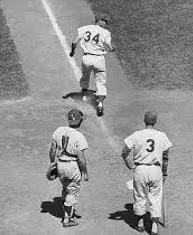
Jim Piersall (34) had his 100th home run trot backwards. (Looking haplessly: Phillies catcher Clay Dalrymple, Mets first baseman Tim Harkness.)

Come to think of it, with a name pair like theirs they could take that act on the road and bring down the house. Unless, of course, they bring down the wrath of a Fun Police pitcher and get to dance erroneously to a little chin music, maestro.

Even in the ancient days, the ones the Fun Police say meant respect, there were those who knew how to have fun. Even the almighty imperial New York Yankees. They had the perfect answer for Bill Veeck’s exploding scoreboard in Comiskey Park. As it happened, they also had the perfect manager for it—Casey Stengel.

Led by the Ol’ Perfesser himself, the Yankees answered one of their own hitting one out by sending up that scoreboard—prancing around the front of the dugout holding Fourth of July sparklers aloft for the Comiskey crowd to see.

And wouldn’t you just love to see a batter hit a milestone home run and celebrate it by trotting around the bases backward? Jim Piersall thought of that, in 1963, when he hit the 100th home run of his major league career, as a Met. Only he learned the hard way that even Stengel’s vaunted sense of humour had its limits.

Piersall led off against Philadelphia Phillies pitcher Dallas Green (future major league manager) in the bottom of the fifth, with the Mets holding a 1-0 lead, and drilled Green’s first service into the Polo Grounds’ right field seats. He took two steps out of the box, did an about face, and backpedaled his way around the bases.

The Phillies were probably too stunned to think of anything other than a few snickers. Piersall’s home run shuffle has yet to be topped even by today’s flippers, fanners, and jugglers. It was Piersall’s first home run as a Met. It was also Piersall’s last home run as a Met.

Stengel—the man who once flipped the bird out from under his hat during a game—was so amused by Piersall’s backpedaling he made sure the veteran outfielder was cut two days later, only to be signed by the tender mercies of the then-toddling Los Angeles Angels.

But I got $6,000 severance pay for one month,” Piersall remembered much later, “which made it my best payday in baseball, although I’d hit only .194 for the Mets. He did me a favor.” Who had the last laugh now?

Put a meal and a stewardess on that flip

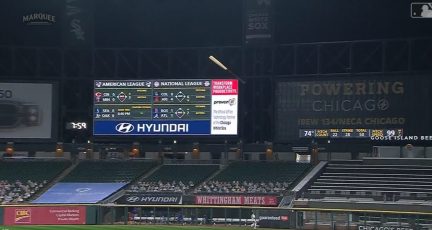
You’re not seeing things. That’s Willson Contreras’s bat in flight after the Cubs’ DH sent a three-run homer about that high en route the right field bleachers Friday night.

If you’re taking tallies to determine the bat flip of the year, Chicago Cubs designated hitter Willson Contreras should be among your top finalists. His Friday night flip in the ballpark formerly known as Comiskey Park, in the top of the third, was an absolute work of art. Enough to make Tim Anderson, Jose Bautista, Bryce Harper, and Tom Lawless resemble nursery school finger painters.

If you’re taking concurrent tallies to determine the most brain-damaged delayed over-reaction to Dali-esque flips, Chicago White Sox pitcher Jimmy Cordero should hold a place among the finalists likewise. He threw a pair of high inside pitches to Contreras and the second caught Contreras flush enough in the back, just off the C that begins the spelling of Contreras’s surname on his uniform back.

Flipped his bat high in the air? Contreras’s flip off the three-run homer he smashed on White Sox starter Dylan Cease (and Desist)’s dollar was the only flip yet where you were tempted to say what you used to holler watching a titanic home run fly out: “Put a meal and a stewardess on that one!”

If you’re going to be Fun Police enough to want retribution for a bat flip that looked as though it took off from O’Hare International and not Contreras’s hands, the time to go for it was Contreras’s next plate appearance in the top of the fifth. Cease walked Contreras on ball one up and a little in, ball two up and away, ball three inside middle, and ball four down and away.

There was no way Cease wanted to feed Contreras anything resembling the fastball that arrived just off the middle of the plate and flew the other way into the right field bleachers two innings earlier.

There was also no way Cease was trying to throw one through Contreras’s assorted anatomy, even if you could make a case that ball one up and in might have been a subtle nastygram reminding Contreras it’s not nice to channel your inner Michelangelo when you’ve already hit a ball through the equivalent of the Sistine Chapel ceiling. Might.

Maybe Cease got it when Contreras defended himself after the game. “I’m not going to change anything,” he told reporters. “I play hard for my team. I always want to do the best for my team. But if they don’t like me, that’s fine. I don’t play for other teams to like me, anyways. And if I have to do it again, I will do it again.”

But there was every way the White Sox—clinchers of a postseason berth at least, hopefuls toward snatching the American League Central title, even in this pandemic-truncated season of surreal—were feeling just a little over-punished on the night.

You tend to feel that way when Yu Darvish and company are shutting you out, Darvish not quite so nail driving as he’s been most of this season—during which he’s redeemed himself to the tenth power and into the Cy Young Award conversation—but effective enough to keep you to three hits and one walk and only two runners getting as far as second base under his command.

You feel even more that way, after Contreras’s bomb flip put the Cubs up 4-0 and Javier Baez’s leadoff launch over the left center field wall made it 5-0 in the top of the fourth, after Victor Caratini wrestled your relief option Gio Gonzalez to a seventh-pitch sinker that didn’t have enough weight to pull it quite to the bottom, and Caratini sunk it into the same bleachers Contreras reached three innings earlier. Not to mention Kyle Schwarber’s second-inning blast, making for the Cubs a four-bomb evening.

“The dog ate his homework,” pleaded White Sox skipper Rick Renteria. “Detention!” replied the umps.

When Contreras got drilled, the Cubs got riled. They hollered mightily from their dugout, enough to get the umpires into a confab that resulted in Cordero, White Sox manager Rick Renteria, and pitching coach Don Cooper the rest of the night off for bad behaviour.

Renteria tried the dog-ate-my-homework excuse after the game. A second-grade child had a better chance of making it stick. “The ball got away from him,” he insisted of Cordero’s cone job. “We couldn’t convince [the umpire] of that . . . There was no warning. They just gathered and ejected him.” As if a second straight up-and-in pitch was inadmissible evidence.

Cordero tried the same excuse. “It was just a bad pitch, a bad pitch to him,” he said after the game. “The ball sunk a lot, and that happened.” Sorry. Attempted sinkers that rise enough to get a man in the back don’t sunk a lot. Detention for you.

Understand that Cubs manager David Ross is just old school enough that it wasn’t programmed into his own playing software to deliver as Contreras did after hitting a hefty home run. But the man whose first major league home run came off an ex-Cubs first baseman named Mark Grace in Arizona late in a blowout, and whose last major league home run put the Cubs up by three in an eventual World Series-winning Game Seven, wouldn’t throw his man under the proverbial bus for his exuberance.

“It wasn’t to disrespect the other group,” Ross told reporters after the Cubs finished what they started, a 10-0 shut-and-blowout. “It was because we’ve been struggling offensively and he brought some swagger. He brought some edge. I loved every second of it. I don’t think he deserved to get hit at all.”

Why, Grandpa Rossy even had the pleasant audacity of comparing Contreras’s orbital flip to the one Anderson delivered a year ago April. When Anderson ripped Kansas City pitcher Brad Keller’s canteloupe over the fence and made of his bat a helicopter rotor while he was at it, got drilled in the rump roast by Keller his next time up, and objected vociferously. Drawing his teammates out of the dugout, getting both Keller and Anderson ejected by Country Joe West—who may or may not have remembered Anderson zapping him over an unwarranted ejection the previous season.

“All the hype is on the guy on the other side when he bat-flipped, right?” said Ross. “I thought Tim Anderson’s bat flip last year where he flipped it and looked in his dugout, that’s what you want. That’s what Willson did.”

Making the White Sox resemble hypocritical flip-floppers is also what Willson did. Their Andersons can flip until the flock flies home, but the opposing flock better not even think about it. The Fun Police are now reduced to the dog eating their homework. The dog looks better than the White Sox.