A calm, objective look at the Mookie Monster

Mookie Betts about to take a low-five from third base coach Dino Ebel after his sixth-inning Game One bomb.

The Mookie Monster is catching more than a few waves of adulation and hype lately. Making three National League Championship Series-altering or sustaining catches in the final three games, then doing something even Babe Ruth never achieved in a single World Series game, does that for you.

“He does things on a baseball field that not many people can do,” says Game One winning pitcher Clayton Kershaw, “and he does it very consistently, which I think separates him from other guys.”

On Tuesday  night, Betts let a couple of other Dodgers take the defensive spotlight gladly in return for drawing one walk, stealing two bases, and hitting a home run. Ruth drew three walks, off one of which he stole second and third, in Game Two of the 1921 World Series.

This Series is only one game old, and Betts hit as many home runs Tuesday night as Ruth hit in the entire ’21 Series—one. No, we’re not comparing Mookie Betts to Babe Ruth just yet, other than to say he has something else in common with the Bambino.

Betts, too, is a former Boston Red Sox star. Betts was traded away while Red Sox Nation was still seeing him in prime time; Ruth was sold before Red Sox fans got to see his complete transition to full-time position playing and his two prime periods—in a very different game—of 1920-24 and 1926-31. And Red Sox Nation isn’t the only baseball outpost still wondering just what the Red Sox were thinking when dealing Betts.

The Ruthian mythology held for too long that then-Red Sox owner Harry Frazee dumped Ruth purely to finance his musical hit No, No, Nanette. (How a 1919 sale finances a 1925 stage production should have escaped thinking people.) Frazee did need money, but not for one of his theatrical productions. He also didn’t need the headaches that came with Ruth, behaving even then like a law unto himself.

Fast forward a century. A very different Red Sox ownership is about as financially challenged as the Saudi royal family. They’re facing Betts hitting free agency after the 2020 season and making little apparent effort to sign him. Betts himself spoke often enough about pondering his market value in that 2020 free agency class. The Red Sox didn’t want to lose him for nothing in return.

Fair enough. But why the Red Sox made no effort to keep their arguable franchise face will be debated at least as long as the old and discredited Curse of the Bambino endured. No matter what the Red Sox didn’t do otherwise last winter to keep the team from collapsing to the basement even in a pandemic-altered year, the Olde Towne Team isn’t likely to go even half as long before its next World Series triumph as they did between selling Ruth and 2004.

“The Red Sox’s payroll issues were not inconsequential,” writes The Athletic‘s Ken Rosenthal, never mind that allowing that the Red Sox doing nothing to re-tool their pitching staff probably did as much to sink them as trading Betts. “The team needed to infuse young talent. But every rational argument club officials make pales in comparison to the importance of keeping a homegrown star, a franchise player, a role model for your organization and a potential Hall of Famer.”

Their loss is the Dodgers’ gain, even if the Red Sox did get some decent young talent in return and rid themselves, while they were at it, of the rest of David Price’s contract before Price’s decline added further miseries. Betts already had a taste of World Series conquest in 2018, even though he didn’t hit well at all while playing solid defense that postseason.

“He does all the little things right,” said Dodgers center fielder Cody Bellinger to Rosenthal, Bellinger having delivered a couple of key postseason hits and defensive gems himself. “You can really learn from that when a guy’s that good and wants to win and continues to do the small things that go unnoticed by a lot of people. It’s really special.”

The guy Betts is being compared to most now hasn’t even gotten more than one quick postseason taste in his rookie season. The Los Angeles Angels aren’t exactly in the poorhouse financially. They’re in the poorhouse in baseball terms, though, since they seem almost terminally unable to build a team their franchise player and the game’s best all around, still, can be proud of.

Once the Mookie Monster cranked his act into overdrive starting in NLCS Game Five, the concurrent subject became Mike Trout, his lack of postseason credentials, and even why Trout is therefore an overrated hype. The foolishness there only begins with the roll of Hall of Famers who either never got to strut in the postseason, came up too short when they got several chances, but still shook out as their generations’ best.

It only continues with ignoring that Trout wasn’t responsible for such ultimately backfiring moves as the Albert Pujols contract—which became an albatross mostly because of Pujols’s injury issues impacting his once-unshakable plate discipline—and the utter failure to develop credible pitching on both ends of the game. That may or may not have only begun with doing little to nothing to keep Zack Greinke beyond his second-half 2012 rental.

Trout’s loyalty to the organisation that brought him forward is nothing but admirable in a business for which loyalty is and has always been a disposable commodity. The only difference between pre- and post-free agency “loyalty” is that pre-free agency teams were under no such obligation and liberal to the point of libertine when it came to “loyalty” to most of their players.

A guy doesn’t sign an extension equivalent to the economy of a small country if he thinks he’s been done dirty off the field. Even nice-guy Trout has his limits, though. He said not too subtly this year that he’s tired of the Angels losing. But when the game’s all-universe player says he’s fed up with falling short and shorter, will the Angels listen at last?

The show Betts is putting on this postseason is as staggering as the 99 Cent Store-budget Tampa Bay Rays bumping, grinding, flying, and diving their way to the American League’s best irregular season record and into the World Series in the first place. But if Betts’s partisans really want to go there with the Trout comparisons, well, you asked for it.

Betts has seven seasons in the Show. Here they are next to Trout’s first seven. First, looking conventionally:

First Seven Seasons BA OBP SLG OPS OPS+
Mookie Betts .301 .373 .522 .895 135
Mike Trout .310 .420 .579 1.000 178

Well, I tried to warn you. And, in absolute fairness, Betts’s line is astonishing for a leadoff hitter, which I’ll take a different crack at shortly.

Now—sorry, can’t resist—look at the pair using my Real Batting Average metric, which I think gives you the complete look at a player at the plate. (It also does what the traditional batting average fails to do: treats hits as they should be treated, not treating all hits as having equal value—which they don’t.) Total bases + walks + intentional walks + sacrifice flies + hit by pitches, divided by total plate appearances:

Real Batting Average PA TB BB IBB SF HBP RBA
Mookie Betts 3875 1786 395 26 33 21 .583
Mike Trout 2012-2018 4538 2171 684 86 43 63 .671

Again, Betts has a remarkable profile for a leadoff hitter. But granted that distinction versus a guy who bats second much of the time and third almost as much of the time, the Mookie Monster isn’t quite the Millville Meteor just yet. (Since you went there: Betts does have a Most Valuable Player award—to Trout’s three that should have been four.)

On the other hand, it might be a lot more prudent and accurate to compare Betts to the first seven seasons of another leadoff man of certain renown.

Real Batting Average PA TB BB IBB SF HBP RBA
Mookie Betts 3875 1786 395 26 33 21 .583
Renowned Leadoff Man 4445 1639 674 24 20 23 .535

The leadoff man of certain renown is Hall of Famer Rickey Henderson. Did you figure for even one milli-second that there but for the grace of his life of crime on the bases would Henderson come up short of Betts? That the Mookie Monster in his first seven seasons is actually better at the plate than the Man of Steal?

Maybe you didn’t before, but you ought to now. Especially since Betts has a slightly better knowledge than Henderson of what to do when his bat takes unexpected time off and becomes a one-man version of the Rays’ collection of aerialists, acrobats, high-wire walkers, and tumblers.

It’s enough to make the Dodgers’ spanking new $396 million man the biggest bargain of the year. Just don’t ask Betts. All he’s ready to do is tell you the most important thing he did in Game One, and it wasn’t the jolt he hit the other way that landed in the right field seats in the bottom of the sixth. For him, it was the double steal that led to him scoring on an offline throw from first base an inning earlier.

“I think it just kept the line moving,” he told reporters. “It was a good play there, and I’ve gotta give credit to the hitters that came up after for driving in runs and keeping constant pressure. It just showed that we don’t have to hit home runs to be successful.”

Not even when it’s the aggregation that led the National League in bombs this irregular season and last full season. It ought to make for one hell of a World Series show going forward.

The Rays off script, the Dodgers on top

Clayton Kershaw opened the 2020 World Series with more than a flourish.

Somehow, no matter what the pandemic threw down in baseball’s way, we managed to arrive at the World Series. Somehow, the game’s 99 Cent Store from Tampa Bay bumped, pole vaulted, and sky dove to a Series against the game’s Amazon from Los Angeles.

In Globe Life Field, the brand-new playpen of the Texas Rangers. Where the turf is artificial, the roof makes it resemble the hangar for a Boeing 747, and you can just can all the hoo-ha about the wonders of a neutral-site World Series.

The Dodgers entered with a sort-of home field advantage.They’ve been playing at Globe Life from their National League division series forward. With the pandemic-inspired divisional geography schedule on the irregular season, the Rays never got to play the Rangers even once.

They’ve been been playing there from their division series forward. With the pandemic-inspired divisional geography schedule this irregular season, the Rays never got to play the Rangers even once. And the Dodgers sure took advantage of that inadvertent home-field advantage of a sort Tuesday night.

They waited out a hard labouring Rays starter Tyler Glasnow, aided and abetted by Rays manager Kevin Cash forgetting his well-tested plot, then flipped their merry-go-round to cruising speed from the fourth through the sixth innings, and beat the Rays in Game One, 8-3.

Clayton Kershaw did more than his share starting for the Dodgers. With the continuing questions about his overall postseason life of bad fortune, Kershaw brought the best of his new self to bear, his sliders out-numbering his fastballs, striking out eight through six and getting nineteen misses on 38 swings against him for the highest single-game whiff rate of his entire major league life.

“Kershaw was dealing,” Cash said postgame. “You see why he’s going to the Hall of Fame one day.”

What nobody could see clearly was why Cash pushed his luck with Glasnow labouring to survive, his eight strikeouts negated by six walks—including the leadoff pass to Max Muncy opening the bottom of the fourth to start the Dodgers’ fun—and with only a 2-1 deficit against him when he came out of it.

Will Smith grounded Muncy to second almost right then and there. But Cody Bellinger—the man who rang the Atlanta Braves bell so resoundingly in the seventh National League Championship Series game—hit the first pitch into the Dodger bullpen in right center field. After walking Chris Taylor to follow and wild-pitching Taylor to second, Glasnow was lucky to escape with his and the Rays’ lives on a pair of back-to-back strikeouts.

That’s where Cash moved against his own successfully established grain. The Rays live and prosper on not letting the other guys get third cracks at their pitchers and thus keeping their pitchers from falling into position to fail or get failed. They play that game better than most and rolled the American League’s best irregular season record for their trouble.

Cash withstood the alarms blasted after he lifted Charlie Morton in American League Championship Series Game Seven after five and two-thirds efficient innings when trouble brewed with the Rays up 3-0. The move aligned perfectly to the Rays’ usual M.O. and it paid off with a pennant.

On Tuesday night, though, he left Glasnow in for the fifth despite 107 pitches to that point. With Ryan Yarbrough throwing in the Rays bullpen, Glasnow walked Mookie Betts on four straight balls following an opening strike. Over the past three seasons including a 34-start span, Glasnow had only thrown 100 pitches or more in a game three times, and Tuesday night wasn’t exactly one of his prime outings.

Cash still didn’t make a move after the walk to Betts. Room enough for the Dodgers to boot the merry-go-round. Glasnow walked Corey Seager after Betts stole second without a throw on a low pitch. He struck Justin Turner out, somehow—except that Betts and Seager delivered a near-textbook double steal.

Then Max Muncy bounced one right to Rays first baseman Yandy Diaz. Diaz threw home. This was supposed to be one of those plays the Rays’ usually larger-than-life defense executes with an arm missing and half asleep. Except that Diaz’s throw arrived up the third base line and Betts slid into the plate while Seager took third and Muncy stood safe at first.

“The at-bat with Muncy right there,” Cash said post-game, “just was hoping it felt like [Glasnow] was the best guy to get a strikeout.” Not on a night when only 58 of Glasnow’s 117 total pitches were strikes. Glasnow himself acknowledged trying to rush things a little too much in the beginning, but once he adjusted that he thought his mechanics were off.

“I have to execute pitches better and hold runners better,” he said, admitting the latter is probably his weakest attribute. “Later in the game, I wasn’t really able to throw anything for a strike except the heater. I think the changeup, I probably should have thrown that a little bit more . . . That curve ball, later on, I really didn’t have much feel for it.”

Smith knocked Seager home and Muncy to third with a jam-shot single to center. Finally Cash brought in Yarbrough, a good relief pitcher but a young man whose career to date includes that he’s vulnerable pitching with one out and rare (for him) inherited runners but better when he starts an inning clean.

The lefthander got rid of the lefthanded Bellinger on a pop up to third, but righthanded Chris Taylor lined Muncy home with a clean single to left and pinch-hitter Enrique Hernandez sent Smith home by shooting a base hit between short and third.

Yarbrough escaped with no further damage. Cash sent Josh Fleming out for the sixth. The Mookie Monster sent his first pitch into the right field seats. An infield pop out later, Turner and Muncy doubled back-to-back. Fleming didn’t surrender another run through his next two innings worth of work but that came under the too-familiar heading of taking one for the team.

Not that the Rays left things uninteresting on their end. They chased Kershaw’s relief Dylan Floro with one out in the seventh. Manuel Margot singled right through the middle infielders and Joey Wendle drove on to left center that Bellinger gave a great chase until the ball hit off the heel of his glove, setting the Rays up with second and third.

Then Cash sent Ji-Man Choi to bat for Willy Adames. Dodger manager Dave Roberts brought in lefthander Victor Gonzalez to face the lefthanded Choi. Cash pulled Choi for division series hero Mike Brosseau. And Brosseau lined Margot home with a single to right with Wendle stopping at third. He didn’t stay long. Kevin Kiermaier—whose fifth-inning solo home run was his first hit since being hit by a pitch in ALCS Game Three—lined a single to right to send Wendle home.

It was the final Rays homecoming of the night, but it almost wasn’t. Rays catcher Mike Zunino lined a missile right through the box that Gonzalez snatched just sticking his glove to his right, the ball’s force spinning him right into position to throw and double up Brosseau scrambling back to second. A hair off line or the glove missing by a hair and that missile might have been an RBI single with the Rays still swinging. Might.

The Rays tried to flip their own merry-go-round switch and the Dodgers succeeded in throwing a stick into the motor belt, with Pedro Baez and Joe Kelly finishing up throwing the spotless final two innings.

It was also a night to make history. Kershaw nailed his 201st lifetime postseason strikeout, moving him into second place behind his fellow likely Hall of Famer-to-be Justin Verlander. Betts became the first player in World Series history to homer, steal, and score twice in the same Series game. Cash became the first Little League World Series player to manage in the World Series when he grew up.

“It’s great to get the Series going with a win,” said Kershaw to reporters after the game. “That’s the biggest thing, for us, is to get going. Get that first game—it’s always important to get that first game of a series. Just for me, personally, it’s awesome, you get to pitch well and get a win in a World Series. Like I said, I’m just thankful for another opportunity.”

Bellinger going deep looked like a man who shook off the shoulder dislocation his NLCS bombing brought when it happened during the dugout celebration. He took no chances this time.”I said it before the game,” he told reporters post-game. “If I hit one today, I’m not touching anyone’s arm. I’m going straight foot.”

Since he hit the first Dodger bomb of the Series, Bellinger got to lead the first such dance. Appropriately. And you thought last year’s World Series champion Dancing Nationals knew how to bust moves and cut rugs.

Does Luhnow still not get it?

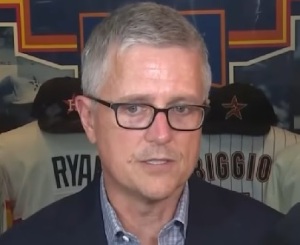
Jeff Luhnow, in front of the uniforms of two Astros Hall of Famers about whose baseball counsel he couldn’t have cared less—but probably should have.

Deposed and disgraced former Houston Astros general manager Jeff Luhnow wants you to know that those who brewed what became Astrogate went rogue on him. He also wants you to know that nobody told him a blessed thing about the off-field-based, illegal sign-stealing scheme, and things would have been different if they had.

Where have I heard that before?

Oh, yes. Once upon a time, in 1971, I heard it from deposed New York City police commissioner Howard Leary. He’d either looked the other way, or denied what was in front of him for years, as graft ran even more rampant in his department than a decade earlier, when bookie Harry Gross had almost as many New York cops on his payroll as the city did.

Luhnow gave an extensive interview Monday to Vanessa Richardson of KPRC, Houston’s NBC affiliate. “Whether it’s the players or the video staffers, they just decided on their own to do it and that’s a shame,” Luhnow told Richardson, “because had they come and asked me for permission I would have said no. Had they gone and asked Jim for permission, he would have said no. There’s just no reason why that should have happened.”

When Leary in 1971 was hauled before the Knapp Commission empaneled to get to the depths of what clean cops Frank Serpico and David Durk exposed to The New York Times, the ex-commissioner told the panel wearily that nobody told him anything, either, and by God things would have been different if anybody had.

The original Times story actually prompted Leary to denounce the paper for McCarthyism of the worst sort (his words). Serpico biographer Peter Maas revealed in due course that, when one of the few superiors Serpico trusted suggested to Leary that the plainclothesman was due a promotion and commendation for trying to expose rampant corruption, Leary snapped, “He’s a psycho!”

“In that case,” the superior rejoined dryly, “maybe the department needs more psychos.”

The Astros don’t need psychos to move past Astrogate. But they could use a lot better than their former general manager continuing to throw people under the proverbial bus while insisting falsely enough that it wasn’t him or didn’t begin with him.

Richardson asked Luhnow for a kind of timeline of the Astro Intelligence Agency’s operation. After beginning his reply by mentioning “a cabal” of video staffers and “coaches” executing the sign-stealing scheme via illegal camera operation—and saying they actually opened for business in 2016—Luhnow said, “It was pretty blatant. They were assigning duties, ‘Who’s on codebreaker duty tonight’.”

Pay close attention to “codebreaker.” Now, remind yourself that last February Wall Street Journal reporter Jared Diamond exposed a front office-developed algorithm called  Codebreaker, and shown to Luhnow in September 2016, brought to him by an Astros front-office intern who told him the algorithm could steal opposing catcher’s signs.

That was already far above and beyond traditional on-field gamesmanship, baserunners or coaches catching and deciphering opposition pitch signs to transmit to batters. (Or, catching pitchers tipping pitches.) That also preceded whoever it was that decided to either take an existing center field camera off mandatory transmission delay or install an additional camera transmitting real-time to clubhouse monitors.

If Luhnow wants you to believe nobody told him a bloody thing about any such espionage, beware the for-sale sign on whatever North Pole beach shop he owns.

Former longtime St. Louis Post-Dispatch sportswriter Jose de Jesus Ortiz pounced at once. “If Luhnow wants to say [Astros] players & [former manager] AJ Hinch didn’t tell him, he can go there,” Ortiz tweeted angrily enough. “Some might even believe him, but in my 23 years of covering ball I’ve found that players rarely spill info outside of the group. You can think you know, but you don’t. But he hired the ‘code breakers’.”

That was after Ortiz fumed, “Here’s the [fornicating] truth about Jeff Luhnow & baseball ops under him. They didn’t take into consideration what Nolan Ryan, Craig Biggio, Reid Ryan & Enos Cabell had to offer on baseball ops. It’s quite rich of him to [be] wondering why they didn’t know” about the Astros’ extralegal sign-stealing.

Luhnow didn’t mention a specific name, and Richardson hadn’t even prompted him to go there, but when he said, “one of the people who was intimately involved, I had demoted from a position in the clubhouse to a position somewhere else, and after I was fired he was promoted back into the clubhouse,” the assumption quickly became that he referred to Reid Ryan—the son of Hall of Famer Nolan.

Craig Biggio, of course, is a Hall of Fame second baseman. Enos Cabell was a corner infielder/outfielder for the 1972-80 Astros. They may not be the only baseball people whose counsel their baseball employers ignore, but the Astros’ apparent ignorance thereof hurt worse than any of the 285 pitches that hit Biggio during his long playing career.

Reid Ryan was the president of the Astros’ business operations for seven years until he was re-assigned in November 2019. (And, replaced by Crane’s son, Jared.) He was known if anything for applying himself to enhancing the fan experiences at Minute Maid Park.

When he was demoted his father quit the organisation outright at once. (Reid also insisted after his reassignment that the Astros’ 2017 World Series title wouldn’t really be tainted by the AIA cheating operation.) That wasn’t exactly part of the future Nolan Ryan had in mind after he threw his final major league pitch and accepted his plaque in Cooperstown.

Luhnow was the president of baseball ops. Jim Crane made clear Reid Ryan handled business & Luhnow handled baseball ops,” Ortiz reminds us. “It was Luhnow’s culture. I wish him well, but he exits Houston as he arrived, [defecating] on people who devoted their lives to the Astros.”

Luhnow’s Astro “culture” was long exposed as a result-oriented culture in which human relationships were cheap and too often disregarded.”Luhnow had all year to speak,” Ortiz continued. “But as was the case throughout his tenure Luhnow is as calculated as ever. That’s why baseball folks throughout the country say he’s dismissive of traditional baseball folks, scouts, players, etc. He sees them as assets, people to manipulate.”

He practised what legendary football coach Vince Lombardi is still misquoted as saying, even today: Winning isn’t everything, it’s the only thing. He denied responsibility when the Astros were exposed and caught in the first place. He barely flinched when it turned out the most apologetic Astros for Astrogate were such former Astros as J.D. Davis, Tony Kemp, Dallas Keuchel, and Jake Marisnick.

But he said little to nothing about the former Astro who blew the Astrogate whistle in the first place. Mike Fiers’s revelations included that he and several other players tried convincing sportswriters to expose the AIA only to discover those writers couldn’t convince their editors to let them run with it without even a single player willing to put his name on it.

The Oakland Athletics, for whom Fiers has pitched since mid-2018, filed formal complaints with Manfred’s office. So, apparently, did a few other teams. Manfred made a point of saying his office investigates any and all such complaints, yet nothing really seemed to move until Fiers spilled to Athletic reporters Ken Rosenthal and Evan Drellich almost a year ago.

When Hinch spoke to Sports Illustrated‘s Tom Verducci after his own firing, he, too, was remorseful over his Astrogate role, which was kind of a non-role of sorts: aside from destroying a couple of the clubhouse monitors receiving the illegally-pilfered intelligence, he did nothing much if anything.

“I should have had a meeting and addressed it face-forward and really ended it,” he admitted. “Leadership to me is often about what you preach. Your pillars of what you believe in. Leadership is also about what you tolerate. And I tolerated too much. And that outburst . . . I wanted to let people know that I didn’t like it. I should have done more. I should have addressed it more directly.”

That’s still a great deal more owning up than Luhnow has done. The former GM still thinks he was targeted specifically on behalf of Manfred needing a head or two on plates to show the commissioner meant business. He also still thinks it was just about everybody else’s fault.

“The reality is, the Astros cheated in 2017, and cheated a little bit again in 2018 using just the decoder method, and it was wrong, and it should never have happened, and I’m upset,” Luhnow told Richardson.

I’m really upset that it happened. I’m upset for our fans, I’m upset for players on other teams that gave up hits as a result of this that should never have happened. If we won games because of it, it should never have happened, and we didn’t need to do it. We had a great team. The team we put together in 2017, a lot of which is still together today is one of the best teams of the 21st century, and has had an incredible stretch. And there’s no reason why we needed to explore breaking the rules to gain an advantage, it made no sense to me.

Now he tells us. On the threshold of a World Series in which his former Astros won’t be appearing thanks to the Tampa Bay Rays.

If there was no reason for the 2017-18 Astros to break the rules to gain an advantage, why didn’t Luhnow kill it in its Codebreaker crib? The Los Angeles Dodgers and the Atlanta Braves may win their next World Series titles sooner than the answer arrives.

Luhnow would have done far better to heed not the actual or alleged Vince Lombardi credo but that of another sports legend, writer Grantland Rice:

When One Great Scorer comes
to write against your name,
He marks not that you won or lost,
but how you played the game.

A Curt Flood Award? The first should go to Andy Messersmith

“Curt Flood stood up for us. [Catfish] Hunter showed what was out there. Andy showed us the way.”—Hall of Fame catcher Ted Simmons.

My first notice came when I saw San Francisco Chronicle writer Susan Slusser’s praise: “How wonderful! The [Major League Baseball Players Association] is instituting a Curt Flood Award for the Oakland native whose efforts helped bring about free agency and allow players to, eventually, be paid their worth on the open market. It will be handed out for the first time Thursday.”

I know who should receive the first Curt Flood Award, and I hope to God the Players Association thinks likewise. The first Flood Award ought to go to Andy Messersmith.

Flood’s Christmas Eve 1969 letter to then-commissioner Bowie Kuhn was the Second Shot Heard ‘Round the World. “After twelve years in the Major Leagues,” he began, “I do not feel that I am a piece of property to be bought and sold irrespective of my wishes.” Flood fired his gun from the same city in which a certain former slave proclaimed that living now on free soil made him thus a free man.

Small wonder that George F. Will would nickname Flood Dred Scott in Spikes. “[Scott] was not the last time,” Will wrote in 1993, “that the Supreme Court would blunder when asked when a man can be treated like someone’s property . . . Six years later—too late to benefit him—[Flood’s] cause prevailed. The national pastime is clearly better because of that. But more important, so is the nation, because it has learned one more lesson about the foolishness of fearing freedom.”

Flood’s was the groundbreaker that didn’t quite make it. But the graceful center fielder kicked a door open just wide enough for further pressure. Catfish Hunter kicked it a little further open in 1974, after Oakland Athletics owner Charlie Finley reneged on a contracted-for insurance payment to the Hall of Fame pitcher and Hunter was thus awarded his free agency.

The Hunter case didn’t challenge the reserve clause itself. The bidding war to follow for his services was won by the team who actually offered him the third-highest dollar-worth amount among the suitors but the division of the dollars Hunter wanted most, including an annuity to guarantee his children’s education. But it shone a light his fellow players had only suspected might reveal platinum on a fair, open job market.

The official name of the case to come would be John A. Messersmith vs. Los Angeles Dodgers. (Messersmith preferred to be known as Andy, though his middle name was actually Alexander.) The official net result of his almost unexpected 1975 challenge was to finish what Flood began. Almost unexpected?

Messersmith first emerged as a California Angels comer with a bristling fastball, a deadly changeup, a 2.77 ERA, a 3.04 fielding-independent pitching rate, and an upbeat personality that didn’t mind crossing the line to periodic flakiness. The Angels traded him to the Los Angeles Dodgers in November 1972, in a multi-player swap that made a somewhat temporary Angel out of Hall of Famer Frank Robinson.

He was just as good and stubborn on the mound with the Dodgers, finishing fifth in the 1973 National League ERA race (2.70), then becoming one of the league’s two 20-game winners with a 2.59 ERA in 1974 for a pennant-winning Dodgers aggregation. He also finished second to his relief pitching teammate Mike Marshall in the Cy Young Award voting.

“He’s one of the best competitors I’ve ever managed,” said his manager, Walter Alston, before that World Series. “He can do it all. He can pitch, field his position, has a good move to first . . . Andy is the kind of guy who wants the baseball. He wants to pitch and that’s why I put him up there with the other great pitchers I’ve had the good fortune to manage.”

Andy was also the kind of guy who proved to be just as stubborn talking contract as getting hitters out. He reported unsigned to spring training 1975, the original issue being not whether he’d get a well-earned raise from the $100,000 he earned in 1974 but how much of a raise. Then, according to Wall Street Journal writer John Helyar in The Lords of The Realm: The Real History of Baseball, the Dodgers’ then-general manager, Al Campanis, screwed the proverbial pooch:

As they sat in [Campanis’s] Vero Beach office . . . Campanis infuriated the pitcher. Quite apart from how well the pitcher had performed, quite apart from how much the Dodgers could allegedly afford, he injected a deeply “personal issue.” (Even eighteen years later, the matter cut so deep with Messersmith he wouldn’t elaborate on it.”)

Two things happened. One, Messersmith severed talks with the GM. “This is way out of the boundaries of negotiations; this is something else,” he told Campanis. “I’m not going to deal with you anymore.” He insisted on shifting the talks to Peter O’Malley, the club’s president. The other thing to emerge was a new non-monetary demand. No way, Messersmith decided, would he let Al Campanis be in a position to dictate his career. He’d already had to change teams once when he crossed his first GM, the Angels’ Dick Walsh. Now he wanted a no-trade clause in his contract. “I’m going to have some control of my destiny,” declared Messersmith.

O’Malley was more to Messersmith’s taste but no more amenable to a no-trade clause. “We’ve never given one,” he said, “and we aren’t going to start now.”

So Messersmith refused to sign a new contract and pitched 1975 without one. “At the start,” he’d say later, “it was all personal. Al Campanis had stirred my anger, and it became a pride issue. When I get stubborn, I get very stubborn.” The National League’s hitters got a not-so-friendly reminder. Messersmith led the league with forty starts and seven shutouts, and finished second with his 2.29 ERA, and the hitters only hit .213 against him.

“Every time he took the ball,” Hall of Fame catcher Ted Simmons said, “everybody in management wanted him to fail and everybody from the players wanted him to succeed. He was doing it for us all.”

By August, however, Messersmith found himself pitching for something above and beyond the need to stuff Al Campanis. The union’s original executive director, Marvin Miller, called him. By that time baseball had only one unsigned player on active duty—Messersmith himself. Miller wanted to know if Messersmith would consider filing a grievance seeking free agency if he finished the season unsigned.

The Dodgers didn’t make it simple for him. Neither did the near-constant questions from sportswriters Helyar summed up as, “So how ’bout that contract, Andy?” They kept hiking the money the longer and the better Messersmith pitched. Come September, Helyar noted, the offer was three years and $540,000 total. But the offer still excluded the no-trade clause that was Messersmith’s most unbreakable demand.

“We had no intention of trading Andy Messersmith,” O’Malley insisted. “He was a quality individual, a quality performer, and a delight to have on the team.” Messersmith took one look at Campanis still in the front office and decided there was no dollar amount able to buy him off.

“When Peter came up with the dough, I was adamant,” Helyar quoted Messersmith remembering. “The money was incredible, but they wouldn’t bring the no-trade to the table. I’d gotten stimulated by Marvin and [union general counsel] Dick [Moss]. Now I understood the significance of what this was all about. I was tired of players having no power and no rights.”

Miller’s only concurrent worry was whether the incredible money would back Messersmith off the grievance track. The union director thus enlisted pitcher Dave McNally, technically unsigned but contemplating retirement following persistent arm soreness. McNally agreed join a grievance. Messersmith had no intention of backing away from it. “I’ve come this far,” he said. “I need to see this through.”

There’s no reason why a club should be entitled to renew a player’s contract year after year if the player refuses to sign and wants to go elsewhere. I thought about it for a long time and I didn’t do it necessarily for me, because I’m making a lot of money. I didn’t want people to think, ‘Well, here’s a guy in involuntary servitude at $115,000 a year.’ That’s a lot of bull. But then, when you stop and think about the players who have nowhere to go and no recourse … this isn’t for a guy like me or any other established ballplayer unless you’re having problems with your owner or something like that. It’s more for the guy who is sitting on the bench and who believes he hasn’t been given a chance.

When the hearings in the case finally took place before arbitrator Peter Seitz, Messersmith stood his ground. And the earth moved under his feet.

After first flattening Kuhn—especially the commissioner’s staggering bid to claim that the end of the reserve clause would mean corrupted or thrown games—Moss delivered a knockout punch with the least likely glove: Minnesota Twins owner Calvin Griffith, courtesy of a Minneapolis Star story from March 1974: “If [a player] doesn’t sign by March 10, I can invoke the option clause. If I do that, I can cut him as much as I want up to 20 percent. Of course, he would then be playing out his option. At the end of the season he would be a free agent.”

In other words, for decades the owners used the strict language of uniform players contract Section 10(A) unlawfully, agreeing among themselves not to sign players who refused their incubment teams’ offers. Seitz, who preferred (and indeed all but begged) that the owners and the players negotiate and settle themselves, was left no choice after the owners’ Player Relations Committee leader John Gaherin told him, “There’s no change in our position. So turn the crank.”

Seitz turned the crank. Miller signed “assent” and Gaherin signed “dissent” on the document aboard which Seitz ruled in favour of Messersmith. (And McNally, though it was understood if often forgotten that the former Baltimore Orioles standout had signed onto the case strictly as a human insurance policy.) Gaherin promptly and almost apologetically handed Seitz a letter firing him as baseball’s arbitrator.

“Curt Flood stood up for us,” Simmons said. “[Catfish] Hunter showed what was out there. Andy showed us the way. Andy made it happen for us all. It’s what showed a new life.”

It would also have been nice and in the spirit of Flood and Messersmith if the union had thought concurrently to finish what former executive director Michael Weiner began in 2011, and bring complete and final pension redress to what remain 600 plus short-career major league players frozen out of the 1980 pension re-alignment.

Weiner and then-commissioner Bud Selig made possible their current stipend of $625 per quarter for every 43 days’ major league service time for up to four years. The bad news: those players can’t pass the stipend on to their families should they pass on before the stipend ends. They also can’t be part of the players’ medical plan. Miller himself is known to have said that failing to review and revamp that 1980 pension realignment while he led the union was his biggest regret.

But if there’s a better inaugural recipient of the Curt Flood Award than the man who finished what Flood began, I’m unaware of him. Baseball players since have known what they owe Flood. They don’t always remember what they owe Messersmith, too. Giving him the first Flood Award would remind them powerfully.

Go easy, Braves Republic

Dansby Swanson, unable to elude Superman in a single step. Swanson tried to correct a mistake on the spot and got tagged and bagged for his trouble.

No sport’s history is as thick and hydra-headed as baseball’s, and that includes its chapters on heart-crashing loss. Few sports fans are as addicted as baseball fans to the idea that the other guys can’t win so much as the teams to which they plight their troths can only choke.

It’s one thing to marry your rooting passion to teams that seem forever mired in mediocrity. It’s one thing to marry that passion to teams that struggled to make the journey, finally got their periodic pass to the October ball, and found the queen of the ball laughing in their faces when they asked her to dance.

But marrying your passion to teams who get to the top of Mount Nebo as regularly as the Atlanta Braves and the Los Angeles Dodgers and get kicked to the rocks below when they thought they’d cross to the Promised Land at last, just as regularly?

The Braves haven’t won the World Series since NASA lost contact with Pioneer 11. The Dodgers haven’t won it since the birth of Donald Trump’s fourth White House communications director (Hope Hicks). For a little perspective, the Milwaukee Brewers, the San Diego Padres, the Seattle Mariners, the Tampa Bay Rays, the Texas Rangers, and the Colorado Rockies have never yet reached the Promised Land.

The Braves have eighteen division titles since 1991, including that staggering (if you disallow the season disruption of the 1994 strike) fourteen straight, with five pennants and that one World Series win. The Dodgers have thirteen division titles since 1988, including the incumbent eight straight, with two pennants (back-to-back) and no World Series wins.

The demigods of the Elysian Fields being who they are, naturally the Braves and the Dodgers played for the pennant in this pandemically arrayed season almost straight out of Bizarro World.

Commissioner Rob Manfred’s pandemic-inspired short irregular season inspired his too-far-expanded postseason experiment that actually allowed two teams with irregular season losing records (the since-vanquished Brewers and the Houston Astros with identical 29-31 records) to enter in the first place. Perhaps with exemplary and extraterrestrial justice, the World Series will feature nobody whose butts weren’t parked in first place at irregular season’s end.

But I digress. Too many teams lose because someone does what he knows is wrong and nobody else has the presence or the authority to stop him. Too many more teams lose because someone doing the right thing has it blow up in his face courtesy of the unexpected countermove or glitch.

Too many fans, too, cling tighter if their teams’ histories feature too deep a canon of falling short when it was time to stand the tallest. It’s never the other guys who were just that much better, it’s their guys who can only and always dissemble. Even if they didn’t dissemble. Even if the parallel to the law that somebody has to lose is that everybody gets to play again tomorrow or next year.

Braves fans are starting the choke memes already, if they didn’t start them right after Dansby Swanson and Austin Riley ran them out of a possible game-out-of-reach rally in the top of the fourth inning in National League Championship Series Game Seven.

Well, maybe they waited until Mookie Betts fleeced Freddie Freeman with a staggering, solo home run-stealing catch that would have fattened a Braves lead back to two runs in the top of the fifth Sunday night. Maybe they waited until pinch hitter Enrique Hernandez tied the game at three with a leadoff solo home run in the bottom of the sixth.

Maybe they waited until Cody Bellinger broke the tie with a solo bomb in the bottom of the seventh and Julio Urias finished what he started, three innings’ shutout relief.

Maybe.

Swanson didn’t cut his Braves off at their own pass by going rogue, exactly. He tried turning a mistake into a virtue and learned the hard way that the other guys administer justice but not mercy.

When Nick Markakis grounded one sharply to Justin Turner right of the third base line, Swanson probably should have stood fast forcing Turner to take the sure out at first keeping two runners in scoring position. But he ran on contact.

Swanson tried for the textbook play when Turner threw home right on the button, getting himself into the rundown starting maybe fifteen feet from the plate, the better to leave Austin Riley—whose RBI single busted the tie to set up first and second, which became second and third on a wild pitch—room to take third and keep at least one insurance run ninety feet from the plate with two on and one out for on-deck batter Cristian Pache.

What Swanson didn’t expect was Riley at second hesitating before breaking for third. Maybe Riley saw no chance to advance at first no matter how well Swanson handled things on the rundown track. When Riley broke for third at last, Turner tagged Swanson with a Superman-like dive and threw from his knees to shortstop (and eventual NLCS MVP) Corey Seager hustling to cover third just before the dive.

Riley dropped into his slide the split second Turner threw. He was D.O.A. It turned out that so were the Braves from there, but they still had five innings to atone. They didn’t bargain on the Dodgers’ relief pitching keeping them to one measly walk the rest of the night.

Neither did they bargain on the Dodgers’ Game Six starter Walker Buehler flicking away the bases loaded and nobody out in the second inning by striking out the next two batters before inducing an inning-ending ground out. Never mind Betts robbing Marcell Ozuna with that likewise back-to-the-wall-scaling, extra base hit-stealing catch in the fifth.

Neither did they bargain on their pitching staff that became a shutout machine in the earlier postseason rounds suddenly proving human, after all. Or, on the Dodgers shaking off manager Dave Roberts’ day-late/dollar-short lift of Clayton Kershaw with Game Four tied at one to win three straight elimination games for the pennant.

It would have been mad fun to see the Braves tangle with the Rays in the World Series. The Scrum of the Southeast. But there wouldn’t necessarily have been a guarantee for the Braves. Not against a team that got out-hit by both the Empire Emeritus and the Houston hulks and still found ways to beat them both. Not against a team that hit .171 with men in scoring position all postseason long—and still won the American League pennant.

But I have a personal message for Braves Republic. Go easy on the choke label. The cumulative differences between the Braves and the Dodgers are half a pencil thin. The Dodgers only out-hit the Braves by nine points and only out-pitched the Braves by 1.26 in the ERA column. Makes perfect sense when you remind yourselves as the broadcasters did too often: including the NLCS, the Dodgers scored exactly one more run than the Braves all year.

Timing often has the bigger hand, unfortunately. That and, as good as you are, the other guys proving to be just that little bit better. It’s not as though the Braves were taken down by a fluke team. They didn’t fall to the 1944 St. Louis Browns, the 1945 and 2006 Detroit Tigers, the 1959 Chicago White Sox, or even the 2002 Anaheim Angels. It’s also not as though the Dodgers had to beat a bunch of pushovers to win the National League pennant.

Think about this, too, Braves Republic. What you have now is a team with at least one potential future Hall of Famer on the assumption that a 30-year-old Freeman isn’t on the threshold of his decline phase, and a lot of good-to-great-looking youth on the mound, at the plate, in the field. You have a steady manager and a smart enough front office.

What those fourteen-straight Braves division winners had was as many as four Hall of Famers at once—three top-of-the-line pitchers (Tom Glavine, Greg Maddux, John Smoltz) and the arguable number five third baseman of all time (Chipper Jones)—and still had only one World Series ring to show for it.

Even as this year’s Braves go home from this season that will be remembered as Alfred Hitchcock Presents The Inner Sanctum of the Outer Limits of the Twilight Zone, well, Lucy, who got more splainin’ to do?