No argument here?

Lou Piniella often performed his own punt, pass, and kick demonstration when recalcitrant umpires simply refused to see his wise, temperate, and sagacious logic.

Before the tragic shooting that ended his career as a major league umpire (but not his life, which cancer ended sixteen years later), the late Steve Palermo had, shall we say, an exchange with then-Yankee outfielder Lou Piniella over a pitch call. “Where was that pitch at?” demanded Piniella over the strike he believed a ball.

Palermo was renowned before and after his shooting for balancing dignity, competence, and wit. Now he couldn’t resist suggesting to Piniella—no slouch himself for spontaneous wit—that a Yankee in front of thirty thousand people had no business ending a sentence with a preposition. “OK,” Piniella shot back, “where was that pitch at, asshole?”

Umpires aren’t always supreme at levying the syntax. Some of them are barely competent to be calling balls and strikes in the first place. Enough so that the advent of robotic strike zone helpmates may prove sooner than we think. Causing self-appointed baseball purists a few stomachaches.

Such purists had trouble enough with official replay, never mind that it takes far less time for a replay review than for a debate (ahem) between a manager and an umpire. Robby the Umpbot makes enough of them go from apoplectic to St. Vitus Dance. One of the things they fear is the further dissipation of on-field arguments.

Many don’t want to hear about the time element. To them, managers rushing from the dugout intent on ranting their heads off, slicing and dicing umpires to chunks, is first class entertainment. They may not have paid explicitly to get into the ballpark to see umps and skippers collide, but they won’t say no if there’s a robust, randy, rip-roaring clash between the two.

It isn’t about time,” insists one fellow member of an online baseball discussion group. “I saw some of Piniella’s greatest tirades first hand and it was theatre. I miss the rising tide of an umpire warning a dugout only to have the manager come boiling out and the fun had just begun.”

Such people miss Piniella the player grown up (prove it) to become a major league manager and going nuclear at the slightest drop of a dubious call. If Piniella ever opened a school for baseball managing, many suspected, a student wouldn’t graduate without the appropriate credits for base and hat throwing.

Early in his managing career, Piniella kicked dirt, threw his hat, and ran temperamental sprints between umpires during a nationally-televised game against the Indians—on his wife’s birthday. The loving husband called his wife at home. Mrs. Piniella answered, “I’m forty-four  years old and I’m married to a four-year-old.”

Not exactly. Let a four-year-old witness a Piniella, a Billy Martin, an Earl Weaver, or a Bobby Cox exploding on an ump. Let the poor tyke decide then and there, that’s the way to get Mom and Dad to reverse when telling him “no.” Sweet Lou, Billy the Kid, the Earl of Baltimore, and the Sage of Atlanta merely got sent to their rooms. The real four-year-old would arrive unable to sit for hours.

Lots of umpires cross the line between sound game administration and tyranny for its own sake. They behave as though they’re the reason you paid your way into the park or ponied up for a cable television sports package in the first place. It’s absolutely fair to suggest that the Piniellas, Martins, and Weavers had their share of justifiable arguments, if not justifiable tantrums.

Other umpires aren’t exactly the tyrannical type and don’t believe they’re the stars of the show. But the cool judges don’t like their judgment questioned any more than the hanging judges do.

If they’re supposed to be the adults in the room, so are the managers and the coaches. Even Weaver, who suffered neither fools nor umpires gladly, knew it. “You must remember that anyone under thirty — especially a ballplayer — is an adolescent,” Weaver told Washington Post baseball bellwether Thomas Boswell once upon a time.

I never got close to being an adult until I was 32. Even though I was married and had a son at 20, I was a kid at 32, living at home with my parents. Sure, I was a manager then. That doesn’t mean you’re grown up.

Until you’re the person that other people fall back on, until you’re the one that’s leaned on, not the person doing the leaning, you’re not an adult. You reach an age when suddenly you realize you have to be that person. Divorce did it to me. It could be elderly parents, children . . . anything. But one day you realize, “It’s me. I’ve got to be the rock.”

That’s the same man about whom Palermo remembered, “That little [expletive] called me names that would get a man killed in other places. And that was on days I didn’t throw him out.”

Last year’s pan-damn-ically truncated irregular season forced games played without fans in the stands. The echo wasn’t half as deafening as some tirades from managers to umpires. Maybe the most unforgettable was Nationals manager Dave Martinez disputing a call with a loud, roaring, audible-outside-the-yard Horseshit! Horse [fornicating] shit! Didya hear me?!?

Football arguments aren’t that much fun, are they? Maybe with good reason. If a football player objects to a referee’s call and the call isn’t reversed, the player’s next move might resemble this:

When Palermo died, Royals manager Ned Yost remembered being a backup catcher in a game Palermo worked behind the plate. “As a catcher, some umpires are horrible to work in front of,” Yost said. “They don’t want to talk. Steve was always good about being able to talk and discuss pitches. If you thought it was a strike, he would always engage.”

It’s one thing when players go berserk with the umps. Weaver’s observation doesn’t just apply when it comes to managing them. You want to talk Sacred Unwritten Rules? Being the adults in the room is one of them for the arbiters and the skippers.

No nonsense, please, about managers going out for the rounds with the umps just to fire up their teams. If you’ve got to get yourself sent to your room to fire your players up, you might consider a different career.

(It’s to wonder whether Bobby Cox is really proud of breaking John McGraw’s record for ejections with 158. As successful as his Braves were, it’s impossible to believe Cox needed to fire his players up that often. It’s more possible to believe people were shocked that Cox wasn’t ejected from his own Hall of Fame induction.)

The umps have an unfair advantage, of course. They’ve also been known to get hotter than Weaver when one of their own gets disciplined for taking it too far. Rare, but it happens. When the old umpires’ union’s chief Richie Phillips lamented in 1999 that umps wanted to “feel good about themselves,” he referred largely to his men steaming when colleague Tom Hallion was suspended for bumping Rockies catcher Jeff Reed during an argument.

Imagine how the umps then or now would have reacted if a player wasn’t suspended for bumping an ump. Billy Martin (truly a case of arrested development) would have resembled Cicero.

Nostalgia for the Martins’, Piniellas’, and Weavers’ explosions runs almost fever pitch, but none runs by comparison (if at all) for the genuinely adult confrontations. A shame. If Gil Hodges spoke to plate umpire Lou DiMuro at all late in Game Five of the 1969 World Series, it was more like a news commentary from Eric Sevareid. The Miracle Mets skipper was about as animated as a cactus.

Hodges simply retrieved a ball smudged with shoe polish from Cleon Jones’s spiked shoe, walked calmly out to the plate area, and showed it to DiMuro. DiMuro ruled Jones a hit batsman and awarded him first base. The next Mets batter, Donn Clendenon, hit one off the left field scoreboard.

The umpires need far more Steve Palermos and far fewer Angel Hernandezes. But maybe the skippers need far more Gil Hodgeses and far fewer Billy Martins. (For more than one reason.) The tantrums aren’t “theatre,” they’re Daffy Duck versus the Tasmanian Devil—on amphetamines.

So it’s fun, fun, fun to see Dave Roberts or Dusty Baker or Aaron Boone or Joe Maddon or Dave Martinez get into an umpire’s face and read him the riot act. I’ll surrender that fun, fun, fun happily on behalf of getting things right in the first place. I did it with replay. I’ll do it with Robby the Umpbot.

Lament if you must over high tech dissipating the violent dialogues between managers and umpires. But is it really less edifying to get things right than to see forty-, fifty-, or sixty-somethings turn baseball games into Duck Amuck without being half as funny? The answer is . . .

Welcome, Robby the Umpbot?

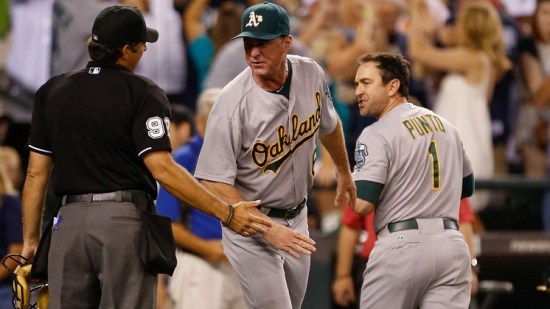
James Hoye’s game-ending strike call on a badly borderline pitch didn’t amuse Oakland manager Bob Melvin or batter Nick Punto in this 2014 debate. (Ironically, Hoye at last review was considered an ump friendlier to hitters than pitchers when calling balls and strikes.) Too many umps with too many individual strike zones may mean the robot ump coming to the Show soon enough once the bugs are un-bugged.

Now and then, it seems as though I can’t live life too long before I hear someone arguing that the Supreme Court often gets a little too big for its constitutional britches. Surely you’ve heard the argument, “The Constitution is what the Supreme Court says it is,” countered customarily by those who demur with, “That’s what you think.”

Baseball has a comparable argument. The rule book isn’t quite the Constitution, of course, but if you think about aligning a baseball game to the Supreme Law of the Land the pitcher taking a sign from his catcher and winding up to throw to the plate could be the Preamble, and—unless the batter connects—the strike zone could be Article I. (It’s actually in Rule 2.0, but let’s not get technical.)

And there are those who love the game and all it stands for dearly who’ll tell you, “The strike zone is what the umpire says it is.” If you think the Constitution is grist for judicial tyranny arguments, just get yourself into a debate about the strike zone as grist for umpires as judicial tyrants—and the coming of robotic umpiring.

The so-called “traditionalist” doesn’t want anything or anyone other than umpires deciding the strike zone and calling balls and strikes. That’s the way it’s been done for a century and a half, right? I don’t want to automate those guys out of a job. Leave that to [the] auto industry. Keep automation out of baseball.

Never mind that automation didn’t come strictly to the auto industry. Never mind, too, that baseball’s welcomed automation since the advent of the electric-light scoreboard and the pitching machines that are still in use in spring training camps.

For the ump behind the plate, his job begins with construing MLB Rule 2.0’s definition of the strike zone properly: [T]hat area over home plate the upper limit of which is a horizontal line at the midpoint between the top of the shoulders and the top of the uniform pants, and the lower level is a line at the hollow beneath the kneecap [determined by] the batter’s stance as the batter is prepared to swing at a pitched ball.

It doesn’t say, “The strike zone is whatever the umpire says it is.” Like the Supreme Court as defined in Article III of the Constitution, the umpire has pitch and play-calling perimeters. Like the Supreme Court, the umpire also has limits. Unfortunately, both retain the capability of disobeying those limits. The Supreme Court may actually be better behaved. May.

Enough baseball people thought about it enough that the automated strike zone is all but on the threshold of arriving in the Show. It’s going to be tried this season in the newly-constructed Low-A Southeast League, which you used to know as the Florida State League. It’s not exactly bug-free just yet, as The Athletic‘s Jayson Stark warns:

This is said to be an “improved” version of the [Automated Ball-Strike System] used in the Atlantic League and Fall League. But what baseball needs to study most closely is what definition of the strike zone needs to be plugged into the computer to produce a zone that resembles what current hitters and pitchers think of as a strike. When the Atlantic League used the rulebook strike zone in 2019, the robots called strikes on pitches that not a single human in the park thought was a strike. That has to change for this system to work in the big leagues.

So there is some thought that ultimately, baseball might need to shrink the top of the electronic zone significantly, bring the bottom of the zone up slightly and expand the corners microscopically. But those adjustments might also be used to produce more balls in play. So this is a highly significant work in progress.

They’ll have to work out lots of bugs first, of course. Things such as tracking pitch movement accurately and the technology’s timing algorithms. Things also including but not limited to making sure Robby the Umpbot doesn’t call “strike!” on big curve balls that bounce in front of the plate and up onto the absolute floor of the zone—assuming the next Vladimir Guerrero doesn’t swing on it anyway and loft a bloop single or rip a screaming line drive past the infield.

They’ll also have to find the way to program it to conform to the tiny subtleties in the batter’s box movements of the one man on the field who does have the greatest legal leeway to define the strike zone. It ain’t the men in black and gray, kiddies.

The strike zone rule allows the batter leeway to define the zone. There’s no official uniform batting stance. If there was, Hall of Famer Rickey Henderson would have been up you-know-what’s creek. There were times the Man of Steal at the plate looked almost like a catcher in a crouch behind it. It’s not on the umpires to say, in effect, “I don’t like your batting stance, so I’m just going to teach you a little lesson in the proper plate approach.”

(There are no official uniform pitching deliveries, either, in case you wondered. The pitchers who’d be up the same creek if there were would only begin with Hall of Famer Juan Marichal, with his approximately sixteen different windups and half as many leg kicks, including his famous Rockettes-like high kick.)

The ump who blows a strike call or a play call isn’t committing mischief even an eighth as grave as the Supreme Court blowing the Dred Scott decision. But think of the rallies compromised or ended, the stretch drive games, the championship series games killed, because of the umpire calling it not just wrong but flagrantly wrong.

The umps aren’t exactly strangers to debates over strike zones and their assumption of the right to define them. The original Major League Umpires Association imploded in large part over baseball government’s 1999 bid to hold them to account over them. MLB asked teams to chart the pitches and report individual umpire strike zones, the old union said, essentially, you our bosses have some pair evaluating the performance of we your employees.

“[J]ust another case of Big Brother watching over us,” snapped old MLUA chief Richie Phillips. Then Phillips turned up on the 14 June 1999 installment of Real Sports, the HBO sports program, and equated umpires with (wait for it!) federal judges: “And I don’t believe they should always be subject to the voter, just like federal judges are not subject to the voter.”

That one Sandy Alderson—now the Mets’ president of baseball operations, then the commissioner’s executive vice president of baseball operations—couldn’t resist: “Federal judges can be impeached. I got worried when I found out that players were more concerned with who was umpiring the next day than they were about who was pitching.”

Alderson might also have pondered that there was cause for alarm about pitchers more concerned who was calling their pitches than who’d be trying to hit them.

“The game is played by humans… why take away one of the most human elements of the game???” demands a member of an online baseball forum in which I take part. “That’s what makes it beautiful.” Is one of the most human elements of the game no longer supposed to be trying to get it right? Are the players the only ones required to get it right while the umpires are obliged to anything but?

If you don’t want to automate the umpires out of the home plate part of their jobs, insist that they do their jobs. We’re not trying to eliminate the colourful, fun umpires; God knows it makes the game a lot more fun when your Fernando Tatis, Jrs. and Mookie Bettses are matched by your Ron Lucianos and Dutch Rennerts.

Oops. Luciano left the game in 1979. (And, tragically, committed suicide a decade and a half later.) Rennert retired after the 1992 season. (He died three years ago.) In 1991, a survey of managers, general managers, coaches, and scouts rated Rennert—whose Statue of Liberty-high raised fist and kneeling thrust right calling a strike was topped only by a holler that could (and usually did) drown out a full house at Dodger Stadium—the third-best umpire in the Show.

Today’s umpires are about as much fun as a COVID diagnosis. Watching them blowing calls and then so ostentatiously behaving as though the rules are what they say are the rules on the spot isn’t entertaining. You’ll sooner name the starting lineup of the 1903 St. Louis Browns on Opening Day without clicking the link than you’ll name fans who pay royally for a day at the ballpark to see the home plate ump first.

Those who can’t accept a technological corrective to arbitrary self-aggrandising, potentially wrong game-changing behaviours should be pitied. Those who insist the “human element” alone justifies denying the corrective and keeping umpires above the actual rules of baseball play, even if it means games and maybe even championships turning or ending for the wrong reasons, should be condemned.

This commissioner gotta commission better

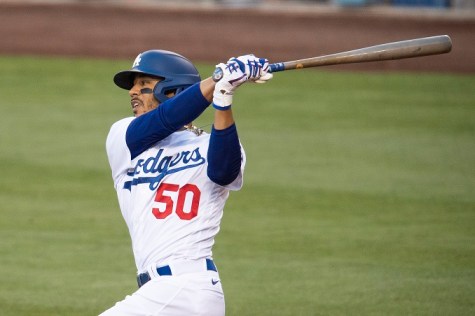
Commissioner Rob Manfred hands a piece of metal to 2020 World Series-winning Dodgers co-owner Mark Walter.

Once upon a time, when Ed Fitzgerald chaired the Milwaukee Brewers and former Red Sox star George Scott was their first baseman, Scott surveyed the lay of the team’s baseball land. Then, he offered Fitzgerald sage counsel which the chairman may or may not have taken above and beyond a shaft of Scott’s underappreciated wit.

“You know, Mr. Fitzgerald,” said the Boomer, “if we’re gonna win, the players gotta play better, the coaches gotta coach better, the manager gotta manage better, and the owners gotta own better.” It’s to wonder whether Scott, who died in 2013, might be surveying the lay of baseball’s land today from his seat in the Elysian Fields, adding, “And, the commissioner gotta commission better.”

Good luck with that. Commissioner Rob Manfred remains baseball’s Nero, fiddling while the game burns. The good news is, the fires are scattered and more vulnerable than the current edition of the Pirates. The bad news is, Manfred too often behaves as though this fire needs just a couple of sprinkles to quench while that fire requires gasoline. When he’s able to make up his mind in the first place.

The fact that there is confusion about whether or not there will be a universal DH in MLB for the upcoming season,” tweets former Dodgers and Mets player development official Nick Francona, perhaps channeling his inner George Scott, “is a reflection of how bad the commissioner is at doing commissioner things.”

Commissioner things include something outlined formally in the Major League Baseball Constitution: Section 2(b) and 2(c) let the commissioner investigate and remedy or punish “any act, transaction, or practise charged, suspected, or alleged not to be in the best interests of the national game of Baseball.”  Section 3 outlines the commissioner’s punitive remedies, including the maximum $2 million fine against a team, $500,000 fine against an owner or club executive, and “an amount consistent with the then-current basic agreement with the Major League Baseball Players Association.”

In other words, baseball commissioners have slightly broader powers over the game than presidents of the United States have over the country. But they don’t always use those powers when they should and ignore them when they shouldn’t.

Think of things this way: Presidents have itched for grander powers than that chintzy Constitution gave them in the first place. Sometimes they’ve gotten them; sometimes, Congress has handed them to the president on a platter. But even there the president has his (or her, perhaps, in the future) limits, even if he (she) accepts them kicking and screaming.

Richard Nixon once thought that if the president does it it’s not illegal–and was disabused of that idea profoundly enough. Bill Clinton and Barack Obama shamelessly believed, as Clinton’s aide Paul Begala once said, infamously, “Stroke of the pen, law of the land. Kinda cool,” regarding lawmaking which isn’t really the executive branch’s constituted function, though assorted Congresses past have pawned enough of their lawmaking off to the executive branch. Donald Trump once said, “Then I have an Article II, where I have the right to do whatever I want as president.”

Maybe those men should have sought to become baseball commissioners. Section 4 of the MLB Constitution says that, unless it’s something on which votes are required, the commish can’t be limited in acting in the game’s best interest.

Tanking teams? Guess what. Section 4 says the integrity of the game “shall include without limitation, as determined by the Commissioner, the ability of, and the public perception that, players and clubs perform and compete at all times to the best of their abilities.” (Emphasis added.) For clubs, you’d have to be naive at minimum or sight and hearing impaired at maximum to believe a club’s performance is limited to the play on the field.

Astrogate? Well, it was fully within Manfred’s right to decide the better part of valour was to hand players on the 2017-18 Astros blanket immunity in return for spilling about the how and why of the Astro Intelligence Agency. That doesn’t mean it was within his smarts. So the Astros got fined $5 million max, owner Jim Crane got fined five hundred large, Manfred threw in a couple of forfeited choice draft picks for good measure, and—except for general manager Jeff Luhnow—the cheaters got away with it officially, if not in the public eye.

If only the powers to act in the game’s best interest included the kind of intelligence test that would have required Manfred to remember the good of the game isn’t restricted to making or saving money for it. He could have told the tankers, “Nobody likes to lose, money or games, but if you didn’t get into this game to even try winning you might want to think about getting out.”

(P.S. The commissioner can force an ownership out, at least by way of calling for a vote to throw him or her out. There’s no “deprivation of property rights” involved, as someone of my former acquaintance tried to plead when Bud Selig finally forced Dodgers owner Frank McCourt to sell. Baseball’s a franchise business. Just like McDonald’s. Break the rules, abuse your franchise, you’re out, whether you’re making Big Macs or a baseball team.)

Manfred had the same power to tell the 2017-18 Astro players, “You’re going to spill, or I’m going to spill you.” The Astros might not have even thought about trying that non-apologetic apology/apologetic non-apology presser last year before the pan-damn-ic shut spring training down.

And Manfred could have made an effort toward more than near-boilerplate in denouncing cheating, the way A. Bartlett Giamatti—then president of the National League—did in upholding the suspension of ball-doctoring Phillies pitcher Kevin Gross, even if Manfred isn’t anywhere in Giamatti’s league as a writer, speaker, or thinker:

Acts of cheating . . . are secretive, covert acts that strike at and seek to undermine the basic foundation of any contest declaring the winner—that all participants play under identical rules and conditions. Acts of cheating destroy that necessary foundation and thus strike at the essence of a contest. They destroy faith in the games’ integrity and fairness; if participants and spectators alike cannot assume integrity and fairness and proceed from there, the contest cannot in its essence exist.

Manfred’s ham-handed bid to try tying the universal DH to the expanded postseason was so clumsy—though not quite as clumsy as his try at reneging on the pro-rated players’ pay deal before last year’s irregular season finally launched—that you couldn’t blame the players union from saying no, nein, and nyet. The commissioner also gives little indication that he understands the former’s benefit to the game on the field and the latter’s compromise of it.

Has anyone shown Manfred the historical futility of pitchers at the plate instead of throwing to it? (Does he even know the DH was a National League idea first?) Has anyone explained to him the universal DH isn’t going to add jobs as much as it’ll offer a fair number incumbent pine riders chances to get in the game, because they may not be leather virtuosi but they can sure swing the bat and create runs?

Has anyone really sat Manfred down to explain that the postseason was diluted and saturated already with the double wild cards in each league without his even thinking about making last year’s pan-damnic-ally inspired expansion/dilution a permanent thing? Has anyone explained to Manfred that the more postseason games, the more saturation, and the more general fan interest dissipates by the time the World Series rolls around?

All that and more might require something that seems beyond Manfred’s competence, if not his being. Whatever errors his predecessor and former boss Bud Selig committed, and Selig was baseball’s Fiorello La Guardia in that regard (the legendary New York City mayor: When I make a mistake, it’s a beaut), even his least flexible critics never questioned that Selig genuinely loved baseball.

Few fans and certainly no commissioner before or since have been as eloquently shameless in loving baseball as deeply as the ill-fated Giamatti loved the game. It’s not even close. But not even in anger would Selig refer to the World Series trophy as just a piece of metal, under any impetus. Dive into the voluminous published writings about his successor and you won’t go more than a few minutes without seeing questions as to whether Manfred even likes, never mind loves the game. One minute it seems yes, the next, no.

Baseball hasn’t been quite as irrevocably “traditional” as its self-appointed purists wish to think. Much like the country that is its home, the game has rid itself of dubious traditions in the past and created or allowed newer ones throughout its history. It takes a commissioner of vision to conjugate the distinctions and develop or promote the remedies required if and when required.

Manfred isn’t exactly a man of vision. Unless you consider monkeying around with the ball, awarding free cookies on second base to open extra half innings, imposing arbitrary limits on pitching changes, ignoring the real culprit of protracted games (hint: it takes less time to bring relief pitchers in and have them ready to face the next batters than to run the commercials that run during those changes), and fiddling while the tankers burn the their fans and the game itself visionary.

It’s enough to make you afraid of what’s going to happen when the current collective bargaining agreement finally does expire after this season. That is, unless Manfred and MLBPA executive director Tony Clark—himself not necessarily over-endowed with vision—decide at last to start thinking about the true good of the game above and beyond saving or making money for it.

Maybe it’s time to consider a different way to choose a baseball commissioner. From the beginning, the commissioner has been the owners’ pick alone. Maybe it’s finally (if not long past) time to bring the players into that process. Maybe it’s time for a commissioner to be chosen from a vote of thirty team ownership representatives and thirty team player representatives.

Quick: Name one fan who ever paid his or her hard earned dough for a day or night at the ballpark to see the team’s owner—except perhaps for lusty protest over protracted calamity. (Who else remembers the Yankee Stadium Banner Day winner of the late 1980s, wearing a monk’s outfit, carrying a Grim Reaper’s scythe, from which hung the placard, “Forgive him, Father, for he knows not what he does”—and ejected from the yard promptly on official orders?)

Manfred is in over his head holding the job. He shouldn’t have had the job in the first place. But so long as he does—barring an uprising among his employers, the owners, he has it through the end of 2024—this commissioner gotta commission better.

Home Run—a poem


This is the first baseball poem I have ever written.—JK.

Home Run

The first pitch
inside and tight.
The batter’s flinch
the grunted “ball one”
the re-composing step
back into the box.

The second pitch
diving to the floor
of the flexible zone
swung on and missed
even the pitcher
surprised by the breeze.

The third pitch
rising like temperature
at a nasty debate
the batter allows
its swift escape.

The fourth pitch
from the inside looking out
the batter off guard
lines it into the camera well
deuces wild.

The fifth pitch
imitation of
the Arch de Triumphe
the batter knows
a ripoff when he hits it
high drive
somewhere over the rainbow
into the mighty river.

Dyson drydocked for domestic violence

If Sam Dyson was stunned by surrendering Jose Bautista’s postseason-advancing bomb, imagine how stunned his former girlfriend was by his attacks upon her and her pet.

Until today, relief pitcher Sam Dyson was probably known best as the co-catalyst for one of the Show’s most ridiculous brawls, half a year after he surrendered the postseason home run that provoked it. Today he says goodbye to baseball 2021, having been suspended for the season for violating the Show’s domestic violence policy.

When Dyson hit free agency in November 2019, The Athletic revealed a pair of social media posts by his former girlfriend provoked a baseball government investigation. Athletic writers Ken Rosenthal and Katie Strang unearthed that her posts in which she didn’t name the assailant referenced Dyson after all.

At the time, Alexis Blackburn wrote on social media about receiving violent haranguing and objects thrown at herself and her cat. Today, Strang shared a statement from Blackburn to herself on Twitter:

I had the strength and courage to come forward so other women and victims know they aren’t alone, that this isn’t healthy, that you’re worth more than the bruises on your body and the bitch you’re referred to . . . We fought hard and we were validated by one of the largest sports organisations in the world.

The Athletic‘s initial expose included quoting Blackburn writing on the Instagram account she kept on behalf of her cat, Snuckles. “No one deserves to be intimidated, scared, worthless, and hopeless.”

Once upon a time, Dyson himself could actually be thought of as believing likewise.

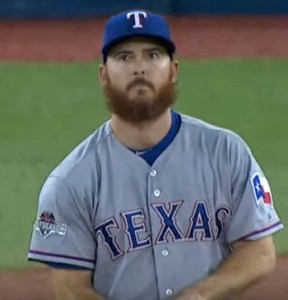
We take you back to 14 October 2015, when Dyson as a Ranger squared off against Jose Bautista of the Blue Jays in Game Five, bottom of the seventh, in an American League Division Series. With two on and two out, and a 1-1 count, Dyson—himself a one-time Blue Jay—threw a fastball toward the inner half of the plate and up the middle. Uh-oh.

Bautista hit a monstrous three-run homer off the rim of the upper left field deck. Punctuated by a whirlybird of a bat flip as Bautista strode out of the box to run it out. The blast turned a three-all tie into a 6-3 Jays advantage that held up to send them to the American League Championship Series.

The worst thing Dyson did or said then was misintepret Edwin Encarnacion’s gestures calling for fans to quit throwing things around the stadium and engage in a brief argument. The second worst came after the game when he changed into his Fun Police uniform.

“Jose needs to calm that down, just kind of respect the game a little more,” Dyson told reporters afterward. “He’s a huge role model for the younger generation that’s coming up playing this game, and I mean he’s doing stuff that kids do in Wiffle ball games and backyard baseball. It shouldn’t be done.” That’s how many kids playing Wiffle ball who grow up to hit postseason-advancing skyrockets?

Fast forward now to the 2016 regular season series between the two teams.

Dyson faced Bautista in the first game of a May set between the two in Toronto. If he or the Rangers wanted a little revenge for that October blast flip, this was the time to seek it. But Dyson never once made any move against Bautista. Neither did any other Ranger—until the final game of the season between the two teams, in Arlington, 15 May 2016.

Bautista whacked a three-run double off Rangers reliever Tom Wilhelmson in the top of the sixth. The next Jays batter, Encarnacion, got drilled on the first pitch. After the Rays loaded the bases on him in the top of the seventh, Wilhelmson yielded to Matt Bush, who surrendered a sacrifice fly but nothing else to make the game 6-3, Jays.

Then Bautista led off against Bush—freshly returned to baseball after his imprisonment for manslaughter when his motorcycle ran over an elder man who subsequently forgave him for the crime—in the top of the eighth. Exactly why Bush did what he did with the first pitch still escapes, since he wasn’t even part of the Rangers organisation when Bautista hit the postseason-advancing blast.

But Bush drilled Bautista on pitch one. A fly out later, Justin Smoak grounded to third for a double play. Bautista slid hard into second baseman Rougned Odor, straight over the pad, with Odor on the relay throw looking very much like he was more interested in trying to decapitate Bautista than in finishing the double play.

“I could have injured him, but I chose not to,” Bautista said after the game. “I tried to send the message that I didn’t appreciate getting hit.” Especially not seven months after the fact, in the latest innings of the final contest between those two teams for the rest of the year, when any Ranger pitcher had six previous 2016 occasions to send Bautista a message about going interstellar and celebrating the launch so ostentatiously.

“Having failed [decapitation], and apparently ignorant of how in the wrong Bautista wasn’t,” I wrote at the time, and I haven’t changed my mind almost six years later, “Odor watched Bautista spring up preparing to defend himself, knowing Odor looked as though he had further mayhem on his mind. And then it came. First Odor shoved Bautista. Then, when Bautista extended an arm in a very obviously defensive position, Odor swung and landed that right cross.”

Just what did Odor expect to receive at second base after Bautista got drilled by Bush so late, if Bautista was given the chance—a dozen roses with a singing telegram? If your team is cowardly enough to wait until Bautista’s last possible chance to face you all year to send a seven-month-old message, you might want to consider yourself grateful that a hard slide into second base was all you got before you decided to throw a punch or two.

Both benches emptied. The umpires may have figured Bush threw the driller under orders because he wasn’t ejected, though he was fined. Odor and Bautista got ejected posthaste, with Odor getting eight games suspended plus a fine and Bautista getting one game—because the slide was illegal under the Utley Rule but nothing worse. Appropriately.

As I noted further at the time, “Funny how all the so-called ‘old schoolers’ canonizing Odor forgot Bautista answered that unwarranted plunk the old-school way. Throw at Jackie Robinson, Hank Aaron, Frank Robinson, Willie Mays, Duke Snider, and if they got the chance on a followup grounder they’d have sliced and diced the nearest middle infielder on the play at second.”

The real-life law-enforcement Texas Rangers motto, legendarily, is: “One riot, one Ranger.” The baseball Rangers left themselves after that set with a likewise indelible image: One Ranger, one riot.

All throughout that early-year season series, up to and including the scrum Odor’s idiocy (and that of whomever ordered the hapless Bush to throw the Bautista driller) provoked, Dyson was one Ranger who behaved like a complete professional.

Somewhere along his travels to come, from the Rangers to the Giants, from the Giants to the Twins, before right shoulder capsule surgery looked to bench him for 2020, Dyson in whatever frame of mind he was decided his girlfriend deserved violent bawlings out and target practise a few too many times for her comfort and his professional good. And in that order.

His frame of mind isn’t an excuse. This isn’t a soldier or a Marine in the early grip of post-traumatic stress syndrome, having violent nightmares about the death and destruction he’s lived, trying to injure his wife while dead asleep and unaware of what he’s doing.

It’s entirely possible for couples in any kind of love, to disagree and debate without exchanging thoughts and feelings for loud, lewd insults and self-propelled objects at each other’s heads and bodies.

There are indeed worse things a man can do than surrender a monstrous, ultimately postseason series-winning home run. Dyson went from there and from professionalism in refusing to seek vengeance seven months after the fact to taking whatever out violently on his one-time girlfriend and her pet. For making them victims like that, there’s only one appropriate word.

The word is disgust.

Commissioner Rob Manfred’s statement upon announcing Dyson’s suspension read, “Having reviewed all of the available evidence, I have concluded that Mr. Dyson violated our policy and that discipline is appropriate.”

How about saying, “I’ve seen the evidence. Eff our ‘policy,’ what he did to her’s a crime.  This guy’s lucky that a year off without pay is all I can give him. What’d be appropriate is me throwing things at him to see how he likes it.”