Stop wearing 42 ubiqitously on Jackie Robinson Day

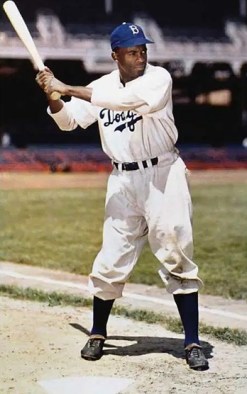
Jackie Robinson

Only one Show team really has the call to wear 42 on Jackie Robinson Day. But he can still be honoured by the rest of the Show on his day . . .

Before he was anything else once he broke baseball’s disgraceful colour line, Jackie Robinson was a Dodger. A Brooklyn Dodger. A Dodger as the first major league Rookie of the Year (the award became one for each league in 1949), a Dodger when the Boys of Summer finally made this year next year (the 1955 World Series), and a Dodger when he retired at 37.

My friend Howard Cole, a splendid baseball writer who created the Internet Baseball Writers Association of America (and very kindly lured me into life membership), tried to remind people of that point around Jackie Robinson Day 2013.

“Truth be told,” he wrote for L.A. Weekly then, “while I understand the reasoning behind it, I’m a little jealous of the teams that get to share in the holiday. They didn’t do anything in particular, and some made things as difficult for Jack as can possibly be.” Not to mention that not every team other than the Cleveland Indians (with Larry Doby) and a third Show team got the near-immediate hint.

“I’d kind of like to see just the Dodger players wearing the number 42 on their jerseys,” Cole continued, “with the rest of teams bowing in reverence.”

Retiring Robinson’s uniform number baseball-wide is one thing, but my friend Cole is right. On Jackie Robinson Day—whether everyone’s playing on the actual day or whether, as this week, it covers two days since several teams were off Thursday—only one team has the proper call to wear 42 on their backs.

That team is Robinson’s team.

It’s not that the entire Dodger team necessarily welcomed him with open arms and hugs when he first arrived in 1947. There were teammates who did so. There were others who didn’t. There were those among the latter who petitioned to push the Dodgers not to bring Robinson up from the Montreal Royals, where he’d won the International League batting title and helped lead them to the league championship.

Robinson had to change hearts and minds the hard way. In a Dodger uniform. He had to change hearts and minds on both his own team and the rest of the league. It was easier to convince a barracuda to think about a strictly vegetation diet. Maybe the toughest mind he had to change was the man said to have petitioned the Dodgers to block Robinson’s advent in the first place.

But there the Dodgers were clinching the 1947 pennant. And there in The Sporting News was a remarkable quote: No other ballplayer on this club, with the possible exception of Bruce Edwards, has done more to put the Dodgers up in the race as Robinson has. He is everything Branch Rickey said he was when he came up from Montreal.

That was Dixie Walker talking. The same Dixie Walker who’d once said he’d sooner stay home and paint his house than play with a black man on his team. The same Dixie Walker who eventually made a reputation as a coach for helping young black players adjust and improve their swings at the plate. Though he’d be one-upped by a southern white teammate named Bobby Bragan.

When Branch Rickey called his southern Dodgers to ask about the Walker petition and their real feelings, Bragan said right out he’d been raised to segregation. Rickey agreed to trade Bragan but never made the deal. Bragan’s heart and mind could be changed by only one man. Robinson.

Rickey asked Bragan if he’d play his best with Robinson on the team. The reluctant Bragan said yes, he would. Then, little by little, piece by piece, Bragan found himself drawn to Robinson. They’d talk baseball, on the team train and in the dugout, maybe sharing a joke or two. Before long, as a remarkable profile by Joe Posnanski said, Bragan found himself dissenting from his own family’s dismissal of Robinson. “Wait a minute,” he told his family, “you don’t know him.”

“Bragan and Robinson became friends, real friends, the sort who would go to each other’s houses for dinner occasionally, the sort who would happily embrace whenever they came across each other,” Posnanski wrote. “And Robinson was always proud that Bragan became known as a man who would treat people fairly, honestly, no matter the color of their skin.”

Bragan went further. He became a manager in the minors and the majors and developed a bigger reputation for helping young minority ballplayers—including turning a frustrated kid in the Dodger system into a switch hitter and shepherding his path to the Show, a kid named Maury Wills.

“I think it’s just a matter of becoming acclimated to the thing by association,” Bragan ended up writing in his memoir, Baseball Has Done It. “I was exposed to integration daily under the shower, in the next locker, on the bus, in the hotel and many conversations . . . All this adds up to a tolerant attitude, a little more understanding of the situation than if we’d never left Alabama.”

If only today’s Bragans in and out of baseball were that open. And not just when it comes to black players, black people. When the Indians’ Yu Chang—a middle infielder by trade placed at first base, and a Taiwan native—made an unfortunate ninth-inning throwing error (instead of stepping on the pad for the second out, his throw to second trying for a double play hit Yasmani Grandal in the helmet, allowing the White Sox to score the winning run), he was hit with particularly racist Twitter messages.

“Maybe fix those slanty eyes and you can throw the ball straight jerk off,” said the nastiest of the messages and probably the one above all that hit Chang between his eyes. “Exercise your freedom of speech in a right way,” he tweeted, “I accept all comments, positive or negative but DEFINITELY NOT RACIST ONES. Thank you all and love you all. #StopAsianHate.”

I hope I wasn’t the only one who noticed that that happened to a member of the team that followed the Dodgers’ lead almost immediately, when the Indians’ then-owner Bill Veeck bought Larry Doby from the Newark Eagles of the Negro National League and Doby broke the American League colour line in July 1947.

Hank Thompson

Hank Thompson—the St. Louis Browns became baseball’s third integrating team when picking Thompson and Willard Brown in 1947.

Would you like to know or be reminded how baseball’s re-breaking of the colour line (there’d been black and Latino players in the pre-20th Century game, however scattered or short lived before the colour line was imposed in earnest) actually progressed? Here you go:

After Robinson in Brooklyn and Doby in Cleveland, the next team to admit black players in 1947 was the St. Louis Browns, with infielder Hank Thompson and outfielder Willard Brown. Brown at 32 played one season with the Browns but became a Hall of Famer by way of the eventual Negro Leagues Committee in 2006; he’d been a solid slugging player for the legendary Kansas City Monarchs.

Also 1947—the Dodgers brought up pitcher Dan Bankhead, whose Show career didn’t amount to much. From there, here are the first black/minority players with each major league team of the time:

1949—Hall of Famer Monte Irvin, the outfielder who broke the New York Giants’ colour barrier.

1950—Sam Jethroe, outfielder, Boston Braves. Anyone who says Boston just wouldn’t have accepted black or minority players in those years should be called a liar. The Braves welcomed black players as liberally as the Tom Yawkey Red Sox wouldn’t.

1953—Ernie Banks (shortstop, Chicago Cubs), Bob Trice (pitcher, Philadelphia Athletics), Carlos Bernier (outfielder, Pittsburgh Pirates). Bernier was a black Puerto Rican; a year later, the Pirates welcomed African-American second baseman Curt Roberts. Inexplicably, Show historians tend to consider Roberts and not Bernier the first black Pirate.

1954—Tom Alston (first baseman, St. Louis Cardinals), Nino Escalera and Chuck Harmon (outfielder, infielder-outfielder, respectively, Cincinnati Reds—both players debuted in the same game), Carlos Paula (outfielder, Washington Senators).

1955—Elston Howard (catcher, Yankees).

1956—Ozzie Virgil (catcher/infielder, Tigers).

1957—John Kennedy (infielder, Phillies).

1959—Pumpsie Green (infielder, Red Sox.)

If you want to be absolutely technical about it, only three teams in today’s Show really have any business thinking about wearing 42 on Jackie Robinson day: the Dodgers, the Indians, and the Orioles, who’d moved from St. Louis in the first place after 1953 but who thought nothing of bringing two black players to the major league team in the same year as Robinson premiered.

What should the other teams do on Jackie Robinson Day if they have no call in certain ways to wear 42? I have an idea: Let the teams in both leagues who were there before expansion wear the numbers of their first black players.

Let the Braves wear Sam Jethroe’s number 5. Let the Red Sox wear Green’s number 12. Let the Cubs wear Ernie Banks’s 14 and the White Sox wear Minnie Minoso’s 9. Let the Tigers wear Ozzie Virgil’s 22. Let the Giants wear Monte Irvin’s 20. (He debuted with 7 but changed his number in 1950.) Let the Yankees wear Elston Howard’s 33. Let the Athletics wear Bob Trice’s 23, let the Phillies wear John Kennedy’s 8. Let the Cardinals wear Tom Alston’s 10, let the Twins (the original Senators) wear Carlos Paula’s 31. (Paula wore 31 for two of his three Washington seasons.)

Let the subsequent expansion teams wear the numbers of significant black players who played contiguous to their areas unless we know whom their first chosen black players might have been:

Los Angeles Angels—Julio Becquer, 19. The first black player the Angels picked in the 1960 expansion draft that created the team.

Texas Rangers—Since they were born as the second Washington Senators, maybe they could wear Homestead Grays legend Buck Leonard’s 32.

New York Mets—Martin Dihigo, Hall of Fame pitcher for the New York Cubans, 17.

Houston Astros—This is a stretch: the Newark Eagles moved to Houston in 1948, by which time the team’s most notable players were either going to the Show or gone. Maybe Ray Dandridge, the Hall of Famer who wore 38 as an Eagle.

Kansas City Royals—This one’s a no-brainer: Satchel Paige, who wore 25 as a Kansas City Monarch.

Milwaukee Brewers—The erstwhile Seattle Pilots have a kind of choice: they could wear Luke Easter’s 9, since Easter once played for the Seattle Steelheads; or, they could wear Henry Aaron’s 44, since Aaron was the first black player signed by the Braves after they moved to Milwaukee and played his final MLB season with the Brewers.

Julio Becquer

Julio Becquer, the first black player to be selected by the Angels in the expansion draft creating the team.

San Diego Padres—John Ritchey, the first black player in the Pacific Coast League, who played as it happened for the Padres of that old venerable PCL. Uniform number: 1, I think.

Washington Nationals—Born as the Montreal Expos, well, nobody could top Jackie Robinson who’d been a Montreal Royal. But since they’re ensconced in Washington and won their franchise-first World Series as the Nats, they could go for a Homestead Grays immortal since the Grays played most of their games in Washington: Hall of Famer Josh Gibson, 20.

Seattle Mariners—Artie Wilson, who integrated the ancient Seattle Rainers of the ancient PCL and was the last Negro Leagues player known to hit .400. I haven’t been able to unearth his Rainers uniform number, but when he made it briefly to the New York Giants he wore 15.

Toronto Blue Jays—Charlie White, relief pitcher, Hall of Famer as a Negro Leaguer, and one of the first two black players signed to the longtime minor league Toronto Maple Leafs after Jack Kent Cooke bought the team in 1951. I can’t find his Negro Leagues uniform numbers, but he did wear 24 as a brief mid-1950s Milwaukee Brave.

Colorado Rockies—Middle infielder Bubbles Anderson. The only Negro Leaguer known to have been born in Colorado. Played for the Negro minor league Denver White Elephants, whose schedule often included games against white Colorodan minor league teams. Later played for the Monarchs and the Birmingham Black Barons. Number: 22.

Florida Marlins—Herbert Barnhill, a catcher for the Jacksonville Red Caps, Florida’s only-ever entry in the Negro American League. The Red Caps lured Barnhill from the Atlanta Black Crackers. Number: Possibly 18.

Arizona Diamondbacks—Ford Smith, pitcher and the only native of Arizona ever to play in the Negro Leagues, with four seasons as a Monarch before the New York Giants signed him to play in their organisation. Smith never made the Giants. I can’t unearth his uniform number, either, so since he was the first from Arizona let the D’Backs wear 1 with his name on the back.

Tampa Bay Rays—Walter Lee Gibbons, pitcher, who played for the Tampa Rockets of the Florida State Negro League before joining the legendary Indianapolis Clowns of the Negro American League. Number: 19.

If the foregoing has been a bit of a sprawl, I apologise. But it just doesn’t seem right that every Show team should wear 42 on Jackie Robinson Day. Not when only one team in the Show has the true right to claim Robinson as their own pioneering Hall of Famer, not when only two other teams took the same-season hint.

That team is the Dodgers. Everyone else, please ponder the foregoing and do your best to make it so. But don’t stop there, either. It would make everything Robinson stood for and believed meaningless if baseball can’t convince more of today’s generations of young black and other American minority people to embrace and feel at home playing Robinson’s game as their game, too.
He almost killed the Mets

Citi Field

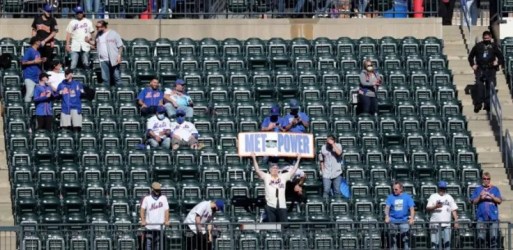
Met fans at Citi Field earlier this month. Bernie Madoff, the man whose grand ripoff made Charles Ponzi resemble a piker and nearly destroyed the Mets, has died.

There’s a 34-story building in Manhattan known as the Lipstick Building. Not because it ever housed a particular cosmetics company but because of its look. It resembles a glass-and-girder lipstick tube. The co-designers were John Burgee Architects and Philip Johnson, the latter a once-fabled disciple of modern architecture’s “White God No. 2” (Tom Wolfe’s phrase) Ludwig Mies van der Rohe.

The Lipstick Building seems an appropriate place to have housed the working offices of Bernard L. Madoff Investment Securities. That firm’s founding father only thought he’d applied enough lipstick to the $65 billion pig exposed as the single greatest ripoff in Wall Street history in 2009, a ripoff that made Charles Ponzi resemble a piker.

As one Tweeter phrased it Wednesday morning, “RIP Bernie Madoff, the man who made Bobby Bonilla day possible.” For openers.

Madoff’s death at 82 was reported earlier Wednesday, the federal Bureau of Prisons saying nothing more other than to confirm the financier’s death. The bureau wouldn’t disclose the actual cause “for safety, security and privacy reasons,” though it was known that Madoff suffered end-stage kidney disease and other maladies.

He was an equal opportunity defrauder, nicking and draining the rich and the modest alike. The reputed 37,000 victims around the world include Nobel Peace laureate Elie Wiesel, film legend Steven Spielberg, Yeshiva University, a Syracuse local of the plumbers’ union, the charity for Jewish leukemia and lymphoma patients despite his younger son’s fight against lymphoma, and an Afghanistan war veteran.

They also included Hall of Fame pitcher Sandy Koufax and a few other sports figures such as former Mets middle infielder Tim Teufel and New York Islanders hockey dynasty wingman Bob Nystrom. And, especially, former Mets owners Fred Wilpon, Jeff Wilpon, and Saul Katz.

The elder Wilpon invested with Madoff beginning in the mid-1980s, not long after he became the Mets’ co-owner and, in time, very likely unaware that promised massive returns were illusory at best. Those promised returns enabled the Mets in 2000 to agree to a buyout of veteran but fading Bobby Bonilla’s remaining contract.

The actual remaining value was $5.9 million. The Mets instead agreed to pay him $1,193,248.20 a year for the coming 25 years at eight percent interest. Bonilla gets that check every 1 July. Wilpon believed that double-digit returns on his Madoff investments would cover the Bonilla buyout and deliver glandular profits above and beyond whatever they’d be paying their former player. Not quite.

The Mets will be on the hook for the Bonilla buyout until 2035. The Wilpons found themselves on the hook for $65 million in loans to meet the Mets’ payroll after Madoff admitted to prosecutors that he’d ripped off billions of his investors’ monies while financing a lavish lifestyle for his wife and family.

Were the Wilpons plain victims like most of Madoff’s clients? Did they know more about Madoff’s bloated ripoff than they let on? One bankruptcy trustee named Irving Picard thought so.

Tasked with recovering monies lost in the Madoff scheme, Picard sued the Wilpons to compel them, as Crain’s New York Business described, to “return $300 million in ‘fictitious profits,’ paid out to their family, their associates, and businesses by Mr. Madoff ’s firm over many years.”

The New York Times called that a “novel claim,” noting Picard “was initially seeking an extra $700 million because he says, the Mets’ owners looked the other way while they benefited from Madoff’s fraud.”

It wasn’t that simple to determine whether the Wilpons and Katz were victims like the others or whether they looked the other way because their investments with Madoff became more of a part of the Mets’ business model than once intended.

“Clearly, Wilpon ignored the warnings because it benefitted him to do so,” argued Sports Are From Venus writer Zachary Diamond in September 2019. “He did not go against Madoff and his fraud at any point because of how financially important it was to his business. Had it not benefited him, Wilpon most likely would have stopped investing with Madoff, as one should do after learning something was fraudulent.”

“Madoff promised and delivered consistent, high, and ultimately false returns of as much as 12%-18% of their investments, which is why the Wilpons and Katz had such an extensive relationship with him,” writes AMNY‘s Joe Pantorno.

Of course, they didn’t know that; relying on Madoff for quick, extra cash as needed to help bolster the Mets’ roster in the late 90s and early 2000s, for example.

But the Wilpons used money made from Madoff as collateral on other loans, so when Madoff went bust, Mets ownership had to borrow $430 million against the team and an additional $450 million against their regional television network, SNY.

It created massive debts that forced the Wilpons to pay over $100 million per year alone, created alongside the annual $43 million payment on Citi Field.

That was why Mets fans’ wishes of their favorite team going out and signing that big-name free agent didn’t happen often enough. That was why a club that plays in the largest sports market on the planet was being run like it played its games in Kalamazoo instead of New York City.

“The fallout shrunk the [Mets’] payroll, from $140 million in 2011 to $95 million in 2012 to $85 million in 2014 as salaries rose across the game,” writes ESPN’s Joon Lee. “Subsequently, the Wilpons slowly lost power and financial stake in the team.”

In 2012, federal judge Jed Rakoff ruled that Picard overshot his target by a glandular distance. “After careful consideration,” Rakoff proclaimed, “the court concludes that the trustee has entirely failed to demonstrate the kind of extraordinary circumstances that would warrant this court in granting his motion,” saying Picard hadn’t proven the Wilpons and Katz “willfully blinded themselves” to Madoff’s chicanery. The Wilpons and Picard settled in due course for $162 million.

When the depth of Madoff’s ripoff was exposed, hedge fund titan Steve Cohen bought a $20 million stake in the Mets. Today Cohen is the Mets’ owner, after buying the Wilpons and Katz’s majority stakes last September. The Mets have since begun behaving like the large market team the Madoff ripoff throttled them from being in its wake.

As of today, according to the U.S. Attorney’s office for the Southern District of New York, victims of the Madoff ripoff have recovered roughly eighty percent of the estimated total $65 billion out of which they were swindled in the first place. The Wilpons and Katz made off with $2.4 billion when selling the Mets.

“Bull or bear market, recession or recovery, Madoff’s clients were always guaranteed a great year,” writes New York Post columnist Mike Vaccaro.” At the very least [Fred] Wilpon — a man who was his own self-made success story in business — was grossly and almost irresponsibly naive.”

Signing shortstop Francisco Lindor to a ten-year, $341 million contract extension just before the current major league season began would have been unthinkable, so long as the Wilpons and Katz remained the Mets’ majority owners while still having to pay over $143 million to retire the loans compelled by the Madoff ripoff.

Madoff’s investment victims weren’t his sole victims, of course. His oldest son Mark committed suicide two years after Madoff’s arrest; his younger son Andrew died of lymphoma in 2014. Mark and Andrew Madoff had listened to their father confess to the racket in December 2008, with the father promising to get things straightened out within the next 24 hours. They didn’t give him the chance, going to their lawyers and then to the authorities.

Ruth Madoff broke off all contact with her husband after the suicide; their grandchildren are said to have changed their names hoping to escape what Town & Country called “the family shame.” Mrs. Madoff was allowed to keep $2.5 million in return for forfeiting all her other assets, the magazine said, and must report any spending over $100 to a bankruptcy trustee.

New York City mayor Bill deBlasio, a man who normally shows wisdom by standing athwart it, says Madoff’s death doesn’t mean it’s time to dance on a grave. “[B]ut let’s just be honest: Many, many people were hurt by his actions,” deBlasio told the press. “It’s time to hopefully turn the page and move forward.”

The victims may first turn to the page on which they’ll see Clarence Darrow saying, “I have never wished a man dead, but I have read a great many obituaries with a great deal of pleasure.”

Paul Lo Duca learns the hard way

Paul Lo Duca, Billy Wagner

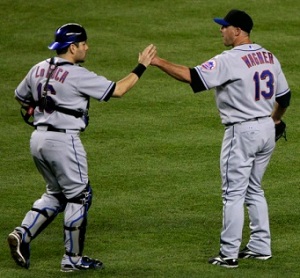
Paul Lo Duca and Billy Wagner share a high-five after nailing down a Mets win. Claiming Joe West’s strikes could be bought with Wagner’s classic Chevy sends Lo Duca from high five to out five hundred large . . .

You can accuse one of baseball’s two most notorious umpires of anything you like. Call him a craven self-promoter. Say his strike zone behind the plate is more flexible than politician’s policy positions. Tell the world he’s a meathead for complaining about the length of a baseball game between two certain teams over whom he appoints himself judge and jury.

Those won’t get you hauled into court to answer for defamation. But say on the air that Joe West’s strikes could be bought for the price of using your pitcher’s classic automobile and it’ll cost you six figures. Especially when West wasn’t even behind the plate in the games in question when you caught that pitcher.

Former major league catcher Paul Lo Duca is learning the hard way after losing a defamation lawsuit West filed in 2019. That year, Lo Duca accused West, the single most notorious umpire this side of Angel Hernandez, of being very generous calling strikes with relief ace Billy Wagner on the mound, after Wagner agreed to let the chunky umpire use the lefthander’s 1957 Chevrolet any old time he chose whenever they were in town together.

That’ll cost Lo Duca $500,000 plus interest paid to West after a decision in Manhattan Supreme Court Monday, during a session to determine damages for which Lo Duca didn’t even show up according to numerous published reports.

Lo Duca claimed on a 2019 sports betting podcast that he talked to Wagner after a game in which Wagner both advised Lo Duca to set up a little more inside on the hitters and suggested West would give Wagner the inside corners a little more generously. Why? Here’s Lo Duca himself aboard that podcast:

We’re playing like a really tight game against the Phillies and Billy Wagner comes in from the bullpen. I used to go to the mound every time and like, ‘What’s going on?’ and he’s like, ‘Hey, Joe’s behind the plate. Set up a couple more inches inside. I was like, ‘Are you kidding me? Joe hates me.’ He’s like, ‘No, no, no, no, no, no. Joe loves me.’

I go, ‘He hasn’t given us the corner all day.’ He’s like, ‘Don’t worry about it.’ He literally throws 10 pitches and strikes out three guys. Joe rings up all three guys. Eight out of the nine pitches were at least three to four inches inside, not even close. Guys were throwing bats and everything. Joe walks off the field.

I get back into the clubhouse and I’m like, “What the [fornicate] just happened just right now?” And Wagner just winks at me. I’m like, “What’s the secret?” He’s like, “Eh, Joe loves antique cars so every time he comes into town I lend him my ’57 Chevy so he can drive it around so then he opens up the strike zone for me.”

I’m like, “This guy’s been throwing me out for the last 10 years of my life and all I needed to do was rent him a ’57 Chevy?”

'57 Bel Air

A 1957 Chevrolet, the kind of car Billy Wagner didn’t use to buy strikes from Joe West.

There were two problems with Lo Duca’s revelation, as things turned out. Problem One: West countered, and the records support him, that he was never behind the plate when Wagner was on the mound with Lo Duca catching in either 2006 or 2007, the two seasons Lo Duca spent with the Mets. Problem Two: Wagner himself submitted a December 2020 affidavit denying he talked to Lo Duca about buying West off with a vintage Chevy or anything else.

Manhattan Supreme Court Judge John Kelley found it too simple to rule in West’s favour when Lo Duca didn’t show up Monday or respond directly to West’s suit otherwise. As of this writing, Lo Duca hasn’t responded to the court ruling and Wagner hasn’t spoken publicly about the case or the critical conversation he denies ever happened.

West remembers working only one Mets-Phillies game behind the plate in the 2006-2007 time frame and Wagner wasn’t on the mound at any time during the game—which ended on a home run, not three straight punchouts. Unlike on a lot of occasions when he calls strikes balls, balls strikes, outs safe, and safes out, West was dead right about that.

You can look it up. In 2006-2007, the Mets played 27 games that ended in walk-offs. Their record in those games: 18-9. (That’s a .667 winning percentage in those games, for those scoring at home.) They included two walk-off games with the Phillies in each year; the Mets won only one of those games:

9 May 2006—Final score: 5-4, Phillies. The walk-off blow: Mets reliever Aaron Heilman’s throwing error on Bobby Abreu’s grounder, allowing David Delluci (two-out triple) to score the winner. Billy Wagner: didn’t pitch. Paul Lo Duca: caught and batted second in the lineup. Home plate umpire: Doug Eddings.

23 May 2006—Final score: 9-8, Mets, sixteen innings. The walk-off blow: Carlos Beltran’s leadoff home run off Phillies reliever Ryan Madson. Wagner: pitched the 11th; fly out, two swinging strikeouts. Lo Duca: caught the entire game and batted second. Home plate umpire: Jeff Kellogg.

28 August 2007—Final score: 4-2, Phillies. The walk-off blow: Ryan Howard’s two-run homer off Guillermo Mota. Wagner: didn’t pitch. Lo Duca: caught and batted seventh. Home plate umpire: Joe West. Most likely, this is the game West himself remembers.

30 August 2007—Final score: 11-10, Phillies. The walk-off blow: Chase Utley’s RBI single through the hole at second, after Tadahito Iguchi singled to tie the game and stole second. Wagner: pitched the ninth and surrendered the tying and winning runs. Lo Duca: entered the game in the eighth taking over for Mike DiFelice and batting eighth. Home plate umpire: Ed Hickox.

Four times the Mets and the Phillies played games ending in walk-off hits in 2006 and 2007. Joe West was the plate umpire for one of those games, in which Wagner didn’t pitch but Lo Duca caught. In the two games in which Wagner did pitch, he struck out two of his three batters in the first game but struck out none of the batters he faced in the second game.

As a matter of fact, Wagner was credited with the pitching wins in three Mets walk-offs in 2006 and two in 2007. So we should have a look at those, too:

9 April 2006, vs. the Marlins—Final score: 3-2, Mets. The walk-off blow: David Wright’s sacrifice fly in the bottom of the ninth. Wagner: pitched the top of the ninth, worked his way out of a two-out jam by inducing a ground out to second base, no strikeouts. Lo Duca: caught the entire game and batted second. Home plate umpire: Ed Montague.

1 May 2006, vs. the Nationals—Final score: 2-1, Mets. The walk-off blow: Lo Duca’s grounder to relief pitcher Gary Majewski on which Majewski’s throwing error trying to start a double play allowed Endy Chavez to score the winner. Wagner: pitched a spotless ninth with two swinging strikeouts and a ground out right back to the box. Home plate umpire: Chris Guccione.

19 May 2006, vs. the Yankees—Final score: 7-6, Mets. The walk-off blow: Wright scoring Lo Duca with a fly single off Hall of Famer Mariano Rivera. Wagner: struck the side out swinging in the top of the ninth. Lo Duca: of course, caught the entire game and batted second. Home plate umpire: Alfonso Marquez.

23 June 2007, vs. the Athletics—Final score: 1-0, Mets. The walk-off blow: Wright’s RBI double. Wagner: shook off a leadoff single in the top of the ninth to get a bunt ground out, a fly out, and a swinging strikeout. Lo Duca: started the game but came out for a pinch hitter in the sixth. Home plate umpire: Marvin Hudson.

21 August 2007, vs. the Padres—Final score: 7-6, Mets. The walk-off blow: Luis Castillo’s RBI single. Wagner: pitched the ninth and surrendered a game-tying run on Kevin Kouzmanoff’s sacrifice fly, during a rough inning in which he surrendered a single, a walk, and a hit batsman to load the bases for Kouzmanoff. Lo Duca: didn’t play. Home plate umpire: Angel Hernandez.

Five times between 2006 and 2007 Billy Wagner ended up the pitcher of record in walk-off wins by the Mets; only once did he get credit for the win when the Mets walked it off after he’d surrendered a tying run. Paul Lo Duca was behind the plate for Wagner in three of the five. Joe West didn’t call balls and strikes in any of those five games, including the one such game in which Wagner did strike out the side—against the Yankees, not the Phillies—with Lo Duca behind the plate.

West plans to retire after this season. Trying to bring Lo Duca to account, West’s legal team pressed his fear that the Lo Duca podcast appearance would injure his chances to be elected to the Hall of Fame, especially considering he stands to break Hall of Fame umpire Bill Klem’s record for games umpired. As The Athletic points out, umps elected to Cooperstown earn a lot more on the rubber chicken and autograph circuits if they have the Hall of Fame on their resumes.

Never mind whether or not you think West belongs in Cooperstown. Lo Duca forgot one of the key lessons we learn at ages younger than Lo Duca’s when he first made the Show: Look before you leap. The tide may have receded.

Don’t blame replay for Bohm staying safe

Travis d'Arnaud, Alec Bohm

Repeat after me: Alec Bohm was out at the plate . . . Alec Bohm was out at the plate . . . (Atlanta Journal-Constitution photo.)

The arguments against using replay to determine close plays included that it would take a big, big, big piece of the human factor out of a game. Well, what the hell was that we saw in Atlanta Sunday night?

It was the human factor getting it wrong despite having what Braves pitcher Drew Smyly called five different angles on a nationally televised game.

It was home plate umpire Lance Barrett missing a call on a bang-bang play at the plate in the top of the ninth but the replay review crew out of New York essentially doubling down on the wrong call, despite how right Smyly was and having five or even more angles to review.

It was Phillies third baseman Alec Bohm colliding with Braves catcher Travis d’Arnaud as he arrived sliding as d’Arnaud with the ball lunged to block the plate, forcing Bohm to slide just offline enough to miss touching the plate even with his lead foot.

It was the Phillies winning 7-6 when the Braves went three-and-three in the bottom of the ninth and Bohm saying almost nothing but, “I was called safe. That’s all that matters.” Note that “I was called safe” isn’t exactly the same thing as saying, “I was safe.”

Even the Mets weren’t that coyly disingenuous about Michael Conforto elbowing his way to a blown call in his favour and a bases-loaded hit-by-pitch walkoff against the Marlins last Thursday.

With one out in the top of the ninth Phillies shortstop Didi Gregorius lofted a fly the other way to left. Marcell Ozuna strode in toward the line to catch it. As Bohm tagged at third, Ozuna fired a two-hop strike down the line that hopped into the crouching d’Arnaud’s mitt. In the same split second d’Arnaud turned right, his folded leg across the plate with the tag on the sliding Bohm’s back leg.

D’Arnaud did bump Bohm in front of the plate for a moment. Bohm’s left foot, his lead foot, never touched the plate, flying just over it, and neither did the rest of his body parts, before he sprang up in a bent-knee pirouette and turned another one upright, waving his arms, including one wave that looked as though he were making a safe call.

If you want to give Barrett a benefit of the doubt you could say plausibly that d’Arnaud sprawling across the plate after the bumping tag on Bohm might (underline that) have obstructed his full view of Bohm’s slide.

“We saw it,” insisted Phillies manager Joe Girardi standing by his man and the review crew at once. “It looked like his big toe kind of hit the corner of the plate is what we saw when we saw a lot of the angles.”

I saw it, too, from a lot of the angles. For Girardi to say that, Bohm’s big toe must have been on his heel. On the angle his foot flew over the plate, his heel was actually a hair or two closer to hitting the plate than his big toe was.

Smyly didn’t pitch all that well Sunday night—he surrendered five runs on five hits in five innings’ work, including a two-run homer to Ozzie Albies in a three-run first and a leadoff solo to Freddie Freeman in the bottom of the fifth. But his perspective on that play at the plate was anything but impaired.

“[I]t’s clear that his foot didn’t touch the plate, that it was on the chalk,” Smyly told reporters post-game. “Everyone saw it and sees it, everyone knows it. And for MLB not to overturn that, it’s embarrassing. Why even have replay if you won’t overturn that? That’s the way I feel about it. I think everybody feels that way. There’s five different angles. It’s clear, he didn’t touch the plate.”

#HeDidntTouchThePlate became a Twitter hashtag almost as fast as the original play went down in the first place. Better that than the Truist Park audience throwing debris down onto the field. They had every right to be outraged, but better chanting (as they did) Bull-[sh@t]! Bull-[sh@t!] than throwing junk and at least one bottle kept from doing damage by, ironically, the netting hoisted to protect fans from bullet-fast foul balls.

Braves shortstop Dansby Swanson, himself native to Atlanta, may have felt his team got jobbed, but he wasn’t too thrilled about the fans’ display, either. “It’s an embarrassing representation of our city because I know from being from here, that’s not how we act,” he said after the game.

And then probably the worst part of it all, I don’t think people realize we have families here. There are kids that are here, kids that are sitting in the front row, and you’ve got bottles whizzing by their heads. Just endangering kids that may not be able to protect themselves is downright embarrassing, and it should never happen again. It just can’t happen, and it never needs to happen again.

It spoiled a night on which both teams brought their bats to town and swung them with authority. From Albies in the first and Freeman in the fifth to Ronald Acuna, Jr.’s fourth-inning sacrifice fly and mammoth seventh-inning home run. From Rhys Hoskins’s leadoff bomb in the fourth and Gregorius’s three-run homer two outs and back-to-back singles later, to Bryce Harper’s opposite-field leadoff launch seven or eight rows into the left field seats in the sixth.

When The Athletic queried the New York replay crew about the Bohm safe call, the journal received an e-mail reply: “After viewing all relevant angles, the Replay Official could not definitively determine that the runner failed to touch home plate prior to the fielder applying the tag. The call STANDS, the runner is safe.” How many angles was “all relevant angles?”

“It makes me not even want [replay review] anymore,” d’Arnaud said. “Honestly, it just slows the game down. It took like five minutes for them to decide that and, to me, they got it wrong. So I’d rather just not have it and get the game going.”

Some plays take a little longer than five minutes to decide, some take a little less. D’Arnaud’s frustration is the most understandable among any Brave. When Conforto was ruled a hit batsman as plate ump Ron Kulpa changed his strike call in the bottom of the ninth last Thursday, Mets broadcaster Ron Darling asked why have replay if the review umpires can’t get it right.

Kulpa admitted his mistake the following day. (He got a lovely ovation from the Citi Field audience Saturday for his admission.) Barrett hasn’t weighed back in at this writing. But the issue isn’t replay itself. The issue is that there’s still a human factor in baseball games, major league or otherwise, and that factor can still get it wrong even with every potential angle showing otherwise.

Even a major league player or two ripped the call. Padres third baseman Will Middlebrooks tweeted, “How do you watch that replay and say he’s safe. Hahaha this is a joke.” Of all people, Angels all-everything center fielder Mike Trout tweeted, “So bad…” followed by an emoji showing a smiley face in tears laughing. D’Arnaud’s brother Chase, himself a former major league utility infielder, tweeted back to Middlebrooks and Trout, “the guy makes that call in New York should be interviewed just like players who get interviewed after games.”

Not just by reporters but by baseball’s government, too.

It’s far too early in the major league season for a game and a call like that to wreak real havoc on a pennant race, of course. If the safe call was overturned as it should have been, it would have meant the Braves and the Phillies each at 5-4 and tied for first in the National League East this morning.

But if a replay review crew can still blow what angle after angle showed them wasn’t a runner safe across the plate in mid-April, how egregiously will they blow a similar call down the stretch in a game that weighs like a bank vault on the races?

“I try to control what I can control”

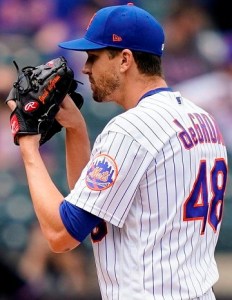
Jacob deGrom

He pitches like Tom Seaver for a team that hits like the St. Louis Browns when he’s on the mound.

Here we go yet again. And it’s getting more ridiculous than before. To the point where someone might be tempted to spike Jacob deGrom’s MP3 player with the Four Tops.

Once upon a time, that legendary Motown quartet sang, “It’s the same old song/with a different meaning since you’ve been gone.” Except it isn’t deGrom who’s gone, it’s the Mets offense when he’s on the mound.

He’s too much a team player to say it, but he must be tempted to wish his teammates wouldn’t just sing “Reach Out, I’ll Be There” but mean it and show it.

For the second time in his first two 2021 starts, deGrom pitched like a Hall of Famer. For the second time in his first two starts, his Mets could have been hauled into court for non-support and for trashing what he left behind. Or, at least, for impersonating the St. Louis Browns.

On Saturday his only blemish was the 0-2 fastball Marlins rookie Jazz Chisholm deposited over the right field fence in the top of the second, after deGrom struck Garrett Cooper and Brian Anderson out swinging.

Those were two of fourteen strikeouts deGrom nailed in eight innings’ work. He threw 95 pitches and 76 were strikes; he scattered five hits including the Chisholm bomb; he was, in other words, the Jacob deGrom who may still remain the favourite for this year’s National League Cy Young Award.

If the Mets keep playing this kind of baseball with deGrom on the mound, the righthander may set another precedent, even in theory: the first 20-game “loser” to win the Cy Young Award.

Don’t laugh, it could happen. DeGrom has an 0.64 ERA and a 1.55 fielding-independent pitching rate. Right now, these Mets seem capable entirely of going the distance to hang 20 losses in deGrom’s locker despite him making their late Hall of Famer Tom Seaver resemble the late Anthony Young.

Marlins rookie Trevor Rogers pitched like a deGrom aspirant on the other side, with ten punchouts in six innings and three measly hits against him while walking two to deGrom’s none. He threw 68 percent of his pitches for strikes to deGrom’s 80 percent. These Marlins need all the good news they can find and Rogers, a lefthander who stands an inch taller than deGrom does physically, may be some of their best news this year.

For eight innings the game stayed 1-0 and deGrom’s elegant assassination of the Marlins other than the Chisholm blast was rewarded with the Mets forgetting that it’s neither necessary nor possible to hit six-run homers every time they check in at the plate.

They had Brandon Nimmo opening the first with a double and taking third when the Marlins misplayed Francisco Lindor’s bunt at second base—and stranded him when Lindor got arrested for attempted grand theft second base followed by Michael Conforto and Pete Alonso striking out.

They had Dom Smith leading off the fifth with a line single past second base but James McCann dialing an immediate Area Code 6-4-3; then, they got the gift of Jeff McNeil wringing Rogers for a full count walk and taking second on a balk with Jonathan Villar at the plate—but they also got Villar striking out for the side.

They had deGrom himself leading off the sixth with a base hit, first and second when Nimmo followed immediately with a walk, and first and third when deGrom had room enough to tag for it on Lindor’s fly to the back of right field—and Conforto and Alfonso striking out for the side again.

They had six chances to get men in scoring position home and blew all six chances. Even allowing how tough Rogers was on the day, that’s six veterans unable to out-think the rookie when they were at the plate and give their own man even two runs to work with.

Of course, in deGrom’s first start the Mets actually let him leave a game with a lead only to see one inning of shutdown relief followed by another of the bullpen puking the bed. This time, the Mets left deGrom in a 1-0 hole—and the bullpen had another stomach upset.

Specifically, the one imposed by Edwin Diaz opening the Miami ninth. He served Starling Marte a grapefruit to hit for a long double on 0-1 and handed Jesus Aguilar a 1-0 meatball to dump into short right center for an RBI single. Just when it looked like Diaz would contain the damage with a fly out to center (Cooper) and a grounder to short (Anderson) forcing Aguilar at second, he walked Chisholm unintentionally and served Miguel Rojas an orange to shoot through the hole at shortstop and send Anderson home.

Then Jeurys Familia kept the damage to a pair by striking out Chad Wallach on three pitches. What was the reward in the bottom of the ninth? Doing nothing against Miami reliever Yimi Garcia. Lindor lined out to the right side of the infield, Conforto grounded out to second, and Alonso looked at strike three right on the floor of the zone on 1-2.

Guess Conforto couldn’t elbow his way into getting something going the way he did Thursday, when he did or didn’t quite get out of the way of a pitch that caught him on the elbow guard with the bases loaded in the bottom of the ninth.

Twenty viewings of that segment and I still couldn’t tell for dead last certain whether Conforto thought about a swing and snuffed the thought at once, or whether he thought he might get away with taking one for the team. Those who think Conforto was looking for a sneaky play should be reminded that his career-long habit with two strikes on him is to lean over the plate a little more than normal.

Plate ump Ron Kulpa rung him up on strike three—then called hit batsman. A replay review didn’t overturn the call that Kulpa knew should have been strike three with the batter failing to get out of the way of the strike. Even the Mets’ own broadcast team—Gary Cohen, Keith Hernandez, and Ron Darling—knew Conforto got away with manslaughter.

The ump declared mea Kulpa right after that game. He got cheered by the Citi Field crowd Saturday, appropriately. We know too much about ump malfeasance and umpires refusing to admit they blew one; we should expect an ump getting some love when he admits he made a big mistake.

The boo birds let the still-struggling Conforto have it in the sixth. Speculation abounds that Conforto in his contract walk year and other formidable Met hitters are pressing too heavily at the plate. (They’re 6-for-41 with men in scoring position so far.)

Nimmo all but admitted as much when he told a reporter, “That could be happening, I’m not in everyone’s mind, but I do try and talk and figure out what guys are thinking, but that definitely could be happening as the game goes on and the runs are not there . . . it definitely could be happening in some guys’ minds.”

Ask deGrom—as the same reporter did about him having a 2.06 ERA since 2018 while the Mets have been six games under .500 in his starts in the same span—and you’re not going to get him to admit he just might have those non-support papers ready to file at the nearest courthouse.

Even if he isn’t quite the most luck-afflicted of hard-luck pitchers. Nobody denies deGrom pitches in an ocean of rotten luck. But he’s not even the most hard-luck pitcher in Met history, believe it or not. That dubious honour belongs to Jon Matlack, whose 39 percent of starts with two runs or less to work with is the highest in franchise history. Higher than the 37 percent shared by Matt Harvey and Hall of Famer Nolan Ryan, higher than the 33 percent of Hall of Famer Tom Seaver, higher than deGrom’s 35 percent.

That could change rather drastically, if the Mets continue their very dubious practise of forgetting how to hit when deGrom is on the mound. Bless him, deGrom doesn’t want to think about things like that. Yet. “I try to control what I can control,” he insisted, “and that’s getting ready for my next start. I hadn’t seen that stat. These guys are great. They’re going out there giving 100 percent. Today we just got beat.”

If he doesn’t exactly sound like the abused spouse who’s willing to believe yet again that the abuser will keep the promise to never, ever, ever do that again, he’s not that far from it, either. If he keeps pitching like a Hall of Famer and wins a third Cy Young Award this year, despite his team making his “won-lost” record resemble an Anthony Young Award winner’s, someone’s going to have to do an intervention.