PETA, the gulli-bulls

Tyler Matzek

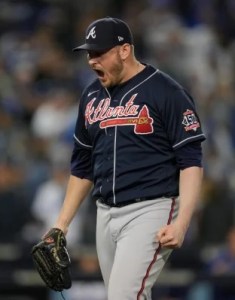
Braves postseason relief star Tyler Matzek.

Major league bullpens are controversial today because fans and commentators who incline toward one or another kind of baseball “purism” think enough teams today depend too much upon their occupants. People for the Ethical Treatment of Animals would like to make them even more controversial, at least until their name, too, is changed.

What’s wrong with “bullpen,” you ask? You might want to withdraw that question. PETA thinks that call to the bullpen should be turned into a call to the “arm barn” post haste. The organisation fearing that the very name of baseball’s bullpens makes fun of male cattle bound for the slaughterhouse thinks nothing of asking their renaming for . . .

Well, I’ll let Urban Dictionary say it for me: “shoving one’s fist up one’s [derriere]. Similar to fisting only a funnier word. Hey sailor… wanna go home and arm barn me?” I’ll also let PETA’s executive vice president Tracy Reiman say it for them: “Words matter, and baseball bullpens devalue talented players and mock the misery of sensitive animals.”

Apparently, we didn’t have enough to trouble us away from the World Series this week. We lamented the Braves’ continuing allowance of the insulting Tomahawk Chop and commissioner Rob Manfred’s abject ignorance of its insult. We wondered whether the Series moving to Atlanta meant yet more rounds of the Chop’s chant and hand gesture or the Braves’ administrators ordering its demise.

We also might have wondered which was actually more degrading to the play of the game itself—Braves fans persisting with the Chop, which is obnoxious racism; or, those Astro fans who still think their heroes were singled out and “scapegoated” over the most extreme illegal electronic cheating the game has known so far, which is plain decadent.

(Instruct me, please, how other teams using for sign stealing what MLB itself provided—replay rooms available to all teams, all parks, tempting the kids to imbibe when Mom and Dad left the liquor cabinet keys behind, so to say—equals the Astros’ elaborate 2017-18 hybrid of front office-generated cheating algorithms, plus an illegal real-time camera sending opposing signs to clubhouse monitors, for deciphering and transmission to batters at the plate.)

But no. PETA had to weigh in charging baseball with what the group calls “speciesism” over the designation of that semi-isolated space in which relief pitchers reside and prepare for entry into the middle of a game, often as not into the middle of excruciating jams into which the mound incumbents or the defenses or both have bumped their teams.

Reiman is either unaware or disinclined to believe that baseball’s relief pitchers have been more than their origins—pitchers who couldn’t cut the mustard as starters—for several decades. She’s also either unaware or disinclined to believe the bullpen was named not for the hold of bulls slaughterhouse bound but for . . . a brand of tobacco, sort of.

“The enclosure we now call a bullpen began much later [in baseball’s evolution,” wrote Peter Morris in A Game of Inches: The Story Behind the Innovations that Shaped Baseball, “because relief pitchers were highly uncommon in early baseball . . . ”

It was a couple of more decades [into the 20th Century] before relief pitchers became common enough to make permanent bullpens necessary. Their name primarily reflects that the area was an enclosure, but it may also have been influenced by the Bull Durham signs that were prominent [on outfield walls] in ballparks from 1911-1913.”

Morris wrote further, “Supporters of this theory note that the earliest known reference dates to 1913,” when a Washington Post writer said of Philadelphia Athletics pitching coach Ira Thomas that he “corrects the faults of the youthful trajectory hurlers and takes them to the bullpen in the afternoon and keeps them warmed up.”

Maybe I shouldn’t have cited that. Some other activist group with just as small a ratio of sense to passion is liable to demand the baseball bullpen be re-named that the game may quit glorifying that which is hazardous to our health. But ignorance is at least as hazardous to the nation’s and the game’s health as any pouch of Bull Durham before the brand’s 1988 demise.

“Devalue talented players?” Relief pitchers may not yet earn quite the dollars that starting pitchers still earn, but before Reiman decides they’re devalued—by a section name or otherwise—she might wish she’d been there for sights and sounds discussed previously in other contexts on these pages.

Maybe she doesn’t remember, never saw, or never heard of the earlier relief masters such as Firpo Marberry, Hugh Casey, Joe Page, Jim Konstanty (the National League’s Most Valuable Player in 1950), Lindy McDaniel, Elroy Face, Don Mossi, Don McMahon, Larry Sherry (the 1959 World Series MVP), Stu Miller, Ron Perranoski, Dick (The Monster) Radatz, or Phil (The Vulture) Regan. (She certainly doesn’t look old enough to have seen Radatz as just about the only reason to watch the 1962-65 Red Sox.)

Maybe she doesn’t remember or didn’t see and hear the standing ovations for Hall of Fame relievers Hoyt Wilhelm, Rollie Fingers, Goose Gossage, Bruce Sutter, Lee Smith, Dennis (the Menace) Eckersley, Trevor Hoffman, and The Mariano when they strode in from the pens to pin opposing lineups back when their game predecessors faltered or the lead in the last inning or two was too close for comfort.

Maybe she wonders how she could have slept while nine relief pitchers—Sutter, Fingers, Eckersley, Mike Marshall, Sparky Lyle, Willie Hernandez, Steve Bedrosian, Mark Davis, Eric Gagne—won Cy Young Awards between 1974 and 2003.

Perhaps Reiman didn’t watch spindly Kent Tekulve (a pitcher so slender he could hide behind a telephone pole) factor in the “Fam-I-Lee” Pirates’ 1979 World Series triumph; or, Al (The Mad Hungarian) Hrabosky sending himself nuclear before toeing the rubber to throw a pitch.

Maybe she missed the Reds’ Nasty Boys relief team (Norm Charlton, Rob Dibble, Randy Myers) or the Royals’ H-D-H relief team (Greg Holland, Wade Davis, Kelvim Herrera) factoring large in their respective 1990 and 2015 pennants and World Series triumphs.

Nor could she have seen AJ Minter and Tyler Matzek pin the Dodgers to the wall en route their Braves winning the pennant, or keep the Astros in line in Game One of the current Series. Such devaluations have tremendous value to championship-aspirant baseball teams. They also bring fans in the stands to a boil of joy.

But Reiman cares greatly that baseball’s bullpen, which wasn’t named explicitly for the pen holding bulls en route the slaughterhouse, should be re-named for a particularly grotesque act of, shall we say, sexual extremism.

PETA is known as much for allowing the slaughter of 90 percent plus of abandoned dogs and cats under its care as they’re known now for defending “sensitive” bulls against insensitively-designated baseball bullpens. Their designated hitter doesn’t seem to think suggesting name changes such as, say, “relief pool,” or “the firehouse,” was refreshing or racy enough to fit their narrative.

One hears the immortal Bugs Bunny snickering, “What a gulli-bull . . . what a nin-cow-poop.”

WS Game Two: Hunted, pecked, pricked, poked

Max Fried

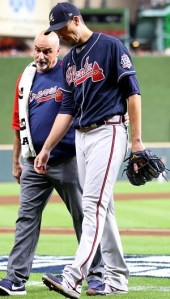
Max Fried—getting stung repeatedly in the second hurt almost worse than if he’d been bludgeoned.

If you look purely at the line score of World Series Game Two, you’d think the Braves had their heads handed to them in the bottom of the second. But if you watched the game, you know the Astros dismantled them, almost too simply, and with some inadvertent help from the Braves themselves, to win 7-2 Wednesday night.

As a matter of fact, when the game began you could have been forgiven for thinking it might turn into a bit of a pitching duel despite the teams swapping a run each between the bottom of the first and the top of the second—one on a solo home run, one on a sacrifice fly.

Overall that’s about how the game shook out—if you didn’t include the Astros’ hunt-peck-prick-and-poke of four runs out of Braves starter Max Fried in the bottom of the second, after he fooled Carlos Correa into looking at a particularly nasty third-strike curve ball. Jose Altuve’s eighth-inning home run almost seemed a by-the-way insurance run.

“We didn’t want to go to Atlanta down by two,” Altuve said postgame. “So we left everything we had in there tonight. Obviously, very important win to tie the Series to keep going from there.”

“Obviously, I’m not happy about it.” said Fried. “Playoffs is a big momentum game. You’ve got to do everything you can to keep the crooked number off the scoreboard.”

It might actually have hurt less if he’d been bludgeoned than it did the way he was pecked in the second. And, if Astros starter Jose Urquidy hadn’t brought his A game to the mound, leaving the Braves mostly unable to hit him even if they’d swung warehouse gates.

Fooling Correa into the strikeout must have seemed aberrant even to a pitcher who struck out six in five innings’ work and walked only one batter. The second inning made Fried’s outing look far worse than it was in the long run, but a true shelling it wasn’t. It was like getting stung by angry hornets one after the other a few times before he finally slithered out of it.

It started with Kyle Tucker spanking a base hit up the middle and Yuli Gurriel punching one through the shift-opened right side for a base hit to follow up at once, sending Tucker to third. Fried jammed Jose Siri into a slow tumbling grounder to the far left side of the mound, but Tucker came home when they couldn’t get the swift Siri at first.

Then Martin Maldonado, a catcher so prized for his work behind the plate that Astro manager Dusty Baker bears with his pool noodle of a bat, punched one through the left side for a base hit. The problem now was the Braves’ usually sure-handed, sure-armed defense.

Left fielder Eddie Rosario came up with the ball and threw to third in a bid to stop Siri if they couldn’t stop Gurriel from scoring. Only third baseman Austin Riley came trotting down the line to serve as the cutoff man, and shortstop Dansby Swanson got caught unable to get to third covering in time because he was in short left. Rosario’s throw thus sailed wild and Siri sailed home with the fourth Astro run of the night. Ouch!

Maldonado went to second on that throw and took third when Braves catcher Travis d’Arnaud let one escape with Altuve at the plate in an 0-2 count. Altuve flied out with Maldonado having to hold at third, but Michael Brantley pulled a base hit to right on which Maldonado could have walked home safely, making it 5-1.

Innings like that are as common to the Astros when they’re swinging right as you might think the big bombing innings would be. But they were the best in the game this year at avoiding strikeouts at the plate and hitting in most directions out to the field.

They may also have picked up on Fried tipping pitches. No, they’re not pulling another Astro Intelligence Agency trick or three. The rules since Astrogate’s explosion and aftermath include maximum replay room security. But the Astros were known without and before any Astrogate shenanigans for picking up even the tiniest tells from opposing pitchers and exploiting them mercilessly.

Fried’s habit of wiggling his glove fingers around the ball in his hand rapidly as he prepares to throw to the plate, like an amphetamine-driven lobster clawing its dinner down to manageable bites, may well have handed the Astros inadvertent but invaluable pitch  intelligence. After the second, Fried quit the glove snapping for the most part—and retired the next ten hitters he faced.

When Yordan Alvarez walked and Correa sent a base hit to left opening the bottom of the sixth, Braves manager Brian Snitker hooked Fried in favour of Dylan Lee. After Tucker forced Correa at second with Alvarez taking third, the Braves’ defense faltered into the sixth Astro run.

Gurriel grounded sharply to Swanson at shortstop. He threw to second baseman Ozzie Albies hoping to start an inning-ending double play. Albies lost the ball as he turned to throw on to first. Tucker was ruled safe until a review was called—did Albies have control of the ball to get the out while losing it as he drew the ball out of his glove to throw on?

Several television replays showed Albies lost control of the ball after all, but not by as much as first surmised. The safe call held, and Alvarez scored, but Albies’s throw wasn’t in time to get Gurriel at first. Lee shook off a rather daring double steal to set up second and third by striking Siri out. Snitker brought in Jesse Chavez, and Chavez got Maldonado to fly out for the side.

The Braves got their second run in the top of the fifth when Freddie Freeman singled d’Arnaud home. Other than that, both bullpens kept each side behaving itself except for Altuve sending Drew Smyly’s first pitch of the bottom of the seventh into the Crawford Boxes, before the veteran reliever fell into and squirmed out of his own bases-loaded jam with no further damage.

Maybe the true shock of the evening was the Braves handing the ball to Kyle Wright for the bottom of the eighth. Wright’s a 26-year-old pitcher with a 6.56 fielding-independent pitching rate in four seasons. He had a 9.64 FIP and a 9.95 ERA in two brief starts on the regular season while up and down from the minors.

Throwing that against the Astros was something like offering to assure Hall of Famer Henry Aaron would face nothing but batting practise pitchers by decree, right? Wrong. Wright shocked the entire ballpark by striking the side out in order—including Maldonado and Altuve looking at third strikes after Siri opened with a three-pitch swinging strikeout.

“It was so encouraging to see Kyle tonight,” said Snitker postgame, even if he was thrown up as a sacrificial lamb in a lost game. “Just getting in there for that one inning and getting him out there and experiencing this atmosphere because he could play a huge part going forward. I thought he threw the ball extremely well.”

Wright lived on effective curve balls and sinkers Wednesday night. Snitker was inspired enough to ponder possibilities for Wright to spot start or even open a bullpen game during the Atlanta leg. With Charlie Morton gone thanks to that fibula fracture, Snitker needs to get even more creative with his pitching arrays now. Wright’s surprise may lift some of that burden a hair or two.

“He was locating,” said catcher d’Arnaud postgame. “His sinker was moving a lot. His curveball was moving a lot. He did a tremendous job. When I caught him in a rehab game for me, he looked exactly the same as he did that day. It was fun working with him, and it was great seeing him have the success today, especially in the World Series.”

With the tied Series moving to Atlanta for three possible games, thus switching the Braves to a home field advantage, it’s comforting to know that near the end of a night the Braves were pecked to death they might have found the Wright stuff, for however long.

WS Game One: Flash! Bash! Alakazam!

Jorge Soler

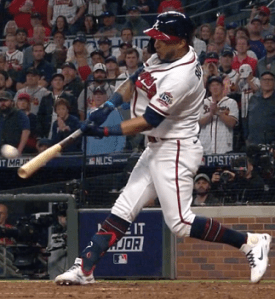
Soler swings into history and toward a Game One Braves win . . .

Yordan and Eddie Tonight, the Miniseries? The show went on, but they weren’t exactly the stars of the show Tuesday night.

Oh, they performed rather splendidly. But they turned out the headliners blown off the stage by the fourth-lowest opening performer and a wild animal act.

Which is just what Jorge Soler did with the third pitch of World Series Game One from Astros starter Framber Valdez. And, what the Braves bullpen did to the Astros the rest of the way in an emphatic enough 6-2 Braves win.

Fresh off his marquee performance against the Red Sox toward the Astros’ American League pennant, Valdez could only watch with everyone else in the Minute Maid Park house as Soler became the first player in major league history to open a World Series opener with a home run.

The audience could only watch, too, with a hybrid of frustration broken up only occasionally by their usual racket while four Braves relief pitchers kept the Astros to their only runs of the game. Not to mention helping guarantee the Braves a temporary home field advantage at least.

Valdez fell behind Soler 2-0 when he threw a sinker that dumped enough ballast en route the plate that it had altitude enough for Soler to send it on hefty flight into the Crawford Boxes above the left field scoreboard. A ground out (Freddie Freeman), an infield single (Ozzie Albies, beating out a grounder wide of the mound’s left side), and a quick theft of second later, Austin Riley split the left center gap with the RBI double.

The game wasn’t even half an hour old, and already fans of both teams must have asked, Yordan who? Eddie what?

That was before the Braves more or less snuck a third run home in the second—back-to-back opposite-field singles (Travis d’Arnaud to right, Joc Pederson to left), a long fly to the center field wall enabling two tag-ups and second and third, and Soler’s grounder to short getting Pederson caught in a rundown while d’Arnaud crossed the plate.

And, before Eddie Rosario pulled a leadoff base hit to right in the third and—following a come-back-on-message visit to Valdez from Astros pitching coach Brent Strom—Adam Duvall turned a hanging changeup into a cruise missile straight into the Crawfords and sent Valdez out of the game.

“It was my first World Series game, so I’m not going to tell you that I didn’t feel the pressure,” Valdez admitted postgame. “I think just being behind in the count so much is what hurt me more than anything in this game.”

In between Soler’s Series-opening history mark and Duvall’s two-run rip, Morton too a hard smash from Yuli Gurriel off his leg to open the Houston second. The ball ricocheted to Freeman at first for a simple enough out. Morton pitched on, getting the next two outs to end the second and then striking Jose Altuve out called on a particularly nasty curve ball.

“That one got me good,” Morton’s said to have told his catcher d’Arnaud of the Gurriel comebacker that ended up ending his season. “I’m sorry,” Morton told any and everyone who happened by after his exit and after the game ended.

He’d looked distinctly uncomfortable before throwing Altuve that out pitch. He looked pained but determined after it. Pained enough to come out of the game. He turned out to have pitched to three Astros on a broken fibula that means the end of his postseason and the Braves having to do what they’ve done best in an injury-dominated year—skip out of the way at the last second when disaster comes careening down the street.

A 37-year-old veteran channeling his inner Bob Gibson (1967: tried to pitch on after fellow Hall of Famer Roberto Clemente ripped one off his leg; fracture kept him out thirteen weeks)—and apologising for it postgame. “[I]f that doesn’t tell you everything you need to know about Charlie Morton,” said Freeman postgame, “I’m not sure what does.

Morton’s been there, done that. His career’s first half was as much big and small injuries costing him a lot of his prime time as it was pitching like a craftsman in six postseasons with one World Series ring and a splendid-enough 3.35 lifetime postseason earned run average to show for it. The man is nothing if not a walking exercise in pain management.

“I didn’t think it was broken,” d’Arnaud said. “I just thought he took a line drive off of his leg. But to go out there and strike out the next guy with a broken leg, it blows my mind.” Actually, it turns out Morton’s first X-rays showed no break, but he probably stressed his leg into the break while working on Altuve.

This is the Braves’ lot in 2021 so far. They incurred, dodged, withstood, and found ways to sneak through disaster to get to the postseason in the first place, never mind the World Series. A leg fracture taking their elder starting pitcher out for the rest of the way? Tell them about it. It wouldn’t shock them if they woke up on Game Two day having been kidnapped for the unreachable ransom.

Charlie Morton

Charlie Morton, escorted from the field in the third.

“No kidding. I don’t want to know what’s next,” said manager Brian Snitker after Game One. “But this is what we do, right?” Right. Nothing to it. Hit them with a tidal wave. Send them another hurricane riding the oblivion express. To these Braves those are just sun showers and some autumn breezes.

So far. It’s not that the Braves push their luck by design or premeditation. But you can’t help wondering just how many times they can still just wave their magic bats, gloves, or arms, and—flash! bash! alakazam!—make the other guys disappear.

Snitker had to reach for one of those arms a lot sooner than he might have expected going in. He brought AJ Minter in to take over for Morton. Minter pitched two and two thirds that would have been shutout ball if shortstop Dansby Swanson, usually one of the most sure-handed, sure-footed of the breed, hadn’t inadvertently kicked Astro center fielder Chas McCormick’s hard one-out, first-and-third grounder aside, enabling Kyle Tucker (one-out double) to score the first Astro run.

Luke Jackson followed Minter with one and two-thirds scoreless pitching before handing off to Tyler Matzek with lefthanded swinger Michael Brantley coming up with two outs in the seventh. He shook Brantley’s base hit off to strike Alex Bregman out looking for the side. But he couldn’t do a thing about Alvarez’s leadoff triple to the rear of right center opening the bottom of the eighth.

Alverz came home almost predictably when the next Astro batter, Carlos Correa, grounded out to second. After Matzek struck Tucker out on a somewhat violent swing, Gurriel ripped a drive off the left center field wall whose carom Rosario played perfectly, before throwing in perfectly to nail Gurriel at second trying to stretch the hit.

Or was it? At first glance it looked as though Gurriel’s drive hit on or above the yellow line atop the wall, which would have meant home run. Several television replays confirmed what the umpires on review ruled for certain—the ball struck the wall clearly if just barely below the line. Hocus pocus!

Not that it would have mattered in the end. The Braves landed an extra insurance run in the top of the inning, when Swanson wrung himself into a one-out walk and Soler on a check swing squibbed one into no man’s land beyond the mound that Astros reliever Ryne Stanek couldn’t get on a dive. Enabling Swanson to take third, before Freeman popped out to short right with Swanson on the run home and sliding in safely around Astro catcher Martin Maldonado’s backswinging tag attempt. Shazam!

So the Braves’ M&M Bulls didn’t do it with quite the howitzer heft by which they pinned the Dodgers to the wall winning National League Championship Series Game Six. But they did just what they had to do and kept the Astros from even thinking about a Game One overthrow regardless.

Will Smith shook a leadoff walk to pinch-hitter Aledmys Diaz off in the bottom of the ninth to get three straight ground outs—two force outs at second base, and a ground out to second—and that ended the game.

Abracadabra!

“Our team doesn’t worry,” said Astros manager Dusty Baker postgame, “and our team’s very confident. We have the knack of bouncing back after losses, after tough losses because they don’t quit, they don’t give up, they don’t get down. That’s the secret of sports.”

Beware, Mr. Baker. Your very confident Astros are up against a team that’s had to bounce back from tougher losses than Game One.

These Braves had to bounce back from losing their junior franchise face to a season-ending injury, after losing key young pitcher to a re-injured Achilles tendon and a key bomber to domestic violence protocols. Not to mention losing their leadoff hitting right fielder to COVID for the entire division series and most of the NLCS.

So the Braves will have to find a few more creative ways to survive losing their elder starter and clubhouse sage for the rest of the Series, too? Big whoop. Bad as losing Morton is, this, too, comes right into this year’s wheel house. They’d surely rather not, but where other teams crumple under the weight of forced creativity, these Braves thrive on it. So far.

Starters-as-relievers postseason? As new as Lysol.

Walter Johnson

Hall of Famer Walter Johnson—a starter used in relief to help win the 1924 World Series.

Baseball’s capacity to amuse is almost as profound as the game’s ability to inspire. It’s amusing to see the gnashing of teeth and the wringing of hands over this postseason’s phalanx of starting pitchers who had to yield to their bullpens for assorted reasons. You’d almost think someone was trying to legislate the pitching star out of baseball.

If someone is, they simply weren’t watching the games or hearing the crowds. They also have a rather troublesome ignorance of baseball history. And maybe, too, a continuing bias against relief pitching.

Sure, we love to see and remember the greatest starters of our times. I grew up watching the Hall of Fame like of Jim Bunning, Steve Carlton, Don Drysdale, Whitey Ford, Bob Gibson, Catfish Hunter, Sandy Koufax, Juan Marichal, Jim Palmer, Tom Seaver.

But I also remember seeing and feeling the thrills and kicks when the bullpen like of Dick Radatz came into a game. Hell, Radatz was practically the only reason to bother with the 1963-65 Red Sox. He was big, beefy, intimidating-looking (not for nothing was his nickname The Monster), and looked as though he was about to eat the opposing hitters for lunch.

Until his shoulder deserted him (overwork, plus [speculated] taking someone’s advice trying to add a slider to his howitzer fastballs) some time in 1965, Radatz was as big a pitching star as any starting virtuoso. Even if he did come in for the ninth of the 1964 All-Star Game and surrender a walkoff bomb to then-Phillies star Johnny Callison.

There were more relief aces than you might remember in Radatz’s time. Ted Abernathy, for a few seasons, anyway. Lindy McDaniel. Elroy Face. Eddie Fisher. Stu Miller. Ron Perranoski. Pedro Ramos, at least for the final weeks of that staggering Yankee stretch drive to snatch the 1964 American League pennant. Phil (The Vulture) Regan. Larry Sherry (the 1959 World Series MVP). Hoyt Wilhelm (the first Hall of Fame relief pitcher). Al Worthington.

You might care to note that, whether you’re paying attention now or paid attention then, four of those relievers had top-five Most Valuable Player finishes: McDaniel (1960) and Radatz (1963) each had a fifth-place finish; Perranoski (1964) and Fisher (1965) each had a fourth-place finish.

Think about that for a moment: In four of those seasons there were MVP voters who thought a quartet of relief pitchers might have been among the most valuable players in baseball. Now, those voters then considered won-lost records; those guys were credited with double-digit wins, and a few of them probably got their wins after blowing leads but hanging in while their teams managed to eke or bang out the wins late.

(Face, of course, was an 18-game “winner” in 1959, still a record for relief pitchers, never mind that he also had nineteen save opportunities—applied retroactively—and blew nine of those. In fact, according to Cooperstown Cred, one of the major reasons Chicago Tribune scribe Jerome Holtzman came up with the dubious “save” stat was his feeling that Face’s won-lost record actually over-stated his real value.)

But still.

Were you really watching when AJ Minter and Tyler Matzek clamped the vault door shut on the Dodgers in Game Six of the National League Championship Series? The noise in Truist Park when that pair threw four scoreless relief innings, helping the Braves punch their tickets to the World Series, could have drowned a heavy metal concert out.

Especially when Matzek walked right into a small fire his immediate predecessor Luke Jackson left behind. With eight pitches, Jackson surrendered a leadoff double, a walk, and an RBI double setting up second and third. With eight more pitches, Matzek struck out the side—including future Hall of Famer Albert Pujols and fellow former MVP Mookie Betts.

When Matzek got the Mookie Monster swinging to finish that escape act—if you can go from crossing the high wire to breaking your way out of the chains in the tank in one inning, Matzek did—the Truist crowd went from nuclear to Crab Nebula.

There’s been no better moment of absolute pressure relief pitching than that in this postseason. So far. Who knows what the World Series will bring, above and beyond Yordan and Eddie Tonight? Whatever it brings, come on, baby, don’t fear the reliever. (Unless you have to hit against him.) Or, for that matter, the starter-as-reliever.

You say the starter-as-reliever is just another nefarious creation of today that’s ruining pitchers and pitching? It didn’t exactly come up roses for Max Scherzer this time, of course. But it hasn’t crossed a lot of minds, either, that maybe a 37-year-old man who threw a heavier workload in September than he had any month all season might have been bound for a dead arm by the time he had to say no to starting NLCS Game Six.

But it wasn’t exactly a new thing, either. Not. even. close.

Go back to the 1924 World Series, Game Seven, for openers. When Washington Senators manager Bucky Harris not only delivered what we call a bullpen game to win that Series but secured the Old Nats’ shot at it by bringing (and the crowd went wild, too) Hall of Fame starting pitcher Walter Johnson in from the bullpen for what proved four innings’ shutout relief.

When Casey Stengel managed the Yankees, his five straight pennants and World Series rings out of the chute came in no small measure because he was audacious enough to use a starter in relief. You may have heard of him: Allie Reynolds.

The Ol’ Perfesser used Reynolds as both a starter and reliever in several of those World Series. (Including in the ninth of Game Four, 1950 Series, when Stengel brought him in to get the final out of the Yankee sweep—after rookie Ford allowed the potential tying run to reach.)

Allie Reynolds

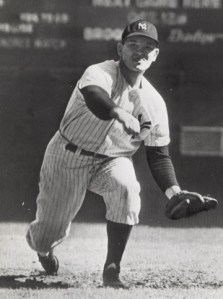
Allie Reynolds—Casey Stengel loved using his terrific starter in relief when it mattered most. Especially in a few World Series.

Reynolds also spent 1951 throwing two no-hitters and making six relief appearances on the regular season. Pay careful attention now: Reynolds, his Hall of Fame catcher Yogi Berra, and St. Louis Browns starter Ned Garver—credited with 20 wins for the hapless Brownies—tied for the most first-place votes in that year’s American League Most Valuable Player Award voting. (Yogi won the award by way of his superiority in the secondary votes.)

And, even with the stat applied retroactively, Allie Reynolds—who started 71 percent of his games and relieved in 29 percent of them—is tied for the third-most relief saves in World Series history, behind The Mariano and Hall of Famer Rollie Fingers.

Starters as relievers? Unprecedented and the End of the Grand Old Game As We Knew It? Please.

Smokey Joe Wood, 1912 World Series Game Eight. (Two scoreless after coming in in the eight; surrendered the tying run, bailed out by “Snodgrass’s Muff” in the tenth inning.) Hall of Famer Grover Cleveland Alexander, Game Seven 1926 Series. (The fabled bases-loaded, inning-ending strikeout of Hall of Famer Tony Lazzeri.)

Hank Borowy, 1945 Series. (Four scoreless relief innings, Game Six.) Harry Brecheen, 1946 Series. (Credited with his third win of the set in Game Seven—in relief.) Bob Turley. (Won the ’58 Series MVP winning one start and making two relief appearances including the Game Seven-winning seven-inning gig.)

Hall of Famer Bert Blyleven, Game Five 1979 Series. (Four innings shutout relief in a Pirate must-win.) Four Royals starters in relief in the 1985 World Series. Sid Fernandez, Game Seven, 1986 World Series. (Four strikeouts in two and a third’s shutdown relief enabling room for a Mets comeback win.)

Orel Hershiser, 1988 NLCS. (A save in Game Four.) Hall of Famer Randy Johnson, Game Seven 2001 Series. (An inning and a third shutout relief preceding Luis Gonzalez walking it off for the winning Diamondbacks.)

Madison Bumgarner

Starter-as-reliever: MadBum, Game Seven, 2014 World Series.

Madison Bumgarner, Game Seven 2014 Series. (Five scoreless in relief for the Giants’ third Series rings in five years.) Charlie Morton and Clayton Kershaw, Game Seven 2017 Series.

Nathan Eovaldi, 2018 Series. (The Game Three extras, six virtuoso before Max Muncy ended it with an eighteenth-inning home run.) Chris Sale, 2018 Series. (The final three Game Five outs for the Red Sox triumph.) Stephen Strasburg, 2019 NL wild card game. (Three scoreless in relief.) Max the Knife, Game Five, this year’s NLDS.

The only reason any of those ballpark crowds wouldn’t have gone nuts was because the deeds were done by the visiting pitchers. (Game Five, this year’s NLDS between the age-old-rival Dodgers and Giants in San Francisco, a notable exception.)

And if starters-as-relievers looks like a more contemporary phenomenon, it may well be because they’ve played more postseason games as the years went passing by.

Well, it was amusing to see the teeth gnashing and hand wringing over the starters-as-relievers this time around—for a little while. The problem is that it comes from lack of self-informing, willfully or otherwise. It’s not funny anymore to see some stubborn “purist” or “traditionalist”—in the stands, in front of television, or in the press—blow his or her gasket first and do their homework later.

NLCS Game Six: The Braves’ new world

Eddie Rosario

Eddie Rosario hits the three-run homer that proved the game/set/NLCS winner for the Braves. (TBS screen capture.)

You thought Yordan Alvarez was the force the Red Sox couldn’t stop in the American League Championship Series? Have a good, long look at Eddie Rosario, the force the Dodgers couldn’t stop in the National League Championship Series.

There should be some interesting showdowns in the forthcoming World Series. When each LCS Most Valuable Player threatens to throw every round of ammunition they have, including cruise missiles, at each other’s pitching and defenses. If Alvarez and Rosario stay as they just were, they’ll make World War II resemble a snowball fight.

Rosario’s three-run homer off Walker Buehler in the bottom of the fourth Saturday night, and the Braves bullpen—especially AJ Minter and Tyler Matzek—throwing five one-run, ten-strikeout, one-walk innings, sent the Braves to the World Series with a 4-2 win. The regular season’s least-winning division winner buried the season’s second-winningest team.

Maybe the Astros don’t resemble such overdogs after all? Maybe this year’s Braves resemble not on-paper favourites but a miracle team?

Wrestled by the Dodgers out of last year’s short-season, ghoulash-playoff National League pennant. Buried a game under .500 at this year’s All-Star break. Then spending the second half playing .611 baseball while most of the rest of the National League East—which wasn’t all that powerful in the first place—dissipated. The Astros were .604 at the break but .563 in the second half.

Now the Braves stand as National League champions with a legitimate shot at taking the Astros down. They manhandled the Dodgers when it mattered most Saturday night. They didn’t let a little thing like getting blown out 11-2 in Game Five to lose twice in three games in Dodger Stadium bother them all that much.

“We’re up 3-2, and we’re going home,” said Braves first baseman and franchise face Freddie Freeman after Game Five. “It’s a great position to be in.” The guy whose eighth-inning division series Game Four blast off Brewers relief ace Josh Hader made the NLCS possible for the Braves in the first place sounded like an incurable optimist then. After Game Six, he sounds like a prophet.

But he put any prophetic powers he had to one side in the middle of the Braves’ postgame celebration. “I think this might be the definition of pure joy,” he said. “It really is. I really don’t, it hasn’t hit me at all. I don’t really know how to feel.”

Rosario know exactly how to feel, especially after he caught hold of Buehler’s dangling cutter with Travis d’Arnaud (two-out walk) and pinch hitter Ehire Adrianza (two-out double) on second and lined it a few seats inside the right field foul pole. “It’s truly a great moment,” Rosario said amidst the celebration, “not just in my career, but in my life as well, but I want more. I want to win the World Series.”

He was one of three mid-season trades Braves general manager Alex Anthopoulos delivered when the Braves resembled the walking dead. They’d lost young superman Ronald Acuna, Jr. for the year to a torn ACL. They’d lost young pitching comer Mike Soroka to an Achilles tendon blowout after nine months rehabbing its original tear. They’d lost bombardier Marcell Ozuna to domestic violence issues and administrative leave.

Only one man around or observing the Braves decided there was still something worth saving. Anthopolous brought in Rosario from the Indians plus former Dodger Joc Pederson from the Cubs, Adam Duvall from the Marlins, and Jorge Soler from the Royals.

Pederson made himself enough of a pain in the rump roast casting a string of pearls before swine against his former team with his NLCS heroics at the plate. But even Anthopolous couldn’t have predicted Rosario—traded from the Indians for faded early-season pinch-hitting wonder Pablo Sandoval; the guy who came to the Braves injured and unable to play until 28 August—would steal the show and the set in the end.

“It’s still not lost on any of us that we didn’t accomplish our goal,” said Dodgers manager Dave Roberts postgame. “But for me, I’m giving credit to the Braves, because they outplayed us, plain and simple.”

The Dodgers knew going in that winning Game Six Saturday night would be on wings and prayers almost regardless of the opponent. Especially after Max Scherzer’s wing still remained dead enough to keep him from starting the game. Especially having to put the ball into Buehler’s wing on three days’ rest for only the second time in his young and promising career and this postseason.

They couldn’t afford a bullpen game so close to the one that hoisted them while they blew the Braves out in Game Five. But for three innings Buehler looked more than capable of keeping the Braves at bay, other than Austin Riley’s ground rule RBI double in the bottom of the first.

“I could tell when I was warming up that it was still tired,” Scherzer said after his Game Six scratch. The concern is “arm fatigue.” Historically, “arm fatigue” or “shoulder fatigue” have proven too often that they’re euphemisms for more serious issues. Late Saturday we learned Max the Knife said he’d be good to go for starting Game Seven.

Could it be our boy’d done something rash? The Dodgers still had to get there first. So much for that idea.

Scherzer’s trade deadline acquisition from the Nationals along with shortstop Trea Turner helped secure the Dodgers’ postseason arrival in the first place. Now, no matter what Buehler had starting Saturday night, the Dodgers’ streak of seven straight postseason elimination wins started Game Six close to final jeopardy.

Even allowing their injury quotient, they’d played like minor leaguers in most of the first four NLCS games. Chris Taylor almost singlehandedly yanked them back to the majors with his three-bomb Game Five.

Even if they managed to make the Braves look somewhere between silly and foolish in that game, by way of a bullpen worn down to their own winging prayers, and a jack-of-most-trades who’d hit about half his own weight down the final season stretch but who suddenly resembled what used to be his Hall of Famer-in-waiting teammate Albert Pujols.

These Dodgers couldn’t afford much of anything entering Saturday. They entered the postseason without first baseman Max Muncy thanks to his dislocated elbow and without longtime pitching ace Clayton Kershaw thanks to an elbow strain, and Dustin May to Tommy John surgery.

They’d lost reliever Joe Kelly to an injured bicep and third baseman Justin Turner to a hamstring injury during the NLCS. Both were considered gone for the rest of the postseason, however long it might last for the team that won 106 regular-season games—but still had to win the wild card game before the division series triumph that put them here at all.

Dodger fans approaching Game Six wanted to think, “They have us right where we want them,” even in Atlanta. It turned out the Dodgers had the Braves right where the Braves wanted whatever remained of Los Angeles’s Blue Man Group.

It didn’t have to be a plunge. It had only to be Minter relieving starter Ian Anderson and pitching four-strikeout, three-up/three-down ball in the fifth and the sixth. It had only—and especially—to be Matzek, walking into a second-and-third, nobody-out Dodger fire, after A.J. Pollock doubled the second and final Dodger run home . . . and striking out the side on eleven pitches. Including the Mookie Monster on three straight, ending the last serious Dodger threat of the night.

The night before, Red Sox starter Nathan Eovaldi bulled his way out of a bases-loaded jam in Houston by striking out the side. The difference was that Eovaldi stuck his landing while his offense remained sound asleep. Matzek stuck his landings with a two-run lead to protect and hand off.

He dispatched the Dodgers three-and-three in the eighth, handed Braves reliever Will Smith the two run lead, and watched with a packed Truist Park as Smith struck out the first two before getting Pollock to end it with a ground out to shortstop.

Once upon a time, Matzek was a Rockies washout who had to re-invent his pitching career with the independent leagues’ Texas AirHog. Now he’d blown what air was left out of the Dodgers’ tires. With his room for error about the size of a linen closet.

“My job is simple,” the beefy lefthander said after the game. “It’s go ahead, get out there and just try to strike guys out . . . I can’t let a pop up or a ground ball go through. I am looking to get those guys out and strike them out. It’s a simple job. Just go out there and throw my best stuff and I was lucky that my best stuff worked tonight.”

Just about all the Braves’ best stuff worked Saturday night. Just about none of the Dodgers’ did.

Especially against that mid-season pluck from the Indians who just nailed a 1.647 OPS for the entire NLCS, with a posteason series record-tying fourteen hits, nine runs driven in, three home runs including two in Game Four, two four-hit games, plus the base hit that walked a second straight Braves win off in Game Two.

This is a National League champion who didn’t even reach the .500 level until 6 August. They broke the record for the latest .500 reach by three days. The previous record holder was a team that went on to win the pennant and sweep the World Series. You may have heard of them: the 1914 Miracle Braves.

Sometimes things that happen to be in your franchise DNA take awhile to manifest. For the not-so-miraculous Astros awaiting the World Series showdown, that may not prove to be a good thing. It may well depend upon which half of Yordan and Eddie Tonight proves the bigger performer.

They may not have the Hall of Fame power (pitchers Tom Glavine, Greg Maddux, and John Smoltz; third baseman Chipper Jones) of the last Braves World Series team. But there shouldn’t be anyone calling this year’s Braves flukish now.