Ugly flamingo

Once and for all. When they began referring to the free cookie on second base to begin each extra half-inning as Manfred man, I cringed. Not just because of the concept itself, but because I did and still do like only one Manfred Mann. And it’s taking every ounce of psychic strength to keep Manfred man from killing Manfred Mann for me.

For the life of me I can’t imagine Commissioner Rube Goldberg writing, never mind singing, the lyric to Manfred Mann’s greatest single and maybe the single prettiest love song of the 1964-66 British Invasion this side of “And I Love Her”:

Some sweet day, I’ll make her mine, pretty Flamingo,
then every guy will envy me, ’cause paradise is where I’ll be.

Because it was anything but some sweet day when Manfred decided it needed to be in the Show. And not every guy envies him for it. His idea of baseball paradise often includes detours into baseball’s Inferno. One of his predecessors began his professional life as a teacher and scholar whose specialty was Dante. We’re lucky if Manfred’s knowledge of Dante goes as far back as Bo Bichette’s one-time slugging father.

Many baseball “traditions” have deserved to go the way of the large stone bases with which the game we know began. Extra inning games without encumbrance or monkey business aren’t one of them.

Seriously. I get the alarm from teams concerned for the issues a long game one day leaves on their rosters for the game the day after. (Such issues are why I favoured the doubleheader of seven-inning games, and still do.) I get relief pitchers concerned for the extra erosion on their arms and shoulders if they’d worked a day or two before and then went into a late, long-lasting marathon.

But I don’t mean to say I don’t care whose arm gets ground down when I say that half the fun of baseball in the first place was the prospect of a tight game going to extra innings. When Astros rookie Jeremy Peña homered to end an eighteen-inning division series marathon and the Mariners’ season at once, it ended an affair that included twelve pitchers used between both sides and grand theater.

They don’t all go as marathon as that, regular or postseason.

They don’t all go 26 innings the way Brooklyn and Boston did in 1920, ending in a one-all tie because of darkness. (This was prehistoric baseball, before the lights went on in Cincinnati and in due course elsewhere.)

They don’t all go 25 the way the White Sox and the Brewers did in 1984 (this was the game that provided Harold Baines his [snort] Hall of Fame credential: he homered to end it), or the way the Cardinals and the Mets did a decade earlier. (This one ended with road running: the Cardinals’ Shake ‘n’ Bake McBride scored all the way from first . . . on a wild pickoff throw. No, they didn’t now dream up the pickoff throw limit the better to keep pitchers from being embarrassed by run-scoring throwing errors in the bottom of the 25th or elsewhere.)

They don’t all go 24 the way the Astros and the Mets did in April 1968, when the game ended on a classic Astroturf hit: a grounder skidding away from Mets shortstop Al Weis, allowing the winning run to score. (Credit to the Astrodome’s scoreboard operators for an inspirational message in the 20th inning: We hope you are enjoying tonight’s third game as much as you enjoyed the first two.)

Or, the way the Giants and the Mets did in a doubleheader nightcap in 1964, the Giants finally winning it and teenage Mets first baseman Ed Kranepool ending his day having played all 33 innings. (The Mets are the only franchise in Show history to play three 23+ inning games in their lifespan. They also lost all three.) In fact, in over a century plus of major league ball as we’ve known it, only eight games have gone 23 or more and only nine have gone exactly 22.

They don’t even all go eighteen, the way the Red Sox and the Dodgers did going eighteen in Game Five of the 2018 World Series, before Nathan Eovaldi’s stout six-inning relief performance was wrecked by Max Muncy with a leadoff launch over the left field fence. And I sure don’t remember anyone kvetching about the length of that one while it was ongoing.

So Manfred man was created first as one way to quicken things up during the pan-damn-ically shortened 2020 season, then kept year-by-year to quicken things up with or without a pan-damn-ic. Now, Manfred man’s been voted permanent by a joint competition committee until or unless voted otherwise by another joint competition committee. But who’s kidding whom?

Too many from Manfred onward complain incessantly about the length of baseball games. How many of those people kvetch about Super Bowl LVII requiring what proved to be three hours and thirty-one minutes to play? (No kvetch except over the halftime shows. I get that, too. For crying out loud, save the mini-concerts for post-game.) The team sport which yields its own singular blend of comedy and drama might take three plus hours—and even those who think Manfred’s as good for the game as a grease puddle to a pedestrian believe too much is more than enough.

“Certainly, everyone working at the game appreciates avoiding twenty-inning marathons,” writes The Athletic‘s Eno Sarris. “But those attending the game might disagree, and cite the fact that, with this rule in place, extra-inning runs have scored at over two times the rate they score in the first nine innings. That’s fundamentally different baseball! Their retort might ask baseball teams to build their rosters with more pitchers capable of going longer in emergency situations.”

The good news, and it’s the only spot of it in this regard, is that Manfred man still won’t show up in the postseason. Yet. The further bad news is that Manfred man won’t necessarily prevent the occasional extra inning games from turning into the equivalent of two games or even a third. There’s no absolute guarantee that Manfred man will turn into a run as swiftly as its advocates love to believe and its opponents per Sarris fear.

Suppose we re-aligned one of the actual key causes of protracted sports contests: broadcast commercials. (Admit it: at the stadium, you’ve seen players lingering before continuing play, the better to accommodate this call to the bullpen, that insertion of the special teams, the other double switch, the kickoff team’s advent yonder.) Imagine how much shorter a baseball game might be with broadcast commercials only between the full, not the half innings.

(Don’t go there: No, the Lords of Baseball don’t want their broadcast revenues cut; but, yes, they might go for negotiating delicious prices on mere full-inning commercials and getting them.)

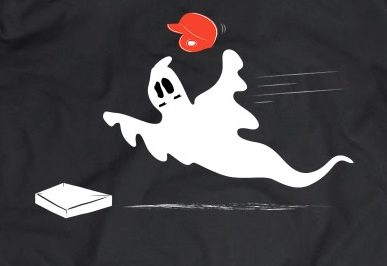
Maybe that’s the core of the problem. The thinking person’s sport is somewhat overrun with short, shallow thinking. (It makes you wonder about the real objection to analytics/sabermetrics: it requires thought, and lots of it.) Starting with the man who brought to baseball’s extra half innings the ugly flamingo, also known as the ghost runner. (Who you gonna call? Ghostbusters, hopefully.)


Ch-ch-ch-changes

2023 bases

Are the new bases (left) really that effronterous?

“A state without the means of some change,” wrote Edmund Burke in Reflections on the Revolution in France, “is without the means of its conservation.” As spring training opens, baseball faces more change. Stop snarling, self-identified and self-righteous purists and traditionalists, and start thinking.

It’s too easy to forget that a game without the means of some change is a game without the means of its conservation, too. It’s even easier to forget that baseball has never remained a static game. Would you like to know the game you’d be watching if it had?

You’d see a game end after one or the other team scored 21 runs, no matter which inning the 21st arrived. In theory, the game could have ended after one inning. In fact, the highest-scoring first inning in major league history happened in 1952, when the Boys of Summer Dodgers dropped a mere fifteen-spot on the Reds.*

You wouldn’t see the game mandated to end in the ninth inning until 1857, barring extra innings. You’d see large stones for bases and, a little later, wood posts. You’d see any old thing—marble, metal, glass—as home plate, so long as it was round, until 1899. You wouldn’t see anything resembling the colloquial “bags” for bases until canvas bases were introduced . . . in 1877.

You’d see pitchers barred by the rules from throwing higher than underhand. If it’s before 1887, you’d actually see batters calling for pitches—“high,” “fair,” or “low”—and umpires ordering pitchers to throw precisely those. You’d see foul balls not called strikes, at least before 1894. You’d see strike three on a third foul ball until 1901. You’d see pitchers required by law to throw from standing positions from 1863-1867. (Hall of Famer Juan Marichal, he of the eighteen different windups and about ten different leg kicks, wouldn’t have had a major league career with or without ethnic restrictions.)

You wouldn’t see fly outs until 1864, until which time what you know today as the one-hop base hit was ruled an out if the outfielder caught it on the first hop. You wouldn’t see the batter getting away with running past first after ripping a base hit without being called out until 1870. Come to think of it, you wouldn’t see a batter’s box until 1872. And you wouldn’t see ball four equaling a walk until 1889—before which walks were nine, seven, six, and then five balls.

You might be astonished to hear assorted purists and traditionalists screaming bloody murder at any, most, or even all those changes. You might even think, what fools those mortals were. So think twice before you start screaming again over, say, new bases coming to the ballparks near you that will be . . . a mere three inches larger around than the pads were through the end of last year’s World Series.

Don’t snort at those who understood slightly larger bases might mean slightly fewer injuries. The reason you don’t hear about how many runners broke themselves on the ancient stone bases is because you don’t know who they might have been and whether those injuries were recorded. Now try to imagine whether future Hall of Famer Mike Trout would have missed a full two-thirds of one season with a nasty thumb injury if he’d gone into a base three inches larger around.

Of course, it’s not every purist or traditionalist who thinks of safety first. (Please. Enough such creatures think enough players injured in the line of duty are goldbricking it and exposing themselves as fragiles when they don’t heal and return from those injuries within, oh, a few days.) They’re too busy counting the numbers anticipating a hike in basepath crime.

Last year, there were 3,297 stolen base attempts. Seventy-five percent succeeded. Ten years earlier, there were 4,365 attempts with 74 percent successful. Less proved slightly more last year. But as Keith Law reminded us in Smart Baseball, “speed kills” cuts both ways in baseball. Speed with brains is Hall of Famers such as Lou Brock (75 percent success), Ty Cobb (81 percent), Rickey Henderson (81 percent), and Tim Raines (85 percent); if your runner isn’t successful 75 percent or better, you’d “be better off having the first base coach nail [your] runner’s foot to the bag.”

We get to say goodbye, too, to those notorious infield defensive overshifts, which often placed at least one infielder into the role of a fourth outfielder. Well, now. Those who think they were contemporary aberrations might forget, assuming they knew, that there were managers playing the overshift as far back as in Cy Williams’s day. Williams, of course, was a power hitting dead-ball era center fielder who once hit thirteen homers without leading his league (1915, when Gavvy Cravath led the National League with a then unheard-of 25) but hit twelve the next year and led the entire Show.

“My biggest complaint about the shift,” says David Robertson, relief pitcher, “is, how do you explain it to kids? What’s the point of having a shortstop if he can’t play shortstop.” Well, let’s ask a shortstop. Mets shortstop Francisco Lindor is on record saying the end of the shifts might mean the return of more “exciting” infield plays. He may not be wrong.

But I would rather have seen the shifts busted the way they tended to be in Williams’s day and in that future day of another Williams, Ted, not to mention how some hitters the past few years did thwart them. The problem was that not every hitter could go the other way, not through neglected learning but because hitting itself is as much organic as anything else. And there were those teams who fumed when smart hitters thought about dropping bunts into that delicious free real estate.

(You guessed it. I’m going there, again. Be gone, bunts, except a) if you have the next Brett Butler [383 lifetime bunts, 85 percent for base hits]; or, b) if you have enough free real estate even without the shifts—say, a stone-handed infield playing just at the edge of the outfield grass—to have first base on the house. Unless you’re up with first and second and nobody out, you have less chance scoring after a sacrifice bunt than before it. The most precious commodity you have with your team at the plate is outs to work with. A sac bunt blows a third of that resource. The defense thanks you for your help.)

The pitch clock? I’m still on the fence about it. Last year’s minor league games did shorten up a bit under the rule. Commissioner Rob Manfred hopes putting it into the majors—a pitcher now has fifteen seconds to throw to the plate with the bases empty and twenty seconds with a man on base—will shorten it up in the Show. He still doesn’t get that certain rule tinkerings won’t do half as much to shorten the times of games as certain broadcast tinkerings.

As in, eliminating the commercials not just between half-innings but from every pitching change in a game. I’ll guarantee it: fans watching at home used to love seeing the teams change sides and go through their quick warmups before getting back to play. I’ll guarantee it further: it takes less time to get a relief pitcher into a game from the bullpen than to run those pitching-change commercials.

And while we’re at it, I’m going here, again, too—if you’ve brought a pitcher into the middle of a jam, and it wasn’t because the incumbent was injured, why are you wasting his time, your time, and his arm with the eight warmups on the game mound? What do you think he was doing getting ready in the bullpen, practising his dance moves?

He might have thrown the equivalent of a quality start’s minimum pitches before you brought him in. He’ll be as ready as possible to face that first batter the moment you give him that good-luck pat on the fanny. Let him get to it. Now, you’ve shaved 45 seconds more off the game time in addition to dumping those pitching-change commercials. (Does Manfred consider, as a commissioner who thinks the good of the game equals making money for its owners, that you could charge a bit extra for the between-ends-of-innings spots and thus not lose money without the half-inning and pitching-change spots?)

The pickoff throw limit? The late Vin Scully used to love describing what he called “the game within the game,” including those contests between ornery baserunners and pitchers determined to keep them from getting too ornery, if not putting them under arrest. (Once upon a time, a Phillies pitcher, Art Mahaffey, proud of his effective pickoff move, swore to pick off his first major league baserunner. The spindly righthander picked off the first three Show men to reach base against him.)

It was just as much fun as anything else to watch Hall of Famer Nolan Ryan try to outsmart Henderson on base before the Man of Steal took off with grand theft in his heart and his legs. (I didn’t choose that pair arbitrarily: Ryan blew one through Henderson for his history-making 5,000th lifetime strikeout.) Or, to watch Hall of Famers Don Drysdale, Sandy Koufax, Juan Marichal, and Tom Seaver engage battles of wits with Brock at first.**

We’ll learn soon enough whether these changes wreak as much damage as the free cookie on second to begin each extra half inning has done so far. Just don’t use the “tradition” argument. That argument began dying before the Civil War ended. But Mr. Manfred might have been (I hate to use a four-letter word) wise to ponder another Scully observation:

Football is to baseball as blackjack is to bridge. One is the quick jolt. The other the deliberate, slow-paced game of skill . . . It’s all there in front of you. It’s theatre, really. The star is the spotlight on the mound, the supporting cast fanned out around him, the mathematical precision of the game moving with the kind of inevitability of Greek tragedy. With the Greek chorus in the bleachers.

Whichever chorus caught hold of Manfred’s ear and refused to let go without a fight, the changes he’s sought and begun to impose seem a mixed jar of nuts and berries. The question before the house then becomes not whether but which of the nuts will come out on top when you shake the jar. Which nuts, and whether the thinking person and his or her sport will prove to have another allergy to them.

———————————–

* Legend has it that Reds starter Ewell (The Whip) Blackwell, knocked out after surrendering three runs with one out (a leadoff ground out), returned to the team hotel after his shower . . . and shortly met his relief, Bud Byerly, at the hotel. Byerly opened his turn by his catcher Dixie Howell throwing Andy Pafko out stealing, before surrendering a walk and five straight RBI singles.

The Reds went through four pitchers (Blackwell, Byerly, Herm Wehmeier, and Frank Smith)  before the first-inning carnage ended. The Dodgers with Hall of Famer Duke Snider—batting for the third time in the inning, having opened the bloodshed with a two-run homer—caught looking at a third strike.

Except for Snider’s one-out blast, the Dodgers scored ten of their fifteen runs with singles. The other three scored on two bases-loaded walks (both by Smith) and a bases-loaded hit batsman. (Hall of Famer Jackie Robinson, Wehmeier’s first batter, plunked on 1-0, sending Billy Cox home.) Or, if you’re scoring in longhand at home, one nuke followed by eight machine gunnings and three enemy mistakes.

** At least two decades before Hall of Famer Tony Gwynn earned his “Captain Video” nickname for taping his plate appearances to correct mistakes, Lou Brock habitually carried a small, handheld, old-style movie camera, using it to film pitchers the better to pick up any “tell” he could get to help him with his life of basepath crime.

Snapped Drysdale, when spotting Brock with the camera, “I don’t want to be in your goddam movies, Brock!” That from a man who was almost as famous for making numerous television guest spots as he was for making pitches on the mound.


“I was floored. It was a massive story.”

Bang the can slowly!

The passage from the Astros’ dugout in Minute Maid Park to the clubhouse. The wires above the trash can connected to a monitor, presumably seated between the can and the Everlast bag, “exactly as the (sign stealing) setup had been described to me.” (2018 photograph by Evan Drellich, published this morning in The Athletic.)

Come Valentine’s Day, baseball will receive a gift that won’t exactly be a love letter, or even a mash note. It’s going to get Athletic reporter Evan Drellich’s account of Astrogate and the broader issues raised and/or revived by the 2017-18 Astros’ above-and-beyond, and very illegal, electronic sign-stealing intelligence operation. At last.

Drellich, of course, is the reporter who teamed with Ken Rosenthal to break the Astrogate story in November 2019, shortly after the Astros fell to the Nationals in the World Series. This morning, The Athletic published an excerpt from Winning Fixes Everything: How Baseball’s Brightest Minds Created Sports’ Biggest Mess. It reveals that what became Astrogate didn’t just arrive to Drellich on a flaming pie over three years ago.

A year before Drellich and Rosenthal dropped the opening shot, Drellich was a Red Sox beat writer NBC Sports Boston, following a tour covering the Astros for the Houston Chronicle. During the 2018 postseason, in which the Red Sox beat the Astros in the American League Championship Series, he found himself speaking to people with first-hand knowledge that the Astros cheated beyond mere replay room reconnaissance on their way to their franchise-first World Series title.

“These were not sources on the outside pointing fingers, but people who knew—who had lived it,” he writes.

I learned how the Astros used a camera in center field to zoom in on the signs the catcher flashed the pitcher before the pitch. How the Astros had set up a television monitor near their dugout, where the players sit during games, to be able to see that video feed, and how they brazenly banged on a garbage can with a baseball bat and other devices to communicate what they gleaned from that screen. It was an advantage, many players felt, to know what was coming, be it a straight fastball or a bending curveball. And to use technology to gain that knowledge was beyond the pale.

This wasn’t just one player breaking the rules, either. This was a World Series–winning team that had collectively cheated, and the public didn’t know it.

I was floored. It was a massive story, the kind, frankly, many reporters dream of, and some might even dread. I was confident in everything I had at the outset—indeed, it all proved to be true. But to get a story done, I would need further corroboration.

One Astros source warned of the context of cheating in the sport, an encouragement that in hindsight could have both been earnest, but also self-serving, meant to deflect attention away from what the Astros had done. Nonetheless, I wanted to learn for myself and include it in my reporting—in what environment did this behavior arise?

Drellich first sought to get an idea from none other than the highest cheating Astrogate mind himself, the Astros’ then general manager Jeff Luhnow, during that ALCS. He spotted Luhnow in the Astros’ Minute Maid Park dugout. “He was the architect of the team,” Drellich writes, “and I tried to get his attention as he was walking away from me. ‘You won’t find anything,’ he said defensively, making clear he wouldn’t talk to me.”

The night the Red Sox won that ALCS, in Houston, Drellich acted upon the aforementioned first-hand knowledge shared with him and walked toward the Astros clubhouse. He even photographed what he saw just past the steps down from the dugout. Oops.

When the Red Sox met the Dodgers in the 2018 World Series, Drellich met with two baseball officials hoping to get a picture of what baseball’s government was or wasn’t doing about electronic sign stealing. One started generalising the suspicions until Drellich broke in to tell him he had sources from within the Astros’ operations telling him about the extent of their Astro Intelligence Agency, so to say.

“‘They have acknowledged that?’ one [official] said. ‘I mean, I can’t speak to that. I mean, to our knowledge—you have your information, and we have ours, and that’s all we can go off. As to whether that has occurred, to our knowledge we are completely unaware. I am confident in the measures that we’ve taken’.”

Drellich wasn’t trying to be a friendly tipster to MLB because he couldn’t. “It’s not a reporter’s job to steer sources to the league,” he writes. But he also saw too clearly that, at that time, MLB wasn’t exactly in that big a hurry to act.  He also knew that, having multiple sources but none willing to go on the public record just yet, he needed to find the one who would.

To get something, anything on the record, Drellich writes, he composed a “general piece on electronic sign-stealing” in November 2018, after the Red Sox beat the Dodgers in five in that World Series. “Very quickly,” he continues, “my doubts about the support I had at NBC Sports Boston proved correct. When they fired me in February 2019, I was blindsided, but perhaps I shouldn’t have been.”

His unemployment didn’t last long. The Athletic hired him, placing him into proximity with Ken Rosenthal: “Together, we would pick up my reporting on the Astros.” Indeed. Rosenthal had the sport-wide cred to make the calls Drellich couldn’t yet make. Such calls as to Danny Farquhar, the White Sox pitcher who heard the Astros banging the can slowly and called his catcher right to the mound to switch up their signs.

Such calls as to Mike Fiers, the pitcher who had something even more precious to offer on the record than an opposing pitcher who had ears to hear and brains to act accordingly: Fiers had been a 2017 Astro. And he was only too willing to go on record now, after assorted failed attempts by himself and others to convince other writers to expose Astrogate.

Drellich writes that Rosenthal asked Fiers if he was comfortable being quoted. “Well, that’s the whole thing about this. I don’t want to be put out there like that,” the pitcher began.

But they already know, so honestly, I don’t really care anymore. I just want the game to be cleaned up a little bit because there are guys who are losing their jobs because they’re going in, they’re not knowing. Young guys getting hit around in the first couple of innings starting a game, and then they get sent down. It’s bullshit on that end. It’s ruining jobs for younger guys. The guys who know are more prepared. But most of the people don’t. That’s why I told my team. We had a lot of young guys with Detroit trying to make a name and establish themselves. I wanted to help them out and say, “Hey, this stuff really does go on. Just be prepared.”

By “they already know,” Fiers indicated the Astros knew he’d tried to warn subsequent teammates on the Tigers and the Athletics. “Fiers, to his immense credit, stood by his words and never tried to back out before the investigation ran,” Drellich writes. “He helped change the sport, and the toll ostensibly has been heavy for him.”

Ostensibly? Fiers hasn’t pitched in the Show since the pan-damn-ically shortened 2020 season. He’s been to the Mexican League and the Chinese Professional Baseball League since, before signing with the Toros del Este of the Dominican Winter League last September. Age to one side (he’s 37), Fiers probably still finds one person denouncing him as a traitorous snitch for every one applauding him as a brave whistleblower.

“Many fringe players train in the Caribbean during the offseason to prepare themselves for the upcoming Major League season in hope of finding a better contract,” wrote Sports Illustrated‘s Ben Silver when Fiers signed that deal. “Fiers, though, may face an uphill battle. He is forever linked with the Houston Astros’ cheating scandal and teams may no longer wish to associate themselves with the weight his name carries.”

“At the time Ken spoke to Fiers, we were preparing to publish our findings without his account,” Drellich continues. “It’s impossible to say exactly how the world would have reacted to the story had Ken not spoken to him—if all the sources had been unnamed. But the facts of the story had already been ascertained, and we had Farquhar’s account.”

The whistleblower’s is often a lonely lot. “Whether Fiers was quoted or not,” Drellich writes, “it seems unlikely to me that MLB would have been able to ignore the general outcry. But our investigation was still in a much better position with Fiers on the record. His name helped validate everything instantly, making it harder for anyone to try to shove the story aside.”

Today’s Astros are the defending 2022 World Series champions, no longer the Luhnow team that cheated from the top down to extents above and beyond mere basepath or even mere replay room reconnaissance. (Only three Astrogate team members remain on the roster; one, Jose Altuve, has been shown conclusively as the one Astro who rejected stolen signs consistently.) Nothing suggests that the 2022 Astros didn’t beat the Phillies straight, no chaser.

But the Astrogate taint remains, at least until the last Astrogate team member no longer wears their uniform. There remain only too many who think the whole thing wasn’t the Astros’ fault for having committed the crimes but Fiers’ fault for having blown the whistle on the record. Today’s excerpt demonstrates that Winning Fixes Everything promises to knock that and other Astrogate canards into the middle of next year.

Concussions killed Mauer’s career, not his Cooperstown case

Joe Mauer

Mauer’s critics, not Mauer, should be shamed for willfully ignoring what concussions did to end his catching life and, in time, his playing career.

Scott Rolen’s election to the Hall of Fame triggered almost immediate discussions about next year’s likely Hall of Fame class. Social media being what it is, as opposed to what we wish it became, Rolen’s election also triggered an unfathomable outpouring of bile against one of three deserving Hall of Famers who make their first appearances on the writers’ ballots toward 2023’s end.

Adrián Beltré is a Hall of Fame lock. Not just because he’s a paid-in-full member of the 3,000 hit club but because he has 93.5 wins above replacement-level player (WAR) and he’s the number-two third baseman ever in terms of run prevention: Beltré’s 168 defensive runs above his league average is second all-time to Hall of Fame Brooks Robinson. (Baseball Reference rates Beltré the number four all-around third baseman.)

Chase Utley deserves a plaque in Cooperstown, too, even if his lack of black ink might be blinding. He wasn’t an overwhelming hitter, but he was a run machine once he reached base, including being worth 45 runs as a baserunner and worth another 25 runs due to his ability to avoid double plays. He’s also fourth for run prevention at second base (+141 runs, behind only (in ascending order) Hall of Famers Bid McPhee, Joe Gordon, and Bill Mazeroski.

And, then, there’s Joe Mauer. The number seven catcher all-time according to Baseball Reference. Uh-oh.

“I’ve never seen fans of a team hate an all-time great of their own the way some Twins fans do Mauer, tweeted The Cooperstown Casebook author Jay Jaffe. “They’re just so convinced he gave them a raw deal for that contract.” As in, the eight-year, $184 million contract extension he signed with the Twins in March 2010. As in, before the injury that ultimately put paid to his life as a catcher, then a ballplayer period.

It’s as though a man whose baseball profession had already led him to knee and leg issues committed some grave capital crime when, in August 2013, Mauer took a hard foul tip off his face mask. It caused a concussion that soon caused the Twins to pull him out from behind the plate and move him to first base—a position left largely vacant when they traded Justin Morneau to the Pirates a year before Mauer’s concussion.

Morneau, who suffered a concussion on a baserunning play the year Mauer signed that yummy contract extension, and who would suffer a second concussion on another diving play after he’d signed with the Rockies for 2014. One concussed first baseman eventually replaced by a concussed catcher who’d never again be the player he’d been prior to August 2013.

The guy with a reputation as a baseball gym rat who played the game with a commitment and a steadiness that caused some people to mistake him for emotionlessness spent the rest of that contract extension doing his level best to play despite things like the balance issues and light sensitivities that now made hitting a challenge and fielding a battle.

The Twins’ struggles around Mauer’s had far less to do with Mauer’s and more to do with its ownership seeming to impose a de facto spending cap the rest of Mauer’s career, including major league salaries and minor league development. But the native son, the franchise face, was too simple a target to resist, as the injured often are.

As if Mauer hadn’t battled enough at the plate following 2013, in May 2018 he suffered a second one after he dove chasing a foul ball and injured his neck. Concussion symptoms kicked in a few days later. They didn’t just impact him on the field, either. His wife, Maddie, told The Athletic they were no treat for him at home with two young twin daughters to raise, either. (The story was published as she was about to give birth to their third child, a son.)

“It’s not quiet at our house and they don’t understand why dad wants it to be quiet or be in a different room or have the lights off,” Mrs. Mauer said.

Our girls had been born about a month prior (to the 2013 concussion). Both of these times it does put things into perspective that you’re dealing with these symptoms at work, but you’re dealing with them at home just as much. I think that’s something he may not have talked about as much publicly, but it was a difficult challenge to be going through concussion-like symptoms with children.

“The neck [injury] is an easy one to take care of,” Twins trainer Tony Leo told The Athletic for the same story. “We can fix that. But the concussion had all these ebbs and flows going up and down.”

I think people don’t appreciate how much it impacts you on a day-to-day basis with just simple things like getting out of bed. Am I going to feel OK? Am I going to have a headache? Am I going to have ringing in my ears? Am I going to feel nauseous? Am I going to be able to see all right? When I turn on the lamp next to my bed, is that light going to cause me to start having a headache? Am I going to be too agitated and upset at my kids when it’s not their fault, but just because of all the sensations going on.

Everything starts compounding and adding to the anxiety you’re going through when you’re trying to minimize all these distractions and trying to allow the brain to heal. Little things trigger big symptoms, which cause you to doubt whether you’re healing or not. It’s really hard to remove yourself from everything let alone when you’re in the clubhouse with music, all the lights we have, TVs, people. You have the same thing at home with the day-to-day living that . . . We get focused on the baseball. I get focused on getting them back on the field for the game. But how do you start minimizing everything else in life that’s bothering you, especially with kids who just want to be around dad?

Maybe instead of soaking Mauer in a phlegm-and-bile bath because of what his head refused to let his body do at the level it once did during five of the eight years of that contract extension, the idiot brigades might consider what it took for Mauer to continue playing at all, at any level. After they consider that, perhaps miraculously, it actually didn’t compromise his Hall of Fame case.

As a catcher, Mauer—unusually tall for a backstop at 6’5″—was easy to overrate while he played. I made that mistake once myself. I’m not making that mistake again. I’m going to show you where Mauer will sit among Hall of Fame catchers who played in the post-World War II/post-integration/night-ball era, according to my Real Batting Average (RBA) metric. (Total bases + walks + intentional walks + sacrifice flies + hit by pitches, divided by total plate appearances.)

Catchers PA TB BB IBB SF HBP RBA
Mike Piazza 7745 3768 759 146 45 30 .613
Roy Campanella 4815 2101 533 113 50* 30 .587
Joe Mauer (as C) 3943 1640 478 79 35 13 .569
Johnny Bench 8674 3644 891 135 90 19 .551
Yogi Berra 8359 3643 704 91 95* 52 .549
Carlton Fisk 9853 3999 849 105 79 143 .525
Ted Simmons 9685 3793 855 188 100 39 .514
Gary Carter 9019 3497 848 106 99 68 .512
Ivan Rodriguez 10270 4451 513 67 76 58 .503
HOF C AVG .547

You’re not seeing things. Among that group of Hall of Fame catchers, Mauer is number three—eighteen points ahead of Johnny Bench, and twenty points ahead of Yogi Berra, the two men considered the greatest all-around catchers who ever played the game. (You might care to know, too, that as a catcher Mauer had 62 more walks than strikeouts at the plate.) He was also a highly-regarded pitch framer behind the plate who was worth 65 defensive runs above average for his entire life there.

Mauer retired in 2018 because he decided at last that family life without further health compromise was more important than his itch to compete. (The Twins retired his uniform number 7 the following season.) “Experiencing a concussion looks different for everyone,” he said in his formal retirement letter to Twins fans, “but my personal experience forced me to look beyond baseball at what is best for me as a husband and father.”

Instead of shaming Mauer because they don’t get what two concussions did to his Twins life under that contract extension, the idiot brigades should marvel that those two serious, life-and-career-altering injuries didn’t compromise his case as a Hall of Fame catcher in waiting, and even admire him for having the will to try playing on in spite of them. And, for deciding that being a husband and father was more important than playing the game he loved.

But that might ask too many people to surrender their ongoing and erroneous belief that injuries incurred in real competition equal weakness at best, thievery at worst, and character flaws somewhere in there, too. “I am done with a lot of things,” Jaffe also tweeted, “but especially done arguing about Mauer with Twins fans who don’t understand the impact of the concussions on his career.” As of this sentence, so am I.

Rolen rolls into Cooperstown at last

Scott Rolen

A big enough bat at the plate . . .

When Scott Rolen was in his absolute prime, Sports Illustrated said of him, among other things, that he “could have played shortstop with more range than Cal Ripken.” When he was with the Cardinals following his somewhat unfairly contentious departure from Philadelphia, the St. Louis Post-Dispatch asked where Rolen ranked among his era’s third basemen, then answered: the best at the moment.

Rolen’s overdue election to the Hall of Fame Tuesday still inspired carping enough among the philistines who think it was just another case of defining the Hall down. Maybe he wasn’t charismatic. He certainly wasn’t the cheerleading or the self-promoting type. But he was just as SI‘s Tom Verducci described him in 2004, “a no-nonsense star who does it all.”

That’s practically what they said about legendary Tigers second baseman and Hall of Famer Charlie Gehringer, too. He was so no-nonsense he was nicknamed the Mechanical Man. Rolen was many things at the plate and in the field. Merely mechanical wasn’t among them.

“Rolen played with an all-out intensity,” wrote The Cooperstown Casebook author Jay Jaffe, “sacrificing his body in the name of stopping balls from getting through the left side of the infield . . . and he more than held his own with the bat as well, routinely accompanying his 25–30 homers a year with strong on-base percentages.”

This son of Indiana schoolteachers did little more than let his preparation and his play do most of his talking. It’s worth repeating further that he didn’t blow up the nearest inanimate objects when a swing missed, a play faltered, or a game was lost. He played to win, but he lived what most confer lip service upon: let’s get ’em tomorrow. I say it again: if Rolen was a fighter pilot, he’d have earned a reputation as the classic maintain-an-even-strain type. The Right Stuff.

He has the numbers to support it, too, at the plate and in the field, where he knew what he was doing with a bat in his hand and didn’t sacrifice his body at third base or on the bases for naught. Once, he dropped into a slide into second base that wasn’t aggressive or out of line but so forceful that he flipped Royals second baseman Tony Graffanino and knocked shortstop Gerónimo Berroa down. Observed Verducci, “[It was] like a bowling ball picking up a 2-5 combination for the spare.”

“Berroa had this look on his face,” said Cardinals pitcher Matt Morris to Verducci, “like, I didn’t even hear the train whistle!”

First, let’s review Rolen one more time according to my Real Batting Average (RBA) metric: total bases + walks + intentional walks + sacrifice flies + hit by pitches, divided by total plate appearances. This table shows where he stands among all Hall of Fame third basemen who played in the post-World War II/post-integration/night-ball era:

HOF 3B PA TB BB IBB SF HBP RBA
Mike Schmidt 10062 4404 1507 201 108 79 .626
Chipper Jones 10614 4755 1512 177 97 18 .618
Eddie Mathews 10100 4349 1444 142 58 26 .596
Scott Rolen 8518 3628 899 57 93 127 .564
George Brett 11625 5044 1096 229 120 33 .561
Ron Santo 9397 3779 1108 94 94 38 .544
Wade Boggs 10740 4064 1412 180 96 23 .538
Paul Molitor 12167 4854 1094 100 109 47 .510
Brooks Robinson 11782 4270 860 120 114 53 .458
HOF AVG .557

You see it right. RBA has Rolen as the number-four offensive third baseman of the group and seven points ahead of the average RBA for such Hall third basemen. You can do an awful lot worse than to say you weren’t quite as great a batter as Mike Schmidt, Chipper Jones, and Eddie Mathews. But you can’t exactly carp when you shook out slightly better at the plate than George Brett, Ron Santo, Wade Boggs, Paul Molitor, and Brooks Robinson.

Scott Rolen

. . . and an Electrolux at third base.

Now, let’s put Rolen at third base. Only one of those Hall of Famers has more defensive runs above his league average than Rolen does (+140) above his—Robinson (+293). And, only two of them join him among the top 24—Schmidt (+129) and Boggs (+95). The eye test told you that Rolen was willing to throw himself under a train to make a play at third. It also told you what the meds confirmed in due course, that injuries were going to grind him into a harsh decline phase, as happened after his last solid St. Louis season.

“[He’s] the perfect baseball player,” then-Brewers manager Ned Yost said of him not long after he reached the Cardinals in the first place. “It’s his tenacity, his preparation, the way he plays. He tries to do everything fundamentally sound. And he puts the team first—there’s no fanfare with him.”

Maybe the Phillies should have had Yost to lean upon instead of Larry Bowa (manager) and Dallas Green (advisor) during Rolen’s first six-and-a-half major league seasons. Green especially dismissed him in 2001 as “satisfied with being a so-so player. He’s not a great player. In his mind, he probably thinks he’s doing OK, but the fans in Philadelphia know otherwise. I think he can be greater, but his personality won’t let him.”

That was at a point when Rolen struggled at the plate though he was making plenty of plays at third base. Rolen finished that season with a splendid enough .876 OPS and the second of his eight Gold Gloves. His personality won’t let him. Again, the misinterpretation of Rolen’s even strain as indifference.

Call it a classic case of not knowing what you had until he and you were both gone, but Bowa offered a far different assessment upon Rolen’s Cooperstown election. “To be honest with you,” Bowa told MLB-TV, “I thought he should have gotten in a few years ago. I was very happy for him.”

This guy is the ultimate professional, played the game the right way. As a manager, as a coach, you looked at guys like that, very few mental mistakes, always on top of his game. Played the game as hard as you could play for nine innings. There was really nothing Scott couldn’t do on the baseball field. He was a hitting machine, he drove in runs, hit lots of doubles, unbelievable third baseman. He had a tremendous pair of hands, a great arm. If he didn’t play a game, it was because he had an injury or something like that. This guy posted every day. His work ethic, off the charts. This guy was a tremendous baseball player.

That’s the manager who ripped Rolen a few new ones and demanded then-Phillies GM Ed Wade trade him, after Rolen called out the Phillies’ penny-pinching anticipating the arrival of Citizens Bank Park. “Fans deserve a better commitment than this ownership is giving them,” Rolen told then-ESPN writer Jayson Stark. “I’m tired of empty promises. I’m tired of waiting for a new stadium, for the sun to shine.”

In St. Louis, Rolen found a home and three postseason trips including a World Series ring, yet he ran afoul of manager Tony La Russa, who soured on him for—the horror!—injuries he incurred during honest competition on the field. Then-GM John Mozeliak eventually traded him to the Blue Jays, a deal Mozeliak came to regret by his own admission.

When former Cardinals GM Walt Jocketty landed in Cincinnati and discovered Rolen wanted to play closer to home, he didn’t hesitate to wrest him from the Jays onto the Reds. He helped those Reds to a couple of postseasons while he was at it—even after a brain-scrambling concussion and lower back issues.

If you should happen to be traveling through Smithville, Indiana, you may come upon a facility known as Camp Emma Lou. It’s a retreat built by the Enis Furley Foundation, created by Rolen and his wife Niki in 1999, aimed at children and their families struggling with illness, hardship, and other issues and giving them expenses-paid weekend retreats. The foundation and the camp are named for two of Rolen’s dogs.

That’s also the current Indiana University director of baseball player development, who got the call from the Hall and granted a request from his son immediately following a call to his parents with the news. “[I]t’s about thirty degrees here, supposed to snow twelve inches,” he told a reporter, “but there we were, about fifteen minutes after the call, in the driveway having a catch. I’ll remember that forever.”

It’s not every son who gets to have a catch with a freshly-minted Hall of Fame father.