“I’m the one probably most surprised . . . “

Shohei Ohtani

Ohtani takes one of his curtain calls from the Miami audience Thursday evening.

If you absolutely must become baseball’s first 50/50 man, as in 50+ home runs and 50+ stolen bases in a single season, you couldn’t pay for any more earth-moving way to do it than Shohei Ohtani found Thursday evening.

A 6-for-6 day at the plate. As many runs batted in in one game as his Dodgers teammate Freddie Freeman has so far in all September. Three RBI hits serving as just the overture to both Ohtani’s history-making suite and the Dodgers smothering the hapless Marlins, 20-4, in the Fish’s own tank.

Theft number 50 after a first-inning double and theft number 51 after the second-inning RBI single. A two-run double in the third ruined only by Ohtani getting himself thrown out trying to stretch it into a triple.

Almost exactly the way Hall of Famer in waiting Albert Pujols demolished the Rangers after the sixth inning in Game Three of the 2011 World Series (three bombs: one each in the seventh, eighth, and ninth innings), Ohtani’s real mayhem began in the sixth:

A man on second and one out in the sixth, Ohtani sent an 0-1 slider into the second deck behind right center field. It made him only the second Dodger behind Shawn Green to hit 49 in a season. Second and third off a wild pitch and two out in the seventh, Ohtani hit one the opposite way into the left field bullpen. That founded the 50/50 Club and earned him a loud curtain call in a road ballpark.

First and second and two out in the ninth, Ohtani slammed the best possible exclamation point upon the proceedings when he drove a high meatball from a sacrificial lamb (read: Marlins position player, Vidal Bruján) well into the upper deck behind right field. With another curtain call to follow.

“To be honest,” Ohtani told a television interviewer through an interpreter post-game, “I’m the one probably most surprised. I have no idea where this came from, but I’m glad that I performed well today.”

The loanDepot Park audience in Miami didn’t have much to root for from their own lack of heroes this year (the Marlins have already been eliminated from the postseason mathematically), so it didn’t cost them anything but netted them plenty of respect to hand history their day’s loudest ovations.

If you’re my age, you can compare it to the day the usually unapologetic rooters of the early Mets suddenly turned on their anti-heroes on that fine 1964 Father’s Day in Shea Stadium, when Hall of Fame pitcher Jim Bunning threatened to pitch the first perfect game in the 20th Century National League. When Bunning finished what he started, he was hit with a wild standing O and an invitation to appear on The Ed Sullivan Show.

Credit Marlins manager Skip Schumaker, whose ten-year major league playing career included one season (2013) with the Dodgers, for looking into the teeth of the hurricane demolishing his club, with Ohtani potentially carrying number 50 in his bat, seeing second and third and two outs in the seventh, electing not to put Ohtani aboard to give the Fish a better survival chance with aging Kevin Kiermaier—whose bat is now as useless as his glovework remains a study—due to hit behind him.

“If it was a tight game, one run lead or we’re down one,” the manager said postgame, “I probably put him on. Down that many runs [nine], that’s a bad move baseball-wise, karma-wise, baseball god-wise. You go after him to see if you can get him out. I think out of respect for the game, we were going to go after him. He hit the home run. That’s just part of the deal.”

“A lot of us actually looked at the opposing dugout and I think a lot of the coaches were telling Skip, ‘Hey, we should walk him right here’,” said Dodger third baseman Max Muncy, who’d scored on Ohtani’s early single and final home run. “I’ve always loved Skip. When he was the first base coach in San Diego, I always talked to him. I heard all guys love to play for him. For him to do that, that’s awesome.”

“The game was certainly out of hand,” said Dodger manager Dave Roberts. “Guys got their starters out and then to take that potential moment away from the fans, Shohei himself, Skip understood that. It was bigger than that and I’ve got nothing for respect for that.”

Kiermaier striking out to end that seventh merely amplified the magnanimity of what Schumaker refused to do. A team out of any pennant race has a lot more for which to apologise to their fans than trying to stop the unstoppable force on a night he’s making history on its dollars. And leading his team to a National League West division clinch while he’s at it.

Ohtani previously entered the rareified 40/40 club by hitting a grand slam. This was different. This was a night the Dodgers used the Marlins for target practise and Ohtani proved to have the most ammunition to expend. Even MLB officials were in on the act, swapping out regulation game baseballs for pre-authenticated balls before Ohtani batted in the seventh.

When he turned Mike Baumann’s curve ball into history, those officials scurried to siphon as much memorabilia as they could carry away from Ohtani, perhaps leaving observers to ask only how they’d managed to miss his uniform belt, undershirt, and jock strap.

It isn’t every day that a player has a ten-RBI, six-hits, five extra-base hits, three home runs, two stolen bases day. No player had done all of those over a career, according to OptaSTATS. Not Babe Ruth or Lou Gehrig, not Ted Williams or Stan Musial, not Mickey Mantle or Willie Mays, not Henry Aaron or Roberto Clemente, not Dick Allen or Mike Schmidt, not Barry Bonds or Ken Griffey, Jr.

Ohtani did all five in a single day.

“With this game of baseball, it was a win for Major League Baseball,” said Roberts. “I know people all over the globe were watching this game and we’re excited to see that they got a chance to witness history.”

Roberts and Schumaker understood what too many forget, including among those who administer the game, but which longtime New York Times baseball writer George Vecsey got, watching then-commissioner A. Bartlett Giamatti getting it, too, when Giamatti almost gave in and pumped his fist watching Hall of Fame pitcher Nolan Ryan ring up his 5,000th lifetime strikeout at Hall of Fame outfielder/base larcenist Rickey Henderson’s expense: “baseball is about rooting, about caring.”

Nowhere was that more evident than when Ohtani popped out of the visitors’ dugout to take one of a couple of curtain calls after his blasts. A young fan on the other side of the side rail, holding a sign up just above the rail, but level with Ohtani’s face:

I SKIPPED MATH
TO WATCH
HISTORY.
OHTANI 50/50.

If I’m that boy’s English teacher, I give extra credit for the school-age pun of the season.
A tale of two tankers

Derek Bender

Bender—tanking by tipping.

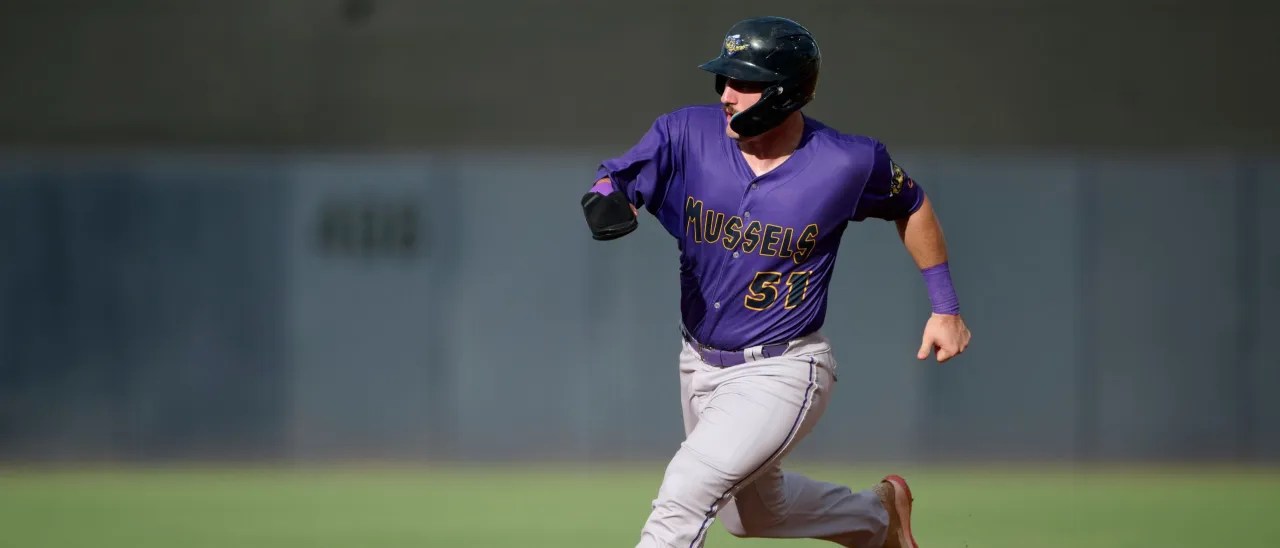
Derek Bender was a sixth-round draft this past July. The Twins handed him a $297,500 bonus and sent him right to the Fort Myers Mighty Mussels, their Low A-level team, to begin his seasoning into whatever he might become as a catcher. Seeing more action at first base, throttling himself by too many batting strikeouts, likely to start 2025 back in Myers.

Then came the game that turned the Mussels from the guys who’d had a six-game lead for the Florida State League’s Western Division title in July to eliminated from postseason play this month. Bender seemingly did his level best to help make sure the Lakeland Flying Tigers (Tigers) took the title.

Last Thursday, the news arrived that the Twins eliminated Bender from their organisation. They learned that, in game two of the doubleheader that sealed the Mussels’s elimination, Bender was telling Lakeland hitters exactly what Mussels starting pitcher Ross Dunn was going to throw. Multiple published reports cited Bender quoted as saying he wanted the season to be over and done with.

He’d gone from a power threat in college at Coastal Carolina to a struggler during his first taste of pro ball. Now, a .200/.273/.333 slash line with two home runs and a 20-to-5 batting strikeout-to-walk ratio might indeed prompt you to wish to go home, regroup, and start afresh the following spring. I’m not sure how often it prompts a player to tank in a key pennant race game.

Bender’s pitch tipping abetted a four-run second inning for the Flying Tigers, who went on to win the game 6-0, thus sweeping the doubleheader and clinching the FSL West. Flying Tigers coaches, according to ESPN, told Mussels coaches about Bender’s tips. ESPN said Flying Tigers players were genuinely surprised they were being told what was coming.

Nobody’s accusing the Flying Tigers of wrongdoing. But the Twins struck a powerful blow against tanking of any kind, even a single game’s worth. Their minor league tanker having been exposed, they sent him packing after he spent the Mussels’s final two regular-season games watching from the bullpen instead of his normal dugout positioning.

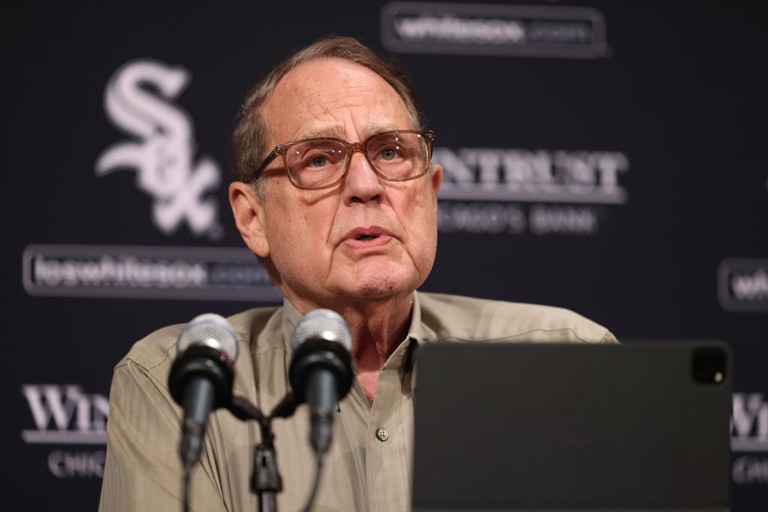
Jerry Reinsdorf

Reinsdorf–“Going back to last year, we have made difficult decisions and changes to begin building a foundation for future success.” White Sox fan says, “Tanks a lot!”

Jerry Reinsdorf is the owner of the White Sox. The team who’s threatening to push the 1962 Mets to one side for regular-season futility. At this writing they’re only five losses from tying and six from passing those Original Mets. Even if they probably shocked Chicago into stunned silence by taking two of three from the Athletics over the weekend. (Who have surprises of their own to point to in their final known Oakland season thus far: they’re actually a .549 team since the All-Star break.)

The White Sox are the team about whom Reinsdorf said in an 11 September statement that, oops, we’ve up and blown it and it didn’t just happen spontaneously:

Everyone in this organization is extremely unhappy with the results of this season, that goes without saying. This year has been very painful for all, especially our fans. We did not arrive here overnight, and solutions won’t happen overnight either. Going back to last year, we have made difficult decisions and changes to begin building a foundation for future success. What has impressed me is how our players and staff have continued to work and bring a professional attitude to the ballpark each day despite a historically difficult season. No one is happy with the results, but I commend the continued effort. I expect to have more to say at the end of the season.

Leave it to Cup of Coffee writer/impresario Craig Calcaterra to blow a hole in that: “1. It IS the end of the season, so what in the hell are you waiting for? 2. Unless the more you have to say is ‘I am selling the Chicago White Sox,’ no one really cares.” The sad part is that the Reinsdorf statement may be the most unintentionally humourous utterance out of any humourless White Sox organism all year long.

There you have it. Two American League Central teams giving two distinct lessons in how to deal with tanking of any kind and tankers of any level.

The one who learned of their minor league tanker and disappeared him post haste has a two and a half game advantage at this writing for the third AL wild card. The one whose owner all but confessed to being his team’s top tankman has yet to face any insurrection among fellow owners to sell his team but stares into the oncoming light of a 121+ loss season.

Reinsdorf has never been accused credibly of being a funnyman. But he faces his White Sox setting a new record for regular-season defeat without even a hundredth of the good humour, self-deprecating wit, and plain mad fun, of the team whose record endured 62 stubborn years against all previous challengers.

Ed Kranepool, RIP: “Wouldn’t it be great?”

Ed Kranepool, Casey Stengel

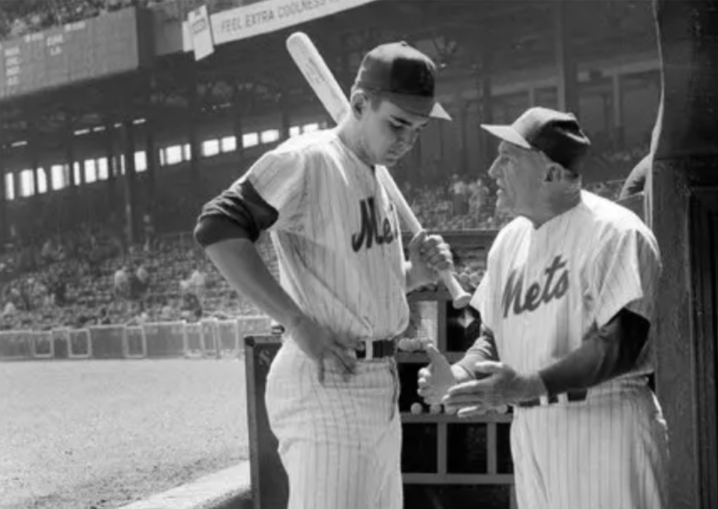
Teenage Met Ed Kranepool listens to Professor Stengel, 1962.

As a teenage prospect out of New York’s James Monroe High School, Ed Kranepool landed an $80,000 bonus plus incentives to sign with the original Mets. He spent what the government let him keep of the bonus partly on a Thunderbird convertible and mostly on a split-level home for his widowed mother in White Plains.

Then he caught his first airplane flight ever to join the Mets in Los Angeles. Lucky him. He landed in time to join the team on the June 1962 day Hall of Famer Sandy Koufax no-hit them. The seventeen-year-old missed getting into the game; manager Casey Stengel wanted a pinch hitter late but decided on his old Yankee platoon hand Gene Woodling instead.

“Thank God,” Kranepool was recorded as saying. He’d have to settle for playing on the losing side of three no-hitters including Hall of Famer Jim Bunning’s Father’s Day 1964 perfect game.

A kid who begins his major league life as a 1962 Met surely had something to say about this year’s Blight Sox who threaten those Mets’ record for season-long futility. “I’ve gotten calls lately about the White Sox, but there’s not much to say,” said Kranepool, who died at 79 Sunday.

I don’t care if they lose more games than that original Mets team. It was a bad baseball team with a bad mix of young guys and some great older stars whose best years were behind them. In a clubhouse like that, when you’re young like I was, all you want is to learn and get better and have the season end. But whether the White Sox finish with more losses than that team—what does it matter to me?

Kranepool didn’t just have that season end. Before the decade ended, he’d go as he once phrased it, “from the outhouse to the penthouse,” as a member of the 1969 Miracle Mets. The outhouse years were rarely pretty for a kid upon whom wild expectations were piled. On the other hand, Kranepool developed a Metsian sense of humour about it.

He was one of only two licensed stock brokers playing in the National League at the time; Bunning was the other. He took to discussing Mets life in stock market terminology.

“During the World Series,” he told New York Times sportswriter Joseph Durso in 1967, “the Dow-Jones wire carries the score every inning, plus the home runs and pitchers. Wouldn’t it be great if the Mets got into the Series and I hit a home run that was flashed over the ticker along with the quotations? Boy, the office would go wild.”

A few million offices and residences in New York, when it actually did happen to both the Mets and Kranepool two years later. The Mets shook off a Game One loss to demolish the Orioles in four straight . . . and Kranepool smashed a one-out homer off Oriole reliever Dave Leonhard, sending a slightly hanging breaking ball over the center field fence with one out in the bottom of the Game Three eighth.

He had an up and down relationship with his teammate-turned-manager Gil Hodges, though. Both men headstrong but one the boss who’d survived World War II and the other a young man whose father was killed in that wae before he was born. They butted heads often as not until 1971, when Kranepool had a fine if not spectacular season.

“[T]hings seemed to get a little better between us, Gil and me,” he told Maury Allen for After the Miracle: The Amazin’ Mets Twenty Years Later.

I think we were beginning to understand each other. I had matured and was becoming a more productive player. Then he got his fatal heart attack in West Palm Beach that next spring of 1972, and Yogi [Berra] took over. Maybe I never appreciated Gil. I don’t know. He was a hard man to get to know. He was very tough, very strong. But he was smart. I think he was the first to know in 1969 how good we were.

Just like any other manager asked after a miracle Series triumph to explain how it came to be and answering by spreading his palms apart, grinning, and saying, “Can’t be done.” Kranepool thought otherwise. “Gil was a great manager, a very smart baseball man,” he told Allen. “I’m sure I would have learned a lot more about the game if he had lived.”

When Wayne Coffey wrote They Said It Couldn’t Be Done a few years ago, for the 50th anniversary of the 1969 Mets, Kranepool was even more concilatory, even if it could only be with Hodges’s ghost. “We really were a team,” he began.

Sometimes you win in spite of your manager, but not with this club. Gil did everything right. He made every possible move to help our club. He never tricked you. He was so consistent . . . You never showed up at the ballpark not ready. Once he said he was going to do something, he stuck to it. You were prepared when you went to the park. You got your rest. You were ready. You worked hard to stay in shape because you knew you would be called on. He kept everybody sharp.

Kranepool never became a bona fide superstar, but he remained iconic in New York, especially when he enjoyed a late career second life as a successful pinch hitter. Three years ago, studying pinch hitters with over 300 plate appearances since the heyday of their patron saint Smoky Burgess, I ranked Kranepool number sixteen according to my Real Batting Average metric. (TB + BB + IBB + SF + HBP / PA. Kranepool: .484 RBA.) Shea Stadium rocked with “Ed-die! Ed-die!” chants every time he loomed as a pinch hitter.

As content as he became with his Mets career as it was, as embittered as he became over the team’s mal-administration following the death of their beloved original owner Joan Payson (“Joan Payson was like a grandmother to me and to everybody else,” he once said), Kranepool came to take a realistic view of his Mets life. (His eighteen-season tenure remains a Mets record.) Including the ill effect of rushing a seventeen-year-old to the Show and not exactly letting him develop in short minor league stints in the seasons to follow.

“They shoulda left me in the minor leagues to develop, and they woulda got a better player out of it,” Kranepool was once quoted as saying. “A kid of seventeen isn’t equipped to handle that pressure. They said, ‘Ed’s going to lead them from a bad ballclub to the pennant.’ One player, even a Hall of Famer, can’t do that.”

1969 Mets

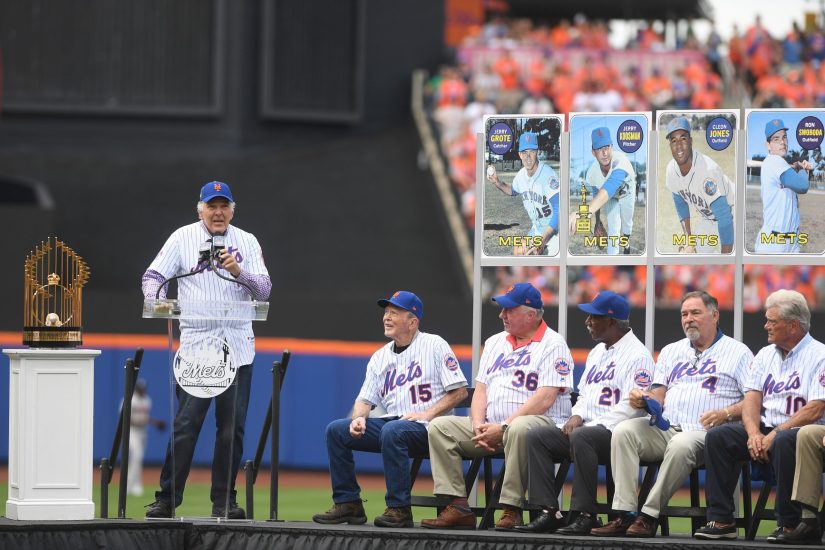
Ed Kranepool (at the podium) addresses a Citi Field crowd on the 50th anniversary of the 1969 Mets. Listening, left to right: Jerry Grote (C), Jerry Koosman (LHP), Cleon Jones (LF), Ron Swoboda (RF), Duffy Dyer (C). (Bergen Record photo.)

Nobody questioned his fortitude. After one such brief minor league turn in 1964, Kranepool was recalled to the Mets in time to play a doubleheader . . . all 32 innings of it at first base. He went 4-for-14 on the day/night with two runs scored, plus a double and a triple among the four hits. His mother went the distance with him in the Shea Stadium stands . . . because she was holding onto his car keys and house keys.

After his playing career ended. Kranepool took up life as a businessman, made peace with future Mets administrations, and became a happy presence at assorted Mets functions and commemorations as well as spring training. He also dealt with diabetes and kidney disease, receiving a transplant in 2019 after a two-year wait that was frequent news in New York. (A then-59 year old Met fan–whose own husband had received such a transplant—turned up as the donor.)

“I knew Krane for 56 years,” said Miracle Mets outfielder/first baseman Art Shamsky. “We did so many appearances together. We had lunch last week and I told him I would be there next week to see him again. I’m really at a loss for words. I can’t believe he’s the fourth guy from our 1969 team to pass this year.”

“We knew each other so well,” said pitcher Jerry Koosman, “and I could tell by his eyes if a runner was going or not. He saved me a lot of stolen bases.”

Kranepool’s death of cardiac arrest followed the 2024 deaths of shortstop (and eventual Mets coach and manager) Bud Harrelson, catching anchor Jerry Grote, and pitcher Jim McAndrew. As Mets together, those plus others listened attentively whenever Kranepool told them of those early Met seasons as lovable losers.

“We used to celebrate rainouts,” the man the fabled Shea Stadium Sign Man, Karl Ehrhardt, once called the Killer Krane would say.

In time Kranepool would be respected by teammates for baseball smarts as well as his straight, no chaser personality. A personality that compelled his teammates to name him their player representative as the Major League Baseball Players Association began finding its wings after hiring Marvin Miller to run the union.

“I wasn’t afraid to protect the players and attend the meetings and the associations,” he once told a reporter. “And the players, themselves, that doesn’t bode well for you, sometimes, when you’re speaking on behalf of the group, owners can take it as a bone of contention. I wasn’t afraid of getting traded, nor was I afraid of speaking out against others’ interests.”

Kranepool and his first wife, Carole, raised a son who was athletic but far more interested in music and electronics and ultimately raised two sons and a daughter himself. Kranepool remarried happily a Sotheby’s realtor named Monica whom he met during his stock brokering days. (She has four grandchildren of her own.)

“I’ve been lucky to have a great team at home—my wife and family. And also the Met organization,” he said after his transplant. “I’ve been with them since 1962. Those are the only two teams I knew up until that time. Now I have an extended team.”

He didn’t just mean his medical team, either. Kranepool was also one of several Mets who set up Zoom calls with residents of assorted elder care facilities, during the original COVID-19 pan-damn-ic, as a way to pay forward his kidney transplant. “This is a summer that none of us will forget,” he told northjersey.com writer Justin Toscano. “You’re always looking to talk to somebody to brighten their day, and hopefully they can brighten mine.”

He needn’t have worried. He had an immediate and extended family to brighten his days. He now has an even more extended one welcoming home to the Elysian Fields. Led, perhaps, by the skipper whom he didn’t always understand but who probably greeted him with, “We’re ok, Eddie. You got the point, after all.”

They’re not the ’62 Mets. More’s the pity.

Francisco Lindor, Garrett Crochet

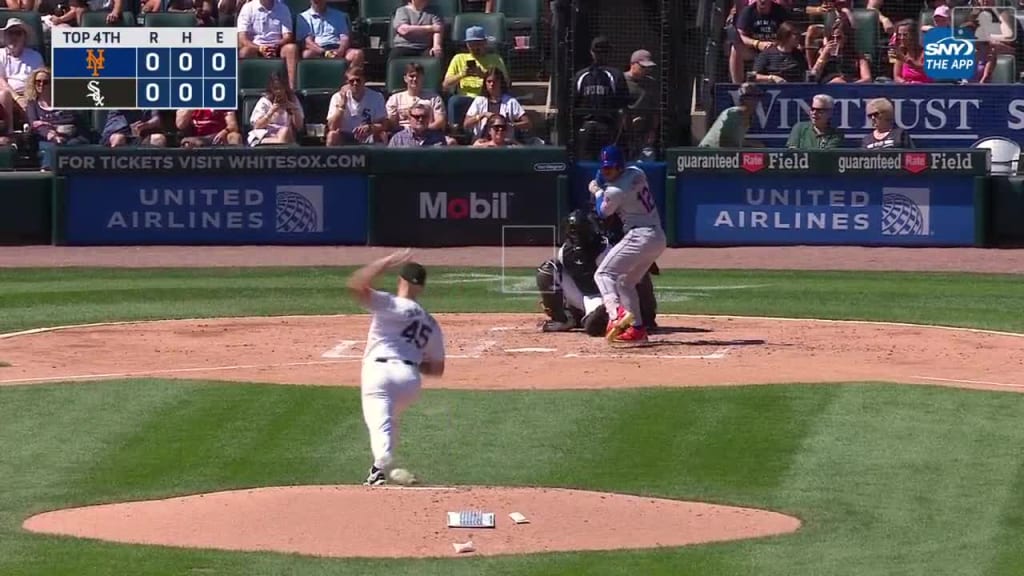
White Sox lefthander Garrett Crochet’s fourth-inning opening service had but one destiny Sunday afternoon: a blast into the left center field bleachers by Mets shortstop Francisco Lindor. (SNY image.)

Who’d have thought? Certainly not baseball’s 2024 schedule makers, who couldn’t possibly have predicted that this year’s White Sox’s road to eternal infamy would include hosting the team whose ancestors they threaten to eclipse for season-long futility.

“Meet the Mets,” the White Sox said of their weekend’s house guests. They certainly proved extremely generous hosts, allowing the postseason-contending Mets to sweep them in Guaranteed Rate Field. By now, Chicago’s South Side shrugs, when other condign responses seem more futile than the White Sox themselves.

In a way, the Mets out-scoring the White Sox 12-4 could be construed as showing mercy upon the downtrodden. By Baseball Reference‘s blowout definition (a five-run difference or better), the White Sox are 8-33 and counting. The Mets won with only a four-run advantage Friday, a two-run advantage Saturday, and a two-run advantage Sunday.

“They are not quitting,” said White Sox interim manager Grady Sizemore of his hapless charges after Saturday’s loss. “They are not folding. But it would be nice to have some of those balls fall, to get some bleeders or something.”

They’ve been the fastest to a hundred losses, the fastest to mathematical postseason elimination, and finished the weekend with a new franchise record for regular season losses. Their ballpark rang with chants of “M-V-P! M-V-P!” Sunday afternoon . . . for Mets shortstop Francisco Lindor, who started the day’s scoring by hitting Garrett Crochet’s first pitch of the fourth inning into the left center field bleachers.

I’m not sure “bleeders” is an appropos word out of a White Sox mouth this year. This team’s been bleeding from square one. And they haven’t even had a fragment of the perverse charm of the 1962 Mets whose modern-era single-season record of 120 losses the White Sox now threaten with too much credibility.

Which may be one reason why one starting pitcher and one relief pitcher on the 1962 Mets are wary of the Blight Sox pushing them out of the record books. Jay Hook was credited with the Mets’ first pitching win, when he helped bust a Met life-opening nine-game losing streak. Craig Anderson was credited with back-to-back wins in relief during a May 1962 doubleheader, and they’d be the last pitching wins with which he’d be credited in his entire major league life, a nineteen-decision losing streak just ahead of him.

They’re both well aware that this year’s Mets are chasing a place in the postseason while this year’s White Sox are chasing them and their 1962 teammates living, dead, or otherwise. Neither Anderson nor Hook wants to see the White Sox break their team’s 120 in ’62. “I want them to win at least twelve more games,” Anderson told The Athletic‘s Tim Britton before the weekend set began. “I hope they do, for their sake.” The White Sox would have to win half their remaining 24 games to make Anderson’s wish come true.

“It’s shattering when it’s happening to you, and I’m sure the White Sox are feeling that right now,” said Hook to the same writer. “I wouldn’t wish that on anybody. You don’t like to go through life thinking you were part of the worst team of whatever you did.”

It’s what the pair didn’t say aloud to Britton that makes the big difference. So I’ll say it, yet again. This year’s White Sox, like numerous historically horrible baseball teams, merely suck. The Original Mets sucked . . . with style. This year’s Blight Sox don’t even have the sense of humour of undertakers.  The Original Mets cultivated one to survive.

Now, it’s hardly the White Sox’s fault that they lack a Casey Stengel to take and keep the hardest heat off their players. But deposed manager Pedro Grifol was something between a wet blanket and a grump, and Sizemore is too earnest to help. He’s almost like National Lampoon’s Animal House’s Chip Diller, upright in his ROTC uniform, the streets overrun by the panicked under siege from a Delta House operation, pleading, “Remain calm. All is well!”

Telling the world his team isn’t folding isn’t enough. Especially since it’s been folded since the end of May. That’s when the Blight Sox stood proud with a 15-43 record. It wasn’t even enough to leave them room for a comeback comparable to the 2019 Nationals—who were 15-23 on 10 May but 24-33 at that May’s end, before overthrowing themselves to go 69-36 the rest of the way and wrest their way to a World Series conquest while they were at it.

Give Stengel the keys to a city, as New York did, and he’d say (as in fact he did), “I’m gonna use this to open a new team.” Give Sizemore the keys to Chicago and he’s liable to hand it to the opposition with the most sportsmanlike intentions after they handed his men their heads yet again.

“Come an’ see my amazin’ Mets,” Stengel would hector. “I been in this game a hundred years but I see new ways to lose I didn’t know were invented yet.” Sizemore wouldn’t shock anyone by saying, “It is what it was.” He’s hardly Grifol’s kind of grump, he’s too innately cheerful for that, but neither has he seized the moment with wit. He’d never cut the mustard in the Ol’ Perfesser’s parlour.

Sizemore can say his Blight Sox have hit more doubles so far than those Mets did all ’62, and stolen more bases, too. But the ’62 Mets even had a respectable team .318 on-base percentage to the Sox’s .278. Getting the ’62 Mets on base wasn’t half the problem that keeping them there or cashing them in without them dying by hook, crook, or schnook was.

Well, on Sunday afternoon, the White Sox had an inning that could have been from the 1962 Mets play book: Luis Robert, Jr. took one for the team leading off the seventh, getting plunked by Mets starter Sean Manaea, but then he was thrown out stealing. Andrew Vaughn drew a two-out walk and Gavin Sheets dropped a base hit in front of sliding Mets left fielder Jesse Winker, but Miguel Vargas flied out to Winker and out went that threat.

Those ’62 Mets were also infamous for the sort of fielding that made you think (ha! you thought I could resist another telling) they really had Abbot pitching to Costello with Who the Hell’s on First, What the Hell’s on Second, You Don’t Want to Know’s on third, and You Don’t Even Want to Think About It’s at shortstop. The National League’s first expansion draft rules and entry fees had much to do with it. But the Mets turned into Ringling Brothers and Barnum & Stengel Circus entirely on their own from there.

The Blight Sox defense at this writing is worth a few less defensive runs below league average than the Original Mets. But they don’t have anyone on the team with a fortieth of the perverse endearment of the Mets’ mid-May ’62 acquisition Marvelous Marv Throneberry. Their whole defense is about as funny as a stink bomb in a sewage treatment plant.

“[T]he Mets are losers, just like nearly everybody else in life,” wrote Jimmy Breslin in his post-1962 valedictory, Can’t Anybody Here Play This Game?

This is a team for the cab driver who gets held up and the guy who loses out on a promotion because he didn’t maneuver himself to lunch with the boss enough. It is the team for every guy who has to get out of bed in the morning and go to work for short money on a job he does not like. And it is the team for every woman who looks up ten years later and sees her husband eating dinner in a T-shirt and wonders how the hell she ever let this guy talk her into getting married.

They were also the team through whom those people found ways to laugh through their sorrows before trying to drown them. Not so these Blight Sox.

“I love the idea that [the Original Mets] were the worst baseball team of the modern era,” writes A Year in Mudville author David Bagdade, whose book reviewed the 1962 Mets but who admits to being a White Sox fan, the poor dear, “but that they lost with personality and humor and that they remain one of the most loved teams of any era despite (or possibly because of) their record. The ’24 Sox are just a steaming pile of baseball ineptitude. They don’t lose with personality and humor. They just lose. I don’t want anything about this Sox team to be enshrined in baseball immortality.”

Too late, perhaps. In their perversely entertaining ways, the Original Mets gave the downtrodden hope. If these White Sox caught the downtrodden drowning, they’d sooner throw them anchors.

“There’s an end for all athletes”

Joey Votto

Joey Votto, shown batting in a 2019 game. 

Watching a baseball great retire at all is enough. Watching him do it during a season is more of an eye-opener and a mood killer. Hearing him say honestly that he doesn’t have it anymore could very well be baseball’s red badge of courage.

When Joey Votto realized he simply couldn’t will himself to another self-resurrection after a slow start, the way he’d done on more than one occasion during his 17-season major league career, he did the only thing that could be done by a man who said often enough that he’d leave money on the table rather than play poorly.

Realizing his comeback attempt to make it to the Blue Jays wasn’t going to happen, Votto simply retired last week. Just like that. No grand gesture, no grand and often foolish farewell tour. The greatest first baseman in the history of the Reds, bought out by his longtime home after last year, unlikely to turn a minor league contract with the Jays into seeing Jays action unless he was seated in the ballpark, decided enough was more than enough.

The day after Votto made his Instagram announcement, the Reds met the Jays at Rogers Centre and buried the Jays 11-7. Votto was delayed by car trouble and didn’t get to see the game, but he did get to the visitors clubhouse in order to say hello and goodbye to old teammates. Then, as The Athletic‘s Kaitlyn McGrath wrote, he talked to the press.

“I was not waxing and waning,” Votto began, “but I had moments where I was like, ‘Is this the right thing to do? And do I want the organization to tell me that I’m done?’ And I just decided, you’ve played long enough, you can interpret what’s going on. And I was awful. I was awful down there. And the trend was not fast enough, and I didn’t feel at any point in time like I was anywhere near major-league ready. I can say to the very last pitch I was giving my very all. But there’s an end for all athletes. Time is undefeated, as they say.”

Because he never got to suit up for the Jays in regular-season major league play (a longtime dream, since he grew up rooting for the Jays in his native Canada), Votto gets to retire as a single-team player. He also gets to retire as one of the game’s über-mensches, a guy who throve on fan interaction, liked to hang at chess clubs, and spoke out about a battle with protracted anxiety and depression in the wake of his father’s death.

Votto even made time to make it up to a young girl who adored him and the Reds but wept when he was tossed from a game in San Diego in the first inning over arguing balls and strikes. Told that little Abigail Courtney was heartbroken at not being able to see her hero play, Votto sent her a ball signed, “I am sorry I didn’t play the entire game. Joey Votto.” Then, he blew her family to tickets for the next day’s game and made a point of meeting and spending time with the girl, not to mention signing anything she handed him.

Last November, after the Reds declined his option and handed him the buyout, Abigail’s mother, Kristin, Xtweeted her immediate response: “The Reds are a bunch of PUTZES!!!” Mom assured one and all that Abigail (now 9 and playing softball in southern California) used that word only when she’s furious.

You can imagine about three-quarters of Reds Nation reacting comparably. Even if they knew in their hearts of hearts that Father Time caught up to their longtime first base fixture who was an on-base machine to what some critics thought was a fault: they blamed him for refusing to swing at unhittable pitches even with chances for “productive” outs. Please.

Your most precious commodity at the plate for an inning is outs to work with; your second most precious is baserunners. And if you have men on base ahead of you, would you rather see the man at the plate drawing the walk or swinging away for the “productive out” but  landing himself in a rally-altering or killing double play?

Let’s flip that coin and see what the other side says. Oh, yes — Votto swung at only 19 percent of the pitches he saw that didn’t hit the strike zone between 2012-2020; you can presume that, framing that period, Votto’s selectivity rarely wavered otherwise. A guy retiring with a .409 lifetime OBP, who led his league in that stat seven times and the entire Show three, doesn’t get there by swinging at practically anything. Nor does he create runs, which Votto did quite splendidly, retiring thus with a +145 wRC.

That and far more are why Votto will end up with a plaque in Cooperstown in due course. You might care to see how he sits against all post-World War II/post-integration/night-ball era Hall of Fame first basemen according to my Real Batting Average metric. (TB + BB + IBB + SF + HBP / PA.)

First Base PA TB BB IBB SF HBP RBA
Jim Thome 10313 4667 1747 173 74 69 .653
Jeff Bagwell 9431 4213 1401 155 102 128 .636
Willie McCovey 9692 4219 1345 260 70 69 .615
Joey Votto 8746 3706 1365 147 48 81 .611
Harmon Killebrew 9833 4143 1559 160 77 48 .609
Orlando Cepeda 8698 3959 588 154 74 102 .561
Gil Hodges 8104 3422 943 109 50 25 .561
Eddie Murray 12817 5397 1333 222 128 18 .554
Tony Perez 10861 4532 925 150 106 43 .526
HOF AVG .592

But Votto also joins a small roll of players who saw the end before it showed itself to them. Dearly though he wanted one final major league turn, in and for the city where he grew up, Votto didn’t want a free ride or a legacy call-up. If he didn’t earn his way, he didn’t want to be there. Out of respect for the Jays and the fans.

“This isn’t my organization, so how can I show up and make it my day, my moment?” he said. “Here’s an at-bat, here’s a game, here’s a stretch of time. To me, it’s disrespectful to the game. I also think it’s disrespectful to paying fans that want to see a high-end performance, and I would have given them an awful performance. So truly, I can say that I tried my very best and I just came up short. And I’ve had 22 years of not coming up short, so I guess I’m due.”

If that resembles an echo of another city’s baseball past, it should. Votto faced Father Time slightly over 35 years after the arguable greatest player in Phillies history called it a career — in a season’s second month, no less.

“I could ask the Phillies to keep me on to add to my statistics,” said Hall of Famer Mike Schmidt through tears at a press conference, “but my love for the game won’t let me do that.” He did, Thomas Boswell wrote, “what so many great athletes have failed to do; he left us wanting more.”

So did Joey Votto.

This essay was published in slightly different form at Sports Central.