Unknown's avatar

About Jeff Kallman

Member, Internet Baseball Writers Association of America and the Society for American Baseball Research.

Baseball’s death wish?

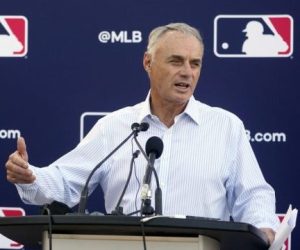
Rob Manfred

Rob Manfred announcing the cancellation of the 2022 regular season’s first two weeks. He has made clear his vision for the good of the game is making money for the owners and too little more.

I’ve quoted it often but it all but screams now. “We try every way we can think of to kill this game,” said Hall of Fame manager Sparky Anderson once upon a time, “but for some reason nothing nobody does never hurts it.”

That’s Anderson’s body among many now performing imitations of washing machine spin cycles in their graves, while their beings in the Elysian Fields pray today’s baseball owners haven’t pushed the game closer to its own.

“I had hoped against hope,” commissioner Rob Manfred said Tuesday evening, “I wouldn’t have to have this press conference where I am going to cancel some regular season games. I want to assure [baseball] fans that our failure to reach an agreement was not due to a lack of effort by either party.”

It was to laugh that you might not wish to commit manslaughter.

That was the man whom we are, as one Twitter denizen tweeted, “old enough to remember [saying] cancelling regular season games over his MLB #Lockout would be a disaster.” The disaster is of Manfred’s own and his bosses’s making.

That was the man whose bosses, the owners, compelled him to impose a lockout, just after midnight 1 December, when baseball’s previous collective bargaining agreement expired, rather than allow themselves and the Major League Baseball Players Association to continue operating the game under the former agreement while negotiating a new one.

That was the man who presided over 43 days’ worth of absolute dead silence from the owners’ side to follow. Dead silence, including nothing in the way of an offer from the owners to the players. Dead silence, but not oblivion.

Eyes unclouded by either cataracts or selectivity saw this was not dismissable as mere  billionaires versus millionaires. Eyes thus unclouded saw that Manfred claiming major league baseball franchises return less on what is invested to buy and run them was a shameless and shabby lie.

Eyes at full strength see that only 31.4 percent of the players’ union’s active major league membership earns more than a million dollars in a season, that 28.2 percent of that membership are minor league players on teams’ forty-man rosters who earn no more than $40,500.

“Player pay has decreased for four consecutive years, even as industry revenues grew and franchise values soared and the would-be stewards of the game pleaded to anyone who would listen that owning a baseball team isn’t a particularly profitable venture,” wrote ESPN analyst Jeff Passan on the day of Manfred’s first deadline for a deal without cancelling games.

Players’ service time has been manipulated to keep them from free agency and salary arbitration. The luxury tax, instituted to discourage runaway spending, has morphed into a de facto salary cap, and too many teams are nowhere near it anyway, instead gutting their rosters and slashing their payrolls because the game’s rules incentivize losing. The commissioner has called the World Series trophy a “piece of metal,” and the league has awarded the team that did the best job curtailing arbitration salaries a replica championship belt.

Eyes open wide saw that Manfred and his bosses are the (lack of) class attempting nothing short of its level best to push players further back toward what they were prior to 1975-76.

That was then: Curt Flood, in his courageous but failed bid to break the ancient abused reserve clause, proclaimed, “A $90,000 a year slave is still a slave.” And, Andy Messersmith, who finished what Flood started: “I was tired of players having no power and no rights.” This is now: Owners and their administrators, enough of whom originate in the corporate world, refer to baseball players as assets, commodities, elements, liabilities, pieces.

They wish you to forget that baseball is unlike the typical industry in which the worker bees make the products sold, because in baseball the worker bees are the product sold.

They also wish you to forget that a small market is in the eye and the adjusted ledger of the beholder. “There is no such thing as a ‘small market’,” tweeted Ben Verlander, an actor and the brother of future Hall of Fame pitcher Justin Verlander. “If you want a bigger market. Put more money into your team and make them competitive.” (The “small market” Pirates, believed among baseball’s premiere tankers, are worth $1.2 billion.)

Last weekend, negotiations dragged before Monday’s marathon sessions deep into the night enabled exactly what the players thought would occur, the owners refusing to budge more than milliliters if that far on any concessions the Players Association wanted to sign on the proverbial dotted line—and then propagating as Manfred ultimately did that by God they’d gone to the mattresses trying to get a deal.

This time, however, the players had an invaluable weapon in the PR wars. They weren’t shy about taking it to social media, any more than serious fans were shy about hitting the Internet running to fact-check any and just about every one of Manfred’s claims about the owners in serious binds. Finding them very wanting.

“If times are so tough for these clubs financially over the last five years,” tweeted Giants third baseman Evan Longoria Tuesday afternoon, “show us the financials. Be transparent.”

From the moment the lockout began through the moment Commissioner Nero announced the first two series of the regular season were cancelled—if not for his entire commissionership—he’s been very transparent about his view of the good of the game: making money for the owners, and precious little else.

Another future Hall of Fame pitcher, Max Scherzer, whose plainspokenness and willingness to put in sixteen-hour days at the bargaining table has impressed as much as he impresses on the mound, makes plain he’s not thinking purely of himself or the considerable dollars he’ll lose for every regular season day with an unplayed game.

“It’s about everybody else. I’m in a position to fight for those guys and sacrifice my salary to make this game better,” Max the Knife insisted to USA Today baseball columnist Bob Nightengale.

We all want to make the game better for the next generation behind us, and we’ll do whatever it takes to make that happen. The former players that fought for the game and fought for the players, I realized the benefits from that. I had an unbelievable career for all of the rights that everybody fought for, going back to Curt Flood. Now I have the opportunity to do that for the next generation.

“Scherzer and the union are fighting for pay for the young players who aren’t eligible for salary arbitration, seeking large raises in minimum salary and bonus pools,” Nightengale continued.

They are fighting to make sure that teams are actually trying to win and not to collect draft picks with a draft lottery. They are fighting to make sure that every team can freely sign free agents without a restrictive luxury tax, pointing out the absurdity of the San Diego Padres having a larger payroll than the New York Yankees. They are fighting to make sure the integrity of the regular season is not compromised, willing to accept a twelve-team playoff system, but not fourteen teams.

It would be even better if Scherzer and his fellows, and Nightengale and his fellows in the baseball press, also remembered a particular group among the former players who fought for their brethren and for the game itself and who deserve considerably more attention than either the Players Association or the owners have paid.

There remain 525 former major leaguers, playing prior to 1980 but whose careers were short for assorted reasons, frozen out of that year’s pension re-alignment, but who were gained $625 per 43 days’ major league service time in a 2011 deal between the late Players Association director Michael Weiner and then-commissioner Bud Selig, worth up to $10,000 a year for them depending on their actual major league time.

Those players—including 1969 Miracle Mets Rod Gaspar and Bobby Pfeil and former Rangers fresh-from-high-school pitching phenom turned mishandled David Clyde—didn’t receive those annual stipends as they should have in February, also thanks to the owners’ apparent baseball death wish.

“The owners . . . still they couldn’t help themselves, couldn’t resist going for the throat,” writes The Athletic‘s Ken Rosenthal. “They, too, could end up net losers, depending upon how much [baseball’s] place in the entertainment landscape is diminished. But they seemingly would rather take that risk than satisfy the players who pitch and hit and make teams so valuable.”

The day you see baseball fans walking about wearing jerseys with names on the back such as Angelos, Crane, Lerner, Liberty, Monfort, Moreno, Nutting, Guggenheim, Reinsdorf, Ricketts, or Steinbrenner, among others, is the day you should see swine in the colours of American Airlines.

“They may not break the union,” writes Rosenthal’s fellow Athletic scribe Andy McCullough of Manfred and his bosses. “But they will break something.” They already have. They’ve broken the heart of a nation starved for the sort of post pan-damn-ic normalcy that baseball alone might provide.
About those “unprofitable” franchises, continued

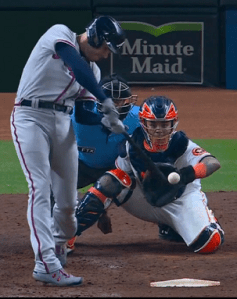
Freddie Freeman

Freddie Freeman—here hitting his World Series Game Six home run—is really more affordable for the Braves to re-sign than you think . . . but that’s not the only reason the Braves’ disclosed financials should give pause while the owners’ lockout continues apace. (Fox Sports screen capture.)

The answer is: $564 million dollars. The correct question: How much revenue did the world champion Braves generate in 2021? “Where the you-know-what did you come up with that figure?” I can hear you ask. Allow me to steer you toward Forbes contributor Maury Brown.

“Liberty Media reported their 2021 year-end financial report,” Brown tweeted Friday, “and with it the Braves posted $20 million in operating income and adjusted [operating income before depreciation and amortization] was $104 million. Baseball revenues per game over the 12 months was $6 million.”

Per game. Just multiply $6 million by 79 home games (the Braves had one such game postponed last year) and, unless your math is wrong or your calculator is on the proverbial fritz, you get $474 million. “For the uninitiated,” Brown tweets further, “operating income is a form of profit.”

Now throw in the Braves’ postseason march of sixteen games: winning the National League division series in four, the National League Championship Series in six, and the World Series in six. They played eight at home and eight, including that breathtaking World Series clincher, on the road. So that’s another $48 million for them.

Throw in, too, what Liberty Media calls the Braves’ “development revenue”: $42 million. Now you should read $564 million. And the foregoing is available only because, as a publicly-traded company, Liberty Media is required by law to disclose its financials in reasonable detail every year.

“Baseball revenue,” Liberty’s disclosure says, “is comprised of (i) ballpark operations (ticket sales, concessions, corporate sales, retail, suites, premium seat fees and postseason), (ii) local broadcast rights, and (iii) shared Major League Baseball revenue streams, including national broadcast rights and licensing.”

Never mind that, as The Athletic‘s Jeff Schultz writes, “the [Braves’] numbers only amplify what an absurdity it is that [franchise face Freddie] Freeman remained unsigned before the [owners’] lockout,” though it’s certainly worth pondering. It’s worth pondering that, the next time you hear any Braves administrator or pro-ownership observer say they couldn’t possibly afford to make Freeman a Brave for life, you should duck so you’re not knocked  over by their growing noses.

Freeman evinces substance above and beyond the pure baseball ability and sensibility that’s bound to have suitors willing to give him the sixth year he seeks if the poor Braves aren’t. A decade before he became president of the National League, A. Bartlett Giamatti wrote of such substance in Hall of Famer Tom Seaver, when Seaver was purged unceremoniously from the 1977 Mets: “[A]mong all the men who play baseball there is, very occasionally, a man of such qualities of heart and mind and body that he transcends even the great and glorious game, and that such a man is to be cherished, not sold.”

Technically, Freeman won’t be sold, not by the Braves, anyway. A free agent sells himself, assuming the market isn’t rigged. But sold out by the team for whom he’s performed enviably and, yes, quite profitably for both sides in his career is something else entirely.

What’s worth pondering is what’s taking the Major League Baseball Players Association so long to demand the rest of baseball’s owners open their books and prove what commissioner Rob Manfred has pleaded to be their “unprofitability,” to be their franchises’ inability to increase in value annually.

“[O]n the broadest scale,” Yahoo! Sports’s Hannah Keyser wrote a little over a fortnight ago, “they don’t want to make all the economic concessions that the union is asking for and one of the reasons they’re citing is that they can scarcely afford it.”

Remember: This lockout was the owners’ idea entirely. They could very well have said to the players, “Look, the CBA’s expired, but we can continue operating baseball under the terms of the expired deal while we work together to hammer a new one out.” Each side might have been hotter than hell to make sure the next CBA was more reasonable as they saw it, but nobody put a gun to the owners’ heads forcing them to impose a lockout.

Remember, too: The players have offered several compromises from their original positions and the owners, in effect, have told them to go fornicate themselves. Which amounts to saying, as well, “Leave us alone to continue suppressing your cumulative compensation, allowing teams to tank for fun and profit instead of playing competitive baseball, monkeying around with your major league service time, jamming our broadcasts with commercials taking longer than pitching changes do, finding ways to rig your legitimate employment market, etc. etc., blah-blah, woof-woof . . .”

Dodgers pitcher Walker Buehler tweeted last week, since deleted, “This isn’t millionaires versus billionaires. This is workers versus owners.” A critic quoted one and snorted, “But it’s also millionaires vs. billionaires, right, Walker?” citing Buehler’s current deal concurrently. My Internet Baseball Writers Association of America colleague Daniel Epstein shot that one out of the park faster than Eddie Rosario’s division series Game Five-making three-run homer off Buehler flew into the right field seats.

No, it isn’t. Only 31.4% of MLBPA members earn more than a million. 28.2% are minor leaguers on the 40-man roster earning $40,500. Walker Buehler just happens to be one of the millionaires (bc he’s great and he earned it). His career net worth is 0,002% of the average owner’s.

Think about that, too, the next time you forget that fans don’t pay their ways into ballparks to see their teams’ owners, all but two of whom are not bound legally but ought to be bound—by amended baseball rules and by plain, ethical sense—to open their books and allow the players to see what is, as opposed to what’s propagated.

With his bosses’ approval, Manfred says unless the deal is done by the close of business 28 February (that’s tomorrow, ladies and gentlemen), Opening Day isn’t guaranteed and neither is a full 162-game season. (Fair disclosure: I have skin in that game, tickets for myself and my son to the Angels’ home opener.)

Forget his former free cookie on second to begin extra half innings. Manfred and his have run this thing to where they open the ninth with the bases loaded. Compared to that, the 1919 World Series was played straight, no chaser.

Crazy Joey Gallo?

Joey Gallo

Calling for baseball to go to law to ban what he can’t traverse isn’t Joey Gallo’s best play.

I don’t recall any banners at Yankee Stadium making the connection last year, but Joey Gallo—the all-or-nothing corner outfielder/designated hitter the Yankees landed from the Rangers just before the trade deadline—shares a name with one of New York’s most legendary organised crime figures.

Some seeing Gallo’s recent comments on baseball’s defensive overshift epidemic (some think it’s a pandemic) might be inclined to hang the same nickname upon him as was once attached to his Mob namesake two decades before Gallo was born.

Crazy Joey Gallo the mafioso bragged about leading the four-man crew who assassinated  Murder, Incorporated boss Albert Anastasia one minute (“You can just call us the Barbershop Quartet,” Gallo is said to have quipped about the foursome who whacked Anastasia in his barber’s chair) and applied himself to studying letters, philosophy and watercolour painting during eight years in prison the next.

“Upon his return to Brooklyn in 1971,” wrote Selwyn Raab in Five Families: The Rise, Decline, and Resurgence of America’s Most Powerful Mafia Empires, “Gallo could quote and discuss the nuances of Balzac, Kafka, Sarte, Camus, and Flaubert . . . His pseudo-intellectual trappings were a con man’s camouflage.” (Balzac: Behind every great fortune lies a crime.)

Gallo was once described by a fellow inmate as “articulate and had excellent verbal skills being able to describe gouging a man’s guts out with the same eloquent ease that he used when discussing classical literature.” Picture him if he’d lived to become a godfather himself. The Renaissance Don.

Crazy Joey Gallo the Yankee hit man executes opposing pitchers with long-distance bombs every 15.1 plate appearances. But he strikes out every three plate appearances and draws walks every seven. When the coronavirus pan-damn-ic throttled baseball for half of 2020, Gallo set up a batting cage in his home. He did much swinging but might have been served equally by doing more serious thinking.

“I get the defensive strategies,” Gallo told The Athletic‘s Hall of Fame writer Jayson Stark. “I do. I am 100 percent not against that . . . But I think at some point, you have to fix the game a little bit. I don’t understand how I’m supposed to hit a double or triple when I have six guys standing in the outfield.”

This year’s edition of The Bill James Handbook shows a table indicating that, last season, 51 percent of all batted balls were hit right into the defensive overshifts. Baseball Prospectus writer Russell Carleton determined that lefthanded hitters such as Gallo saw more pitches with the overshifts on than without . . . for the first. time. ever.

The shifts took game-wide hold in this century (the Rays in 2008 began the contemporary trend) because they work, at least against batters at the plate who can’t hit other than dead pull and think they can or need to hit six-run homers with every swing. But they’re not a 21st century schizoid plot. Joe Posnanski gathered the evidence into mostly one place in 2014.

Decades before Hall of Famer Lou Boudreau deployed it against Hall of Famer Ted Williams, the New York Giants deployed it against the Phillies’s Cy Williams, who hit a ton in his home Baker Bowl (its field resembled Fenway Park in reverse, right down to its metallic, high, short-distance right field wall) but only ounces on the road. (In 1923, Williams led the Show with 41 home runs . . . but his OPS was 1.042 at home and .838 on the road.)

Thanks to Posnanski resurrecting a Fleer baseball card showing it, this was Boudreau’s shift on the Splinter:

The Boudreau shift on Ted Williams

The once-notorious Williams shift.

People who think pull hitting is purely a choice should ponder Posnanski’s observation, drawn from more tons of research than the tons Williams hit despite the shifts.

Williams did try to adjust somewhat with the help of [Hall of Famer Paul] Waner. He backed off the plate some, and he did hit a few more balls the other way. But not many. He could not stop being Ted Williams. If he needed a reason to pound balls the other way, he had one long before Boudreau shifted. After all, in left field at Fenway Park stands the greatest incentive for lefty opposite field hitting there is: The Green Monster. The wall made Wade Boggs a star and made Bill Mueller a batting champ. Williams, though, didn’t take much advantage of the Green Monster. He hit like he hit.

Beyond that, I doubt the shift took away 15 points of batting average from him or anything like it. It probably didn’t take away any points in the long run. From 1939-1946, Williams was a .353 hitter. From 1947 to 1957—even with his career again interrupted by war and with his body aging—he was a .348 hitter. The shift maybe have had its subtle effects on his hitting. I suspect it had a much larger effect on his psyche and on the story people told about him.

From 1947 through 1957, according to my Real Batting Average metric (total bases + walks + intentional walks + sacrifice flies + hit by pitches, divided by total plate appearances), Ted Williams was (wait for it!) a .750 batter. He also averaged 47 strikeouts and 153 walks per 162 games during that span. Even though, as Posnanski observed, “the shift became his constant companion.” Taking a mere five points off his hitting average.

In other words, once he accepted the overshift as part and parcel of his way of life in the batter’s box, Ted Williams pretty much remained Ted Williams. He wasn’t the only all-but-dead-pull hitter of his time, either. According to one Joe DiMaggio biographer, Maury Allen (in Where Have You Gone, Joe DiMaggio?), when the righthanded Hall of Famer was offered the thought that he might put a few more home runs on his resume if he tried aiming toward Yankee Stadium’s fabled short right field porch, he dismissed the thought in a huff.

“I could piss those over that wall,” the Clipper harrumphed. “That’s not hitting.” That kind of stubbornness wasn’t born with the three-true-outcomes generation.

Hall of Famer Stan Musial became a pull hitter after a few major league seasons. But he once observed, “[O]nce in a while you’ve got to give in to the pitcher,” he once said. “You just can’t, you know he’s out there thinking just like you are, and he has some idea about what he might want to do of course, and so a lot of times you’ve got to go with the pitch [hit it to the opposite field]. Which most hitters can’t do.”

The shifts finally came into game-wide play because they work against hitters who can hit only one way, whether consciously or by natural inclination. Did you really think a team was just going to line themselves up against a wall to be machine-gunned without even thinking about doing something to keep the assassins from bringing their guns to bear?

I suspect the opposite syndrome might take hold, in time, if a team is bedeviled by a guy who’s killing them hitting almost strictly the other way. Try to imagine lefthanded, other-way shooting Boney Boxorocks—or even Hall of Famer Wade Boggs (who probably should have seen such shifting: almost half his hits went up the middle or the other way to left)— seeing the opposite of the Williams/Gallo shift: third baseman, second baseman, and first baseman crowding the left side of the infield, shortstop out a few feet onto the left field grass.

Gallo the Yankee is no Teddy Ballgame, Yankee Clipper, or Man. Formal rule changes in baseball, as in legislation, are undertaken and consecreated best after long, careful thinking and not under the lash of hysteria. Citizens demand those making law make it without thinking longer term. Baseball players such as Gallo think much the same style. But they might wish to go to their own batting minds first. They might want to think about . . .

Yep, I’m going there yet again. The bunt.

I’ve argued even recently that there are only two or three times a team should even think about bunting, and one of them is if you should be fortunate enough (or your analytics-overdriven team fell asleep on draft day) to have the next Brett Butler in your lineup. (Butler dropped 337 bunts in his long playing career, and 85 percent of them were for base hits.) Sacrifice bunts, I repeat, waste outs with almost no real scoring return for their trouble.

But if you see the defensive overshift on, you should be crazy enough to think with the pitcher even more. He’s not going to try throwing you something away when he knows he’s got more protection against a pull hit than a gangster with a bought-and-paid-for cop by his side. But pitchers make mistakes, too, from the merest raw rook to the most well done Hall of Famer in waiting.

When he makes a mistake to your outside, and if you’re not half as prideful as Ted Williams, just drop your bat to bunt, then just tap the ball onto all that delicious, open, free real estate. Even if they left the corner baseman at his base, or have that corner outfielder playing only a few feet short of the infield dirt, they’re not going to reach that ball in time to get you out. Bartolo Colon could beat such a bunt out.

The second most precious commodity a team at bat has behind outs to work with is baserunners. If outs to work with are rhodium, baserunners are platinum. Let a few batters fed up with the overshifts think about bunting onto the open expanses they’re gifted, and the shifts will fade back on their own. Teams won’t deploy what won’t work.

Crazy Joey Gallo the self-styled renaissance racketeer didn’t live long enough to become a Renaissance Don. In likely retaliation for ordering the hit attempt that left Don Joseph Colombo “vegetabled” (in mob parlance) in front of the don’s own family, the renaissance racketeer was hit in front of his own family ten months later.

Crazy Joey Gallo the Yankee might live a longer, healthier baseball life if he forgets asking baseball to whack defensive shifts with its law and, instead, helps sends them toward a death due to natural causes. The causes of hitters doing some real thinking at the plate while playing, still, the thinking person’s sport.

Another numbers game—uniform numbers, that is

Fernando Valenzuela

Tyler Kepner and Jay Jaffe aren’t the only observers who think the Dodgers should retire Fernando Valenzuela’s number 34. 

The owners and the players have been talk-talking at last this week, in consecutive days’ meetings. It sure took long enough. Hope the owners are proud of themselves. Remember this: It’s as much of a lie to blame this lockout on the players as it is to call under-attack Ukraine a client of the State Department.

So until the owners show they’re serious about saving spring training and maybe a portion of the regular season to come, and admit that they could damn well have let baseball continue its hot-stove season and spring training while playing under the expired CBA and negotiating honourably with the players, I’m going to think about something else.

Retired uniform numbers, for example.

Blame it on The Cooperstown Casebook author Jay Jaffe, responding to the New York Times‘s Tyler Kepner, in a tweet: “Your semiannual reminder that it’s past time for the #Dodgers to retire Fernando Valenzuela’s #34. Ridiculous waste of an opportunity to do so on the 40th anniversary of his rookie-season heroics in 2021.”

Seven years ago, writing elsewhere, I pondered retired numbers, including the Yankees’ flood worth of them, when they elected to retire Bernie Williams’s number 51. Valenzuela was an omission on my part when it came to numbers the Dodgers should retire. But I’m on board with it now.

Until too many innings and too many screwballs too young turned him into a journeyman Valenzuela was a great pitcher. He’s also become an icon after his pitching career ended, as a broadcaster two decades on, representing his fellow Latinos with insight and earning numerous honours from that community.

Mark Armour, the founder of the Society for American Baseball Research’s Bio Project, sees and raises. He thinks the Dodgers should also retire Don Newcombe’s 36. I’d be on board with that wholly. Big Newk had his struggles beyond his race—his worst enemy proved to be himself—but he was the first black man to start the first game of a World Series; he was the National League’s first Rookie of the Year (the award’s first two years were major league whole awards); and, he was the first Cy Young Award winner in 1956.

If we’re talking strictly about the Dodgers, still, I have two more numbers they should retire: 25 and 47.

Tommy John wore 25 as a Dodger. He was also a Dodger when he agreed to become the first pitcher to undergo the career-saving surgery that’s borne his name long since. If you take his career strictly on its own terms without the surgery he might pull up short of a Hall of Famer—though he was a better pitcher than newly-elected contemporary Jim Kaat by a few miles—but throw in his status as a pitching health co-pioneer and he deserves the honour. And his uniform number’s retirement.

Andy Messersmith wore 47 as a Dodger. He pitched terrifically as a Dodger. (ERA: 2.51; fielding-independent pitching: 3.15.) He also finished what Curt Flood started as a Dodger—he pitched 1975 without a contract, after then-GM Al Campanis offended him soul deep, then refused all subsequent big-money Dodger offers to cave in and took it all the way to an arbitrator.

Messersmith did the heaviest lifting. Arm-and-shoulder-addled but technically-unsigned Dave McNally walked away from the game that June and signed onto the grievance in August at Marvin Miller’s behest on a just-in-case basis, since Miller feared Messersmith might not go the distance. Fear unfounded. Messersmith went all the way and won what Flood couldn’t in the end: the end of the reserve era and the right of players to negotiate their services on an open market once and for all.

If that doesn’t deserve a number retirement, too, I’m lost for knowing what does.

Back seven years ago, I had other ideas about whose numbers should be retired. Let’s revisit a few of them:

Angels—Tim Salmon (15). The Kingfish was the franchise face until they signed Hall of Famer Vladimir Guerrero as a free agent. Salmon also helped the Angels win their only World Series to date, even if Troy Glaus was named that Series’s MVP. But don’t even think about retiring number 27 until Mike Trout’s career is over; Trout’s already been ten times the player Guerrero was, including Vlad the Impaler’s Hall-making years with the Montreal Expos.

Astros-–J.R. Richard (50). He’s still the arguable best pitcher the Astros have ever had. (Justin Verlander isn’t liable to endure long enough to stake a claim on that title, though he should have his number retired by the Tigers in due course.) The end of his career was nobody’s fault even if you could argue the Astros then were negligent in not smelling trouble when he complained of shoulder fatigue before the strokes.

Athletics—Lefty Grove (10), Al Simmons (7). Who cares that Simmons had a uniform number only one year and Grove, three? How do you not retire two Hall of Famers’ numbers? Especially that of the man who was, arguably, the greatest pitcher in “organised” baseball prior to World War II and integration and night ball?

Blue Jays—Carlos Delgado (25), John Olerud (9), and Cito Gaston (43). The two best first basemen in franchise history, and their only World Series-winning manager—who did that back-to-back while he was at it. Isn’t that case enough?

Braves—Fred Haney (2). Manager Haney led the Braves to their first back-to-back pennants and a World Series title the first time. That should speak for itself.

Brewers—Harvey Kuenn (32). Managed them to their only World Series appearance and took them to seven games. His free-swinging lineup of sluggers earned that team the nickname Harvey’s Wallbangers. How many teams do you know get nicknamed for their manager?

Cardinals—Curt Flood (21), Scott Rolen (27). Curt Flood stood up for us. [Catfish] Hunter showed what was out there. Andy [Messersmith] showed us the way.—Hall of Famer Ted Simmons. Rolen? He only solidified a Hall of Fame case as a Cardinal and, while he was at it, helped them win the 2006 World Series (and with a 1.213 Series OPS while he was at it).

Cubs—Gabby Hartnett (9), Joe Maddon (70). Hall of Fame catcher remembered almost strictly for “The Homer in the Gloamin’,” the ninth-inning game-winner as darkness approached then-unlit Wrigley Field, to put the Cubs in first place three days before they nailed the 1938 National League pennant. But Hartnett was also a well-above-average defensive catcher.

And if you don’t know why manager Maddon should have his Cubs number retired, you must have slept through the 2016 World Series.

Diamondbacks—For now, ask me when Ketel Marte’s (4) career is over.

Giants—Barry Bonds (25), Buster Posey (28). ‘Nuff said. I hope. (Do I really have to say Posey’s the greatest catcher in the history of the franchise?)

Guardians (former Indians)—Kenny Lofton (7), Early Wynn (24). Lofton’s a should-be Hall of Famer whose case deserves a thorough review from the Today’s Game Committee. Wynn is a Hall of Fame pitcher. If the Hall of Fame is a criteria for number retirement, Wynn’s been overdue since before John F. Kennedy was shot out of the White House.

Marlins—Josh Beckett (21). The first Fish pitcher to bag a World Series for them and win the Series MVP who wasn’t subjected to an immediate fire sale.

Mariners—Felix Hernandez (34), Ichiro Suzuki (51). The worst-kept secret in Seattle and elsewhere is that Ichiro’s going to Cooperstown. So why wait? The second worst-kept secret: King Felix may actually edge out Hall of Famer Randy Johnson as the greatest peak value pitcher the Mariners ever had, even adjusting the Big Unit for pitching as a Mariner in an era of insane offense.

Mets—Dwight Gooden (16), Keith Hernandez (17), Ed Kranepool (7), Darryl Strawberry (18), David Wright (5). Mex, Dr. K, Straw, and Captain America should be obvious. But Kranepool? He was only the longest-serving original Met (from 1962 he played eighteen seasons with the team), one of the most popular Mets, and a terrific pinch hitter in the final four or five seasons of his career.

Nationals—Ryan Zimmerman (11). There are reasons they call him Mr. National. They only begin with his entire sixteen-season career being played from the first year the Nats were open for business in Washington.

Orioles—Mike Mussina (35). Their best pitcher of the 1990s also happens to be a Hall of Famer. What are they waiting for, permission from the Yankees?

Padres—Dick Williams (23). If they could retire Steve Garvey’s 6 for helping them to their first World Series—despite his best years long behind him in Los Angeles, and despite not being their best player (though he did hit that game-winning bomb to send the NLCS to the deciding Game Five)—there’s an even greater case for retiring the 23 of the manager who shepherded them there in the first place.

Phillies—Jimmy Rollins (11), Chase Utley (26). The best middle infield combination in franchise history. Utley has a Hall of Fame case and Rollins comes up short enough of the Hall, but the Phillies never had a better pair surrounding second base at once and for so long.

Pirates—Elroy Face (26), Jim Leyland (14). Even if contemporary metrics make his signature season less than it seemed at the time, Face remains the best relief pitcher in franchise history. Leyland, of course, managed the Pirates back to greatness in the mid-to-late 1980s and early 1990s.

Rangers—Frank Howard (33). I’m not entirely sure how the Rangers look upon their Washington past, but if they look kindly upon it then the behemoth bomber who was the Senators for all intent and purpose from 1965-71 deserves his number retired.

Rays—Joe Maddon (70). Commanded them to their first World Series in 2008.

Reds—Ernie Lombardi (4), Jim Maloney (46). Lombardi became a Hall of Fame catcher mostly by way of his big bat; Maloney was the Reds’ best pitcher of the 1960s.

Red Sox—Terry Francona (47), Roger Clemens (21). Clemens remains in a dead heat with Pedro Martinez as the greatest Red Sox pitcher, ever, though if you go by their fielding-independent pitching as Red Sox Martinez comes out slightly better. (Actual/alleged PEDs  Nazis beware: Clemens wasn’t suspect until after he left Boston, I think.) Francona, of course, managed them to the end of the actual or alleged Curse and won a second World Series on their bridge while he was at it, too.

Rockies—Clint Hurdle (13). Managed them to their only World Series thus far.

Royals—Whitey Herzog (24), Dan Quisenberry (29). The White Rat managed them to practically all American League postseasons in the late 1970s. Quisenberry, as delightful a character as he was a pitcher, was the best relief pitcher the Royals ever had until the brief but profound stature of H-D-H (Greg Holland, Wade Davis, Kelvin Herrera) in the mid-2010s.

Tigers—Jim Bunning (14), Mickey Lolich (29), Lou Whitaker (1). Two of the franchise’s four best post-World War II pitchers (Justin Verlander’s eventual 36 retirement is a given, and Jack Morris’s 47 is already retired), and their should-be Hall of Fame second baseman. Did I mention Bunning’s a Hall of Famer, too?

Twins—Joe Judge (5), Sam Rice (22), Johan Santana (57), Walter Johnson (25). The Twins may well disdain their Washington origins, too, but you can sort of understand why: the ancient legend went “Washington—First in war, first in peace, and last in the American League.” But the Ancient Senators’ best first baseman (Judge), Hall of Fame outfielder (Rice), and greatest pitcher, period (you know who) deserve the honour. So does Santana, the greatest 21st Century pitcher the Twins have had.

(Fair disclosure: Johnson only wore a number after he became the team’s manager. But some technicalities deserve to be bypassed and if any Nat/Twin deserves a number retirement, it’s the Big Train.)

White Sox—Al Lopez (42). The South Siders should have retired Lopez’s 42 long before the game-wide retirement of Jackie Robinson’s 42 made it superflous. Just put the number up in Lopez’s White Sox colours anyway. The man who led the White Sox to their first World Series since the Black Sox’s 1919 deserves it.

Yankees—Mel Stottlemyre (30). As if they don’t have enough retired numbers already? But Stottlemyre was the Yankees’ best pitcher during their lost decade of 1965-75, though Fritz Peterson was an awfully close second. Stottlemyre also became a respected pitching coach for both the Mets and, in due course, the Yankees themselves. And how can you hand a man a Monument Park plaque without retiring his number?

Update: The Tigers plan indeed to retire Lou Whitaker’s number 1 this summer—assuming there’ll be a season.

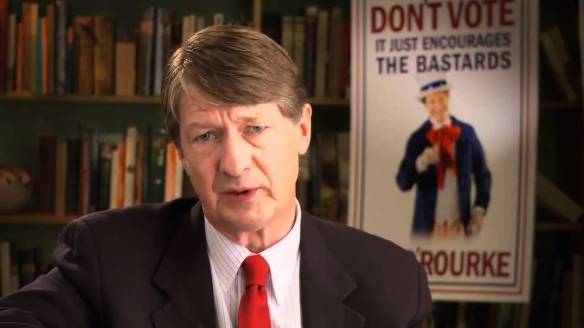
P.J. O’Rourke, RIP: He bowed to my superior mastery, once

P.J. O'Rourke

P.J. O’Rourke promoting one of his many books: “If government were a product, selling it would be illegal.”

I wasn’t even aware he was suffering. Maybe I’d simply fallen awhile out of that cheerful loop in which the spinning was tolerable because he’d been there to make you laugh, the better to prevent you from wishing to commit murder, manslaughter, mayhem, mincemeat, or My Mother, the Car.

P.J. O’Rourke, the funniest non-sportswriter in America, lost his fight against lung cancer Tuesday at 74. Back in 2008 he’d announced he was diagnosed with treatable, survivable rectal cancer. It almost figured, sadly. Fifteen years after he beat one pain in the ass—very different from the ones he beat with scolding joy sticks regularly in his writings—he couldn’t find a way not to run out of breath.

I suppose if he had any sporting passion, it was cars, if not necessarily NASCAR. (He seems to have liked shooting golf and ducks once upon a time, as well, but we’ll forgive him for now. For  the ducks. You get dinner out of that and it doesn’t cost you club memberships and green fees.) He once gathered up a passel of essays about cars into a splendid anthology. Its title alone could have been a single paragraph:

Driving Like Crazy: Thirty Years of Vehicular Hell-bending Celebrating America the Way It’s Supposed to Be—With an Oil Well in Every Backyard, a Cadillac Escalade in Every Carport, and the Chairman of the Federal Reserve Mowing Our Lawn.

Most writers would kill, maim, or demand the American return of the Smart Car in return for receiving the ability to write one actual paragraph half as springy or funny as that single book title. Though I wouldn’t go so far as to wish a Cadillac Escalade in every carport. I’d wish every carport a 1959 Mercedes-Benz fintail sedan.

Why? Because my beloved Aunt Beatsie owned one. In midnight blue. She owned and drove it for almost thirteen years, I think. She kept that car in immaculate running, looking, seating, and driving condition. Then she traded it in for a 1972 Chevrolet Impala. That was like trading Willie Mays for Willie Montañez. And America needs consistent reminders that baseball teams aren’t the only ones prone to the fart of the deal.

Actually, I take something back. O’Rourke was something of a NASCAR fan. “Oh, Jesus,” he wrote (in “NASCAR is Discovered By Me,” republished in Driving Like Crazy),

that stupendous noise, that beautiful and astounding sound—not the flatulent blasting of the drag strip or the bucket-of-puppies squeal of tiny Grand Prix engines, but a full-bore iron-block stroked-out American symphony of monster pandemonium. Exhaust notes so low they shake the lungs like rubber bell clappers in the rib cage and shrieks of valves and gears and push rods wailing in the clear ands terrifying soprano of the banshee’s wail—I could not leave my earplugs in, it was too beautiful.

Well, that didn’t make him a terrible person.

David Harsanyi, a senior writer for National Review, remembers a conversation with O’Rourke the only time the two ever met. He remembers it because he didn’t raise as a subject the time O’Rourke turned him down for a book promotional blurb in an e-mail reply to his request. “This has nothing to do with high standards of personal integrity,” O’Rourke began. “It’s just that I live in fear that I’ll lavish praise upon a work that somewhere, deep in its unread-by-me manuscript, claims that Pope John Paul II headed the conspiracy to murder Natalie Wood—or some such.”

The elegies I’ve read from those who knew him well enough touched invariably on his personal charm, kindnesses, and in-person wit that was at least equal to his written wit. In writing, of course, O’Rourke evolved from a National Lampoon semi-libertine (he edited that once-august repository of ribald ruckus once upon a time) to the kind of libertarian who suffered no fools gladly regardless of their side in the ideological zoo’s subdivisions.

He roasted left and right on behalf of the simplest political philosophy: Keep your meathooks to yourself and mind your own business. He also phrased it with a little less of the equivalent of a ball-peen hammer in an address to the libertarian Cato Institute where he served as its H.L. Mencken Research Fellow: There is only one basic human right, the right to do as you damn well please. And with it comes the only basic human duty, the duty to take the consequences.

But I had the honour of receiving a small brush of his kindness a little over three years ago, by way of American Consequences, the online journal he co-founded and edited until his death. It was my only exchange with the man, ever, and he didn’t even have to fear any claim about any actress’s murder by any pontiff or anyone else.

After the 2018 mid-term elections, in a “Letter from the Editor” he titled “Demented Politics, Lunatic Markets,” O’Rourke wrote, “If the 116th Congress were the World Series and Trump was the umpire, he’d send both teams to the showers so that he could be the pitcher and the batter and throw every strike and hit every home run. And he’d also want to be the only hot dog vendor in the stadium.”

I couldn’t resist sending him an e-mail comment about that. And, as things turned out, O’Rourke couldn’t resist publishing my comment in the journal’s next issue.

My comment: “Longtime fan, first time writing about an AC article. Reality check: If Congress were the World Series and President Tweety the umpire, the Series would have been the Baltimore Orioles against the San Diego Padres in Ebbets Field. And Tweety would have pitched, caught, homered, owned the concessions, named himself the Series MVP, and declared the Giants and the Dodgers had damn well better move back to Harlem and Flatbush and start building Edsels again. Yours cordially . . . “

Jeff,” O’Rourke replied in print, “I bow before your superior mastery of the sports metaphor!”

Well. I never drove fast on drugs while getting my wing-wang squeezed without spilling my drink. But I was handed high praise from the man who still drove fast when (his words) the drugs were mostly Lipitor, the wing-wang needed more squeezing than it used to before it got the idea, and spilling his drink was no problem since he kept the sippy cups from when his kids were toddlers and left the baby seat in the back seat so that, when he got pulled over, he looked like a perfectly innocent grandparent.

“Without sports metaphors,” O’Rourke once wrote, “American journalism would experience, as it were, sudden death.” Based on twenty-one books collecting around a thousand essays (I could be short there) that instructed while amusing and delighting, the man who bowed to my superior mastery of the sports metaphor should be recognised as American sociopolitical satire’s all-time home run champion.